
Sep 23, 2026
By Transpire Insight
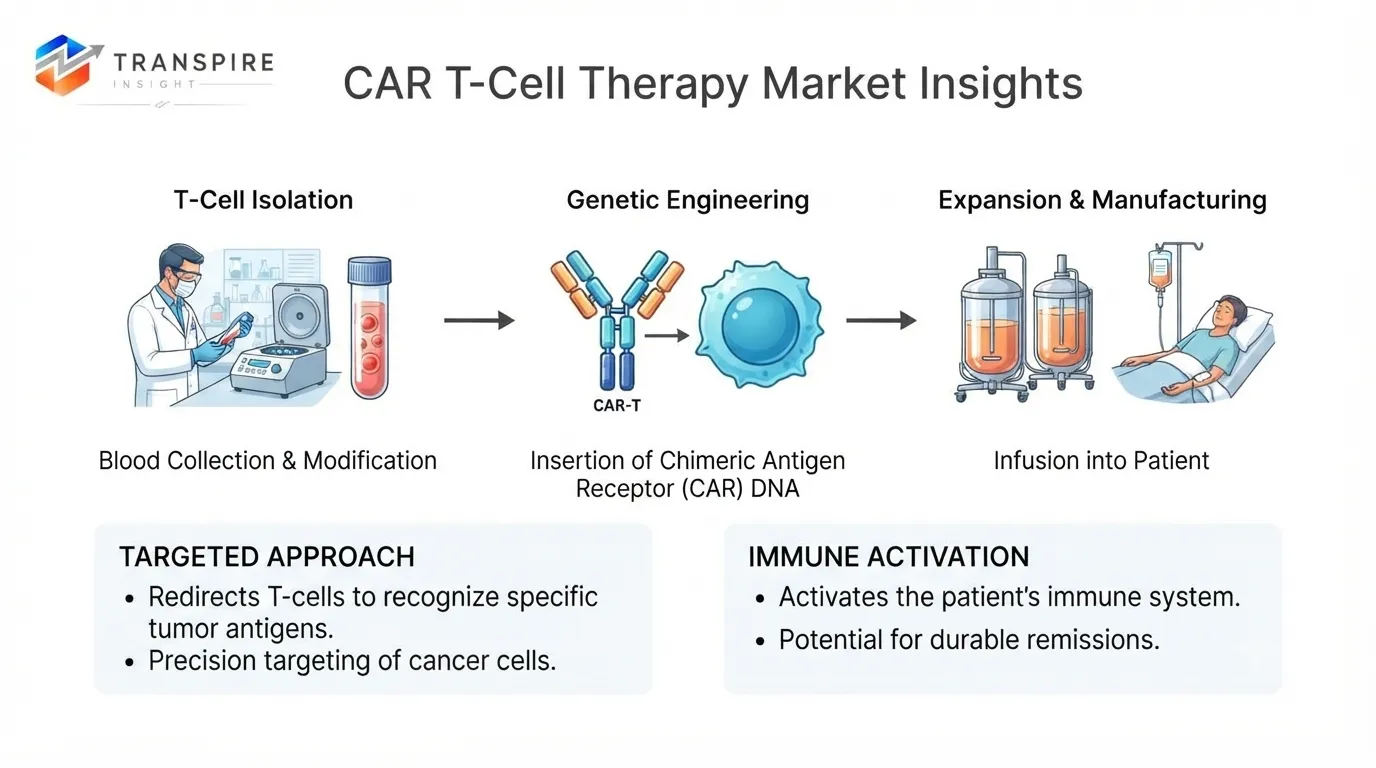
CAR T-cell therapy has transformed treatment possibilities for selected blood cancers, and continued research, new indications and manufacturing innovation could broaden the market beyond its original applications.
The global CAR T-cell therapy market is entering a new stage as pharmaceutical companies, biotechnology firms and research institutions work to expand cell therapy beyond a relatively narrow group of hematological cancers.
CAR T-cell therapy is a form of personalized immunotherapy in which a patient's T cells are genetically modified to recognize and attack cancer cells.
The technology has already demonstrated significant clinical impact in selected blood cancers. The next commercial opportunity lies in expanding eligible patient populations, improving manufacturing efficiency, developing next-generation therapies and investigating applications in additional diseases.
Published market estimates differ substantially because some studies include only approved CAR T products while others include broader cell-therapy development pipelines. Recent estimates place the market at approximately USD 4.7 billion in 2025, with the potential to reach around USD 15 billion by 2035.
A new era of personalized cancer treatment
The commercial opportunity begins with the fundamental value proposition of CAR T-cell therapy.
Conventional cancer medicines generally involve standardized products administered across large patient populations.
CAR T-cell therapy is different. The treatment is personalized around the patient's own immune cells.
This approach can produce powerful responses in selected cancers, particularly certain blood malignancies.
The success of approved therapies has encouraged pharmaceutical companies to invest heavily in manufacturing, clinical development and next-generation approaches.
Market Size
The global CAR T-cell therapy market is estimated at approximately USD 4.7 billion in 2025 and could reach around USD 15.3 billion by 2035, representing an estimated CAGR of roughly 12.5%.
Other market studies report higher values when broader cell-therapy categories or additional pipeline products are included, making market definition an important factor when comparing forecasts.
Hematological cancers remain the core market
CAR T-cell therapy has achieved its strongest commercial position in blood cancers.
Approved products have targeted conditions including certain forms of leukemia, lymphoma and multiple myeloma.
This established clinical base provides manufacturers with a foundation for further growth.
The market is supported by increasing awareness among oncologists, specialized treatment centers and improvements in patient selection.
As physicians gain greater experience with cellular therapies, treatment pathways can become more standardized.
Multiple myeloma is creating another growth opportunity
Multiple myeloma has become an important area for CAR T-cell development.
The disease can be difficult to manage after patients have received several previous lines of treatment.
CAR T therapies targeting specific cancer-associated antigens have provided another treatment option for selected patients.
Expansion into additional lines of therapy could significantly increase the addressable patient population, although clinical outcomes, treatment sequencing and reimbursement remain important considerations.
Solid tumors remain the major long-term opportunity
One of the biggest opportunities for the CAR T-cell therapy industry is solid tumors.
Solid tumors represent a much larger potential patient population than the hematological cancers where CAR T therapies have already demonstrated strong performance.
However, developing effective CAR T treatments for solid tumors is considerably more difficult.
Tumor heterogeneity, antigen selection, the tumor microenvironment and immune suppression can limit therapeutic effectiveness.
Researchers are therefore investigating new targets, combination approaches and improved cell-engineering strategies.
If these challenges can be overcome, solid tumors could significantly expand the long-term commercial opportunity.
Manufacturing remains a critical challenge
CAR T-cell therapies require sophisticated manufacturing.
Cells must be collected, processed, genetically modified, expanded, tested and delivered back to the patient.
This process is considerably more complex than conventional pharmaceutical manufacturing.
Manufacturing capacity therefore directly affects patient access.
Companies are investing in automation, centralized manufacturing and improved production processes to reduce turnaround times and increase reliability.
Faster manufacturing could become a major competitive advantage because patients with aggressive diseases may not be able to wait extended periods for treatment.
Next-generation CAR T therapies could improve performance
The industry is moving beyond first-generation approaches.
Researchers are investigating cells with improved persistence, stronger tumor recognition and enhanced resistance to the suppressive tumor environment.
Other strategies include dual-targeting approaches designed to reduce the risk of cancer cells escaping treatment by losing a single target.
Allogeneic or donor-derived approaches are another area of interest because they could potentially reduce manufacturing time and move the industry toward more standardized products.
Cost and reimbursement remain major barriers
CAR T-cell therapies can involve substantial treatment costs.
The economic burden extends beyond the therapy itself. Patients may require specialized centers, hospitalization, monitoring and management of treatment-related complications.
Payers therefore evaluate not only the acquisition price but also long-term clinical outcomes and overall healthcare costs.
Demonstrating durable responses and reduced downstream treatment requirements could strengthen the economic case for CAR T therapies.
Treatment-related risks require specialized care
CAR T-cell therapy can produce serious adverse reactions, including cytokine release syndrome and neurological complications.
This means treatment must generally be delivered in specialized centers with appropriate monitoring and clinical expertise.
As the market expands, the availability of trained healthcare professionals and certified treatment centers will become increasingly important.
The industry must therefore expand not only manufacturing capacity but also the healthcare infrastructure required to administer these therapies safely.
China and Europe are becoming important markets
North America remains a major center for CAR T development and commercialization, supported by pharmaceutical investment, specialized cancer centers and regulatory infrastructure.
Europe is also expanding access and research activity.
China has become an important center for cell-therapy research and development, with a growing biotechnology ecosystem and substantial clinical-investigation activity.
Other emerging markets are likely to develop more gradually because of treatment costs, infrastructure requirements and regulatory considerations.
Key challenges
The biggest challenge is manufacturing complexity.
Unlike conventional medicines, CAR T therapy involves living cells and patient-specific processes. This creates logistical and quality-control challenges.
High costs are another barrier.
Treatment access can also be limited by the number of specialized hospitals capable of administering therapy.
In addition, resistance and relapse remain important clinical challenges.
Finally, expanding CAR T into solid tumors will require substantial scientific advances.
Competitive landscape
The competitive landscape includes large pharmaceutical companies, biotechnology companies, specialist cell-therapy developers and academic institutions.
Competition is increasingly focused on clinical effectiveness, manufacturing speed, safety, target selection and expansion into new indications.
Top 10 Companies in CAR T-Cell Therapy Market
Headquarters: Basel, Switzerland
Novartis has been a major pioneer in commercial CAR T-cell therapy. Its Kymriah platform established an important position in personalized cellular immunotherapy and helped demonstrate the commercial potential of CAR T treatments.
Headquarters: Foster City, California, USA
Gilead is a major player in cellular therapy through its Kite subsidiary. Kite has developed and commercialized CAR T therapies for several blood-cancer indications and maintains substantial manufacturing and research capabilities.
Headquarters: Princeton, New Jersey, USA
Bristol Myers Squibb has developed a significant cellular-therapy portfolio through its CAR T products. The company's broader oncology franchise provides opportunities to integrate cellular therapies into wider cancer-treatment strategies.
Headquarters: New Brunswick, New Jersey, USA
Johnson & Johnson participates in CAR T therapy through its collaboration with Legend Biotech. The partnership has established an important commercial presence in multiple myeloma and demonstrates the role of large pharmaceutical companies in scaling specialized cell therapies.
Headquarters: Somerset, New Jersey, USA
Legend Biotech is a specialist cell-therapy company with a strong focus on CAR T technology. Its collaboration with Johnson & Johnson has provided a major commercial platform while the company continues to develop additional cellular-therapy opportunities.
Outlook: Could CAR T-cell therapy move beyond blood cancers?
CAR T-cell therapy is likely to remain one of the most important areas of cancer-treatment innovation.
The established market in blood cancers provides a strong commercial foundation, while multiple myeloma and earlier-line treatment opportunities could expand demand further.
The biggest long-term opportunity is solid tumors.
If researchers can solve the challenges associated with tumor heterogeneity, immune suppression and target selection, CAR T-cell therapy could address a much larger patient population.
At the same time, manufacturing innovation will be critical. Faster, more automated and potentially off-the-shelf approaches could improve access and reduce costs.
The future of CAR T-cell therapy will therefore depend on a combination of clinical innovation, manufacturing efficiency, safety, reimbursement and broader patient access.


Send us a brief description of your challenge and we'll get back to you within 24 hours.

 inquiry@transpireinsight.com
 APAC:+91 7666513636
 Address


