
Oct 15, 2026
By Transpire Insight
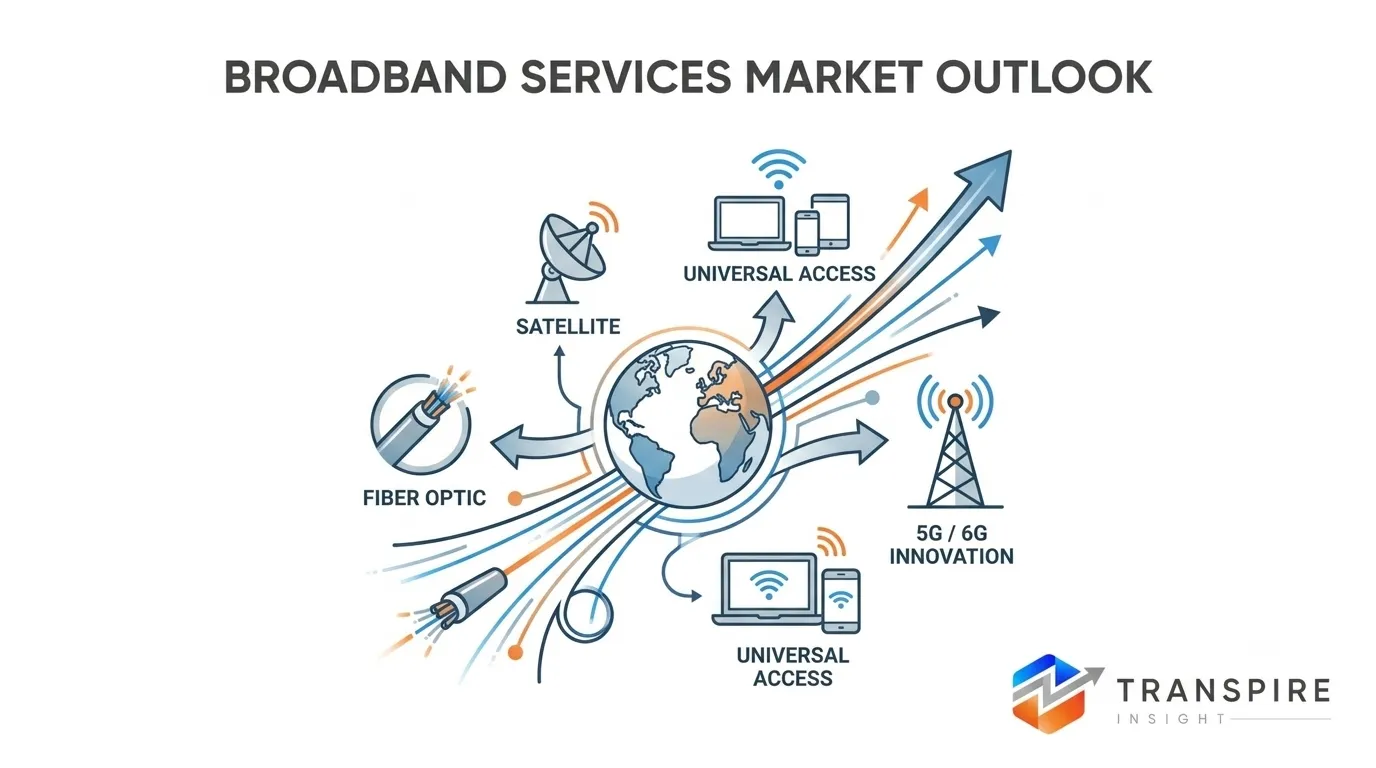
The global Broadband Services Market is expanding as households, businesses, public institutions, and connected devices demand faster and more reliable internet access. Fiber-to-the-home, 5G fixed wireless access, satellite broadband, Wi-Fi upgrades, cloud computing, artificial intelligence, streaming, and connected applications are increasing network capacity requirements.
Broadband Services Market Overview
Broadband services provide high-speed internet connectivity through technologies such as:
Transpire Insight estimates that the global Broadband Services Market was valued at approximately USD 545.8 billion in 2025, increased to around USD 602.6 billion in 2026, and is projected to reach approximately USD 1,208.5 billion by 2033, representing a CAGR of approximately 10.41%.
| Market Indicator | Transpire Insight Estimate |
| Market Value (2025) | USD 545.80 Billion |
| Expected Market Value (2026) | USD 602.60 Billion |
| Estimated Market Value (2033) | USD 1,208.50 Billion |
| Forecast CAGR (2026–2033) | 10.41% |
| Leading Region in 2025 | Asia Pacific |
| Second-largest Region | North America |
| Fastest Growing Region | Asia Pacific |
Independent June 2026 research estimates the global market at approximately USD 547.9 billion in 2025 and USD 600.4 billion in 2026, with fiber accounting for approximately 35.3% of the connection market in 2025.
Latest Global Market Developments
Fiber networks provide the bandwidth and latency characteristics required for increasingly data-intensive services.
AI workloads, cloud applications, data centers, and connected services are contributing to rapidly increasing data consumption.
In September 2026, AT&T announced a multi-year agreement worth more than USD 3 billion with Corning to supply fiber and cable as the company expands its network.
The company plans to reach approximately 60 million fiber locations by the end of the decade, illustrating the scale of ongoing fiber infrastructure investment.
5G FWA allows operators to provide high-speed home and business connectivity without deploying fiber directly to every premises.
Low-earth-orbit satellite networks are increasing broadband availability in remote and underserved locations.
India recorded approximately 1.080 billion broadband subscribers in May 2026, including about 47.4 million wired subscribers and 17.97 million fixed-wireless subscribers.
AT&T reported that the average AT&T Fiber household consumes more than 1 terabyte of data each month, approximately five times its 2016 level.
Why Do Broadband Services Matter?
Broadband infrastructure has become essential for:
As more economic activity becomes digitally connected, broadband infrastructure increasingly functions as a fundamental business and consumer utility.
Key Factors Driving the Market
1. Rising Data Consumption
Video, cloud applications, gaming, AI, and connected devices continue increasing bandwidth requirements.
2. Fiber Deployment
Operators are expanding FTTH and other fiber architectures.
3. 5G Fixed Wireless
FWA provides an alternative approach to high-speed home and business connectivity.
4. Digitalization
Businesses and households increasingly depend on continuous internet access.
5. Government Connectivity Programs
Public investment and universal-service initiatives support broadband expansion.
Five High-Potential Markets
1. China
China's large connected population and extensive fiber infrastructure create substantial broadband demand.
2. India
India represents a major growth opportunity, with more than one billion broadband subscriptions reported in May 2026.
3. United States
The U.S. market is supported by large fiber investments, cable networks, FWA, satellite services, and enterprise connectivity.
4. Japan
Japan has a highly developed broadband ecosystem and strong fiber penetration.
5. Brazil
Brazil's expanding fiber infrastructure and increasing digital adoption support broadband growth.
Competitive Landscape
Top 5 Companies
Opportunities for Small Investors
Challenges & Restraints
Infrastructure costs, right-of-way restrictions, rural deployment economics, spectrum availability, cybersecurity, network maintenance, regulatory requirements, and competitive pricing can affect broadband operators.
Conclusion
The Broadband Services Market is entering an infrastructure-intensive phase as fiber, 5G FWA, satellite connectivity, cloud computing, and AI-driven data demand converge.
India's broadband base surpassed 1.08 billion subscriptions in May 2026, while major U.S. operators continue making multibillion-dollar fiber investments.
The strongest opportunities will increasingly be found in fiber expansion, fixed wireless access, rural connectivity, enterprise broadband, network automation, and high-capacity infrastructure.


Send us a brief description of your challenge and we'll get back to you within 24 hours.

 inquiry@transpireinsight.com
 APAC:+91 7666513636
 Address


