
Sep 16, 2026
By Transpire Insight
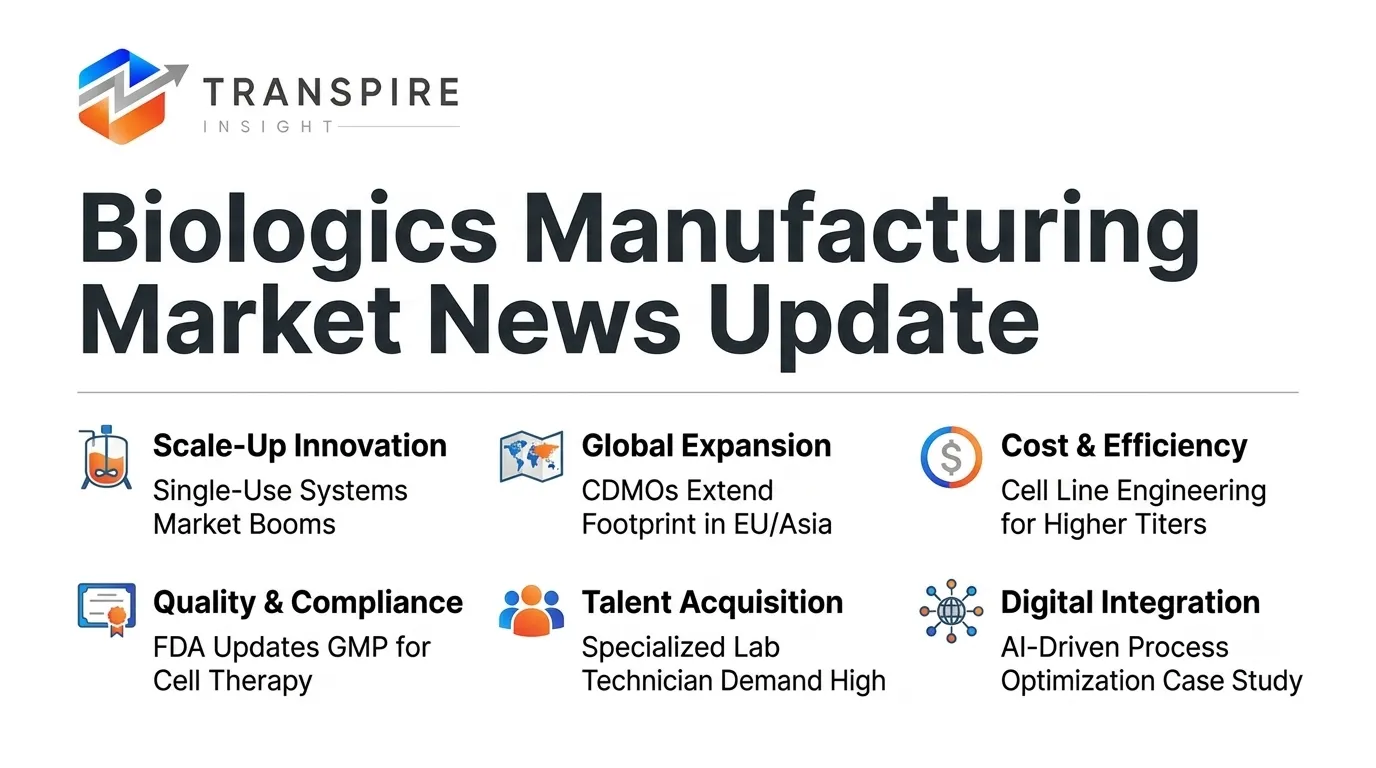
Biologics manufacturing is entering a high-growth phase as pharmaceutical companies expand production capacity for monoclonal antibodies, vaccines, recombinant proteins, cell and gene therapies, while contract manufacturers, single-use technologies, automation, and regionalized supply chains reshape the global biopharmaceutical manufacturing landscape.
The Transformation of Biologics Manufacturing
Biologics manufacturing has become a strategically important part of the global pharmaceutical industry as healthcare systems increasingly rely on complex biological medicines to address cancer, autoimmune diseases, rare disorders, infectious diseases, and other chronic conditions. Unlike conventional small-molecule medicines, biologics are produced using living cells or biological systems, requiring highly specialized facilities, controlled production environments, sophisticated purification processes, and stringent quality controls.
The growing number of biologic drug candidates entering clinical development is creating significant pressure on manufacturers to expand capacity while maintaining product quality, regulatory compliance, and cost efficiency. Pharmaceutical and biotechnology companies are increasingly turning to contract development and manufacturing organizations (CDMOs) to gain access to specialized facilities and technical expertise without building every manufacturing capability internally.
The global biologics manufacturing market was valued at approximately USD 40.1 billion in 2025 and is projected to reach USD 140.6 billion by 2033, representing a 16.7% CAGR from 2026 to 2033. The market is estimated at approximately USD 47.7 billion in 2026. North America accounted for the largest regional share in 2025, while Asia-Pacific is projected to record the fastest growth during the forecast period.
Global Biologics Manufacturing Market Statistics
Global Biologics Manufacturing Market Size was valued at approximately USD 40.1 billion in 2025, projected to reach USD 140.6 billion by 2033, reflecting a 16.7% CAGR from 2026–2033.
Estimated 2026 Market Value: approximately USD 47.7 billion.
Contract manufacturing represented the largest manufacturing mode in 2025 as biopharmaceutical companies increasingly outsource production to specialized CDMOs.
Monoclonal antibodies accounted for the largest modality segment, representing approximately 40.1% of the market in 2025.
Oncology represented the leading disease-indication segment, accounting for approximately 38.9% of the market in 2025.
North America held approximately 41.7% of the global market in 2025, making it the leading regional market.
Asia-Pacific is expected to register the fastest growth through 2033, supported by expanding biopharmaceutical manufacturing capabilities and increasing investment in biologics production.
India's biologics manufacturing market generated approximately USD 1.10 billion in 2025 and is projected to reach USD 4.21 billion by 2033, expanding at an 18.1% CAGR.
Major Causes of Biologics Manufacturing Market Growth
The rapid expansion of biologics manufacturing is being driven by several interconnected healthcare, technological, and commercial developments.
Rising Demand for Targeted Biologic Therapies
The growing prevalence of cancer, autoimmune disorders, diabetes, rare diseases, and other complex conditions is increasing demand for targeted therapies. Biologics can interact with specific biological targets and have become an important component of modern treatment strategies.
The growing pipeline of monoclonal antibodies, recombinant proteins, vaccines, and advanced therapies is consequently creating additional manufacturing requirements. As more biologic candidates progress from clinical development to commercialization, manufacturers require flexible and scalable production infrastructure.
Expansion of Contract Manufacturing
Contract manufacturing has become one of the most important structural trends in the biologics industry. Smaller biotechnology companies often lack the capital, facilities, technical workforce, and regulatory infrastructure required to establish commercial-scale manufacturing.
CDMOs allow developers to outsource process development, analytical testing, manufacturing, scale-up, and other activities to specialized organizations. Large pharmaceutical companies are also using external manufacturing partners to supplement internal capacity and accelerate production timelines.
The contract manufacturing segment held the largest share in 2025 and is expected to remain one of the fastest-growing portions of the market.
Increasing Adoption of Single-Use Manufacturing
Single-use bioreactors, bags, filters, and other disposable production components are becoming increasingly important in biologics manufacturing.
Compared with traditional stainless-steel infrastructure, single-use systems can provide greater flexibility, reduce cleaning requirements, and support faster facility turnaround. They are particularly attractive for multiproduct manufacturing and facilities producing smaller or variable batch volumes.
The expansion of single-use capacity by major CDMOs demonstrates the growing importance of this approach. FUJIFILM Biotechnologies' 2026 UK expansion, for example, introduced 2,000-liter and 5,000-liter single-use bioreactors with a total capacity of up to 19,000 liters.
Growing Cell and Gene Therapy Manufacturing Requirements
Cell and gene therapies introduce highly specialized manufacturing requirements involving cell processing, viral vectors, aseptic handling, analytical testing, and specialized logistics.
As more advanced therapies move toward clinical and commercial development, manufacturers are investing in facilities capable of supporting these products alongside conventional biologics. This is encouraging CDMOs to diversify their technology platforms and develop flexible manufacturing networks.
Increasing Need for Supply-Chain Resilience
The pharmaceutical industry is increasingly focused on manufacturing resilience following disruptions in global supply chains. Companies are evaluating manufacturing locations based not only on production costs but also on regulatory stability, geopolitical considerations, proximity to major markets, and supply security.
This is contributing to the development of regional manufacturing hubs in North America, Europe, and Asia-Pacific. Recent investments in U.S. manufacturing and new Japanese biologics facilities demonstrate the growing importance of geographic diversification.
Recent Developments in Biologics Manufacturing
FUJIFILM Expands UK Single-Use Biomanufacturing Capacity
In February 2026, FUJIFILM Biotechnologies opened an expanded biomanufacturing and process-development presence in Teesside, United Kingdom, supported by approximately £400 million of investment. The expansion includes a 110,000-square-foot manufacturing facility with 2,000-liter and 5,000-liter single-use bioreactors and up to 19,000 liters of total capacity. The company also opened a Bioprocess Innovation Centre focused on high-throughput and continuous process development.
FUJIFILM Advances Its Global Expansion Program
In April 2026, FUJIFILM Biotechnologies provided an update on its multi-year USD 8 billion expansion plan, including mammalian cell-culture manufacturing projects in the United Kingdom and the United States. The strategy combines single-use manufacturing with large-scale stainless-steel production and expanded process-development capabilities.
Bora Biologics Expands U.S. Single-Use Capacity
In July 2026, Bora Biologics announced the addition of its Rockville, Maryland facility to its U.S. commercial manufacturing platform. The expansion increased the company's installed U.S. single-use drug-substance capacity to 20,000 liters across two FDA-registered facilities, with scalability to 30,000 liters.
AGC Biologics Secures Commercial Commitment for New Japan Facility
In July 2026, AGC Biologics announced a long-term commercial manufacturing agreement for five biologics programs at its new Yokohama facility. The customer is expected to use at least 35 batches per year, while the facility is designed to add 18,000 liters of single-use manufacturing capacity through four 2,000-liter and two 5,000-liter bioreactors.
Bristol Myers Squibb Announces New U.S. Manufacturing Investment
In August 2026, Bristol Myers Squibb announced plans to invest approximately USD 2.3 billion in a new 600,000-square-foot manufacturing facility in Houston, Texas. The site is intended to manufacture small-molecule medicines as well as complex products including biologics and antibody-drug conjugates, demonstrating the continuing shift toward large-scale domestic biopharmaceutical production.
Areas of Opportunity
The future of biologics manufacturing extends across conventional biologics as well as increasingly complex therapeutic modalities.
Monoclonal antibodies will remain a major opportunity because of their broad application across oncology, autoimmune disorders, inflammatory diseases, and other therapeutic categories.
Biosimilars represent another substantial opportunity as healthcare systems seek more cost-efficient alternatives to established biologic medicines. Their production requires sophisticated analytical characterization and manufacturing capabilities, creating demand for specialized facilities.
Cell and gene therapies are creating a new manufacturing opportunity because these products require specialized processing platforms and highly controlled production environments.
Vaccines and recombinant proteins continue to require scalable manufacturing capacity, particularly as governments and pharmaceutical companies seek stronger regional supply chains.
Meanwhile, CDMO services are becoming increasingly valuable as emerging biotechnology companies seek flexible access to manufacturing infrastructure without committing to large capital investments.
Emerging Strategies to Strengthen Biologics Manufacturing
Continuous Bioprocessing
Continuous manufacturing is emerging as an important approach for improving process efficiency, reducing manufacturing footprints, and supporting consistent production.
Instead of treating production as a sequence of isolated batch operations, continuous approaches allow certain manufacturing stages to operate for extended periods. This can improve process control and potentially reduce manufacturing bottlenecks.
The increasing incorporation of continuous process-development capabilities into CDMO facilities demonstrates growing interest in this approach. FUJIFILM's UK Bioprocess Innovation Centre, for example, includes capabilities for both high-throughput and continuous process development.
Automation and Digital Manufacturing
Automation is becoming increasingly important as biologics production becomes more complex. Automated systems can monitor manufacturing parameters, control equipment, collect production data, and support consistent process execution.
Digital manufacturing platforms can also help manufacturers identify process deviations earlier and improve traceability. The combination of automation, data analytics, and process monitoring is therefore becoming an important component of modern biologics facilities.
Modular and Single-Use Facilities
Modular manufacturing strategies can help companies respond more rapidly to changes in production requirements. Single-use technologies further increase flexibility because equipment can be deployed for different products without extensive cleaning and validation cycles associated with traditional stainless-steel systems.
The combination of modular design and single-use technologies may become particularly important for CDMOs serving multiple customers and therapeutic modalities.
Regionalized Manufacturing Networks
Biopharmaceutical companies and CDMOs are increasingly building geographically distributed manufacturing networks rather than relying on a small number of production locations.
This strategy can reduce supply-chain concentration risk, improve proximity to customers, and support regulatory requirements in different markets. The commitment to new manufacturing capacity in the U.S. and Japan illustrates the growing importance of geographic resilience.
Regional Development
Biologics manufacturing is developing differently across regions because countries vary in pharmaceutical infrastructure, regulatory environments, biotechnology investment, manufacturing expertise, and access to specialized talent.
North America
North America remains the leading global market for biologics manufacturing. The region accounted for approximately 41.7% of global market revenue in 2025, supported by the United States' large pharmaceutical industry, advanced biotechnology ecosystem, extensive CDMO infrastructure, and high level of investment in biologic therapies.
The United States is expected to remain the dominant country-level market. Its biologics manufacturing revenue was approximately USD 15.86 billion in 2025 and is projected to reach USD 54.64 billion by 2033, representing a 16.4% CAGR.
The region is also experiencing a significant expansion of domestic manufacturing infrastructure as pharmaceutical companies seek greater supply-chain resilience and respond to changing trade and industrial policies.
Europe
Europe has a mature biopharmaceutical manufacturing ecosystem supported by established pharmaceutical companies, biotechnology firms, research institutions, and CDMOs.
The United Kingdom, Germany, Switzerland, France, Italy, Denmark, and other European markets maintain important roles in biologics development and manufacturing. Investments in single-use manufacturing, advanced therapies, and process development are strengthening the region's capabilities.
The expansion of FUJIFILM Biotechnologies' Teesside operations illustrates how Europe continues to attract major investments in advanced biologics manufacturing infrastructure.
Asia-Pacific
Asia-Pacific is projected to be the fastest-growing regional market through 2033. Expanding pharmaceutical manufacturing capabilities, lower production costs in selected markets, increasing biotechnology investment, and growing domestic healthcare demand are supporting the region's development.
China is becoming an increasingly important manufacturing center. Its biologics manufacturing market was approximately USD 2.16 billion in 2025 and is projected to reach USD 9.28 billion by 2033, representing a 19.8% CAGR.
India is another high-growth market. Its biologics manufacturing sector is projected to expand from approximately USD 1.10 billion in 2025 to USD 4.21 billion by 2033, with an 18.1% CAGR.
Japan is also gaining strategic importance as pharmaceutical companies and CDMOs seek geographically diversified and resilient manufacturing networks. AGC Biologics' Yokohama development demonstrates the growing role of Japan as a regional biologics manufacturing hub.
Latin America
Latin America represents an emerging opportunity as countries increase investment in pharmaceutical manufacturing, biotechnology, vaccines, and healthcare infrastructure.
Brazil and Mexico are particularly important because of their population size, pharmaceutical industries, and potential to develop regional manufacturing capabilities. Government initiatives aimed at improving local pharmaceutical production could support long-term biologics manufacturing development.
Middle East & Africa
The Middle East and Africa remain comparatively developing biologics manufacturing markets, but investment in healthcare infrastructure and pharmaceutical localization is creating new opportunities.
Countries seeking greater domestic medicine production may increasingly invest in biotechnology capabilities, vaccine manufacturing, biosimilars, and specialized pharmaceutical facilities. Over time, regional production could reduce dependence on imported biologic medicines and improve supply security.
Challenges & Restraints
Despite strong growth prospects, biologics manufacturing faces significant technical, financial, and regulatory challenges.
One of the largest barriers is manufacturing complexity. Biologic medicines are highly sensitive to changes in temperature, pH, cell-culture conditions, purification parameters, and other process variables. Even relatively small process deviations can affect product quality.
High capital requirements also remain a challenge. Commercial-scale biologics facilities require sophisticated bioreactors, purification systems, cleanrooms, analytical laboratories, quality-control infrastructure, and highly trained personnel.
Regulatory requirements are another major constraint. Manufacturers must demonstrate consistency, sterility, process control, and product quality while complying with regulatory standards across multiple jurisdictions.
The industry also faces a shortage of specialized talent. Bioprocess engineers, analytical scientists, quality specialists, validation professionals, and other skilled workers are essential to operate advanced biologics facilities.
Finally, the growing complexity of biologic modalities creates additional manufacturing challenges. Cell and gene therapies, antibody-drug conjugates, and other advanced products often require specialized technologies and more flexible production systems.
Top 10 Companies Working in the Biologics Manufacturing Market
These companies represent major participants across biologics development, contract manufacturing, process development, cell-culture production, analytical services, and advanced biopharmaceutical manufacturing. The competitive landscape also includes major pharmaceutical companies such as Pfizer, Amgen, AbbVie, Novo Nordisk, Johnson & Johnson, Bristol Myers Squibb, Eli Lilly, and Roche.
1) Lonza Group Ltd.
Lonza is one of the world's largest CDMO organizations and maintains capabilities spanning biologics, mammalian cell culture, bioconjugates, drug products, and other pharmaceutical technologies.
The company reported strong CDMO performance in 2025, with core CDMO sales growth of 21.7% to CHF 6.5 billion, while forecasting 11%–12% growth for 2026. Its performance was supported by contributions from its Vacaville site and several technology platforms.
2) Samsung Biologics
Samsung Biologics has established itself as a major global biologics CDMO with large-scale manufacturing infrastructure and an expanding international footprint.
The company's strategy increasingly emphasizes manufacturing scale, global capacity, and geographic diversification. Its move into U.S. manufacturing also reflects the broader industry trend toward localized production and proximity to major pharmaceutical markets.
3) WuXi Biologics
WuXi Biologics provides integrated biologics development and manufacturing services to pharmaceutical and biotechnology customers.
Its capabilities across research, development, process development, and commercial manufacturing position the company within the growing outsourced biologics production ecosystem.
4) FUJIFILM Diosynth Biotechnologies
FUJIFILM Biotechnologies is rapidly expanding its global biologics manufacturing network through large-scale investments in the United States, United Kingdom, Japan, and other locations.
Its 2026 Teesside expansion combines single-use manufacturing, process development, and continuous processing capabilities, demonstrating the company's focus on flexible and technology-enabled biologics manufacturing.
5) Thermo Fisher Scientific Inc.
Thermo Fisher Scientific participates across the biopharmaceutical value chain, including manufacturing technologies, biologics services, analytical systems, and CDMO capabilities.
Its broad technology portfolio allows pharmaceutical and biotechnology companies to access equipment and services required for development and commercial production.
Market Expert View
The biologics manufacturing industry is moving from a capacity-driven model toward a flexible, technology-enabled, geographically diversified manufacturing ecosystem.
The most important competitive factors are increasingly extending beyond production scale. Pharmaceutical companies and biotechnology developers are looking for partners that can provide process development, regulatory expertise, rapid technology transfer, specialized modalities, analytical capabilities, and reliable commercial supply.
The expansion of single-use systems and continuous processing is likely to remain central to this transformation. At the same time, the increasing localization of manufacturing in the United States, Japan, and other strategic markets suggests that supply-chain resilience will become a more important consideration in manufacturing decisions.
The combination of growing biologic pipelines, increasing CDMO outsourcing, advanced therapies, and large-scale manufacturing investments provides a strong foundation for continued market expansion.
Conclusion
The global biologics manufacturing market is entering a period of rapid expansion as pharmaceutical and biotechnology companies increase production of monoclonal antibodies, recombinant proteins, vaccines, biosimilars, cell therapies, and gene therapies.
With the market estimated at approximately USD 47.7 billion in 2026 and projected to reach USD 140.6 billion by 2033, the industry is positioned to grow at a reported 16.7% CAGR during 2026–2033.
The next phase of industry development will be shaped by CDMO outsourcing, single-use bioreactors, continuous bioprocessing, automation, advanced analytics, modular facilities, and regional manufacturing strategies. As biologic medicines become more complex and globally important, manufacturers capable of combining scale, flexibility, technology, regulatory expertise, and supply-chain resilience are likely to gain a stronger competitive position.


Send us a brief description of your challenge and we'll get back to you within 24 hours.

 inquiry@transpireinsight.com
 APAC:+91 7666513636
 Address


