
Sep 19, 2026
By Transpire Insight
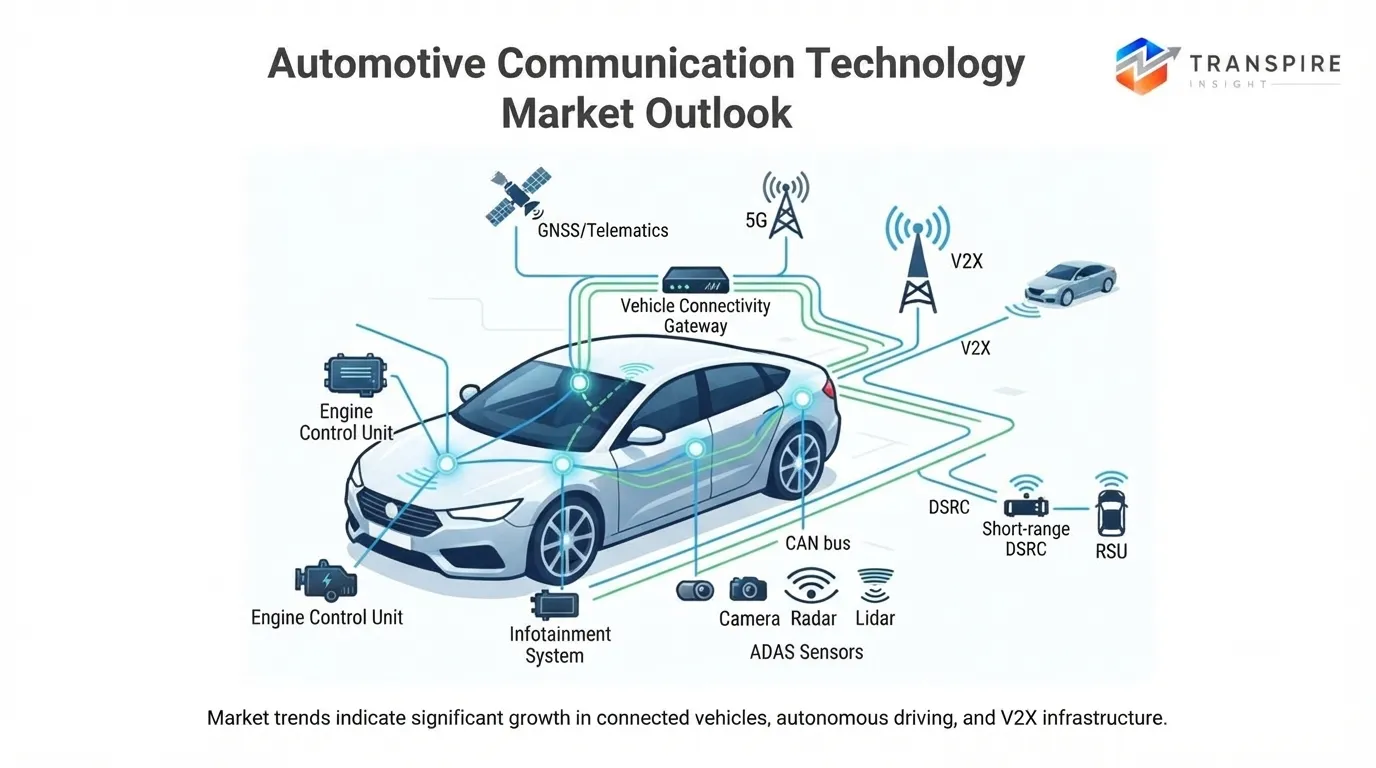
Automotive communication technology is becoming the digital backbone of modern vehicles as automakers move toward software-defined architectures, advanced driver assistance, electrification, connected services, and increasingly data-intensive vehicle systems.
Modern vehicles contain numerous electronic control units, sensors, cameras, displays, powertrain controllers, battery-management systems, infotainment platforms, and connectivity modules.
These components depend on communication networks to exchange information reliably and rapidly.
The global automotive communication technology market was valued at approximately USD 21.7 billion in 2025 and is expected to reach around USD 66.8 billion by 2035, expanding at a CAGR of approximately 12.4%. For editorial purposes, this can be rounded to approximately USD 22.5 billion in 2025 and USD 69 billion by 2035, representing about 12.6% annual growth.
Automotive Communication Technology Market Growth Drivers
Rise of Software-Defined Vehicles
The transition toward software-defined vehicles is one of the most important growth drivers.
Instead of treating vehicle electronics as independent systems, manufacturers are increasingly using centralized and zonal architectures that allow software to control multiple vehicle functions.
This creates demand for faster, more scalable communication networks.
Increasing Electronic Content
Modern vehicles contain increasing numbers of sensors, controllers, cameras, displays, ECUs, and connected systems.
As electronic content rises, the requirement for reliable vehicle networking also increases.
Electrification
Electric vehicles require sophisticated battery-management systems, power electronics, thermal management, charging controls, and connected functions.
The growth of EVs is therefore creating additional demand for advanced communication technologies.
Automotive Communication Technology Market Trends
Automotive Ethernet
Automotive Ethernet is becoming increasingly important as vehicle systems require higher bandwidth.
CAN and LIN remain essential for many applications, but Ethernet is increasingly being adopted for high-speed data applications involving cameras, infotainment, ADAS, gateways, and centralized computing.
Zonal Architectures
Zonal architecture is changing the organization of vehicle electrical systems.
Instead of relying on large numbers of independent communication structures, manufacturers can consolidate functions geographically and connect them to centralized computing platforms.
V2X Communication
Vehicle-to-everything communication allows vehicles to exchange information with infrastructure, other vehicles, pedestrians, and network services.
V2X can support traffic management, safety applications, connected mobility, and future autonomous-driving systems.
AI and Cloud Connectivity
Connected vehicles increasingly exchange information with cloud platforms for navigation, diagnostics, personalization, software updates, fleet management, and predictive maintenance.
This increases the amount of data that must be transmitted securely and reliably.
Automotive Communication Technology Market Challenges
The rapid expansion of vehicle communication systems creates interoperability challenges.
Automakers must manage multiple protocols, legacy architectures, cybersecurity requirements, functional-safety standards, and complex software environments.
Cybersecurity is particularly important because connected vehicles create additional pathways that could potentially be exploited.
Cost is another challenge. Advanced processors, communication controllers, transceivers, sensors, gateways, and software can increase vehicle development costs.
Automotive Communication Technology Market Competitive Landscape
The market includes automotive Tier-1 suppliers, semiconductor manufacturers, networking specialists, and electronics companies.
Recent analysis indicates that Denso, Harman International, ZF Friedrichshafen, Valeo, and Magna collectively held approximately 41.9% of the market in 2025, while Denso alone held more than 13%.
Other important participants include Bosch, Continental, Aptiv, NXP Semiconductors, Yazaki, Mitsubishi Electric, Autoliv, and Lear.
Top 10 Companies in the Automotive Communication Technology Market
Company Profiles
Denso Corporation
Denso is a major global automotive technology supplier with expertise in vehicle electronics, communication modules, sensors, ECUs, and connectivity.
Its communication and networking technologies support data exchange across vehicle systems, including connected services and ADAS-related applications.
Harman International
Harman provides automotive infotainment, telematics, connectivity, displays, audio, and software solutions.
Its ability to combine communication technology with the in-vehicle digital experience gives the company a strong position as vehicles become more connected.
ZF Friedrichshafen AG
ZF provides electronic control units, vehicle systems, sensors, and connectivity technologies supporting chassis, safety, and advanced driver-assistance applications.
Its broad automotive systems portfolio provides opportunities to integrate communication technologies into increasingly software-driven vehicle architectures.
Valeo SE
Valeo is a major automotive technology supplier active in electrification, driver assistance, thermal systems, lighting, and electronic systems.
Its involvement in multiple vehicle technology categories provides opportunities as communication networks become increasingly integrated with ADAS and electrification systems.
Magna International Inc.
Magna provides automotive systems, electronics, body systems, powertrain technologies, and complete vehicle solutions.
Its broad manufacturing and engineering capabilities allow it to participate in the development of increasingly connected and electronically integrated vehicles.
Outlook
The automotive communication technology market is positioned for strong long-term growth as connected vehicles become more sophisticated.
The industry is moving from traditional CAN- and LIN-based networks toward a combination of automotive Ethernet, zonal architectures, centralized computing, V2X, cloud connectivity, and software-defined vehicle platforms.
Hardware currently remains the largest component, accounting for approximately 65.5% of the market in 2025, while software is expected to grow faster as vehicle architectures become increasingly software-centric.
The transition will create opportunities across semiconductors, networking hardware, communication software, gateways, ECUs, cybersecurity, telematics, and cloud platforms.
Overall, automotive communication technology is becoming less of a supporting vehicle function and more of a fundamental infrastructure layer for the next generation of connected, electric, automated, and software-defined mobility.


Send us a brief description of your challenge and we'll get back to you within 24 hours.

 inquiry@transpireinsight.com
 APAC:+91 7666513636
 Address


