
Oct 03, 2026
By Transpire Insight
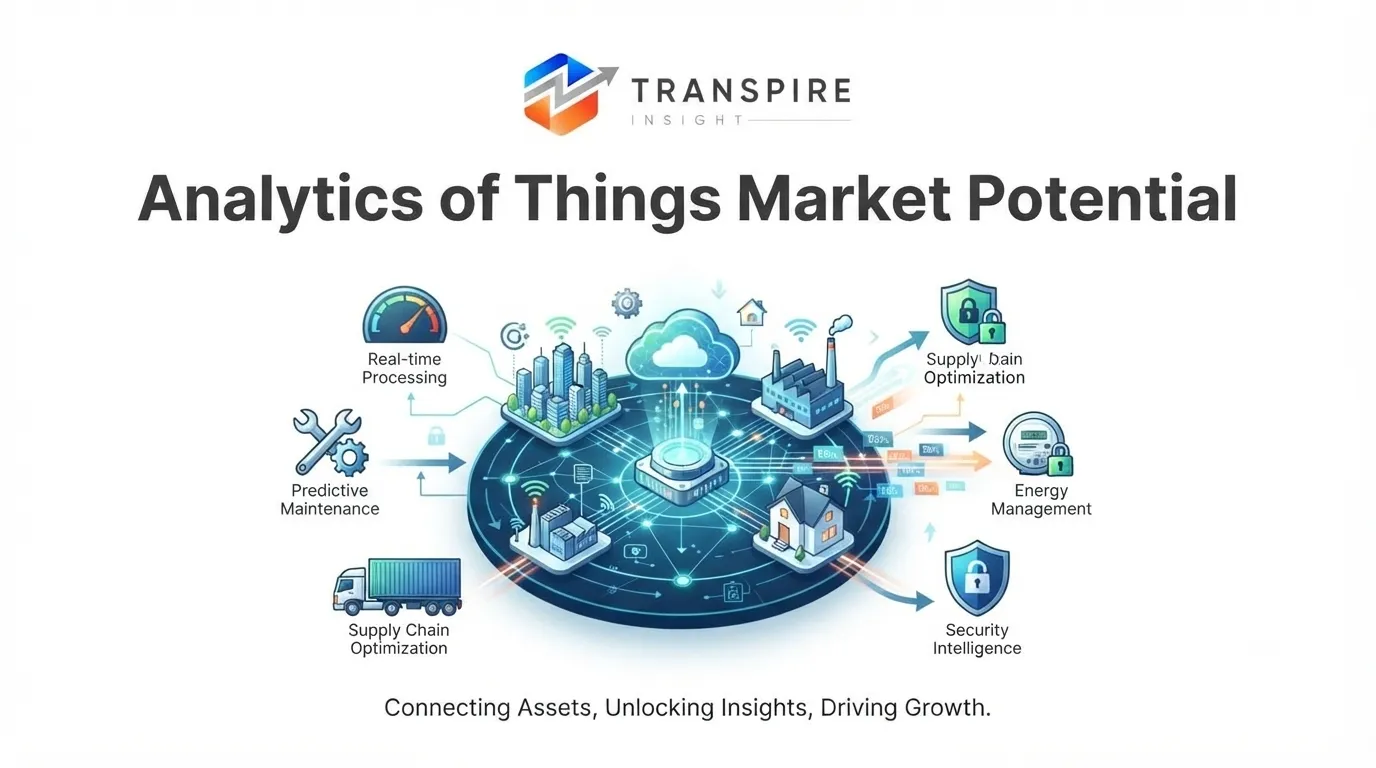
The Analytics of Things (AoT) market is entering a more advanced phase as enterprises move beyond simply connecting machines, sensors, vehicles, buildings, and other physical assets. Organizations are increasingly focused on analyzing the continuous streams of information produced by these connected systems and converting that information into operational decisions, predictive Insight, automated responses, and measurable business outcomes.
The combination of Internet of Things connectivity, artificial intelligence, machine learning, edge computing, cloud platforms, digital twins, and real-time analytics is expanding the role of Analytics of Things across manufacturing, healthcare, transportation, energy, retail, agriculture, logistics, financial services, and smart infrastructure. As connected assets become more intelligent, analytics is becoming an important layer between raw device data and automated decision-making.
September 2026: The global Analytics of Things market is developing rapidly as organizations seek to extract greater value from IoT-generated data. Market estimates differ considerably depending on whether research firms define AoT as a specialized analytics category or include the wider IoT analytics ecosystem. Future Market Insight estimates the dedicated Analytics of Things market at approximately USD 468.3 million in 2025 and projects it to reach USD 2.07 billion by 2035 at a 16.0% CAGR. Other market studies use a broader definition and place the 2024-2025 market in the tens of billions of dollars. This difference reflects market-scope methodology rather than a single universally accepted market boundary.
Market Size
For this analysis, the Analytics of Things Market refers to software, platforms, analytics capabilities, and associated services used to analyze data generated by connected physical assets and IoT devices. It includes descriptive, diagnostic, predictive, prescriptive, and automated analytics capabilities, together with cloud and on-premises deployment models.
On this defined basis, the market is estimated at approximately USD 510 million in 2025 and is projected to reach around USD 2.25 billion by 2035, representing an estimated CAGR of approximately 16.0% during the forecast period.
The growth trajectory is supported by the increasing volume of telemetry produced by connected assets and the need to convert that information into operational intelligence. Research on the broader IoT analytics market shows the same structural trend at a much larger scale. For example, 360iResearch estimates the broader IoT analytics market at USD 39.32 billion in 2025 and USD 132.16 billion by 2032, while Fortune Business Insight estimates USD 42.22 billion in 2025 and USD 201.77 billion by 2034.
The distinction is important because Analytics of Things represents the intelligence layer applied to data generated by connected things, while broader IoT analytics reports may encompass a much wider collection of platforms, connectivity-related analytics, infrastructure, services, and industrial data technologies.
Connected Devices Are Creating a Larger Analytics Opportunity
The expansion of connected devices is one of the fundamental factors supporting Analytics of Things adoption. Sensors installed in industrial equipment, vehicles, medical devices, buildings, warehouses, utility infrastructure, and consumer products continuously generate information about operating conditions.
Traditional reporting systems generally analyze historical business data. AoT systems are designed to work with high-volume, time-sensitive streams that can reveal changes in asset behavior almost immediately.
Manufacturers can use machine data to identify abnormal vibration, temperature changes, pressure fluctuations, production deviations, or energy-consumption patterns. Logistics operators can analyze vehicle location, fuel consumption, route behavior, and equipment condition. Buildings can use sensor data to monitor occupancy, temperature, air quality, and energy demand.
This transition is changing the role of analytics from periodic reporting to continuous operational intelligence.
Microsoft's current IoT architecture, for example, combines connected devices with cloud-to-edge capabilities and analytics so organizations can generate actionable Insight from physical assets and operations.
Artificial Intelligence Is Expanding Analytics of Things Capabilities
Artificial intelligence and machine learning are becoming central components of advanced AoT platforms.
Earlier IoT deployments often concentrated on dashboards and threshold-based alerts. Modern Analytics of Things platforms can identify patterns across multiple variables and use historical data to determine whether an asset is operating normally.
Predictive analytics can estimate the likelihood of equipment degradation. Anomaly detection can identify unusual sensor behavior. Prescriptive analytics can recommend potential responses after an abnormal condition has been detected.
This development is particularly important in industrial environments where large quantities of machine data are difficult to interpret manually.
PTC's ThingWorx platform, for example, provides analytics capabilities covering descriptive analysis, predictive modeling, anomaly detection, predictive scoring, and prescriptive scoring.
The increasing availability of machine-learning tools is also reducing the amount of specialist data-science work required for certain IoT analytics applications. This could help enterprises deploy analytics across a larger number of assets without building separate analytical models for every device.
Edge Computing Supports Real-Time Analytics
The movement of analytics toward the edge is another important market trend.
Sending every sensor reading to a centralized cloud environment can create latency, bandwidth, security, and cost challenges. Edge analytics allows selected data processing to occur closer to the source.
This is especially useful when an application requires rapid action. Industrial machinery, autonomous systems, connected vehicles, energy infrastructure, and safety systems may not be able to wait for a remote cloud service to analyze every event.
Microsoft's Azure Stream Analytics can process streaming data in the cloud or on intelligent-edge environments, while Azure IoT Edge supports local processing to reduce unnecessary data transfers and maintain operations during intermittent connectivity.
The increasing combination of edge computing and cloud analytics is therefore creating hybrid architectures in which immediate decisions occur locally while larger datasets are transferred to centralized environments for historical analysis, model development, reporting, and enterprise planning.
Digital Twins Strengthen Analytics of Things Applications
Digital twins are also becoming closely connected with Analytics of Things.
A digital twin represents a physical asset, process, facility, or system within a digital environment. When continuously connected to real-world sensor data, the digital representation can be used to monitor performance and evaluate possible operational changes.
Manufacturers can create digital representations of production equipment. Energy companies can model turbines, grids, or generation assets. Building operators can simulate energy consumption and occupancy. Transportation companies can model vehicle fleets and infrastructure.
The combination of real-time telemetry, analytics, simulation, and machine learning allows organizations to move from simply observing assets toward understanding how assets may behave under different conditions.
This trend is likely to encourage further adoption of AoT platforms in asset-intensive industries.
Predictive Maintenance Remains a Major Application
Predictive maintenance is one of the most commercially important applications of Analytics of Things.
Instead of servicing equipment only according to a fixed schedule or waiting for a breakdown, organizations can analyze machine-condition data to identify early warning signals.
Temperature, vibration, pressure, acoustic signals, electrical consumption, operating cycles, and other parameters can be combined to identify deviations from normal operating patterns.
The objective is to reduce unexpected downtime, improve maintenance scheduling, extend asset life, and optimize spare-parts management.
PTC describes IoT analytics applications around questions such as when maintenance should occur, whether consumables need replacement, and when service intervention may be required.
As manufacturing plants become increasingly automated, the financial value of identifying equipment problems before failure becomes an important factor supporting demand.
Manufacturing Could Remain a Major End-Use Industry
Manufacturing represents one of the strongest application environments for Analytics of Things because factories contain large populations of connected machines generating continuous data.
Industrial organizations are deploying sensors across production lines, robotics, motors, compressors, pumps, machine tools, conveyors, and quality-control systems.
AoT platforms can analyze this information for:
The evolution toward smart factories is increasing the amount of data available for analysis. As organizations connect operational technology with enterprise IT systems, the ability to combine machine data with production, supply-chain, and business information is becoming increasingly important.
Healthcare Applications Are Expanding
Healthcare organizations are also generating significant amounts of connected-device data.
Medical equipment, patient-monitoring systems, wearable devices, hospital infrastructure, pharmaceutical logistics systems, and connected diagnostic technologies can produce continuous streams of information.
Analytics of Things can help organizations identify trends in device performance, monitor environmental conditions, improve equipment utilization, and support operational planning.
For example, connected hospital equipment can provide information about utilization rates and maintenance requirements. Pharmaceutical logistics systems can monitor temperature and location conditions during transportation.
Healthcare applications require strong attention to privacy, cybersecurity, interoperability, and regulatory requirements. Consequently, vendors that can combine analytics with secure data-management capabilities may have opportunities to expand within this segment.
Smart Buildings and Energy Management
Buildings are increasingly becoming connected environments.
Sensors can monitor occupancy, lighting, temperature, air quality, electricity consumption, water usage, equipment status, and security conditions.
Analytics of Things platforms can analyze these signals to identify energy-consumption patterns and operating inefficiencies.
A building-management system can use analytics to determine when heating, cooling, lighting, or ventilation systems should operate based on occupancy and environmental conditions.
Energy companies can similarly use connected infrastructure data to identify demand patterns and monitor distributed assets.
As organizations focus on energy efficiency and emissions management, analytics-driven monitoring is expected to become increasingly relevant.
Transportation and Logistics
Transportation networks generate enormous quantities of connected data.
Fleet-management systems can collect information from vehicles relating to location, speed, fuel consumption, engine conditions, driver behavior, and maintenance status.
Analytics platforms can combine this information with route, weather, traffic, and operational data.
The result can include improved fleet visibility, maintenance planning, route optimization, fuel management, and asset utilization.
In advanced environments, real-time analytics can support automated responses to changing road or vehicle conditions.
Microsoft's reference architecture for IoT analytics specifically describes applications including fleet management, facilities management, and connected manufacturing, demonstrating the breadth of these use cases.
Deployment Models: Cloud, On-Premises and Hybrid
Cloud-based deployment is gaining importance because it allows organizations to scale analytics infrastructure without maintaining equivalent physical infrastructure.
Cloud platforms can ingest large quantities of IoT data, provide centralized analytical tools, support machine-learning workloads, and integrate information from geographically distributed assets.
However, on-premises deployment remains relevant for industries with strict data-security requirements, legacy operational technology, regulatory constraints, or low-latency requirements.
Hybrid architectures are therefore expected to remain an important part of the market.
An organization may process critical information locally at the edge, store historical data in the cloud, and use centralized machine-learning infrastructure to develop predictive models.
Descriptive to Prescriptive Analytics
The Analytics of Things market can be divided by analytical maturity.
Descriptive analytics explains what happened.
Diagnostic analytics investigates why an event happened.
Predictive analytics estimates what may happen next.
Prescriptive analytics evaluates potential actions and recommends how the organization could respond.
Automated analytics goes one step further by allowing predefined or AI-supported systems to initiate responses based on analytical results.
This progression is important because companies increasingly want analytics systems to become part of operational workflows rather than remain isolated dashboards.
Regional Market Outlook
North America
North America represents one of the most developed environments for Analytics of Things because of extensive cloud adoption, industrial digitization, advanced enterprise software infrastructure, and significant investments in artificial intelligence and IoT.
The United States has a large concentration of technology providers, industrial companies, cloud platforms, and analytics specialists.
Broader IoT analytics research identifies North America as a leading regional market, with Fortune Business Insight estimating that the region represented 38.52% of global IoT analytics revenue in 2025.
Europe
Europe is experiencing increasing demand for industrial analytics, smart manufacturing, energy optimization, connected transportation, and sustainable infrastructure.
Germany, France, the United Kingdom, and other European economies are investing in connected industrial environments and digital transformation.
Analytics can also support energy-efficiency initiatives by providing organizations with detailed information about resource consumption.
Asia-Pacific
Asia-Pacific is expected to provide substantial growth opportunities as manufacturing capacity, smart-city investments, connected infrastructure, and digital transformation initiatives expand.
China, India, Japan, and South Korea are developing large ecosystems around industrial IoT, electronics, telecommunications, cloud services, and connected devices.
Future Market Insight identifies China and India among the faster-growing country markets in its Analytics of Things assessment, although country-level growth estimates differ depending on methodology.
Latin America and Middle East & Africa
These regions are gradually increasing adoption of connected infrastructure in areas such as utilities, logistics, manufacturing, agriculture, transportation, and smart buildings.
The availability of cloud services and lower-cost connected sensors is helping reduce some barriers to deployment.
Competitive Landscape
The Analytics of Things market includes global technology companies, cloud providers, industrial automation specialists, consulting firms, analytics companies, and IoT platform developers.
The competitive environment is shaped by several factors, including platform scalability, AI capabilities, edge-to-cloud integration, interoperability, cybersecurity, data visualization, machine-learning functionality, industry-specific solutions, and integration with enterprise applications.
Major players identified across market research include Microsoft, IBM, Amazon Web Services, SAP, PTC, Siemens, Oracle, TIBCO, Cisco, Intel, Accenture, Capgemini, SAS, and other technology and consulting companies.
Top 10 Companies in Analytics of Things Market
Company Profiles
1. Microsoft Corporation
Microsoft is a major technology provider in cloud computing, data analytics, artificial intelligence, and IoT. Its Azure ecosystem connects IoT services with data-processing, machine-learning, analytics, and visualization capabilities.
Azure IoT supports cloud-to-edge architectures, while Azure Stream Analytics is designed for processing high-volume streaming information. Microsoft also provides analytics tools for organizations seeking to analyze telemetry and operational data generated by connected devices.
2. International Business Machines Corporation (IBM)
IBM participates in the Analytics of Things ecosystem through enterprise analytics, artificial intelligence, hybrid cloud, asset management, and industrial data technologies.
Its technology portfolio enables organizations to combine operational data with enterprise information and apply analytics to asset-intensive operations. IBM's broader enterprise software capabilities position the company across industrial, infrastructure, healthcare, and other data-intensive applications.
3. PTC Inc.
PTC is strongly associated with industrial IoT through its ThingWorx platform.
ThingWorx Analytics supports descriptive, diagnostic, predictive, and prescriptive capabilities, including anomaly detection and predictive scoring. The platform is designed to help industrial organizations extract actionable information from connected equipment and operational systems.
4. Cisco Systems, Inc.
Cisco operates across networking, cybersecurity, edge computing, industrial connectivity, and IoT infrastructure.
The company's role in the Analytics of Things ecosystem is supported by its ability to connect distributed devices and operational environments while providing infrastructure for collecting and transmitting data.
Cisco's positioning is particularly relevant to industrial facilities, transportation, energy, buildings, and enterprise environments where secure connectivity is fundamental to IoT analytics.
5. Oracle Corporation
Oracle provides cloud infrastructure, database technology, enterprise applications, analytics, and data-management capabilities that can support IoT-related workloads.
Its enterprise technology portfolio allows organizations to combine operational data with business applications and analytical systems.
Oracle's strength in databases and cloud computing gives it opportunities across asset management, supply-chain analytics, manufacturing, logistics, and other connected-enterprise applications.
6. SAP SE
SAP is a major enterprise software provider with capabilities spanning business applications, data management, supply-chain systems, asset management, and analytics.
Its role in Analytics of Things is closely connected to the integration of physical-asset information with business processes.
For manufacturers and asset-intensive companies, combining IoT-generated information with enterprise resource planning, supply-chain, maintenance, and financial data can provide a broader operational view.
7. Siemens AG
Siemens is a major industrial technology provider with extensive exposure to industrial automation, manufacturing software, digital twins, industrial connectivity, and analytics.
The company's industrial focus positions it strongly within smart manufacturing environments where connected equipment produces large volumes of operational information.
Siemens can address analytics requirements across factory automation, industrial assets, infrastructure, energy, and digital manufacturing.
8. SAS Institute Inc.
SAS is widely associated with advanced analytics, artificial intelligence, statistical modeling, and data management.
Within Analytics of Things, its capabilities can be applied to sensor and machine-generated information to identify patterns, anomalies, and predictive signals.
SAS's analytical heritage is relevant for organizations that require sophisticated statistical and machine-learning capabilities rather than simple IoT dashboards.
9. Accenture plc
Accenture operates across technology consulting, cloud transformation, artificial intelligence, data analytics, and industrial digital transformation.
The company supports organizations implementing large-scale connected-enterprise programs and integrating IoT information into business operations.
Its consulting-led model enables it to participate in strategy, technology implementation, systems integration, and analytics transformation projects.
10. Capgemini SE
Capgemini provides consulting, technology services, cloud transformation, data analytics, artificial intelligence, and digital engineering capabilities.
The company's position in Analytics of Things is supported by its work in connected products, industrial transformation, data platforms, and enterprise digitalization.
Its broad services portfolio allows it to participate in IoT analytics projects where organizations require both technology implementation and business-process transformation.
Key Trends Shaping the Analytics of Things Market
Several trends are expected to influence the market through the next decade.
AI-powered analytics: Machine learning is moving analytics from static reporting toward prediction and automated decision support.
Edge intelligence: More analytics workloads are moving closer to sensors and machines to reduce latency and bandwidth requirements.
Digital twins: Virtual representations of physical assets are becoming more closely integrated with live operational data.
Cloud-native platforms: Scalable cloud architectures are enabling organizations to process data from geographically distributed connected assets.
Industrial AI: Manufacturing companies are increasingly combining machine data with AI models for maintenance, quality, and process optimization.
Real-time decision-making: Organizations are placing greater value on analytics that can generate operational responses quickly rather than producing delayed reports.
Cybersecurity: As connected devices expand, securing data flows, device identities, networks, and analytical environments is becoming a critical requirement.
Interoperability: Enterprises increasingly need analytics platforms capable of combining data from different devices, manufacturers, protocols, and legacy systems.
Challenges Facing the Market
Despite strong growth potential, Analytics of Things adoption faces several challenges.
Data quality remains a major concern because inaccurate sensors or inconsistent device information can produce unreliable analytical results.
Integration can also be difficult. Enterprises often operate equipment from multiple manufacturers using different communication protocols and data formats.
Cybersecurity represents another challenge because connecting operational assets to networks increases the number of potential attack surfaces.
Organizations may also struggle with a shortage of professionals who understand both operational technology and advanced analytics.
Finally, the economic case for IoT analytics must be demonstrated. Enterprises need to connect analytics investments with measurable improvements such as lower downtime, reduced energy use, better asset utilization, improved product quality, or increased operational efficiency.
Outlook
The Analytics of Things market is moving from basic IoT monitoring toward intelligent, predictive, and increasingly automated decision-making.
The convergence of IoT, artificial intelligence, edge computing, cloud infrastructure, digital twins, and advanced analytics is creating a technology environment in which physical assets can continuously communicate their operating conditions and analytical systems can interpret those signals.
Manufacturing, transportation, energy, healthcare, logistics, retail, and smart infrastructure are expected to remain important application areas.
Market research also indicates that the broader IoT analytics ecosystem is expanding rapidly, with several 2026 studies forecasting double-digit growth through 2032.
As organizations increasingly connect machines and infrastructure, the commercial value will depend less on the number of connected devices and more on how effectively the resulting data can be converted into useful decisions.
Analytics of Things is therefore emerging as an important bridge between the connected physical world and intelligent enterprise operations. Companies capable of combining secure connectivity, real-time processing, artificial intelligence, predictive modeling, and actionable business workflows are positioned to participate in the next stage of IoT-driven digital transformation.


Send us a brief description of your challenge and we'll get back to you within 24 hours.

 inquiry@transpireinsight.com
 APAC:+91 7666513636
 Address


