
Sep 24, 2026
By Transpire Insight
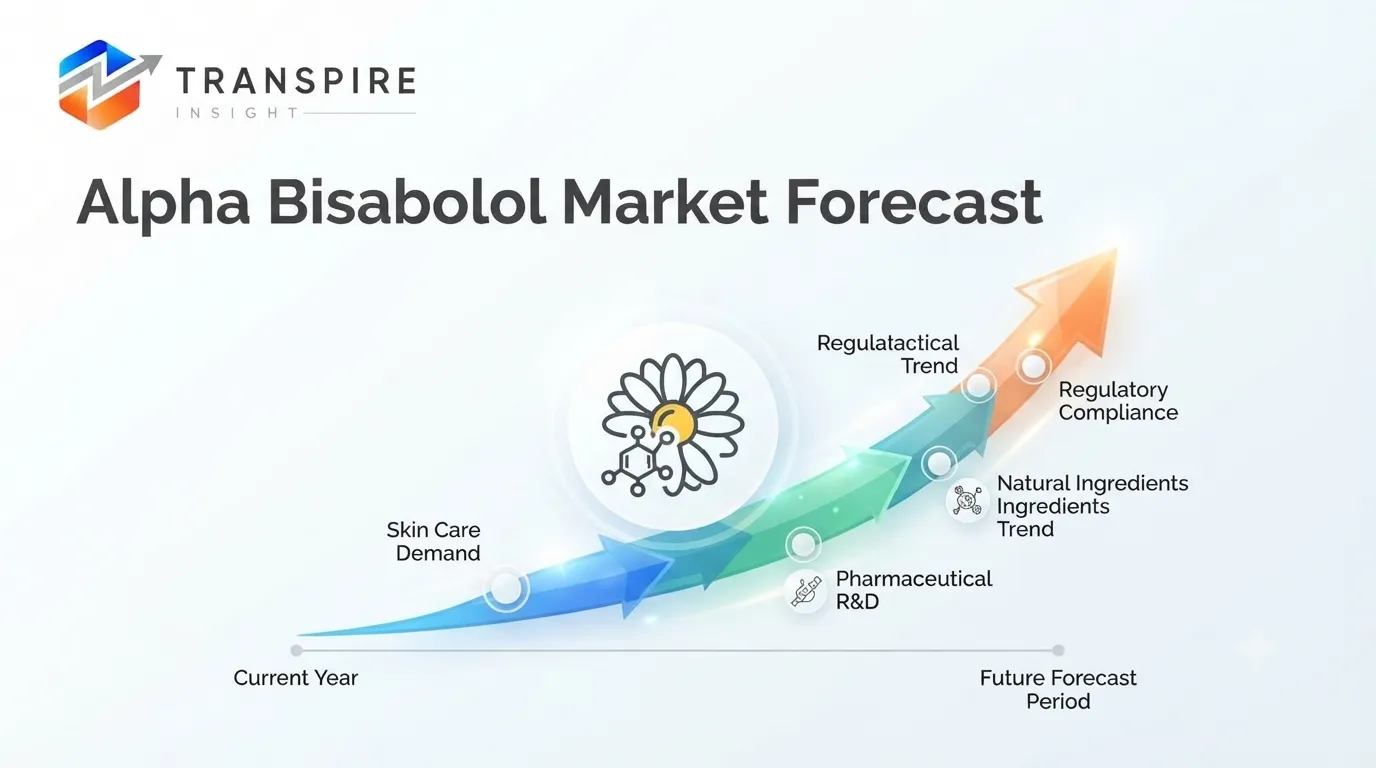
Cosmetic and personal-care manufacturers are increasingly searching for ingredients that can combine functional performance with consumer demand for gentle, naturally derived formulations. Alpha bisabolol is attracting attention because of its soothing, anti-inflammatory, antimicrobial and skin-conditioning characteristics.
The expansion of premium skincare, clean-label cosmetics, sensitive-skin products and pharmaceutical formulations is creating new opportunities for alpha bisabolol suppliers and ingredient manufacturers.
September 2026: Alpha bisabolol is a naturally occurring sesquiterpene alcohol used across cosmetics, personal care, oral-care products and selected pharmaceutical applications. It is primarily associated with botanical sources such as German chamomile and the candeia tree, although synthetic and nature-identical production routes are also important to commercial supply.
The ingredient is particularly valued for its ability to support formulations designed for sensitive or irritated skin. It is incorporated into creams, lotions, facial products, after-sun products, deodorants, shampoos and other personal-care formulations.
As consumers become more attentive to ingredient labels, manufacturers are increasingly evaluating botanical ingredients that can provide both functional benefits and marketing value.
Market Size
The global alpha bisabolol market was estimated at approximately USD 26.5 billion in 2025 and is projected to reach around USD 41.0 billion by 2034, expanding at a CAGR of approximately 4.9% during 2026–2034.
Current market studies place the market in a broadly similar range, although estimates differ depending on whether the market includes only purified alpha bisabolol or a broader range of related cosmetic and botanical ingredient applications. One current estimate places the market at USD 26.81 billion in 2025 and USD 41.41 billion by 2034.
North America represents an important high-value market, while Europe remains influential because of its strong cosmetics industry and demand for natural ingredients. Asia Pacific is expected to experience significant growth as personal-care consumption expands across China, India, Japan and Southeast Asia.
Natural and Botanical Ingredients Drive Demand
One of the strongest factors supporting alpha bisabolol demand is the increasing consumer preference for naturally derived cosmetic ingredients.
Consumers are increasingly examining product labels and looking for ingredients associated with gentle skincare and botanical formulations.
Alpha bisabolol fits this trend because it can be derived from botanical sources and has a long history of use in cosmetic formulations.
However, natural sourcing does not automatically mean that all commercial alpha bisabolol is obtained from plants. Manufacturers may select natural, synthetic or nature-identical sources depending on purity, price, availability and formulation requirements.
This flexibility allows ingredient suppliers to serve different segments of the cosmetics industry.
Skincare Represents the Core Application
Skincare is one of the most important applications for alpha bisabolol.
The ingredient is commonly used in formulations designed to soothe and condition the skin. It can be found in moisturizers, facial creams, serums, after-sun products and products designed for sensitive skin.
The premium skincare industry is particularly attractive because consumers are willing to pay more for products positioned around specialized ingredients.
As cosmetic brands increasingly launch targeted products for redness, dryness, sensitivity and environmental stress, alpha bisabolol can provide formulation value.
The increasing popularity of minimalist skincare routines may also benefit ingredients that provide multiple functional properties within a formulation.
Cosmetics Manufacturers Seek Multifunctional Ingredients
Cosmetic companies are under pressure to reduce formulation complexity while maintaining product performance.
Ingredients that can provide several benefits may therefore become increasingly valuable.
Alpha bisabolol can contribute soothing and conditioning characteristics while supporting the sensory profile of certain formulations.
This makes it useful in products ranging from facial care and body care to after-shave formulations.
Premium cosmetics brands can also use botanical sourcing as part of their product positioning.
Oral Care Creates Additional Opportunities
Alpha bisabolol is also used in selected oral-care formulations.
Its antimicrobial and soothing properties make it relevant to products designed for oral hygiene and sensitive-mouth applications.
Toothpaste, mouthwash and other oral-care formulations can provide additional demand outside traditional skincare.
Although oral care represents a smaller application compared with skincare, diversification into these areas can help ingredient suppliers reduce dependence on a single end-use segment.
Pharmaceutical Applications Expand the Addressable Market
Alpha bisabolol's functional properties have also generated interest in pharmaceutical and therapeutic formulations.
The ingredient may be incorporated into topical products where soothing or anti-inflammatory properties are desirable.
The growth of dermatological products and specialized topical formulations could therefore provide additional opportunities.
However, pharmaceutical applications generally require stricter quality specifications and regulatory compliance than conventional cosmetic formulations.
This creates an opportunity for suppliers capable of providing high-purity, traceable and consistently manufactured material.
Sustainability Is Becoming More Important
Sustainability is becoming an increasingly important factor in cosmetic ingredient purchasing decisions.
Candeia-derived alpha bisabolol has historically attracted attention because it represents a natural source, but sustainable sourcing practices remain important.
Manufacturers are increasingly examining raw-material traceability, responsible harvesting and environmental impact.
This is encouraging suppliers to develop more transparent sourcing systems and production methods.
Biotechnology and fermentation-based approaches could eventually create additional routes for producing high-purity botanical ingredients while reducing pressure on natural resources.
Synthetic Production Provides Supply Stability
Natural raw-material supply can be affected by weather, agricultural conditions and regional availability.
Synthetic and nature-identical production can provide manufacturers with greater consistency.
For large cosmetics companies, predictable quality and supply can be just as important as natural origin.
This creates a competitive environment in which suppliers must balance natural positioning with cost, purity and scalability.
North America Maintains Strong Demand
North America represents one of the largest markets for alpha bisabolol because of its advanced cosmetics, personal-care and pharmaceutical industries.
The region has a strong market for premium skincare and clean-label products.
The United States is particularly important because of the size of its beauty and personal-care industry and the presence of major cosmetic brands.
Europe is another important region because consumers have a strong interest in natural cosmetics and ingredient transparency.
Asia Pacific is expected to demonstrate strong growth as disposable incomes rise and consumers increasingly adopt premium skincare products.
Asia Pacific Creates New Opportunities
China, Japan, South Korea and India are becoming increasingly important markets for specialty cosmetic ingredients.
South Korea's advanced skincare industry creates demand for specialized functional ingredients, while Japan has a mature market for high-quality personal-care products.
India offers long-term growth potential because of its expanding middle class, rising beauty-product consumption and growing domestic cosmetics industry.
Local cosmetic manufacturing is also increasing, creating opportunities for regional ingredient suppliers.
Competitive Landscape
The alpha bisabolol market includes specialty chemical manufacturers, natural-ingredient suppliers and cosmetic raw-material companies.
Competition is based on purity, sourcing, consistency, price, production capacity, regulatory compliance and technical support.
Key participants and suppliers associated with the broader alpha-bisabolol industry include BASF, Symrise, Atanor, Gustav Heess, Kobo Products, Spec-Chem Industry, Biogründl, Nippon Fine Chemical and other specialty ingredient companies.
Top 10 Companies in Alpha Bisabolol Market
1. BASF
Headquarters: Ludwigshafen, Germany
BASF is one of the world's major chemical and cosmetic-ingredient suppliers. Its extensive portfolio and global manufacturing capabilities allow it to serve large personal-care and pharmaceutical customers.
2. Symrise
Headquarters: Holzminden, Germany
Symrise is a major supplier to the fragrance, flavor and cosmetic industries. Its expertise in specialty ingredients provides access to customers developing premium personal-care formulations.
3. Atanor
Headquarters: Argentina
Atanor is involved in chemical manufacturing and has participated in the supply of specialty chemical ingredients. Its regional production capabilities support customers across agricultural, industrial and chemical markets.
4. Gustav Heess
Headquarters: Leonberg, Germany
Gustav Heess specializes in plant oils, natural ingredients and specialty raw materials used across cosmetics and pharmaceutical formulations.
5. Kobo Products
Headquarters: South Plainfield, New Jersey, USA
Kobo Products supplies specialty ingredients and formulation technologies to the cosmetics and personal-care industry. Its portfolio supports manufacturers developing advanced skincare products.
Outlook: Could Alpha Bisabolol Become a More Strategic Cosmetic Ingredient?
Alpha bisabolol is positioned to benefit from the convergence of natural cosmetics, sensitive-skin products and premium personal care.
The market's future will depend on consistent raw-material supply, sustainable sourcing, formulation innovation and the ability of suppliers to provide high-purity products at competitive prices.
Biotechnology could become particularly important over the longer term as ingredient manufacturers look for scalable alternatives to traditional botanical extraction.
As cosmetic consumers continue to prioritize gentle formulations and recognizable functional ingredients, alpha bisabolol could become an increasingly valuable component of modern skincare and personal-care products.


Send us a brief description of your challenge and we'll get back to you within 24 hours.

 inquiry@transpireinsight.com
 APAC:+91 7666513636
 Address


