
Sep 24, 2026
By Transpire Insight
Governments and industrial companies are accelerating efforts to develop low-carbon hydrogen production as part of broader decarbonization strategies. Alkaline water electrolysis is attracting significant attention because of its technological maturity, established industrial experience and suitability for large-scale hydrogen projects.
Investment in renewable energy, government hydrogen targets, electrolyzer manufacturing capacity and demand from steel, chemicals and energy industries are creating a strong foundation for the alkaline electrolysis equipment market.
September 2026: Hydrogen is increasingly viewed as an important component of long-term industrial decarbonization.
While hydrogen can be produced using several methods, electrolysis offers a pathway to produce hydrogen using electricity and water.
When renewable electricity is used, the resulting hydrogen can have a significantly lower carbon footprint than hydrogen produced from fossil fuels.
Alkaline water electrolysis is one of the most established electrolyzer technologies.
The technology uses an alkaline electrolyte and electrodes to split water into hydrogen and oxygen.
Market Size
The global alkaline water electrolysis hydrogen production equipment market was estimated at approximately USD 1.51 billion in 2025 and is projected to reach around USD 3.18 billion by 2033, expanding at a CAGR of approximately 9.7% during 2026–2033.
Transpire Insight currently values the market at USD 1.492 billion in 2025 and forecasts USD 3.105 billion by 2033 at a 9.60% CAGR.
Europe remains a major market because of its green-hydrogen policies, while Asia Pacific is expected to benefit from large-scale electrolyzer manufacturing and industrial hydrogen projects.
Decarbonization Is the Main Market Driver
Industrial decarbonization is one of the strongest forces behind green-hydrogen investment.
Industries such as steel, chemicals, refining and fertilizers use large quantities of hydrogen.
Replacing fossil-based hydrogen with renewable hydrogen could reduce carbon emissions.
This is encouraging governments and industrial companies to invest in electrolyzer systems.
The economics remain challenging in many regions, but declining renewable-electricity costs and technological improvements could gradually improve project viability.
Steel Industry Creates Significant Demand
Steel production is one of the most important future applications for green hydrogen.
Hydrogen can potentially replace fossil fuels in certain steelmaking processes, particularly direct-reduced iron production.
As steelmakers face increasing carbon-reduction requirements, hydrogen-based production routes are receiving greater attention.
Large-scale electrolyzer installations could therefore be located near renewable-energy projects and steel plants.
Chemical Industry Remains a Major User
The chemical industry already consumes large quantities of hydrogen.
Hydrogen is used in ammonia production, methanol production, refining and other processes.
Replacing conventional hydrogen with electrolytic hydrogen provides a pathway toward lower-carbon chemical production.
Existing hydrogen demand therefore gives the industry an immediate potential market for green hydrogen.
Large-Scale Electrolyzers Are Expanding
The market is gradually shifting from small demonstration systems toward larger commercial projects.
Large-scale electrolyzer plants require multiple stacks, power-electronics systems, gas-separation equipment, water treatment, cooling systems and control technologies.
This creates opportunities beyond the electrolyzer stack itself.
Equipment suppliers capable of delivering complete integrated systems may gain a competitive advantage.
Renewable Energy Integration Supports Demand
Solar and wind power are intermittent.
Electrolyzers can potentially absorb electricity during periods of high renewable generation.
This creates a link between green hydrogen and renewable-energy management.
Hydrogen can then be stored and transported for later use.
As renewable capacity increases, electrolyzers could become part of broader energy-storage and grid-balancing systems.
Modular Systems Provide Flexibility
Modular alkaline electrolyzer systems allow projects to scale capacity over time.
This can be useful for industrial users that want to expand hydrogen production gradually.
Containerized systems can also simplify installation and deployment.
Modular designs may be particularly attractive in emerging hydrogen markets where infrastructure is still developing.
Electrolyzer Efficiency Is Becoming More Important
Efficiency is a critical factor in hydrogen economics.
Electricity represents a major component of hydrogen-production cost.
Even small improvements in electricity consumption per kilogram of hydrogen can influence project economics at large scale.
Manufacturers are therefore working on electrode materials, cell design, current density and system integration.
Water Treatment Is an Important Supporting Technology
Electrolyzers require treated water.
Large hydrogen plants therefore require water purification, circulation and management systems.
In regions with water scarcity, developers must also evaluate water availability and recycling.
This is creating opportunities for companies providing integrated water-treatment and hydrogen-production systems.
Europe Maintains a Strong Position
Europe is one of the most important markets for alkaline electrolysis equipment.
Government targets, industrial decarbonization programs, renewable-energy investment and hydrogen subsidies are supporting deployment.
Transpire Insight highlights policy support across Europe, Japan, South Korea and Australia as an important factor accelerating alkaline electrolysis adoption.
Germany, France, Spain, the Netherlands and other European markets are investing in hydrogen infrastructure.
Asia Pacific Expands Manufacturing Capacity
Asia Pacific is becoming increasingly important because of its large electrolyzer manufacturing base.
China has developed significant manufacturing capabilities and is investing in large-scale hydrogen projects.
Japan and South Korea are also investing in hydrogen technologies.
India is developing its own green-hydrogen ecosystem and has announced initiatives to support domestic hydrogen production.
Competitive Landscape
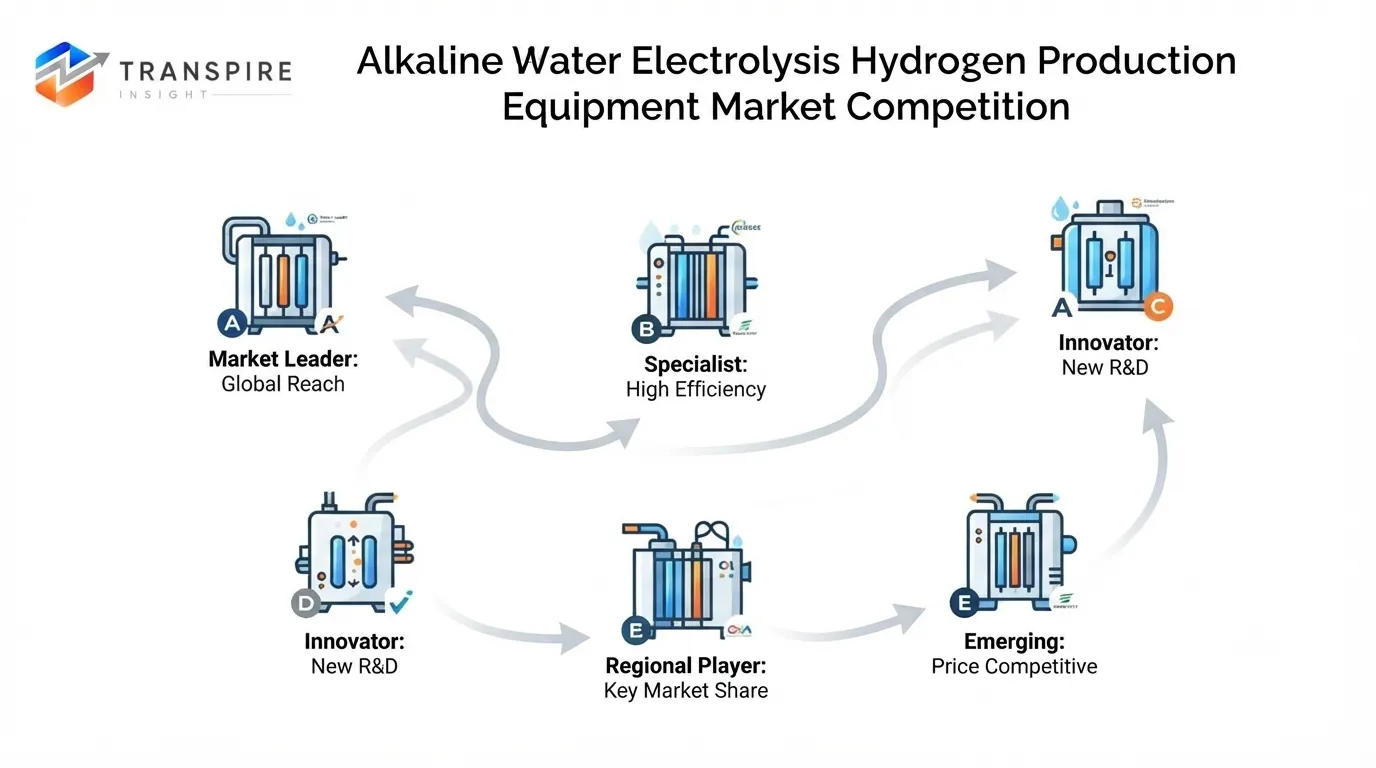
The alkaline electrolysis market includes established industrial-gas companies, electrolyzer manufacturers and engineering firms.
Competition is based on electrolyzer efficiency, system reliability, stack life, project cost, manufacturing scale and ability to provide integrated solutions.
Key participants include Nel, thyssenkrupp nucera, John Cockerill, Siemens Energy, Plug Power, LONGi Hydrogen, Sungrow Hydrogen, Enapter, Cummins and McPhy.
Top 10 Companies in Alkaline Water Electrolysis Hydrogen Production Equipment Market
1. Nel ASA
Headquarters: Oslo, Norway
Nel develops electrolyzer technologies and hydrogen fueling solutions. Its portfolio includes alkaline electrolyzer systems designed for industrial-scale hydrogen production.
2. thyssenkrupp nucera
Headquarters: Dortmund, Germany
thyssenkrupp nucera specializes in large-scale electrolysis systems. The company has positioned alkaline water electrolysis as a core technology for industrial hydrogen projects.
3. John Cockerill
Headquarters: Seraing, Belgium
John Cockerill provides large-scale electrolyzer solutions and has significant experience in industrial engineering and energy systems.
4. Siemens Energy
Headquarters: Munich, Germany
Siemens Energy participates in hydrogen technologies through electrolyzers, renewable-energy integration and broader energy infrastructure.
5. Plug Power
Headquarters: Latham, New York, USA
Plug Power develops hydrogen-generation, storage and fuel-cell technologies. Its portfolio includes electrolyzer systems designed to support green-hydrogen production.
Outlook: Could Alkaline Electrolysis Become the Backbone of Industrial Green Hydrogen?
Alkaline water electrolysis is likely to remain one of the most important technologies for large-scale hydrogen production.
Its technological maturity, established supply chain and scalability give it an advantage in industrial applications.
The market will nevertheless face challenges involving electricity costs, renewable-energy availability, project financing, water requirements and infrastructure.
Future systems are likely to become more efficient, modular and digitally controlled.
As governments and industries move from hydrogen announcements toward actual commercial projects, large-scale alkaline electrolyzer deployment could accelerate significantly through the remainder of the decade.
The technology could ultimately become a major bridge between renewable electricity and hard-to-decarbonize industrial sectors.


Send us a brief description of your challenge and we'll get back to you within 24 hours.

 inquiry@transpireinsight.com
 APAC:+91 7666513636
 Address


