
Sep 30, 2026
By Transpire Insight
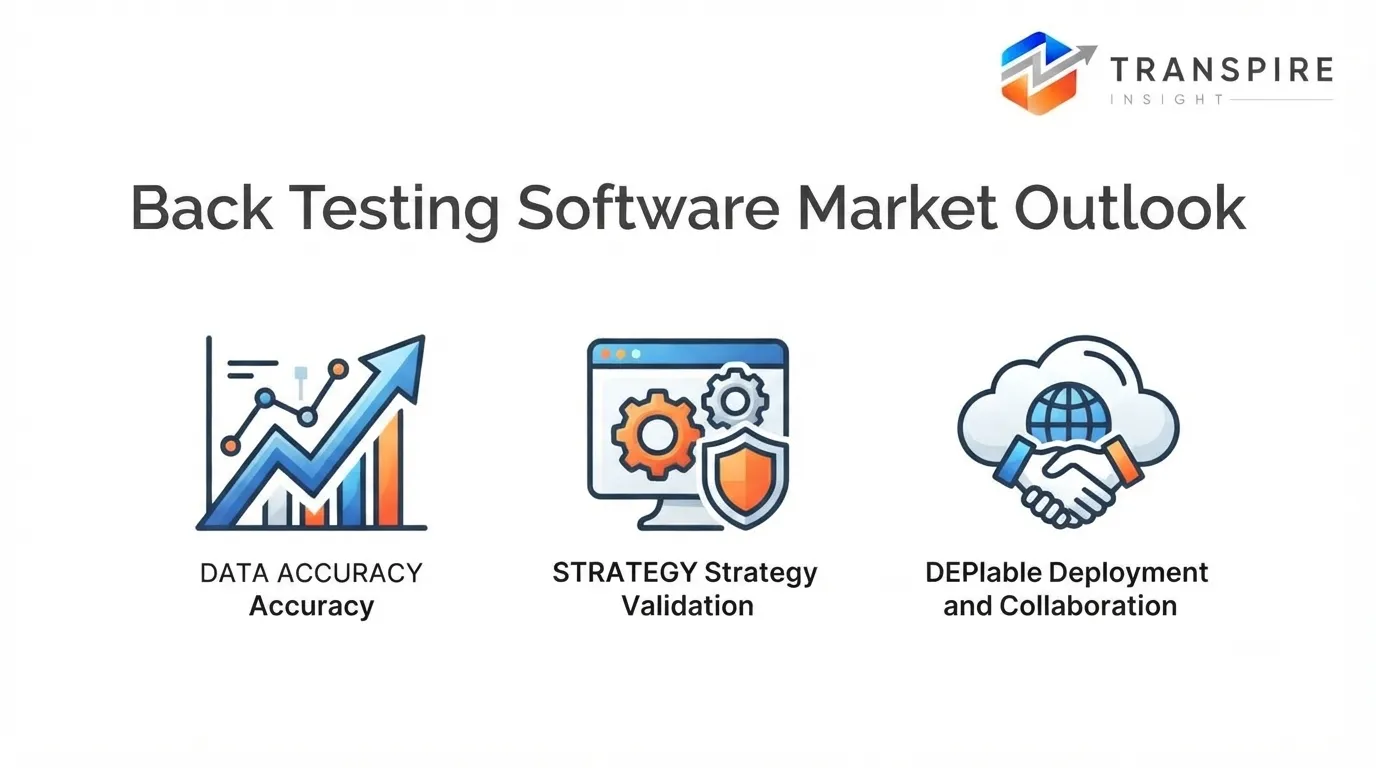
Financial markets are becoming increasingly automated as institutional investors, hedge funds, asset managers, brokerages and retail traders adopt algorithmic strategies. As trading models become more complex, back testing software is evolving from a basic strategy-testing tool into an important infrastructure layer for model validation, risk assessment and portfolio optimization.
The growing use of artificial intelligence, cloud computing, high-frequency market data and automated trading systems is creating new opportunities for advanced back testing platforms capable of processing large datasets and simulating increasingly realistic market conditions.
September 2026: Back testing software allows traders, quantitative analysts, portfolio managers and financial institutions to evaluate trading strategies using historical market data before deploying them with live capital.
A strategy can be tested against historical prices, volumes, volatility, corporate actions, transaction costs and other market variables to determine how it might have performed under different conditions.
The technology has become increasingly important as financial markets move toward systematic and algorithmic trading.
Modern platforms can perform significantly more sophisticated analysis than traditional spreadsheet-based testing. They can support portfolio simulations, Monte Carlo analysis, optimization, risk measurement, execution modeling and automated strategy evaluation.
The growing availability of cloud computing is also allowing users to run large numbers of simulations without investing heavily in local computing infrastructure.
Market Size
The global back testing software market was estimated at approximately USD 452 million in 2025 and is projected to reach around USD 850 million by 2032, expanding at a CAGR of approximately 9.5% during 2026–2032.
Current market research estimates the 2025 market at approximately USD 444.16 million and forecasts USD 833.83 million by 2032 at a CAGR of 9.41%. Other estimates place the 2025 market closer to USD 500 million, reflecting differences in market definition and the software categories included.
North America remains an important market because of its large institutional-investment ecosystem, while Europe benefits from strong quantitative-finance capabilities and regulatory emphasis on model governance. Asia Pacific is expected to experience significant growth as algorithmic trading, fintech adoption and retail participation expand.
Algorithmic Trading Is the Primary Market Driver
The increasing use of algorithmic trading is one of the strongest factors supporting back testing software demand.
Algorithmic systems can execute predefined trading rules automatically and analyze market conditions at speeds that are difficult to achieve through manual trading.
However, deploying an algorithm without adequate historical testing can expose investors to substantial model risk.
Back testing allows developers to determine whether a strategy would have generated acceptable returns under historical conditions.
It also allows users to evaluate drawdowns, volatility, win rates, risk-adjusted returns and other performance indicators.
As more investment decisions become automated, the need to validate those decisions before deployment is increasing.
Artificial Intelligence Is Changing Strategy Development
Artificial intelligence is creating a new generation of quantitative trading strategies.
Machine-learning models can analyze large datasets and identify relationships that may not be obvious through traditional technical analysis.
However, AI-based models introduce additional risks, including overfitting, data leakage and unstable relationships between historical and future market conditions.
This makes robust back testing particularly important.
Modern platforms are increasingly incorporating machine-learning workflows, feature engineering and large-scale simulation capabilities.
Some systems can test multiple parameter combinations and compare model performance across different market environments.
The objective is increasingly moving beyond simply asking whether a strategy made money historically.
Instead, investors want to know whether the strategy remains robust under changing conditions.
Cloud Deployment Gains Momentum
Cloud-based back testing is becoming increasingly attractive to both institutional and smaller users.
Cloud infrastructure allows traders to access computing resources without purchasing expensive servers.
Large simulations can be distributed across multiple computing resources, reducing the time required to test complex strategies.
Current market research identifies cloud-based deployment as the leading deployment category, with one 2026 estimate placing its share at approximately 62.7% in 2025.
Cloud systems can also provide centralized access for research teams.
Multiple analysts can work with common datasets, strategies and experiment results.
This is particularly valuable for financial institutions where model development involves teams across different locations.
Institutional Investors Represent a Major User Group
Institutional investors remain one of the most important customer groups.
Asset managers, hedge funds, brokerages and pension funds use quantitative analysis to evaluate investment strategies and manage portfolio risk.
Institutional users generally require more advanced functionality than individual traders.
They may need large historical datasets, high-frequency data, transaction-cost modeling, scenario analysis, audit trails and integration with portfolio-management systems.
Back testing platforms therefore increasingly compete on scalability and governance rather than simply ease of use.
Current market research estimates that institutional investors represented approximately 65% of the market in 2025 in one market segmentation.
Retail Algorithmic Trading Expands the Addressable Market
Back testing is no longer restricted to professional quantitative teams.
Retail traders are increasingly using automated strategies through broker APIs and trading platforms.
The expansion of algorithmic trading in India is one example of this broader democratization. Recent industry reporting points to increased access to broker APIs, AI-enabled trading tools and regulatory developments that are making algorithmic trading more accessible to individual traders.
Retail users generally prioritize ease of use, affordable pricing, pre-built indicators and integration with brokers.
This is encouraging vendors to develop visual strategy builders and low-code interfaces.
The result is a wider addressable market for back testing platforms.
Historical Data Quality Is Becoming a Competitive Advantage
The quality of historical data can significantly influence the reliability of a back test.
Incorrect prices, missing data, survivorship bias and inaccurate corporate-action adjustments can produce misleading results.
Professional users therefore increasingly demand high-quality historical datasets.
Platforms are integrating equities, futures, options, foreign exchange, commodities and cryptocurrency data.
Tick-level data is particularly valuable for strategies that depend on execution timing.
The availability of alternative datasets is also expanding the scope of testing.
Investors can increasingly evaluate strategies using sentiment, economic indicators, news, weather, satellite and other nontraditional datasets.
Transaction Costs and Slippage Improve Realism
A major limitation of simplistic back testing is that it can ignore the costs associated with executing trades.
Brokerage fees, bid-ask spreads, market impact, slippage and liquidity can significantly affect strategy performance.
Advanced platforms therefore increasingly include transaction-cost models.
This allows users to simulate more realistic trading conditions.
For high-frequency strategies, execution assumptions can determine whether a strategy is viable.
Consequently, transaction-cost analysis is becoming a critical differentiator among professional back testing platforms.
Risk Management Is Becoming More Important
Back testing is increasingly being used as part of broader risk-management processes.
A strategy can be profitable historically while still exposing investors to significant losses under certain market conditions.
Modern systems therefore support stress testing and scenario analysis.
Users can examine how strategies perform during market crashes, periods of high inflation, interest-rate shocks or extreme volatility.
This allows portfolio managers to identify vulnerabilities before deploying capital.
Back testing is consequently becoming more closely connected to enterprise risk-management systems.
Monte Carlo Simulation Expands Testing Capabilities
Historical testing alone cannot capture every possible market scenario.
Monte Carlo simulation provides an alternative by generating many possible outcomes based on defined statistical assumptions.
It can help investors evaluate potential ranges of returns and losses.
Combining historical testing with Monte Carlo simulations can provide a broader assessment of strategy robustness.
This is especially useful for portfolio optimization and risk management.
Strategy Optimization Creates New Opportunities
Back testing platforms increasingly include optimization engines.
Users can test multiple combinations of indicators, entry rules, exit rules and risk parameters.
Automated optimization can reduce the time required to identify potentially effective strategy configurations.
However, excessive optimization can also create overfitting.
Leading platforms therefore increasingly need to provide tools that help users distinguish between genuinely robust strategies and strategies that merely fit historical data.
Walk-forward analysis, out-of-sample testing and cross-validation can help address this issue.
Integration With Trading Platforms Becomes Essential
Back testing software is increasingly expected to connect directly with brokers and trading platforms.
A seamless research-to-execution workflow allows users to develop a strategy, test it, optimize it and eventually deploy it through the same environment.
APIs are becoming important because they allow users to connect data providers, brokers and portfolio-management systems.
The more integrations a platform offers, the easier it becomes for users to incorporate back testing into their existing workflows.
North America Maintains a Strong Position
North America is one of the leading markets for back testing software.
The region benefits from a large hedge-fund industry, sophisticated asset managers, established exchanges and extensive adoption of quantitative investment strategies.
The United States is particularly important because of its concentration of financial institutions and technology companies.
The region also has a strong ecosystem of financial-data providers and cloud-computing companies.
These factors support the development of sophisticated back testing platforms.
Europe Emphasizes Transparency and Governance
Europe represents another important market.
Financial institutions are placing increasing emphasis on model transparency, risk management and auditability.
These requirements support demand for software capable of documenting model assumptions, datasets and testing results.
The region's strong quantitative-finance ecosystem also supports adoption among asset managers and institutional investors.
The United Kingdom, Germany, Switzerland and France are important markets for financial-technology solutions.
Asia Pacific Could Record Strong Growth
Asia Pacific is expected to be one of the fastest-growing regional markets.
The region combines expanding financial markets with rapid digital adoption.
China, India, Japan, Singapore, South Korea and Australia are developing increasingly sophisticated financial-technology ecosystems.
India is particularly attractive because of the rapid growth of retail participation and increasing access to algorithmic trading infrastructure.
Cloud-based platforms may be particularly well positioned in emerging markets because they allow users to access advanced computing without major infrastructure investments.
Open-Source Tools Increase Competitive Pressure
Commercial back testing platforms increasingly compete with open-source frameworks.
Python-based libraries and community-developed quantitative tools provide researchers with flexibility and customization.
Open-source ecosystems can accelerate innovation and allow developers to build highly specialized workflows.
However, enterprise customers may still prefer commercial platforms because of professional support, security, data integration and service-level agreements.
This creates a market in which open-source and commercial technologies can coexist.
Competitive Landscape Is Highly Fragmented
The back testing software market includes specialized quantitative platforms, trading terminals, financial-data companies and broader investment-technology providers.
Competition is based on data quality, simulation speed, ease of use, programming flexibility, integrations, cloud capabilities and pricing.
Current market research identifies companies including AlgoTrader, AmiBroker, Bloomberg, Interactive Brokers, MetaQuotes, MultiCharts, NinjaTrader, OneMarketData, Portfolio123, QuantConnect, QuantInsti, Quantower, QuantRocket, Sierra Chart, TradeStation, Trading Technologies, TradingView and Wealth-Lab.
Top 10 Companies in Back Testing Software Market
1. TradingView
Headquarters: New York, United States
TradingView is a widely used financial-market charting and analysis platform with strategy-testing capabilities. Its large user community and browser-based environment have helped make systematic analysis more accessible to retail traders and professional users.
Its scripting ecosystem allows users to create and evaluate rule-based trading strategies.
The platform benefits from its broad coverage of financial markets and strong integration between charting, analysis and strategy development.
2. QuantConnect
Headquarters: New York, United States
QuantConnect focuses heavily on quantitative strategy development and algorithmic trading.
Its platform supports cloud-based research and back testing and is designed for users who require more programming flexibility.
The company is particularly relevant to quantitative developers who want to work with Python and other programming environments.
Its cloud infrastructure allows users to run complex simulations without maintaining their own high-performance computing environment.
3. MetaQuotes Software
Headquarters: Limassol, Cyprus
MetaQuotes is best known for its MetaTrader trading platforms.
MetaTrader environments provide automated-strategy development and testing capabilities that are widely used by foreign-exchange and derivatives traders.
The company's large ecosystem of brokers, developers and algorithmic-trading users gives it a strong position in retail automated trading.
4. TradeStation
Headquarters: Plantation, Florida, United States
TradeStation combines brokerage services with trading and strategy-development technology.
Its platform provides tools for developing, testing and automating trading strategies.
The company's integrated approach allows users to move between research and live trading within a connected ecosystem.
This positioning makes TradeStation relevant to traders who want strategy development and execution capabilities in one platform.
5. NinjaTrader
Headquarters: Denver, Colorado, United States
NinjaTrader provides trading technology and strategy-development tools, particularly for futures and active traders.
Its ecosystem supports automated trading, charting and historical strategy analysis.
The platform's emphasis on active trading and futures markets provides a distinct position within the broader back testing software landscape.
Outlook: Could AI Make Back Testing a Core Layer of Automated Investment?
Back testing software is moving from a specialist quantitative tool toward a broader decision-support platform.
The next stage of development is likely to involve greater integration between artificial intelligence, historical data, cloud computing and automated execution.
AI could allow users to generate and test larger numbers of strategy variations while identifying patterns across multiple asset classes.
At the same time, stronger governance will be necessary.
A successful back test does not guarantee future profitability, and advanced software cannot eliminate market uncertainty.
The most valuable platforms will therefore be those that combine powerful simulation with robust risk controls, transparent assumptions and reproducible results.
Cloud deployment, machine learning, alternative datasets and automated strategy generation are expected to remain major areas of investment.
As financial markets become increasingly systematic, back testing could evolve into a foundational layer connecting research, portfolio construction, risk management and automated execution.
The long-term opportunity is therefore not simply to make strategy testing faster. It is to make investment-model validation more realistic, transparent and scalable.
For financial institutions, fintech companies and increasingly sophisticated retail traders, that capability could become an essential part of the modern trading infrastructure.


Send us a brief description of your challenge and we'll get back to you within 24 hours.

 inquiry@transpireinsight.com
 APAC:+91 7666513636
 Address


