
Sep 23, 2026
By Transpire Insight
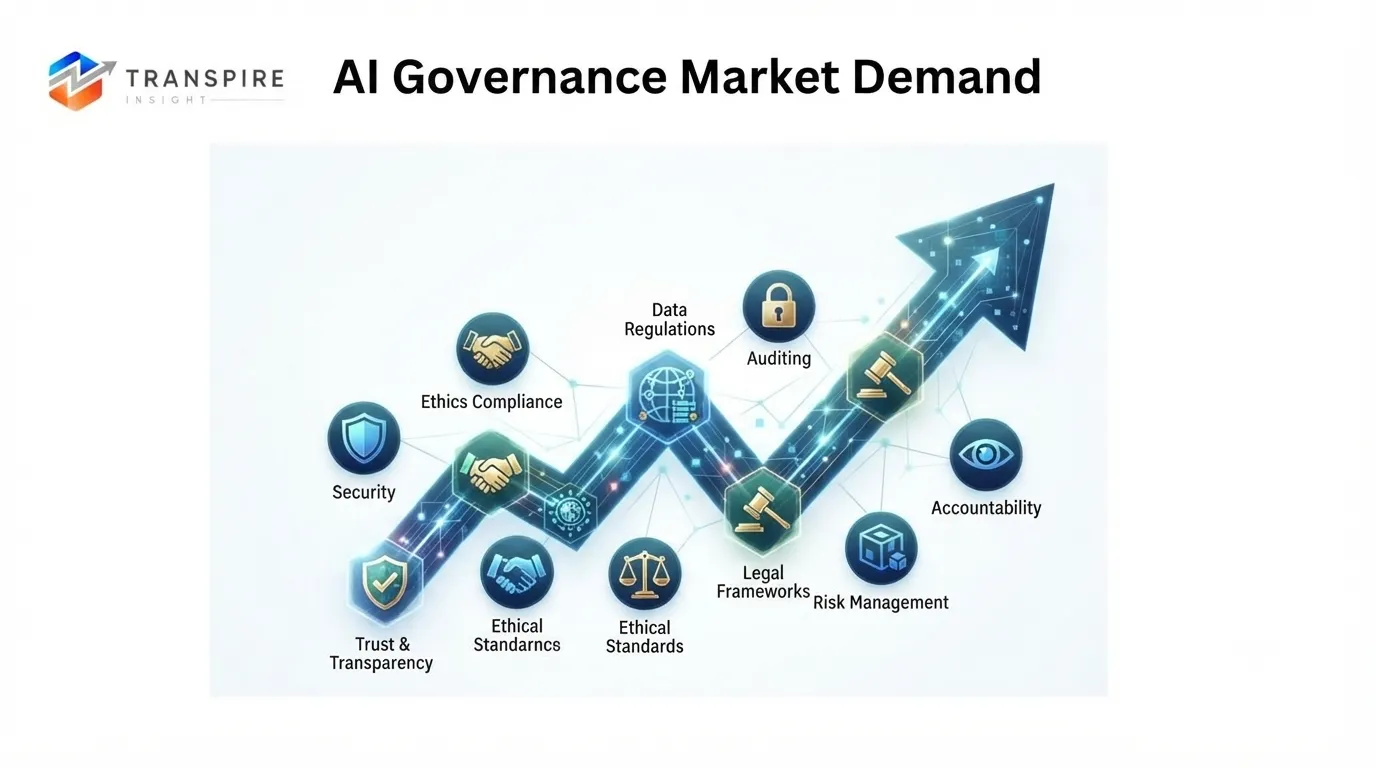
Artificial intelligence is moving rapidly from experimental projects into business-critical applications, increasing the need for organizations to monitor how AI systems are developed, deployed and used.
Growing regulatory scrutiny, rising AI-related risks and demand for transparency are creating a new market for governance platforms that help organizations establish policies, monitor models and demonstrate responsible AI practices.
September 2026: Artificial intelligence is becoming embedded across financial services, healthcare, manufacturing, retail, telecommunications, government and other industries.
However, the rapid adoption of AI also creates concerns related to bias, privacy, cybersecurity, explainability, intellectual property, model performance and regulatory compliance.
AI governance technologies are designed to help organizations manage these risks by creating frameworks for policy enforcement, model documentation, monitoring, risk assessment and accountability.
Market Size
The global AI governance market was estimated at approximately USD 875 million in 2025 and is projected to reach around USD 13.6 billion by 2035, expanding at a CAGR of approximately 31.6% during 2026–2035.
Market estimates vary considerably because AI governance is an emerging category with different definitions. One recent estimate places the 2025 market at USD 839.2 million and forecasts USD 13.1 billion by 2035, while other research methodologies produce significantly different market sizes.
North America currently represents the largest market, while Asia Pacific is expected to demonstrate strong growth as enterprises in the region expand AI adoption and regulatory frameworks mature.
Regulatory Compliance Is the Main Market Driver
Regulation is becoming one of the strongest drivers for AI governance adoption.
Governments and regulators are increasingly establishing requirements around transparency, risk management, privacy and responsible AI.
Organizations operating across multiple jurisdictions may need to understand different regulatory requirements and demonstrate that their AI systems comply with applicable rules.
This is increasing demand for centralized governance platforms that can provide documentation and oversight across multiple AI applications.
Enterprises Need Greater AI Transparency
Many organizations are moving from small AI experiments toward large-scale deployment.
As AI systems become involved in customer service, financial decisions, healthcare processes and business operations, companies need greater visibility into how those systems operate.
AI governance tools can help maintain inventories of models and applications, document ownership, assess risks and monitor changes.
This is particularly important for enterprises managing hundreds or thousands of AI models and AI-enabled applications.
Generative AI Creates New Governance Challenges
Generative AI is creating a new layer of governance requirements.
Large language models can generate inaccurate information, expose sensitive data or produce content that creates legal and reputational risks.
Organizations therefore need policies covering model selection, data usage, access controls, human oversight and output monitoring.
The rapid adoption of AI agents is also expanding the governance challenge because autonomous systems can potentially perform actions rather than simply generate information.
AI Model Monitoring Becomes More Important
AI governance is not limited to the initial approval of a model.
Models can change as data, usage patterns and business environments evolve.
Organizations therefore require continuous monitoring to identify changes in accuracy, fairness, risk and compliance.
Governance platforms can help establish automated alerts and reporting systems that allow teams to respond when models exceed predefined risk thresholds.
Financial Services Remains a Major Application
Banks, insurers and financial institutions have traditionally operated under strict model-risk requirements.
AI introduces additional complexity because organizations may use machine learning models for credit assessment, fraud detection, customer segmentation and other processes.
Governance platforms can provide documentation and monitoring capabilities that help financial institutions maintain oversight.
The regulated nature of the financial industry therefore makes it an important market for AI governance technologies.
Healthcare Creates Significant Opportunity
Healthcare organizations are increasingly adopting AI for diagnostics, administrative automation, medical research and patient support.
However, healthcare AI must address sensitive data, accuracy, privacy and patient-safety concerns.
AI governance systems can help organizations document models, monitor performance and establish accountability.
As healthcare AI adoption grows, governance could become a standard component of enterprise AI infrastructure.
Cloud Deployment Gains Momentum
Cloud-based AI governance platforms are gaining attention because they can be deployed across distributed AI environments.
Cloud deployment can also simplify updates and provide centralized visibility.
However, some organizations continue to prefer on-premise or hybrid approaches because of data-security requirements and regulatory concerns.
The market is therefore likely to contain a combination of cloud, on-premise and hybrid governance architectures.
North America Leads the Market
North America remains the largest AI governance market.
The region benefits from a strong concentration of technology companies, enterprise AI adoption and regulatory activity.
The United States is particularly important because many major AI developers and enterprise-software companies are headquartered there.
Asia Pacific is expected to record strong growth as enterprises across China, Japan, India, South Korea and Southeast Asia increase AI adoption.
Competitive Landscape Is Becoming More Crowded
The AI governance market includes major cloud providers, enterprise software companies, data-management companies and specialized AI governance startups.
IBM, AWS, Microsoft, OneTrust and SAS are among the major companies identified in current market research. One recent estimate indicates that these five companies collectively accounted for approximately 38.2% of the market in 2025.
Specialized vendors such as Credo AI, Holistic AI, ModelOp, Monitaur and FairNow are also contributing to the development of the emerging governance ecosystem. Gartner's 2026 AI governance platforms research includes several specialist providers alongside major enterprise technology companies.
Top 10 Companies in AI Governance Market
1. IBM
Headquarters: Armonk, New York, USA
IBM has developed a broad AI governance portfolio focused on enterprise AI risk management, model governance, explainability and responsible AI.
Its existing presence in enterprise software and consulting provides an advantage when organizations seek to integrate AI governance into broader technology environments.
2. Microsoft
Headquarters: Redmond, Washington, USA
Microsoft has expanded its responsible-AI and governance capabilities across its cloud and AI ecosystem.
Its position is strengthened by the widespread use of Azure and Microsoft enterprise software, allowing governance capabilities to be integrated into existing business environments.
3. Amazon Web Services
Headquarters: Seattle, Washington, USA
AWS provides cloud infrastructure and AI services that support enterprise AI development and governance.
Its governance capabilities are increasingly linked with security, identity, data protection and AI application management.
4. SAS Institute
Headquarters: Cary, North Carolina, USA
SAS has extensive experience in analytics, model management and risk management, particularly in highly regulated industries.
This provides a strong foundation for AI governance applications involving model validation, monitoring and compliance.
5. OneTrust
Headquarters: Atlanta, Georgia, USA
OneTrust provides privacy, risk and governance technologies and has expanded into AI governance.
Its existing expertise in privacy and compliance gives the company an opportunity to connect AI governance with broader enterprise risk-management processes.
Outlook: Could AI Governance Become as Important as AI Itself?
AI governance is likely to become a core layer of enterprise technology infrastructure.
As organizations move from isolated AI experiments toward AI agents, automated decision-making and large-scale deployment, governance will increasingly need to operate continuously rather than as a one-time approval process.
Future platforms are likely to combine AI inventories, risk assessment, model monitoring, compliance automation, privacy controls and agent governance.
The companies capable of integrating these capabilities into existing enterprise technology environments could gain a strong competitive advantage.
As regulatory requirements become more mature and organizations become more dependent on AI, AI governance could evolve from a specialist compliance function into a standard requirement for enterprise AI deployment.


Send us a brief description of your challenge and we'll get back to you within 24 hours.

 inquiry@transpireinsight.com
 APAC:+91 7666513636
 Address


