
Aug 17, 2026
By Transpire Insight
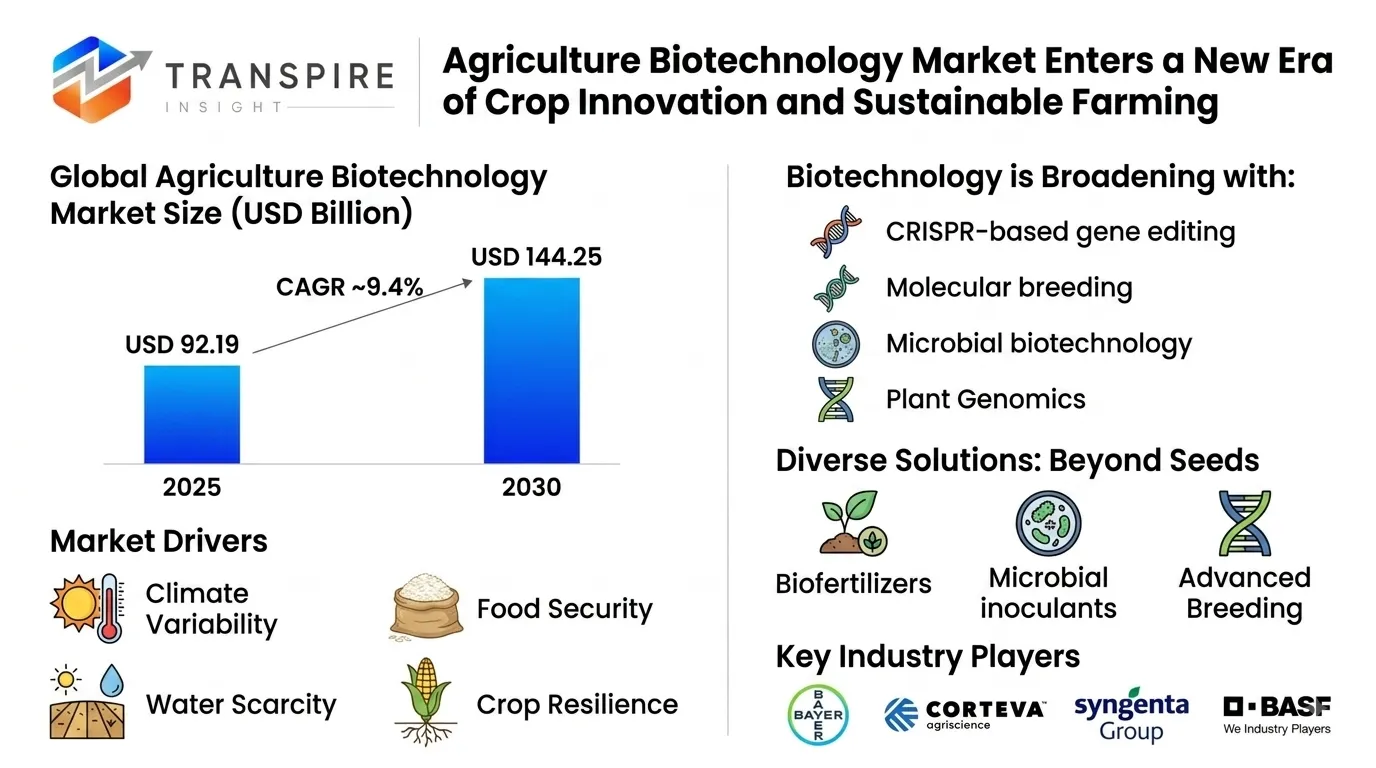
According to Transpire Insight, the agriculture biotechnology market is entering an important phase of transformation as farmers, seed developers, biotechnology companies, and agricultural research organizations increasingly adopt genetic engineering, gene editing, molecular breeding, microbial technologies, and biological crop solutions. The global agriculture biotechnology market was valued at approximately USD 92.19 billion in 2025 and is projected to reach around USD 144.25 billion by 2030, expanding at a CAGR of approximately 9.4%during the forecast period.
The global agricultural industry is moving beyond conventional crop improvement as climate variability, declining arable land, pest resistance, water scarcity, and increasing food-security requirements create pressure for more productive and resilient farming systems. Agriculture biotechnology is becoming an important technological pathway for addressing these challenges by enabling the development of crops with improved yield potential, enhanced resistance to pests and diseases, greater tolerance to drought and salinity, and improved nutritional characteristics.
The industry analysis indicates that biotechnology is no longer limited to conventional genetically modified crops. The emergence of **CRISPR-based gene editing, molecular breeding, microbial biotechnology, biological crop protection, plant genomics, and computational biology** is broadening the technology base of modern agriculture. These technologies allow developers to target specific crop characteristics with greater precision and accelerate the development cycle for new agricultural traits.
Agriculture Biotechnology Bets on the Future of Resilient Farming
For decades, agricultural productivity was primarily improved through conventional breeding, fertilizer application, chemical crop protection, irrigation, and mechanization. The increasing complexity of agricultural challenges is now shifting the focus toward biological and genetic technologies.
Agriculture biotechnology is helping researchers develop crop varieties that can perform more effectively under environmental and biological stress. Gene editing can modify specific characteristics without necessarily introducing foreign genetic material, while molecular breeding enables researchers to identify and select desirable traits more efficiently.
The growing use of biotechnology is particularly important as farmers face unpredictable weather patterns and increasing pressure to produce more food from limited agricultural resources. Technologies that improve nitrogen-use efficiency, water-use efficiency, pest resistance, and tolerance to heat or drought can potentially improve farm productivity while reducing resource requirements.
The market is also expanding beyond seeds. Biotechnology-based solutions now include **biofertilizers, microbial inoculants, biostimulants, biological crop protection products, plant tissue culture, and advanced breeding platforms**. This diversification is creating new commercial opportunities across the agricultural value chain.
Download the exclusive Agriculture Biotechnology Market sample report today to uncover expert insights, emerging trends, and the opportunities defining the future of the industry.
Why Agriculture Biotechnology Matters
Agriculture biotechnology is becoming strategically important because global food production must increase while agricultural resources remain constrained.
The technology enables companies to develop crops with improved agronomic characteristics and helps farmers respond to changing environmental conditions. Biotechnology can also support more targeted crop protection by improving resistance against insects, pathogens, and diseases.
At the same time, investment is increasingly moving toward next-generation technologies. Gene editing, computational biology, microbial discovery, precision breeding, and biological crop solutions are attracting interest because they can potentially shorten development timelines and address crop-specific challenges.
Agricultural biotechnology is also becoming closely connected with precision agriculture. Digital farming systems can provide information about soil conditions, crop performance, weather patterns, and pest pressure, while biotechnology can provide the biological tools required to respond to those conditions. This combination is creating an increasingly integrated agricultural innovation ecosystem.
Competitive Analysis
The competitive landscape of the agriculture biotechnology market includes large multinational agricultural companies as well as specialized biotechnology and seed-development firms. BASF SE, Bayer AG, Syngenta Crop Protection AG, Corteva Agriscience, and Evogene Ltd. are among the prominent companies operating across different areas of the market.
Bayer and BASF maintain significant positions through their extensive agricultural research capabilities, seed technologies, crop protection portfolios, and biotechnology pipelines. Corteva is strengthening its position through advanced seed genetics, trait development, and gene-editing technologies, while Syngenta combines crop protection and seed expertise with precision-agriculture capabilities.
Evogene represents the technology-driven side of the industry, using computational biology and data-driven approaches to identify biological and genetic solutions for crop productivity and sustainability.
Competition is increasingly shifting from simply developing new agricultural products toward building integrated technology platforms that combine genetics, biological inputs, digital agriculture, data science, and crop-specific knowledge.
Financial Impact
The expansion of agriculture biotechnology is creating significant commercial opportunities for companies operating across seeds, crop protection, biological inputs, research services, and agricultural technology.
The market's projected expansion to approximately **USD 144.25 billion by 2030** demonstrates the increasing economic importance of biotechnology within the global agricultural sector.
The financial opportunity extends beyond genetically modified seeds. Biological crop protection, microbial products, gene-editing platforms, precision breeding, and climate-resilient crop development are creating additional revenue opportunities.
Agricultural companies are also increasing investment in research and development because successful biotechnology traits can generate value across multiple growing seasons and geographic markets. However, the financial returns depend heavily on regulatory approvals, field performance, farmer adoption, intellectual-property protection, and the ability to scale production.
Gene Editing Is Reshaping Crop Development
Traditional crop breeding can require multiple generations of selection before a desirable trait becomes commercially viable. Gene-editing technologies are changing this process by allowing researchers to make more targeted genetic modifications.
CRISPR-based technologies are particularly important because they can be used to modify characteristics associated with yield, disease resistance, stress tolerance, nutritional quality, and other agronomic properties.
The growing acceptance of gene editing could also change the competitive dynamics of the seed industry. Companies with advanced genomic databases, breeding populations, proprietary editing platforms, and strong regulatory expertise may gain advantages in bringing new varieties to market.
Regulation remains a major factor. Different countries apply different frameworks to genetically modified organisms and gene-edited crops, which can influence development costs, commercialization timelines, and market access.
Recent regulatory developments in Europe have also increased attention around gene-edited crops. Proposed changes to European rules could create a more favorable environment for certain gene-edited plants that do not contain foreign DNA, potentially expanding opportunities for agricultural biotechnology companies.
Proceed to Checkout to purchase the exclusive Agriculture Biotechnology Market report and gain instant access to in-depth market intelligence, strategic analysis, and future growth opportunities.
Biological Solutions Expand the Biotechnology Opportunity
Agricultural biotechnology is increasingly moving toward biological solutions that complement genetic technologies.
Microbial inoculants, biopesticides, biofertilizers, and biostimulants are being developed to improve plant health, nutrient availability, soil performance, and crop resilience. These products can become part of integrated crop-management systems rather than functioning as standalone replacements for conventional agricultural inputs.
The increasing interest in biological products is also attracting major agricultural companies. According to a 2026 CropLife survey, **Corteva was identified by 39% of respondents as a supplier of biological products, followed by BASF at 31% and Bayer Crop Science at 26%**.
This demonstrates how established agricultural companies are increasingly incorporating biological technologies into their broader product portfolios.
The integration of biotechnology and biological agriculture could therefore become one of the most important developments shaping the next generation of farming systems.
AI and Computational Biology Accelerate Agricultural Innovation
Artificial intelligence is increasingly becoming an enabling technology for agricultural biotechnology.
Researchers can use computational tools to analyze genetic information, identify potential biological targets, evaluate microbial characteristics, and accelerate the discovery of new crop-protection compounds. AI can also help companies analyze large datasets generated through plant breeding and field trials.
This is particularly valuable because agricultural biotechnology involves large and complex datasets. Genetic information, environmental conditions, soil characteristics, disease patterns, and crop-performance data can be combined to identify relationships that would be difficult to detect through conventional research methods.
The combination of AI and biotechnology could therefore reduce research inefficiencies and improve the ability of companies to develop crop-specific solutions.
Major Agricultural Biotechnology Companies Move Quickly
The competitive environment is becoming increasingly active as major agricultural companies expand their biotechnology portfolios.
In August 2025, BASF, Corteva Agriscience, and M.S. Technologies announced a trait-licensing agreement in Brazil involving BASF's nematode-resistant soybean trait and Corteva's Enlist E3 and Conkesta E3 soybean technologies. Field trials reportedly demonstrated more than 90% control of targeted nematode threats.
Such collaborations demonstrate the increasing importance of technology sharing and trait integration within modern agricultural biotechnology.
Rather than developing every technology internally, companies are increasingly using licensing agreements, partnerships, research collaborations, acquisitions, and technology platforms to accelerate innovation and reach farmers more efficiently.
Customize the exclusive Agriculture Biotechnology Market report today to receive tailored insights, country-specific analysis, and business-focused market intelligence.
Market Impact: The Beginning of a Biotechnology-Driven Agricultural Transformation
The agriculture biotechnology market represents a broader transformation in the way food is produced.
Agricultural productivity is increasingly influenced by the convergence of genetics, biotechnology, digital agriculture, artificial intelligence, microbiology, and precision farming. This convergence is moving the agricultural sector toward more targeted and data-driven production systems.
Biotechnology can potentially help farmers increase productivity while reducing losses caused by pests, diseases, environmental stress, and inefficient resource utilization. At the same time, biological products can support soil health and integrated crop-management approaches.
The impact extends across multiple industries, including seed production, crop protection, agricultural chemicals, biological inputs, food processing, biotechnology research, genomics, precision agriculture, and agricultural technology.
Companies capable of integrating these technologies into commercially scalable solutions are expected to gain strategic advantages as global agriculture becomes increasingly focused on productivity, resilience, sustainability, and resource efficiency.
The Key Players Shaping the Agriculture Biotechnology Market
Founded In: 1863
Headquarters: Leverkusen, Germany
Bayer is one of the major global agricultural biotechnology companies, with its Crop Science business covering seeds, traits, crop protection, and digital agricultural technologies. The company has significant capabilities in plant genetics and crop development and continues to invest in technologies designed to improve crop productivity and resilience.
Bayer's biotechnology strategy includes the development of improved crop traits, advanced breeding technologies, biological solutions, and digital tools. Its broad agricultural portfolio provides the company with an integrated position across multiple stages of crop production.
Founded In: 2019
Headquarters: Indianapolis, United States
Corteva is a major global seed and agricultural technology company with a strong focus on plant genetics, seed technologies, crop protection, and biotechnology.
The company is investing in advanced breeding and gene-editing approaches to develop crop varieties with improved yield potential and resistance to environmental and biological stresses. Corteva's combination of seed genetics, agricultural research, and global distribution provides a strong platform for commercializing biotechnology-based agricultural innovations.The company also maintains a significant position in agricultural biologicals. Its biological products were identified as the most frequently sourced among respondents in CropLife's 2026 survey, at **39%**.
Founded In: 2000
Headquarters: Basel, Switzerland
Syngenta is a major agricultural technology company operating across seeds and crop protection. The company uses biotechnology, advanced breeding, biological solutions, and digital technologies to address agricultural productivity and sustainability challenges
Syngenta's biotechnology activities are focused on improving crop performance, enhancing resistance to pests and environmental stresses, and supporting more efficient agricultural production.
The company's global presence also allows it to adapt agricultural biotechnology solutions to different crops, climates, regulatory environments, and farming systems.
Founded In: 1865
Headquarters: Ludwigshafen, Germany
BASF maintains a strong position in agricultural biotechnology through its crop protection, seed, biological, and trait-development activities.
The company is investing in innovative agricultural technologies designed to improve crop performance while supporting more sustainable farming practices. Its biotechnology strategy includes advanced traits, biological solutions, and research aimed at addressing emerging agricultural challenges.
BASF is also becoming increasingly active in agricultural biologicals. In the 2026 CropLife survey, BASF was identified by 31% of respondents as a supplier of biological products.
Schedule a meeting with our market experts to discuss the exclusive Agriculture Biotechnology Market report and identify the best research solution for your organization.
Transpire Insight Experts View
According to Transpire Insight analysis, the agriculture biotechnology market is moving from a technology-focused industry toward a broader agricultural innovation ecosystem.
The next phase of growth will not depend solely on genetically modified crops. Instead, the market is expected to be shaped by the convergence of gene editing, advanced breeding, agricultural biologicals, microbial technologies, AI, genomics, and precision agriculture.
The most important competitive advantage will increasingly come from the ability to convert biological discoveries into scalable, commercially viable solutions that address real farming challenges.
Agricultural biotechnology is also becoming increasingly important for climate resilience. Crops that can tolerate drought, heat, salinity, pests, and diseases could help farmers maintain productivity under increasingly variable environmental conditions.
As biotechnology becomes more integrated with artificial intelligence, molecular breeding, microbial science, and digital farming, the agriculture industry is expected to enter a new phase in which biological innovation becomes a central component of global food production, sustainability, and agricultural resilience.


Send us a brief description of your challenge and we'll get back to you within 24 hours.

 inquiry@transpireinsight.com
 APAC:+91 7666513636
 Address


