
Oct 13, 2026
By Transpire Insight
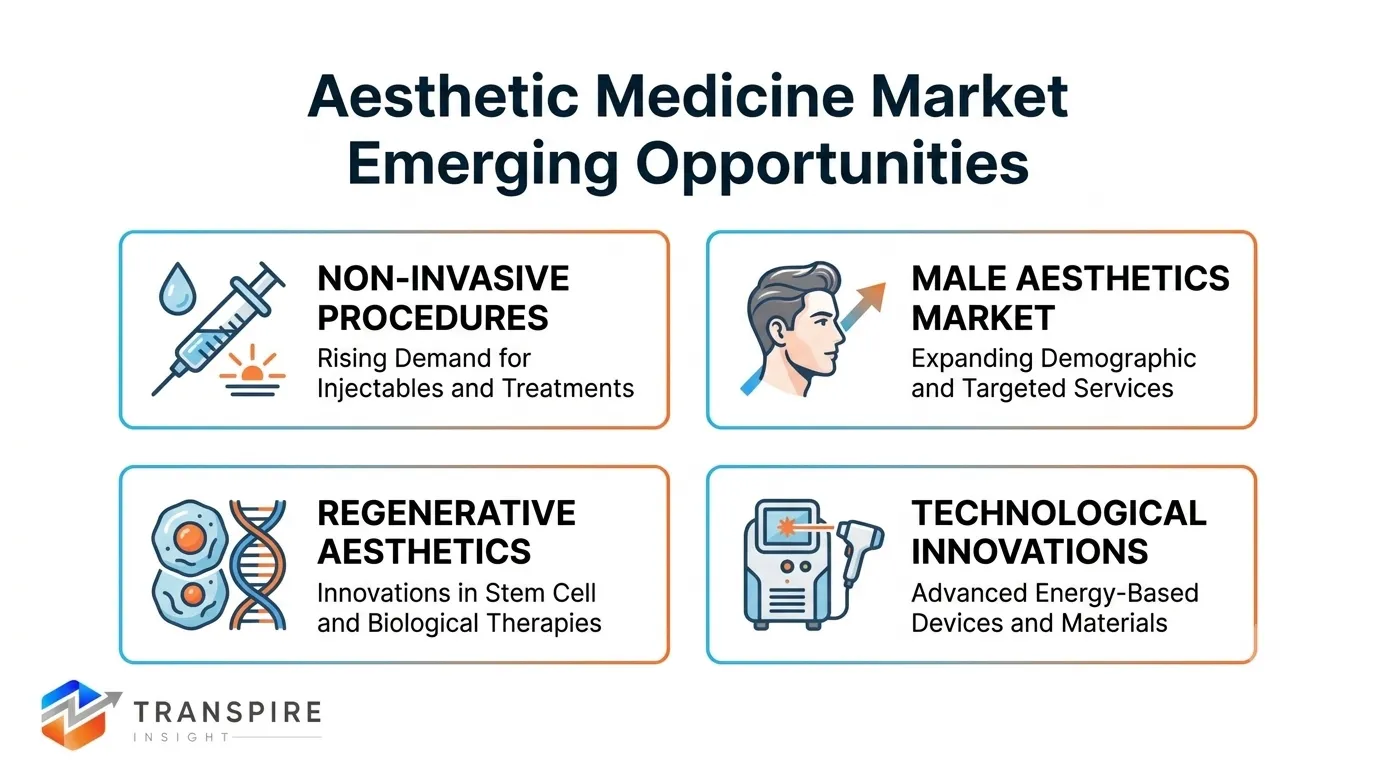
The global Aesthetic Medicine Market is expanding as consumers increasingly seek minimally invasive and non-surgical treatments for facial rejuvenation, skin quality, body contouring, hair restoration, and age-related aesthetic concerns. Advances in energy-based devices, injectables, personalized treatment protocols, and medically supervised aesthetic care are reshaping the industry.
Aesthetic Medicine Market Overview
Aesthetic medicine encompasses medical procedures and technologies designed to improve appearance, skin quality, facial features, body contours, and other cosmetic characteristics.
Major categories include:
Transpire Insights estimates the global Aesthetic Medicine Market at approximately USD 24.18 billion in 2025, increasing to around USD 26.20 billion in 2026 and reaching nearly USD 45.80 billion by 2033, representing an estimated CAGR of 8.30%.
Latest Global Market Developments
Consumers increasingly seek procedures involving limited downtime compared with traditional surgery.
Clinicians increasingly combine energy-based technologies, injectables, and skin treatments to address multiple aesthetic concerns.
In June 2026, India's CDSCO clarified that injectable aesthetic products such as botulinum toxin and certain fillers should fall under stronger medical and drug-related oversight rather than being treated simply as cosmetics.
Industry reporting indicates that India's aesthetic-injectables sector was estimated at approximately ₹700 crore, with tighter oversight potentially encouraging consumers toward medically supervised providers.
Radiofrequency, ultrasound, laser, and other energy-based technologies are increasingly used for skin tightening, contouring, and rejuvenation.
In September 2026, Classys partnered with Photonence to introduce its Volnewmer and Ultraformer technologies in India, reflecting the expansion of energy-based aesthetic platforms.
Practitioners increasingly use patient-specific skin characteristics, age, facial structure, and treatment goals to develop individualized protocols.
A growing portion of demand is shifting from corrective procedures toward maintenance-oriented skin and appearance management.
Why Aesthetic Medicine Matters?
Aesthetic medicine combines healthcare expertise, medical devices, pharmaceuticals, and consumer services.
The sector supports:
The market's development is increasingly tied to clinical quality and practitioner expertise rather than simply treatment availability.
Key Factors Driving the Market
1. Growing Demand for Minimally Invasive Procedures
Consumers increasingly prefer treatments involving shorter recovery periods.
2. Aging Population
An expanding older population creates demand for treatments addressing age-related changes.
3. Technological Innovation
New energy-based devices and improved injectables are broadening treatment options.
4. Social and Digital Influence
Online information and visual social platforms have increased consumer awareness of aesthetic treatments.
5. Personalized Care
Consumers increasingly expect treatments tailored to individual anatomy, skin type, and desired outcomes.
Five High-Potential Markets
1. United States
The U.S. remains a major market supported by established aesthetic clinics, advanced devices, injectables, and strong consumer spending.
2. Brazil
Brazil has a mature aesthetic-procedure ecosystem and a large professional base across dermatology and plastic surgery.
3. South Korea
South Korea is an important market for cosmetic dermatology, energy-based treatments, injectables, and aesthetic-device innovation.
4. China
China offers significant long-term growth potential due to its large population, expanding middle class, and growing aesthetic-services industry.
5. India
India represents a rapidly developing opportunity. Industry estimates cited in 2026 project India's aesthetic dermatology market to reach approximately USD 383.79 million by 2032, with a 2025–2032 CAGR of 16.34%.
Competitive Landscape
Top 5 Companies
Opportunities for Small Investors
Challenges & Restraints
Regulatory compliance, treatment safety, practitioner qualifications, product authenticity, adverse events, high device costs, consumer expectations, and reputational risk remain important challenges.
Greater regulatory scrutiny can also increase compliance requirements for clinics and product distributors.
Conclusion
The Aesthetic Medicine Market is transitioning toward minimally invasive, technology-driven, personalized, and medically supervised treatments.
The 2026 developments in India demonstrate how regulatory oversight and technology adoption are simultaneously shaping the market.
Future opportunities are likely to concentrate around energy-based platforms, combination treatments, advanced injectables, personalized protocols, practitioner training, and integrated aesthetic-clinic services.


Send us a brief description of your challenge and we'll get back to you within 24 hours.

 inquiry@transpireinsight.com
 APAC:+91 7666513636
 Address


