
Oct 05, 2026
By Transpire Insight
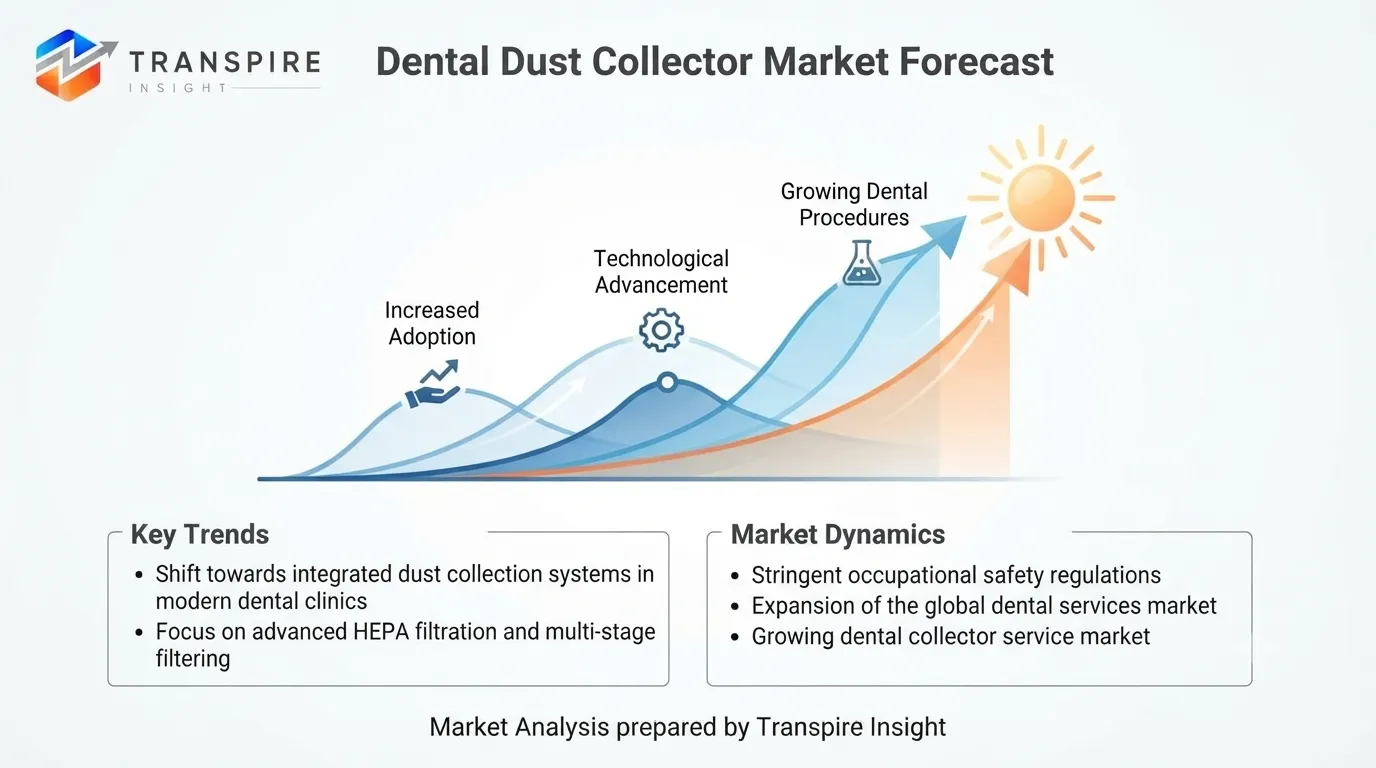
The global Dental Dust Collector Market is gaining importance as dental clinics and laboratories increasingly focus on controlling fine particulate matter generated during grinding, polishing, cutting, milling, and fabrication activities. The rapid adoption of CAD/CAM dentistry, digital milling, restorative procedures, and laboratory automation is increasing the volume of fine dental materials handled inside professional environments, creating greater demand for efficient extraction and filtration systems.
Modern dental dust collectors are evolving from basic extraction equipment into specialized systems designed around filtration efficiency, low operating noise, energy consumption, mobility, automatic filter management, and compatibility with digital dental equipment. As awareness of occupational air quality and respiratory exposure increases, manufacturers are developing compact, high-performance systems for both individual workstations and larger multi-user dental laboratories.
The Dental Dust Collector Market is developing alongside the broader expansion of dental care, laboratory fabrication, and digital dentistry. A January 2026 TechSci Research assessment estimates the global market at approximately USD 207.27 million in 2025, with the market projected to reach USD 334.62 million by 2031, representing a CAGR of approximately 8.31%. Another August 2026 market assessment covering dental dust collectors estimates the market at approximately USD 224.2 million in 2024 and projects it to reach USD 321.1 million by 2030, at a CAGR of 6.2%. The difference reflects variations in market scope, product categories, and forecasting methodology.
Market Size
For this analysis, the global Dental Dust Collector Market is estimated at approximately USD 207.3 million in 2025 and is projected to reach approximately USD 334.6 million by 2031, expanding at a CAGR of about 8.31% during 2026–2031. This estimate follows the current TechSci Research definition covering specialized extraction systems used to remove hazardous particulates, aerosols, and vapors produced during dental procedures and laboratory fabrication.
The underlying growth opportunity remains connected to several structural developments within dentistry, including the increasing number of restorative and cosmetic procedures, expansion of dental laboratories, growing use of CAD/CAM equipment, adoption of milling technologies, stronger workplace-safety awareness, and demand for cleaner clinical and laboratory environments.
Dental dust collectors capture particles generated when dental materials are mechanically processed. Depending on the application, these materials may include plaster, stone, acrylic, ceramic, zirconia, composite materials, and metal particles.
Digital Dentistry Is Increasing Demand for Dust Extraction
The transition from conventional dental production methods toward digital workflows is one of the most important factors supporting demand for dental dust collection equipment.
CAD/CAM systems have expanded the use of digital scanning, computer-aided design, milling, and automated manufacturing within dental laboratories and clinics. Digital milling can generate significant quantities of fine particulate matter, particularly when processing ceramics, zirconia, acrylic materials, and other restorative materials.
The increasing adoption of desktop and chairside milling equipment is therefore creating demand for compact extraction units that can operate alongside digital production systems.
A 2025 industry analysis noted that the proliferation of CAD/CAM systems, 3D printing, and high-speed rotary instruments has increased the generation of fine dust and strengthened the need for efficient collection technologies.
Dust extraction is consequently becoming an integral part of modern digital dental workflows rather than an optional laboratory accessory.
Dental Laboratories Remain a Major Application Area
Dental laboratories represent one of the most important application environments for dental dust collectors.
Laboratories routinely perform grinding, polishing, trimming, milling, finishing, and other processes that generate airborne particles. Technicians may work with multiple materials and equipment types during the fabrication of crowns, bridges, dentures, orthodontic appliances, implant components, and other dental restorations.
Because laboratory production can involve several workstations operating simultaneously, centralized extraction systems are particularly relevant to larger facilities.
One 2026 market analysis estimated that dental laboratories accounted for approximately 65% of the application market in 2024, reflecting their comparatively high dust-generation intensity. The same analysis identified dental clinics as a faster-growing application segment as smaller practices increasingly adopt compact extraction systems.
This creates opportunities for manufacturers offering both centralized and workstation-specific extraction technologies.
Centralized Systems Offer Advantages for Large Laboratories
Centralized dust collection systems are designed to serve multiple workstations through a shared extraction infrastructure.
They can provide consistent suction, reduce the number of individual extraction units required, and help laboratories organize their work areas more efficiently.
According to Reed Intelligence, centralized dust collectors represented approximately 58% of the market in 2024. Their adoption is associated with large laboratories that require continuous extraction across multiple workstations.
Centralized systems can also help reduce workplace noise when the primary extraction equipment is positioned away from individual technicians.
However, installation can require higher upfront investment and greater planning than portable systems.
Portable Dust Collectors Are Creating New Opportunities
Portable systems are becoming increasingly attractive for smaller dental laboratories, individual practitioners, mobile applications, and facilities where permanent extraction infrastructure is not practical.
Portable units can be positioned close to the dust-generating equipment and moved between workstations when required.
Reed Intelligence estimates that the portable segment could record approximately a 7.8% CAGR during its forecast period.
The introduction of battery-powered systems is adding another dimension to portable extraction.
Renfert's SILENT XS, for example, is positioned as a mobile suction unit for dental applications, while the company offers a broader portfolio covering mobile suction, workbench extraction, CAM-system extraction, and device extraction.
This product development illustrates how manufacturers are responding to demand for flexibility and compact equipment.
HEPA Filtration Is Becoming More Important
Filtration technology represents a major area of innovation within dental dust collection.
Modern systems can use different filtration approaches, including cartridge filters, HEPA filters, paper filters, bag filters, fiberglass filters, reversible filters, and multi-stage filtration systems.
HEPA-based systems are particularly relevant where very fine particulate capture is required.
TechSci Research identifies HEPA filters as the fastest-growing filter segment in its market assessment.
Manufacturers are also working to improve filter life, airflow consistency, automatic cleaning, and filter replacement indicators.
Efficient filtration can help reduce airborne particulate accumulation while also protecting downstream equipment from excessive dust exposure.
Wet and Dry Extraction Technologies Serve Different Applications
Dental dust collectors can broadly be divided into wet and dry extraction approaches.
Wet systems use liquid to capture or suppress particulate matter and can be useful in applications involving substantial dust loads.
Dry systems use filtration, suction, and separation technologies to collect particles without liquid.
Market research indicates that wet-type systems have historically held a significant position because they can suppress dust effectively while handling substantial particulate loads.
Dry systems, meanwhile, offer advantages where users prefer simpler installation, lower water dependence, compact configurations, or direct integration with digital milling equipment.
The appropriate technology depends on the type of material being processed, volume of dust generated, workstation configuration, maintenance requirements, and facility preferences.
Occupational Safety Is Strengthening Demand
Workplace health and safety awareness is another major market driver.
Dental professionals and laboratory technicians can be exposed to fine particles generated during mechanical processing of dental materials. Greater awareness of indoor air quality and occupational exposure is encouraging practices and laboratories to introduce engineering controls.
The growth of workplace safety requirements is particularly relevant in developed markets where employers are expected to address airborne contaminants and maintain appropriate working conditions.
TechSci Research highlights occupational safety and infection-control considerations as important drivers of the market's expansion.
For dental laboratories, dust collection can therefore serve both an environmental and operational function.
Cosmetic Dentistry Supports Equipment Demand
Cosmetic dentistry is another application supporting the market.
Increasing consumer interest in aesthetic dental procedures has contributed to greater demand for crowns, veneers, bridges, aligners, and other dental restorations.
The production of these products often requires laboratory grinding, polishing, trimming, milling, and finishing.
A 2026 market assessment identified cosmetic dentistry as a leading end-use category within its broader market segmentation.
As aesthetic procedures become more technologically advanced, the associated laboratory workflows are likely to require increasingly sophisticated dust-control equipment.
Orthodontics and Restorative Dentistry Expand the Addressable Market
Orthodontic and restorative applications also create opportunities for dust extraction manufacturers.
Orthodontic laboratories work with acrylics, polymers, metals, ceramics, and other materials while producing appliances and components.
Restorative dentistry generates demand for crowns, bridges, implant restorations, dentures, and other products that may require grinding and polishing during production.
As dental practices increasingly integrate digital scanning and chairside production, some of these manufacturing processes are moving closer to clinics.
This decentralization could create additional demand for compact systems designed specifically for smaller clinical environments.
3D Printing Is Adding Another Source of Demand
Dental 3D printing is expanding rapidly across laboratories and clinical settings.
The technology is being used for models, surgical guides, temporary restorations, orthodontic products, dentures, and other dental applications.
Although 3D printing processes differ from conventional milling, post-processing activities can generate particulate matter. Sanding, trimming, finishing, and processing printed components can therefore create a need for localized extraction.
The broader expansion of digital dental manufacturing is consequently creating opportunities for dust collector manufacturers to design systems specifically for integrated digital workflows.
Noise Reduction Is Becoming a Product Differentiator
Noise is an important consideration in dental laboratories and clinics.
Extraction equipment may operate for extended periods, meaning excessive noise can negatively affect the working environment.
Manufacturers are increasingly emphasizing low-noise motors, improved acoustic insulation, optimized airflow, and compact fan designs.
Renfert's current dental suction portfolio, for example, includes several configurations designed for different workstation and laboratory applications, demonstrating the industry's movement toward application-specific extraction solutions.
Low-noise performance can be particularly important for small clinics where treatment rooms and equipment areas are located close to one another.
Energy Efficiency Is Becoming a Competitive Factor
Energy consumption is another area of product development.
Dental dust collectors may operate for long periods, particularly in laboratories with multiple workstations.
Energy-efficient motors, automatic suction control, intelligent standby functions, and variable-speed technologies can help reduce unnecessary energy consumption.
Advanced systems can adjust extraction performance according to actual demand instead of operating continuously at maximum capacity.
This approach can improve operating economics while reducing the environmental footprint of dental laboratories.
Smart Dust Collection Could Become a Future Trend
Connected and intelligent dust collection represents an emerging opportunity.
Smart systems can potentially monitor filter condition, airflow, motor performance, operating hours, and maintenance requirements.
Sensors can help users identify when filters need replacement or when suction performance is declining.
Digital monitoring could also allow dental laboratories to integrate extraction equipment into broader facility-management systems.
The introduction of smart monitoring technologies by industry participants indicates that manufacturers are beginning to move beyond basic mechanical extraction toward more data-driven equipment management. Reed Intelligence, for example, identifies smart dust collectors and real-time monitoring as emerging areas of development.
Regional Outlook
North America
North America represents one of the most established markets for dental dust collection systems.
TechSci Research identifies North America as the largest regional market in its current assessment.
The region benefits from established dental infrastructure, high healthcare expenditure, extensive dental laboratory activity, advanced equipment adoption, and comparatively strong awareness of occupational safety.
The United States represents the largest individual market within the region. A Global Industry Analysts assessment estimated the U.S. dental dust collector market at approximately USD 61.1 million in 2024 and projected China to grow at approximately 9.5% CAGR through 2030.
Europe
Europe is another important market due to its established dental equipment industry and strong emphasis on workplace standards.
Germany, Italy, France, the United Kingdom, and other European countries have substantial dental laboratory and manufacturing ecosystems.
European manufacturers also have a strong presence in dental extraction technology. Renfert, Dürr Dental, Zubler, BEGO, W&H, and other companies contribute to the region's competitive landscape.
W&H, headquartered in Austria, reports more than 1,300 employees and exports products to more than 130 countries, illustrating the international reach of European dental technology manufacturers.
Asia Pacific
Asia Pacific represents an important growth opportunity because of expanding dental infrastructure, rising healthcare expenditure, increasing dental tourism, and growing adoption of digital dentistry.
China, Japan, South Korea, India, Australia, and Southeast Asian countries are increasing their use of advanced dental equipment.
The expansion of dental laboratories and manufacturing capabilities is creating demand for both centralized and portable extraction equipment.
China is expected to be particularly important because of its large manufacturing base and projected growth in dental dust collection demand.
India also represents an emerging opportunity as dental clinics and laboratories increasingly adopt CAD/CAM systems, digital scanners, milling equipment, and laboratory automation.
Latin America
Latin America is gradually developing as a growth market for dental equipment.
Brazil and Mexico have relatively large dental sectors, while other countries are investing in modern clinics and laboratory infrastructure.
The adoption rate of premium dust collection systems remains influenced by equipment costs, maintenance availability, and awareness of workplace exposure.
Increasing dental tourism and modernization of private dental facilities could support demand over the longer term.
Middle East and Africa
The Middle East and Africa represent an emerging opportunity for dental dust collector manufacturers.
Private healthcare investment, dental tourism, expansion of specialist clinics, and modernization of dental laboratories are supporting demand for advanced dental equipment.
However, differences in healthcare infrastructure, equipment affordability, and regulatory enforcement create uneven adoption across countries.
Competitive Landscape
The Dental Dust Collector Market includes specialized extraction manufacturers as well as broader dental equipment companies.
Competition is increasingly focused on filtration efficiency, suction performance, noise reduction, energy efficiency, compact design, automation, filter life, mobility, and compatibility with CAD/CAM systems.
Current market research identifies companies including Renfert, Vaniman Manufacturing, Buffalo Dental Manufacturing, Quatro Air Technologies, Dürr Dental, Zubler, DentalEZ, Handler Manufacturing, Henry Schein, Planmeca, Comco, Ray Foster Dental Equipment, Ko-max, BEGO, and Erio among market participants.
Manufacturers are also differentiating through specialized products for laboratories, clinics, milling systems, workbenches, and individual dental machines.
Top 10 Companies in Dental Dust Collector Market
1. Renfert GmbH
Renfert is one of the most recognized companies in dental laboratory equipment and has a strong presence in dust extraction.
Its product portfolio includes mobile suction systems, workbench extraction units, CAM extraction units, device extraction systems, and dust extractor boxes.
The company's SILENT range demonstrates its focus on specialized extraction for different dental laboratory workflows.
2. Vaniman Manufacturing Co.
Vaniman is a U.S.-based manufacturer specializing in dust collection, abrasive blasting, laboratory equipment, and dental extraction technologies.
The company develops systems for dental laboratories and other technical environments where fine particulate control is required.
Its specialization in dental laboratory dust extraction supports its position within the market.
3. Buffalo Dental Manufacturing Co., Inc.
Buffalo Dental Manufacturing develops equipment for dental laboratories and professional dental applications.
Its product portfolio includes dust collection and laboratory equipment designed around the practical requirements of dental technicians.
The company's established presence in dental laboratory equipment supports its participation in the global dental dust collection market.
4. Quatro Air Technologies
Quatro Air Technologies specializes in air purification and source-capture systems.
The company provides extraction technologies designed for applications where fine particles and airborne contaminants must be captured near their point of generation.
Its expertise in filtration and air-quality equipment supports opportunities in dental laboratories and other technical environments.
5. Dürr Dental SE
Dürr Dental is a major dental technology company with expertise in suction, compressed air, imaging, hygiene, and dental treatment systems.
Its knowledge of dental vacuum technology provides a strong foundation for dental suction and extraction solutions.
The company's continued development of suction technologies and air-purification systems makes it an important participant in the market.
6. Zubler Gerätebau GmbH
Zubler specializes in dental laboratory equipment and systems.
The company offers technologies designed to support dental technicians and laboratories, including extraction and related laboratory solutions.
Its focus on professional laboratory applications makes it relevant to the high-performance dental dust collection segment.
7. DentalEZ, Inc.
DentalEZ is an established dental equipment company serving clinical and laboratory environments.
Its product portfolio includes equipment and solutions used by dental professionals and laboratories.
The company's established distribution network and dental-sector expertise provide a foundation for participation in the dust collection market.
8. Handler Manufacturing Company
Handler Manufacturing develops equipment for dental laboratories, including workstations, polishing systems, dust collection equipment, and related laboratory products.
The company's focus on dental laboratory infrastructure allows it to address extraction requirements alongside other workstation needs.
This integrated laboratory approach can be particularly valuable to small and medium-sized dental laboratories.
9. Henry Schein, Inc.
Henry Schein is a major distributor of healthcare products and services, including dental equipment and supplies.
Although its role differs from specialized dust-collector manufacturers, its extensive distribution network gives it an important position in the dental equipment supply chain.
Henry Schein's broad customer base across dental practices and laboratories creates opportunities for distribution of dust-control technologies.
10. Planmeca Oy
Planmeca is a major dental equipment and technology company with a broad portfolio spanning dental units, imaging, CAD/CAM, and digital dentistry.
The company's position within digital dental workflows gives it relevance to the broader ecosystem surrounding dust extraction.
As CAD/CAM and digitally integrated dental systems expand, manufacturers with capabilities across the digital dental environment can participate in the development of integrated clinical and laboratory workflows.
Market Challenges
Despite favorable growth prospects, the Dental Dust Collector Market faces several challenges.
High initial equipment costs can limit adoption among small dental practices and independent laboratories.
Advanced filtration equipment can also involve recurring costs for filters, replacement components, maintenance, and servicing.
Limited awareness remains an issue in some developing markets where dental facilities may prioritize treatment equipment over environmental and occupational controls.
Space constraints can also influence purchasing decisions. Smaller clinics may require compact systems that can fit beneath benches or close to individual treatment equipment.
Noise and vibration can affect user acceptance if extraction systems are poorly designed.
Filter maintenance represents another operational challenge. A collector with inadequate maintenance can experience declining suction performance and reduced filtration efficiency.
Manufacturers therefore need to balance performance with affordability, ease of maintenance, energy efficiency, and compactness.
Future Outlook
The future of the Dental Dust Collector Market will be closely connected to the modernization of dental laboratories and clinics.
The growing adoption of CAD/CAM systems, digital milling, 3D printing, high-speed rotary instruments, and increasingly automated laboratory workflows will continue generating demand for efficient particulate extraction.
The market is also moving toward smarter, quieter, more compact, and energy-efficient systems.
Portable battery-operated products could expand the addressable market among small practices and mobile applications, while centralized systems will continue serving high-volume laboratories.
The introduction of sensors and real-time monitoring could further improve maintenance and equipment utilization.
Current market forecasts point toward sustained growth. TechSci Research projects the market to increase from approximately USD 207.27 million in 2025 to USD 334.62 million by 2031, while another 2026 assessment projects growth from USD 224.2 million in 2024 to USD 321.1 million by 2030.
The central opportunity for manufacturers will be to combine high-efficiency particulate capture, low noise, low energy consumption, intelligent monitoring, compact design, and seamless compatibility with modern dental equipment.
As dentistry becomes increasingly digital and laboratory processes become more automated, dust collection will increasingly be viewed as an integral component of professional dental infrastructure rather than simply an accessory.
The Dental Dust Collector Market is therefore positioned to benefit from the convergence of digital dentistry, occupational safety, laboratory automation, advanced filtration, and growing demand for cleaner professional environments.


Send us a brief description of your challenge and we'll get back to you within 24 hours.

 inquiry@transpireinsight.com
 APAC:+91 7666513636
 Address


