
Oct 14, 2026
By Transpire Insight
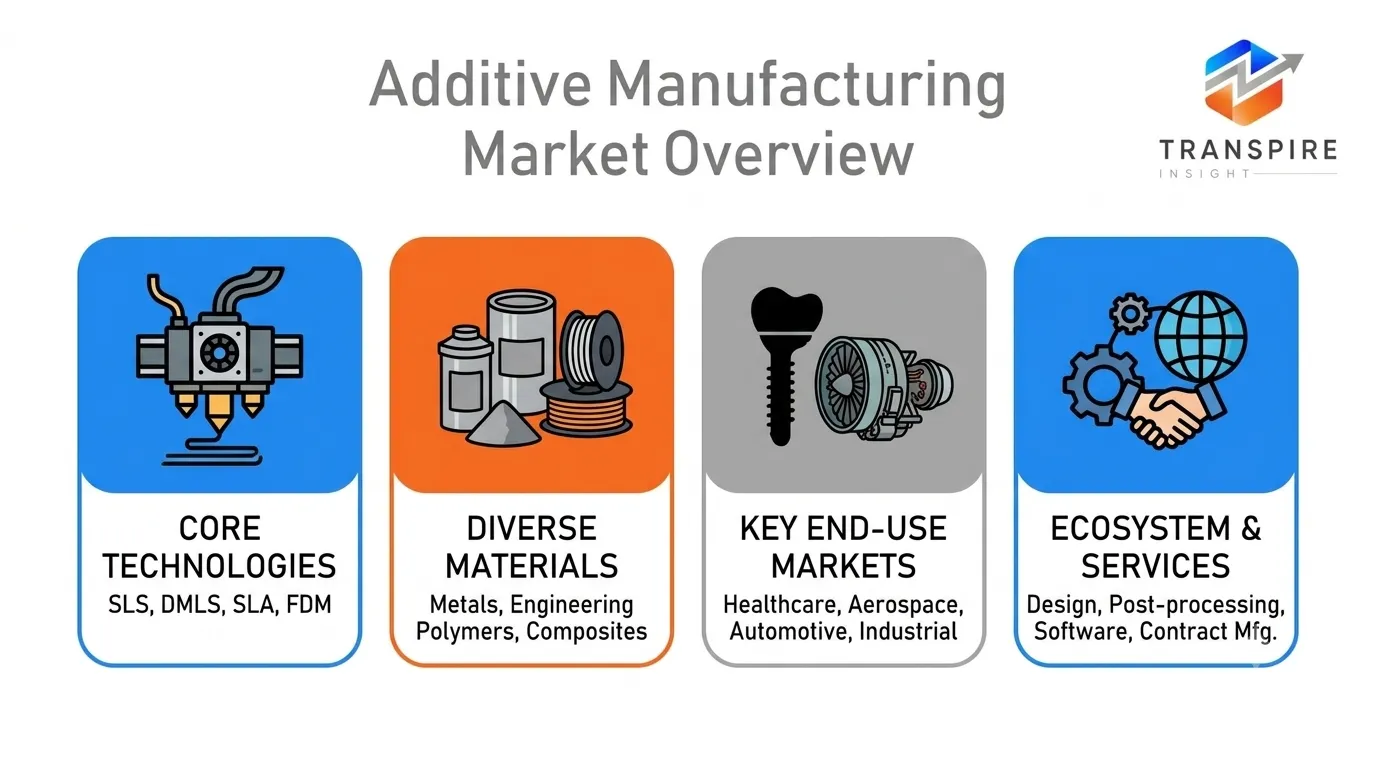
The global Additive Manufacturing Market is progressing from prototyping toward increasingly sophisticated production applications. Industrial adoption across aerospace, healthcare, automotive, energy, defense, and specialized manufacturing is increasing demand for advanced printers, engineering materials, production software, post-processing, and additive manufacturing services.
Additive Manufacturing Market Overview
Additive manufacturing creates physical components by depositing or consolidating material layer by layer from digital designs.
Major technologies include:
Materials include:
Transpire Insights estimates the global Additive Manufacturing Market at approximately USD 24.25 billion in 2025, increasing to around USD 26.88 billion in 2026 and reaching approximately USD 52.85 billion by 2033, representing an estimated CAGR of 10.15%.
Latest Global Market Developments
The 2026 Wohlers analysis emphasizes increasing utilization of installed AM capacity rather than simply rapid printer-unit expansion.
AM Research reported that the metal AM market reached approximately USD 1.81 billion in Q2 2026, compared with USD 1.59 billion in Q2 2025.
AM Research reported total metal, polymer, and ceramic 3D-printing markets of approximately USD 4.48 billion in Q2 2026, representing 12% year-over-year growth.
Lightweight components, complex geometries, and reduced part counts make additive manufacturing attractive for aerospace applications.
Patient-specific implants, surgical planning models, dental components, and prosthetic applications continue to support demand.
Manufacturers increasingly require build-preparation software, simulation, process monitoring, digital-twin capabilities, and quality-control systems.
New metal alloys, engineering polymers, ceramics, and composites are allowing manufacturers to address more demanding applications.
Governments and manufacturers are increasingly interested in local production capability for critical components, reducing dependence on long international supply chains.
Why Additive Manufacturing Matters?
Additive manufacturing can change how components are designed, produced, and supplied.
Its advantages include:
However, its commercial value depends heavily on production speed, material cost, repeatability, certification, and post-processing.
Key Factors Driving the Market
1. Industrial Production
Manufacturers increasingly use AM for end-use components rather than only prototypes.
2. Aerospace Lightweighting
Complex lightweight structures provide significant opportunities for metal AM.
3. Healthcare Personalization
Patient-specific manufacturing is creating specialized demand.
4. Supply-Chain Resilience
Local production can reduce dependence on long component supply chains.
5. Material Innovation
Improved materials are enabling applications previously unsuitable for additive processes.
Five High-Potential Markets
1. United States
The U.S. has a mature additive-manufacturing ecosystem spanning aerospace, defense, healthcare, automotive, and industrial applications.
2. Germany
Germany remains an important industrial AM market due to its strong automotive, engineering, machinery, and manufacturing base.
3. China
China offers significant growth potential through industrial manufacturing, electronics, aerospace, and government-backed advanced manufacturing initiatives.
4. Japan
Japan contributes through precision manufacturing, robotics, electronics, automotive production, and advanced materials.
5. India
India is developing capabilities across aerospace, defense, healthcare, automotive, education, and industrial manufacturing.
Competitive Landscape
Top 5 Companies
Opportunities for Small Investors
Challenges & Restraints
High equipment costs, material expenses, production speed, certification requirements, post-processing, skilled-labor shortages, intellectual-property concerns, and quality consistency remain major challenges.
For highly regulated applications such as aerospace and medical devices, qualification and certification can substantially extend commercialization timelines.
Conclusion
The Additive Manufacturing Market is increasingly shifting from a prototype-centric technology toward production-oriented manufacturing infrastructure.
The 2026 Wohlers Report shows that global AM revenue reached approximately USD 24.2 billion in 2025, while current quarterly data indicate continued double-digit growth across metal, polymer, and ceramic 3D-printing markets.
The next stage of development will increasingly depend on production throughput, advanced materials, process monitoring, software integration, certification, and the ability to manufacture economically at scale.


Send us a brief description of your challenge and we'll get back to you within 24 hours.

 inquiry@transpireinsight.com
 APAC:+91 7666513636
 Address


