

Workforce Management Software Market Summary:
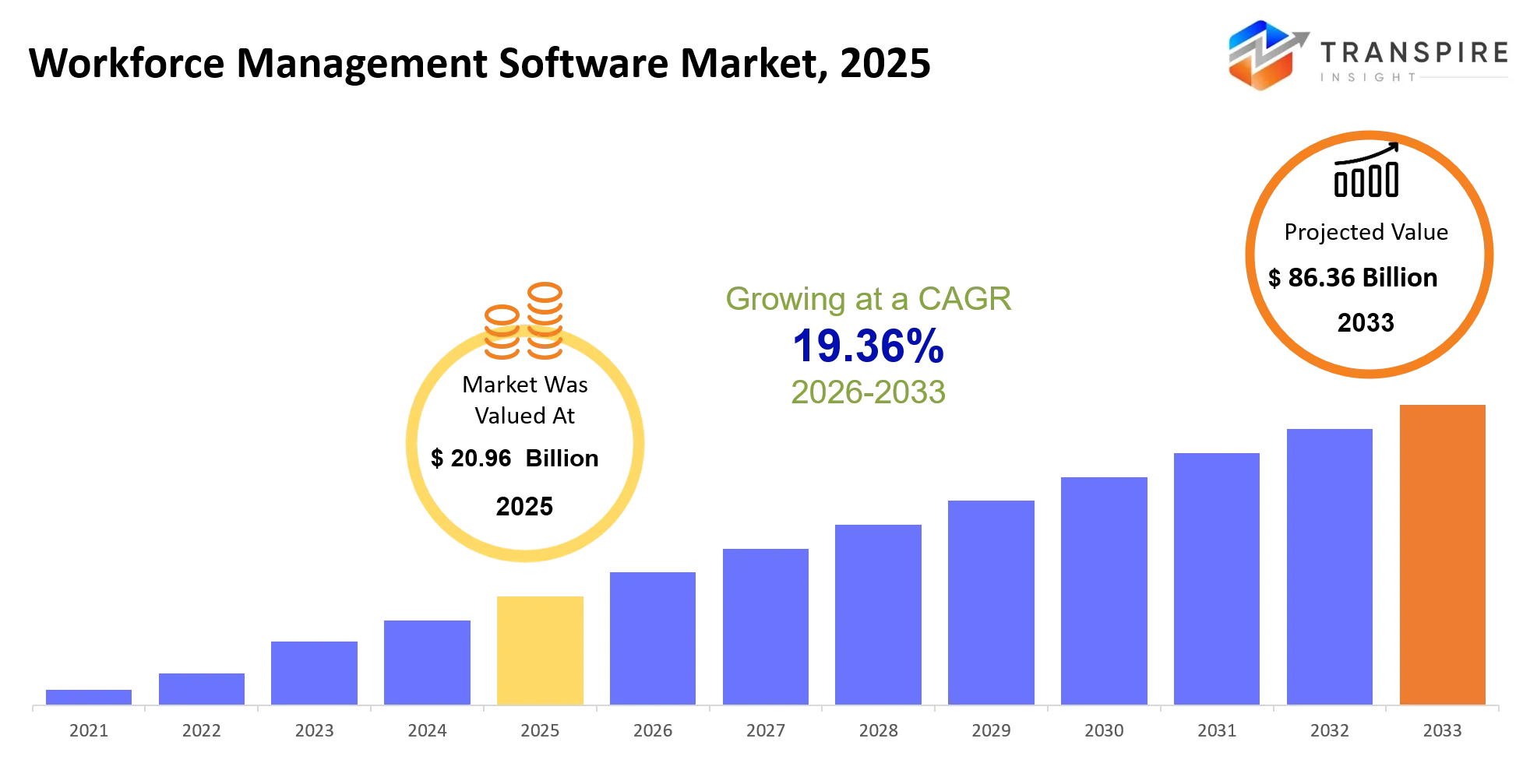
As per the Transpire Insight Analysis, The Workforce Management Software Market size is estimated at USD 20.96 billion in 2025 and is anticipated to reach USD 86.36 billion by 2033, growing at a CAGR of 19.36% from 2026 to 2033.
In the past three to five years, workforce management software has evolved from a back-office scheduling solution to a full-scale operations platform for labour planning, attendance, payroll, productivity and employee experience. Companies are using these tools to optimise staffing according to workload, monitor overtime and manage distributed teams. The structural change toward a fully integrated, cloud-based workforce platform has accelerated as organisations seek to replace standalone human resources apps and spreadsheets. But the driving force behind this has become the perennial challenge of aligning labour supply with unpredictable operational demand in retail, health care, hospitality and logistics - as well as the regulatory headwinds surrounding algorithmic management as it relates to transparency and human intervention. Costs for labour and the complexity of scheduling have grown, prompting companies to strategically leverage workforce data to inform decisions. Vendors benefit by creating ongoing subscription opportunities, while customers benefit by eliminating systems and better managing labor utilization.
Workforce Management Software Market Size & Forecast:
- Market Size 2025: USD 20.96 Billion
- Expected Market Value (2033): USD 86.36 Billion
- Forecast CAGR (2026–2033): 19.36%
- Leading Region in 2025: North America
- Fastest Growing Region: Asia Pacific
- Key Company Profiles: UKG, Workday, ADP, Oracle, SAP, Dayforce, NICE, Verint, Infor, WorkForce Software, Zebra Technologies, Blue Yonder, Quinyx, Deputy, When I Work.
Key Workforce Management Software Market Insights:
The workforce management layer is becoming a layer of intelligence that now links labour cost to employee availability to business performance. The competitive edge is no longer just about scheduling tools, but also about supporting execution with AI, adapting to regulations, and enhancing employee experience on the front line.
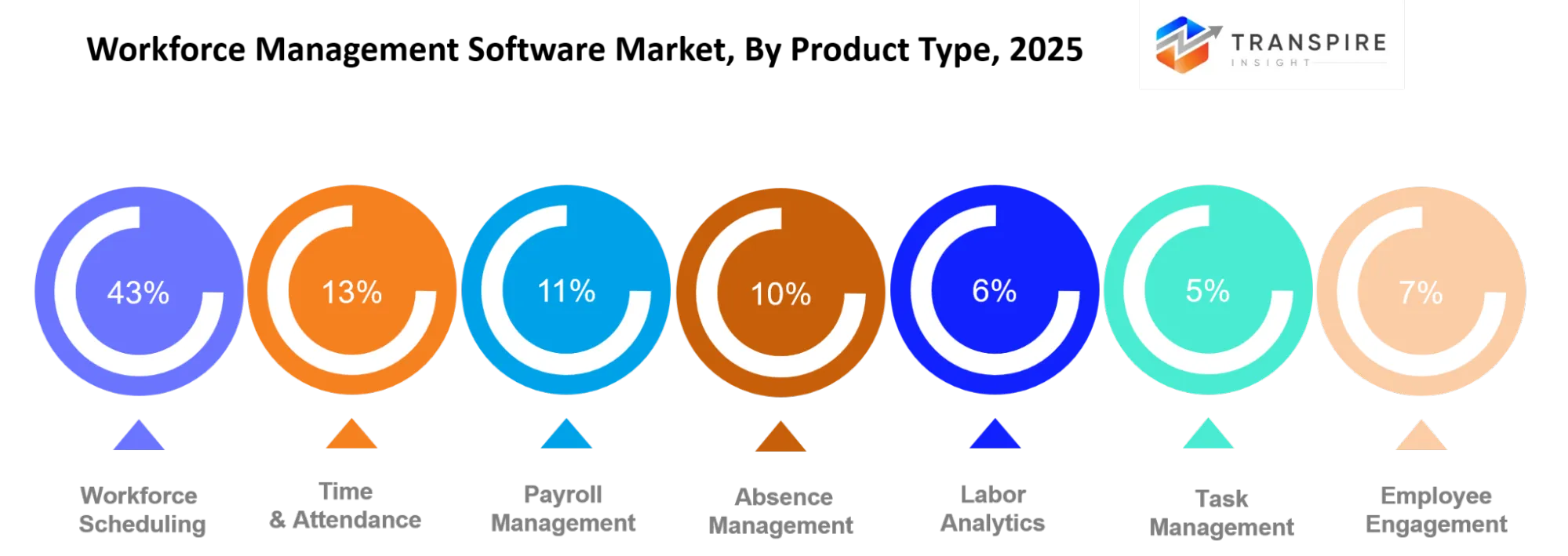
- Workforce Scheduling accounts for 27.5%, and Quinyx is leading in the artificial intelligence fairness logic of working hours, working shifts, and the distribution of working hours.
- Time & Attendance represents 23.0%, while Deputy's Analytics+ goes beyond clock-in data to provide a full view of shifts.
- Payroll errors are detected, and pay is validated before each run by Payroll Management, which makes up 15.0% of UKG's Agentic Pay.
- Absence Management is 10.0%, and Dayforce has increased its Absence Management pay and time-off AI agents to automate routine requests to the workforce.
- Labour Analytics is 9.5% of the total; meanwhile, UKG’s Workforce Intelligence Hub brings together scheduling, time, hiring, pay, and benchmarking data.
- Task Management makes up 8.0%, and Zebra Technologies enables frontline mobility and operational workflows to support deskless execution.
- Employee Engagement is at 7.0%, and Workday's Employee Sentiment Agent correlates the signals from the workforce to HR decision-making.
- Cloud and SaaS deployment is the predominant approach, as ADP integrates its unified Workforce Management Suite into HCM and payroll solutions in 140+ countries.
- The integration of AI has moved past action recommendations; UKG's Claude and Deputy AI facilitate conversational workforce decision-making and task execution.
What are the Key Drivers, Restraints, and Opportunities in the Workforce Management Software Market?
Driver:
Compliance complexity is becoming a purchasing trigger. Employers now face overlapping overtime, break, leave, union, and predictive-scheduling rules across cities, states, and countries. This is triggered by expanding worker-protection legislation and multi-site operations; it shifts WFM from an efficiency purchase to a risk-control investment, increasing adoption of rule engines, exception tracking, and audit trails. AI has changed the value proposition. Machine-learning models can forecast demand from POS, bookings, weather, and historical labour data, then generate schedules that respect skills, availability, and regulations. This converts WFM into a labour-cost optimisation tool, supporting adoption where overtime, understaffing, or service quality directly affects revenue.
Restraint:
Integration and localisation remain structurally difficult. WFM must synchronise with HR, payroll, ERP, POS, and time-capture systems while reflecting country-specific labour rules, works-council practices, languages, and pay policies. This persists because workforce data is fragmented and regulatory requirements change frequently, raising implementation costs and slowing rollout.
Opportunity:
AI-enabled workforce intelligence and compliance-focused scheduling offer substantial expansion potential. Vendors can combine demand forecasting, employee skills, availability, and labour regulations into unified decision-support platforms. For example, healthcare providers could deploy predictive scheduling to anticipate patient workloads and reduce staffing gaps. Cloud-based solutions, particularly across digitally modernizing Asia-Pacific markets, can extend adoption among mid-sized businesses without extensive infrastructure investment.
Driver Impact Analysis for the Workforce Management Software Market
|
Driver |
Relative Impact on Growth (%) |
Geographic Relevance |
Impact Timeline |
Demand Strength |
Growth Mechanism |
Key Beneficiaries |
Major Constraint |
|
AI-powered workforce forecasting and scheduling automation |
26% |
North America, Europe, Asia-Pacific |
Medium-term (2–4 years) |
High |
Predicts demand and automates schedules, reducing understaffing and overtime. |
WFM vendors, analytics providers, retailers, hospitals, contact centres. |
Forecast bias, explainability gaps, and limited clean data. |
|
Increasing labour regulations and compliance requirements |
24% |
Europe, North America, Australia |
Medium-term (2–4 years) |
High |
Automates working-time rules, audit trails, and jurisdiction-specific reporting. |
Multinational employers, payroll vendors, compliance-focused WFM providers. |
Frequent rule changes and costly localisation requirements. |
|
Rising labour costs and workforce productivity optimisation |
20% |
North America, Europe, Asia-Pacific |
Short-term (≤2 years) |
High |
Optimises staffing levels, overtime, and labour-budget utilisation. |
Retailers, manufacturers, logistics firms, healthcare operators, software vendors. |
Implementation costs and employee resistance to monitoring. |
|
Cloud-based deployment and mobile workforce management adoption |
17% |
Asia-Pacific, North America, Europe |
Short-term (≤2 years) |
High |
Enables scalable deployment and real-time access for deskless teams. |
SMEs, distributed employers, SaaS vendors, frontline managers. |
Connectivity gaps, cybersecurity risks, and legacy-system integration. |
|
Enterprise digitisation and replacement of legacy workforce systems |
13% |
Asia-Pacific, Latin America, Middle East and Africa |
Long-term (≥4 years) |
Medium |
Replaces spreadsheets with integrated scheduling, attendance, and payroll workflows. |
SMEs, HR departments, system integrators, payroll platforms. |
Change-management burden and fragmented enterprise data. |
|
Total |
100% |
Global |
— |
— |
— |
— |
— |
What Has the Impact of Artificial Intelligence Been on the Workforce Management Software Market?
AI is transforming workforce management from a reactive administration process to a forward-looking labour function. In scheduling, AI considers demand signals, workers' skills and availability, employment law, and absence patterns to produce optimised schedules. Current platforms are doing scale schedule optimisations- not just giving recommendations for schedule adjustments.
AI's predictive reach now extends to absenteeism risk, overtime risk, attrition risk, and demand forecasting. For example, EU-based manufacturers and logistics operators use machine-learning models fed with point-of-sale and weather data to improve hourly labour forecasts by 15 to 20% relative to simple templates. Operationally, AI manages exception handling, payroll validation, compliance alerts, and schedule modifications. Generative AI copilots can interpret union rules, flag violations, and dramatically reduce schedule generation times so managers can focus on service quality and decisions about workers. These improvements are hindered by the issues of governance and integration. AI-based scheduling that assigns tasks or rates workers on the basis of observed behaviour could fall into the high-risk category in the EU AI Act, which requires transparency and human oversight, along with logging and informing workers. Disconnected data from human resources, payroll, and enterprise resource planning systems can also reduce model accuracy and limit deployment.
In May 2026 launched its AI-powered Smart Scheduling experience. This platform directly addresses complex labour forecasting issues by automatically creating rosters optimised against historical demand data, real-time foot traffic, and specific compliance rules.
Key Workforce Management Software Market Trends:
Workforce management is transforming from being a timekeeping system to integrated, intelligence-driven labour operations. The focus of competition is increasingly on the flexibility of staff, the explainability of automated processes, and the visibility of staff in real time.
- The previously rigid scheduling models have now become flexible, with AI algorithms optimizing schedules based on demand, skills, availability, and regulatory requirements.
- Compliance is no longer a reporting exercise; it is automated rule enforcement and audit-ready documentation.
- Multi-site employers are increasingly looking for quick updates and visibility, driving the replacement of on-premises systems with cloud and SaaS.
- Mobile-first design is altering the ways people behave at the front lines, allowing for shift swaps, clock-ins, leave requests, and manager approvals to be completed on phones.
- Employers are bringing together disparate scheduling, attendance, payroll, and analytics features into end-to-end solutions.
- More employers than before, especially those who have more shifts, are experimenting with AI forecasting tools to gain a more accurate picture of their workforce, as predictive analytics moves into the mainstream.
- Fair scheduling, transparency, and self-service are important factors in retention in hourly jobs, and these factors are receiving weight for worker experience.
- Agentic AI is now making its debut, taking the next stage in the evolution of AI by performing multi-step workflows in the workforce with only a minor amount of manual effort.
- The vendor differentiator for algorithmic transparency is increasing as regulators and works councils require transparency of scheduling decisions.
Workforce Management Software Market Segmentation
Solution:
Workforce Scheduling leads with a 27.5% share because it directly resolves the highest-value problem: matching labour supply to variable demand while controlling overtime and compliance risk. Its growth logic rests on AI forecasting, skills-based assignment, and real-time adjustment; future platforms will increasingly automate schedule execution rather than simply suggest rosters. Time & Attendance, at 23.0%, remains foundational because accurate hours feed payroll, compliance, and analytics. Payroll Management, at 15.0%, benefits from integration with scheduling and tax-rule engines. Absence Management, at 10.0%, and Labour Analytics, at 9.5%, are gaining importance as employers seek to reduce unplanned leave and convert workforce data into planning decisions. Task Management, at 8.0%, and Employee Engagement, at 7.0%, are smaller but strategically significant as WFM expands into execution and retention.
Deployment:
Cloud, SaaS, public cloud, and hosted models are replacing traditional on-premises systems through multi-site accessibility, faster updates, reduced infrastructure costs, and mobile workforce support. Private cloud and hybrid deployments remain important where data residency, security, and legacy integration requirements restrict full cloud migration. Organisations increasingly prioritise deployment flexibility, scalable architecture, and predictable subscription expenses when selecting workforce management platforms.
Enterprise Size:
Large enterprises and multinational corporations prioritise centralised workforce visibility, cross-border compliance, and standardised labour policies. SMEs and startups represent an emerging adoption opportunity as modular SaaS pricing reduces implementation barriers. Government organizations emphasize auditability, statutory compliance, secure employee records, and transparent workforce administration, encouraging procurement of configurable systems that support accountability and long-term operational continuity.
Industry:
Retail, healthcare, hospitality, manufacturing, transportation and logistics, BFSI, and IT and telecom adopt workforce management for distinct operational requirements. Retail addresses fluctuating customer demand, healthcare prioritizes patient coverage, hospitality manages seasonal staffing, manufacturing aligns labour with production, and logistics improves fleet coordination. BFSI emphasises regulated staffing, while technology companies manage distributed technical teams and specialised employee availability.
Function:
Scheduling and forecasting remain central to workforce allocation, while time tracking, leave management, compliance, workforce analytics, and performance management extend software capabilities. Integration connects operational decisions with payroll accuracy, regulatory monitoring, productivity assessment, and employee planning. Consequently, organisations increasingly favour platforms that combine execution, reporting, and management oversight within interconnected workflows.
Worker Type:
Deskless, frontline, field, shift, contract, and remote employees are expanding software requirements. Mobile time capture, offline accessibility, flexible scheduling, and employee self-service improve workforce coordination. Fair scheduling and accessible interfaces are becoming important adoption factors as organisations seek consistent digital experiences across geographically dispersed and employment-contract-diverse workforces.
What are the Key Use Cases Driving the Workforce Management Software Market?
The core use case is demand-driven scheduling for large hourly workforces. Retailers, hospitals, hotels, manufacturers, and logistics operators use Workforce Scheduling, representing 27.5%, to forecast demand, allocate qualified staff, control overtime, and prevent understaffing. AI forecasting improves responsiveness by incorporating sales, bookings, weather, and seasonal patterns.
Expanding applications include Time & Attendance for verified working hours, Payroll Management for accurate wage calculations, and Absence Management for leave coordination. Integrated workflows connect scheduling changes with payroll and compliance records.
Emerging applications emphasise frontline flexibility and workforce intelligence. Mobile self-service enables shift swaps and leave requests, while Labour Analytics identifies absenteeism and overtime inefficiencies. Healthcare and logistics increasingly explore skills-based allocation and predictive staffing, requiring transparency and human oversight.
|
Report Metrics |
Details |
|
Market size value in 2025 |
USD 20.96 Billion |
|
Market size value in 2026 |
USD 25.01 Billion |
|
Revenue forecast in 2033 |
USD 86.36 Billion |
|
Growth rate |
CAGR of 19.36% from 2026 to 2033 |
|
Base year |
2025 |
|
Historical data |
2021 - 2024 |
|
Forecast period |
2026 - 2033 |
|
Report coverage |
Revenue forecast, competitive landscape, growth factors, and trends |
|
Regional scope |
United States; Canada; Mexico; United Kingdom; Germany; France; Italy; Spain; Denmark; Sweden; Norway; China; Japan; India; Australia; South Korea; Thailand; Brazil; Argentina; South Africa; Saudi Arabia; United Arab Emirates |
|
Key companies profiled |
UKG, Workday, ADP, Oracle, SAP, Dayforce, NICE, Verint, Infor, WorkForce Software, Zebra Technologies, Blue Yonder, Quinyx, Deputy, When I Work. |
|
Customization scope |
Free report customization (country, regional & segment scope). Available customized purchase options to meet your exact research needs. |
|
Report Segmentation |
Solution (Workforce Scheduling, Time & Attendance, Payroll Management, Absence Management, Labor Analytics, Task Management, Employee Engagement); Deployment (Cloud, On-Premises, Hybrid, SaaS, Private Cloud, Public Cloud, Hosted); Enterprise Size (Large Enterprises, Medium Enterprises, Small Enterprises, SMEs, Multinational Corporations, Government, Startups); Industry (Retail, Healthcare, Manufacturing, Hospitality, BFSI, Transportation & Logistics, IT & Telecom); Function (Scheduling, Forecasting, Time Tracking, Leave Management, Compliance, Workforce Analytics, Performance Management); Worker Type (Desk-Based, Deskless, Frontline, Field Workers, Shift Workers, Contract Workers, Remote Workers). |
Which Regions are Driving the Workforce Management Software Market Growth?
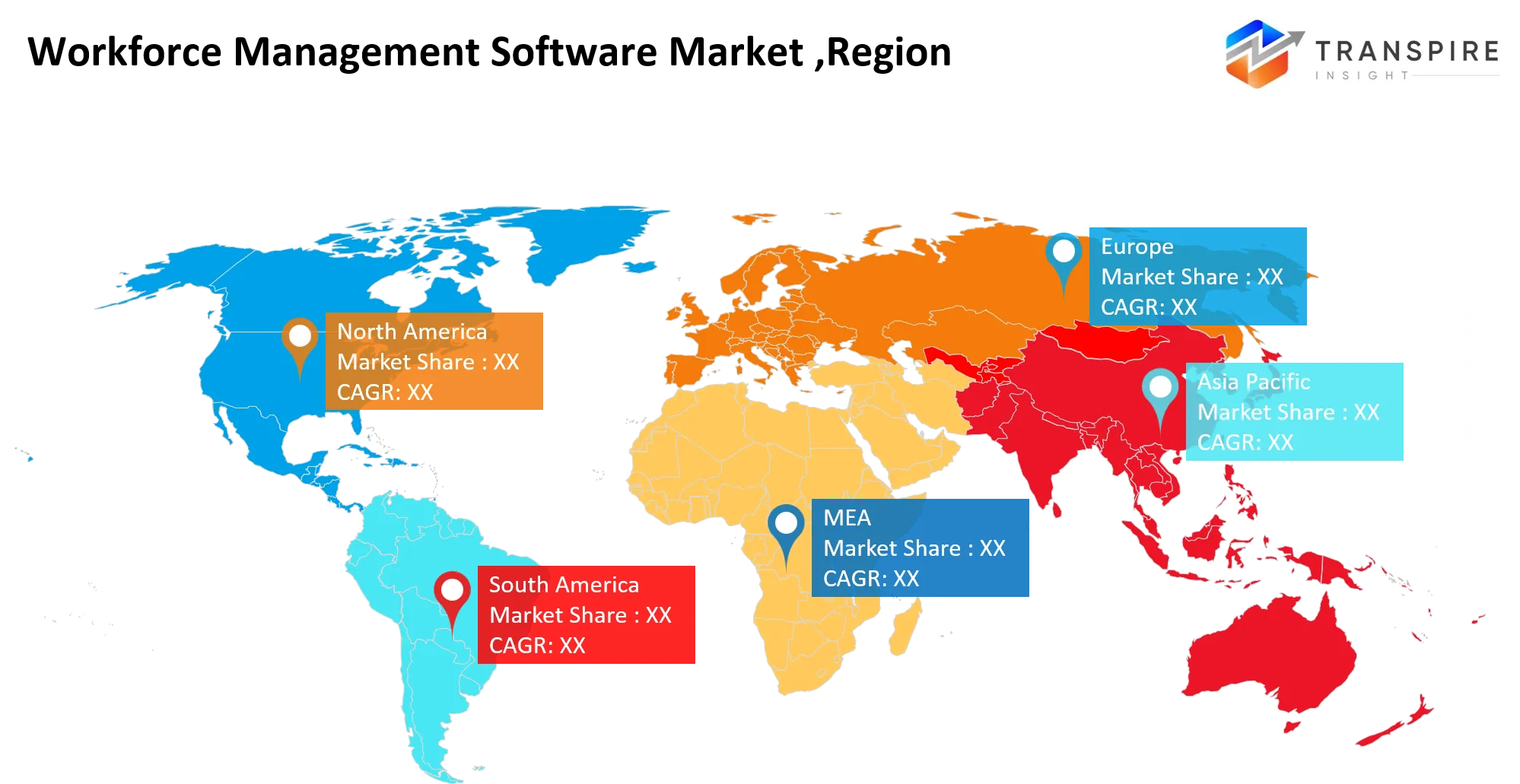
North America remains ahead with 38.7% market share and has maintained its growth by having a mature enterprise software market, early cloud adoption, and demands from the retail, health care, logistics, and finance industries. The strength is complemented by market competition between WFM suppliers, high-end payroll and compliance infrastructure, and high transaction volumes and revenues by multizone/multisite employers that can absorb the costs of the deployment of integrated WFM solutions. North America is also driving product development by adding artificial intelligence assistants to scheduling, payroll, and workforce analytics by UKG, ADP, Workday, and Oracle.
In October 2026, ADP launched new AI-powered tools and Model Context Protocol (MCP) servers within its API Central platform. This deployment enables multi-zone and enterprise employers to securely connect their choice of autonomous AI agents directly with trusted workforce data, automating intricate workflows across payroll and operations while maintaining strict enterprise governance and control.
Europe makes up 27.0% of the market and is largely dissimilar from North America in that adoption is primarily driven not just by labour-cost reductions but by critical compliance issues. Governments all over Europe are imposing prohibitions on working time, rules on overtime, leave, and other new rules for AI governance, which all require complete audit trails, rule engines, and explainable scheduling. Europe's greatest strength is its enterprise user base, works-council and data-protection history, and sustained investment in cloud HR and workforce management platforms.
In November 2026, Nutral Solutions secured a seven-figure debt finance investment from the Northern Powerhouse Investment Fund II (NPIF II). This funding directly supports the workforce management and compliance specialist's strategic expansion across the UK, Ireland, and mainland Europe.
Asia Pacific is the fastest-growing segment, with an 11.2% CAGR and 24.0% market share. The segment has recently experienced growth from the acceleration of enterprise digitalisation, the proliferation of organised retail and logistics, and the adoption of mobile-first employee solutions by deskless workforces. The segment's future growth will come from localised compliance packs, multilingual mobile experiences, and cloud-based deployments for SMBs and heavy-dependent industries. Latin America (6.0%) and the Middle East and Africa (4.3%) are still early-stage markets but are attractive growth opportunities ahead of workforce digitalisation and formalisation.
In June 2026, AscentHR completed a single-stage transaction to acquire 100% of the equity share capital of APAC-focused payroll outsourcing provider OS HRS (specifically its entities in Malaysia, Japan, and India) from Tokyo-based BREXA Inc.
Who are the Key Players in the Workforce Management Software Market, and how do they compete?
In enterprise HCM, competitor use cases include workforce planning and optimisation, and front-line workforce management. Companies including UKG, Workday, ADP, Oracle, SAP, Dayforce, NICE, Verint, Infor, Work Force Software, Zebra Technologies, Blue Yonder, Quinyx, Deputy, and When I Work compete across a range of use cases based on the customer needs and priorities of payroll integration, comprehensive scheduling, industry specialisation, and implementation flexibility. Many of these providers are represented by Gartner as they relate to enterprise workforce management requirements for 2026.
Providers compete based on integration for UKG, ADP, Workday, Oracle, SAP and Dayforce; extensive compliance, reporting and connected workforce and payroll operations for Dayforce; enterprise HCM ecosystem capabilities for Dayforce; connected workforce and payroll capabilities for Work Force Software; manufacturing, retail or supply chain management for Blue Yonder and Infor; workforce software combined with the frontline tools and mobility for Zebra; artificial intelligence for frontline scheduling for Quinyx; ease of use, shift flexibility and deployment options for small, midsize and remote organisations for Deputy and When I Work. The competitive landscape is increasingly focused on outcomes of labour rather than breadth of features.
Key Players are:
- UKG
- Workday
- ADP
- Oracle
- SAP
- Dayforce
- NICE
- Verint, Infor
- WorkForce Software
- Zebra Technologies
- Blue Yonder
- Quinyx
- Deputy
- When I Work
Workforce Management Software Market — Enhanced Competitive Benchmarking
|
Company |
Est. Revenue Share Range |
Key Offerings |
Strategic Positioning |
Geographic Strength |
Technology Focus |
|
UKG |
11–14% |
UKG Pro WFM, UKG Ready, UKG Workforce Management |
Enterprise leadership through deep frontline workforce specialisation |
North America, Europe, Asia Pacific |
AI scheduling, labour analytics, compliance automation |
|
ADP |
8–11% |
ADP Workforce Manager, ADP Workforce Now, ADP Workforce Software |
Payroll-led differentiation with integrated workforce management capabilities |
North America, Europe, Asia Pacific |
Payroll integration, cloud workforce analytics, automated timekeeping |
|
Workday |
7–10% |
Workday HCM, Workday Workforce Management, Workday Scheduling |
Premium enterprise positioning through unified HCM and workforce planning |
North America, Europe, Asia Pacific |
AI-driven scheduling, skills intelligence, cloud-native architecture |
|
Oracle |
6–9% |
Oracle Fusion Cloud HCM, Workforce Scheduling, Time and Labour |
Enterprise suite strategy leveraging ERP and HCM integration |
North America, Europe, Asia Pacific |
AI-enabled scheduling, predictive analytics, integrated cloud architecture |
|
SAP |
5–8% |
SAP SuccessFactors Time Tracking, Employee Central, SAP Fieldglass |
enterprise positioning through connected HR and workforce ecosystems |
Europe, North America, Asia Pacific |
Cloud HCM integration, workforce analytics, configurable compliance |
|
Infor |
3–5% |
Infor Workforce Management, Workforce Scheduling, Labour Forecasting |
Industry-specific differentiation across healthcare and operational sectors |
North America, Europe, Asia Pacific |
AI labour forecasting, demand-based scheduling, industry-specific workflows |
|
Dayforce |
3–5% |
Dayforce Workforce Management, Dayforce Scheduling, Time and Attendance |
Integrated HCM and payroll positioning with workforce optimisation |
North America, Europe |
Continuous payroll integration, workforce analytics, intelligent scheduling |
|
Verint |
2–4% |
Verint Workforce Management, Forecasting and Scheduling, Intraday Management |
Contact-centre specialisation through customer experience optimisation |
North America, Europe, Asia Pacific |
AI forecasting, omnichannel staffing, real-time optimisation |
|
NiCE |
2–4% |
NiCE CXone Workforce Management, Forecasting, Scheduling and Intraday Management |
Contact-centre technology leadership through AI-enabled workforce orchestration |
North America, Europe, Asia Pacific |
Machine learning scheduling, omnichannel forecasting, AI workforce copilots |
|
Blue Yonder |
2–4% |
Blue Yonder Workforce Management, Warehouse Labour Management, Labour Planning |
Supply-chain-integrated workforce optimisation for retail and logistics |
North America, Europe, Asia Pacific |
AI labour forecasting, demand sensing, warehouse workforce optimisation |
Recent Development News
In May 2026, Intuit launched QuickBooks Workforce in the United States, introducing an AI-native human capital management solution that integrates recruitment, onboarding, employee management, and workforce operations. The launch strengthens its workforce management capabilities for small and mid-sized businesses by reducing administrative complexity and improving labour cost visibility.
In May 2026, Tech Mahindra and UKG announced a strategic partnership to accelerate AI-driven workforce transformation and enterprise adoption. The collaboration combines UKG’s workforce management platform with Tech Mahindra’s consulting and implementation capabilities, supporting organisations in improving workforce productivity, operational efficiency, and employee experience.
In June 2026, NiCE launched its Workforce Empowerment Suite, integrating workforce management, quality monitoring, performance management, compliance, and AI operations into a unified platform. The launch enables enterprises to coordinate human employees and AI agents within a common operating framework, supporting workforce optimization, governance, and customer experience improvements.
What Strategic Insights Define the Future of the Workforce Management Software Market?
Market shifts toward autonomous, policy-conscious workforce management, with increasing amounts of scheduling, exception management, payroll validation, and compliance decision support automated by artificial intelligence. Competitive differentiation will be found in platforms that couple automation with explainability and operational fidelity. Operations could be subject to European Union Artificial Intelligence Act regulations, including documentability, explainability, and human-in-the-loop considerations, especially in the delivery of workforce scheduling and task assignment solutions, depending on their intended use and classification. But there is also a growing verticalized AI opportunity for deskless work. The logistics workforce management space is anticipated to grow at a 15.18% compound annual growth rate, more than tripling in size over the next few years, aligned with growing mobile workforce execution, offline capability, and focus on safety. Vendors should be able to show tangible and predictable results, like bettering overtime leakage rates, payroll anomalies, and audit-ready compliance.
Key Segmentations are:
Solution
- Workforce Scheduling
- Time & Attendance
- Payroll Management
- Absence Management
- Labour Analytics
- Task Management
- Employee Engagement
Deployment
- Cloud
- On-Premises
- Hybrid
- SaaS
- Private Cloud
- Public Cloud
- Hosted
Enterprise Size
- Large Enterprises
- Medium Enterprises
- Small Enterprises
- SMEs
- Multinational Corporations
- Government
- Startups
Industry
- Retail
- Healthcare
- Manufacturing
- Hospitality
- BFSI
- Transportation & Logistics
- IT & Telecom
Function
- Scheduling
- Forecasting
- Time Tracking
- Leave Management
- Compliance
- Workforce Analytics
- Performance Management
Worker Type
- Desk-Based
- Deskless, Frontline
- Field Workers
- Shift Workers
- Contract Workers
- Remote Workers
Frequently Asked Questions
Find quick answers to common questions.
The workforce management software market size was valued at USD 20.96 billion in 2025 and is poised to reach USD 86.36 billion by 2033, expanding at a 19.36% CAGR.
Key segments for the workforce management software market are Solution (Workforce Scheduling, Time & Attendance, Payroll Management, Absence Management, Labor Analytics, Task Management, Employee Engagement); Deployment (Cloud, On-Premises, Hybrid, SaaS, Private Cloud, Public Cloud, Hosted); Enterprise Size (Large Enterprises, Medium Enterprises, Small Enterprises, SMEs, Multinational Corporations, Government, Startups); Industry (Retail, Healthcare, Manufacturing, Hospitality, BFSI, Transportation & Logistics, IT & Telecom); Function (Scheduling, Forecasting, Time Tracking, Leave Management, Compliance, Workforce Analytics, Performance Management); Worker Type (Desk-Based, Deskless, Frontline, Field Workers, Shift Workers, Contract Workers, Remote Workers).
Growth is primarily driven by AI-powered workforce scheduling, rising labour-cost pressures, cloud adoption, payroll automation, and increasing demand for real-time workforce analytics and regulatory compliance.
The workforce management software market is led by major manufacturers including UKG, Workday, ADP, Oracle, SAP, Dayforce, NICE, Verint, Infor, WorkForce Software, Zebra Technologies, Blue Yonder, Quinyx, Deputy, and When I Work.
North America dominates with a 38.7% market share, supported by advanced cloud infrastructure, mature enterprise software adoption, strong regulatory compliance requirements, and established technology providers.
Key opportunities include AI-driven workforce analytics, predictive scheduling, vertical-specific solutions for healthcare and logistics, cloud adoption among SMEs, and mobile workforce automation.
- UKG
- Workday
- ADP
- Oracle
- SAP
- Dayforce
- NICE
- Verint, Infor
- WorkForce Software
- Zebra Technologies
- Blue Yonder
- Quinyx
- Deputy
- When I Work
About the Authors

Mayur Shinde
I am Mayur Shinde, a Senior Research Analyst at Transpire Insight, specializing in the Automotive & Transportation and Information & Communication Technology (ICT) Industry. My work focuses on analyzing emerging market trends, technological advancements, competitive landscapes, and industry developments to deliver accurate, data-driven insights. I am passionate about transforming complex market information into clear, actionable content that helps businesses, professionals, and decision-makers stay informed and make confident strategic decisions.

Chakradhar Khansole
Chakradhar serves as the Research Director at Transpire Insight, bringing over 8 years of experience in technology, innovation, and strategic market intelligence. He specializes in transforming complex market data into actionable business insights that enable organizations to make informed, growth-oriented decisions. Recognized for his strategic vision and analytical expertise, Chakradhar leads high-impact research initiatives, delivering comprehensive market assessments, competitive intelligence, and forward-looking industry analysis.
Recently Published Reports
-
Apr 2026
3D Optical Profiler Market
3D Optical Profiler Market Size, Share & Analysis Report By Type (Desktop 3D Optical Profiler, and Portable 3D Optical Profiler), By Technology (Confocal Technology, and White Light Interference), By End-Use Industry (Manufacturing, Research Institutions, Automotive, Aerospace and Defense, Medical Devices, and Other), and Geography (North America, Europe, Asia-Pacific, Middle East and Africa, South and Central America), 2021 - 2031
-
Apr 2026
Depth Sensor Market
Depth Sensor Market Size, Share & Analysis Report By Type (Infrared Depth Sensors, Time-of-Flight (ToF) Sensors, Stereo Vision Sensors, Structured Light Sensors, Ultrasonic Depth Sensors), By Application (Automotive, Robotics, Gaming, Consumer Electronics, Industrial Automation, Healthcare, Security & Surveillance, Others), By End Users (Automotive Manufacturers, Consumer Electronics Companies, Healthcare Providers, Industrial Companies, Security Agencies, Gaming Companies, Robotics Companies, Others), and Geography (North America, Europe, Asia-Pacific, Middle East and Africa, South and Central America), 2021 – 2031
-
Apr 2026
Digital Manufacturing Market
Digital Manufacturing Market Size, Share & Analysis Report By Component (Hardware, Software, and Services), By Technology (Robotics, 3D Printing, Internet of Things (IoT), and Others), By Application (Automotive and Transportation, Aerospace and Defense, Consumer Electronics, Industrial Machinery, and Others), By Process Type (Computer-Based Designing, Computer-Based Simulation, Computer 3D Visualization, Analytics, and Others), and Geography (North America, Europe, Asia-Pacific, Middle East and Africa, South and Central America), 2021 – 2031
-
Apr 2026
Digital Visa Services Market
Digital Visa Services Market Size, Share & Analysis Report By Type (Individual Travelers, Group Travelers), By Application (Tourism, Business Travel, Others), and Geography (North America, Europe, Asia-Pacific, Middle East and Africa, South and Central America), 2021 – 2031