

Vibration Monitoring Market Summary:
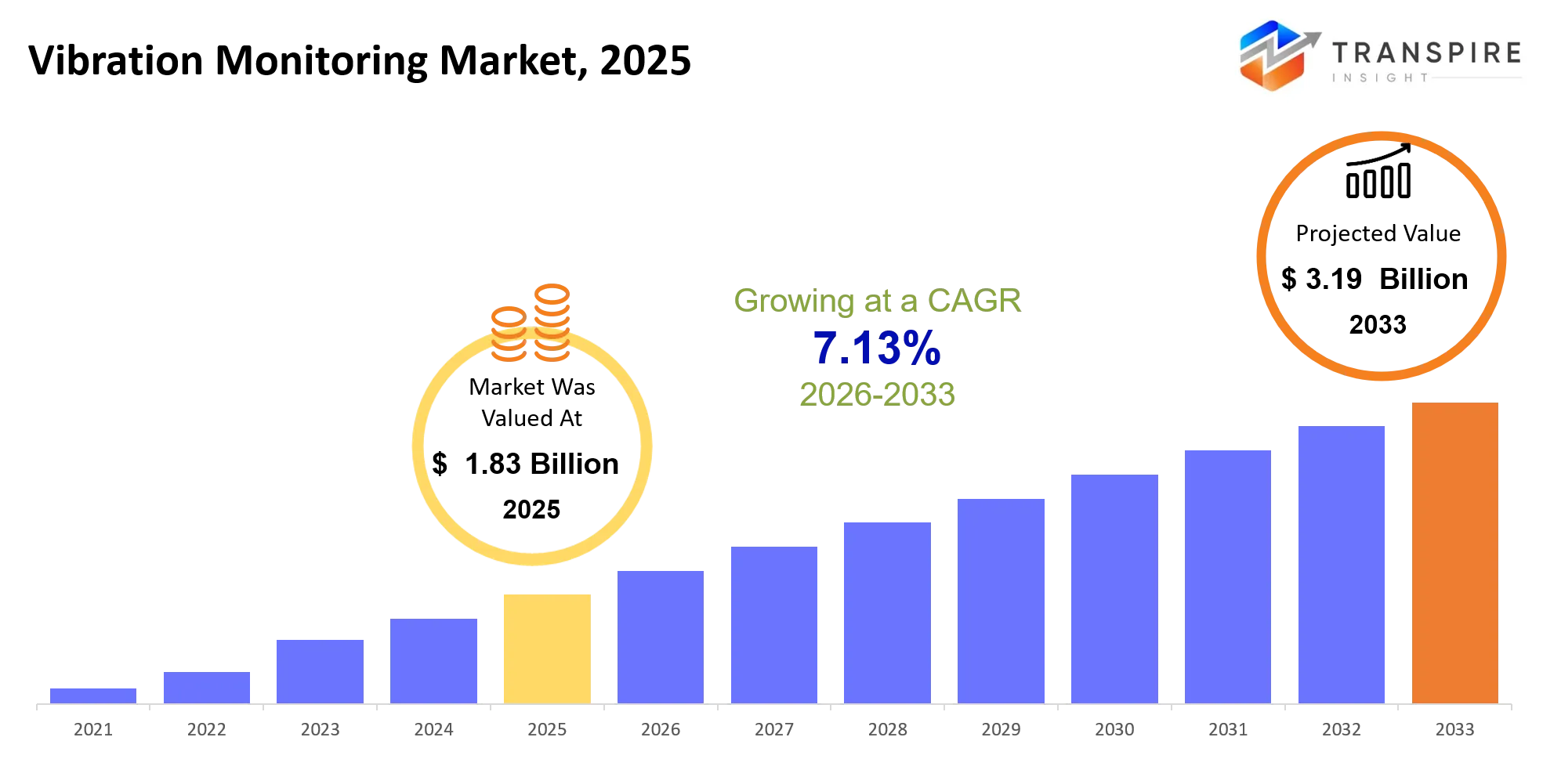
As per Transpire Insight Analysis, the Vibration Monitoring Market size is estimated at USD 1.83 billion in 2025 and is anticipated to reach USD 3.19 billion by 2033, growing at a CAGR of 7.13% from 2026 to 2033.
The vibration monitoring market supports operators by showing how rotating and moving equipment is doing before things go wrong. Sensors pick up on machine behaviour. Monitoring systems turn those readings into alerts. These alerts help maintenance teams plan inspections, plan for replacement parts and schedule service in time. Over the three to five years. It used to rely on checks that happened at set times. Now it uses connected sensors, remote dashboards and analytics that watch equipment all the time. This change is especially important in plants where maintenance teams are small. When a motor, pump or bearing fails unexpectedly, it can stop production. Drive up repair costs. More companies are adopting IoT now. IoT makes it easier to send data from machines that were only checked during scheduled visits. Supply chain problems and the pressure to keep equipment running have pushed operators to catch faults. This has made vibration monitoring more popular. Catching problems early can reduce downtime, improve maintenance planning and help equipment longer. Vibration monitoring keeps equipment healthy. Gives maintenance teams a clear path forward.
Vibration Monitoring Market Size & Forecast:
- Market Size 2025: USD 1.83 Billion
- Expected Market Value (2033): USD 3.19 Billion
- Forecast CAGR (2026–2033): 7.13%
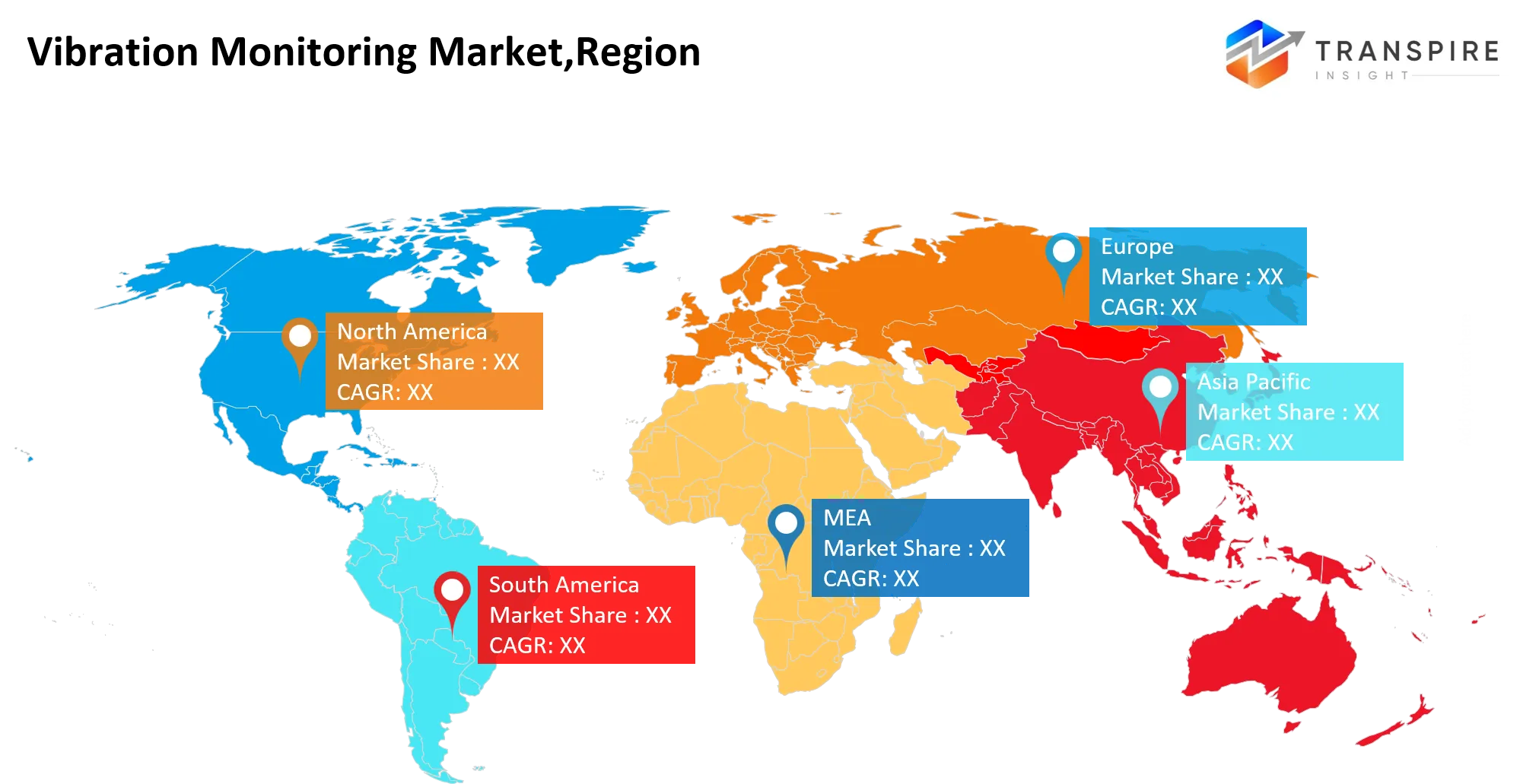
- Leading Region in 2025: North America
- Fastest Growing Region: Asia Pacific
- Key Company Profiles: SKF, Emerson, Baker Hughes, Rockwell Automation, Honeywell, Siemens, General Electric, Fluke Corporation, National Instruments, Meggitt, Brüel & Kjær Vibro, Analog Devices, PCB Piezotronics, Meggitt Sensing Systems, Schaeffler
Key Market Insights:
The market is trending towards wireless monitoring, which is set for rapid growth as operators try to cover their assets without much use of cables. Competition is largely driven by how well suppliers integrate effective sensing and analytics into their solutions.
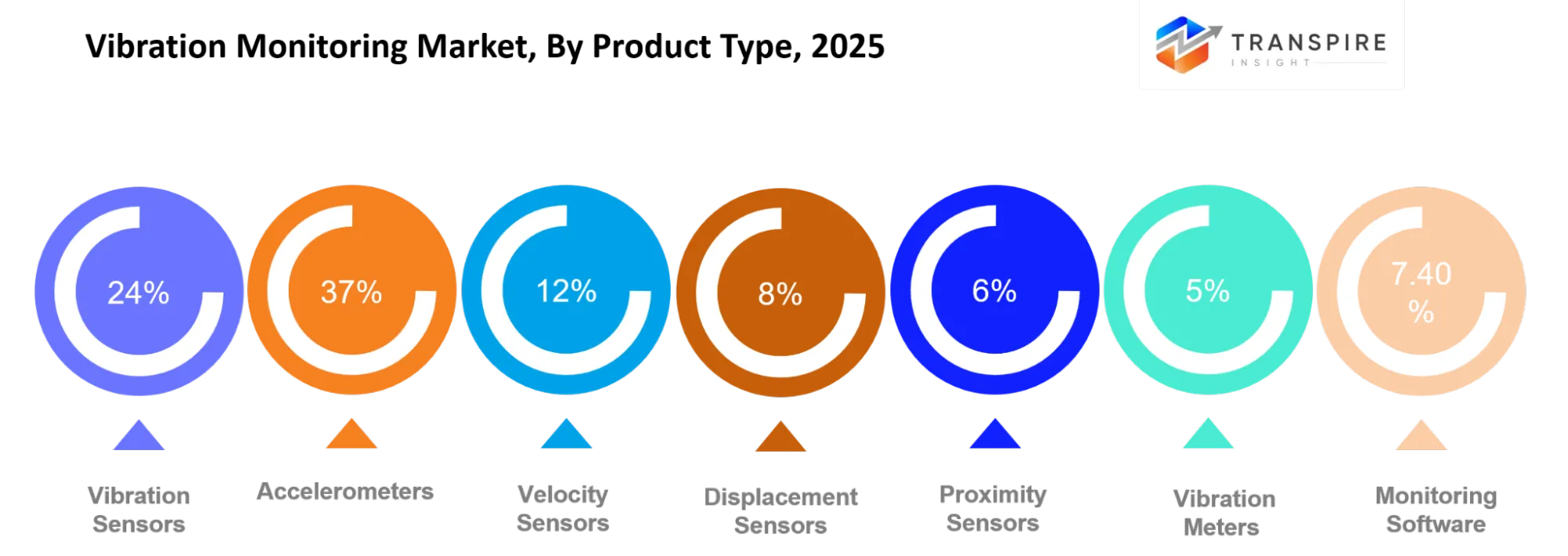
- Vibration sensors account for 24.00% of the share in the given allocation, offering installations for general machines with the data that requires gathering on the general machinery conditions.
- Velocity sensors constitute 12.00%, remaining relevant in machinery for which assessment of vibration strength and overall machine conditions is carried out by velocity measures.
- Displacement sensors hold 8.00% and have applications only in cases when observation of shaft displacement and movement is necessary.
- Proximity sensors account for 6.00% and are important for machines where displacement and position of the shaft are important for safety.
- Vibration meters have 5.00% of allocation and are used by people who require a handheld meter for troubleshooting.
- Monitoring software and data acquisition systems take 4.00% and 3.40%, respectively. Their importance lies in the collection of raw data.
What are the Key Drivers, Restraints, and Opportunities in the Vibration Monitoring Market?
Drivers
Market growth for the is the cost of unexpected equipment failure. For continuous-process industries, the failure of a pump, a motor or a bearing may shut down an entire production line, compromise the quality of the product and lead to unplanned maintenance. This, in turn, has led plant managers to move away from time-based servicing towards condition-based ones, especially those that are combined with vibration data analysis for imbalance, loosening and bearing wear. Readily available industrial IoT gateways and wireless sensors are reducing the hassle of site connection – and leading to the provision of a service stream that creates recurring revenue through software licensing, sensor upgrades and third-party analytics.
Restraints
Cost and speed of deployment to older facilities. A full system might involve a sensor, gateway, installation, software integration, training of personnel and calibration. For small plants or low-criticality assets, it can be difficult to justify the expense, especially if existing control systems communicate in incompatible protocols or staff lack vibration-monitoring experience.
Opportunities
opportunity exists in scalable wireless and edge-based monitoring. Vendors that make installation easy, incorporate strong data security and communicate straightforward fault advice are well-positioned to cater to medium-sized factories as well as to large industrial estates. Digital manufacturing investment in Asia Pacific is a potential solid growth channel for vendors through local integrators, pilots and service partners.
|
Driver |
Relative Impact on Growth (%) |
Geographic Relevance |
Impact Timeline |
Demand Strength |
Growth Mechanism |
Key Beneficiaries |
Major Constraint |
|
Rising demand for predictive maintenance and reduced downtime |
30% |
North America, Europe, Asia Pacific |
Short-term (≤2 years) |
High |
Detects bearing faults early and prevents costly shutdowns. |
Sensor manufacturers, maintenance providers, industrial equipment operators. |
High initial investment and shortage of diagnostic expertise. |
|
Industrial automation and Industry 4.0 adoption |
24% |
Asia Pacific, North America, Europe |
Medium-term (2–4 years) |
High |
Integrates vibration data into automated asset management systems. |
Automation vendors, sensor suppliers, smart factory operators. |
Legacy machinery and incompatible industrial communication systems. |
|
AI-powered analytics and intelligent fault detection |
19% |
North America, Europe, Asia Pacific |
Medium-term (2–4 years) |
High |
Identifies abnormal vibration patterns and predicts equipment failures. |
AI software vendors, analytics providers, industrial maintenance teams. |
Limited failure data and inconsistent model accuracy. |
|
Expansion of wireless sensors, IIoT and cloud monitoring |
16% |
Asia Pacific, North America, Europe |
Medium-term (2–4 years) |
High |
Enables continuous remote monitoring across distributed industrial assets. |
Wireless sensor makers, cloud providers, monitoring service companies. |
Battery limitations, cybersecurity risks and connectivity gaps. |
|
Equipment reliability, safety standards and sustainability priorities |
11% |
Europe, North America, Asia Pacific |
Long-term (≥4 years) |
Medium |
Improves equipment lifespan, operational safety and energy efficiency. |
Industrial operators, compliance specialists, reliability solution providers. |
Budget constraints and inconsistent implementation across industries. |
|
Total |
100% |
Global |
— |
— |
— |
— |
— |
What Has the Impact of Artificial Intelligence Been on the Vibration Monitoring Market?
Artificial intelligence in vibration monitoring is shifting the paradigm from a system that merely records machine data to one that supports analysis and prioritises maintenance tasks. AI algorithms can match incoming vibration readings against historical patterns of machine operation to detect anomalies related to imbalances, misalignment, looseness, or developing bearing issues. With the addition of temperature, speed and acoustic data, these algorithms provide maintenance professionals with a more comprehensive understanding of the asset's condition. While artificial intelligence cannot replace professional engineering judgement, the effectiveness of such a system is dependent on sensor location, data quality, machine operation and the presence of appropriate of failure in the dataset. An algorithm designed to work on one type of machine may not apply to other machines. In addition, changes in the load can cause false alarms. Compatibility with legacy control systems and the cost of software, connectivity and expertise may also hinder the adoption process. The most significant commercial opportunity in the field, therefore, lies in providing a solution that explains its reasoning behind the alert, allows for validation by maintenance staff and integrates with their workflow.
Instance
In September 2025, Weir collaborates with Viking Analytics to embed AI-driven vibration analysis into its digital offerings for mineral processing plants. The technology aids in identifying equipment failures, minimising unplanned downtime, and improving maintenance efficiency.
Key Market Trends:
The market is shifting from standalone devices towards interconnected solutions to help maintenance teams act upon condition-based data about machinery. Practical integration, better diagnostic capabilities, and ease of deployment are more appreciated, along with high accuracy of measurement.
- Plant maintenance has shifted from regular check-ups to condition-based maintenance with vibration data helping operators to decide whether to inspect and repair assets.
- Traditional hardwired solutions are used for critical pieces of machinery, while wireless sensors have started to be installed at dispersed machines where installing cables is costly or disruptive.
- Independent measurements are becoming more and more integrated with dashboards in the cloud and plant management systems so that maintenance personnel can compare histories of machines across plants.
- Data analytics has shifted from setting thresholds for alarms to identifying anomalies and finding patterns in data, which should then be verified by an operator.
- Edge computing has become more relevant in cases when faster local alerts or smaller data loads are required in sensor networks.
- Compatibility with other industrial systems such as PLC, SCADA and CMMS is becoming a priority for industrial buyers, as opposed to monitoring solutions as technical islands.
Vibration Monitoring Market Segmentation
By Component
By components, accelerometers are the leading group in the market, accounting for 37.60%, followed by vibration sensors, which have a share of 24.00%. Velocity sensors make up 12.00%, displacement sensors make up 8.00%, proximity sensors take up 6.00%, vibration meters take up 5.00%, monitoring software has 4.00%, and data acquisition systems represent 3.40%. The broad applicability of accelerometers lies in the ability to measure vibration in different machines under various circumstances.
By Monitoring Type
Based on type, online, portable, wireless, periodic, continuous, remote and predictive monitoring are the segments in this market. Wireless vibration monitoring is estimated as the fastest-growing segment here with a 9.80% CAGR in the brief supplied; its advantages relate to reduced cabling to assets and capability for expanded coverage of hard-to-reach assets. Portable and periodic approaches have a role in inspection and troubleshooting, with continuous and online systems for more vital equipment. Remote and predictive monitoring can have a role if alarms are fed to respond quickly.
By Application
Predictive maintenance is arguably the most popular application, because it connects equipment condition with planned maintenance and helps to prevent costly emergencies. Condition monitoring provides the continuous stream of data needed to determine the asset's health, whereas machine protection helps stop the machinery from operating in unsafe or destructive states. Fault detection aids root-cause analysis, and asset management enables decision-making on repair and replacement based on the accumulated history of the asset's condition. Structural monitoring and process monitoring extend these benefits into new areas and "greenfield" applications for those with the right sensor technology and analytical approaches.
By Industry
Across industries Oil & gas and power generation systems require dependable monitoring systems for their safety-critical applications where equipment failure can stop high-value processes. Demand for manufacturing applications is driven by the requirement for throughput testing of motors, conveyors, pumps and production line machinery. Automotive and aerospace production needs testing and quality assurance, and similar for tooling and specialised manufacturing, while manufacturing, mining and food & beverage plants need equipment to perform reliably in the dusty, rough on-site conditions. Identifying suppliers who can install and service systems at these different types of sites can be as crucial as specifying the right sensor technology.
By Technology
The components of the market include Internet of Things, wireless sensors, artificial intelligence and machine learning, cloud analytics, edge computing, digital twin and predictive analytics. Connectivity through IoT links the field devices to the operations system, whereas wireless sensors might decrease time to install on-site equipment at a vast location. The cloud analytics can provide fleet-wide visibility and a more detailed analysis of long-term patterns, whereas edge computing can support decision making closer to the asset to address problems with latency or disconnection. Digital twins could add the additional insight into the asset performance with the help of predictive analytics.
By End User
Industrial and manufacturing plants and facilities used vibration monitoring to safeguard production equipment and automate maintenance workloads. Power plants and refineries especially regard equipment reliability as crucial, since failures can interrupt wide swaths of normal operations. Mining companies want a tough instrument that is, perhaps, connected remotely to equipment throughout their large facilities. Transportation firms may analyse vibration of their vehicles, railroad lines and supporting infrastructure assets. Testing and research institutions also own monitors. System complexity will be driven by asset criticality, qualification of staff, and the cost of downtime.
What are the Key Use Cases Driving the Vibration Monitoring Market?
The use case is the early detection of mechanical issues in motors, pumps, fans, compressors and bearings. Accelerometers on the split component pick up vibrations that can assist maintenance technicians in detecting potential imbalances, misalignments or wear before equipment breakdown. For use in manufacturing industries, power generation, oil and gas industries and mining, monitoring can assist in condition-based maintenance and machine protection as well as fault detection. It will be possible for the technicians to do comparisons from one period to the other, focus on high-risk machines and even make maintenance schedules according to production needs. Some of the emerging use cases are monitoring remote equipment wirelessly, alerting at the edge when there is limited connectivity and using artificial intelligence in analysing sensors. Such practices can increase coverage of machines that were rarely checked.
|
Report Metrics |
Details |
|
Market size value in 2025 |
USD 1.83 Billion |
|
Market size value in 2026 |
USD 1.97 Billion |
|
Revenue forecast in 2033 |
USD 3.19 Billion |
|
Growth rate |
CAGR of 7.13%% from 2026 to 2033 |
|
Base year |
2025 |
|
Historical data |
2021 - 2024 |
|
Forecast period |
2026 - 2033 |
|
Report coverage |
Revenue forecast, competitive landscape, growth factors, and trends |
|
Regional scope |
United States; Canada; Mexico; United Kingdom; Germany; France; Italy; Spain; Denmark; Sweden; Norway; China; Japan; India; Australia; South Korea; Thailand; Brazil; Argentina; South Africa; Saudi Arabia; United Arab Emirates |
|
Key company profiled |
SKF, Emerson, Baker Hughes, Rockwell Automation, Honeywell, Siemens, General Electric, Fluke Corporation, National Instruments, Meggitt, Brüel & Kjær Vibro, Analog Devices, PCB Piezotronics, Meggitt Sensing Systems, Schaeffler |
|
Customization scope |
Free report customization (country, regional & segment scope). Avail customized purchase options to meet your exact research needs. |
|
Report Segmentation |
Component (Vibration Sensors, Accelerometers, Velocity Sensors, Displacement Sensors, Proximity Sensors, Vibration Meters, Monitoring Software, Data Acquisition Systems); Monitoring Type (Online Monitoring, Portable Monitoring, Wireless Monitoring, Periodic Monitoring, Continuous Monitoring, Remote Monitoring, Predictive Monitoring); Application (Predictive Maintenance, Condition Monitoring, Machine Protection, Fault Detection, Asset Management, Structural Monitoring, Process Monitoring); Industry (Oil & Gas, Power Generation, Manufacturing, Automotive, Aerospace & Defense, Mining, Chemicals, Food & Beverage); Technology (IoT, Wireless Sensors, AI & Machine Learning, Cloud Analytics, Edge Computing, Digital Twins, Predictive Analytics); End User (Industrial Plants, Power Plants, Refineries, Manufacturing Facilities, Mining Operations, Transportation Companies, Research Institutions) |
Which Regions are Driving the Vibration Monitoring Market Growth?
North America
North America supplies the region's largest share, accounting for 35.90%. North America's industrial assets, installed process equipment base, and commitment to reliability programmes across energy and manufacturing industries are well developed and of significant scale, with well-established digital solutions and technical expertise within its operator workforce giving monitoring a natural entry point for integrated operation and maintenance systems. The cost of unplanned downtime and reliability-driven spending support robust demand.
In September 2025, Omnidots commences U.S. production of SWARM vibration sensors. Omnidots has revealed the launch of manufacturing of its SWARM vibration monitoring sensors in Minneapolis as part of a manufacturing agreement with the local manufacturers. This is attributed to increasing demand for vibration monitoring in construction and infrastructure projects in the United States. It will also help the company have products on hand and serve North American customers.
https://www.omnidots.com/en/news/made-in-the-usa-omnidots-swarm-monitors
Europe
Europe constitutes 29.00%. The demand in Europe is based on its advanced manufacturing and engineering capabilities as well as a need to ensure that there is efficiency in manufacturing in its existing industrial plants. Unlike North America, the opportunity in Europe revolves around equipment modernisation, energy savings and monitoring, along with the overall digitisation of its factories.
In June 2026, Södra and Viking Analytics enter into an enterprise-wide AI-based vibration analytics agreement. Södra, the Swedish forest industry firm, has entered into a framework agreement with Viking Analytics to increase the use of vibration analysis based on AI and condition-based maintenance systems. In its Värö mill, the use of the system has been able to bring down weekly alarms from around 500 to 20.
Asia Pacific
Asia Pacific accounts for 26.00% and is the fastest-growing market, where New manufacturing capacity, industrial automation, and investment in power, mining, and process industries are increasing the number of assets and equipment suitable for monitoring. Asia Pacific also presents opportunities for wireless systems, especially in cases where factories are rapidly expanding or installing large quantities of cable would be disruptive. Vendors able to offer local technical support, affordable solutions, and integration partners will be well suited to serve new and existing facilities.
In October 2025, Schaeffler launches Asia Pacific Remote Monitoring Center. Schaeffler announced its launch of the Asia Pacific Industrial Lifetime Solutions Remote Monitoring Center to offer machinery monitoring services and predictive maintenance support. The center employs vibration analysts and artificial intelligence and machine learning solutions to assist industrial companies in identifying equipment faults.
https://www.schaeffler.sg/en/news_media/press_releases/press_releases_detail.jsp?id=88132416
Who are the Key Players in the Vibration Monitoring Market and how do they compete?
Competition in the market , automation and software vendors focusing on machine health. Comparison factors cover measurement accuracy, integration into factory systems, ease of implementation, diagnostic help, and total cost of ownership. Hardware is hardly the only differentiator for vendors now; competitive advantage lies more in transforming data into actionable maintenance. In this regard, Emerson and Baker Hughes have an advantage in leveraging existing industrial partnerships and their additional process or energy business, which makes it possible to integrate monitoring solutions into a bigger package of reliability and asset management services. For SKF, the unique feature will be its deep knowledge of bearings and rotating equipment, making a bridge between the two competencies.For analytics firms, like Viking Analytics, the unique features will be automated diagnostics and anomaly detection, working in cooperation with sensor equipment makers. Overall, expansion in any case is based on partner sales, upgrade opportunities, and the ability to integrate with existing solutions.
Vibration Monitoring Market companies
- SKF
- Emerson
- Baker Hughes
- Rockwell Automation
- Honeywell
- Siemens
- General Electric
- Fluke Corporation
- National Instruments
- Meggitt
- Brüel & Kjær Vibro
- Analog Devices
- PCB Piezotronics
- Meggitt Sensing Systems
- Schaeffler
|
Company |
Est. Revenue Share Range |
Key Offerings |
Strategic Positioning |
Geographic Strength |
Technology Focus |
|
SKF |
Estimated 4–7% |
SKF Multilog, Enlight Collect IMx-1, vibration sensors, condition monitoring software |
Reliability leadership through integrated bearing expertise |
Europe, Asia Pacific, North America |
Wireless sensors, AI analytics, predictive maintenance |
|
Emerson |
Estimated 4–7% |
AMS Wireless Vibration Monitor, AMS 2140, AMS Machine Works, AMS Asset Monitor |
Integrated automation and industrial reliability solutions |
North America, Europe, Asia Pacific |
AI diagnostics, WirelessHART, cloud monitoring |
|
Baker Hughes (Bently Nevada) |
Estimated 4–7% |
3500 System, Orbit 60, System 1, Ranger Pro |
Premium protection for critical rotating machinery |
North America, Middle East & Africa, Europe |
Proximity probes, online monitoring, machinery diagnostics |
|
Siemens |
Estimated 3–5% |
SIPLUS CMS, SIMOTICS condition monitoring, industrial monitoring solutions |
Automation-integrated industrial monitoring solutions |
Europe, Asia Pacific, North America |
Industrial IoT, edge analytics, digital twins |
|
Honeywell |
Estimated 2–4% |
Industrial sensors, asset performance solutions, process monitoring integrations |
Process reliability through automation integration |
North America, Middle East & Africa, Asia Pacific |
Connected sensors, industrial analytics, control integration |
|
Rockwell Automation |
Estimated 2–4% |
Dynamix 1444, FactoryTalk Analytics, Allen-Bradley monitoring components |
Factory automation with integrated machine-health intelligence |
North America, Europe, Asia Pacific |
Connected monitoring, edge analytics, industrial automation |
|
Fluke Corporation |
Estimated 2–4% |
Fluke 810, Fluke 805 FC, 3563 Analysis Vibration Sensor System |
Portable diagnostics for accessible predictive maintenance |
North America, Europe, Asia Pacific |
Portable vibration analysis, wireless sensing, diagnostic algorithms |
|
HBK (Hottinger Brüel & Kjær) |
Estimated 1–3% |
LAN-XI systems, vibration transducers, machine vibration measurement solutions |
Precision measurement and specialist vibration expertise |
Europe, North America, Asia Pacific |
Precision sensors, signal analysis, vibration testing |
|
Parker Hannifin (Meggitt heritage) |
Estimated 1–3% |
Industrial vibration sensors, accelerometers, machinery monitoring components |
Specialist sensing for demanding industrial applications |
North America, Europe, Asia Pacific |
High-temperature sensing, accelerometry, rugged instrumentation |
|
Amphenol PCB Piezotronics |
Estimated 1–3% |
Industrial accelerometers, vibration transmitters, ICP sensors, monitoring systems |
Specialized sensing with broad industrial application coverage |
North America, Europe, Asia Pacific |
Piezoelectric sensing, high-frequency measurement, rugged sensors |
Recent Development News
In January 2026, PCB Piezotronics introduced its series of high-voltage triaxial accelerometers referred to as the HV356A series that can be used to conduct vibration tests of active EV systems. The non-conductive construction of the sensor housing allows conducting tests of components operating on high voltages.
In September 2025, Weir has entered into a strategic collaboration agreement with Viking Analytics to incorporate AI-based vibration analytics within its digital solution referred to as NEXT. The collaboration seeks to enhance the connection between equipment expertise and operational insights through software tools.
What Strategic Insights Define the Future of the Vibration Monitoring Market?
The future trend is towards connected, services-enabled monitoring that integrates sensors, analytics, and maintenance decisions instead of the mere sale of measurement devices. Suppliers that provide simplified installation and operational explanations for alerts are more likely to be chosen by facilities without a large team for vibration analysis. Another hidden threat is the bad positioning of sensors, non-uniform operating data, and too many false alerts that may diminish confidence in the predictive system. In turn, once people stop responding to alerts, the ROI expectations of the facility become unrealistic. One more threat is a fragmented integration of the existing legacy equipment and new digital systems, which increases costs and reduces adoption rates. Wireless and edge-based systems give a chance to monitor expensive-to-connect and hard-to-inspect assets. Suppliers must focus on interoperable products, secure data management, diagnostic explanations and packages of solutions that show their benefits in a limited number of critical assets.
Component
- Vibration Sensors
- Accelerometers
- Velocity Sensors
- Displacement Sensors
- Proximity Sensors
- Vibration Meters
- Monitoring Software
- Data Acquisition Systems
Monitoring Type
- Online Monitoring
- Portable Monitoring
- Wireless Monitoring
- Periodic Monitoring
- Continuous Monitoring
- Remote Monitoring
- Predictive Monitoring
Application
- Predictive Maintenance
- Condition Monitoring
- Machine Protection
- Fault Detection
- Asset Management
- Structural Monitoring
- Process Monitoring
Industry
- Oil & Gas
- Power Generation
- Manufacturing
- Automotive
- Aerospace & Defense
- Mining
- Chemicals
- Food & Beverage
Technology
- IoT
- Wireless Sensors
- AI & Machine Learning
- Cloud Analytics
- Edge Computing
- Digital Twins
- Predictive Analytics
End User
- Industrial Plants
- Power Plants
- Refineries
- Manufacturing Facilities
- Mining Operations
- Transportation Companies
- Research Institutions
Frequently Asked Questions
Find quick answers to common questions.
The vibration monitoring market size was valued at USD 1.83 Billion in 2025 and is poised to reach USD 3.19 Billion by 2033, expanding at a 7.13%CAGR.
Key segments for the vibration monitoring market are Component (Vibration Sensors, Accelerometers, Velocity Sensors, Displacement Sensors, Proximity Sensors, Vibration Meters, Monitoring Software, Data Acquisition Systems); Monitoring Type (Online Monitoring, Portable Monitoring, Wireless Monitoring, Periodic Monitoring, Continuous Monitoring, Remote Monitoring, Predictive Monitoring); Application (Predictive Maintenance, Condition Monitoring, Machine Protection, Fault Detection, Asset Management, Structural Monitoring, Process Monitoring); Industry (Oil & Gas, Power Generation, Manufacturing, Automotive, Aerospace & Defense, Mining, Chemicals, Food & Beverage); Technology (IoT, Wireless Sensors, AI & Machine Learning, Cloud Analytics, Edge Computing, Digital Twins, Predictive Analytics); End User (Industrial Plants, Power Plants, Refineries, Manufacturing Facilities, Mining Operations, Transportation Companies, Research Institutions)
Growth is primarily driven by increasing automation in industry, the need for high equipment reliability, decreasing unplanned downtime, and the incorporation of artificial intelligence, the Internet of Things, and wireless technologies into various industries
The market is led by major manufacturers including SKF, Emerson, Baker Hughes, Rockwell Automation, Honeywell, Siemens, General Electric, Fluke Corporation, National Instruments, Meggitt, Brüel & Kjær Vibro, Analog Devices, PCB Piezotronics, Meggitt Sensing Systems, Schaeffler
North America accounts for 35.90% share of vibration monitoring market because of the high degree of industrial automation, wide acceptance of predictive maintenance systems, advanced infrastructure in manufacturing processes, and presence of key market players. Increased investments in oil & gas, energy, aerospace, and manufacturing industries have helped the region dominate the market.
Opportunities in the international vibration monitoring market exist in the form of increasing predictive maintenance practices, the increasing requirement of wireless monitoring systems, incorporation of AI/IoT technologies, increasing industrial automation, and increasing investment in smart manufacturing and remote equipment monitoring.
- SKF
- Emerson
- Baker Hughes
- Rockwell Automation
- Honeywell
- Siemens
- General Electric
- Fluke Corporation
- National Instruments
- Meggitt
- Brüel & Kjær Vibro
- Analog Devices
- PCB Piezotronics
- Meggitt Sensing Systems
- Schaeffler
About the Authors

Kartik bhong
I am Kartik Bhong, a Senior Research Analyst at Transpire Insight, specializing in the Packaging, Manufacturing, and Construction industry. My work focuses on analyzing market trends, emerging technologies, industry regulations, and competitive landscapes to deliver accurate, data-driven insights. I am passionate about transforming complex industry information into clear, practical content that helps businesses, professionals, and decision-makers stay informed and make confident strategic decisions. Through continuous research and a strong commitment to accuracy, I strive to create reliable, well-researched content that reflects the latest developments across these dynamic industries and supports the vision of Transpire Insight in delivering valuable market intelligence.

Chakradhar Khansole
Chakradhar serves as the Research Director at Transpire Insight, bringing over 8 years of experience in technology, innovation, and strategic market intelligence. He specializes in transforming complex market data into actionable business insights that enable organizations to make informed, growth-oriented decisions. Recognized for his strategic vision and analytical expertise, Chakradhar leads high-impact research initiatives, delivering comprehensive market assessments, competitive intelligence, and forward-looking industry analysis.
Recently Published Reports
-
Apr 2026
Handling and Lifting Equipment Market
Handling and Lifting Equipment Market Size, Share & Analysis Report By Product (Cranes and Hoists, Forklifts, Conveyor Systems, Aerial Work Platforms, Others), By Application (E-Commerce, Automotive and Railway, Food and Beverages, Aviation, Others), and Geography (North America, Europe, Asia-Pacific, Middle East and Africa, South and Central America), 2021 - 2031
-
Nov 2026
HVAC Equipment Market
HVAC Equipment Market Size, Share & Analysis Report By Heating Equipment Type (Boilers and Furnaces, Heat Pumps, and Unitary Heaters), By Ventilation Equipment (Air Handling Units, Humidifiers and Dehumidifiers, Air Filters, and Fan Coiling Units), By Air Conditioning Equipment (Unitary Air Conditioners, Room Air Conditioners, Packaged Terminal Air Conditioners, and Chillers), By End User (Commercial, Residential, Industrial, and others), and Geography (North America, Europe, Asia-Pacific, Middle East and Africa, South and Central America), 2021 – 2031
-
Apr 2026
Refrigeration Valves Market
Refrigeration Valves Market Size, Share & Analysis Report By Type (Solenoid Valves, Expansion Valves, Check Valves, Service Valves, Others), By Application (Commercial Refrigeration, Industrial Refrigeration, Transport Refrigeration, Residential Refrigeration, Air Conditioning Systems), By End User (Food and Beverage Industry, Pharmaceutical Industry, HVAC Industry, Chemical Industry, Others), and Geography (North America, Europe, Asia-Pacific, Middle East and Africa, South and Central America), 2021 – 2031
-
Apr 2026
E-Commerce Packaging Materials Market
E-Commerce Packaging Materials Market By Material Type (Corrugated Boxes, Paper & Paperboard, Foam & Cushioning Materials, Plastic Packaging, Flexible Packaging, Protective Packaging, Others), By Product(Primary Packaging, Secondary Packaging, Tertiary Packaging), By Packaging Function (Protective Packaging, Branding & Presentation Packaging, Transit & Logistic Packaging, Sustainable Packaging, Tamper Evidence Packaging), By End-User (Retail & Consumer Goods, Electronic Appliances, Food & Beverages, Healthcare & Pharmaceutical, Fashion & Apparel, Home & Furnishing, Others); By Industry Analysis, Size, Share, Growth, Trends, and Forecasts 2021-2033