
Vertical Cavity Surface Emitting Laser (VCSEL) Market Summary:
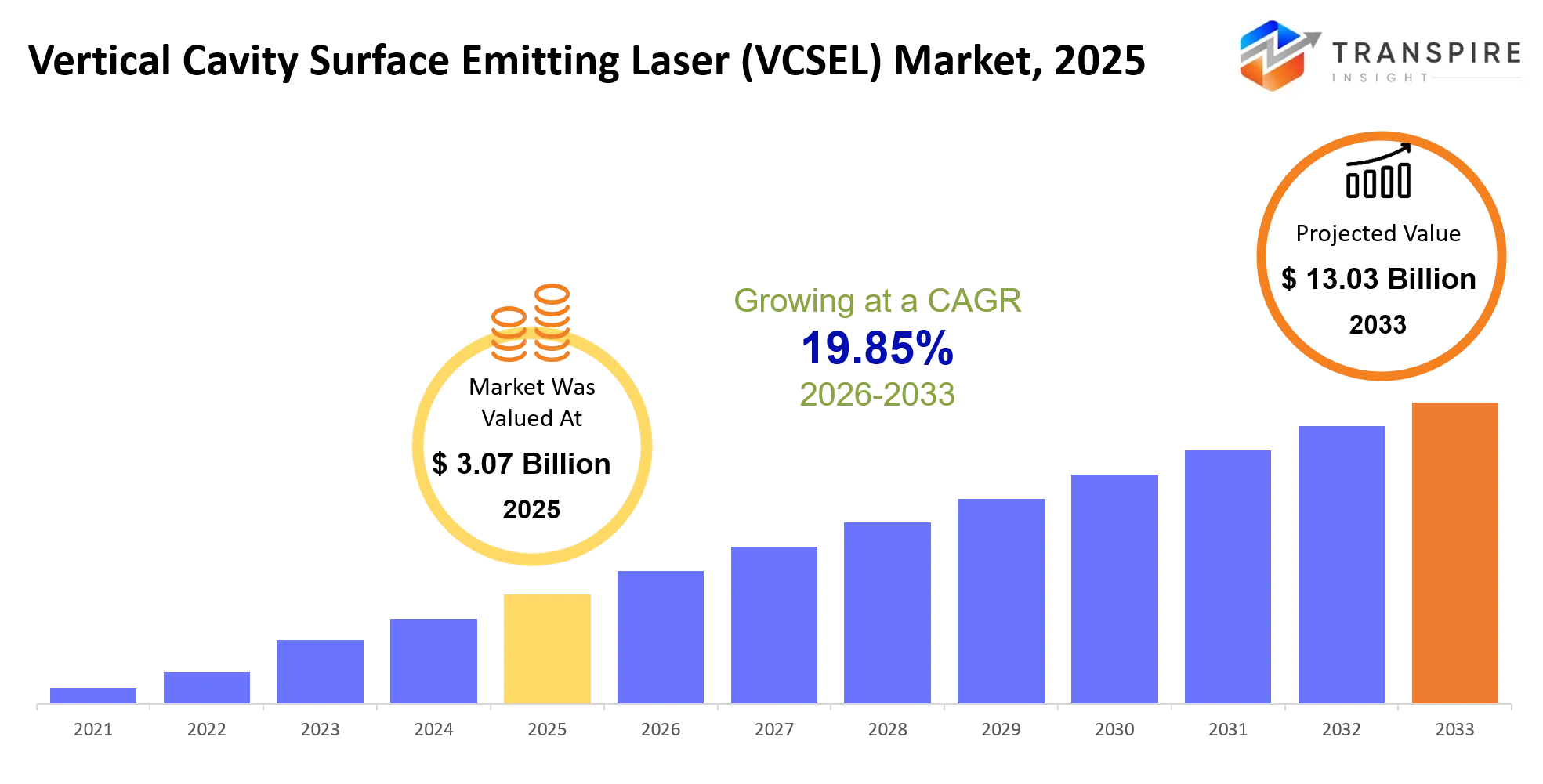
As per Transpire Insight Analysis, the Vertical Cavity Surface Emitting Laser (VCSEL) Market size is estimated at USD 3.07 billion in 2025 and is anticipated to reach USD 13.03 billion by 2033, growing at a CAGR of 19.85% from 2026 to 2033.
The Vertical Cavity Surface-Emitting Laser market is becoming more popular as companies look for power-saving light sources for sensing, sending data and accurate measuring. VCSEL technology is used a lot in face recognition, phone proximity sensors, car driver-assistance systems and fast optical communication. In the past three to five years, the market has grown beyond just electronics for regular people. More and more people are interested in using it for cars, factories and places where data is stored. A big change is happening where companies are using optical tools that help move data faster and make 3D sensing more accurate. The growth of intelligence and more people wanting powerful computers have made it even more important to have good optical connections. As more data is created and devices get better, companies are putting money into VCSEL designs that work better, last longer and fit in easier. These changes are making changes in areas like regular people's things, cars and factories.
Vertical Cavity Surface Emitting Laser (VCSEL) Market Size & Forecast:
- Market Size 2025: USD 3.07 Billion
- Expected Market Value (2033): USD 13.03 Billion
- Forecast CAGR (2026–2033): 19.85%
- Leading Region in 2025: Asia Pacific
- Fastest Growing Region: North America
- Key Company Profiles: Coherent, Lumentum, Broadcom, ams OSRAM, II-VI, TRUMPF, Sony, Hamamatsu Photonics, ROHM, Vertilite, Vixar, Santec, Excelitas Technologies, RayCan, Princeton Optronics
Key Market Insights
The market is moving towards multi-mode technology and is bolstered by well-developed multi-mode technology and rising applications in optical communications, sensing and the automotive industry.
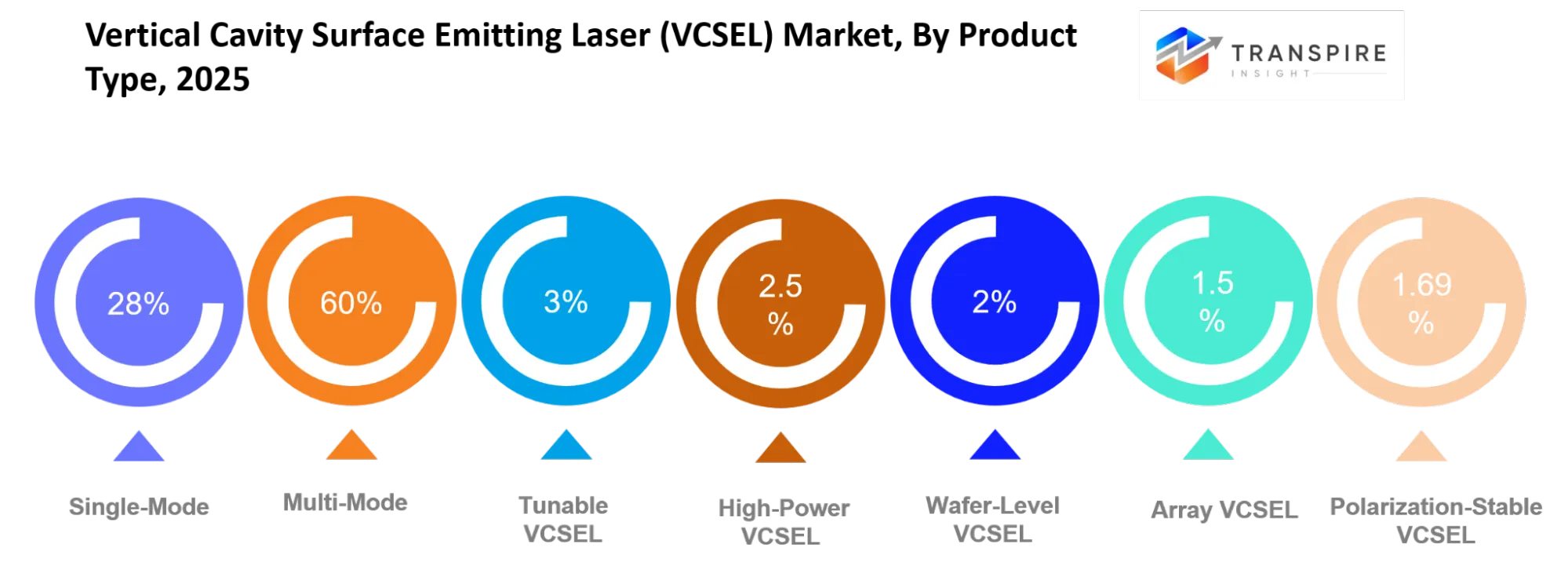
- Multi-mode VCSELs constitute 60.31% of the market, backed by proven applications in optical communications and the sensing industry, while Coherent develops high-speed VCSEL technologies for data centres.
- Single Mode VCSELs comprise 28.0% of the segment, as companies target to develop accurate optical devices for specialised sensing and communication needs.
- Tunable VCSELs are 3.0% of the market, opening up avenues for firms that develop flexible wavelength laser technologies for advanced optical systems.
- High Power VCSELs make up 2.5% of the segment, with companies exploring devices with high power for sensing and specialised illumination needs.
- Wafer Level VCSELs make up 2.0% of the market, motivating semiconductor firms to improve the yield and manufacturing process of devices.
- Array VCSELs make up 1.5% of the segment, as companies develop emitter arrays for parallel optical transmission and connectivity of high-density data centres.
- Polarisation-stable VCSELs are 1.0% of the market, serving specialised applications which require stable optical properties.
What are the Key Drivers, Restraints, and Opportunities in the Vertical Cavity Surface Emitting Laser (VCSEL) Market?
Drivers
The growth of AI compute and high-speed data centres is leading to an obvious commercial opportunity for VCSEL makers. As AI training and inference consume more data movement between computing elements, operators are investigating optical interconnects capable of higher bandwidths and power efficiencies at short distances in data centres. There is also an increasing applications opportunity from consumers for 3D sensing and automotive interest in optical sensing.
Restraints
Complexity of production is still a challenge. The design of VCSELs requires exacting control over the semiconductor layers, optical uniformity, temperature sensitivity and cost-effective yields. For rugged, high-volume applications, using specialised VCSEL devices or integrating them into established optical architectures adds to engineering complexity and cost. We also need to compete with other laser types and sensing architectures, where range, power or large installed bases are more important.
Opportunities
as device makers develop higher-density emitter arrays and lower-power optical links. in automotive sensing as vehicle makers roll out more sophisticated driver-assistance features; and in other emerging application areas as enterprise edge processing becomes more prevalent. Each of these application areas could favour companies that have the ability to produce both high-reliability wafer manufacturing and strong application-specific design expertise, as well as work closely with module manufacturers. Asia Pacific is attractive from a manufacturing and electronics integration standpoint, while North America is attractive from an AI infrastructure investment standpoint.
|
Driver |
Relative Impact on Growth |
Geographic Relevance |
Impact Timeline |
Demand Strength |
Growth Mechanism |
Key Beneficiaries |
Major Constraint |
|
Expansion of AI Data Centers and High-Speed Optical Interconnects |
Highest |
North America, Asia Pacific |
Medium-term |
High |
AI workloads increase demand for high-speed optical links. |
VCSEL manufacturers, optical transceiver vendors, hyperscale data centers. |
Bandwidth limitations and thermal management challenges. |
|
Increasing Adoption of Three-Dimensional Sensing in Consumer Electronics |
High |
Asia Pacific, North America |
Short-term |
High |
Facial recognition and depth sensing increase VCSEL integration. |
Laser manufacturers, smartphone OEMs, sensing module suppliers. |
Smartphone market saturation and changing device designs. |
|
Growing Automotive LiDAR and Advanced Driver-Assistance Systems Adoption |
High |
Asia Pacific, Europe, North America |
Medium-term |
High |
Automotive sensing increases demand for powerful VCSEL arrays. |
Automotive OEMs, LiDAR developers, semiconductor laser manufacturers. |
High qualification costs and competing laser technologies. |
|
Advancements in VCSEL Efficiency, Power and Manufacturing Technology |
Moderate |
North America, Europe, Asia Pacific |
Long-term |
High |
Improved efficiency enables compact, reliable optical devices. |
Photonics companies, semiconductor foundries, industrial equipment manufacturers. |
Fabrication complexity and low production yields. |
|
Expansion into Industrial Automation, Robotics and Specialized Sensing |
Moderate |
Europe, Asia Pacific, North America |
Long-term |
Medium |
Machine vision and robotics expand specialized VCSEL applications. |
Industrial automation vendors, robotics integrators, sensor manufacturers. |
Application-specific requirements slow commercialization and adoption. |
|
Total Relative Impact |
100% |
market |
— |
— |
— |
— |
— |
What Has the Impact of Artificial Intelligence Been on the Vertical Cavity Surface Emitting Laser (VCSEL) Market?
The use of artificial intelligence in the development of VCSEL arrays lies in its influence on the development of the processes in semiconductor manufacture, optical communications, and sensing. As the AI workloads increase, there is a requirement of increased speed of interconnection of the processor, accelerator, and networking devices in data centres. The new VCSEL arrays are being developed to deliver short-range optical interconnects that have high bandwidth and controlled energy consumption. Coherent has released its next-generation two-dimensional VCSEL and photodiode arrays in September 2025 that are dedicated to delivering AI optical interconnects. Artificial intelligence may assist the manufacture of VCSELs through analysis of the inspection images, finding defects during the process of the VCSEL production, and process variations. Prediction models could be used to assist in equipment maintenance prediction and wafer quality control. As regards the automotive and industrial fields, AI systems may analyse the optical measurements in order to enable detection of objects and distance estimation and automation of inspection processes. The use of AI is complicated by issues of implementation cost, requirements towards data accuracy, testing of models, and integration into current systems.
Instance
In September 2025, Coherent launched advanced VCSEL and photodiode arrays for high-speed, low-power optical connectivity in AI data centres. This illustrates the increasing importance of VCSEL technology in handling growing AI data transmission needs.
Key Market Trends:
The VCSEL industry is transitioning from consumer-oriented sensing applications to a combination of optical communications, automotive sensing, and general industrial applications.
- Innovation within the industry is shifting from single emitters to optical arrays, enabling simultaneous optical signals and smaller design form factors.
- Advancing trends in AI computing are driving suppliers to introduce VCSEL-based components in fast and short-distance optical communication solutions.
- Data centre providers are becoming more attentive to power consumption when building up computing infrastructure. This increases the demand for fast, reliable, and energy-efficient optical links.
- VCSELs are being considered for optical systems beyond mobile phones, such as driver sensing, depth sensing, and other applications related to cars.
- Semiconductor manufacturers pay growing attention to inspection, process uniformity, and yield improvement due to the complexities of optical device production.
Vertical Cavity Surface Emitting Laser (VCSEL) MarketSegmentation
By type
the worldwide VCSEL market consists of Single-Mode, Multi-Mode, Tunable VCSEL, High-Power VCSEL, Wafer-Level VCSEL, Array VCSEL, Polarization-Stable VCSEL, and Other VCSELs. Multi-Mode VCSELs constitute the largest distributed share in the market (60.31%), as they have been established to be used in optical communication and sensing at short reaches. Single-Mode VCSELs constitute 28.0%, Tunable VCSELs 3.0%, High-Power VCSELs 2.5%, Wafer-Level VCSELs 2.0%, Array VCSELs 1.5%, Polarization-Stable VCSELs 1.0%, and Others 1.69%. All shares sum up to 100%. The established multimode VCSEL base offers scale, and specialised VCSELs offer opportunities in high-speed links and application-specific systems.
By wavelength
the market consists of Red, Near Infrared, Shortwave Infrared, 850 nm, 940 nm, 980 nm, 1060 nm, and Other VCSELs by wavelength. Near-infrared VCSELs are used in sensing applications such as 3D sensing, illumination, and optical communications, while 850 nm VCSELs have an established application in multimode optical communications. 940 nm VCSELs are important in infrared sensing applications, including those not using any visible illumination.
By material
There are several material choices within this market – Gallium Arsenide, Gallium Nitride, Indium Phosphide, Aluminium Gallium Arsenide, other compound semiconductors, silicon-based materials, hybrid materials, and other material systems. Gallium arsenide and aluminium gallium arsenide are critical to VCSELs for traditional applications; some other semiconductor systems may be used for special wavelength and performance needs. The material type impacts emission level and output, efficiency, temperature characteristics, and product manufacturability. Future developments in this respect will need to balance these between yield and performance for the desired application. No percentage figures are shown for the component material types.
By application
The market is classified into Data Communication, 3D Sensing, LiDAR, Industrial Heating, Laser Printing, Infrared Illumination, Automotive Sensing and others. Data communication is likely to drive adoption of optical links for computing infrastructure and 3D sensing to enable depth measurement & spatial recognition in electronic devices. Additional sensing systems with projected demand include automotive sensing and LiDAR, as well as its rapid growth in systems used in vehicles; industrial heating, laser printing, and infrared illumination are each projected to use the technology for different types of equipment and operations.
By end user
Is targeted at Consumer Electronics, Automotive, Industrial, Healthcare, Telecommunications, Data Centres, Military and Defence, amongst others. Consumer electronics offer a known market with sensing and illumination devices, while data centres offer a nascent market due to the network speed needed for optical communications. Automotive customers will value robust devices for harsh environments, while industrial and healthcare users will want system-specific features. Telecoms and defence applications will have different requirements for reliability, integration, operating environments
By device type
The market covers Smartphones, Sensors, Transceivers, Optical Modules, LiDAR Systems, Wearables, Industrial Devices, and others. Smartphones and wearables employ smaller optical components for sensing and user-interface features, whereas transceivers and optical modules provide interconnects between computing and network devices. The use of LiDAR systems is an important development with scope for smaller optical emitters being incorporated into sensing architectures. Industrial devices need to operate reliably under specified conditions. As component and system manufacturers release more integrated optical systems, the opportunities at the device level will rest on features such as reliability, power consumption, component costs, and how they fit into the overall system.
What are the Key Use Cases Driving the Vertical Cavity Surface Emitting Laser (VCSEL) Market?
Multimode VCSELs are well-suited for short-reach optical communications and infrared sensing, and hence are applicable in data centres and consumer electronics. is an indicator of the proven nature of this technology. Applications that are developing include smartphone depth sensing, facial recognition, industrial inspection, and automotive sensing. In data centres, VCSELs can be used in transceivers and optical arrays for high-speed communication among computing elements. The demonstration by Coherent of advanced VCSEL arrays for AI infrastructure developments. The future applications may include next-generation LiDAR systems, specialised healthcare sensing, and optical links for AI computing. LiDAR systems are a possible growth driver, provided the forecast period and market methodology is confirmed.
|
Report Metrics |
Details |
|
Market size value in 2025 |
USD 3.07 Billion |
|
Market size value in 2026 |
USD 3.66 Billion |
|
Revenue forecast in 2033 |
USD 13.03 Billion |
|
Growth rate |
CAGR of 19.85% from 2026 to 2033 |
|
Base year |
2025 |
|
Historical data |
2021 - 2024 |
|
Forecast period |
2026 - 2033 |
|
Report coverage |
Revenue forecast, competitive landscape, growth factors, and trends |
|
Regional scope |
United States; Canada; Mexico; United Kingdom; Germany; France; Italy; Spain; Denmark; Sweden; Norway; China; Japan; India; Australia; South Korea; Thailand; Brazil; Argentina; South Africa; Saudi Arabia; United Arab Emirates |
|
Key company profiled |
Coherent, Lumentum, Broadcom, ams OSRAM, II-VI, TRUMPF, Sony, Hamamatsu Photonics, ROHM, Vertilite, Vixar, Santec, Excelitas Technologies, RayCan, Princeton Optronics |
|
Customization scope |
Free report customization (country, regional & segment scope). Avail customized purchase options to meet your exact research needs. |
|
Report Segmentation |
Type (Single-Mode, Multi-Mode, Tunable VCSEL, High-Power VCSEL, Wafer-Level VCSEL, Array VCSEL, Polarization-Stable VCSEL, Others)Wavelength (Red, Near Infrared, Shortwave Infrared, 850 nm, 940 nm, 980 nm, 1060 nm, Others)Material (Gallium Arsenide, Gallium Nitride, Indium Phosphide, Aluminum Gallium Arsenide, Other Compound Semiconductors, Silicon-Based, Hybrid Materials, Others)Application (Data Communication, 3D Sensing, LiDAR, Industrial Heating, Laser Printing, Infrared Illumination, Automotive Sensing, Others)End User (Consumer Electronics, Automotive, Industrial, Healthcare, Telecommunications, Data Centers, Military & Defense, Others)Device Type (Smartphones, Sensors, Transceivers, Optical Modules, LiDAR Systems, Wearables, Industrial Devices, Others) |
Which Regions are Driving the Vertical Cavity Surface-Emitting Laser (VCSEL) MarketGrowth?
North America
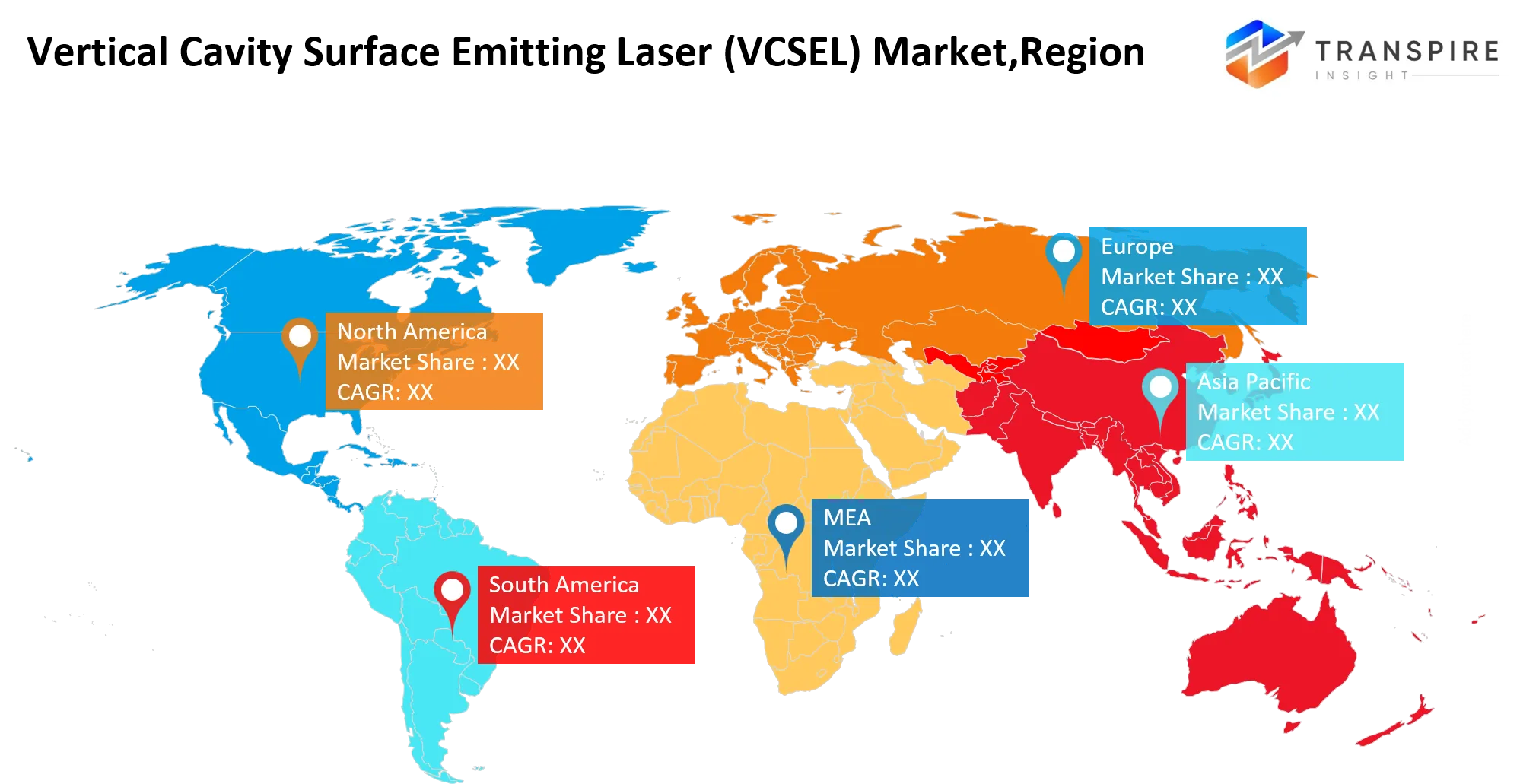
North America constitutes 19.37% of the regional distribution of supply and is categorised as the fastest-growing region at a 20.3% CAGR. AI computing infrastructure and high-performance data centres create potential for VCSEL-based optical interconnects. The presence of photonics suppliers and advanced computing infrastructure supports growth. Future growth is dependent on data centre investments, product qualifications and successful migration of new optical architectures to mass production.
In September 2026, Lumentum, Qualcomm and Corning presented a new optical connectivity demo for AI infrastructure based on VCSEL technology. The future presentation will demonstrate the combination of Lumentum’s high-density 1060 nm VCSEL solutions, Qualcomm’s interface technologies and Corning’s multimode fibre connectivity.
Europe
Europe accounts for 24.11%. It is aided by the presence of photonics research, semiconductor engineering, industrial automation and auto technology development. Companies like ams OSRAM and TRUMPF add value to the optical and laser technology ecosystem of the region, with sensing and industrial system applications. Growth can be sustained through continued investment in specialised manufacturing and auto electronics, even though individual shares for countries have not been mentioned.
In September 2026,ams OSRAM presented a thin-film VCSEL solution for AI scale-up. The company demonstrated next-generation 850 nm thin-film microVCSEL arrays with capabilities of parallel optical data transmission along with a connectorized multi-core fibre solution provided by ams OSRAM's ecosystem partner BizLink.
Asia Pacific
Asia Pacific accounts for 45.48% of the shares. This is because it is home to semiconductor manufacturing facilities, electronics supply chains, and device consumers. In addition, Asia Pacific can leverage the existing network of optical component manufacturers that serve customers from other regions. Adoption of sensor technologies and optical communications will strengthen its position further, but growth may not be uniform across countries.
In December 2025, ROHM Semiconductor released RPR-0730 high-speed optical sensor using VCSEL technology. This compact sensor utilises a 940 nm VCSEL and phototransistor in order to accurately detect small parts and fast-moving components. Its applications are label printers, conveyor systems, industrial machinery and motor rotation detection. This development illustrates possible applications of VCSELs in the electronics and industrial automation sectors in the Asia Pacific region.
Who are the Key Players in the vertical-cavity surface-emitting laser (VCSEL) Marketand how do they compete?
The competition in the VCSEL market is based on optical performance, production reliability, integration, cost-effectiveness, and meeting the needs of customers. The main competitors are Coherent, Lumentum, ams OSRAM, Broadcom, TRUMPF, Hamamatsu Photonics, VERTILAS, and Vertilite. Each company has its unique competitive position depending on the product range, production capabilities, and involvement in consumer electronics, data communication, automotive sensing, and industrial applications. Lumentum provides services to the communications and sensing industries through a wide range of photonics products, whereas Broadcom competes using optical connectivity solutions and semiconductor integration. ams OSRAM offers an emitter technology along with optical sensing capabilities and develops AI-based optical interconnects. TRUMPF works in special applications of lasers and photonics, while Hamamatsu Photonics is involved in a wide range of optoelectronics. VERTILAS has a unique competitive position based on its special long-wavelength VCSELs.
Vertical Cavity Surface Emitting Laser (VCSEL) Marketcompanies
- Coherent
- Lumentum
- Broadcom
- ams OSRAM
- II-VI
- TRUMPF
- Sony
- Hamamatsu Photonics
- ROHM
- Vertilite
- Vixar
- Santec
- Excelitas Technologies
- RayCan
- Princeton Optronics
|
Company |
Est. Revenue Share Range |
Key Offerings |
Strategic Positioning |
Geographic Strength |
Technology Focus |
|
Lumentum Holdings Inc. |
Estimated 12–18% |
3D sensing VCSELs, high-power VCSEL arrays, datacom lasers |
High-volume sensing and optical connectivity leadership |
North America, Asia Pacific, Europe |
High-power arrays, 3D sensing, optical interconnects |
|
Coherent Corp. |
Estimated 10–16% |
850 nm VCSELs, VCSEL arrays, datacom optical components |
Broad photonics portfolio and vertically integrated manufacturing |
North America, Asia Pacific, Europe |
GaAs devices, high-speed datacom, multi-emitter arrays |
|
ams OSRAM AG |
Estimated 8–13% |
Infrared VCSELs, sensing arrays, automotive emitters |
Application-specific sensing and automotive differentiation |
Europe, Asia Pacific, North America |
Infrared sensing, driver monitoring, automotive integration |
|
Broadcom Inc. |
Estimated 5–9% |
850 nm VCSELs, optical transceiver components, datacom laser solutions |
High-speed data-center connectivity specialization |
North America, Asia Pacific |
High-speed optical links, VCSEL-photodiode integration |
|
TRUMPF Photonic Components |
Estimated 4–7% |
High-power VCSELs, VCSEL arrays, sensing emitters |
Industrial reliability and high-power laser specialization |
Europe, North America, Asia Pacific |
High-power arrays, thermal management, industrial sensing |
|
Vertilite Co., Ltd. |
Estimated 2–5% |
VCSEL chips, infrared arrays, sensing modules |
Flexible manufacturing and Asian market expansion |
Asia Pacific, North America, Europe |
GaAs VCSELs, chip-level integration, infrared sensing |
|
VERTILAS GmbH |
Estimated 1–3% |
Long-wavelength VCSELs, gas-sensing lasers, spectroscopy emitters |
Specialized long-wavelength and industrial sensing solutions |
Europe, North America, Asia Pacific |
Long-wavelength VCSELs, single-mode emission, spectroscopy |
|
Hamamatsu Photonics K.K. |
Estimated 1–3% |
Semiconductor laser devices, infrared emitters, optical sensing components |
Precision photonics and specialized sensing applications |
Asia Pacific, Europe, North America |
Optical measurement, infrared sensing, photonic integration |
|
Sony Semiconductor Solutions Corporation |
Estimated 1–3% |
VCSEL-based sensing solutions, 3D sensing components, optical sensing technologies |
Consumer electronics ecosystem and depth-sensing expertise |
Asia Pacific, North America, Europe |
Time-of-flight sensing, compact optical systems, 3D imaging |
|
Santec Holdings Corporation |
Estimated 0.5–2% |
Specialized laser sources, optical measurement systems, photonics solutions |
Niche photonics expertise and precision optical applications |
Asia Pacific, North America, Europe |
Precision optical control, laser characterization, |
Recent Development News
In September 2026, Lumentum demonstrated a collaboration with Qualcomm and Corning that uses 1060 nm VCSELs for high-density optical die-to-die connectivity. This partnership is designed to provide high-speed and energy-efficient links for future AI scale-up systems.
In August 2025, Coherent extended its multi-year strategic supply contract with Apple to ensure the production of VCSELs for the Face ID features in iPhone and iPad devices. The contract ensures long-term supply of components and continued production at Coherent's Sherman, Texas, site.
What Strategic Insights Define the Future of the Vertical Cavity Surface Emitting Laser (VCSEL) Market?
The future of the worldwide VCSEL market will be based on the ability of manufacturers to progress from proven sensing applications into high-value optical communication and special industrial applications. AI data centres represent an exciting opportunity, although commercial viability will require more than improved speed from VCSELs. Energy efficiency, robustness, manufacturability, and compatibility with future optical architectures will be essential.A hidden danger is that competing technologies or changes in system architecture could result in reduced demand for certain VCSEL designs before manufacturers recoup their development costs. Wavelength requirements, distances, and integration costs could also hinder the adoption of certain technologies. There is an emerging opportunity in highly integrated VCSEL arrays for AI interconnects, as well as ongoing opportunities in automotive and industrial sensing. Companies should focus on co-development with customers, increasing production yield, and designing for specific applications. A combination of proven revenue streams with select investments in new optical technologies can mitigate risks associated with individual end markets.
Type
- Single-Mode
- Multi-Mode
- Tunable VCSEL
- High-Power VCSEL
- Wafer-Level VCSEL
- Array VCSEL
- Polarization-Stable VCSEL
- Others
Wavelength
- Red
- Near Infrared
- Shortwave Infrared
- 850 nm
- 940 nm
- 980 nm
- 1060 nm
- Others
Material
- Gallium Arsenide
- Gallium Nitride
- Indium Phosphide
- Aluminum Gallium Arsenide
- Other Compound Semiconductors
- Silicon-Based
- Hybrid Materials
- Others
Application
- Data Communication
- 3D Sensing
- LiDAR
- Industrial Heating
- Laser Printing
- Infrared Illumination
- Automotive Sensing
- Others
End User
- Consumer Electronics
- Automotive
- Industrial
- Healthcare
- Telecommunications
- Data Centers
- Military & Defense
- Others
Device Type
- Smartphones
- Sensors
- Transceivers
- Optical Modules
- LiDAR Systems
- Wearables
- Industrial Devices
- Others
Frequently Asked Questions
Find quick answers to common questions.
The vertical cavity surface emitting laser (VCSEL) market size was valued at USD 3.07 Billion in 2025 and is poised to reach USD 13.03 Billion by 2033, expanding at a 19.85% CAGR.
Key segments for the vertical cavity surface emitting laser (VCSEL) market are Type (Single-Mode, Multi-Mode, Tunable VCSEL, High-Power VCSEL, Wafer-Level VCSEL, Array VCSEL, Polarization-Stable VCSEL, Others)Wavelength (Red, Near Infrared, Shortwave Infrared, 850 nm, 940 nm, 980 nm, 1060 nm, Others)Material (Gallium Arsenide, Gallium Nitride, Indium Phosphide, Aluminum Gallium Arsenide, Other Compound Semiconductors, Silicon-Based, Hybrid Materials, Others)Application (Data Communication, 3D Sensing, LiDAR, Industrial Heating, Laser Printing, Infrared Illumination, Automotive Sensing, Others)End User (Consumer Electronics, Automotive, Industrial, Healthcare, Telecommunications, Data Centers, Military & Defense, Others)Device Type (Smartphones, Sensors, Transceivers, Optical Modules, LiDAR Systems, Wearables, Industrial Devices, Others)
Growth is primarily driven by increasing demand for 3D sensing technology, rising adoption of VCSELs in smartphones and consumer electronics, expanding data center and optical communication infrastructure, growing use in automotive safety systems, and advancements in semiconductor manufacturing technologies
The market is led by major manufacturers including Coherent, Lumentum, Broadcom, ams OSRAM, II-VI, TRUMPF, Sony, Hamamatsu Photonics, ROHM, Vertilite, Vixar, Santec, Excelitas Technologies, RayCan, Princeton Optronics
The Asia Pacific region leads in the VCSEL market, holding 45.48% of the market share. This is attributed to robust semiconductor production facilities, increased demand for consumer electronics, data center construction, and widespread use of VCSELs in smartphones, 3D sensing technology, automobiles, and industrial products.
Opportunities in the VCSEL market include the increasing need for 3D sensing in smartphones, optical communication in data centers, VCSELs in automotive LiDAR and driver assistance systems, as well as their applications in industrial automation, medical devices, and fast data transmission.
About the Authors

Avinash Kumar
I’m Avinash Kumar, a Senior Research Analyst at Transpire Insight, with expertise in the Electronics and Semiconductor and Energy & Power industry. My work focuses on analyzing emerging technologies, market trends, industry developments, and innovation across these sectors. I specialize in transforming complex technical and market insights into clear, research-backed content that helps professionals, businesses, and decision-makers stay informed. Through continuous industry research and data-driven analysis, I strive to deliver accurate, reliable, and practical perspectives on the latest advancements shaping the semiconductor and energy landscape.

Chakradhar Khansole
Chakradhar serves as the Research Director at Transpire Insight, bringing over 8 years of experience in technology, innovation, and strategic market intelligence. He specializes in transforming complex market data into actionable business insights that enable organizations to make informed, growth-oriented decisions. Recognized for his strategic vision and analytical expertise, Chakradhar leads high-impact research initiatives, delivering comprehensive market assessments, competitive intelligence, and forward-looking industry analysis.
Recently Published Reports
-
Apr 2026
Fiber Optic Faceplates Market
Fiber Optic Faceplates Market Size, Share & Analysis Report By Type (< 300 mm2, 300-350 mm2, and > 350 mm2, By Application (Night Vision, Holographic Imaging, Medical, and Others), and Geography (North America, Europe, Asia-Pacific, Middle East and Africa, South and Central America), 2021 - 2031
-
Apr 2026
High Temperature Superconductors Market
High Temperature Superconductors Market Size, Share & Analysis Report By Type (1G HTS, and 2G HTS), By Application (Power Cable, Fault Current Limiter, and Transformer), and Geography (North America, Europe, Asia-Pacific, Middle East and Africa, South and Central America), 2021 - 2031
-
Apr 2026
Industrial Plugs and Socket Market
Industrial Plugs and Socket Market Size, Share & Analysis Report By Type (Industrial Plugs, Industrial Sockets), By Current (Up to 32 A, 32 to 125 A, Above 125 A), By Protection (Dustproof and Splash Proof, Waterproof, Explosion Proof), By End User (Heavy Industries, Oil and Gas, Chemicals and Pharmaceuticals, Power Generation, Others), and Geography (North America, Europe, Asia-Pacific, Middle East and Africa, South and Central America), 2021 - 2031
-
Apr 2026
InGaAs Avalanche Photodiodes Market
InGaAs Avalanche Photodiodes Market Size, Share & Analysis Report By Type (1100 - 1700 nm, and 1000 - 1600 nm), By Application (Missile Warning System, Muzzle Flash Detection, Wafer Defect Inspection, Laser Rangefinders, and Others), and Geography (North America, Europe, Asia-Pacific, Middle East and Africa, South and Central America), 2021 - 2031