
Vascular Access Device Market Summary:
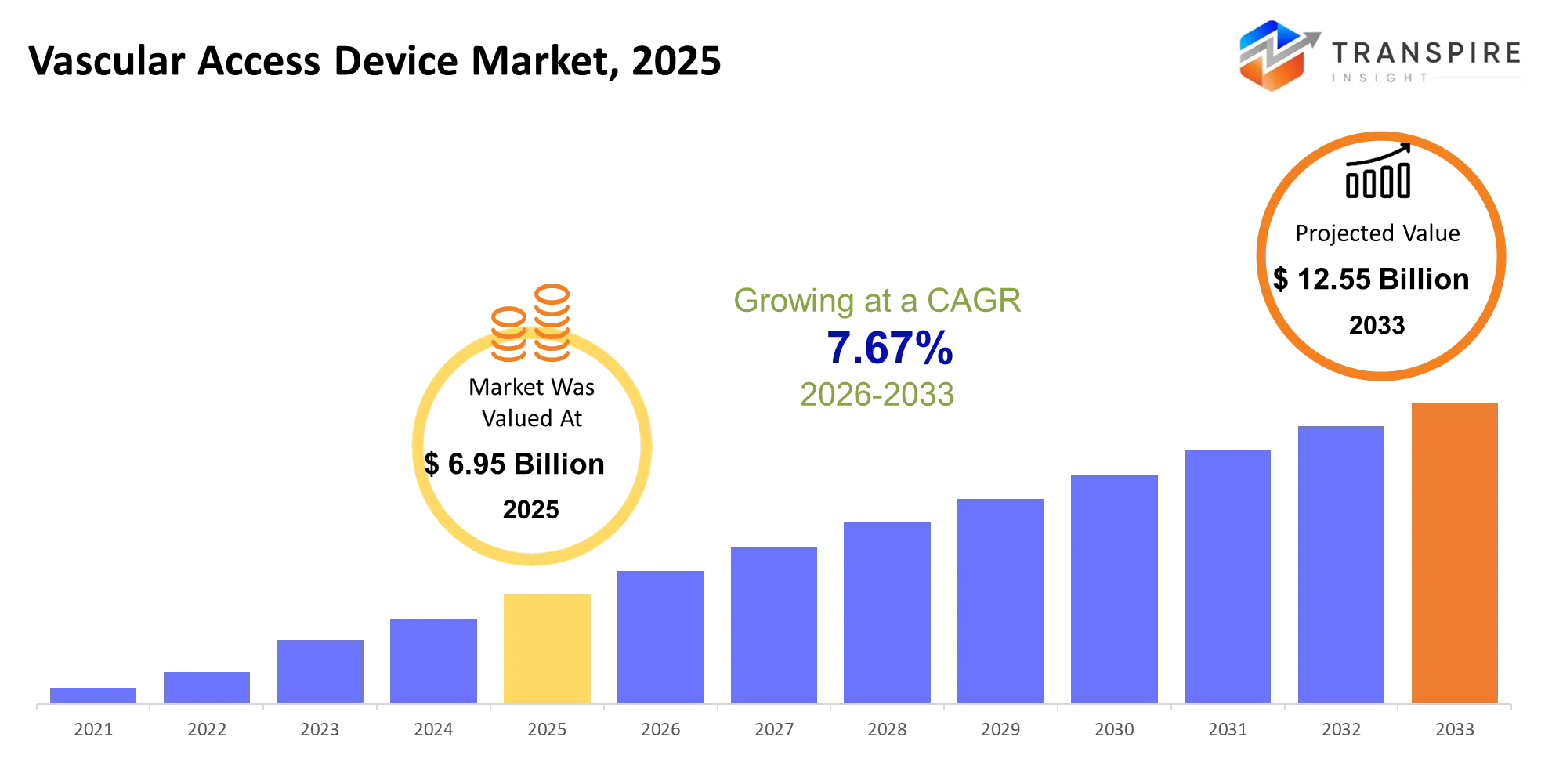
As per Transpire Insight, the Vascular Access Device Market size is estimated at USD 6.95 billion in 2025 and is anticipated to reach USD 12.55 billion by 2033, growing at a CAGR of 7.67% from 2026 to 2033.
The vascular access device market supports the delivery of medicines, fluids, nutrition, blood products and dialysis treatments by giving healthcare providers access to a patient’s bloodstream. Hospitals and other medical facilities use these devices every day for IV therapy, emergency care, cancer treatment and managing long-term illnesses. In the three to five years the industry has focused more on keeping infections from catheters low preventing blood clots and making vascular access procedures more successful. A major change has been the shift toward using ultrasound to guide catheter insertion well as new catheter designs that stay in place longer while causing fewer problems. As treatments become more complex and patients need repeated access to their veins there is growing interest in devices that work well and last longer. With healthcare providers putting emphasis on patient safety and reducing the need, for repeated procedures manufacturers have a chance to create better materials, safer insertion tools and devices that match different treatment lengths.
Vascular Access Device Market Size & Forecast:
- Market Size 2025: USD 6.95 Billion
- Expected Market Value (2033): USD 12.55 Billion
- Forecast CAGR (2026–2033): 7.67%
- Leading Region in 2025: North America
- Fastest Growing Region: Asia Pacific
- Key Company Profiles: BD, Teleflex, B. Braun, Edwards Lifesciences, Terumo, Smiths Medical, ICU Medical, AngioDynamics, Merit Medical Systems, Vygon, Cook Medical, Nipro, Cardinal Health, Argon Medical Devices, Romsons
Key Market Insights:
The market is driven by the demand for reliable vascular access in the context of acute care, long-term therapy, and specialised procedures. Product differentiation is becoming more and more based on patient safety, catheter performance, and reduction in complications.
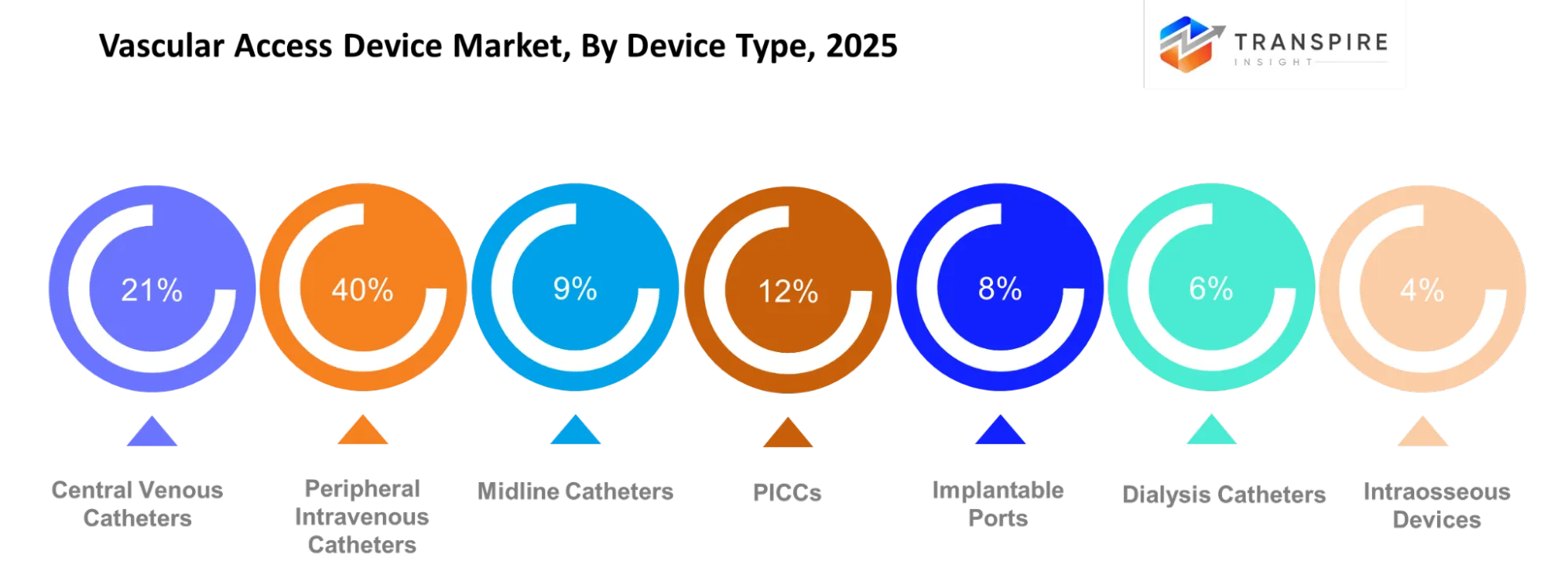
- Peripheral intravenous catheters constitute 39.5% of the market, which is due to their traditional use in standard hospital therapy and short-term intravenous administration.
- Midline catheters will have a 9.7% CAGR, which is fueled by the interest in prolonged intravenous access and a reduced number of insertion attempts.
- Central venous catheters are 21.0% of the market, maintaining their relevance in critical care and therapy that requires central venous access.
- PICCs make up 12.0%, being used for longer-term administration of medications and access.
- Implantable ports constitute 8.5% of the market and are relevant for patients with recurring treatment needs, including chemotherapy.
- Dialysis catheters constitute 6.0% of the market, providing vascular access for patients undergoing hemodialysis.
- Intraosseous devices are 2.0% of the market, providing an alternative method of vascular access.
What are the Key Drivers, Restraints, and Opportunities in the Vascular Access Device Market?
Drivers:
Market adoption is driven by the requirement for reliable IV access in emergency, ICU, cancer and long-term therapy environments. Multiple attempts at cannulation create discomfort, wasting time and adding to the workload of staff, a problem that drives hospitals to prefer devices which are appropriate to the duration and level of complexity of the patient's therapy. The growth of specialist vascular access services, along with heightened awareness of catheter-associated adverse events, also promotes investment in the device materials and insertion methods.
Restraints:
High cost of acquisition, training and hospital budget discrepancies may prevent facilities from purchasing advanced devices. Additional issues to be taken into account by facilities include infection prevention protocols, staff capability, product interoperability and ongoing consumable costs. Such barriers remain because of the need to handle vascular access devices safely and treat patients using the right clinical technique, while saving money on complications may not be shared across departments.
Opportunities:
A significant chance comes from midline catheters and other next-generation peripheral access devices and ultrasound-guided insertion systems. Markets want to target solutions that can help ensure first-attempt success and avoid unnecessary replacement of catheters. There is also opportunity in developing new products for dialysis access and other applications that typically require higher longevity, when traditional access methods are less sustainable. An example is the commercial launch of the aXess hemodialysis vascular access device in Europe by Xeltis
|
Driver |
Relative Impact on Growth (%) |
Geographic Relevance |
Impact Timeline |
Demand Strength |
Growth Mechanism |
Key Beneficiaries |
Major Constraint |
|
Rising prevalence of chronic diseases and long-term infusion therapy |
28% |
North America, Europe, Asia-Pacific |
Long-term (≥4 years) |
High |
Expands demand for chemotherapy, dialysis, and intravenous medications |
Catheter manufacturers, hospitals, infusion service providers |
High treatment costs and limited healthcare budgets |
|
Increasing focus on catheter-related infection prevention and patient safety |
24% |
North America, Europe |
Short-term (≤2 years) |
High |
Encourages adoption of antimicrobial catheters and safety-engineered devices |
Medical device manufacturers, hospitals, infection-control teams |
Premium product pricing and strict compliance requirements |
|
Technological advancements in catheter design and insertion techniques |
20% |
North America, Europe, Asia-Pacific |
Medium-term (2–4 years) |
High |
Improves placement accuracy and reduces vascular access complications |
Device innovators, ultrasound vendors, healthcare providers |
High technology costs and specialized training requirements |
|
Aging population and rising surgical and hospital admission volumes |
16% |
Europe, North America, Asia-Pacific |
Long-term (≥4 years) |
High |
Increases demand for reliable access during complex medical treatments |
Hospitals, catheter suppliers, clinical care providers |
Workforce shortages and pressure on hospital expenditure |
|
Expansion of outpatient infusion, ambulatory care, and home healthcare |
12% |
North America, Europe, Asia-Pacific |
Medium-term (2–4 years) |
Medium |
Shifts infusion treatments toward convenient non-hospital settings |
Home healthcare providers, portable device manufacturers, patients |
Infrastructure gaps and challenges in home-care monitoring |
|
Total |
100% |
— |
— |
— |
— |
— |
— |
What Has the Impact of Artificial Intelligence Been on the Vascular Access Device Market?
AI provides the potential opportunity to enhance the procedure of vascular access through the interpretation of ultrasound images, vein identification, and decision-making during the procedure. In ultrasound-guided insertion, image processing technologies could allow clinicians to identify suitable veins and determine their depth to assist with procedure planning in cases where veins are hard to find. AI-assisted tools could also provide assistance with procedure documentation, training of healthcare professionals, and analysis of clinical data to detect patterns associated with failed insertion or catheter-related complications. Predictive analytics could assist healthcare professionals to identify patients requiring a special access device based on their treatment period, history of access problems, and other clinical factors. This combination with electronic health records could allow more appropriate choice of the device and planning of hospital staff and resources.AI is still being developed in terms of its application in vascular access, and the presence of validated and device-specific tools is not guaranteed. Implementation of such technology requires purchasing equipment and conducting training, as well as integrating it into the current hospital system. Additionally, image quality, differences in patient anatomy, and accuracy of the algorithm could have an impact on the effectiveness of AI.
Instance:
In November 2025,An artificial intelligence-based module that facilitates the procedure for peripheral IV access. It helps in vein identification, distinguishing veins from arteries, and measuring vein size for catheter insertion. This is one example where artificial intelligence can be useful in vascular access planning.
Key Market Trends:
Access technology is evolving from simple catheter availability to more safety in insertion, optimal device selection, and effective management during treatment.
- The development of catheters focuses more on enhancing biocompatibility and using surface technologies designed to minimise thrombosis and other risks.
- Central line access systems become more complex, as companies design products aimed at making the procedure steps simpler and consistent.
- Access technology innovations in dialysis extend beyond traditional catheter devices into technologies that allow creating long-term vascular access.
- The choice of clinical purchases is more influenced by such issues as prevention of complications, work burden and total cost of therapy.
- The trend toward home health care and outpatient therapy increases the demand for access devices that enable planned treatment without compromising safety.
- Manufacturers develop clinical evidence to demonstrate benefits of differentiated catheters.
Vascular Access Device Market Segmentation
By device type:
Peripheral intravenous catheters lead in terms of market share with 39.5%, due to their extensive use in routine drug and fluid administration. Central venous catheters have a share of 21.0%, followed by PICC at 12.0% and midline catheters at 9.0%. Implantable ports make up 8.5%, dialysis catheters 6.0%, intraosseous catheters 2.0%, and others 2.0%. The midline catheter market is expected to grow at the fastest rate of 9.7%, as healthcare providers look for appropriate devices for extended intravenous therapy.
By product type:
Short peripheral intravenous catheters will be used for short-term therapy and routine hospital operations, while extended-dwell peripheral catheters and PICCs will be required by patients requiring access for extended periods. Central venous catheters, ports, dialysis access products, arterial catheters, and other specialised products will cater to specific needs. Future product innovations may be focused on aligning device types with treatment period and health conditions of the patients.
By material:
Polyurethane, silicone, PVC, polyethene, PTFE, polycarbonate, stainless steel and many other materials lend themselves to addressing these different needs such as durability, strength, biocompatibility and flexibility. Material innovation matters – designers need to seek the middle ground of performance and patient comfort. Thrombosis reduction and tissue irritation could help shape more distinctive materials.
By application:
Drug infusion and fluid infusion are the principal applications, along with blood transfusions, nutrition, chemotherapy, dialysis, blood sampling and others. The level of demand depends on the level of treatment complexity and whether frequent access is required. Oncology and dialysis applications offer specific opportunities for products intended for repeated or extended use.
By end user:
Besides the market driving factors of benefits and performance, hospitals will continue to be a leading market for point-of-care devices and products, as they treat emergency cases, perform surgeries, have intensive-care units and provide high-end therapy services. Other settings include clinics, speciality clinics, ambulatory surgical centres, home health care, dialysis centres, emergency room units and other facilities. The market of the future will be to some extent based on whether products can be effectively and safely used in such settings.
By patient type:
This market offers products for adults, pediatric and neonatal patients, geriatric patients, oncology patients, critical care patients, dialysis patients and more. Variations in vessel sizes, indications and treatments, as well as physical and clinical status, impact device selection. Manufacturers capable of offering specialised design features and size ranges may be well-placed to meet such needs.
What are the Key Use Cases Driving the Vascular Access Device Market?
Peripheral intravenous catheters are c used to deliver medications, provide hydration, and for short-term infusion in hospitals and accident & emergency settings due to their established clinical application in the process of treatment. The increasing list of peripheral intravenous catheter applications includes chemotherapy, blood transfusion, parenteral nutrition, and long-term intravenous treatment. These types of catheters include PICCs and central venous catheters used for some treatments of special kinds.The new fields for PICC usage may include providing access to the venous system in cases of difficult-vein patients, long-term dialysis treatments, and catheter placement under ultrasonic guidance. The midline catheter is a possible option in this case.
|
Report Metrics |
Details |
|
Market size value in 2025 |
USD 6.95 Billion |
|
Market size value in 2026 |
USD 7.48 Billion |
|
Revenue forecast in 2033 |
USD 12.55 Billion |
|
Growth rate |
CAGR of 7.67% from 2026 to 2033 |
|
Base year |
2025 |
|
Historical data |
2021 - 2024 |
|
Forecast period |
2026 - 2033 |
|
Report coverage |
Revenue forecast, competitive landscape, growth factors, and trends |
|
Regional scope |
United States; Canada; Mexico; United Kingdom; Germany; France; Italy; Spain; Denmark; Sweden; Norway; China; Japan; India; Australia; South Korea; Thailand; Brazil; Argentina; South Africa; Saudi Arabia; United Arab Emirates |
|
Key company profiled |
BD, Teleflex, B. Braun, Edwards Lifesciences, Terumo, Smiths Medical, ICU Medical, AngioDynamics, Merit Medical Systems, Vygon, Cook Medical, Nipro, Cardinal Health, Argon Medical Devices, Romsons |
|
Customization scope |
Free report customization (country, regional & segment scope). Avail customized purchase options to meet your exact research needs. |
|
Report Segmentation |
Device Type (Central Venous Catheters, Peripheral Intravenous Catheters, Midline Catheters, PICCs, Implantable Ports, Dialysis Catheters, Intraosseous Devices, Others)Product Type (Short PIVCs, Extended-Dwell PIVCs, PICCs, CVCs, Ports, Dialysis Access, Arterial Catheters, Others)Material (Polyurethane, Silicone, PVC, Polyethylene, PTFE, Polycarbonate, Stainless Steel, Others)Application (Drug Administration, Fluid Administration, Blood Transfusion, Nutrition, Chemotherapy, Hemodialysis, Blood Sampling, Others)End User (Hospitals, Clinics, Ambulatory Surgical Centers, Dialysis Centers, Home Healthcare, Emergency Departments, Specialty Centers, Others)Patient Type (Adult, Pediatric, Neonatal, Geriatric, Oncology Patients, Critical Care Patients, Dialysis Patients, Others) |
Which Regions are Driving the Vascular Access Device Market Growth?
North America:
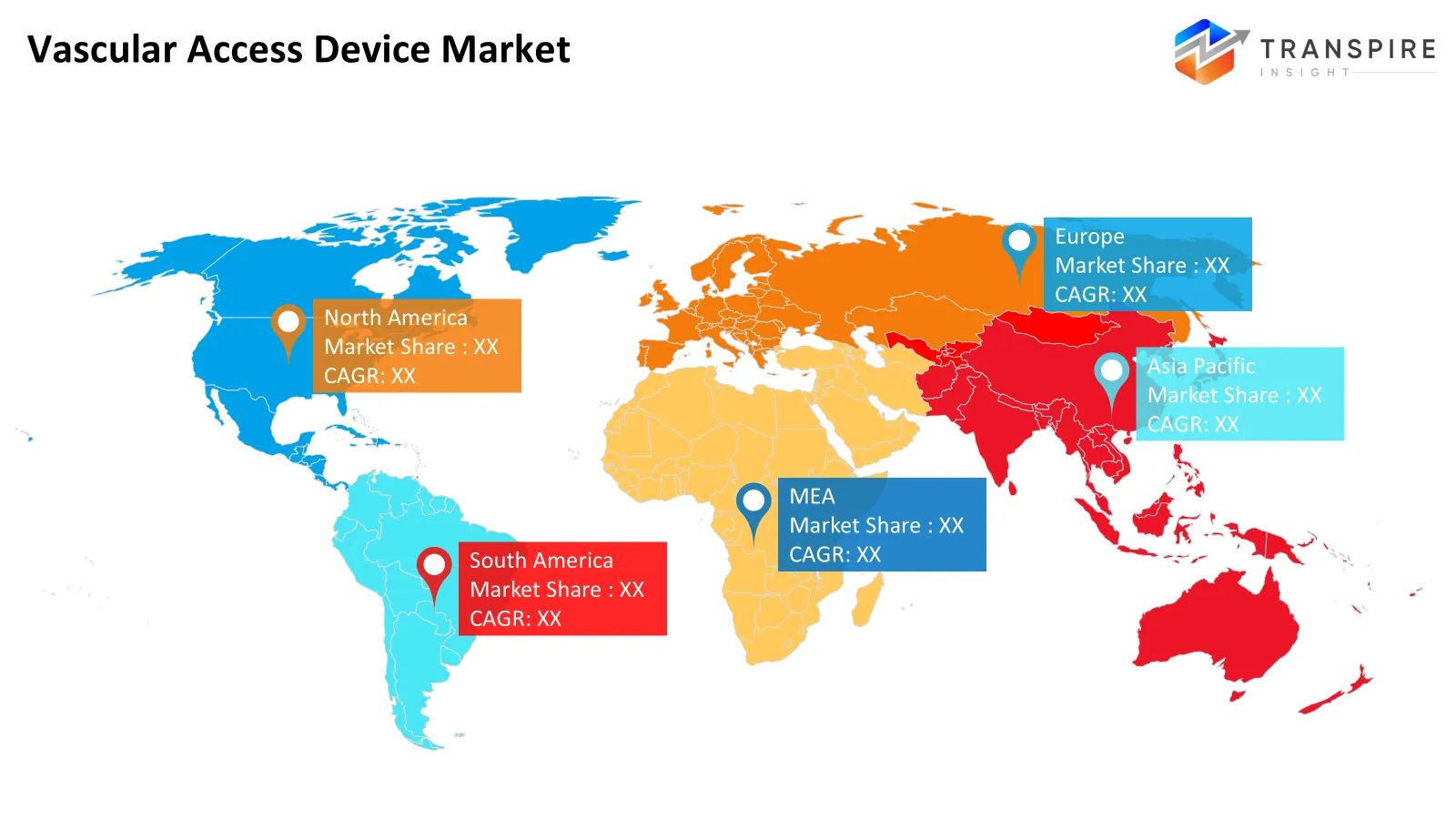
The North American region accounts for 38.2% of the market share. This is due to the availability of established hospitals in addition to advanced medical equipment. The North American region is preferred because of the guidelines, patient safety, and health care facilities that can handle complex cases. The need for catheters comes from intensive care, oncology, and dialysis. The prevention of complications and the insertion process will favour manufacturers of specialised devices.
In April 2026, BD (Becton, Dickinson and Company) presented the US market release of its first 'one-step' central line insertion system, the Centro Vena One. The system aims to remove the complexity associated with the insertion of central venous catheters and to enhance the safety of the patient during vascular access procedures, a further demonstration of ongoing investment in North America's vascular access space.
Europe:
Europe represents a 29.1% share in the vascular access devices market. The reason behind that is having an established health care system and the need for more efficient vascular access devices in hospital as well as non-hospital settings. Unlike North America, where growth comes as a result of increased population, in Europe growth comes about due to the health care budget of each country. There exist clinical guidelines that have to be followed in healthcare facilities in Europe, thus making safety factors important.
In July 2026, Xeltis performed the first commercial implantation of its aXess vascular access device in Germany. This device is used for a patient requiring hemodialysis. The device is designed to facilitate the formation of a living vessel in patients. This development shows the contribution of the European region to the creation of novel vascular access devices for patients with chronic kidney disease.
Asia Pacific:
The Asia Pacific region accounts for 22.0% of the market and is expected to be the fastest-growing segment at a projected CAGR of 8.9%. There are ample opportunities in the Asia Pacific owing to improvements in healthcare infrastructure and access to speciality care, and increased investments in the provision of hospital services. Market growth is especially pertinent where vendors are upgrading their clinical capabilities and access to care for oncology and dialysis patients. Vendors capable of delivering quality products at competitive prices can succeed in this market.
In December 2025, BD Indonesia launched BD Nexiva Closed IV Catheter System in Indonesia. The device was introduced during the national webinar on vascular access management that involved about 1,100 healthcare professionals in the region. The introduction of this new vascular access device aims to reduce the risk of complications such as phlebitis and infiltration.
Who are the Key Players in the Vascular Access Device Market and how do they compete?
The competition in the vascular access device market is based on product reliability, patient safety, clinical evidence, product portfolio, and relationships with healthcare providers. The competition occurs through the existing hospital supply chain, catheter design, catheter insertion, and the ability to cater to various clinical environments. The purchasing decision is also determined by the training needs, consumables, and the impact of the device on the clinical process.BD stands out in terms of the broad portfolio of vascular access products and the safety-focused procedural solutions. release of the CentroVena One catheter insertion system demonstrates BD's approach aimed at making the process of inserting a central line easier and facilitating clinical workflow. B. Braun competes due to its innovations in catheters and devices for difficult venous access. Vygon and AngioDynamics cater to particular clinical needs through their product portfolios. Medtronic, Cook Medical, and Merit Medical compete in other medical device markets which include vascular and catheter-based procedures.
Vascular Access Device Market Companies
- BD
- Teleflex
- B. Braun
- Edwards Lifesciences
- Terumo
- Smiths Medical
- ICU Medical
- AngioDynamics
- Merit Medical Systems
- Vygon
- Cook Medical
- Nipro
- Cardinal Health
- Argon Medical Devices
- Romsons
|
Company |
Est. Revenue Share Range |
Key Offerings |
Strategic Positioning |
Geographic Strength |
Technology Focus |
|
Becton, Dickinson and Company (BD) |
Estimated 18–25% |
Peripheral IV catheters, PICCs, midline catheters, central venous catheters |
Broad portfolio leadership with extensive hospital distribution |
North America, Europe, Asia Pacific |
Closed IV systems, catheter safety, integrated access solutions |
|
Teleflex Incorporated |
Estimated 10–15% |
Arrow PICCs, central venous catheters, antimicrobial catheters, intraosseous devices |
Premium critical-care access and complication-reduction solutions |
North America, Europe, Asia Pacific |
Antimicrobial catheters, guided placement, intraosseous access |
|
B. Braun SE |
Estimated 6–10% |
Introcan Safety IV Catheters, Certofix CVCs, PICCs, access accessories |
Safety-focused products with integrated infusion expertise |
Europe, North America, Asia Pacific |
Needlestick prevention, blood-control technology, catheter safety |
|
ICU Medical, Inc. |
Estimated 5–8% |
Central venous catheters, peripheral IV catheters, needle-free connectors, access products |
Integrated infusion and vascular access portfolio |
North America, Europe, Asia Pacific |
Closed-system access, connector technology, infusion safety |
|
Terumo Corporation |
Estimated 4–7% |
Peripheral IV catheters, introducer sheaths, vascular access needles, access catheters |
Precision-engineered devices with broad medical distribution |
Asia Pacific, North America, Europe |
Catheter engineering, insertion precision, safety-oriented designs |
|
Medtronic plc |
Estimated 3–6% |
Vascular access catheters, introducers, interventional access devices |
Procedure-led competition supported by interventional expertise |
North America, Europe, Asia Pacific |
Minimally invasive access, catheter design, procedural compatibility |
|
AngioDynamics, Inc. |
Estimated 2–4% |
BioFlo PICCs, BioFlo Midlines, central venous access products |
Differentiated catheter materials and specialty access applications |
North America, Europe |
Endexo polymer technology, thrombogenicity-reduction design |
|
Cook Medical |
Estimated 2–4% |
Central venous catheters, PICCs, introducer sets, access needles |
Specialist positioning in procedural and hospital vascular access |
North America, Europe, Asia Pacific |
Catheter design, access systems, minimally invasive insertion |
|
Vygon Group |
Estimated 2–4% |
PICCs, midline catheters, central venous catheters, neonatal access devices |
Clinical specialization in intensive care and neonatal access |
Europe, Asia Pacific, Middle East & Africa |
Neonatal catheter design, infusion safety, specialized access |
|
Medical Components, Inc. (Medcomp) |
Estimated 1–3% |
Hemodialysis catheters, tunneled catheters, PICCs, implantable ports |
Specialty-focused competition in dialysis and long-term vascular access |
North America, Europe, Asia Pacific |
Dialysis catheter engineering, long-term access, biocompatible materials |
Recent Development News
- In July 2025, the new-generation InThrill Thrombectomy System was introduced by Inari Medical, which is a division of Stryker. The device has been designed for clot extraction in small blood vessels and arteriovenous access, including dialysis access procedures. https://www.stryker.com/us/en/about/news/2025/inari-medical-stryker-launches-all-new-inthrill-thrombectomy-system.html
- In April 2026, BD introduced its CentroVena One insertion system for central venous catheters. The integrated design has been developed with the purpose of simplification of the insertion process and patient safety in acute care settings. https://news.bd.com/2026-04-29-BD-Reimagines-Central-Line-Insertion,-Advancing-Leadership-in-Patient-Safety-Through-Breakthrough-Vascular-Access-Technology
What Strategic Insights Define the Future of the Vascular Access Device Market?
The future of the vascular access device market will depend largely on balancing clinical efficacy, patient safety, and the cost of therapy. The emphasis won't only be on the presence of products, but rather, companies have to prove how they will enhance the success rates and help reduce possible complications associated with therapy while ensuring a proper period of administration of treatment through their device. The biggest chances are going to exist in midline catheters, innovative peripheral access devices, and difficult venous access technology. Another risk that is likely to affect this industry is that hospitals might not want to buy expensive devices where the clinical advantages aren't well proven. Differences in clinical training, availability of products, and regulations can act as additional barriers towards the adoption of these products.
Key Segmentations are:
Device Type
- Central Venous Catheters
- Peripheral Intravenous Catheters
- Midline Catheters
- PICCs
- Implantable Ports
- Dialysis Catheters
- Intraosseous Devices
- Others
Product Type
- Short PIVCs
- Extended-Dwell PIVCs
- PICCs
- CVCs
- Ports
- Dialysis Access
- Arterial Catheters
- Others
Material
- Polyurethane
- Silicone
- PVC
- Polyethylene
- PTFE
- Polycarbonate
- Stainless Steel
- Others
Application
- Drug Administration
- Fluid Administration
- Blood Transfusion
- Nutrition
- Chemotherapy
- Hemodialysis
- Blood Sampling
- Others
End User
- Hospitals
- Clinics
- Ambulatory Surgical Centers
- Dialysis Centers
- Home Healthcare
- Emergency Departments
- Specialty Centers
- Others
Patient Type
- Adult
- Pediatric
- Neonatal
- Geriatric
- Oncology Patients
- Critical Care Patients
- Dialysis Patients
- Others
By Regional Analysis
North America
- US
- Canada
- Mexico
Europe
- Germany
- UK
- France
- Italy
- Spain
- Russia
- Rest of Europe
Asia Pacific
- China
- Japan
- India
- South Korea
- Australia
- Rest of Asia Pacific
South America
- Brazil
- Argentina
- Rest of South America
Middle East & Africa
- UAE
- Saudi Arabia
- Qatar
- South Africa
- Rest of the Middle East & Africa
Frequently Asked Questions
Find quick answers to common questions.
The vascular access device market size was valued at USD 6.95 billion in 2025 and is poised to reach USD 12.55 billion by 2033, expanding at a 7.67% CAGR.
Key segments for the vascular access device market are Device Type (Central Venous Catheters, Peripheral Intravenous Catheters, Midline Catheters, PICCs, Implantable Ports, Dialysis Catheters, Intraosseous Devices, Others)Product Type (Short PIVCs, Extended-Dwell PIVCs, PICCs, CVCs, Ports, Dialysis Access, Arterial Catheters, Others)Material (Polyurethane, Silicone, PVC, Polyethylene, PTFE, Polycarbonate, Stainless Steel, Others)Application (Drug Administration, Fluid Administration, Blood Transfusion, Nutrition, Chemotherapy, Hemodialysis, Blood Sampling, Others)End User (Hospitals, Clinics, Ambulatory Surgical Centers, Dialysis Centers, Home Healthcare, Emergency Departments, Specialty Centers, Others)Patient Type (Adult, Pediatric, Neonatal, Geriatric, Oncology Patients, Critical Care Patients, Dialysis Patients, Others).
Growth is primarily driven by increasing demand for chemotherapy and dialysis, a growing number of hospital admissions, the expansion of healthcare infrastructure, and the adoption of advanced catheter technologies that improve patient safety and reduce infection risks.
The market is led by major manufacturers including BD, Teleflex, B. Braun, Edwards Lifesciences, Terumo, Smiths Medical, ICU Medical, AngioDynamics, Merit Medical Systems, Vygon, Cook Medical, Nipro, Cardinal Health, Argon Medical Devices, and Romsons.
North America accounts for 38.2% of the worldwide market of vascular access devices due to the presence of a highly developed healthcare system, increased use of minimally invasive procedures, growing demand for vascular access devices, increased spending on healthcare, and the presence of top-notch medical device companies.
Opportunities in terms of commercialisation of the industry as a result of increased demand for technologically advanced catheters, infection-resistant catheters, home healthcare services, and minimal invasive surgery. Growth in healthcare infrastructure in developing countries and increased use of ultrasound-guided vascular access are other areas that provide opportunities for manufacturers.
- BD
- Teleflex
- B. Braun
- Edwards Lifesciences
- Terumo
- Smiths Medical
- ICU Medical
- AngioDynamics
- Merit Medical Systems
- Vygon
- Cook Medical
- Nipro
- Cardinal Health
- Argon Medical Devices
- Romsons
About the Authors

Pankaj Ghogare Patil
I am Pankaj Ghogare Patil, a Senior Research Analyst at Transpire Insight, specializing in the Pharmaceutical, Chemicals & Materials, Healthcare IT, and Biotechnology industry. My expertise lies in conducting comprehensive market research, analyzing industry trends, evaluating competitive landscapes, and translating complex data into actionable insights. At Transpire Insight, I closely follow emerging technologies, regulatory developments, and market innovations to create accurate, well-researched, and informative content that helps businesses and professionals make informed decisions. I am committed to producing credible, evidence-based articles that reflect industry best practices while making technical topics accessible and valuable for a broad audience.

Chakradhar Khansole
Chakradhar serves as the Research Director at Transpire Insight, bringing over 8 years of experience in technology, innovation, and strategic market intelligence. He specializes in transforming complex market data into actionable business insights that enable organizations to make informed, growth-oriented decisions. Recognized for his strategic vision and analytical expertise, Chakradhar leads high-impact research initiatives, delivering comprehensive market assessments, competitive intelligence, and forward-looking industry analysis.
Recently Published Reports
-
Apr 2026
AI in Diabetic Retinopathy Market
AI in Diabetic Retinopathy Market Size, Share & Analysis Report By Type (Screening AI Systems, Diagnostic AI Systems, and Predictive AI Models), By Application Segment (Hospitals, Ophthalmology Clinics, Diagnostic Centers, and Research and Development), and Geography (North America, Europe, Asia-Pacific, Middle East and Africa, South and Central America), 2021 - 2031
-
Apr 2026
Psychometric Tests Market
Psychometric Tests Market Size, Share & Analysis Report By Type (Personality Tests, Ability/Aptitude Tests, Skill/Knowledge Tests, and Others), By Application (Talent Acquisition and Talent Management), and Geography (North America, Europe, Asia-Pacific, Middle East and Africa, South and Central America), 2021 – 2031
-
Apr 2026
Rare Biological Sample Collection Market
Rare Biological Sample Collection Market Size, Share & Analysis Report By Type (Isolation Kits & Reagent, Blood Collection Tubes, and Others), By Application (Oncology, Transcriptomics, Pharmacogenomics, and Others), and Geography (North America, Europe, Asia-Pacific, Middle East and Africa, South and Central America), 2021 – 2031
-
Jul 2026
Diabetic Retinopathy Market
Diabetic Retinopathy Market Size, Share & Analysis Report By Type (Proliferative Diabetic Retinopathy, and Diabetic Macular Edema (DME)), By Treatment Type (Anti VEGF Drug, Steroid Implants, Laser Surgeries, and Vitrectomy), and Geography (North America, Europe, Asia-Pacific, Middle East and Africa, South and Central America), 2021 – 2031
Our Clients