
United States Zero Trust Security Market Summary
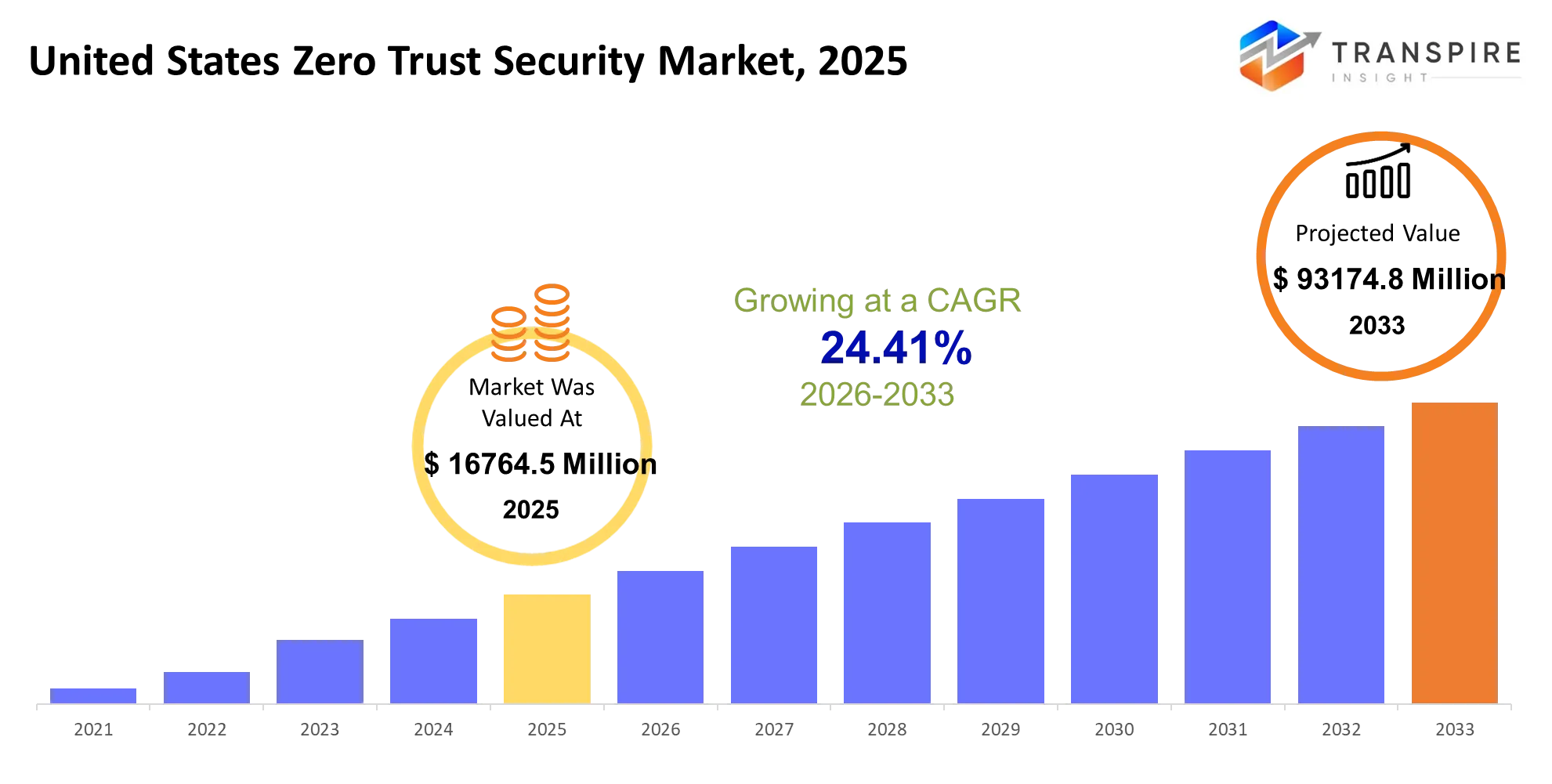
As per Transpire Insight, the United States Zero Trust Security Market size is estimated at USD 16764.5 Million in 2025 and is anticipated to reach USD 93174.8 Million by 2033, growing at a CAGR of 24.41% from 2026 to 2033.
The United States Zero Trust Security Market gives businesses the compute, storage, networking, security, and connectivity they need so they can run websites, applications, databases, enterprise platforms and also more AI workloads without building each layer of infrastructure themselves. Over the last 3–5 years , things have moved away from the old style of server hosting, and toward cloud, hybrid, multi-cloud, edge, plus all that GPU-heavy infrastructure.
During the pandemic, the shift sped up , as organizations moved off physical hardware and into remotely controlled cloud environments. Then the generative AI boom kind of changed the rules again, because suddenly everyone needs high-density processing power. On top of that, U.S. data-center electricity demand has become a real bottleneck, with data centers taking up a big slice of the most recent electricity-load growth. Because of all of this, spending is widening across servers , networking , cooling , storage, managed services and even dedicated AI infrastructure. And as companies put more workloads online and AI jobs demand far more compute capability, hosting providers are often able to earn more, through premium infrastructure, managed services, capacity reservations, and more specialized GPU environments.
United States Zero Trust Security Market Size & Forecast:
- United States Zero Trust Security Market Size 2025: USD 16764.5 Million
- Expected Market Value 2033: USD 93174.8 Million
- Forecast CAGR: 24.41%
- Leading region in 2025: Western United States
- Fastest Growing region: Southern United States
- Key Profile: Palo Alto Networks, Cisco Systems, Microsoft Corporation, IBM Corporation, Zscaler, CrowdStrike, Okta, Fortinet, Broadcom (Symantec), Check Point Software, Akamai Technologies, Netskope, CyberArk, Proofpoint, Trellix
Key Market Insights
- The Western United States kind of leads in infrastructure concentration, backed by established hyperscale campuses, technology firms, fiber networks, and pretty mature cloud ecosystems.
- Southern states are now seeing a quicker build-out pace, mainly because Texas offers land, energy resources, and those favorable conditions for big scale data-center development.
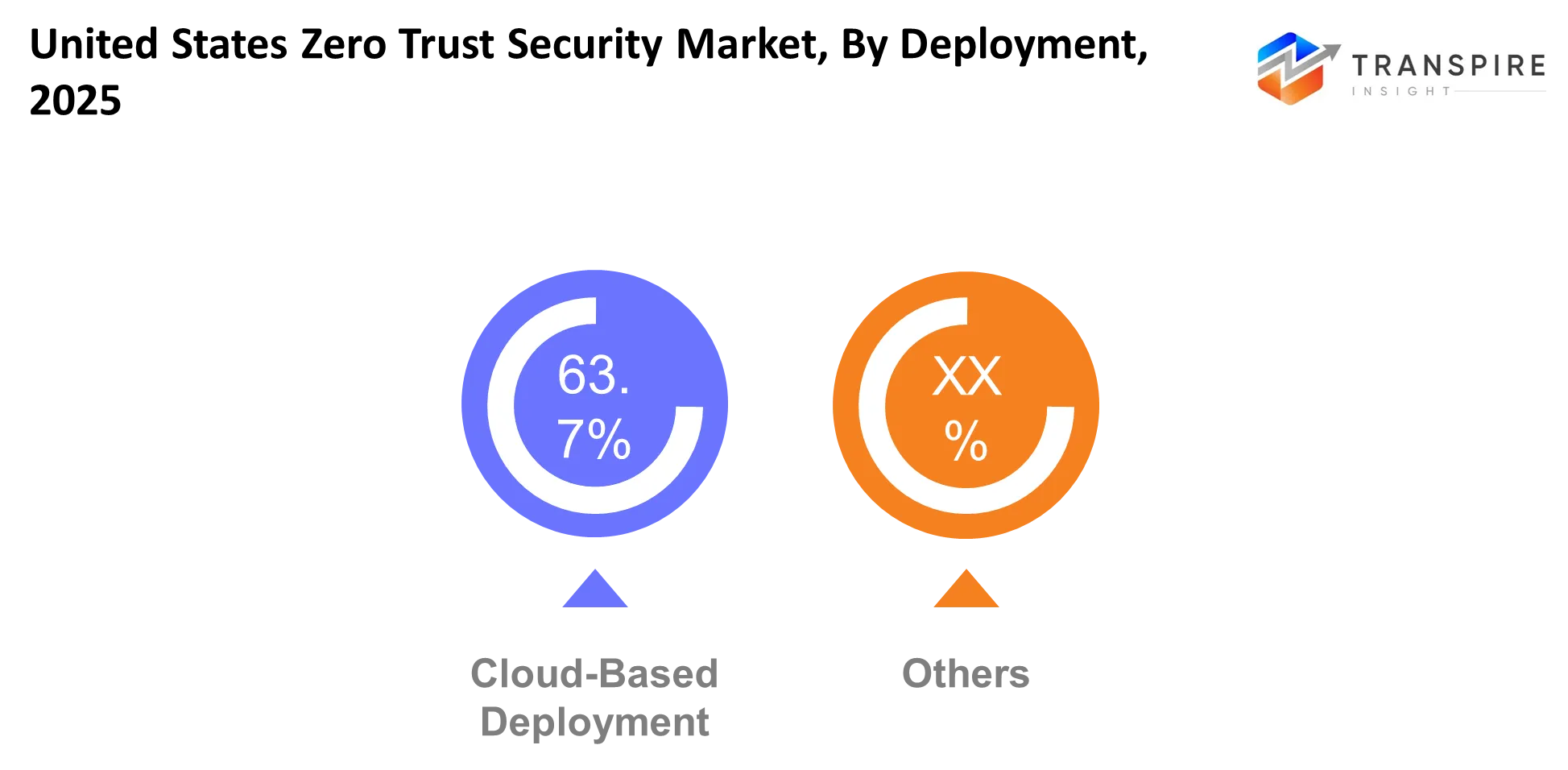
- Cloud-based infrastructure is still the main service format, as enterprises swap out fixed-capacity servers for scalable compute and storage setups , more or less.
- AI workloads are also reshaping infrastructure economics, with enterprise cloud spending landing at $119 billion globally in Q4 2025, per Synergy Research Group.
- Amazon , Microsoft, and Google together represented 63% of enterprise cloud infrastructure spending in Q3 2025, and that kind of really underscores the hyperscaler concentration.
- GPU intensive workloads are pushing providers toward more specialized server setups, quicker interconnect fabric, liquid cooling, plus higher density data center architectures.
- Data-center electricity use is turning into a structural limiter , and U.S. consumption could reach 11.8% of national electricity use by 2030.
- Hybrid and multi-cloud designs are picking up momentum too, since enterprises are trying to balance workload portability, resilience, regulatory needs , and application performance.
- Managed hosting providers are widening cybersecurity, backup, disaster recovery, monitoring, and compliance offerings , so they can stand out beyond basic infrastructure rental.
- Edge infrastructure is moving nearer to enterprise sites, since latency sensitive applications need faster processing for industrial, retail, telecom, and connected device workloads.
What are the Key Drivers, Restraints, and Opportunities in the United States Zero Trust Security Market?
Driver: Generative AI has kinda become a big growth catalyst, because AI training plus inference really need way more compute, storage, networking, and power than a lot of those usual enterprise workloads. Synergy Research Group said global enterprise cloud infrastructure spending hit $419 billion in 2025, and GenAI was listed as the main force behind the faster growth. So AI adoption basically opens extra revenue avenues for hosting providers, think GPU instances, dedicated clusters, high-performance storage, tight networking, and managed AI environments. The same shift also nudges enterprises to rent specialized capacity, instead of buying pricey infrastructure with uncertain utilization
Restraint: Still there are hard constraints, power availability, grid interconnection delays, land limitations, plus cooling needs are structural blockers. U.S. data-center electricity consumption is expected to climb sharply, while DOE estimates suggest data-center electricity use could get to 11.8% of U.S. electricity consumption by 2030. With limited power capacity, new sites can get stuck behind timelines, operating costs tend to go up , and hosting providers may slow down the rate at which they add that revenue-generating capacity
Opportunity: AI-ready regional infrastructure looks like a real expansion opportunity. Texas, and other Southern U.S. markets are drawing data-center projects because there is land and energy resources, and providers are also exploring dedicated power setups and alternative energy arrangements more frequently. That level of AI infrastructure demand could push hosting companies to build out regional GPU clusters, liquid-cooled facilities, plus power-efficient campuses, closer to customers
What Has the Impact of Artificial Intelligence Been on the United States Zero Trust Security Market?
Artificial intelligence is shifting hosting infrastructure, from the kind of relatively standarized server capacity you see everywhere, into something more specialized computing surroundings. Now hosting providers increasingly lean on AI based monitoring to catch abnormal server conduct, foresee hardware failures, place workloads more efficiently, and also juggle cooling plus power usage. With AI-assisted infrastructure management, resources can be adjusted on the fly based on how intense the workload is, and machine learning systems can spot how utilization usually behaves, then help with predictive servicing before a breakdown turns into real downtime. The upsides don’t stop at “just” server management either, because smarter workload scheduling can redirect computing activity toward places with spare capacity, or areas with less grid stress. Also, some recent work has shown that GPU clusters can react to grid signals through workload orchestration while still keeping service levels stable for priority jobs.
AI is also changing the way infrastructure is designed in the first place. Deloitte, for example, projects that U.S. AI data-center power demand could go from 4 GW in 2024 up to 123 GW by 2035, which really points to how large this transition is. Higher density GPU setups push requirements higher too, meaning networking, power delivery, storage, and liquid cooling all have to be more advanced. That, in turn, tends to create extra revenue streams for infrastructure providers. But there’s a big limit that keeps showing up: the cost and complexity of upgrading older, conventional facilities for AI workloads. Power availability, specialized cooling needs, and grid restrictions can still block hosting operators from rolling out AI capacity as fast as customer demand starts growing.
Key Market Trends
- Since 2023, generative AI kinda sped up cloud infrastructure spending, which is sort of pushing providers toward GPU capacity, and high-performance computing environments.
- Enterprise cloud infrastructure spending hit $419 billion in 2025, and honestly that feels like a major expansion compared with the earlier cloud adoption waves.
- Hyperscaler concentration got even stronger, with Amazon, Microsoft, and Google taking 63% of enterprise cloud infrastructure spending in Q3 2025, which is not exactly subtle.
- Since 2020, U.S. electricity demand has accelerated too, and data centers have become a big source of the fresh power consumption.
- Since 2024, AI-focused infrastructure has shifted facility planning, toward liquid cooling, higher-density racks, stronger power delivery, and specialized networking, all of that together.
- Texas and other Southern markets have gained strategic weight as developers look for more land, more electricity, and faster routes for large scale projects.
- Hybrid cloud adoption keeps moving forward, where enterprises mix public cloud agility with private infrastructure for sensitive or performance critical workloads, so it’s not all one thing.
- Managed hosting providers are also increasingly bundling backup, cybersecurity, monitoring, compliance, and disaster recovery rather than just selling standalone server capacity, period.
- Edge deployment has grown as telecom, manufacturing, retail, and connected-device applications want lower latency, plus localized processing instead of relying only on centralized systems.
- AI infrastructure investment is getting tied more and more to energy strategy, so providers are starting to think about dedicated generation, storage, and grid-responsive workload management in a more deliberate way.
United States Zero Trust Security Market Segmentation
By Component:
Software helps with operating environments, virtualization , workload management, monitoring, orchestration, and security functions across hosted infrastructure, even when the setup gets a bit unusual. Hardware covers servers, storage systems, networking equipment, accelerators, power systems and cooling equipment that are needed for actual infrastructure deployment. Services then handle installation, migration, monitoring, maintenance, backup, disaster recovery, and managed infrastructure operations, end to end.
Identity & Access Management, Multi-Factor Authentication, Network Security, Endpoint Security, Data Security, plus Security Analytics all add extra layers of protection around hosted workloads. Security needs are more important now since enterprises are moving business applications and sensitive information onto shared, private, and hybrid infrastructure, so that risk doesn’t creep in unnoticed. Other pieces also support specialized hosting requirements, compliance controls, infrastructure monitoring, and workload-specific configurations that fit what the team is running.
By Deployment:
Cloud based deployment sort of gives scalable computing, storage, networking and application infrastructure , without customers really having to keep the whole physical set up running. Meanwhile On-Premise deployment is still very much a thing for regulated workloads, older legacy applications, tight data control needs , and groups that want direct infrastructure management. Then there’s Hybrid Cloud , which sort of links internal environments with outside cloud capacity, giving more workload flexibility, and a smoother gradual migration path.
SaaS helps with application delivery using hosted environments, whereas Private Cloud offers dedicated infrastructure for enterprise workloads. Public Cloud leans into broad scalability and flexible capacity, while Multi-Cloud lets you split workloads across multiple providers. Edge security meanwhile supports distributed infrastructure that sits closer to users and connected devices , which is especially useful for low latency applications.
By Authentication Type:
Multi-Factor Authentication adds a few extra verification steps before anyone gets into the infrastructure or the application bit. Single Sign-On makes access easier across connected applications, and it also cuts down on the need for that repeated credential typing, pretty much every time. Biometrics leans on physical traits for identity verification, where as Passwordless Authentication lowers the dependence on standard passwords by using cryptographic credentials plus a device based check.
Smart Cards and Hardware Tokens basically act as tangible authentication tools, especially in settings that demand stronger access controls. Mobile Authentication uses your smartphone for verification, while Risk-Based Authentication keeps an eye on the “risk” side by looking at device behavior, location, access patterns, and session characteristics. Other authentication approaches are there too, but they’re meant to back specialized enterprise security policies and those more regulated environments.
By End User:
BFSI organizations really need dependable hosting, specially for banking apps, transaction systems, analytics, customer platforms, and for data that is regulated . Government agencies also lean on hosted infrastructure, for digital services, citizen apps, databases, and protected information systems. Healthcare groups require infrastructure that can grow, for electronic records, medical applications , analytics, and connected healthcare platforms.
IT & Telecom stays a huge infrastructure user, because software platforms, networks, digital applications and communications services all still need nonstop computing capacity. Manufacturing uses hosting infrastructure for connected operations, analytics, industrial applications, and supply-chain systems. Retail leans on hosted environments for e-commerce, customer analytics, inventory platforms, and payment apps. Energy & Utilities, Defense, Education, and other sectors choose infrastructure based on how sensitive the workload is, what the compliance rules say, how high the availability must be, and the overall operational scale.
By Application:
Network Access Control kind of runs the whole thing about connectivity between users, devices, apps, and hosted infrastructure, yes. Endpoint Protection safeguards computers, servers and the connected devices that are working inside those hosted environments, so it’s not just one side. Cloud Security covers workloads, configurations, identities, and data across public, private, and hybrid clouds. Identity Management, on the other hand, manages user privileges and access rights over infrastructure as well as applications, it keeps things aligned.
Data Protection backs up sensitive information with encryption, recovery, backup, retention, and access controls. Application Security protects hosted software from vulnerabilities and also from unauthorized activity that slips in. Remote Access Security is for distributed workforces and external users, they’re the ones reaching business applications. Insider Threat Prevention is aimed at suspicious actions that involve authorized users, while the other solutions cover specialized infrastructure needs and enterprise-security requirements, kind of depending on the setup.
What are the Key Use Cases Driving the United States Zero Trust Security Market?
Enterprise application hosting is still one of those core, steady use cases because companies really need dependable computing, storage, networking, plus backup and disaster recovery, but they don’t want to babysit every infrastructure layer on their own. BFSI, healthcare, government, and IT groups in particular tend to get more out of hosted environments that keep apps running continuously, enforce controlled access, and can expand capacity when demand changes. With cloud and managed hosting as well, organizations can align infrastructure capacity to workload needs, rather than leaving a bunch of underutilized hardware sitting around.
Now, AI workloads and data-heavy applications are getting a lot more attention and honestly they’re a big expanding use case too. Manufacturing teams lean on hosted infrastructure for industrial analytics and connected operations, while retail companies lean into cloud resources for e-commerce, personalization, inventory systems, and transaction handling. Telecom providers also roll out distributed infrastructure so they can deliver low-latency services and edge applications without lagging.
There are also newer patterns showing up, like regional GPU hosting, AI inference infrastructure, and grid-responsive computing. For high-density AI environments, you suddenly need special power, cooling, storage, and networking, which opens up growth chances for hosting providers that go beyond the typical virtual server setup. Power-flexible AI clusters could even help push infrastructure growth forward by moving certain workloads around based on grid conditions, while still holding to the required service levels.
|
Report Metrics |
Details |
|
Market size value in 2025 |
USD 16764.5 Million |
|
Market size value in 2026 |
USD 20225.7 Million |
|
Revenue forecast in 2033 |
USD 93174.8 Million |
|
Growth rate |
CAGR of 24.41% from 2026 to 2033 |
|
Base year |
2025 |
|
Historical data |
2021 - 2024 |
|
Forecast period |
2026 - 2033 |
|
Report coverage |
Revenue forecast, competitive landscape, growth factors, and trends |
|
Regional scope |
United States; Canada; Mexico; United Kingdom; Germany; France; Italy; Spain; Denmark; Sweden; Norway; China; Japan; India; Australia; South Korea; Thailand; Brazil; Argentina; South Africa; Saudi Arabia; United Arab Emirates |
|
Key company profiled |
Palo Alto Networks, Cisco Systems, Microsoft Corporation, IBM Corporation, Zscaler, CrowdStrike, Okta, Fortinet, Broadcom (Symantec), Check Point Software, Akamai Technologies, Netskope, CyberArk, Proofpoint, Trellix |
|
Customization scope |
Free report customization (country, regional & segment scope). Avail customized purchase options to meet your exact research needs. |
|
Report Segmentation |
By Component (Software, Hardware, Services, Identity & Access Management, Multi-Factor Authentication, Network Security, Endpoint Security, Data Security, Security Analytics, Others); By Deployment (Cloud-Based, On-Premise, Hybrid Cloud, SaaS, Private Cloud, Public Cloud, Multi-Cloud, Edge Security, Others); By Authentication Type (Multi-Factor Authentication, Single Sign-On, Biometrics, Passwordless Authentication, Smart Cards, Hardware Tokens, Mobile Authentication, Risk-Based Authentication, Others); By End User (BFSI, Government, Healthcare, IT & Telecom, Manufacturing, Retail, Energy & Utilities, Defense, Education, Others); By Application (Network Access Control, Endpoint Protection, Cloud Security, Identity Management, Data Protection, Application Security, Remote Access Security, Insider Threat Prevention, Others) |
Which Regions are Driving the United States Zero Trust Security Market Growth?
Northern Virginia still ends up being the big, dominant U.S. hosting infrastructure hub, mostly because it has this outstanding data center concentration, thick fiber connectivity, hyperscale presence, plus it sits close to major enterprise and government customers, so it all stacks together. In 2025 the region showed 1,102 MW of net absorption, and meanwhile total inventory climbed to 4,039.6 MW, largely backed by long-standing network infrastructure and broad cloud rollouts. Availability is extremely tight, vacancy is only 0.5% , and that keeps premium pricing fairly locked in, along with stronger long-term preleasing.
The Western side, kinda including Silicon Valley, Phoenix and those adjacent tech corridors, feels different because it leans harder into technology firms, software developers, AI organizations, and workloads that are more innovation driven. Silicon Valley stays strategically important for enterprise tech and AI customers, but power availability is more limited so the physical expansion has been constrained, compared with newer markets. Phoenix and other Western locations are offering extra land and infrastructure paths, so hosting operators can support technology heavy clients while not depending as much on California’s constrained capacity, all right.
Then there’s the Southern region, and honestly Texas plus Atlanta have the strongest expansion momentum, since operators are searching for land, electricity, and fresh capacity away from the more established hubs. Atlanta is sitting at 2,076 MW under construction, while Dallas Fort Worth became the third North American market to push past 1 GW of total supply, which basically signals major hyperscale and AI investment. Texas also has the advantage of broad energy availability and a growing development pipeline, though grid limitations and community constraints are starting to matter more and more.
Who are the Key Players in the United States Zero Trust Security Market and How Do They Compete?
Competition across the U.S. hosting infrastructure space is kinda concentrated mostly among big tech platforms plus a set of specialized security and infrastructure vendors. The differentiation is getting less about raw server capacity, and more about cloud integration, AI readiness, security, geographic footprint, and those managed services that actually stick. You’ll see Microsoft, Cisco, Palo Alto Networks, CrowdStrike, and Akamai Technologies showing up across different, complementary layers of the infrastructure stack. At the same time hyperscale cloud growth and AI workloads are opening doors for more niche providers, but power limits, capacity headaches, and finding the right data-center sites are turning into an important competitive issue too.
Microsoft blends Azure cloud infrastructure with enterprise security and AI tools which helps keep customers around, because the cloud plus security services are bundled in a way that feels natural. Cisco, meanwhile, stays focused on networking, security, observability, and AI-ready data-center connectivity, and the Microsoft tie-in helps it support integrated cloud deployments. Palo Alto Networks is leaning into platform consolidation, and you can see that in its $25 billion CyberArk acquisition, bringing identity protection into the mix for human users, machine identities, and even AI-agent identities, not just the traditional accounts.
CrowdStrike tends to stand out with cloud-native endpoint and threat protection, while Akamai puts the spotlight on distributed infrastructure, edge delivery, and security that sits closer to end users. Overall the competitive direction seems to be moving toward integrated platforms that bring together infrastructure visibility, security controls, identity coverage, networking reach, and AI management, instead of being just isolated point products, or like, single-purpose add-ons.
Company List
- Palo Alto Networks
- Cisco Systems
- Microsoft Corporation
- IBM Corporation
- Zscaler
- CrowdStrike
- Okta
- Fortinet
- Broadcom (Symantec)
- Check Point Software
- Akamai Technologies
- Netskope
- CyberArk
- Proofpoint
- Trellix
Recent Development News
- "In February 2026, Palo Alto Networks completed acquisition of CyberArk. The $25 billion transaction added CyberArk's identity-security platform to Palo Alto Networks' portfolio, strengthening protection for human, machine, and AI-agent identities across cloud environments.https://investors.paloaltonetworks.com/news-releases/news-release-details/palo-alto-networks-completes-acquisition-cyberark-secure--ai-era (Palo Alto Networks)."
- "In March 2026, Cisco and Microsoft expanded their co-engineering partnership for cloud and AI security. The collaboration integrates networking, security, and cloud capabilities to support secure hybrid and multicloud deployments, strengthening both companies' positions in AI-ready infrastructure environments.https://blogs.cisco.com/partner/cisco-and-microsoft-co-engineering-security-for-cloud-and-ai-journeys (Cisco)."
- "In April 2026, Anthropic launched Project Glasswing with AWS, Cisco, CrowdStrike, Microsoft, NVIDIA, Palo Alto Networks, and other partners. The initiative provides selected organizations with Claude Mythos Preview to identify software vulnerabilities and strengthen security across critical digital infrastructure.https://www.anthropic.com/project/glasswing (Anthropic)."
What Strategic Insights Define the Future of the United States Zero Trust Security Market?
Over the next five to seven years, the U.S. hosting infrastructure market will drift toward AI-tuned, power-secured, distributed computing capacity, not just piling on regular server space. AI workloads will still be the core driver, but access to electricity, transmission capability, better cooling, and genuinely suitable sites will… more and more decide what infrastructure projects actually make it to commercial operation. The less obvious kind of risk is market concentration : hyperscalers already take a big chunk of enterprise cloud spending, which ramps up customer reliance on only a handful of providers, and also makes operators more vulnerable to pricing pressure plus supply-chain concentration too.
A meaningful emerging chance is AI infrastructure outside the classic hubs, especially in power-rich Southern and secondary U.S. markets where land availability, and electricity access, can back large campuses. Investors and providers should lean into locations with locked-in power, strong fiber access, expandable parcels, advanced cooling capacity, and clearer regulatory oversight, rather than picking places mainly because the real-estate cost looks cheap. That way, construction slowdowns can be reduced, while the capacity sits closer to where the next generation of AI workloads will need it.
United States Zero Trust Security Market Report Segmentation
By Component
- Software
- Hardware
- Services
- Identity & Access Management
- Multi-Factor Authentication
- Network Security
- Endpoint Security
- Data Security
- Security Analytics
- Others
By Deployment
- Cloud-Based
- On-Premise
- Hybrid Cloud
- SaaS
- Private Cloud
- Public Cloud
- Multi-Cloud
- Edge Security
- Others
By Authentication Type
- Multi-Factor Authentication
- Single Sign-On
- Biometrics
- Passwordless Authentication
- Smart Cards
- Hardware Tokens
- Mobile Authentication
- Risk-Based Authentication
- Others
By End User
- BFSI
- Government
- Healthcare
- IT & Telecom
- Manufacturing
- Retail
- Energy & Utilities
- Defense
- Education
- Others
By Application
- Network Access Control
- Endpoint Protection
- Cloud Security
- Identity Management
- Data Protection
- Application Security
- Remote Access Security
- Insider Threat Prevention
- Others
Frequently Asked Questions
Find quick answers to common questions.
The expected United States Zero Trust Security Market size for the market will be USD 93174.8 Million in 2033.
Key segments for the United States Zero Trust Security Market are By Component (Software, Hardware, Services, Identity & Access Management, Multi-Factor Authentication, Network Security, Endpoint Security, Data Security, Security Analytics, Others); By Deployment (Cloud-Based, On-Premise, Hybrid Cloud, SaaS, Private Cloud, Public Cloud, Multi-Cloud, Edge Security, Others); By Authentication Type (Multi-Factor Authentication, Single Sign-On, Biometrics, Passwordless Authentication, Smart Cards, Hardware Tokens, Mobile Authentication, Risk-Based Authentication, Others); By End User (BFSI, Government, Healthcare, IT & Telecom, Manufacturing, Retail, Energy & Utilities, Defense, Education, Others); By Application (Network Access Control, Endpoint Protection, Cloud Security, Identity Management, Data Protection, Application Security, Remote Access Security, Insider Threat Prevention, Others).
Major United States Zero Trust Security Market players are Palo Alto Networks, Cisco Systems, Microsoft Corporation, IBM Corporation, Zscaler, CrowdStrike, Okta, Fortinet, Broadcom (Symantec), Check Point Software, Akamai Technologies, Netskope, CyberArk, Proofpoint, Trellix.
The United States Zero Trust Security Market size is USD 16764.5 Million in 2025.
The United States Zero Trust Security Market CAGR is 24.41% from 2026 to 2033.
- Palo Alto Networks
- Cisco Systems
- Microsoft Corporation
- IBM Corporation
- Zscaler
- CrowdStrike
- Okta
- Fortinet
- Broadcom (Symantec)
- Check Point Software
- Akamai Technologies
- Netskope
- CyberArk
- Proofpoint
- Trellix
About the Authors

Mayur Shinde
I am Mayur Shinde, a Senior Research Analyst at Transpire Insight, specializing in the Automotive & Transportation and Information & Communication Technology (ICT) Industry. My work focuses on analyzing emerging market trends, technological advancements, competitive landscapes, and industry developments to deliver accurate, data-driven insights. I am passionate about transforming complex market information into clear, actionable content that helps businesses, professionals, and decision-makers stay informed and make confident strategic decisions.

Chakradhar Khansole
Chakradhar serves as the Research Director at Transpire Insight, bringing over 8 years of experience in technology, innovation, and strategic market intelligence. He specializes in transforming complex market data into actionable business insights that enable organizations to make informed, growth-oriented decisions. Recognized for his strategic vision and analytical expertise, Chakradhar leads high-impact research initiatives, delivering comprehensive market assessments, competitive intelligence, and forward-looking industry analysis.
Recently Published Reports
-
Apr 2026
3D Optical Profiler Market
3D Optical Profiler Market Size, Share & Analysis Report By Type (Desktop 3D Optical Profiler, and Portable 3D Optical Profiler), By Technology (Confocal Technology, and White Light Interference), By End-Use Industry (Manufacturing, Research Institutions, Automotive, Aerospace and Defense, Medical Devices, and Other), and Geography (North America, Europe, Asia-Pacific, Middle East and Africa, South and Central America), 2021 - 2031
-
Apr 2026
Depth Sensor Market
Depth Sensor Market Size, Share & Analysis Report By Type (Infrared Depth Sensors, Time-of-Flight (ToF) Sensors, Stereo Vision Sensors, Structured Light Sensors, Ultrasonic Depth Sensors), By Application (Automotive, Robotics, Gaming, Consumer Electronics, Industrial Automation, Healthcare, Security & Surveillance, Others), By End Users (Automotive Manufacturers, Consumer Electronics Companies, Healthcare Providers, Industrial Companies, Security Agencies, Gaming Companies, Robotics Companies, Others), and Geography (North America, Europe, Asia-Pacific, Middle East and Africa, South and Central America), 2021 – 2031
-
Apr 2026
Digital Manufacturing Market
Digital Manufacturing Market Size, Share & Analysis Report By Component (Hardware, Software, and Services), By Technology (Robotics, 3D Printing, Internet of Things (IoT), and Others), By Application (Automotive and Transportation, Aerospace and Defense, Consumer Electronics, Industrial Machinery, and Others), By Process Type (Computer-Based Designing, Computer-Based Simulation, Computer 3D Visualization, Analytics, and Others), and Geography (North America, Europe, Asia-Pacific, Middle East and Africa, South and Central America), 2021 – 2031
-
Apr 2026
Digital Visa Services Market
Digital Visa Services Market Size, Share & Analysis Report By Type (Individual Travelers, Group Travelers), By Application (Tourism, Business Travel, Others), and Geography (North America, Europe, Asia-Pacific, Middle East and Africa, South and Central America), 2021 – 2031