

United States Trivalent Chromium Processing Market Size & Forecast:
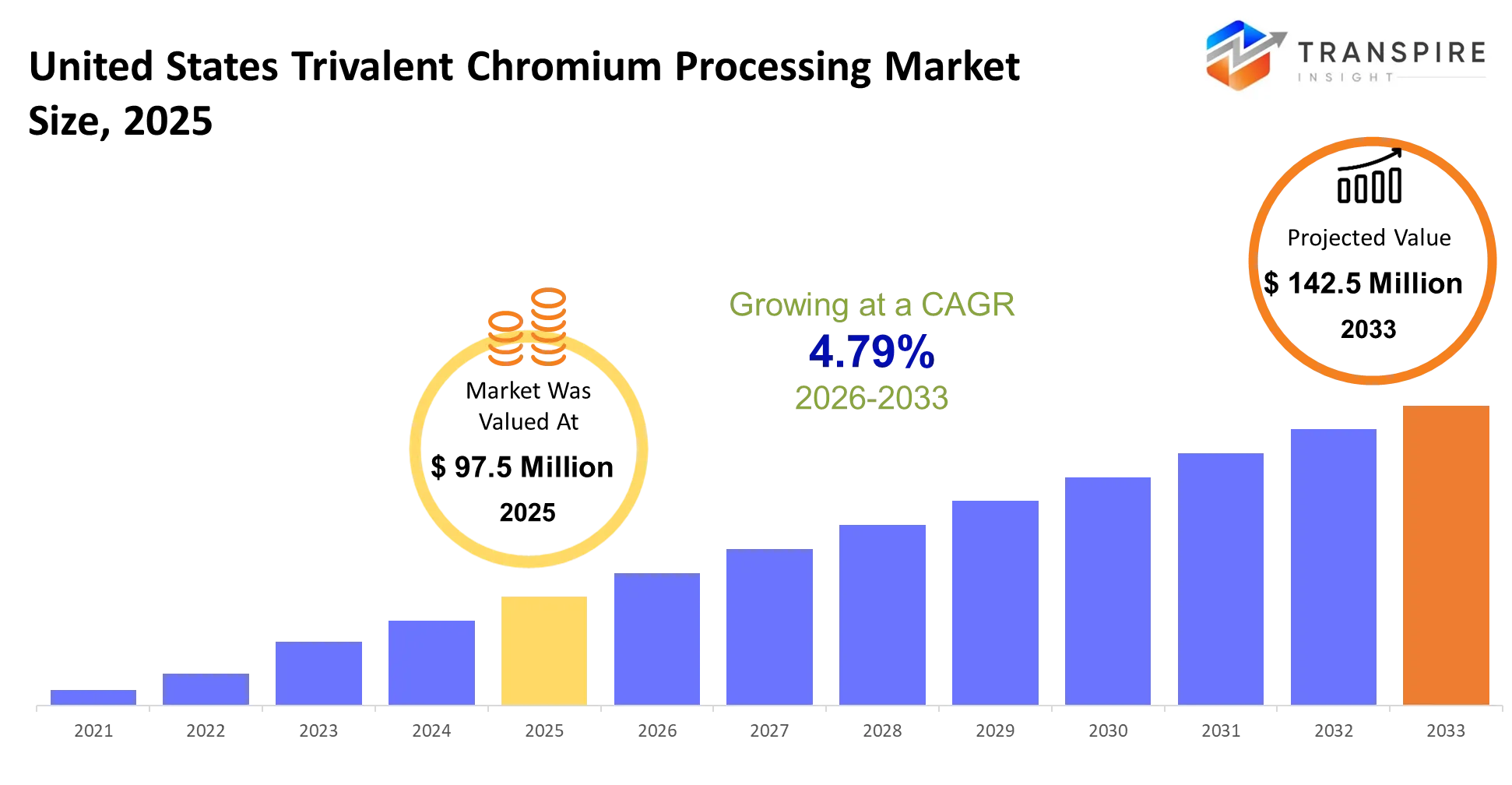
- United States Trivalent Chromium Processing Market Size 2025: USD 97.5 Million
- United States Trivalent Chromium Processing Market Size 2033: USD 142.5 Million
- United States Trivalent Chromium Processing Market CAGR: 4.79%
- United States Trivalent Chromium Processing Market Segments: By Product Type (Chromium Sulfate, Chromium Chloride, Chromium Nitrate, Chromium Acetate, Others); By Application (Metal Finishing, Leather Tanning, Pigments & Dyes, Wood Preservation, Chemical Manufacturing, Others); By Form (Powder, Liquid, Granules, Crystals, Others); By End User (Automotive Industry, Chemical Industry, Textile Industry, Metal Processing Industry, Others)
To learn more about this report,  Download Free Sample Report
United States Trivalent Chromium Processing Market Summary
The United States Trivalent Chromium Processing Market was valued at USD 97.5 Million in 2025. It is forecast to reach USD142.5 Million by 2033. That is a CAGR of 4.79% over the period.
The United States trivalent chromium processing market, really plays out inside industrial metal finishing where manufacturers put down corrosion-resistant coatings on aerospace , defense, automotive, and precision hardware components, usually to replace the older hexavalent chromium systems, but still keeping durability, conductivity, and that surface feel. In the last few years, the whole market has moved in a more structural way from “nice to have” adoption toward compliance led substitution. This is happening because OEMs and subcontractors are phasing out hex chrome, tied to tighter EPA rules and defense procurement standards, so it’s less discretionary and more enforced.
One big trigger has been stricter environmental oversight, plus pandemic-era supply chain disruptions, that quietly showed how much people were relying on only a few compliant chemical suppliers. So now plating facilities are re-qualifying their methods and putting money into certified TCP systems, which raises switching friction costs , but also makes long-term demand a lot clearer. Net growth is now driven by regulatory compliance needs and lifecycle performance targets, not optional improvements, which in turn concentrates revenues with certified solution providers.
Key Market Insights
- The United States trivalent chromium processing market is kinda shifting toward regulation-friendly surface finishing, it’s replacing toxic hexavalent chromium in aerospace and defense manufacturing workflows, you know those high sensitivity processes.
- In the U.S. Southeast aerospace cluster is still doing the heavy lifting, it’s responsible for almost 35–40% share, mainly because aircraft production plus defense contracting creates that concentrated pull.
- Meanwhile, the Western U.S. area is showing the quickest growth from 2024–2030, mostly due to semiconductor hardware ramp ups and precision engineering expanding across the high-tech manufacturing hubs there.
- For technology, TCP conversion coating systems are leading the United States trivalent chromium processing market, holding more than 45% share, and that’s largely because compliance adoption is basically mandatory now.
- The chemical additives segment lands in the second-largest spot, and it supports ongoing surface treatment formulation upgrades at legacy plating facilities, where tweaks are still needed.
- Automated TCP app systems (kinda) are the fastest growing piece, moving much quicker from 2025–2030 because of the push for production efficiency needs. In fact the overall momentum looks pretty strong.
- When it comes to usage, aerospace and defense coatings pretty much take the lead with close to a 50% share, mostly tied to corrosion resistance and also these very strict federal material compliance rules that have to be followed. Not just “nice to have”.
- For applications, industrial machinery finishing is showing the quickest growth, tied to reshoring of precision manufacturing and a wider supply chain diversification trend, you know how it goes. The timing lines up with what factories are prioritizing.
- On the end-user side, aerospace OEMs and defense contractors still stay at the top, they take the biggest consumption share in the United States Trivalent Chromium Processing Market, even when other industries try to catch up.
- And then electronics and semiconductor equipment manufacturers are the fastest-growing end-user category, they are increasing their adoption for high precision conductive coatings, and the demand is getting harder to ignore.
What are the Key Drivers, Restraints, and Opportunities in the United States Trivalent Chromium Processing Market?
The United States Trivalent Chromium Processing Market is mostly pushed forward by tightening environmental compliance rules across aerospace, defense and precision manufacturing, kind of everywhere. The EPA keep adding limits on hexavalent chromium, and alongside that the Department of Defense material standards have basically told manufacturers to move away from older plating systems to certified trivalent chromium processes. This change is not, like, really negotiable. It leads straight into mandatory requalification of production lines which then bumps up adoption rates and helps keep recurring income steadier for certified chemical suppliers and equipment providers. So TCP solutions are now getting embedded into long-term industrial specifications instead of being handled as a “maybe later” type of upgrade.
Still, even with that momentum, there’s a structural restraint around how hard it is to qualify new processes and how much day-to-day disruption happens during the transition. A lot of aerospace and defense parts need extensive testing cycles before new coatings are approved, and that can take months, or even years depending on the program. As a result deployment gets slowed down, and manufacturers end up paying more in the short term, because they have to run parallel plating systems while validation is going on. The switching cost also makes smaller suppliers hesitate, which suppresses the revenue potential across the whole value chain.
A big opportunity is kind of showing up, via automated and closed loop TCP application setups that get tied into Industry 4.0 production lines. Some companies are putting money into digitally controlled plating technologies, especially in U.S. defense manufacturing centers and places that build semiconductor equipment, and they’re cutting down on process variability plus approval timelines, pretty noticeably. With this kind of setup, it’s expected to open quicker qualification cycles, and also drive more adoption into nearby high precision industrial areas.
What Has the Impact of Artificial Intelligence Been on the United States Trivalent Chromium Processing Market?
Artificial intelligence and advanced digital systems are kinda reshaping the United States Trivalent Chromium Processing Market, by changing how plating lines, chemical baths, and compliance systems get handled in high-precision manufacturing setups. In day to day surface finishing facilities, AI-enabled control systems now automate bath chemistry monitoring, by watching real time sensor signals like pH, temperature and metal ion concentration. That helps cut down manual sampling missteps and keeps coating quality more stable across aerospace and defense production lines, even when things run fast.
Meanwhile, machine learning models are being used more often for predictive maintenance of plating equipment, catching early hints of pump wear , filtration blockage, or electrolyte drift before a real failure shows up. Along the same thread digital compliance platforms observe emissions and waste treatment performance, so operators stay in regulatory lockstep with EPA standards while also reducing the time spent waiting for inspections. Overall these upgrades have boosted operational uptime and trimmed rework rates in multiple industrial finishing systems, especially in cases where coating uniformity has to stay tight for certified components.
Still, adoption hits a structural wall, mainly because integration costs can be high and legacy infrastructure is often pretty fragmented in older plating facilities. A lot of small and mid sized operators don’t have the one unified data setup needed for effective AI deployment, and because historical process data is thin, model accuracy can drop in real world production conditions. Even with that, AI driven process optimization is slowly getting better, improving efficiency and easing compliance related costs across advanced trivalent chromium processing operations.
Key Market Trends
- EPA enforcement updates from 2023 to 2025 basically shoved aerospace suppliers toward certified processing setups for trivalent chromium across U.S. defense manufacturing sites.
- Boeing and Lockheed Martin supplier networks then started pushing higher TCP adoption rates after 2022 procurement revisions called for safer surface finishing requirements, not just “better” chemistry.
- Chemical suppliers like Atotech and Chemetall also widened their compliant formulation lineups during 2023–2025, trying to match tougher aerospace material specifications that kept tightening.
- Then the supply chain headaches from 2020–2022 led manufacturers to diversify the approved plating vendors, so they were less dependent on one single source doing hex chrome work.
- Around 2024 automated bath monitoring systems got more popular , replacing manual chemical checks with sensor driven control, especially in high volume plating facilities where consistency matters.
- Qualification timelines actually shrank a bit after 2023 too, mostly because standardized testing frameworks rolled out across the U.S. aerospace material certification programs.
- And by 2025 defense contractors started leaning procurement toward long term TCP certified vendors, which helped lock in more stable contracts for companies providing compliant surface treatment services.
United States Trivalent Chromium Processing Market Segmentation
By Product Type :
Chromium sulfate will have a big say , because it’s used a lot in metal finishing plus electroplating work. Chromium chloride will back up surface treatment workflows where the chemistry needs to act in a stable kind of way. Chromium nitrate and chromium acetate tend to fit more into specialized, niche industrial roles , especially when people are working on tailored coating systems. Then there are other types too, but they only really cover limited however specific needs in chemical processing and manufacturing. So each variety ends up helping with different processing performance requirements, kind of depending on what the line is trying to do.
For the product segment , you should expect fairly steady demand growth, mainly because industrial surface treatment and protective coating applications keep expanding. Chromium sulfate stays the most common compound, mainly for that practical mix of cost and results. Chromium chloride is usually chosen when controlled deposition matters, you know, when you need tighter handling of how it lays down. Chromium nitrate and acetate will keep taking care of more advanced formulation demands. In general, overall product demand will move with industrial growth and with that growing attention on safer chromium based solutions.
By Application :
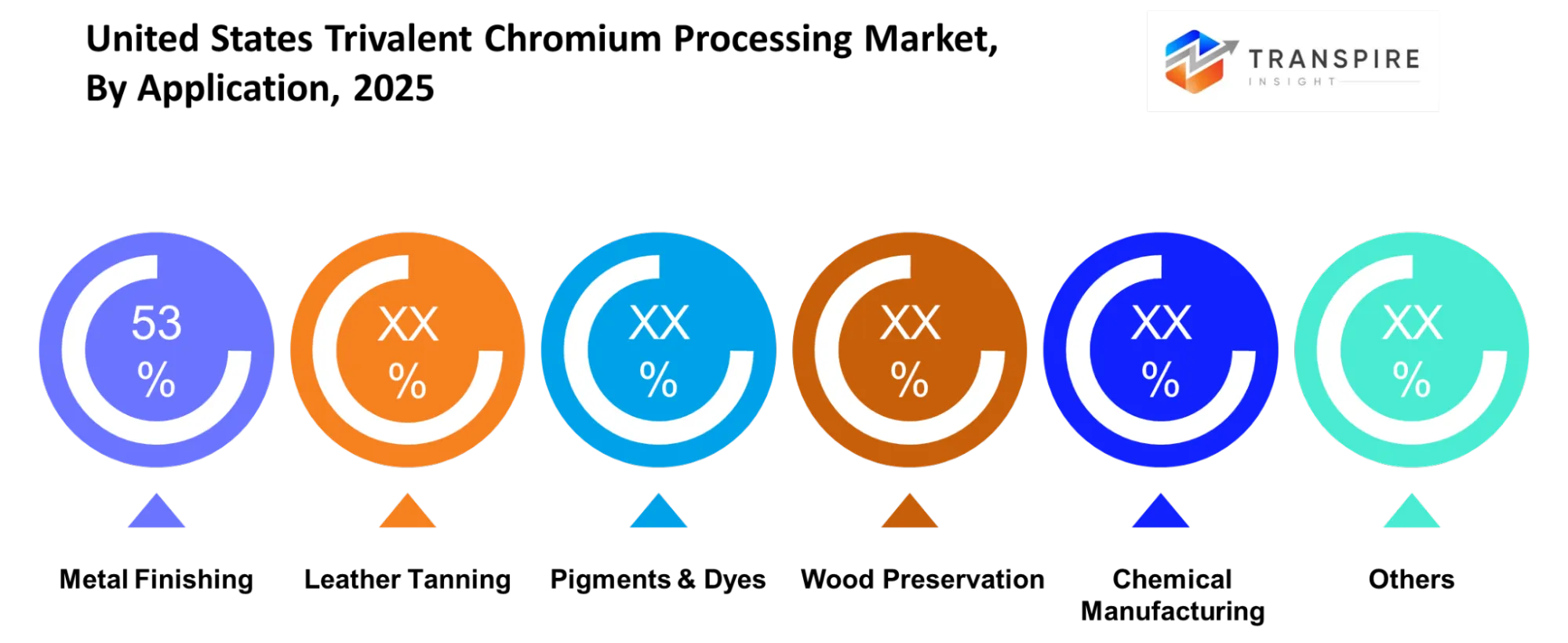
Metal finishing will, uh, remain the leading application because there’s a steady push for corrosion resistant coatings in industrial components, so it just keeps getting traction. Leather tanning will continue to use trivalent chromium in order to make durable leather materials which basically holds up better over time. Pigments and dyes will lean on chromium compounds too, for that stable coloring performance, you know the kind that doesn’t drift. Wood preservation will use chromium based solutions so durability goes up. As for chemical manufacturing and other uses, they’ll keep supporting diversified industrial needs across a bunch of sectors, more or less.
That application segment should grow gradually, since industrial production keeps climbing and infrastructure keeps expanding, it’s kind of connected. Metal finishing will dominate because of its value in extending product life and upgrading surface strength. Leather tanning will keep stable demand within manufacturing industries. Pigments and dyes will back textile and coating industries. Wood preservation will show consistent use in construction related materials. Chemical manufacturing will go on integrating chromium compounds across multiple production processes.
To learn more about this report, Download Free Sample Report
By Form :
Powder form is gonna dominate overall because it’s easier to store, move around, and blend into industrial processes, that part is kinda obvious. Liquid form will be pretty widely used for plating and coating where direct application is needed, no detours. Granules are helpful for controlled release during chemical processing , especially when timing matters. Crystals will show up more in high-purity uses, with stable composition being the key point. Other physical formats will cover customized industrial needs, depending on process routes, and the actual end-use conditions in practice.
For the “form” segment, it is likely to expand as industries push harder on efficiency and process optimization. Powder is expected to stay the go-to, mainly for flexibility and straightforward handling in large-scale operations. Liquid format should see rising demand in continuous processing systems. Granules will back controlled industrial reactions, in a more measured kind of way. Crystals will keep serving specialized work, where purity, plus stability can’t be compromised. Overall demand across all variants will be shaped by manufacturing improvements and the increasing industrial usage of chromium based materials.
By End User :
The automotive industry will be a key end user, because there is strong demand for corrosion resistant coatings and long lasting metal parts, not to mention that demand seems to keep climbing. The chemical industry will use chromium compounds in production runs and in the formulations part of it. The textile industry will lean on chromium based materials for dyeing and finishing processes, kind of as a usual step. The metal processing industry will keep heavy use for surface conditioning and strengthening applications, it feels like that's just how it goes. Other industries will show up too, like construction and general manufacturing sectors.
In terms of the end user segment, it should grow steadily along with industrial expansion and the rising appetite for durable materials. The automotive industry will probably lead, due to increasing vehicle production and that ongoing need for surface protection. The chemical industry will likely keep consumption relatively stable, mostly because those production processes don’t really stop. The textile industry will help sustain demand through dyeing and finishing applications, there is always some cycle there. The metal processing industry will stay a core user, since the need for plating and treatment solutions keeps coming back. Other industries will still contribute incremental demand across manufacturing activities, even if it is not the main driver.
What are the Key Use Cases Driving the United States Trivalent Chromium Processing Market?
Aerospace and defense manufacturing still seems to be the main thing moving the United States Trivalent Chromium Processing Market forward ,sort of. In practice, TCP coatings get put on aircraft structures, landing gear, and fasteners, which is where the really demanding conditions live. The coatings have to hold up with high corrosion resistance and also keep conductivity steady, and then on top of that, strict federal safety standards push companies away from hexavalent chromium systems. So you end up with this mix of performance expectations, plus mandatory compliance, and that ends up creating the most stable and reliable demand, most of the time.
More use cases keep showing up in industrial machinery and precision manufacturing, especially among OEMs that supply heavy equipment and high-stress mechanical assemblies. Electronics and semiconductor equipment manufacturers are in on it too ,they’re adding trivalent chromium processing for conductive yet wear resistant coatings on delicate parts. A lot of the reason appears to be tighter contamination control and the need for dependable production runs, not just one-off trials.
There are also emerging use cases in electric mobility components and advanced energy systems, where companies are testing TCP coatings for battery enclosures and thermal management pieces. These areas are still kind of in early validation mode, but they’re drawing more attention as regulatory pressure, plus material safety expectations, stretch beyond the classic aerospace world.
|
Report Metrics |
Details |
|
Market size value in 2025 |
USD 97.5 Million |
|
Market size value in 2026 |
USD 102.7 Million |
|
Revenue forecast in 2033 |
USD 142.5 Million |
|
Growth rate |
CAGR of 4.79% from 2026 to 2033 |
|
Base year |
2025 |
|
Historical data |
2021 - 2024 |
|
Forecast period |
2026 - 2033 |
|
Report coverage |
Revenue forecast, competitive landscape, growth factors, and trends |
|
Geographic scope |
United States of America |
|
Key company profiled |
Elementis, Lanxess, BASF, Hunter Chemical, Vishnu Chemicals, MidUral Group, American Elements, Oxkem, Hubei Zhenhua Chemical, Brother Enterprises, Yildirim Group, Sichuan Yinhe Chemical, Chemalloy, Noah Chemicals, Sihui Shuanghua |
|
Customization scope |
Free report customization (country, regional & segment scope). Avail customized purchase options to meet your exact research needs. |
|
Report Segmentation |
By Product Type (Chromium Sulfate, Chromium Chloride, Chromium Nitrate, Chromium Acetate, Others); By Application (Metal Finishing, Leather Tanning, Pigments & Dyes, Wood Preservation, Chemical Manufacturing, Others); By Form (Powder, Liquid, Granules, Crystals, Others); By End User (Automotive Industry, Chemical Industry, Textile Industry, Metal Processing Industry, Others) |
Which Regions are Driving the United States Trivalent Chromium Processing Market Growth?
The United States Trivalent Chromium Processing Market, it’s kind of mostly held down by the Southeast aerospace and defense corridor, especially states like Alabama, Texas and Florida. I mean, it dominates, because there’s dense aircraft manufacture happening there, plus defense contracting networks that are pretty strong, and also the compliance enforcement feels tight, like it’s tied to federal procurement standards. Then you get big OEM facilities and Tier-1 suppliers working in a close loop, so surface finishing obligations get built right into how they run production, not as a separate afterthought. And since there are well-established aerospace clusters, trivalent chromium systems can get qualified fast too, which helps keep adoption steady for the long term.
Meanwhile the Midwest is like the steady second hub, more due to a diversified industrial base instead of one big aerospace concentration. Places such as Ohio and Michigan help out through automotive manufacturing, heavy machinery production and industrial component finishing. But unlike the Southeast, the momentum here is shaped by ongoing capital reinvestment cycles, rather than those defense-driven requirements. Manufacturers in the Midwest tend to focus on operational dependability and cost management, so the adoption of compliant plating technologies grows slowly, yet it keeps going. Because of that, the Midwest stays a reliable revenue contributor even when aerospace procurement is kinda slower.
Western United States is seeing the fastest growth , kind of driven by the expanding semiconductor manufacturing and advanced electronics production happening in California and Arizona. Lately , federal incentives for domestic chip output and facility modernization have sped up adoption of precision surface treatment systems since 2023. At the same time, new clean manufacturing standards along with high value fabrication projects are pushing demand for coating technologies that stay compliant. So for investors, and market entrants in general, this region looks like there’s real upside through 2026–2033, as high tech manufacturing keeps scaling, and also diversifies its supply chain footprint .
Who are the Key Players in the United States Trivalent Chromium Processing Market and How Do They Compete?
The United States trivalent chromium Processing Market, looks moderately consolidated like a few bigger players, where a small set of global specialty chemical suppliers actually ends up controlling most certified aerospace-grade formulations. New entrants still run into big walls, mostly because qualification cycles with defense and aerospace OEMs take a long time, also they’re technically demanding, not just a simple purchase. So the incumbents usually defend share with validated performance records, the required regulatory certifications, and pretty tightly integrated customer support, that’s sort of the whole thing. In practice, competition is less about price, and more about process reliability, compliance assurance, and keeping coating performance steady even when the federal standards are strict.
Atotech and MacDermid Enthone, they compete in a more tech-driven way via surface finishing chemistries and integrated plating systems. Atotech leans into combining trivalent chromium formulations with digital process control solutions, aiming to improve bath stability for high-volume aerospace lines. MacDermid Enthone, meanwhile, strengthens their position through heavy aerospace qualification support and chemistry packages that get customized to OEM specifications, not generic mixes. Both of them tend to expand through long-term partnerships with Tier-1 suppliers and lab collaborations, which helps to shorten and accelerate certification timelines, a bit.
Chemetall, Henkel, PPG Industries and Pavco, they sort of differentiate using specialized coatings lines plus application specific know how. Chemetall leans into aerospace oriented surface treatment approvals, kind of like that. Henkel instead mixes material science, with industrial adhesive and coating systems, for wider factory realities where you need it. PPG Industries boosts its position by tying aerospace and defense coating integration across airframe supply routes. Pavco keeps it more niche with trivalent chromium chemistries for precision plating shops, and then pushes ahead via regional technical support services, and also via chosen certification programs, aimed at industrial customers.
Company List
- Elementis
- Lanxess
- BASF
- Hunter Chemical
- Vishnu Chemicals
- MidUral Group
- American Elements
- Oxkem
- Hubei Zhenhua Chemical
- Brother Enterprises
- Yildirim Group
- Sichuan Yinhe Chemical
- Chemalloy
- Noah Chemicals
- Sihui Shuanghua
Recent Development News
In May 2025, the U.S. Army Aviation and Missile Command (AMCOM) Heavy Metals Working Group advanced evaluation of next-generation eTCP (enhanced Trivalent Chromium Pretreatment) technology for aerospace platforms. The initiative supports large-scale replacement of hexavalent chromium coatings with safer trivalent chromium alternatives across U.S. military aviation systems, strengthening demand for TCP adoption in defense supply chains. Source https://finishingandcoating.com/
In March 2026, Atotech (part of MKS Instruments) entered a strategic collaboration with U.S.-based aerospace component manufacturers to scale deployment of trivalent chromium plating technologies across critical flight hardware production lines. The partnership aimed to accelerate substitution of hexavalent chromium processes with environmentally compliant alternatives in aerospace manufacturing.Source https://www.mks.com/
What Strategic Insights Define the Future of the United States Trivalent Chromium Processing Market?
The United States Trivalent Chromium Processing Market is kind of moving, toward tighter integration with regulated aerospace and more advanced manufacturing supply chains where compliance-certified surface finishing ends up being like a default specification, not really a “pick this if you want” option. This shift is being pushed by steady environmental enforcement and also by the fact that defense-grade material standards are getting more complicated, so there is less room for older chromium systems that used to squeak by. In the next 5 to 7 years, adoption will mostly gather around qualified suppliers that are embedded inside OEM ecosystems, not those independent plating operators.
There is also a less obvious kind of risk here from qualification approvals that get over-concentrated among a smaller circle of certified chemical providers. That can create dependency exposure, if regulatory interpretations change, or if there is any kind of supply disruption. Another constraint is substitution pressure from emerging non-chromium nano-coating technologies, which could slip past traditional TCP systems in some industrial applications, even if only in limited cases.
Meanwhile, there’s an opportunity that is forming too, tied to digitally validated and AI-monitored surface finishing lines. These can shorten certification cycles for aerospace parts in a pretty noticeable way. Facilities in the U.S. semiconductor and electric mobility manufacturing corridors are especially well placed for early adoption. Market participants should really lean into co-development partnerships with OEMs, so TCP systems get embedded into next-generation automated production environments, and that helps create longer-term specification lock-in, while also reducing displacement risk later on.
United States Trivalent Chromium Processing Market Report Segmentation
By Product Type
- Chromium Sulfate
- Chromium Chloride
- Chromium Nitrate
- Chromium Acetate
By Application
- Metal Finishing
- Leather Tanning
- Pigments & Dyes
- Wood Preservation
- Chemical Manufacturing
By Form
- Powder
- Liquid
- Granules
- Crystals
By End User
- Automotive Industry
- Chemical Industry
- Textile Industry
- Metal Processing Industry
Frequently Asked Questions
Find quick answers to common questions.
The United States Trivalent Chromium Processing Market size is USD142.5 Million in 2033.
Key segments for the United States Trivalent Chromium Processing Market are By Product Type (Chromium Sulfate, Chromium Chloride, Chromium Nitrate, Chromium Acetate, Others); By Application (Metal Finishing, Leather Tanning, Pigments & Dyes, Wood Preservation, Chemical Manufacturing, Others); By Form (Powder, Liquid, Granules, Crystals, Others); By End User (Automotive Industry, Chemical Industry, Textile Industry, Metal Processing Industry, Others).
Major United States Trivalent Chromium Processing Market players are Elementis, Lanxess, BASF, Hunter Chemical, Vishnu Chemicals, MidUral Group, American Elements, Oxkem, Hubei Zhenhua Chemical, Brother Enterprises, Yildirim Group, Sichuan Yinhe Chemical, Chemalloy, Noah Chemicals, Sihui Shuanghua.
The United States Trivalent Chromium Processing Market size is USD 97.5 Million in 2025.
The United States Trivalent Chromium Processing Market CAGR is 4.79% from 2026 to 2033.
- Elementis
- Lanxess
- BASF
- Hunter Chemical
- Vishnu Chemicals
- MidUral Group
- American Elements
- Oxkem
- Hubei Zhenhua Chemical
- Brother Enterprises
- Yildirim Group
- Sichuan Yinhe Chemical
- Chemalloy
- Noah Chemicals
- Sihui Shuanghua
Recently Published Reports
-
May 2026
Healthcare Polymer Packaging Market
Healthcare Polymer Packaging Market Size, Share & Analysis Report By Packaging Type (Syringes, IV Bottles and Pouches, Clamshells, Blisters, Bottles & Jars, Containers, Tubes, IV Parental Packaging, Others), By Type (Regulated, Non-regulated), By Polymer Type (LDPE (Low-Density Polyethylene), HDPE (High-Density Polyethylene), Homo-polymer (Homo), Random Copolymer (Random), Block Copolymer (Block), PET, Polystyrene, Polyvinyl Chloride, Polyamide/EVOH, Others), and Geography (North America, Europe, Asia-Pacific, Middle East and Africa, South and Central America), 2021 - 2031
-
Apr 2026
Hydrophilic Tape (Waterstop) Market
Hydrophilic Tape (Waterstop) Market Size, Share & Analysis Report By Type (Bentonite-Based Hydrophilic Tape, Rubber-Based Hydrophilic Tape), By Application (Residential Buildings, Commercial Buildings, Infrastructure Projects), and Geography (North America, Europe, Asia-Pacific, Middle East and Africa, South and Central America), 2021 - 2031
-
Apr 2026
Metalens Market
Metalens Market Size, Share & Analysis Report By Type (Visible Light Metalens, and Infrared Metalens), By Application (Consumer Electronics, Automotive Electronics, Industrial, Medical, and Others), and Geography (North America, Europe, Asia-Pacific, Middle East and Africa, South and Central America), 2021 - 2031
-
Apr 2026
PBT Resin Market
PBT Resin Market Size, Share & Analysis Report By Type (Reinforced PBT Resin, Unreinforced PBT Resin), By Processing Method (Injection Molding, Extrusion, Blow Molding, Others), By End-User (Automotive, Electrical & Electronics, Consumer Appliances, Industrial Machinery, Medical Devices, Packaging, Others), and Geography (North America, Europe, Asia-Pacific, Middle East and Africa, South and Central America), 2021 - 2031