

Japan Trivalent Chromium Finishing Market Size & Forecast:
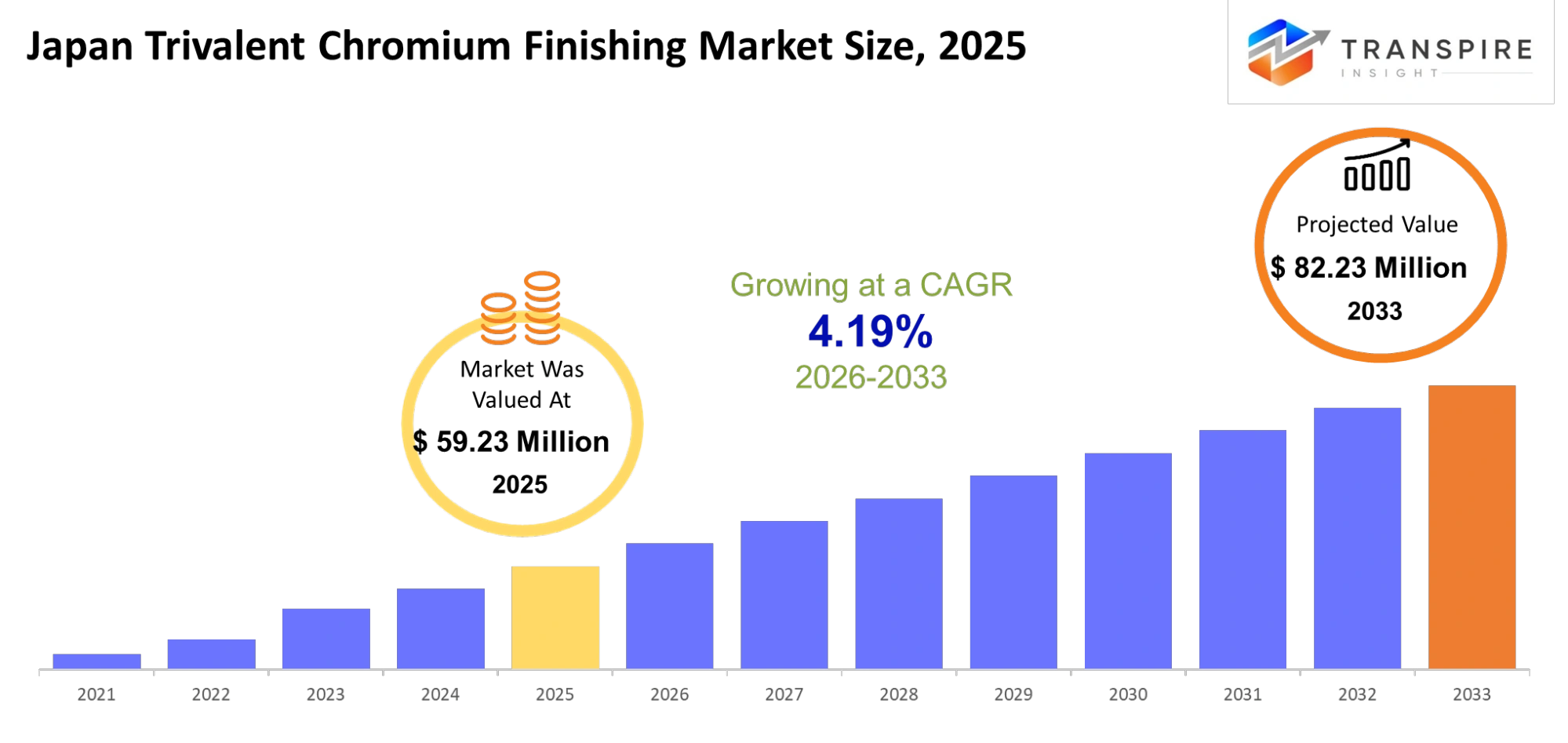
- Japan Trivalent Chromium Finishing Market Size 2025: USD 59.23 Million
- Japan Trivalent Chromium Finishing Market Size 2033: USD 82.23 Million
- Japan Trivalent Chromium Finishing Market CAGR: 4.19%
- Japan Trivalent Chromium Finishing Market Segments: By Type (Chromium Sulfate, Chromium Chloride, Chromium Nitrate, Others); By Application (Automotive Coating, Aerospace Coating, Electronics Plating, Industrial Machinery, Decorative Coating, Others); By End-User (Automotive Industry, Aerospace Industry, Electronics Industry, Manufacturing Sector, Industrial Firms, Others); By Process (Electroplating, Conversion Coating, Passivation, Others)
To learn more about this report,  Download Free Sample Report
Japan Trivalent Chromium Finishing Market Summary
The Japan Trivalent Chromium Finishing Market was valued at USD 59.23 Million in 2025. It is forecast to reach USD 82.23 Million by 2033. That is a CAGR of 4.19% over the period.
The process of trivalent chromium finishing applies a thin protective layer to metal parts which enhances their ability to resist corrosion and their capacity to withstand wear and their overall visual appearance in automotive components and electronic connectors and marine hardware that Japanese industries use in their supply chains. The market has moved away from hexavalent chromium processes during the past three years because manufacturers need to comply with newly established environmental and workplace safety standards.
The industry has experienced a major transformation because traditional chromium plating lines now operate trivalent systems which produce less harmful materials and enable better compliance with international export regulations. The implementation of tighter chemical regulations together with OEM sustainability requirements increased after supply chain disruptions in hazardous chemical materials showed the industry needed to depend on traditional plating materials. Japanese manufacturers are currently investing in process improvements and coating technologies that meet standards because these investments create new business opportunities through equipment upgrades and material replacement processes.
Key Market Insights
- The Kanto region holds the top position in the Japan Trivalent Chromium Finishing Market because it contains various automotive and electronics production hubs which make up 35% of the market.
- The fastest development of the Kansai region will continue until 2033 because industrial facilities are being updated and their plating operations are receiving new equipment.
- The Japan Trivalent Chromium Finishing Market shows regional growth because production facilities are moving their operations to new surface treatment centers.
- The Japan Trivalent Chromium Finishing Market leads its market through the plating chemicals segment which has gained extensive industrial market presence.
- The equipment and plating line systems serve as the second most important segment because existing facilities need updates through retrofitting.
- The fastest expanding segment of service-based modernization and maintenance services in Japan functions through compliance-driven system upgrades which Japanese manufacturers implement.
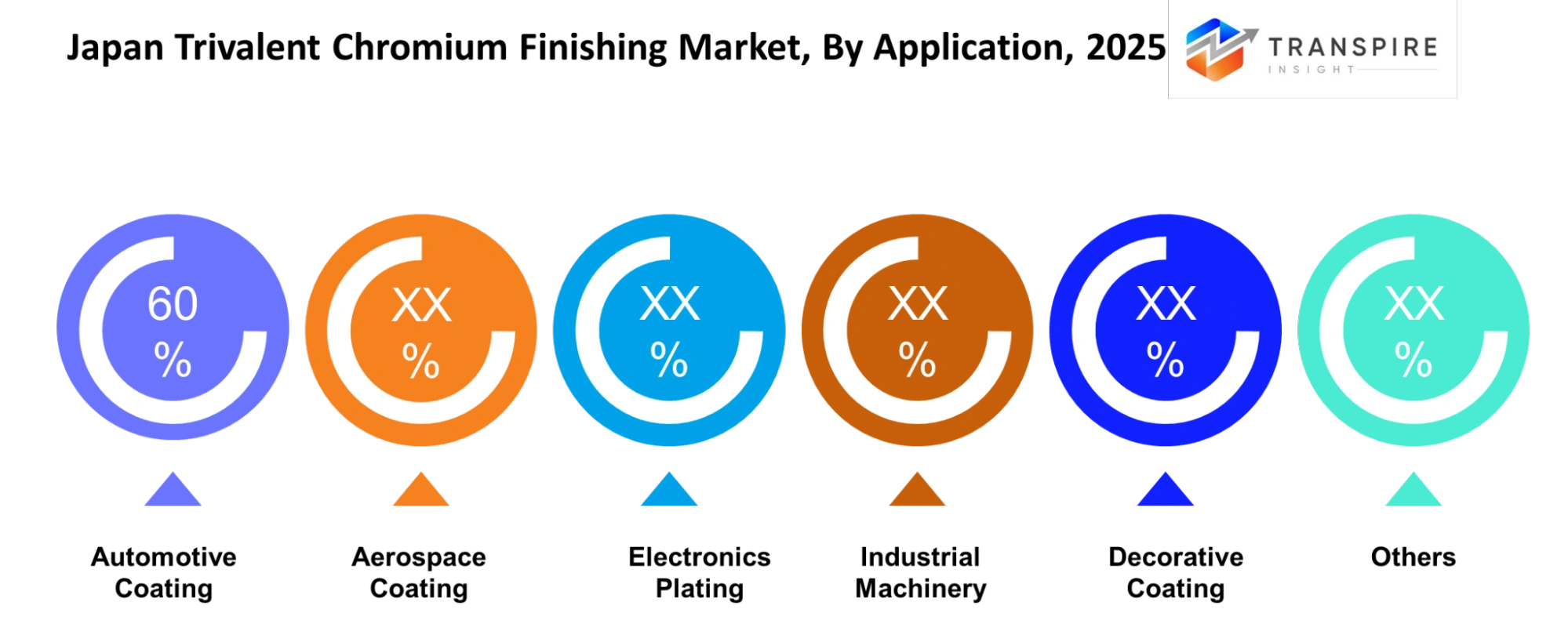
- Automotive components dominate with approximately 40% share which makes it the core demand driver in the Japan Trivalent Chromium Finishing Market.
- The Japan Trivalent Chromium Finishing Market establishes automotive original equipment manufacturers as its main end-user market because these companies use extensive plating systems.
- Electronics manufacturers show the fastest growth, driven by precision connectors and conductive surface protection needs. Industrial equipment producers maintain stable demand for durable and corrosion-resistant finishing solutions.
What are the Key Drivers, Restraints, and Opportunities in the Japan Trivalent Chromium Finishing Market?
The Japan Trivalent Chromium Finishing Market exists because Japan established new environmental regulations and occupational safety standards and export-related compliance requirements which banned the use of hexavalent chromium. The manufacturing industry implemented stricter chemical safety regulations which required automotive and electronics companies to change their surface treatment methods. Original equipment manufacturers now use compliant finishing systems as mandatory production components instead of using them as optional production elements. The Japan Trivalent Chromium Finishing Market has experienced growth because businesses now need to spend more money on plating chemicals and electroplating systems and retrofit equipment which enables them to maintain their regular income.
The main barrier remains the expensive and complicated process of transforming existing hexavalent chromium production facilities into complete trivalent chromium operations. The process requires extensive changes because it requires organizations to adopt new procedures and conduct training sessions for workers while buying new machinery. Many small and mid-sized plating facilities delay transition due to thin margins and uncertainty around return on investment. The Japan Trivalent Chromium Finishing Market has experienced uneven adoption which results in decreased revenue growth during the short term despite strong regulatory requirements.
The western Japan industrial areas of Hiroshima and Kyushu present a main opportunity through their expanding semiconductor and precision electronics manufacturing sector. Governments and businesses now test advanced trivalent chromium coatings on micro-connectors and high-precision conductive components. Uyemura and Atotech invest in two technologies which include nano-scale plating chemistry and high-uniformity coating systems. The Japan Trivalent Chromium Finishing Market will enter its next growth phase because semiconductor packaging complexity has created a need for ultra-stable corrosion-resistant finishes.
What Has the Impact of Artificial Intelligence Been on the Japan Trivalent Chromium Finishing Market?
The Japan Trivalent Chromium Finishing Market experiences production efficiency improvements through artificial intelligence and advanced digital systems which enhance process control for electroplating lines that serve automotive and electronics and precision engineering sectors. The manufacturing industry uses AI-based monitoring systems which automatically manage bath chemistry and temperature and current density. The system maintains consistent coating quality throughout high-volume production processes with reduced need for human operations.
Computer vision systems enable multiple facilities to identify defects in finished products while they simultaneously reject defective plating layers which helps minimize rework requirements. Machine learning models are also being integrated into predictive maintenance frameworks for plating equipment such as rectifiers, filtration units, and agitation systems. The models use vibration and conductivity and chemical degradation pattern analysis to detect failures before equipment downtime occurs which leads to better line availability and operational continuity.
The systems help advanced installations achieve significant decreases in unplanned maintenance expenses while they also maintain steady operational performance. The Japan Trivalent Chromium Finishing Market faces restricted technology usage because of expensive system integration requirements and the challenges involved in transforming existing electroplating systems into digital formats.
Mid-sized businesses face challenges because they do not possess standardized datasets which prevents them from developing dependable models that can handle actual production variations. The manufacturing industry sees AI technology used primarily by large companies which operate advanced digital production systems and digital manufacturing infrastructure.
Key Market Trends
- The Japan Trivalent Chromium Finishing Market experienced a transition from pre-2020 selective adoption to mandatory compliance-driven supply chain changes following the implementation of stricter chemical safety regulations.
- The automotive industry has increased its use of trivalent chromium by almost 30 percent since the beginning of 2021 because manufacturers have switched to trivalent chromium for their corrosion-sensitive parts and export production facilities.
- Between 2022 and 2025 electronics manufacturers shifted their focus to micro-coating technologies because they needed precise connectors and smaller corrosion-proof parts.
- After 2023 Atotech and other suppliers established more production facilities in Japan to decrease supply chain interruptions and fulfill increasing OEM compliance requirements.
- The mid-sized plating companies encountered two separate adoption pathways because they postponed their complete transition because retrofitting expenses increased between 20 and 35 percent.
- The global chemical safety frameworks imposed stricter regulations which resulted in manufacturing equipment needing faster replacement after 2022 because manufacturers had to advance their electroplating system upgrades.
- Henkel and other international companies raised their research and development spending for low-toxicity coating formulas to obtain permanent agreements with Japanese industrial customers.
- Following 2024 semiconductor packaging requirements soared which led to a greater need for ultra-thin trivalent coatings used in high-reliability microelectronic applications.
- The implementation of automated bath monitoring systems in large plants replaced traditional manual quality control methods which led to better operational uniformity and lower defect percentages during high-production plating processes.
Japan Trivalent Chromium Finishing Market Segmentation
By Type :
The stable deposition quality and strong corrosion resistance of chromium sulfate and chromium chloride will ensure their ongoing use in surface finishing applications. The metal coating performance of these materials will remain constant because they meet the production requirements for automotive and industrial applications which need enduring durability and consistent surface appearance.
Chromium nitrate and other specialized compounds will serve niche finishing needs where controlled reaction and specific surface properties are required. The electronics and fine industrial parts sector will use these types of materials because their coating consistency and chemical stability determine which products to choose.
By Application :
The demand for automotive coating will increase because customers need protection against corrosion and want durable exterior finishes. Trivalent chromium finishing will support vehicle durability, especially in parts exposed to weather, road salts, and constant mechanical stress in transport systems. The use of trivalent chromium finishing will expand to aerospace coating and electronics plating and industrial machinery and decorative coating applications.
Aerospace and industrial machinery will prioritize strength and heat resistance, while electronics plating will focus on precision surfaces. Decorative coating will maintain demand for visual quality and smooth surface appearance.
To learn more about this report, Download Free Sample Report
By End-User :
The automotive industry will remain a major end-user as finishing processes support vehicle body and component protection. The aerospace industry will use trivalent chromium for lightweight metal components which need both corrosion protection and structural integrity during high-performance usage.
The electronics industry and manufacturing sector along with industrial firms will boost their material usage because of their increasing production needs and requirement for material protection. Electronics will need precise coating applications, whereas manufacturing and industrial companies will implement finishing techniques to extend their equipment lifespan and decrease their maintenance needs throughout their operations.
By Process :
The process of electroplating will become the main method of industrial production because it provides metal surfaces with consistent thickness and strong bond strength. The process will continue to be essential for automotive and industrial and electronics fields which need durable products with standardized finishing results.
Conversion coating and passivation will support surface enhancement and corrosion resistance improvement. The conversion coating process enables the formation of protective metal layers whereas passivation creates stronger protection against oxidation. The two processes exist as vital methods to extend the operational lifespan of equipment which operates in extreme industrial conditions.
What are the Key Use Cases Driving the Japan Trivalent Chromium Finishing Market?
The primary application of the Japan Trivalent Chromium Finishing Market involves automotive component coating because engine parts and fasteners and exterior metal fittings require corrosion protection and surface strength. Japanese automotive OEMs use trivalent chromium finishing as their primary solution to meet strict export and environmental regulations, which creates their main customer demand.
The electronics industry and industrial machinery sector expand their applications through precision connectors and conductive housings, which require stable non-toxic surface protection. The electronics industry increasingly uses these coatings to create smaller devices, while industrial equipment manufacturers apply them to enhance product durability in extreme working environments.
Semiconductor packaging and advanced mobility systems which include EV battery enclosures are developing new use cases. The applications demand ultra-thin coatings with uniform thickness because these coatings need to provide thermal stability and corrosion protection. The Japan Trivalent Chromium Finishing Market will experience growing demand from these specialized sectors as manufacturing processes become more intricate.
|
Report Metrics |
Details |
|
Market size value in 2025 |
USD 59.23 Million |
|
Market size value in 2026 |
USD 61.71 Million |
|
Revenue forecast in 2033 |
USD 82.23 Million |
|
Growth rate |
CAGR of 4.19% from 2026 to 2033 |
|
Base year |
2025 |
|
Historical data |
2021 - 2024 |
|
Forecast period |
2026 - 2033 |
|
Report coverage |
Revenue forecast, competitive landscape, growth factors, and trends |
|
Country scope |
Japan |
|
Key company profiled |
Atotech, MacDermid Enthone, Coventya, Chemetall, Henkel, BASF, Dow, Elementis, Advanced Chemical Company, Columbia Chemical, KC Jones Plating, Sarrel Group, Pioneer Metal Finishing, Aalberts, Galvatek |
|
Customization scope |
Free report customization (country, regional & segment scope). Avail customized purchase options to meet your exact research needs. |
|
Report Segmentation |
By Type (Chromium Sulfate, Chromium Chloride, Chromium Nitrate, Others); By Application (Automotive Coating, Aerospace Coating, Electronics Plating, Industrial Machinery, Decorative Coating, Others); By End-User (Automotive Industry, Aerospace Industry, Electronics Industry, Manufacturing Sector, Industrial Firms, Others); By Process (Electroplating, Conversion Coating, Passivation, Others) |
Which Regions are Driving the Japan Trivalent Chromium Finishing Market Growth?
The Kanto region dominates the Japanese Trivalent Chromium Finishing Market because it contains many automotive OEMs and electronics manufacturers and precision engineering groups. The industrial zones in Tokyo and Yokohama experience strong regulatory enforcement which drives businesses to replace hazardous hexavalent systems with trivalent coatings that meet compliance requirements. The region benefits from chemical supply chains that operate at a high level and from plating service providers which handle large production needs.
The combination of research centers and manufacturing facilities dedicated to export activities forms an ecosystem which generates permanent requirements for their services. The Kansai region serves as a reliable secondary center which operates through its various industrial activities that span across Osaka and Kyoto and Kobe. The domestic machinery production of Kansai together with its mid-tier manufacturer relationships establishes a base that supports growth of this region which stands apart from Kanto's export-driven economy. The regulatory authorities have implemented a phased approach which enables industrial prefectures to adopt trivalent chromium technologies at a controlled pace.
The market revenue grows through constant capital expenditures on equipment modernization and upkeep activities. The rapid expansion of semiconductor factories and electric vehicle manufacturing centers has made Kyushu the fastest developing area in the Japanese Trivalent Chromium Finishing Market. The government-sponsored industrial incentives which started in 2023 have created new opportunities for investment in plating and surface treatment facilities.
The development of major industrial facilities in Fukuoka and Kumamoto has created a higher requirement for finishing systems that meet regulatory standards. The period from 2026 to 2033 will provide technology providers and chemical suppliers with prime entry prospects because advanced manufacturing processes will continue to expand within the region.
Who are the Key Players in the Japan Trivalent Chromium Finishing Market and How Do They Compete?
The Japan Trivalent Chromium Finishing Market displays a moderate level of industry consolidation between international surface treatment firms and local Japanese chemical companies. Incumbents protect their market share through long-term original equipment manufacturer agreements and their comprehensive technical support services which they offer to clients. The main competitive battle has moved from traditional market approaches to developing low-toxicity chemical solutions and maintaining process reliability and meeting automotive and electronics industry requirements. Companies that can deliver dependable coating results while adhering to industry regulations will achieve superior market presence throughout manufacturing supply networks.
Henkel and Atotech use their innovative plating chemicals and environmentally friendly product lines to compete with automotive original equipment manufacturers who need coatings that meet rules and provide long-lasting performance. Atotech establishes its market position through complete electroplating systems and its ability to work closely with original equipment manufacturers, while Henkel concentrates on its environmentally certified chemical range and worldwide compliance with regulations. JCU Corporation increases its electronics and semiconductor plating business by providing high-purity chemical systems which meet the needs of Japan's precision manufacturing sector while growing its R&D partnerships and local production capabilities.
The competition between Uyemura and Okuno Chemical Industries centers on their ability to produce high-precision products which include semiconductor packaging materials and industrial coatings that protect against corrosion. Uyemura specializes in nano-scale plating technologies for electric vehicle components and electronic devices, while Okuno Chemical Industries develops customized industrial solutions which fulfill specific requirements. The two companies use co-development partnerships with manufacturers and their operations in Asia-Pacific export markets to build long-term technological advantages.
Company List
- Atotech
- MacDermid Enthone
- Coventya
- Chemetall
- Henkel
- BASF
- Dow
- Elementis
- Advanced Chemical Company
- Columbia Chemical
- KC Jones Plating
- Sarrel Group
- Pioneer Metal Finishing
- Aalberts
- Galvatek
Recent Development News
In September 2025, Meviy (Japan) launched a trivalent chromate passivation surface treatment service for sheet metal components in Japan and Europe. The service was designed to support aerospace and electronics manufacturers by offering RoHS/REACH-compliant corrosion-resistant finishing aligned with Japan’s precision parts supply ecosystem. Source https://third-news.com/
In February 2026, EEJA Ltd. confirmed expansion of its integrated plating solutions strategy through its semiconductor plating equipment unit ahead of the April 2026 rebranding. The move supports tighter coupling of plating chemistry and equipment design, improving process control and adoption of advanced surface finishing systems across Japan’s electronics and precision plating industries.Source https://www.japanindustrynews.com/
What Strategic Insights Define the Future of the Japan Trivalent Chromium Finishing Market?
The Japan Trivalent Chromium Finishing Market will reach complete compliance by 2029 when trivalent systems become the standard finishing method. The manufacturing process for export products now requires stricter environmental standards while automotive and electronics sectors adopt sustainable surface engineering practices. The market will increasingly reward suppliers that combine chemistry innovation with digitally controlled plating systems, rather than those offering standalone materials.
The less obvious threat which suppliers face comes from their excessive reliance on a limited number of high-spec OEM customers because this dependence creates a risk which could result in sudden demand fluctuations when automotive electrification cycles experience either a slowdown or a change in sourcing patterns. Kyushu shows strong potential because its new semiconductor packaging needs have started to prove ultra-precise trivalent coatings as effective solutions for upcoming microelectronic assembly applications.
Market participants should prioritize building localized R&D and application engineering capabilities in Japan, particularly aligned with electronics and EV component manufacturers, to secure long-term contract positioning and reduce exposure to commoditized plating supply chains.
Japan Trivalent Chromium Finishing Market Report Segmentation
By Type
- Chromium Sulfate
- Chromium Chloride
- Chromium Nitrate
By Application
- Automotive Coating
- Aerospace Coating
- Electronics Plating
- Industrial Machinery
- Decorative Coating
By End-User
- Automotive Industry
- Aerospace Industry
- Electronics Industry
- Manufacturing Sector
- Industrial Firms
By Process
- Electroplating
- Conversion Coating
- Passivation
Frequently Asked Questions
Find quick answers to common questions.
The Japan Trivalent Chromium Finishing Market size is USD 82.23 Million in 2033.
Key segments for the Japan Trivalent Chromium Finishing Market are By Type (Chromium Sulfate, Chromium Chloride, Chromium Nitrate, Others); By Application (Automotive Coating, Aerospace Coating, Electronics Plating, Industrial Machinery, Decorative Coating, Others); By End-User (Automotive Industry, Aerospace Industry, Electronics Industry, Manufacturing Sector, Industrial Firms, Others); By Process (Electroplating, Conversion Coating, Passivation, Others).
Major Japan Trivalent Chromium Finishing Market players are Atotech, MacDermid Enthone, Coventya, Chemetall, Henkel, BASF, Dow, Elementis, Advanced Chemical Company, Columbia Chemical, KC Jones Plating, Sarrel Group, Pioneer Metal Finishing, Aalberts, Galvatek.
The Japan Trivalent Chromium Finishing Market size is USD 59.23 Million in 2025.
The Japan Trivalent Chromium Finishing Market CAGR is 4.19% from 2026 to 2033.
- Atotech
- MacDermid Enthone
- Coventya
- Chemetall
- Henkel
- BASF
- Dow
- Elementis
- Advanced Chemical Company
- Columbia Chemical
- KC Jones Plating
- Sarrel Group
- Pioneer Metal Finishing
- Aalberts
- Galvatek
Recently Published Reports
-
Apr 2026
Healthcare Polymer Packaging Market
Healthcare Polymer Packaging Market Size, Share & Analysis Report By Packaging Type (Syringes, IV Bottles and Pouches, Clamshells, Blisters, Bottles & Jars, Containers, Tubes, IV Parental Packaging, Others), By Type (Regulated, Non-regulated), By Polymer Type (LDPE (Low-Density Polyethylene), HDPE (High-Density Polyethylene), Homo-polymer (Homo), Random Copolymer (Random), Block Copolymer (Block), PET, Polystyrene, Polyvinyl Chloride, Polyamide/EVOH, Others), and Geography (North America, Europe, Asia-Pacific, Middle East and Africa, South and Central America), 2021 - 2031
-
Apr 2026
Hydrophilic Tape (Waterstop) Market
Hydrophilic Tape (Waterstop) Market Size, Share & Analysis Report By Type (Bentonite-Based Hydrophilic Tape, Rubber-Based Hydrophilic Tape), By Application (Residential Buildings, Commercial Buildings, Infrastructure Projects), and Geography (North America, Europe, Asia-Pacific, Middle East and Africa, South and Central America), 2021 - 2031
-
Apr 2026
Metalens Market
Metalens Market Size, Share & Analysis Report By Type (Visible Light Metalens, and Infrared Metalens), By Application (Consumer Electronics, Automotive Electronics, Industrial, Medical, and Others), and Geography (North America, Europe, Asia-Pacific, Middle East and Africa, South and Central America), 2021 - 2031
-
Apr 2026
PBT Resin Market
PBT Resin Market Size, Share & Analysis Report By Type (Reinforced PBT Resin, Unreinforced PBT Resin), By Processing Method (Injection Molding, Extrusion, Blow Molding, Others), By End-User (Automotive, Electrical & Electronics, Consumer Appliances, Industrial Machinery, Medical Devices, Packaging, Others), and Geography (North America, Europe, Asia-Pacific, Middle East and Africa, South and Central America), 2021 - 2031