

United States Tertiary Butyl Hydroquinone (TBHQ) Market Size & Forecast:
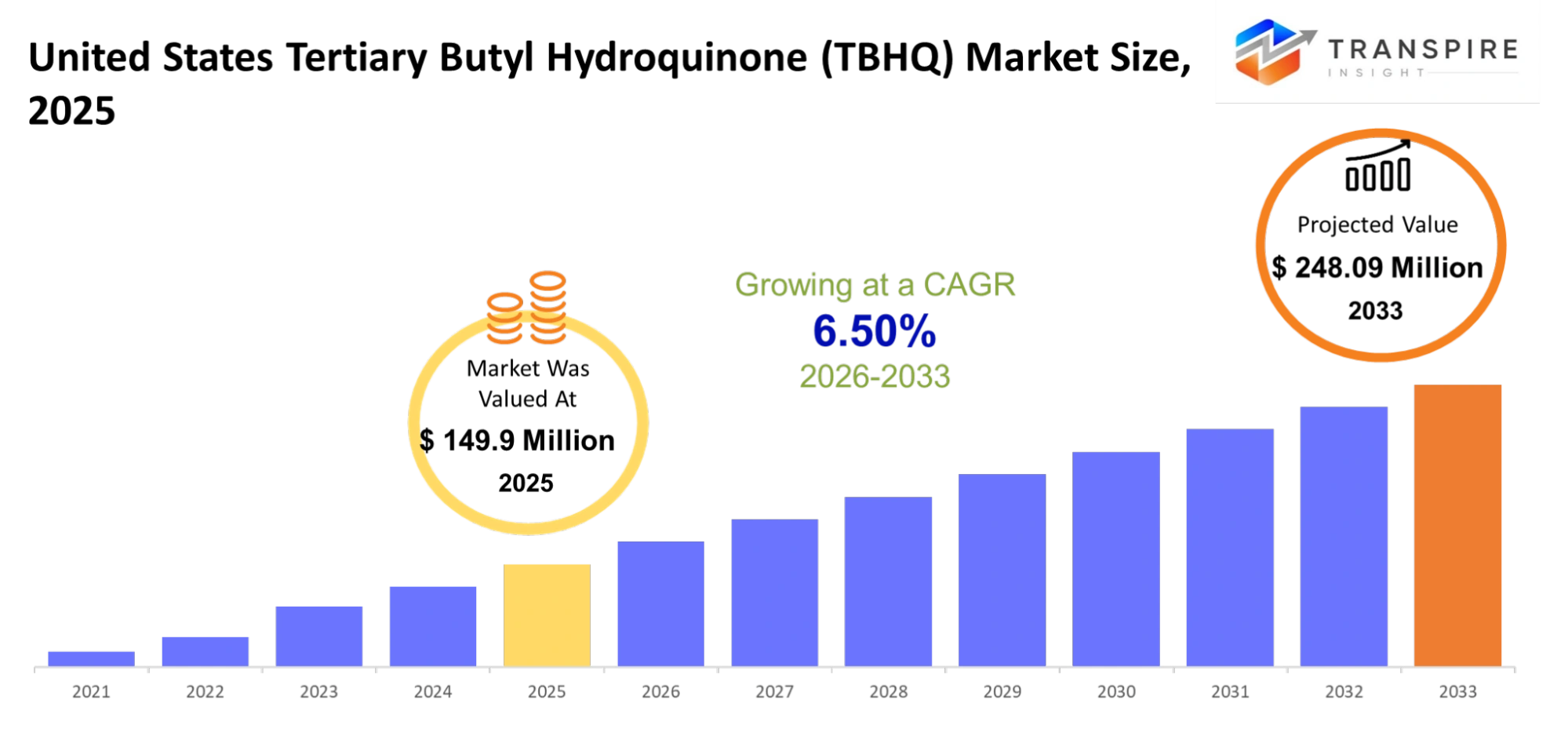
- United States Tertiary Butyl Hydroquinone (TBHQ) Market Size 2025: USD 149.9 Million
- United States Tertiary Butyl Hydroquinone (TBHQ) Market Size 2033: USD 248.09 Million
- United States Tertiary Butyl Hydroquinone (TBHQ) Market CAGR: 6.50%
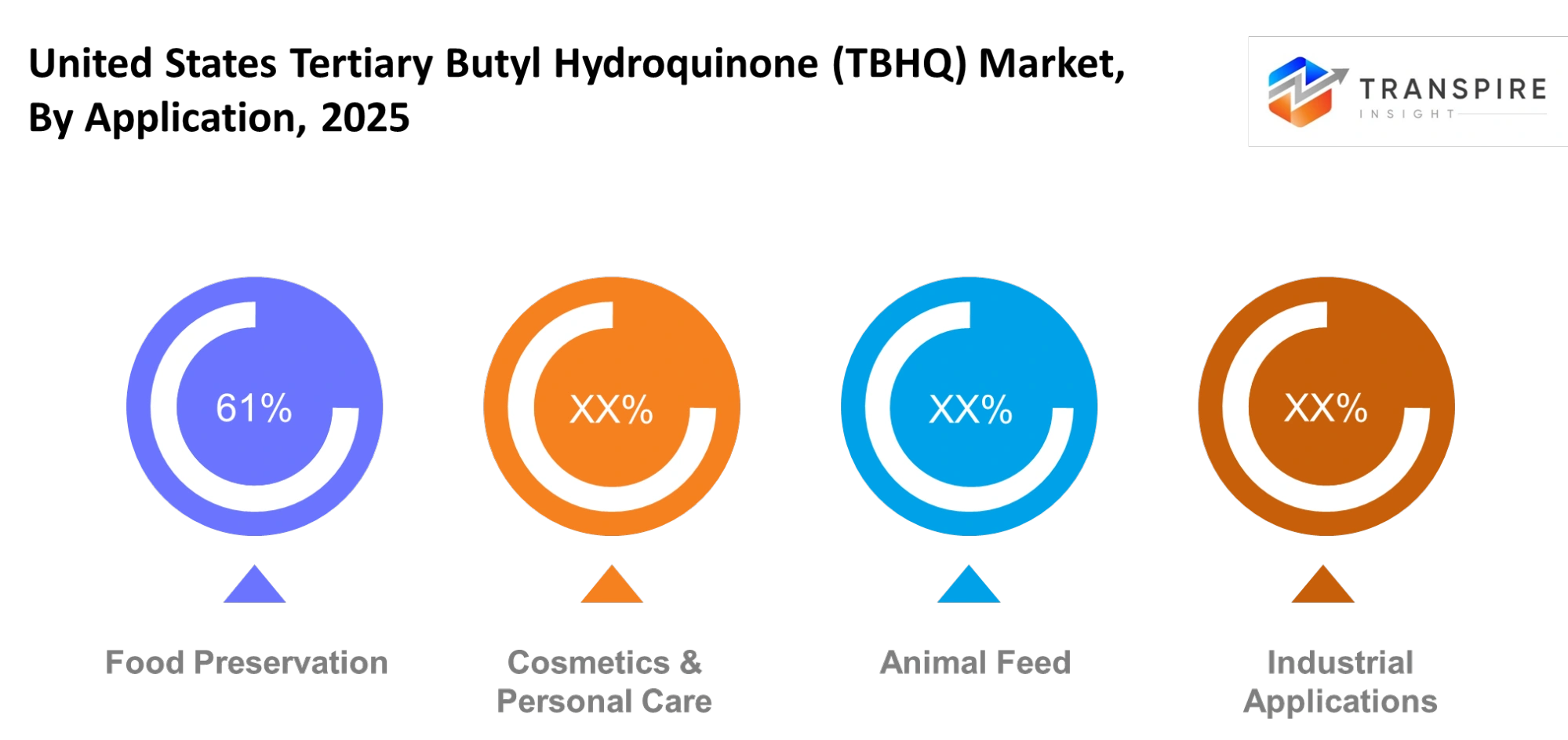
- United States Tertiary Butyl Hydroquinone (TBHQ) Market Segments:By Application (Food Preservation, Cosmetics & Personal Care, Animal Feed, Industrial Applications), By Grade (Food Grade, Industrial Grade).
To learn more about this report,  Download Free Sample Report
United States Tertiary Butyl Hydroquinone (TBHQ) Market Summary:
The United States Tertiary Butyl Hydroquinone (TBHQ) Market size is estimated at USD 149.9 Million in 2025 and is anticipated to reach USD 248.09 Million by 2033, growing at a CAGR of 6.50% from 2026 to 2033. The United States Tertiary Butyl Hydroquinone (TBHQ) Market shows constant development because of its extensive use as a synthetic antioxidant in the food and beverage sector.
The shelf life of processed foods and edible oils and snacks products depends on TBHQ because it helps preserve their freshness. Manufacturers are using TBHQ in greater amounts because consumers now prefer convenience foods which need product stability and quality maintenance. The United States Tertiary Butyl Hydroquinone (TBHQ) Market experiences growth because of this increasing dependency on TBHQ.
The United States Tertiary Butyl Hydroquinone (TBHQ) Market extends beyond food products because it has gained popularity in cosmetics and industrial applications which need oxidation protection for oils and fats and chemical compounds. The adoption of this technology in multiple industries has increased because of regulatory approvals and controlled usage levels.
The market demand will continue because of ongoing formulation technology improvements and the industry needs for products with extended durability. The combination of these elements will create a continuous growth pattern for the United States Tertiary Butyl Hydroquinone (TBHQ) Market throughout the next several years.
What Has the Impact of Artificial Intelligence Been on the United States Tertiary Butyl Hydroquinone (TBHQ) Market?
The artificial intelligence technology now transforms entire industrial sectors while its business effects on the United States tertiary butyl hydroquinone (TBHQ) market continue to grow. AI in United States tertiary butyl hydroquinone (TBHQ) market operations enables market researchers to conduct data analysis through its ability to handle extensive datasets and find meaningful business results.
Through machine learning and predictive analytics, companies use these technologies to track consumption patterns and regulatory changes and emerging market developments which helps them create better demand forecasts. The data-driven method enables better strategic choices and decreases calculation risk which leads to more dependable market growth in the United States tertiary butyl hydroquinone (tbhq) market.
Artificial intelligence drives smart automation through its implementation in United States tertiary butyl hydroquinone (tbhq) manufacturing to enhance operational efficiency in production facilities. AI-powered systems achieve cost savings and productivity boosts by streamlining chemical processing operations and cutting down waste and enhancing quality control processes.
Predictive analytics serves as a tool for supply chain management because it helps businesses handle their logistics and inventory while avoiding disruptions to achieve successful delivery and efficient resource distribution. AI technology boosts innovation speed which helps United States tertiary butyl hydroquinone (TBHQ) market companies establish market advantages through its ability to enhance product consistency and support customization and provide quick responses to market changes.
Key Market Trends & Insights:
- The Midwestern states control the United States market for tertiary butyl hydroquinone (tbhq) because their food processing industries produce 35% of total market results in 2024.
- The Southern region is experiencing its fastest growth because industrial development will drive it to expand at 6.5% CAGR between 2024 and 2030.
- The packaged food industry demands food-grade TBHQ which currently controls more than 60% of the market share in 2024.
- The second-largest market share of industrial-grade TBHQ occurs because people use it to produce polymers and resins and perform chemical stabilization work.
- Pharmaceutical-grade TBHQ is the fastest-growing segment, expected to grow at 7% CAGR due to increasing demand for stabilized formulations.
- Processed food preservation dominates applications, which will generate 65% of the total US market share for tertiary butyl hydroquinone (tbhq) in 2024.
- The cosmetics and personal care application area shows the fastest growth rate because manufacturers use more antioxidants in their products, which results in a 6.8% CAGR expansion.
- The food and beverage sector controls 70% of the market because consumers increasingly prefer ready-to-eat meals and packaged products.
- The cosmetics sector expands rapidly because customers want beauty products that last longer and resist oxidation.
United States Tertiary Butyl Hydroquinone (TBHQ) Market Segmentation
By Application
Food preservation will dominate application usage because people need longer shelf life for edible oils and snacks and ready-to-eat products. The segment will experience strong growth because people will keep eating packaged food products. The cosmetics and personal care market will grow at a steady pace because oxidation control helps products last longer and work better. The skincare and beauty industry will experience rising demand because product innovation continues to develop.
Animal feed applications will grow because people recognize that maintaining feed quality is essential for animal nutritional stability. The industrial sector will experience expansion because resins and polymers and chemical processing operations become more standard. The performance advantages of these sectors will maintain a consistent demand throughout the market. The growth of end-use industries will keep driving the development of all application areas.
To learn more about this report, Download Free Sample Report
By Grade
Food grade will hold a leading share due to strict safety standards and widespread use in food processing industries. The grade will see increased demand because people consume processed food products at high rates. The two factors of regulatory compliance and quality assurance will drive demand for the product on the market. Manufacturers will focus on maintaining consistent quality to meet industry standards.
Chemical stabilization and manufacturing processes will create industrial grade demand which will lead to its substantial market share. Industrial production expansion and material application growth will drive increased demand for the product. The product will see widespread use in different industries because it provides both cost savings and dependable performance. Industrial growth will continue to create constant demand for this particular market segment.
What are the Main Challenges for the United States Tertiary Butyl Hydroquinone (TBHQ) Market Growth?
The united states tertiary butyl hydroquinone (tbhq) market experiences multiple technical and operational issues that prevent it from achieving reliable performance together with operational growth. The main issue scientists need to address involves testing product performance in different storage and processing environments which includes testing its behavior under extreme heat.
The complex requirements for chemical handling and product formulation lead to production inefficiencies that continue through all manufacturing stages. The united states tertiary butyl hydroquinone (tbhq) market experiences growth obstacles because supply chain disruptions make it difficult to obtain essential raw materials.
The united states tertiary butyl hydroquinone (tbhq) market suffers from manufacturing and commercialization obstacles which stem from demanding regulatory compliance standards. The need to comply with food safety standards together with quality certifications results in higher production costs and longer approval processes.
Smaller manufacturers encounter operational difficulties because their processes require substantial capital expenses and complicated operational methods. The market imposes restrictions which prevent companies from developing new products and bringing them to market.
The united states tertiary butyl hydroquinone (tbhq) market encounters adoption obstacles which affect markets that lack technical knowledge and proper infrastructure. Some end users lack awareness regarding proper usage and benefits which affects demand growth. The requirement for skilled workers together with advanced facilities functions as an obstacle that prevents new companies from entering the market. The active adoption of new technologies gets hindered because industries face both funding shortfalls and technological deficiencies.
Country Insights
The Midwest region will maintain its strong position because of its abundant food processing facilities and its existing industrial infrastructure. The manufacturers will maintain stable demand because they need to maintain their product quality and shelf life. The company will achieve additional growth through its established supply chain operations and its ability to obtain essential materials.
The development of this area will proceed through the implementation of modern manufacturing technologies and the maintenance of constant consumer demand. Industrial facilities will maintain their production standards through the implementation of effective storage methods. The production of packaged foods will create additional support. The demand for products in the area will remain stable throughout the year.
The Southern region will experience rapid growth because of its increasing industrial base and its developing food production sector. The demand for oxidation control solutions will grow because processing facilities receive more investments. The market will grow because business conditions improve and logistics networks develop better.
The region will experience development through its increased demand for ready-to-eat meals. The industrial sector will drive broader technology adoption which will benefit several different use cases. Regional demand will create business growth opportunities through affordable production costs. The area will become more significant over time.
Recent Development News
In April 2026, Camlin Fine Sciences Reaffirms TBHQ Product Expansion Across North American Supply Chain: Camlin Fine Sciences, one of the leading global TBHQ manufacturers supplying the U.S. market, continued expanding its antioxidant distribution footprint in North America during 2026. The company reaffirmed TBHQ as a flagship product in its food antioxidant portfolio for U.S. food and industrial customers.
Source: https://www.camlinfs.com
In February 2026, the FDA Begins a Comprehensive Review of Synthetic Food Preservatives Used by U.S. Manufacturers: The U.S. Food and Drug Administration initiated a 2026 review of synthetic food preservatives, signalling tighter scrutiny across antioxidant additives used in processed foods. While focused on BHA, the move directly impacts companies producing similar additives, such as TBHQ, increasing compliance pressure.
Source: https://www.foodnavigator-usa.com
|
Report Metrics |
Details |
|
Market size value in 2025 |
USD 149.9 Million |
|
Market size value in 2026 |
USD 159.64 Million |
|
Revenue forecast in 2033 |
USD 248.09 Million |
|
Growth rate |
CAGR of 6.50% from 2026 to 2033 |
|
Base year |
2025 |
|
Historical data |
2021 – 2024 |
|
Forecast period |
2026 – 2033 |
|
Report coverage |
Revenue forecast, competitive landscape, growth factors, and trends |
|
Country scope |
United States |
|
Key company profiled |
Eastman Chemical Company, Camlin Fine Sciences Ltd., Merck KGaA, Solvay SA, Lanxess AG, Jiangsu Maida New Material Co. Ltd., Haihang Industry Co. Ltd., Tokyo Chemical Industry Co. Ltd., Cayman Chemical Company, Parchem Fine & Specialty Chemicals, Foodchem International Corporation, Finoric LLC, MP Biomedicals LLC, Spectrum Chemical Manufacturing Corp., Alfa Aesar. |
|
Customization scope |
Free report customization (country, regional & segment scope). Avail customized purchase options to meet your exact research needs. |
|
Report Segmentation |
By Application (Food Preservation, Cosmetics & Personal Care, Animal Feed, Industrial Applications), By Grade (Food Grade, Industrial Grade). |
How Can New Companies Establish a Strong Foothold in the United States Tertiary Butyl Hydroquinone (TBHQ) Market?
New entrants aiming to build a strong presence in the United States tertiary butyl hydroquinone (tbhq) market should begin with targeted niche positioning and clear value differentiation. Emerging companies can establish their market presence by targeting high-growth areas which include clean-label food preservation and advanced industrial stabilization. The company can achieve early market success by matching its product range to current industry needs and existing market gaps.strong market research and data-driven entry strategies will improve positioning within the united states tertiary butyl hydroquinone (tbhq) market.
United States tertiary butyl hydroquinone companies will use innovation as their main method to create competitive advantages. Companies that invest in improved formulations, enhanced stability solutions, and safer antioxidant alternatives can address key pain points in food safety and industrial processing. Startups like Camlin Fine Sciences through their innovation units and smaller specialty chemical companies create customized antioxidant blends that suit particular uses. Emerging companies use these innovation methods to create unique market identities while building their future business growth.
New businesses that want to enter the United States market for tertiary butyl hydroquinone (tbhq) must establish strategic partnerships and execute supply chain integration. Food manufacturers and cosmetic brands and industrial processors should work together with their customers for better product adoption and expansion. Businesses can enhance their market availability and work performance through partnerships with distribution companies and technology solutions providers. The partnerships enable businesses to enter new markets while creating trust in their brand during competitive situations.
The United States tertiary butyl hydroquinone market will experience growth through the implementation of smart automation and predictive analytics technologies.Digital tools enable organizations to enhance production workflows while decreasing costs and achieving improved product quality. Companies that use advanced technology together with environmentally friendly solutions will achieve competitive benefits in their industry markets. The system allows organizations to modify their operational processes in response to emerging regulatory standards and changing customer preferences.
Key United States Tertiary Butyl Hydroquinone (TBHQ) Market Company Insights
Competitive pressure exists because established chemical manufacturers operate with their extensive production capacity and their ability to distribute products across multiple locations. Companies will maintain market share through their efforts to deliver high-quality products while controlling production expenses. Strong supplier relationships and stable raw material sourcing will support competitive positioning across key regions.
Leading players will invest in product development and regulatory compliance to achieve industry standards. Companies will prioritize safety and performance which will determine their products' market appeal. Research and development efforts will lead to better product development through improved formulations which produce better results in application. The approach will establish long-term business competitiveness through its implementation.
Mid-sized companies will strengthen presence through strategic partnerships and regional expansion. Companies will enhance their market presence by teaming up with distributors and end-use industries. The organization will draw in more customers through its ability to customize solutions and implement variable pricing options. The organization will create opportunities for stable development through its current work.
Emerging players will establish their presence in competitive markets by developing specialized solutions for specific applications.Companies will develop unique products through their innovative product development process and their targeted product design approach. Specific strategic approaches will enable the organization to enter the market despite its current limitations. Business growth requires organizations to adapt their operations while maintaining efficiency in their work processes.
Company List
- Eastman Chemical Company
- Camlin Fine Sciences Ltd.
- Merck KGaA
- Solvay SA
- Lanxess AG
- Jiangsu Maida New Material Co. Ltd.
- Haihang Industry Co. Ltd.
- Tokyo Chemical Industry Co. Ltd.
- Cayman Chemical Company
- Parchem Fine & Specialty Chemicals
- Foodchem International Corporation
- Finoric LLC
- MP Biomedicals LLC
- Spectrum Chemical Manufacturing Corp.
- Alfa Aesar.
What are the Key Use-Cases Driving the Growth of the United States Tertiary Butyl Hydroquinone (TBHQ) Market?
The United States tertiary butyl hydroquinone (TBHQ) market is experiencing continuous growth because TBHQ functions as an essential antioxidant preservative which the food and beverage industry uses to protect processed foods and edible oils and snacks and packaged convenience meals from spoiling.
The United States market for tertiary butyl hydroquinone (TBHQ) expands because manufacturers use TBHQ to protect their ready-to-eat products and long-shelf-life products from oxidation while maintaining product flavour. The United States' tertiary butyl hydroquinone (TBHQ) market shows growth potential beyond its food sector through industrial applications which require TBHQ as a stabiliser for plastics and resins and petrochemical products.
TBHQ provides a valuable solution for packaging and polymer processing and specialty chemical manufacturing because it protects materials from oxidative degradation during production and storage. The compound's market expansion through various industrial applications creates new revenue streams which suppliers can utilise.
The United States tertiary butyl hydroquinone (TBHQ) market experiences another major growth driver through its rising demand for use in cosmetic products that require TBHQ as a preservative to protect oils and sensitive ingredients used in skincare and beauty products. The market will expand through upcoming innovations which will create high-purity formulations and regulatory-compliant additive development, and manufacturers will increase their R&D investments to develop advanced antioxidant solutions for multifunctional applications which serve consumer and industrial markets.
United States Tertiary Butyl Hydroquinone (TBHQ) Market Report Segmentation
By Application
- Food Preservation
- Cosmetics & Personal Care
- Animal Feed
- Industrial Applications
By Grade
- Food Grade
- Industrial Grade
Frequently Asked Questions
Find quick answers to common questions.
The approximate United States Tertiary Butyl Hydroquinone (TBHQ) Market size for the market will be USD 248.09 Million in 2033.
The key segments of the United States Tertiary Butyl Hydroquinone (TBHQ) Market are By Application (Food Preservation, Cosmetics & Personal Care, Animal Feed, Industrial Applications), By Grade (Food Grade, Industrial Grade).
Major players in the United States Tertiary Butyl Hydroquinone (TBHQ) Market are Eastman Chemical Company, Camlin Fine Sciences Ltd., Merck KGaA, Solvay SA, Lanxess AG, Jiangsu Maida New Material Co. Ltd., Haihang Industry Co. Ltd., Tokyo Chemical Industry Co. Ltd., Cayman Chemical Company, Parchem Fine & Specialty Chemicals, Foodchem International Corporation, Finoric LLC, MP Biomedicals LLC, Spectrum Chemical Manufacturing Corp., Alfa Aesar.
The current market size of the United States Tertiary Butyl Hydroquinone (TBHQ) Market is USD 149.9 Million in 2025.
The United States Tertiary Butyl Hydroquinone (TBHQ) Market CAGR is 6.50%.
- Eastman Chemical Company
- Camlin Fine Sciences Ltd.
- Merck KGaA
- Solvay SA
- Lanxess AG
- Jiangsu Maida New Material Co. Ltd.
- Haihang Industry Co. Ltd.
- Tokyo Chemical Industry Co. Ltd.
- Cayman Chemical Company
- Parchem Fine & Specialty Chemicals
- Foodchem International Corporation
- Finoric LLC
- MP Biomedicals LLC
- Spectrum Chemical Manufacturing Corp.
- Alfa Aesar.
Recently Published Reports
-
Dec 2024
Healthcare Polymer Packaging Market
Healthcare Polymer Packaging Market Size, Share & Analysis Report By Packaging Type (Syringes, IV Bottles and Pouches, Clamshells, Blisters, Bottles & Jars, Containers, Tubes, IV Parental Packaging, Others), By Type (Regulated, Non-regulated), By Polymer Type (LDPE (Low-Density Polyethylene), HDPE (High-Density Polyethylene), Homo-polymer (Homo), Random Copolymer (Random), Block Copolymer (Block), PET, Polystyrene, Polyvinyl Chloride, Polyamide/EVOH, Others), and Geography (North America, Europe, Asia-Pacific, Middle East and Africa, South and Central America), 2021 - 2031
-
Jan 2025
Hydrophilic Tape (Waterstop) Market
Hydrophilic Tape (Waterstop) Market Size, Share & Analysis Report By Type (Bentonite-Based Hydrophilic Tape, Rubber-Based Hydrophilic Tape), By Application (Residential Buildings, Commercial Buildings, Infrastructure Projects), and Geography (North America, Europe, Asia-Pacific, Middle East and Africa, South and Central America), 2021 - 2031
-
Jan 2025
Metalens Market
Metalens Market Size, Share & Analysis Report By Type (Visible Light Metalens, and Infrared Metalens), By Application (Consumer Electronics, Automotive Electronics, Industrial, Medical, and Others), and Geography (North America, Europe, Asia-Pacific, Middle East and Africa, South and Central America), 2021 - 2031
-
Jan 2025
PBT Resin Market
PBT Resin Market Size, Share & Analysis Report By Type (Reinforced PBT Resin, Unreinforced PBT Resin), By Processing Method (Injection Molding, Extrusion, Blow Molding, Others), By End-User (Automotive, Electrical & Electronics, Consumer Appliances, Industrial Machinery, Medical Devices, Packaging, Others), and Geography (North America, Europe, Asia-Pacific, Middle East and Africa, South and Central America), 2021 - 2031