

United States Tenant Billing Software Market Size & Forecast:
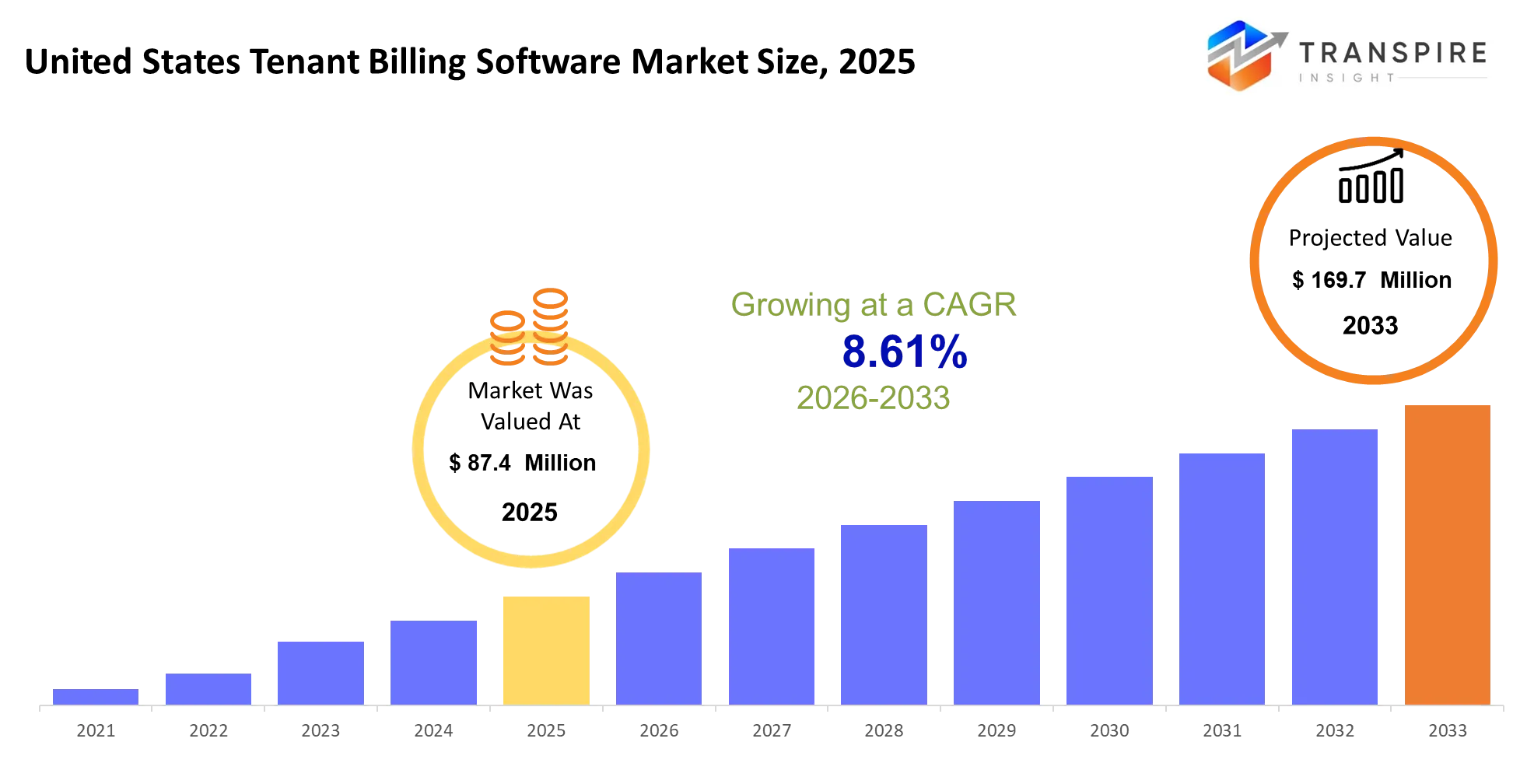
- United States Tenant Billing Software Market Size 2025: USD 87.4 Million
- United States Tenant Billing Software Market Size 2033: USD 169.7 Million
- United States Tenant Billing Software Market CAGR: 8.61%
- United States Tenant Billing Software Market Segments: By Deployment (Cloud-based, On-premise, Hybrid Systems, Others); By Application (Rent Billing, Utility Billing, Lease Management, Expense Tracking, Payment Processing, Others); By Enterprise Size (SMEs, Large Enterprises, Real Estate Agencies, Others); By End User (Property Managers, Commercial Real Estate Owners, Residential Property Owners, Co-working Spaces, Others)
To learn more about this report,  Download Free Sample Report
United States Tenant Billing Software Market Summary
The United States Tenant Billing Software Market was valued at USD 87.4 Million in 2025. It is forecast to reach USD 169.7 Million by 2033. That is a CAGR of 8.61% over the period.
In the United States, tenant billing software gets used by property managers and owners to automatically divide up charges and then invoice tenants, for rent, utilities, common area upkeep and shared building services across multifamily complexes, office towers and industrial parks, sort of thing. Over the last few years the market kind of moved away from manual spreadsheets and older on-premise accounting tools, toward cloud-based SaaS platforms that link with smart submetering and also with enterprise property management systems. COVID-19, honestly, was a big push, it forced landlords to deal with rent disruptions and handle remote operations while still keeping billing accuracy, plus that transparency everyone wants.
At the same time, jumpy energy prices made precise utility pass-through billing feel more urgent, mainly so operators don’t see revenue leakage slip out unnoticed. So adoption has picked up faster because operators now tend to focus on real-time cost allocation and dispute reduction which, in turn, improves cash flow visibility and supports steady recurring software revenues for the vendors.
Key Market Insights
- In 2025, the West region kinda dominates the United States Tenant Billing Software Market, holding nearly 34% share because of high-tech real estate adoption , across the board.
- The Northeast shows solid penetration in commercial properties, pushed by dense urban leasing and enterprise property management demand , which kinda piles up over time.
- The South is the quickest-moving region heading into 2026–2030, mostly linked to multifamily housing expansion and rapid urban migration trends.
- Cloud-based SaaS solutions lead the United States Tenant Billing Software Market with more than 62% share in 2025 , mainly for scalability benefits.
- Still, on-premise billing systems sit as the second-largest segment, and legacy enterprise property management operators keep using them.
- AI-enabled, integrated billing platforms seem to be the fastest moving segment, expected to grow pretty rapidly through 2030, mainly because automation demand keeps climbing.
- Utility billing and cost recovery still dominate the picture, they hold close to 41% share, largely tied to higher energy price pass through needs… which is kind of the main driver there.
- Rent billing automation, though, is where the momentum really shows up. Landlords are pushing for real time invoicing and fewer payment disputes so that segment is growing the fastest among applications.
- In the United States Tenant Billing Software Market, multifamily residential operators take the lead, with about 46% share in 2025, they basically set the pace.
- On the other end, commercial real estate is the fastest-growing end user segment, driven by smart building integration and ESG reporting requirements, both of which keep getting more attention.
What are the Key Drivers, Restraints, and Opportunities in the United States Tenant Billing Software Market?
In the United States Tenant Billing Software Market, growth is mostly powered by the move toward automated cost recovery and, kind of real time utility allocation across big property portfolios. At the same time, energy price swings keep getting worse and expectations for billing transparency are getting stricter, so landlords are gradually swapping manual reconciliation for cloud based billing systems. These platforms usually link up with submetering setups and property management software. The result is better cash flow accuracy and fewer billing arguments, which then ramps up both software adoption and subscription based income for vendors working inside the United States Tenant Billing Software Market.
Still, there’s a pretty stubborn restraint. Mid-tier property management firms often have fragmented, legacy infrastructure. A lot of them lean on old accounting platforms that are baked into their leasing routines, so replacing everything end-to-end is expensive and it tends to disrupt daily operations. Because of that, migration to modern tenant billing platforms happens slower, and software providers see delayed revenue conversion, especially when they focus on smaller commercial buildings or multifamily portfolios.
On the opportunity side, integration with smart building ecosystems and IoT enabled metering is starting to matter a lot. As major U.S. real estate owners put money into connected buildings, tenant billing software is gradually getting embedded into centralized energy and occupancy management frameworks. For instance, in large urban mixed use developments, deployments are enabling automated sensor driven billing, and that improves scalability while also creating fresh recurring revenue streams. So platform vendors across the United States Tenant Billing Software Market can expand faster, without being limited to a single workflow.
What Has the Impact of Artificial Intelligence Been on the United States Tenant Billing Software Market?
Artificial intelligence is steadily reshaping the United States Tenant Billing Software Market, in a way that feels kind of quiet but still important. It’s improving how property operators process, validate, and optimize tenant-level billing data, sort of like smoothing out rough edges. In today’s platforms, AI-driven automation is used to ingest smart meter feeds, notice billing anomalies, and then reconcile utility charges automatically across both large residential and commercial portfolios. As a result, there’s less manual checking work, landlords can speed up invoice cycles and also reduce billing disputes that often come from estimation errors.
Machine learning models are also giving more predictive power, which helps with financial and operational planning, even when conditions shift. These systems more and more forecast tenant utility consumption patterns, flag possible late-payment risks, and adjust energy cost allocation by leaning on historical usage behavior. That tends to improve cash flow predictability and lets operators in the United States Tenant Billing Software Market base billing strategies on real consumption trends, not static estimates from older methods.
On the operational side, AI integration boosts efficiency by cutting down reconciliation time, improving billing accuracy, and enabling quicker dispute resolution. In big portfolios this can lower administrative overhead by a meaningful margin. Still, adoption isn’t effortless, since integration costs can be high, and legacy property management systems are often fragmented, making smooth data flow harder than it should be. On top of that, inconsistent meter data standards across buildings limit model reliability, so full-scale deployment moves more slowly even with strong demand for automation.
Key Market Trends
- Between 2020–2025 property managers kinda rapidly shifted away from on-premise systems, toward cloud SaaS platforms, and by then they were seeing more than 60% adoption across enterprise portfolios.
- Smart meter integration kinda snowballed after 2022, allowing automated utility billing and lowering manual allocation mishaps in big multifamily buildings .
- From 2023 onward, AI anomaly detection tools started to mark unusual consumption behaviors, and that helped cut billing dispute rates across U.S. portfolios , pretty noticeably.
- ESG reporting rules got stronger after 2021, which basically pushed operators to lean into tenant billing systems that can handle granular carbon plus energy tracking.
- Between 2022–2026 vendors such as RealPage, Yardi Systems , and AppFolio expanded through acquisitions, plus API integrations with the proptech ecosystem(s) , all of it.
- Subscription style pricing models replaced one-time licensing, so software providers in the tenant billing space gained steadier recurring revenue, which felt more stable month to month.
- Multifamily operators started adopting faster after 2020, largely because occupancy got more tangled, and tenants wanted clearer cost recovery billing.
- In 2024, cybersecurity spending went up , as billing platforms faced more frequent data breaches and stronger expectations for protecting tenant data.
United States Tenant Billing Software Market Segmentation
By Deployment :
Tenant billing software in the United States uses a bunch of deployment models, depending on infrastructure needs, cost control, and security requirements in property operations. It sort of ends up giving organizations different levels of reach and oversight for tenant billing processes across both residential and commercial properties.
The cloud based setups usually make remote access easier and add scalability, while on-premise solutions keep things under internal control. Then there’s the hybrid approach which mixes both directions and also other niche deployment setups that fit specific circumstances. In the end, each deployment type helps property operations push for better billing accuracy, cleaner data handling and more system flexibility, all based on how busy operations are and what the IT capability looks like.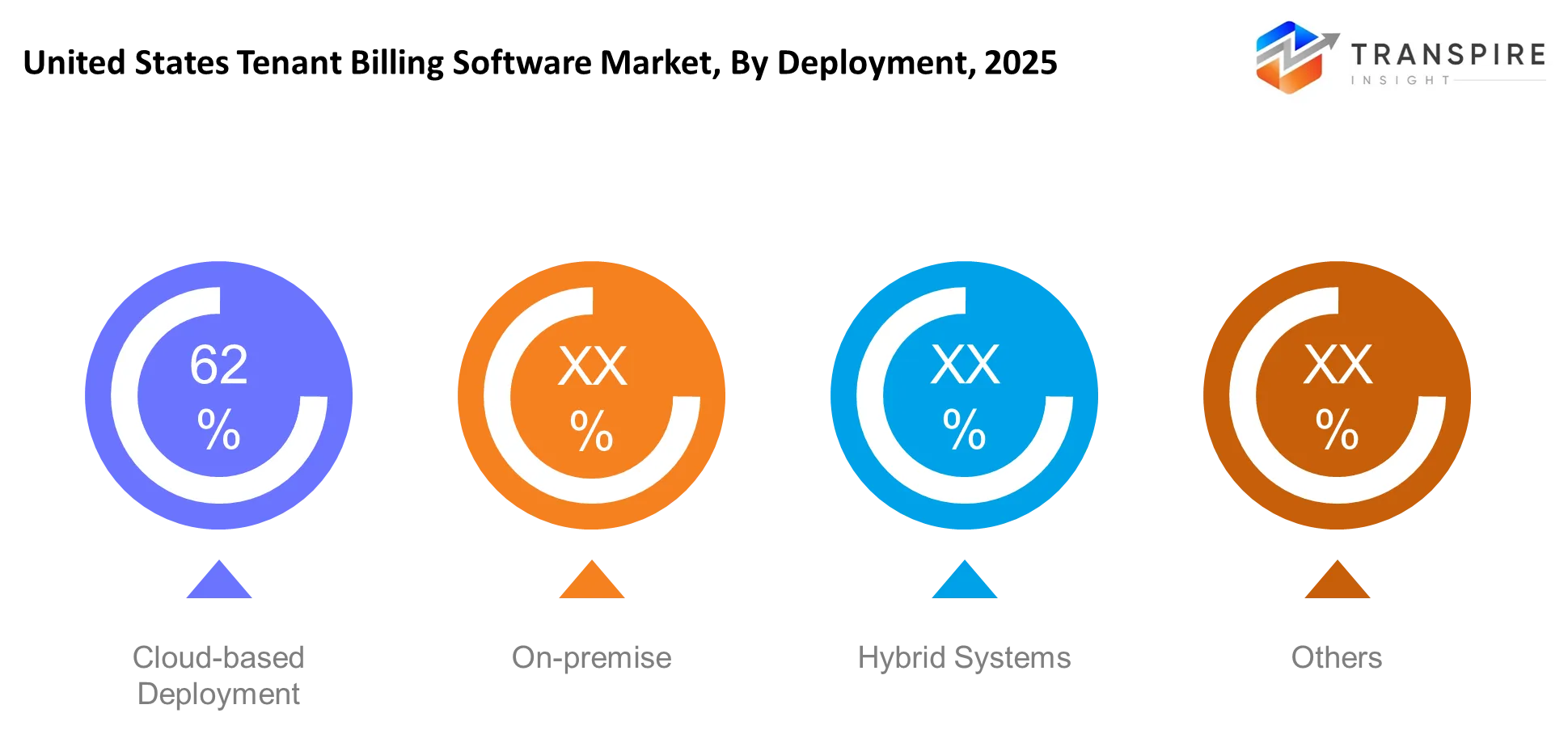
To learn more about this report, Download Free Sample Report
By Application :
Software supports several core property financial tasks across residential and commercial assets. These apps handle tenant related financial workflows in a more organized way, which increases transparency and cuts down on the manual workload that property management activities often create.
Rent billing automates the tenant charges, utility billing manages consumption costs, lease management tracks agreements, expense tracking keeps monitoring spending, and payment processing handles the transactions. Together each of these areas strengthens financial coordination between tenants and property operators, while also improving accuracy, consistency, and the overall billing routine.
By Enterprise Size :
Tenant billing software adoption shifts depending on how big the organization is and how complicated daily operations get. Different enterprise scales end up needing solutions that fit, like to boost billing efficiency, keep tenant records neat, and support financial reporting across entire property portfolios.
SMEs often choose cost controlled tools for basic billing, big enterprises lean toward more advanced platforms for high volume control, and agencies tend to manage client property portfolios. In practice, each enterprise group usually ends up selecting based on what the budget can handle, how far it needs to scale, and how heavy the property management workload feels.
By End User :
The actual software choice is influenced by a mix of property management needs. End users rely on tenant billing systems to make financial tracking less messy, speed up payment collection, and handle tenant related accounting tasks with fewer interruptions.
Property managers oversee tenant accounts, commercial owners manage large facilities, residential owners watch rent collection, and co-working spaces deal with shared billing layouts. Every end user segment then applies a tenant billing software approach to raise operational speed, and to keep financial management more structured even when conditions change.
What are the Key Use Cases Driving the United States Tenant Billing Software Market?
In the United States Tenant Billing Software Market, the main, most dominant use case is basically automated utility cost allocation across multifamily sites, where building operators recover water , electricity, and gas expenses with pretty high precision. The demand keeps climbing because when people try to do manual billing it often spirals into disputes, and there’s also revenue leakage across the shared infrastructure.
A secondary direction of adoption leans toward rent billing automation, plus CAM reconciliation in commercial real estate operations. That ends up helping with lease accounting efficiency and it can also dial down administrative burden in multi tenant buildings, even when the occupancy mix changes a lot.
What’s starting to emerge more and more are AI‑driven consumption forecasting and IoT-enabled smart metering. With those, billing can be adjusted in near real time, not just in batch cycles. Right now, those features are being trialed in advanced smart building projects, where pairing the tenant billing tools with energy management systems helps tune the forecasting accuracy, and it also helps prepare the platform for more dynamic utility pricing models.
|
Report Metrics |
Details |
|
Market size value in 2025 |
USD 87.4 Million |
|
Market size value in 2026 |
USD 95.2 Million |
|
Revenue forecast in 2033 |
USD 169.7 Million |
|
Growth rate |
CAGR of 8.61% from 2026 to 2033 |
|
Base year |
2025 |
|
Historical data |
2021 - 2024 |
|
Forecast period |
2026 - 2033 |
|
Report coverage |
Revenue forecast, competitive landscape, growth factors, and trends |
|
Geographic scope |
United States of America |
|
Key company profiled |
Yardi Systems, AppFolio, Buildium, MRI Software, RealPage, Entrata, Rentec Direct, DoorLoop, Innago, TenantCloud, Oracle, SAP, Propertyware, Hemlane, Rent Manager |
|
Customization scope |
Free report customization (country, regional & segment scope). Avail customized purchase options to meet your exact research needs. |
|
Report Segmentation |
By Deployment (Cloud-based, On-premise, Hybrid Systems, Others); By Application (Rent Billing, Utility Billing, Lease Management, Expense Tracking, Payment Processing, Others); By Enterprise Size (SMEs, Large Enterprises, Real Estate Agencies, Others); By End User (Property Managers, Commercial Real Estate Owners, Residential Property Owners, Co-working Spaces, Others) |
Which Regions are Driving the United States Tenant Billing Software Market Growth?
In a way, the West region sort of leads the United States Tenant Billing Software Market, mainly because it picked up proptech ecosystems early and built solid cloud infrastructure in California and Washington. Big, technology-driven real estate portfolios in places like San Francisco and Seattle help push out automated billing faster, sometimes even sooner than expected. On top of that , California’s sustainability reporting expectations are pretty strict, so companies end up needing more granular utility tracking and tenant-level energy allocation, even when the setup is a little more complex. And then there’s the vendor ecosystem itself—there’s a strong web of software providers plus venture backed property technology firms that keep improvements coming, and help with quick enterprise take-up.
The Northeast region keeps contributing steady revenue, not so much from disruption but from its dense commercial real estate footprint and older institutional property ownership patterns. New York and Boston, for example, tend to lean on consistent regulatory compliance for lease accounting and tenant transparency more than they chase rapid technological changes. A lot of organizations move their legacy billing systems along more cautiously, upgrading step by step, and focusing on stability plus integration with already-used financial platforms. So the modernization happens in a fairly predictable loop, which in turn backs long-term software subscriptions and repeat enterprise agreements.
Meanwhile the South region is showing the fastest growth, largely from fast population inflows and large-scale multifamily housing development across Texas and Florida. Developers are increasingly rolling out digital billing platforms right at the construction stage, which reduces reliance on legacy accounting systems. Add to that , business conditions that feel favorable and comparatively lower operating costs, and cloud based tenant billing tools get adopted at a quicker pace. This momentum also hints that vendors entering the United States Tenant Billing Software Market between 2026 and 2033 may see strong expansion opportunities.
Who are the Key Players in the United States Tenant Billing Software Market and How Do They Compete?
The United States Tenant Billing Software Market is kind of moderately consolidated, with a small crew of established SaaS providers running a lot of the enterprise deployments, while niche proptech entrants go after more specialized property segments. The competition really leans on how strong the platform integration is, how accurate billing is in real time, and whether everything plays nicely with smart metering infrastructure , not just pricing. Most incumbents defend their share by tucking billing modules inside broader property management ecosystems, so the switching cost gets high for big landlords handling mixed portfolios across multifamily and commercial assets.
RealPage kind of focuses on integrated revenue management systems, leaning on AI enabled rent optimization and utility billing consolidation for large institutional owners. It pushes growth through acquisitions of analytics focused proptech firms, which in turn helps reinforce the lock in strategy across the ecosystem. Yardi Systems leans on end to end property management suites, using deep ERP style integration to keep long term enterprise clients, then expand into energy and ESG reporting linked billing modules.
MRI Software competes with a flexible modular architecture, which helps mid market landlords tailor billing workflows and connect third party accounting tools without too much friction. AppFolio differentiates with a cloud native, easy to use interface aimed at small and mid sized residential operators, and it tends to speed up adoption via rapid onboarding. Entrata strengthens its positioning through unified property operations platforms, plus strategic partnerships with smart building technology providers, which extends its presence in high density multifamily developments.
Company List
- Yardi Systems
- AppFolio
- Buildium
- MRI Software
- RealPage
- Entrata
- Rentec Direct
- DoorLoop
- Innago
- TenantCloud
- Oracle
- SAP
- Propertyware
- Hemlane
- Rent Manager
Recent Development News
In July 2025, RealPage announced its acquisition of Livble. The deal expanded RealPage’s rent and tenant payment capabilities by integrating installment-based rent payment options into its existing property management and billing ecosystem, strengthening its position in automated rent collection and tenant financial services in the U.S. market.
Source https://www.theverge.com/
In January 2026, Baselane expanded its property management and tenant billing software platform with enhanced automated utility billing and financial integration features. The update strengthened its banking-linked billing system for landlords by improving automated rent and utility payment tracking, targeting small-to-mid U.S. property owners seeking simplified tenant chargeback workflows. Source https://www.baselane.com/
What Strategic Insights Define the Future of the United States Tenant Billing Software Market?
The United States Tenant Billing Software Market is kind of structurally moving toward fully integrated, AI-enabled property operations platforms where billing is no longer just a backend job but more like a real time function, embedded into these smart building ecosystems. I mean the change is mostly because utility consumption information is now tightly linked with ESG compliance reporting, plus automated financial reconciliation across big real estate portfolios. Over the next 5–7 years, a lot of value creation should concentrate in platforms that unify energy metering, tenant billing, and predictive cost analytics into one operational layer, so it’s kinda seamless.
There’s also a less visible risk that people often miss, market concentration is increasing among a few dominant SaaS providers. That can lead to pricing rigidity, and less flexibility for mid-market property owners. In practice this might slow adoption by smaller operators, since they end up with rising subscription dependency but without the same level of efficiency gains that were originally promised.
On the opportunity side, there’s a strong emerging angle in dynamic utility pricing models enabled by IoT connected buildings. This seems especially relevant in high-density urban redevelopment zones across Sun Belt cities. It basically opens the door for real time, usage based tenant billing, where costs can adjust based on occupancy levels and consumption patterns. Market participants should prioritize open API architectures and utility partnership integrations too, to avoid lock-in, and to capture interoperability driven growth during the next adoption cycle
United States Tenant Billing Software Market Report Segmentation
By Deployment
- Cloud-based
- On-premise
- Hybrid Systems
By Application
- Rent Billing
- Utility Billing
- Lease Management
- Expense Tracking
- Payment Processing
By Enterprise Size
- SMEs
- Large Enterprises
- Real Estate Agencies
By End User
- Property Managers
- Commercial Real Estate Owners
- Residential Property Owners
- Co-working Spaces
Frequently Asked Questions
Find quick answers to common questions.
The United States Tenant Billing Software Market size is USD 169.7 Million in 2033.
Key Segments for the United States Tenant Billing Software Market are By Deployment (Cloud-based, On-premise, Hybrid Systems, Others); By Application (Rent Billing, Utility Billing, Lease Management, Expense Tracking, Payment Processing, Others); By Enterprise Size (SMEs, Large Enterprises, Real Estate Agencies, Others); By End User (Property Managers, Commercial Real Estate Owners, Residential Property Owners, Co-working Spaces, Others).
Major United States Tenant Billing Software Market Players are Yardi Systems, AppFolio, Buildium, MRI Software, RealPage, Entrata, Rentec Direct, DoorLoop, Innago, TenantCloud, Oracle, SAP, Propertyware, Hemlane, Rent Manager.
The Current United States Tenant Billing Software Market size is USD 87.4 Million in 2025.
The United States Tenant Billing Software Market CAGR is 8.61% from 2026 to 2033.
- Yardi Systems
- AppFolio
- Buildium
- MRI Software
- RealPage
- Entrata
- Rentec Direct
- DoorLoop
- Innago
- TenantCloud
- Oracle
- SAP
- Propertyware
- Hemlane
- Rent Manager
Recently Published Reports
-
Apr 2026
3D Optical Profiler Market
3D Optical Profiler Market Size, Share & Analysis Report By Type (Desktop 3D Optical Profiler, and Portable 3D Optical Profiler), By Technology (Confocal Technology, and White Light Interference), By End-Use Industry (Manufacturing, Research Institutions, Automotive, Aerospace and Defense, Medical Devices, and Other), and Geography (North America, Europe, Asia-Pacific, Middle East and Africa, South and Central America), 2021 - 2031
-
Apr 2026
Depth Sensor Market
Depth Sensor Market Size, Share & Analysis Report By Type (Infrared Depth Sensors, Time-of-Flight (ToF) Sensors, Stereo Vision Sensors, Structured Light Sensors, Ultrasonic Depth Sensors), By Application (Automotive, Robotics, Gaming, Consumer Electronics, Industrial Automation, Healthcare, Security & Surveillance, Others), By End Users (Automotive Manufacturers, Consumer Electronics Companies, Healthcare Providers, Industrial Companies, Security Agencies, Gaming Companies, Robotics Companies, Others), and Geography (North America, Europe, Asia-Pacific, Middle East and Africa, South and Central America), 2021 – 2031
-
Apr 2026
Digital Manufacturing Market
Digital Manufacturing Market Size, Share & Analysis Report By Component (Hardware, Software, and Services), By Technology (Robotics, 3D Printing, Internet of Things (IoT), and Others), By Application (Automotive and Transportation, Aerospace and Defense, Consumer Electronics, Industrial Machinery, and Others), By Process Type (Computer-Based Designing, Computer-Based Simulation, Computer 3D Visualization, Analytics, and Others), and Geography (North America, Europe, Asia-Pacific, Middle East and Africa, South and Central America), 2021 – 2031
-
Apr 2026
Digital Visa Services Market
Digital Visa Services Market Size, Share & Analysis Report By Type (Individual Travelers, Group Travelers), By Application (Tourism, Business Travel, Others), and Geography (North America, Europe, Asia-Pacific, Middle East and Africa, South and Central America), 2021 – 2031