

Middle East and Africa Cloud EDA Market Size & Forecast:
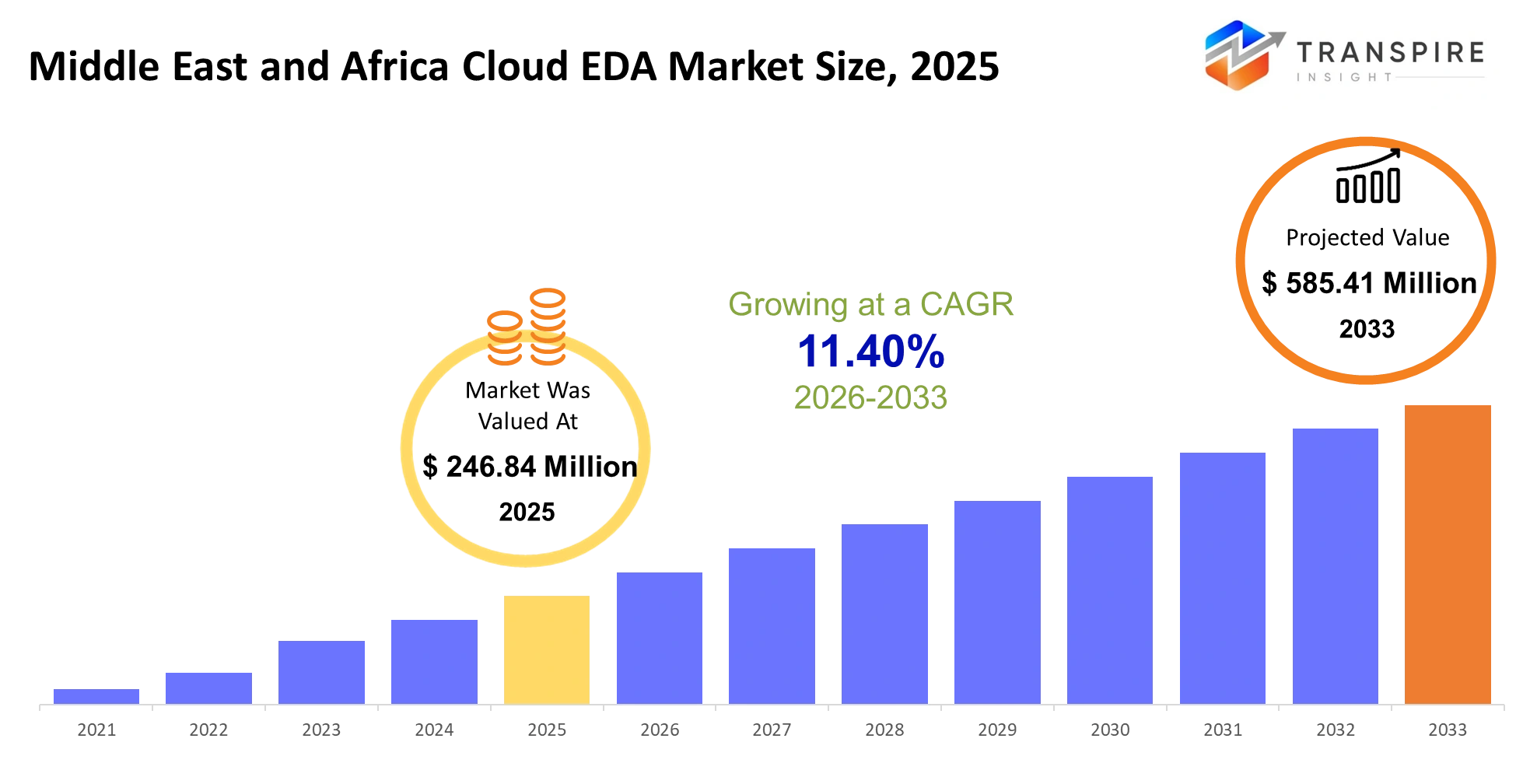
- Middle East and Africa Cloud EDA Market Size 2025: USD 246.84 Million
- Middle East and Africa Cloud EDA Market Size 2033: USD 585.41 Million
- Middle East and Africa Cloud EDA Market CAGR: 11.40%
- Middle East and Africa Cloud EDA Market Segments: By Type (EDA Software, Cloud Platforms, Design Tools, Verification Tools, Others); By Application (IC Design, Semiconductor Manufacturing, PCB Design, Simulation, Verification, Others); By End-User (Semiconductor Companies, Electronics Firms, Design Engineers, Foundries, Research Institutes, Others); By Deployment (Public Cloud, Private Cloud, Hybrid Cloud, Others).
To learn more about this report,  Download Free Sample Report
Middle East and Africa Cloud EDA Market Summary
The Middle East and Africa Cloud EDA Market was valued at USD 246.84 Million in 2025. It is forecast to reach USD 585.41 Million by 2033. That is a CAGR of 11.40% over the period.
The Middle East and Africa Cloud EDA Market kinda helps semiconductor and electronics companies in a practical way, by offering scalable cloud based spaces for chip design , verification, simulation ,and some collaborative engineering work. In general these platforms tackle a real operational pain point , because they cut down the heavy reliance on pricey on premise computing infrastructure while still letting engineering teams that are not even in the same place, work together on tough semiconductor programs in near real time. Telecom operators , AI hardware developers , automotive electronics manufacturers, and government backed research centers now lean on cloud EDA systems to speed up the product development timeline and also make design accuracy better.
Over the last five years, the market has moved away from the older pattern of software licensing and it has been leaning more toward AI enabled, cloud native engineering ecosystems. One big push happened during and after the pandemic, when global semiconductor supply chain disruptions showed weak spots in localized chip availability. That situation also nudged Gulf governments to invest pretty aggressively in sovereign semiconductor capabilities. After that, regional demand grew for scalable verification utilities, cloud simulation platforms, and secure shared design infrastructure. And as semiconductor complexity keeps rising, while AI workloads get heavier, vendors who can blend advanced automation with regionally compliant cloud deployment models are pulling in stronger enterprise budgets , plus longer term agreement opportunities.
Key Market Insights
- Gulf Cooperation Council countries i guess dominated close to 45% of the regional cloud EDA demand in 2025, driven by sovereign AI and semiconductor infrastructure investments.
- North Africa also started showing up as the fastest growing regional market between 2026 and 2033, because electronics manufacturing keeps expanding and industrial digitization programs are moving ahead.
- EDA software actually took the biggest market share in 2025, since semiconductor companies focused on AI assisted chip verification plus cloud based simulation workflows.
- Cloud platforms ended up ranked as the second largest segment, because many enterprises sped up migration away from costly on premise semiconductor design infrastructure after 2024.
- Hybrid cloud deployment is projected to be the fastest growing segment through 2033, mainly due to cybersecurity compliance pressure, and also data localization needs that keep rising.
- IC design applications were responsible for more than 35% of market revenue in 2025, supported by telecom chipset work and AI processor development projects.
- Simulation and verification workloads saw the quickest demand growth, as automotive electronics and industrial IoT systems pushed chip complexity higher across regional industries.
- Semiconductor companies stayed the dominant end user segment, generating roughly 40% of total demand through advanced node chip design and verification activity.
- Research institutes and university engineering centers have been adopting faster since after 2024, as governments broadened semiconductor talent development initiatives and related programs.
- Cadence Design Systems, Siemens Digital Industries Software, Synopsys, and Alphawave Semi also improved their competitive position by using AI enabled verification tools, cloud native platforms and various regional partnerships.
What are the Key Drivers, Restraints, and Opportunities in the Middle East and Africa Cloud EDA Market?
The strongest driver, really, behind cloud EDA adoption speeding up across the Middle East and Africa is the rapid expansion of sovereign AI plus semiconductor infrastructure programs in Gulf economies. Saudi Arabia and the United Arab Emirates have been boosting investment in hyperscale data centers, AI research facilities, and localized chip development after 2023 , and it’s creating direct demand for cloud based design and verification surroundings that can scale. Because of that change, teams see less need for costly on premise computing infrastructure, and engineering staff can sync up across different regions, which in turn pushes software subscription growth ahead, plus it raises enterprise adoption rates among telecom, defense , and industrial technology firms too.
The main restraint still looks like the region’s fairly narrow semiconductor engineering talent pool, and also the uneven availability of high performance cloud infrastructure. When you run advanced chip design work, you need very specialized competence in verification, simulation, and AI assisted design tuning. However , many African markets continue dealing with shortages of seasoned semiconductor engineers and research capacity. This structural squeeze tends to drag implementation timelines out longer, increases reliance on external technical partners, and makes adoption harder for smaller electronics manufacturers, since they often don’t have internal engineering muscle.
A big future opportunity is starting to appear through localized semiconductor R&D ecosystems tied to university collaborations and government supported industrial diversification initiatives. North African countries such as Egypt and Morocco are extending smart manufacturing areas, and growing electronics production capability, which makes things more favorable for cloud native collaborative EDA platforms and AI enabled semiconductor prototyping services.
What Has the Impact of Artificial Intelligence Been on the Middle East and Africa Cloud EDA Market?
Artificial intelligence, plus some advanced digital technologies, are quietly reshaping cloud based electronic design workflows across the Middle East and Africa. They do it by automating those complex semiconductor engineering tasks that used to need a lot of hands on attention, and well, a fair amount of time too. With AI enabled EDA platforms, circuit layout tuning, design rule checking, and the whole verification flow are now handled with far less manual effort. This helps engineering groups shrink chip development timelines, and also raises the odds of a better first pass design. It’s not just theory either, Siemens Digital Industries Software and Cadence Design Systems for example have put generative AI and machine learning models into cloud environments, with the idea to smooth workload orchestration and speed up simulation work for teams that are spread out geographically.
On another front, machine learning approaches are improving prediction inside semiconductor design and the earlier manufacturing preparation stages. Using advanced analytics, teams can estimate thermal behavior, spot potential signal integrity troubles, and map power consumption patterns before any physical prototyping begins. That means fewer late redesign rounds, and in practice it supports better operational efficiency. A few cloud native verification setups have also shared results showing double digit cuts in simulation runtime, and real gains in engineering output, largely from AI assisted debugging and automated test generation. Even so, adoption is still somewhat uneven, because integration costs remain high, there is a shortage of semiconductor engineers trained locally, and cloud access can be inconsistent across parts of Africa. All of that can slow down broad deployment of these AI driven EDA environments, even when the promise looks strong.
Key Market Trends
- Since 2023 , Gulf governments increased funding for semiconductor and AI infrastructure, which kind of pushed cloud EDA adoption past telecom, and straight into defense and industrial electronics projects .
- Siemens and Cadence, during 2025 shifted their product strategy toward AI enabled cloud verification workflows , basically cutting chip validation time for distributed engineering teams , which is fairly important .
- Hybrid cloud deployment got a stronger enterprise pull after 2024 as defense , and public sector buyers tightened data sovereignty rules , and also IP protection requirements .
- Semiconductor startups across Saudi Arabia and the UAE started swapping on-premise design infrastructure for subscription based cloud EDA environments more and more , mostly to reduce the upfront costs that can feel heavy at the beginning .
- PCB and embedded electronics design workloads expanded noticeably after industrial IoT investments accelerated across smart manufacturing and logistics modernization programs , since 2024 .
- Regional universities and semiconductor research institutes also increased their collaborative cloud simulation usage, as governments expanded domestic chip engineering training initiatives during 2025 .
- North African electronics manufacturing hubs drew more EDA platform investment after Morocco and Egypt expanded industrial digitization , along with semiconductor related infrastructure programs .
- Verification tools gained a larger revenue share between 2024 and 2026, because automotive and AI chip developers faced stricter reliability and performance demands , which tends to be non negotiable .
- Global EDA vendors increasingly partnered with regional cloud and engineering firms after enterprises asked for locally hosted platforms , that comply with national cybersecurity regulations .
- Foundries and electronics companies accelerated AI assisted design automation adoption in 2026, to shorten product development cycles and also handle the growing chip complexity efficiently.
Middle East and Africa Cloud EDA Market Segmentation
By Type
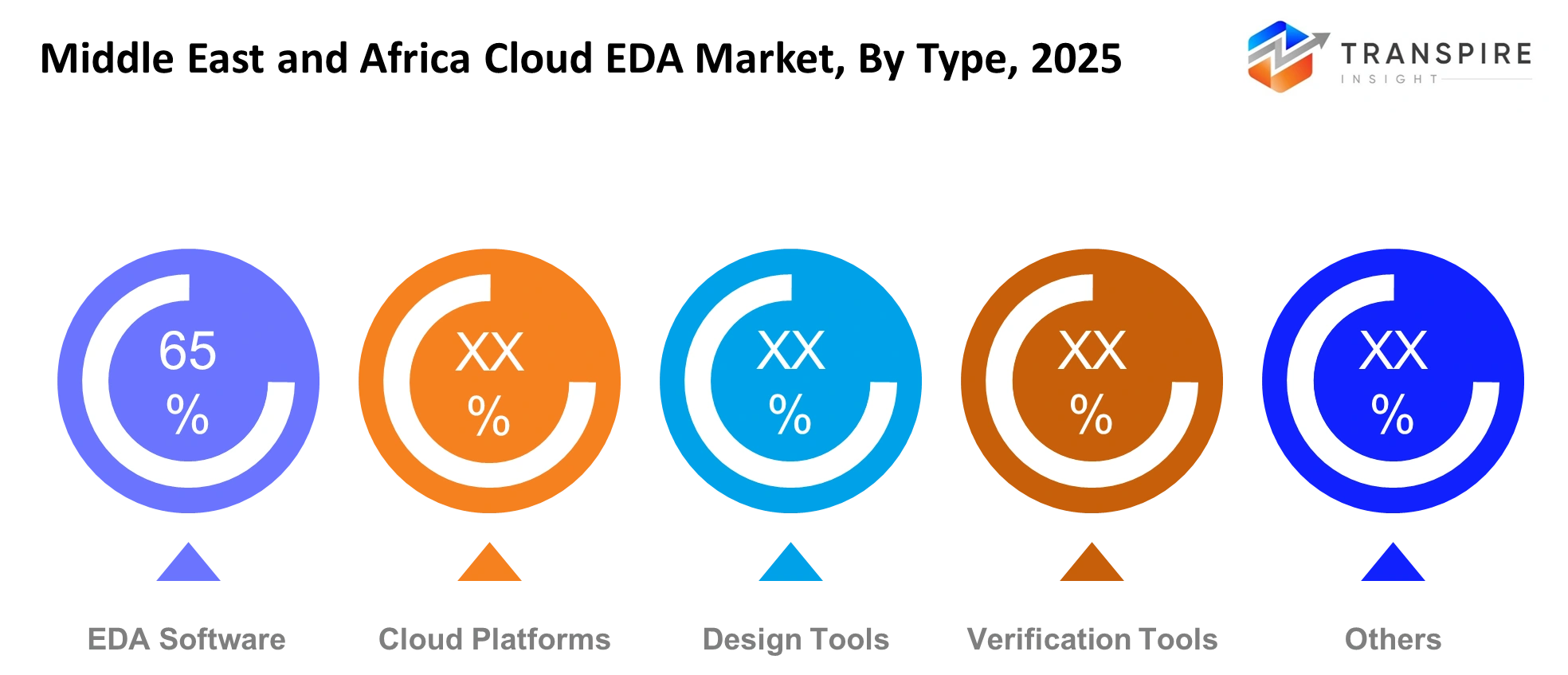
EDA software holds the largest market position ,because semiconductor and electronics companies keep prioritizing integrated design environments that help with complex chip architecture, verification and simulation workflows. There is strong demand from telecom infrastructure projects, AI processor development ,and automotive electronics programs which sustains software licensing and subscription growth across Gulf countries as well as South Africa. Verification tools keep a very solid standing too, since chip complexity keeps rising and reliability requirements become stricter for industrial and defense uses.
Cloud platforms are expanding faster ,as engineering teams move toward remote collaboration and scalable compute infrastructure. Hybrid deployment compatibility along with lower upfront infrastructure costs makes cloud-native design environments feel more attainable for universities ,fabless startups and regional research centers. Design tools aimed at PCB and embedded electronics development are also gaining traction through industrial automation and smart device manufacturing initiatives. During the forecast period, investors and developers are expected to place emphasis on AI-enabled automation features and secure regional hosting capabilities to capture enterprise demand.
To learn more about this report, Download Free Sample Report
By Application
IC design accounts for the highest revenue contribution because advanced semiconductor development needs intensive simulation, verification, and cooperative engineering workloads. Demand stays especially strong for AI accelerators ,telecom chipsets, and data center processor development where shorter design cycles directly influence how quickly products reach the market. Verification applications also maintain a meaningful market share due to increasing compliance requirements and higher performance standards across automotive and industrial electronics sectors.
Simulation plus PCB design use cases keep expanding, mostly because industrial IoT setups are growing, and connected electronics manufacturing is getting more attention. Electronics firms are leaning harder on cloud based simulation tools, to cut the prototyping overhead and raise the design fidelity before anything touches the physical production line. On the semiconductor side, the momentum is even more noticeable, since governments across the Gulf and North Africa are putting more money into local electronics production ecosystems, sort of like building the whole stack nearby. Going forward the strongest growth should favor platforms that mix real time teamwork with AI assisted debugging, plus cloud compute that can scale fast when demand spikes.
By End-User
Semiconductor companies are the leading end user category, mainly because advanced chip development needs steady access to high performance design, simulation, and verification settings. Big organizations gain from cloud EDA infrastructure that removes some hardware lock-in and still supports distributed engineering collaboration across different regions, with fewer bottlenecks. Foundries and integrated device manufacturers also drive meaningful demand, because advanced node manufacturing processes keep getting more intricate, even when product timelines stay tight.
Electronics firms, and design engineers, are kind of turning into key growth contributors as embedded systems, automotive electronics, and industrial automation projects keep expanding across the region. Research institutes, plus university laboratories, are more and more using cloud based platforms to back up semiconductor education , AI hardware experimentation, and team oriented R&D programs . That whole movement leaves room for service providers who can sell flexible subscription style packages, handle managed cloud deployment, and offer localized technical help. Over time, wider buy in by smaller engineering firms could wobble pricing structures and push stronger competition inside mid tier service offerings.
By Deployment
Public cloud deployment is still taking the lead because it usually asks for less upfront capital, and the computing resources are scalable, which makes it feel especially appealing for startups, universities, and mid sized engineering firms. The quick go live schedules , and the fact that you can access everything remotely, also help multinational engineering collaboration among project teams spread across different places. Hybrid cloud setups are getting a lot more attention with enterprises that manage sensitive semiconductor tasks, and defense related workloads too, where they want tighter operational control.
Private cloud deployment still matters a lot for organizations that have to follow data localization rules, and also need intellectual property protection, for sure. Lately, government backed semiconductor programs plus defense electronics work seem to lean more toward secure deployment environments where the infrastructure is hosted in the region. Hybrid cloud adoption is expected to pick up pace through the forecast period, mainly because enterprises want that sweet spot between scalability, compliance, and operational flexibility which is honestly hard to juggle. Technology providers who can merge secure regional hosting with AI driven workflow optimization, or something close to it, may end up with a better position with enterprise buyers.
What are the Key Use Cases Driving the Middle East and Africa Cloud EDA Market?
Cloud-based semiconductor chip design still sort of stays the main reason people look for this Market, especially across the Middle East and Africa , where Cloud EDA demand is strong. Telecom infrastructure providers, AI hardware developers, and government backed digital programs keep moving toward scalable cloud EDA platforms , mainly because it lowers hardware costs , and it helps speed up verification cycles. You can see this push most clearly in Gulf nations that are funding localized semiconductor efforts along with smart infrastructure programs, more and more.
In the meantime, secondary adoption is also growing, particularly in automotive electronics and industrial IoT work. Engineering firms and electronics manufacturers are using cloud EDA tools to assist with sensor integration , power management design, and embedded system development for connected factories, and smart mobility initiatives too . Universities and semiconductor research centers are getting involved as well, mostly for shared chip prototyping, plus simulation style workloads where collaboration matters.
On the newer side, emerging use cases are showing up around defense-grade chip design and edge AI processor development for autonomous systems. Interest is rising in sovereign computing infrastructure, and also in secure domestic semiconductor capabilities, so over the forecast period the market could see a bigger lift for compliant cloud EDA environments that are hosted locally, within the region .
|
Report Metrics |
Details |
|
Market size value in 2025 |
USD 246.84 Million |
|
Market size value in 2026 |
USD 274.97 Million |
|
Revenue forecast in 2033 |
USD 585.41 Million |
|
Growth rate |
CAGR of 11.40% from 2026 to 2033 |
|
Base year |
2025 |
|
Historical data |
2021 - 2024 |
|
Forecast period |
2026 - 2033 |
|
Report coverage |
Revenue forecast, competitive landscape, growth factors, and trends |
|
Regional scope |
Middle East and Africa (Saudi Arabia, United Arab Emirates, South Africa, Rest of Middle East and Africa) |
|
Key company profiled |
Cadence, Synopsys, Siemens EDA, Ansys, Keysight, IBM, Amazon, Google, Microsoft, Zuken, Altium, Dassault Systemes, Silvaco, eInfochips, Mentor Graphics. |
|
Customization scope |
Free report customization (country, regional & segment scope). Avail customized purchase options to meet your exact research needs. |
|
Report Segmentation |
By Type (EDA Software, Cloud Platforms, Design Tools, Verification Tools, Others); By Application (IC Design, Semiconductor Manufacturing, PCB Design, Simulation, Verification, Others); By End-User (Semiconductor Companies, Electronics Firms, Design Engineers, Foundries, Research Institutes, Others); By Deployment (Public Cloud, Private Cloud, Hybrid Cloud, Others). |
Which Regions are Driving the Middle East and Africa Cloud EDA Market Growth?
The Gulf Cooperation Council region, kind of leads the Middle East and Africa Cloud EDA Market, mainly because of aggressive state-backed digital transformation moves and also because of expanding sovereign semiconductor, ambitions. In practice places like Saudi Arabia and the United Arab Emirates keep putting significant money into hyperscale cloud infrastructure, AI research hubs, and more advanced electronics manufacturing capabilities. At the same time, regulatory frameworks that back data localization and promote secure cloud adoption have pushed multinational EDA vendors to form regional partnerships, while also offering localized deployment models. In the background there is a growing ecosystem too, like telecom operators, defense technology programs, semiconductor research centers, and government-funded innovation initiatives, all of which help keep long-term demand alive for cloud-based design environments.
South Africa sits next, it is the second-largest regional contributor, but its position is shaped more by enterprise stability and engineering continuity than by any state-driven semiconductor expansion. The country benefits from a mature ICT services sector, plus established academic engineering networks, and relatively steady enterprise software adoption across industrial and telecom areas. Unlike the Gulf region, South Africa’s growth leans on gradual modernization of existing electronic design workflows, and on steady private-sector investment. It is less about big sovereign tech programs. This careful adoption style, ends up creating dependable recurring revenue opportunities for cloud EDA providers that focus on managed services, verification tools, and collaborative design platforms.
North Africa seems to be coming up as the fastest-growing region, with more activity in electronics manufacturing and a growing gov interest in localised tech production maybe. Egypt and Morocco, for instance have pushed harder on industrial parks, smart manufacturing setup, and semiconductor related learning initiatives meant to pull in foreign technology companies. Lately, better digital connectivity and more available cloud infrastructure have also made it easier, like there s less friction, for cloud based engineering teamwork and even remote chip design routines. So, over the 2026–2033 period, this kind of momentum should open up interesting entry points for vendors and investors who want early positioning in cost-competitive semiconductor and electronics development ecosystems.
Who are the Key Players in the Middle East and Africa Cloud EDA Market and How Do They Compete?
The Middle East and Africa Cloud EDA Market stays pretty moderately consolidated , you know how it goes, where big global EDA vendors hold most of the expensive semiconductor design work, while smaller regional cloud and engineering firms push back using localization efforts and managed service delivery. Lately the fight is less about generic coverage and more about technology depth, secure cloud deployment, and whether they can back advanced-node chip design inside compliance-sensitive arenas like telecom defense, and automotive electronics, it’s sort of all connected. The well-known vendors are defending their shares by stitching AI-driven automation into cloud-native design spaces , and in parallel regional companies come in via partnerships that try to handle sovereign cloud needs plus those local infrastructure gaps that keep showing up.
Cadence Design Systems keeps leaning into technology innovation with cloud-managed semiconductor design platforms, aimed at trimming down infrastructure headaches for fabless firms and research institutions. Their partnership with GSME in Oman basically widened its regional presence, since they delivered localized cloud EDA infrastructure for Middle Eastern semiconductor initiatives. Siemens Digital Industries Software, on the other hand differentiates by leaning on AI-enabled automation and digital engineering workflows that feel integrated, instead of separate. It has also expanded quickly through OEM partnerships and cloud-based AI agents , those agents help improve design productivity and speed up verification cycles for teams that are spread out.
Synopsys competes using a mix of strong advanced IP portfolios and hyperscale cloud compatibility, to support complex AI-driven and high-performance computing chip development. Its edge comes from blending EDA software with semiconductor security and verification tools, which is especially attractive for government-backed digital infrastructure projects across the Gulf region.Alphawave Semi has sort of strengthened its market position via some strategic collaborations, that basically push high-speed connectivity IP deep into cloud-forward semiconductor ecosystems, so AI and data center processors can be rolled out faster, in those emerging regional markets.
Company List
- Cadence
- Synopsys
- Siemens EDA
- Ansys
- Keysight
- IBM
- Amazon
- Microsoft
- Zuken
- Altium
- Dassault Systemes
- Silvaco
- eInfochips
- Mentor Graphics
Recent Development News
In February 2025, Siemens Digital Industries Software entered a strategic OEM partnership with Alphawave Semi. The agreement expanded access to advanced silicon IP and AI-driven chip connectivity solutions through Siemens’ EDA sales network, accelerating cloud-enabled semiconductor design adoption across global and emerging markets.
Source: https://press.siemens.com
In June 2024, Cadence Design Systems entered a partnership with GSME to expand semiconductor and cloud EDA capabilities in Oman and the broader Middle East. The collaboration deployed Cadence Managed Cloud Service to provide secure cloud-based chip design infrastructure, supporting regional semiconductor ecosystem development and engineering scalability.
Source: https://www.cadence.com
What Strategic Insights Define the Future of the Middle East and Africa Cloud EDA Market?
The Middle East & Africa Cloud EDA Market seems to be sliding toward a pretty strategically localized, and also AI-accelerated, design ecosystem, but not in a simple way because it’s being pulled by sovereign semiconductor ambitions , by the steady growth of hyperscale infrastructure and by a rising need for advanced chip design abilities in automotive, telecom and defense circles. In the coming five to seven years, the market’s momentum will rely more and more on governments that push digital self-sufficiency, plus regional data governance, especially across Gulf economies where domestic technology ecosystems are getting heavy funding.
There is also a risk that’s a bit less visible, in the sense that the whole market leans on a tight pool of global EDA vendors , which can mean long term exposure to export controls, licensing limitations and pricing concentration. Meanwhile, an opportunity is quietly taking shape too: cloud-native collaborative EDA platforms that are tuned for fabless startups and for university led R&D clusters, especially in places like Saudi Arabia and the UAE. So, market players should lean into regional partnerships, and invest early in localized cloud compliance capabilities, to lock in longer term competitive standing.
Middle East and Africa Cloud EDA Market Report Segmentation
By Type
- EDA Software
- Cloud Platforms
- Design Tools
- Verification Tools
- Others
By Application
- IC Design
- Semiconductor Manufacturing
- PCB Design
- Simulation
- Verification
- Others
By End-User
- Semiconductor Companies
- Electronics Firms
- Design Engineers
- Foundries
- Research Institutes
- Others
By Deployment
- Public Cloud
- Private Cloud
- Hybrid Cloud
- Others
Frequently Asked Questions
Find quick answers to common questions.
The estimated Middle East and Africa Cloud EDA Market size is USD 585.41 Million in 2033.
Key segments for the Middle East and Africa Cloud EDA Market are By Type (EDA Software, Cloud Platforms, Design Tools, Verification Tools, Others); By Application (IC Design, Semiconductor Manufacturing, PCB Design, Simulation, Verification, Others); By End-User (Semiconductor Companies, Electronics Firms, Design Engineers, Foundries, Research Institutes, Others); By Deployment (Public Cloud, Private Cloud, Hybrid Cloud, Others).
Major Middle East and Africa Cloud EDA Market players are Cadence, Synopsys, Siemens EDA, Ansys, Keysight, IBM, Amazon, Google, Microsoft, Zuken, Altium, Dassault Systemes, Silvaco, eInfochips, Mentor Graphics.
The Middle East and Africa Cloud EDA Market size is USD 246.84 Million in 2025.
The Middle East and Africa Cloud EDA Market CAGR is 11.40% from 2026 to 2033.
- Cadence
- Synopsys
- Siemens EDA
- Ansys
- Keysight
- IBM
- Amazon
- Microsoft
- Zuken
- Altium
- Dassault Systemes
- Silvaco
- eInfochips
- Mentor Graphics
Recently Published Reports
-
Apr 2026
3D Optical Profiler Market
3D Optical Profiler Market Size, Share & Analysis Report By Type (Desktop 3D Optical Profiler, and Portable 3D Optical Profiler), By Technology (Confocal Technology, and White Light Interference), By End-Use Industry (Manufacturing, Research Institutions, Automotive, Aerospace and Defense, Medical Devices, and Other), and Geography (North America, Europe, Asia-Pacific, Middle East and Africa, South and Central America), 2021 - 2031
-
Apr 2026
Depth Sensor Market
Depth Sensor Market Size, Share & Analysis Report By Type (Infrared Depth Sensors, Time-of-Flight (ToF) Sensors, Stereo Vision Sensors, Structured Light Sensors, Ultrasonic Depth Sensors), By Application (Automotive, Robotics, Gaming, Consumer Electronics, Industrial Automation, Healthcare, Security & Surveillance, Others), By End Users (Automotive Manufacturers, Consumer Electronics Companies, Healthcare Providers, Industrial Companies, Security Agencies, Gaming Companies, Robotics Companies, Others), and Geography (North America, Europe, Asia-Pacific, Middle East and Africa, South and Central America), 2021 – 2031
-
Apr 2026
Digital Manufacturing Market
Digital Manufacturing Market Size, Share & Analysis Report By Component (Hardware, Software, and Services), By Technology (Robotics, 3D Printing, Internet of Things (IoT), and Others), By Application (Automotive and Transportation, Aerospace and Defense, Consumer Electronics, Industrial Machinery, and Others), By Process Type (Computer-Based Designing, Computer-Based Simulation, Computer 3D Visualization, Analytics, and Others), and Geography (North America, Europe, Asia-Pacific, Middle East and Africa, South and Central America), 2021 – 2031
-
Apr 2026
Digital Visa Services Market
Digital Visa Services Market Size, Share & Analysis Report By Type (Individual Travelers, Group Travelers), By Application (Tourism, Business Travel, Others), and Geography (North America, Europe, Asia-Pacific, Middle East and Africa, South and Central America), 2021 – 2031