

United States Self-service BI Market Size & Forecast:
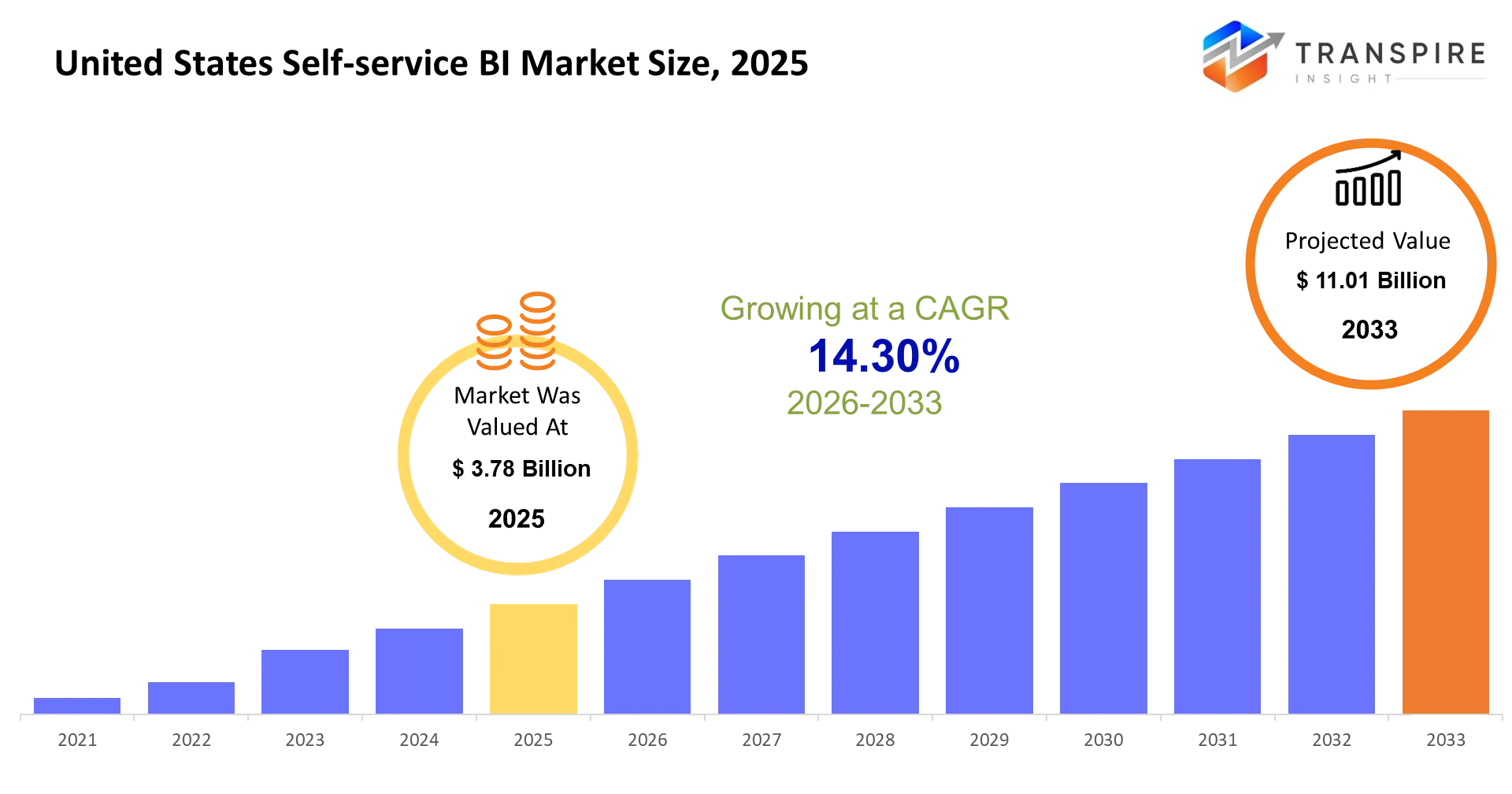
- United States Self-service BI Market Size 2025: USD 3.78 Billion
- United States Self-service BI Market Size 2033: USD 11.01 Billion
- United States Self-service BI Market CAGR: 14.30%
- United States Self-service BI Market Segments: By Component (Software, Services, Cloud BI, On-premise BI, Mobile BI, Embedded BI), By Enterprise Size (SMEs, Large Enterprises, Startups, Government Organizations), By Industry (BFSI, Healthcare, Retail, IT & Telecom, Manufacturing, Education).
To learn more about this report,  Download Free Sample Report
United States Self-service BI Market Summary:
The United States Self-service BI Market size is estimated at USD 3.78 Billion in 2025 and is anticipated to reach USD 11.01 Billion by 2033, growing at a CAGR of 14.30% from 2026 to 2033. The United States self service BI market has moved, sorta from a niche analytics toolset into a kind of core operational layer for enterprises, they want faster decisions and also they don’t want to keep waiting on centralized IT teams. In real life, self service BI platforms help finance managers, supply chain planners, sales leaders ,and even plant operators pull live business data, spin up dashboards and spot performance gaps sort of immediately. This has started to feel essential, especially when organizations have increasingly fragmented data sitting across cloud applications, ERP systems, and industrial operations.
Over the last five years, the whole market changed more structurally, like static reporting got replaced by AI assisted analytics that actually sits inside business routines. The quick shift to cloud infrastructure and hybrid work settings pushed this forward, because traditional IT controlled reporting systems just hit their limits. A big spark was the post pandemic supply chain disruption window, when companies needed near instant visibility into inventory logistics and how customer demand was moving. That pressure then reshaped what buyers cared about, so enterprises leaned toward tools that cut down reporting bottlenecks and shorten decision cycles. So, vendors keep building stronger recurring revenue streams via subscription based analytics ecosystems and embedded automation, basically they’re not only selling dashboards, they are selling ongoing operational help, too.
Key Market Insights
- In the Western United States, the United States Self-service BI Market sort of got the upper hand with almost 36% market share in 2025, mainly because the technology infrastructure is strong and SaaS adoption kept climbing.
- California is still the biggest revenue source, backed by a heavy concentration of cloud analytics vendors as well as steady enterprise digital transformation spending.
- The Southern United States looks like the quickest mover through 2032, with momentum fueled by growing healthcare, logistics, and retail analytics investments.
- More and more enterprises are shifting toward hybrid cloud environments, this keeps pushing demand higher for self-service business intelligence platforms especially across mid sized organizations.
- Cloud based self-service BI platforms led the market with more than 62% share in 2025, because they scale well, use subscription pricing, and usually land faster in production cycles.
- On premise solutions still held the second largest market share in regulated industries where organizations want tighter data governance and better compliance control.
- AI powered analytics plus augmented BI capabilities are expected to grow the quickest segment over the forecast period up to 2032.
- Embedded analytics tools also picked up meaningful share, since companies increasingly weave reporting features right into ERP, CRM, and operational software ecosystems.
- Mobile BI is still accelerating too, especially across field operations, sales management, and supply chain monitoring apps across the United States Self-service BI Market.
- Financial reporting and performance management made up about 31% market share in 2025, driven by the need for real time operational visibility.
- Supply chain analytics emerged as one of the fastest-growing application areas after post pandemic inventory and logistics disruptions kept showing up across U.S. industries.
What are the Key Drivers, Restraints, and Opportunities in the United States Self-service BI Market?
The strongest force pushing the United States Self-service BI market forward is that enterprise shift toward cloud native operations and more decentralized decision making, which somehow everyone talks about but not everyone implements the same way. Over the last five years, many organizations moved important workflows into SaaS platforms, think ERP , CRM, and supply chain systems. That move created huge amounts of operational data, but it is fragmented, and stored in pieces across multiple tools. Old school IT managed reporting models just could not keep pace with the requests, especially for finance teams , logistics managers, or sales departments that need answers in real time. So that bottleneck kinda drove a lot of adoption of self-service BI platforms where business users can put together dashboards and run analytics on their own, and you know it goes on like that. Because of this vendors are seeing lots more recurring subscription revenue while enterprises keep raising spend on embedded analytics, AI assisted reporting, and low-code data visualization tools, too.
Still, data governance complexity remains the biggest structural barrier, limiting the market growth in practice. A lot of large enterprises keep running on legacy infrastructure where operational , customer, and financial data are split between disconnected systems. Bringing all those environments into one analytics architecture means costly modernization efforts , cybersecurity upgrades, and long deployment cycles that can feel endless. As a result deployment dates get delayed, and regulated sectors like healthcare, and banking tend to adopt more slowly. In those areas, inaccurate reporting or unmanaged data access creates compliance exposure, and that can lead to financial penalties, plus other headaches.
Generative AI integration really looks like the most obvious chance for the next growth phase in the United States self-service BI market. A lot of vendors are moving toward natural language query features, so non technical employees can throw together predictive insights without needing coding skills. Honestly this trend is picking up faster and faster across mid sized companies in areas like retail and manufacturing, where labor shortages and operational cost pressure are pushing leadership to spend on automated analytics and decision intelligence platforms.
What Has the Impact of Artificial Intelligence Been on the United States Self-service BI Market?
Artificial intelligence and advanced digital technologies are, in a way, transforming the United States Self-service BI Market , shifting analytics from passive reporting toward automated operational intelligence . In practice enterprises are now using AI-driven dashboards that keep track of financial results, customer behavior, inventory movement and supply chain disruptions , all the while without needing someone to manually generate reports. Machine learning algorithms built into self-service analytics platforms can uncover irregular patterns in procurement spending, anticipate sales fluctuation, and fine tune workforce allocation by drawing from real-time enterprise data streams. Retailers and logistics operators are using predictive analytics models more and more , to boost inventory accuracy and also cut down fulfillment delays , while manufacturers are leaning on AI-powered visualization tools to spot production inefficiencies before they start impacting output quality.
At the same time advanced natural language processing capabilities are changing how people actually adopt these tools. Business users can now ask analytics systems with conversational prompts instead of relying on structured coding or needing SQL-level skills, which reduces the constant dependence on IT departments. This tends to speed up reporting, compress decision timelines, and supports cost reduction tied to manual data preparation and fragmented reporting workflows.
Still, AI adoption runs into a strong bottleneck connected to data integration , because many organizations still work across disconnected legacy systems. Inconsistent data structures and formats can reduce model reliability and drag out implementation. On top of that, high integration costs and limited internal analytics competence continue to slow down broad deployment, especially for mid-sized enterprises juggling hybrid cloud plus on-premise environments .
Key Market Trends
- Since 2021 enterprises kinda reduced reliance on IT-managed reporting, because low-code BI platforms let individual departments spin up analytics themselves across finance ,and operations teams in a more ad hoc way.
- Cloud-native analytics deployments basically overtook on-premise setups once hybrid work became normal, and 2020–2023 made it obvious that centralized reporting infrastructure could introduce delays, sometimes painfully
- Microsoft and Salesforce pushed generative AI into BI more aggressively in 2024, aiming to automate dashboard creation and support natural language querying, without the usual manual back and forth
- Retail ,and logistics firms leaned harder into predictive analytics after pandemic-era supply disruptions showed how brittle manual inventory and demand forecasting could be.
- Healthcare providers moved toward self-service analytics between 2022 and 2025 to sharpen patient flow management, improve staffing visibility, and raise the odds of operational reporting accuracy staying consistent.
- Embedded analytics also grew ,quite a lot, because enterprises started plugging BI capabilities directly into ERP and CRM platforms instead of relying on standalone reporting tools in isolation.
- Mid-sized businesses raised subscription-based BI spending in step with SaaS pricing models, since deployment costs fell and long-term infrastructure caretaking became less of a burden
- Financial institutions invested more in governance-led analytics, partly because stricter cybersecurity regulations increased the need for controlled data access and audit-ready reporting systems, every time.
- AI-assisted data preparation tools took on a chunk of the manual reporting load by automating anomaly detection, forecasting models, and cross-platform data integration processes after 2023.
- Competition got louder as Oracle, SAP, and IBM expanded embedded analytics and industry-specific intelligence options across U.S. enterprises, almost like it became a default pattern.
United States Self-service BI Market Segmentation
By Component
Software platforms keep the top spot inside the component segment, mostly because organizations still prefer scalable analytics environments that kind of lessen the reliance on a centralized reporting team, or at least that’s what many decision makers keep saying. Cloud BI offerings take the biggest adoption share, not only because deployment costs are generally lower but also because subscription pricing stays flexible and the integration path is simpler with ERP and CRM platforms. Embedded BI and mobile BI meanwhile have gotten more momentum too, as many companies move toward near real-time operational awareness across distributed teams and all those field operations.Even with that shift, services stay really essential for implementation and integration, cybersecurity settings and employee training, especially in regulated industries that manage sensitive operational data.
At the same time, demand patterns are tilting toward AI-enabled dashboards, natural language queries, and automated reporting features, all of which compress the time-to-decision. Looking ahead, future growth will likely clump around predictive analytics and embedded intelligence ecosystems , which opens room for vendors that can deliver industry-focused integrations plus cloud-native architectures. This is also adding pressure on legacy on-premise providers to modernize their setup and revisit pricing strategies before they fall behind, or kind of get stuck.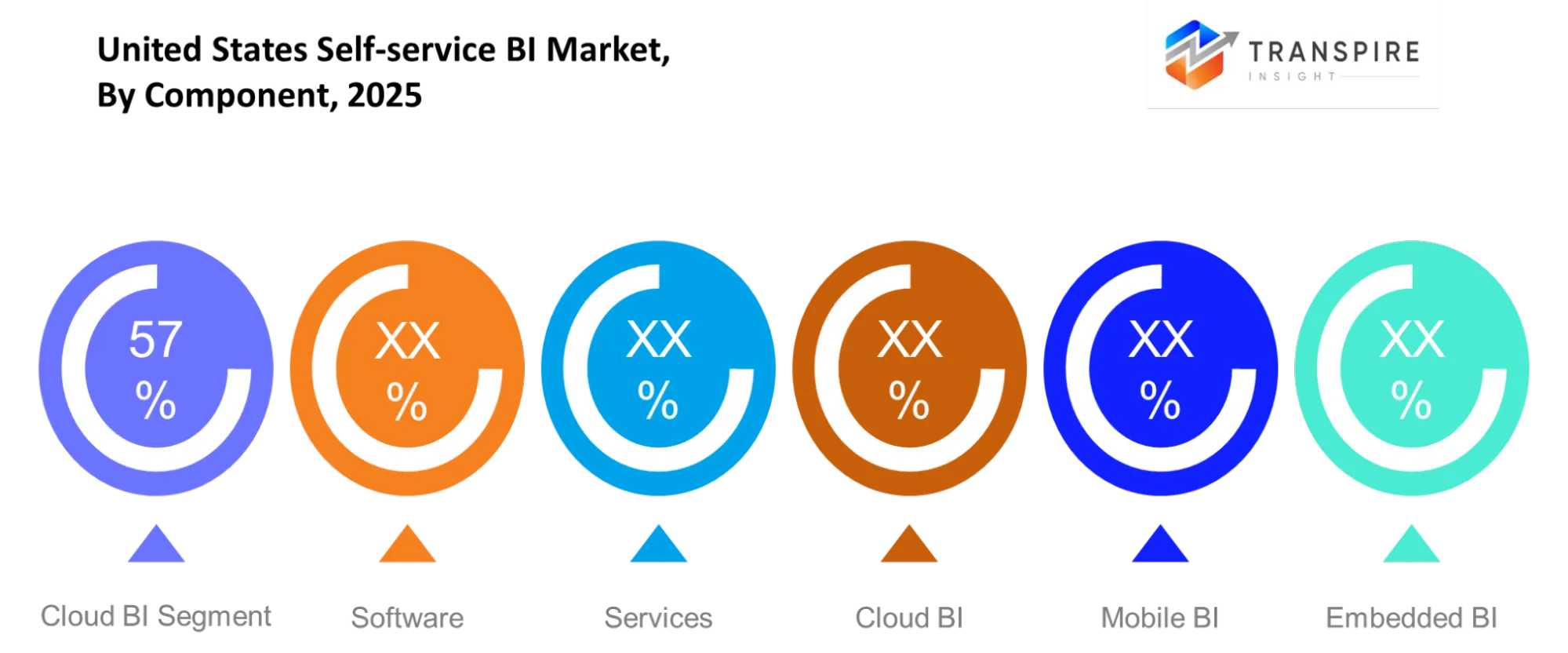
To learn more about this report, Download Free Sample Report
By Enterprise Size
Large enterprises still pretty much lead the enterprise size space , because multinational organizations tend to juggle high-volume operational data across finance , logistics , human resources and customer engagement systems. With strong capital in place, big firms can keep funding advanced analytics platforms, governance frameworks, and AI assisted reporting workflows, even when timelines get messy. SMEs look like the fastest moving segment too , since SaaS pricing models cut down infrastructure hurdles a lot, and they also help shorten the deployment timeline, in practice.
Startups are leaning further toward low code analytics tools for quick scaling, in the sense that they do not need a big IT workforce up front, first. Government orgs keep showing steady adoption, largely tied to compliance reporting, budget monitoring , and public service analytics modernization programs. That said, data integration complexity keeps tripping teams up, and cybersecurity worries still slow adoption for smaller organizations, especially when their infrastructure is fragmented , or half stitched together. Looking ahead, growth will hinge on vendors offering simplified onboarding, industry focused templates, and subscription driven analytics ecosystems that make the whole thing easier for mid sized businesses, while still maintaining enterprise level governance and compliance expectations.
By Industry
BFSI still stays dominant, mostly because financial institutions need ongoing risk surveillance, fraud detection, regulatory compliance updates, and real-time transaction awareness across those complicated operational chains and such. Healthcare comes right behind it, fueled by more investment in patient flow analytics, staffing orchestration, and prescriptive operational governance tools. Retail orgs , have leaned in a lot lately after supply chain disruptions showed obvious weak spots in older inventory prediction methods and customer behavior tracking setups. Manufacturing keeps folding in self-service analytics for production visibility, procurement optimization, and forward-looking maintenance routines, to push operational efficiency up and downtime down.
IT and telecom providers really lean on real-time performance analytics to handle customer interactions and also to spot network utilization trends, while schools and universities are pushing analytics platforms for admission planning and administrative choices more and more. In the next phase, it looks like the market is tipping toward industry- tailored AI models, built-in operational intelligence, and stronger cybersecurity controls so software vendors are essentially being asked to build analytics ecosystems that are focused on specific verticals, shaped around specialized compliance rules and day to day workflow needs.
What are the Key Use Cases Driving the United States Self-service BI Market?
Financial reporting and day to day operational performance monitoring still look like the main use cases behind adoption across big enterprises, and yeah also BFSI organizations. Real-time dashboards let finance teams follow cash flow, regulatory submissions, transaction anomalies, and even branch-level profitability , without having to depend on centralized IT departments too much.
In retail and healthcare, teams are going more self-service analytics , for inventory projection, patient flow streamlining, workforce scheduling, and customer behavior analysis. Manufacturing firms are doing a similar thing with embedded analytics tools , to keep an eye on procurement costs, production efficiency, and supply chain disruptions across sites that are spread out.
Newer stuff shows up as AI driven predictive decision systems, plus natural language analytics platforms , so non-technical employees can pull meaning out of the data using conversational questions. Logistics providers and mid-sized enterprises are also trialing automated forecasting tools that help demand planning, and they cut operational delays as the market keeps shifting pretty fast.
|
Report Metrics |
Details |
|
Market size value in 2025 |
USD 3.78 Billion |
|
Market size value in 2026 |
USD 4.32 Billion |
|
Revenue forecast in 2033 |
USD 11.01 Billion |
|
Growth rate |
CAGR of 14.30% from 2026 to 2033 |
|
Base year |
2025 |
|
Historical data |
2021 - 2024 |
|
Forecast period |
2026 - 2033 |
|
Report coverage |
Revenue forecast, competitive landscape, growth factors, and trends |
|
Geographic scope |
United States of America |
|
Key company profiled |
Microsoft, Tableau, Qlik, SAP, Oracle, IBM, SAS Institute |
|
Customization scope |
Free report customization (country, regional & segment scope). Avail customized purchase options to meet your exact research needs. |
|
Report Segmentation |
By Component (Software, Services, Cloud BI, On-premise BI, Mobile BI, Embedded BI), By Enterprise Size (SMEs, Large Enterprises, Startups, Government Organizations), By Industry (BFSI, Healthcare, Retail, IT & Telecom, Manufacturing, Education) |
Which Regions are Driving the United States Self-service BI Market Growth?
The Western United States seems to lead the market, mostly because there is a heavy mix cloud tech providers , enterprise software companies, and digital innovation hubs spread around California and Washington. Big corporations in Silicon Valley kinda pushed adoption of AI-enabled analytics platforms faster when remote operations and multi-cloud setups grew after 2020 . Also, strong venture capital , plus advanced data infrastructure, and high enterprise IT spend still help teams roll out embedded analytics and low-code BI tools at a quick pace. Beyond that, the region runs on a fairly mature ecosystem of cloud service providers, cybersecurity vendors, and enterprise software developers, and that basically keeps long-term integration going , along with recurring platform upgrades.
The Northeastern United States is the next biggest regional contributor, driven by steady demand from banking, insurance, healthcare, and government organizations. Compared with the West, the growth here relies less on fresh startup experimentation, and more on structured modernization efforts inside industries that are highly regulated. Financial institutions and healthcare systems keep investing in governance-focused analytics platforms, to improve compliance reporting, cybersecurity oversight, and operational visibility. With long-standing enterprise infrastructure, resilient corporate spending habits , and consistent regulatory enforcement, vendors offering analytics tools tend to keep a dependable revenue base across major metro areas like New York and Boston.
Meanwhile the Southern United States shows the strongest growth momentum, as major business relocations keep happening, healthcare networks are expanding , and investments in logistics infrastructure are moving quickly, so regional technology spending patterns are changing.
Who are the Key Players in the United States Self-service BI Market and How Do They Compete?
The competitive landscape in the United States Self-service BI market still looks moderately consolidated, kind of, with global enterprise software providers holding a big slice of the largest corporate deployments while specialized analytics firms push toward mid sized customers and those vertical specific applications. Lately, rivalry really leans on AI integration cloud scalability embedded analytics features and “how fast can we get it running” more than pure pricing, though pricing still matters. The incumbents keep defending their share by extending ecosystems and relying on recurring subscription models, but newer cloud native vendors are messing with older reporting platforms using low code interfaces and quicker implementation cycles. Buyers now more and more expect interoperability with ERP, CRM, and supply chain systems so vendors have to upgrade their integration abilities and cybersecurity frameworks along with analytics performance, it’s not just about visuals anymore, or something like that.
Microsoft stands out by stitching Power BI together with Azure cloud services and enterprise productivity tools, which lets organizations unify analytics inside the workflows they already use.
Microsoft stands out by stitching Power BI together with Azure cloud services and enterprise productivity tools, which lets organizations unify analytics inside the workflows they already use. Microsoft also keeps pushing generative AI features and natural language analytics, so teams are less dependent on specialists all day. Salesforce, meanwhile, leans hard into embedded customer intelligence with Tableau plus CRM linked analytics, giving it an edge for sales prediction and customer engagement observation.
Its strategic AI moves and cross platform integrations help Salesforce keep enterprise retention steady and keep recurring subscription revenue flowing. Oracle fights with a mix of strong database infrastructure governance centered analytics, and industry tuned cloud applications aimed at finance, healthcare and manufacturing customers.
Company List
- Microsoft
- Tableau
- Qlik
- SAP
- Oracle
- IBM
- SAS Institute
Recent Development News
In February 2026, Experian Acquires AtData to Strengthen Data & Analytics Platform: Experian completed the acquisition of AtData to expand its identity, analytics, and fraud detection capabilities. The deal strengthens its data intelligence stack, which directly supports advanced analytics and BI-driven decision systems used by U.S. enterprises.
Source: https://www.nasdaq.com
In February 2026, ServiceNow Acquires Pyramid Analytics to Expand Self-Service BI: ServiceNow announced the acquisition of Pyramid Analytics to significantly enhance its self-service business intelligence and enterprise analytics capabilities. The move strengthens its ability to let business users query and analyze data without relying heavily on technical teams, reinforcing the shift toward AI-enabled BI platforms in enterprise workflows.
Source: https://www.cio.com
What Strategic Insights Define the Future of the United States Self-service BI Market?
The United States Self-service BI Market is kind of shifting in a structural way toward AI-native decision ecosystems, where analytics platforms start acting like embedded operational layers, not like standalone reporting tools . Over the next five to seven years the most forceful growth driver will probably be enterprise demand for autonomous analytics, that blend predictive modeling, natural language querying, and real-time workflow automation, right inside ERP, CRM , and supply chain environments. In other words this transition will likely reward vendors who can push analytics directly into day-to-day business actions , instead of just selling separate dashboard products that sit off to the side.
There’s also a hidden risk, and it has to do with market concentration clustering around a small set of hyperscale cloud and enterprise software providers. As analytics ecosystems become more tightly connected to proprietary cloud infrastructure, enterprises may get hit with higher switching costs, stronger vendor lock-in, and less room to maneuver in multi-cloud situations. That outcome could end up slowing adoption for mid-sized organizations that are looking for interoperable solutions , rather than something rigid.
On the other hand, an emerging opportunity shows up in industry-specific AI analytics models—especially for healthcare, manufacturing, and logistics operations across the Southern United States. Vendors and investors should put attention on vertical-focused platforms that have solid data governance, plus low-code deployment approaches, because those elements will likely shape long-term customer staying power and expansion momentum .
United States Self-service BI Market Report Segmentation
By Component
- Software
- Services
- Cloud BI
- On-premise BI
- Mobile BI
- Embedded BI
By Enterprise Size
- SMEs
- Large Enterprises
- Startups
- Government Organizations
By Industry
- BFSI
- Healthcare
- Retail
- IT & Telecom
- Manufacturing
- Education
Frequently Asked Questions
Find quick answers to common questions.
The Approximate United States Self-service BI Market size for the Market will be USD 11.01 Billion in 2033.
The key Segments of the United States Self-service BI Market are By Component (Software, Services, Cloud BI, On-premise BI, Mobile BI, Embedded BI), By Enterprise Size (SMEs, Large Enterprises, Startups, Government Organizations), By Industry (BFSI, Healthcare, Retail, IT & Telecom, Manufacturing, Education).
Major Players in the United States Self-service BI Market are Microsoft, Tableau, Qlik, SAP, Oracle, IBM, SAS Institute.
The Current Market size of the United States Self-service BI Market is USD 3.78 Billion in 2025.
The United States Self-service BI Market CAGR is 14.30%.
- Microsoft
- Tableau
- Qlik
- SAP
- Oracle
- IBM
- SAS Institute
Recently Published Reports
-
Apr 2026
3D Optical Profiler Market
3D Optical Profiler Market Size, Share & Analysis Report By Type (Desktop 3D Optical Profiler, and Portable 3D Optical Profiler), By Technology (Confocal Technology, and White Light Interference), By End-Use Industry (Manufacturing, Research Institutions, Automotive, Aerospace and Defense, Medical Devices, and Other), and Geography (North America, Europe, Asia-Pacific, Middle East and Africa, South and Central America), 2021 - 2031
-
Apr 2026
Depth Sensor Market
Depth Sensor Market Size, Share & Analysis Report By Type (Infrared Depth Sensors, Time-of-Flight (ToF) Sensors, Stereo Vision Sensors, Structured Light Sensors, Ultrasonic Depth Sensors), By Application (Automotive, Robotics, Gaming, Consumer Electronics, Industrial Automation, Healthcare, Security & Surveillance, Others), By End Users (Automotive Manufacturers, Consumer Electronics Companies, Healthcare Providers, Industrial Companies, Security Agencies, Gaming Companies, Robotics Companies, Others), and Geography (North America, Europe, Asia-Pacific, Middle East and Africa, South and Central America), 2021 – 2031
-
Apr 2026
Digital Manufacturing Market
Digital Manufacturing Market Size, Share & Analysis Report By Component (Hardware, Software, and Services), By Technology (Robotics, 3D Printing, Internet of Things (IoT), and Others), By Application (Automotive and Transportation, Aerospace and Defense, Consumer Electronics, Industrial Machinery, and Others), By Process Type (Computer-Based Designing, Computer-Based Simulation, Computer 3D Visualization, Analytics, and Others), and Geography (North America, Europe, Asia-Pacific, Middle East and Africa, South and Central America), 2021 – 2031
-
Apr 2026
Digital Visa Services Market
Digital Visa Services Market Size, Share & Analysis Report By Type (Individual Travelers, Group Travelers), By Application (Tourism, Business Travel, Others), and Geography (North America, Europe, Asia-Pacific, Middle East and Africa, South and Central America), 2021 – 2031