
United States Regulatory Technology (Regtech) Market Summary
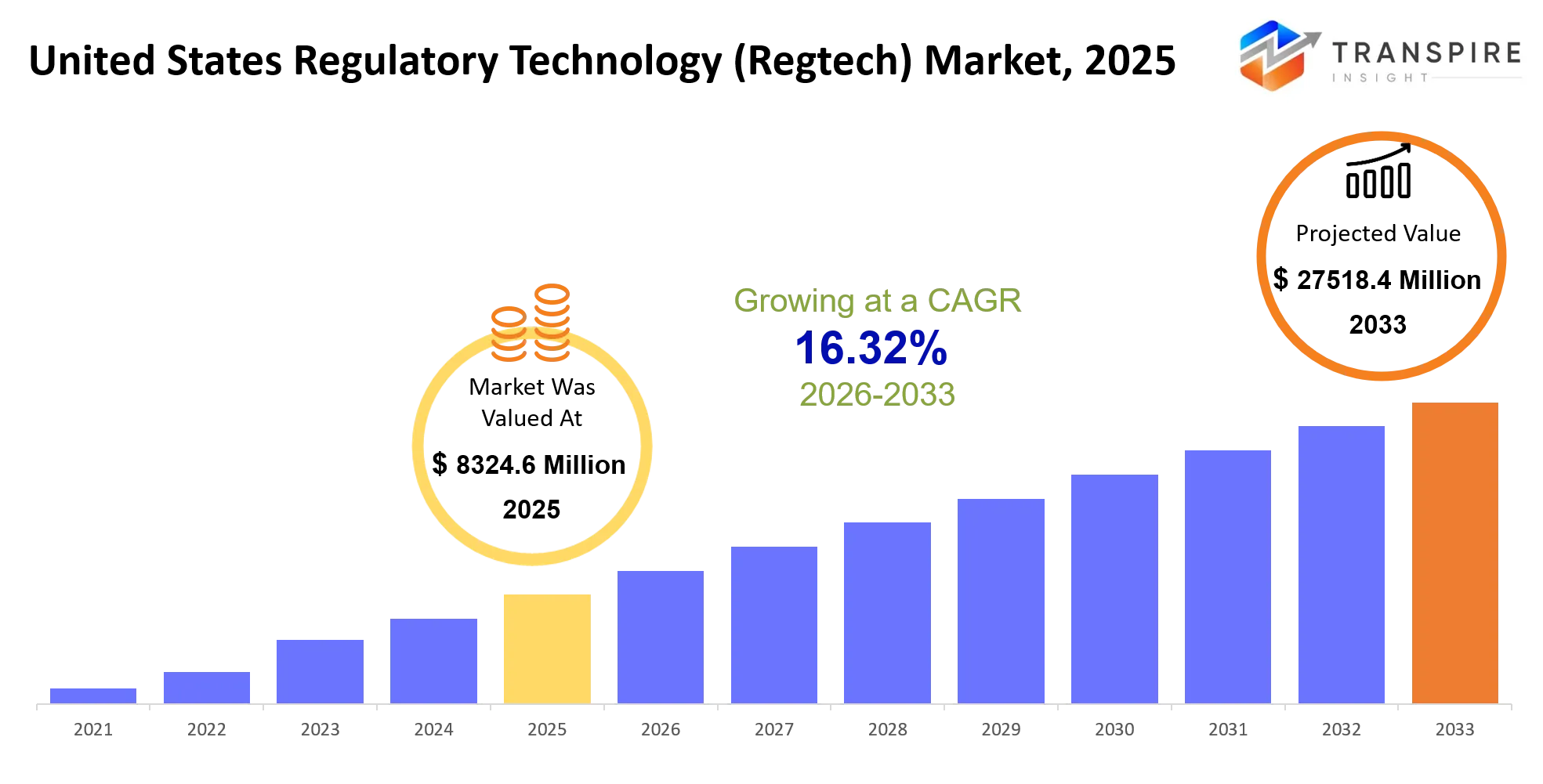
As per Transpire Insight Analysis the United States Regulatory Technology (Regtech) Market size is estimated at USD 8324.6 Million in 2025 and is anticipated to reach USD 27518.4 Million by 2033, growing at a CAGR of 16.32% from 2026 to 2033.
Regulatory technology in practice helps U.S. businesses watch transactions, double-check customers, catch financial crime, wrangle regulatory data, and crank out compliance reports, even when they’re not leaning on piecemeal manual workflows. Banks, insurers , fintech firms, and other controlled or regulated entities are using automated platforms more and more to move through huge sets of regulatory checks while trimming compliance mistakes and lowering operating costs. Over the last three to five years the market has kind of drifted away from standalone compliance tools and toward cloud based platforms, linked risk analytics, AI assisted monitoring, and reporting that basically runs itself. Meanwhile regulatory pressure, especially around anti money laundering, customer identification, data privacy , and financial crime has gotten sharper, which makes continuous monitoring feel non optional. Also the fast growth of digital banking and fintech services keeps pushing transaction volumes higher and makes compliance work feel heavier. So companies are putting more of their technology budgets into automated compliance infrastructure , and this is expected to support market growth from USD 8,324.6 million in 2025 to about USD 27,518.4 million by 2033.
United States Regulatory Technology (Regtech) Market Size & Forecast:
- United States Regulatory Technology (Regtech) Market Size 2025: USD 8324.6 Million
- Expected Market Value 2033: USD 27518.4 Million
- Forecast CAGR:16.32%
- Key Profile: NICE Actimize, FIS Global, Oracle Corporation, IBM Corporation, Thomson Reuters, Wolters Kluwer, MetricStream, SAS Institute, ComplyAdvantage, Trulioo, LexisNexis Risk Solutions, Moody's Analytics, OneTrust, Feedzai, Broadridge Financial Solutions
Key Market Insights
- Market outlook: The United States Regulatory Technology (Regtech) Market feels like it is shifting away from point solutions and toward more whole cloth integrated compliance platforms that enable continuous monitoring and also automated reporting, in a way that is kinda smoother than before.
- Regional dominance: In 2025 the Northeast showed up as the front runner supported by a dense concentration of banks, insurers, fintech companies, and financial regulators, all clustered so the ecosystem behaves like it has momentum.
- Regional growth: The Western region looks set for quicker expansion because fintech hubs are rolling out automated KYC, AML, fraud prevention plus cloud compliance systems, and that adoption cycle is gaining speed.
- Component trend: Compliance management software is still staying in front as the main technology category, while risk analytics platforms are quietly but steadily becoming more strategically important across financial institutions, especially where decision quality matters
- Deployment shift: Cloud based and SaaS solutions are getting picked up more and more, since regulated organizations want a compliance backbone that scales without heavy internal hardware investments, and honestly without the headache
- Application leadership: Regulatory compliance remains the top application, yet AML, KYC, transaction monitoring, and fraud detection keep driving big budgets for technology spending, even when priorities change mid year.
- End-user demand: Banks are still major buyers, while fintech companies are a fast growing customer group because digital financial services create high volume compliance workloads, that never really slow down.
- Enterprise adoption: big enterprises still have strong spending power, while SMEs are increasingly picking SaaS compliance tools ,mostly because subscription models make the upfront tech costs feel less painful and that, kinda lowers the entry barrier.
- Technology transition: AI, machine learning, natural language processing, and advanced analytics are nudging compliance operations away from rule based screening, toward risk based decision support. So there’s more contextual insight in the workflow and less rigid verification ,almost like the system is helping rather than just rejecting.
What are the Key Drivers, Restraints, and Opportunities in the United States Regulatory Technology (Regtech) Market?
Stronger financial crime controls and digital transaction volumes that keep climbing are like major growth forces. Banks and fintech companies now handle big volumes of customer , and transaction data across online channels , which ups the workload tied to AML KYC fraud detection and regulatory reporting. Automated screening plus continuous monitoring can cut down the manual review, but it also improves response speed, so the business case for investing in compliance technology starts to look pretty direct . With cloud deployment and SaaS pricing, the entry barriers get even lower, so organizations can swap out scattered old tools for more scalable platforms.
Still, tying everything into legacy banking, insurance, and enterprise systems is a real structural barrier. Many large orgs run several databases compliance applications identity systems and reporting environments all at once. That makes data standardization, along with system integration, expensive. Migration tends to need extensive validation, cybersecurity controls, employee training , and regulatory testing. Because of that, timelines can stretch, and for technology providers revenue realization can get delayed.
There is a next-stage opening in AI enabled compliance analytics , basically. Machine learning can help prioritize higher-risk transactions, surface unusual behavioral patterns, summarize regulatory changes, and also assist with investigation workflows. Generative AI moreover brings openings for automated regulatory document analysis , and better compliance knowledge management. If more AI infrastructure shows up across U.S. financial institutions, it can lift spending on intelligent monitoring platforms and integrated compliance ecosystems.
What Has the Impact of Artificial Intelligence Been on the United States Regulatory Technology (Regtech) Market?
Artificial intelligence is kinda changing compliance operations by auto- doing transaction screening, customer risk scoring, document review, regulatory shift monitoring, and case prioritization, all at once maybe. Machine learning models can look at transaction behavior across huge datasets and spot odd patterns that rule-based systems might not really catch. Then natural language processing can pull out obligations from regulatory materials, and link those requirements with internal policies, controls, and reporting pathways, which helps in practice. Financial institutions are also using AI to reduce false alarms in AML monitoring, so compliance teams can spend more time on higher-risk cases instead of wading through everything. Advanced analytics can also make monitoring faster and enable more consistent compliance choices across large volumes of transactions.
On the fraud side, predictive capabilities are getting a lot of attention Anti-Money Laundering for prevention and broader risk management. Machine learning models can flag behavioral signals connected with account takeover, payment scams, suspicious transactions, or even changes in customer risk before the usual review steps notice anything. With AI in place, analyst productivity tends to go up, investigation cycles can get shorter, and there’s less repetitive manual clicking, though it really depends on data quality and model governance overall. A big downside still shows up as the cost of weaving AI into older compliance platforms, and also concerns like explainability, regulatory validation, data privacy, and not enough high-quality training data for specialized risk situations, which can trip up performance.
Key Market Trends
- Since 2021, financial institutions kinda pushed cloud migration harder, moving away from isolated compliance apps and toward more scalable platforms that support ongoing monitoring and yeah, continuous visibility.
- From 2022 onward, AI assisted screening really took off as compliance teams want fewer false positives, and also quicker investigation cycles, without the usual delays.
- Digital banking growth has stretched transaction monitoring workloads, so fintech companies are more willing to deploy automated AML and KYC infrastructure instead of doing everything manually.
- RegTech providers are increasingly doing this kind of thing where identity verification and fraud analytics sort of mash together, so instead of only stand alone customer screening products, you end up with wider platforms, that do more than one simple task.
- Generative AI adoption picked up steam after 2023 and it basically pushed compliance teams to test automated regulatory research, plus document interpretation, and also policy orchestration, all at once, maybe a bit too quickly.
- Large financial institutions are leaning harder into API based integration now, letting compliance platforms connect straight into banking, payment, and customer-data systems, without all the extra stitching.
- Since 2021, subscription style SaaS offerings have expanded quite a bit, and that reduces the upfront tech spend. It also makes things easier for mid sized financial organizations, where budgets are tighter, like they can’t afford heavy implementation cycles.
- Cybersecurity and data privacy rules have nudged vendors toward stronger encryption, stricter access controls, cleaner audit trails, and broader governance features. Not just the basic settings that people expect.
- And partnerships between tech providers and financial institutions are up as well, which helps in building customized compliance workflows, and often speeds up deployment in regulated business environments, where timing really matters.
- Competitive differentiation is starting to lean toward explainable AI, real time analytics, unified data environments, and automated regulatory change management, all together.
United States Regulatory Technology (Regtech) Market Segmentation
By Component
Software is basically the core tech layer behind automated compliance monitoring, customer screening, risk assessment, reporting, and workflow management stuff. On one side, compliance management software backs policy controls and regulatory obligations, but on the other, risk analytics platforms dig into customer , transaction , and operational risk, sort of like a deeper pulse check. Identity verification solutions then help validate customer information during onboarding periods. Meanwhile fraud detection solutions look at suspicious behavioral patterns, in a more watchful way. Reporting tools back up standardized regulatory submissions and also internal compliance documentation, not just external filing. Cloud platforms boost scalability and data accessibility, while services and consulting help with implementation, customization , system integration, and regulatory process transformation. There are also other component offerings for specialized compliance requirements across financial and other regulated industries.
The component mix is slowly drifting toward integrated platforms, instead of standalone apps that each do one job. Software adoption will still stay strong as banks , fintech companies, insurers, and other regulated organizations want automated workflows that feel consistent. Services and consulting will mainly assist migration from legacy environments and the rollout of new compliance architectures. And honestly, risk analytics, identity verification, fraud detection, and reporting capabilities should gain even more value as organizations start connecting several compliance functions through unified technology environments, rather than keeping them in separate silos.
By Deployment
Cloud based deployment helps with scalable compliance operations, and lets organizations beef up their computing capacity as both transaction volumes, and customer volumes rise. Meanwhile, On-Premise systems still serve the group that wants direct infrastructure control, but then Hybrid Cloud models kind of bridge internal systems with outside cloud resources. SaaS gives subscription based access and it cuts down on the initial, heavy infrastructure needs. Private Cloud keeps a controlled environment for sensitive regulatory information, whereas Public Cloud brings scalable infrastructure for wider workloads. Multi-Cloud deployment also supports resilience plus vendor diversification , and Edge Deployment can fit localized processing requirements. There are, of course, other deployment models that cover specialized security, integration, and day to day operational needs.
Over time, cloud deployment is going to get stronger adoption, mainly because compliance workloads are getting more data heavy, and more geographically distributed too. SaaS will stay appealing for SMEs and fintech companies, since subscription models lower the capital load up front. Hybrid Cloud, along with Private Cloud, will stay important in big financial organizations that handle sensitive information and still depend on legacy systems. Multi-Cloud strategies can improve resilience and flexibility, while On-Premise infrastructure keeps being used by organizations that insist on strict internal control requirements.
By Application
Regulatory Compliance still the kinda main application area, you know, covering policy management, regulatory monitoring, documentation ,and control testing—overall. Anti Money Laundering (AML) and Know Your Customer (KYC) applications help with customer screening, transaction review, and financial crime prevention, pretty directly. Fraud Detection looks at odd behavior, while Risk Management evaluates exposure across customers , transactions ,and business operations. Then Transaction Monitoring follows financial activity against set risk indicators, and Identity Management backs customer verification. Regulatory Reporting tends to automate data collection and submission steps, and Audit Management supports evidence gathering, control validation, and audit trails. Some other applications cover the more specialized regulatory requirements too, as needed.
Application priorities are moving toward continuous monitoring and automated decision support ,more than before. AML, KYC , fraud detection, and transaction monitoring will get serious investment as digital transaction volumes expand. Regulatory reporting will also improve through automated data collection ,validation ,and workflow management in a more streamlined, almost orchestral way. Audit management and identity management will increasingly plug into broader compliance platforms, creating integrated control environments, not separate operational processes.
By End User
Banks show up as a major user group ,because banking operations create really wide needs for AML , KYC, fraud monitoring, customer verification , and regulatory reporting. Financial Institutions tend to lean on compliance platforms for risk assessment , transaction surveillance, and regulatory documentation. Insurance Companies use technology across fraud prevention , customer verification , and regulatory controls, kind of a layered thing. FinTech Companies really need automated compliance infrastructure for digital onboarding and all those high-volume transactions too. Government Agencies use regulatory technology for oversight and monitoring, while Healthcare Organizations put compliance systems to work on sensitive information and on regulatory obligations.
Telecom Companies and Retail Enterprises, they usually lean on identity, fraud, privacy, and risk controls for those big customer ecosystems. Other users also exist, like regulated enterprises with specialized compliance requirements and they’re usually not standard.
Big financial organizations will keep being major buyers, because complex regulatory frameworks demand extensive monitoring capabilities. FinTech Companies will keep pushing strong technology adoption as digital services expand , and compliance requirements start getting even more demanding over time. Insurance Companies and healthcare organizations will raise investment in identity, fraud, privacy , and reporting functions. Telecom Companies and Retail Enterprises will adopt more focused solutions where customer identity, payment security , data protection, and fraud risks need automated controls.
By Enterprise Size
Large Enterprises end up spending a lot on technology because their operations are pretty complicated, they need wide compliance coverage, more advanced analytics, and also integration across several business systems, kind of all at once. SMEs are lately leaning on subscription based platforms for compliance tasks without putting in a huge infrastructure effort. Financial Startups, from the start, usually need scalable KYC and AML along with identity verification and fraud controls, like early-stage must-have things. Public Sector Organizations use compliance tech for oversight, reporting, audit management, and data governance. Global Enterprises typically look for multi jurisdictional compliance capabilities, meanwhile Mid Sized Businesses try to stay with cost effective platforms, with flexible deployment choices. Private Institutions and other entities usually adopt specialized solutions depending on regulatory exposure and how big their operations are, more or less.
Overall enterprise size affects what they buy first, how they will deploy it, and how long implementation takes. Large and Global Enterprises will likely keep investing in integrated platforms, advanced analytics, and connectivity between multiple systems. SMEs and Mid Sized Businesses will generally prefer SaaS options with steady subscription costs, plus faster going live times. Financial Startups will focus on API based compliance infrastructure, whereas Public Sector Organizations and Private Institutions will put weight on governance, security, auditability, and controlled handling of data.
What are the Key Use Cases Driving the United States Regulatory Technology (Regtech) Market?
Regulatory compliance is still, kind of, the main use case, because banks and other controlled financial organizations have to keep managing AML, KYC, reporting audit, and all the risk requirements. Automated compliance platforms cut down the manual data wrangling, and they also tie regulatory duties to everyday operational workflows. Big banks in particular show really strong demand, since transaction volumes and regulatory reporting needs lead to a lot of ongoing monitoring work, that piles up.
AML and KYC are widening across banks, other financial institutions, and fintech companies too, mostly because digital onboarding and electronic payments are increasing customer volumes. Fraud detection and transaction monitoring are picking up traction as well, since online financial channels create unfamiliar patterns of suspicious activity. Automated identity verification helps fintech providers onboard people faster while still keeping the needed compliance guardrails in place.
Newer use cases, show up as AI supported regulatory change management and automated compliance investigations. Generative AI can read regulatory documents, find the relevant obligations, and help compliance teams with policy updates. Predictive risk analytics also gives a chance to catch fraud earlier, and make investigation more focused across huge transaction datasets.
|
Report Metrics |
Details |
|
Market size value in 2025 |
USD 8324.6 Million |
|
Market size value in 2026 |
USD 9546.7 Million |
|
Revenue forecast in 2033 |
USD 27518.4 Million |
|
Growth rate |
CAGR of 16.32% from 2026 to 2033 |
|
Base year |
2025 |
|
Historical data |
2021 - 2024 |
|
Forecast period |
2026 - 2033 |
|
Report coverage |
Revenue forecast, competitive landscape, growth factors, and trends |
|
Regional scope |
United States |
|
Key company profiled |
NICE Actimize, FIS Global, Oracle Corporation, IBM Corporation, Thomson Reuters, Wolters Kluwer, MetricStream, SAS Institute, ComplyAdvantage, Trulioo, LexisNexis Risk Solutions, Moody's Analytics, OneTrust, Feedzai, Broadridge Financial Solutions |
|
Customization scope |
Free report customization (country, regional & segment scope). Avail customized purchase options to meet your exact research needs. |
|
Report Segmentation |
By Component (Software, Services, Consulting, Risk Analytics Platforms, Compliance Management Software, Identity Verification Solutions, Fraud Detection Solutions, Reporting Tools, Cloud Platforms, Others); By Deployment (Cloud-Based, On-Premise, Hybrid Cloud, SaaS, Private Cloud, Public Cloud, Multi-Cloud, Edge Deployment, Others); By Application (Regulatory Compliance, Anti-Money Laundering (AML), Know Your Customer (KYC), Fraud Detection, Risk Management, Transaction Monitoring, Identity Management, Regulatory Reporting, Audit Management, Others); By End User (Banks, Financial Institutions, Insurance Companies, FinTech Companies, Government Agencies, Healthcare Organizations, Telecom Companies, Retail Enterprises, Others); By Enterprise Size (Large Enterprises, SMEs, Financial Startups, Public Sector Organizations, Global Enterprises, Mid-Sized Businesses, Private Institutions, Others) |
Which Regions are Driving the United States Regulatory Technology (Regtech) Market Growth?
The Northeast is expected to keep being the dominant regional market because New York and the surrounding financial centers host major banks insurers investment firms, and fintech companies that are under intensive compliance requirements. There is strong regulatory oversight too, plus dense financial infrastructure which basically means steady demand for AML KYC, fraud detection, transaction monitoring, and regulatory reporting platforms. Also the region has a mature technology ecosystem connecting financial institutions with compliance software providers, data vendors, consultants, and cybersecurity specialists. So, this kind of concentration helps with faster technology adoption and it gives established vendors a solid customer base for advanced analytics and AI enabled compliance solutions… or something like that.
The Southern region, meanwhile, brings a different growth base through its expanding banking insurance, payments, and corporate services foundation. States like Texas and Florida benefit from population growth, business expansion, and more financial activity, which then creates ongoing compliance technology needs across big and mid sized organizations. There’s also a wider blend of financial institutions along with technology enabled businesses which reduces dependence on one single industry and helps maintain consistent investment in risk management infrastructure. Versus the Northeast, the South offers vendors chances to reach newer digital operations that can roll out cloud based compliance systems without so much legacy infrastructure to deal with.
The Western region is positioned as the fastest growing area due to its cluster of technology firms, fintech startups, digital payment providers, and innovation focused financial services businesses.
Who are the Key Players in the United States Regulatory Technology (Regtech) Market and How Do They Compete?
Competition is becoming more and more tech- driven , where big enterprise vendors go head-to-head with specialized RegTech players , and also with AI-first entrants. Pricing is still a factor for SaaS deployments, but the real separation now leans on things like detection precision, how fast you integrate, how deep the data coverage goes, whether the AI can be explained in plain language, and the capability to tie together AML , KYC, fraud , risk, and reporting workflows. NICE Actimize, FIS Global, Oracle, IBM, Thomson Reuters, and Wolters Kluwer generally benefit from wide-ranging enterprise relationships, while firms like ComplyAdvantage, Feedzai, Trulioo, and MetricStream seem to aim more at narrow compliance and risk needs. So overall, the field tends to reward vendors who can blend regulatory know-how with scalable cloud muscle.
NICE Actimize is trying to stand out via AI-powered fraud , and financial crime prevention. In January 2026, the company rolled out its Actimize Insights Network, and it leans on real-time counterparty risk cues, so financial institutions can spot questionable recipients before any funds actually move. Feedzai is moving along a similar “platform” angle , with a February 2026 partnership with Neterium, where it brings real-time transaction screening together with its RiskOps platform, with the goal of cutting down integration effort and reducing those annoying false positives.
Oracle Corporation and IBM Corporation both compete by leaning hard on enterprise integration, cloud infrastructure, analytics , and long-running relationships with organizations in regulated industries. Thomson Reuters and Wolters Kluwer, meanwhile, seem to strengthen their stance through regulatory intelligence, compliance content that’s more specialized, and workflow-centered tools.
Company List
- NICE Actimize
- FIS Global
- Oracle Corporation
- IBM Corporation
- Thomson Reuters
- Wolters Kluwer
- MetricStream
- SAS Institute
- ComplyAdvantage
- Trulioo
- LexisNexis Risk Solutions
- Moody's Analytics
- OneTrust
- Feedzai
- Broadridge Financial Solutions
Recent Development News
"In January 2026, NICE Actimize launched the Actimize Insights Network. The network provides real-time counterparty risk intelligence across fraud and financial crime operations, strengthening proactive payment fraud detection and reducing dependence on isolated institutional data.https://www.businesswire.com/news/home/20260127747308/en/NICE-Actimize-Unveils-Insights-Network-the-Unified-Force-for-Proactive-Fraud-Financial-Crime-Prevention (Business Wire)."
"In February 2026, Feedzai entered a strategic partnership with Neterium on AML screening. The collaboration integrates Neterium's cloud-native screening infrastructure with Feedzai's RiskOps platform, enabling real-time transaction screening, fewer integrations, and improved compliance efficiency.https://www.finextra.com/pressarticle/108834/feedzai-partners-neterium-on-aml-screening (Finextra)."
"In March 2026, CUBE entered a partnership with Microsoft for AI and compliance. The collaboration integrates CUBE's automated regulatory intelligence with Microsoft Azure to help financial institutions manage regulatory change through scalable cloud-based compliance technology.https://www.finextra.com/pressarticle/109272/cube-and-microsoft-partner-for-ai-and-compliance (Finextra)."
What Strategic Insights Define the Future of the United States Regulatory Technology (Regtech) Market?
The United States Regulatory Technology, or Regtech market, is kinda moving in a pretty clear direction toward integrated AI-enabled compliance infrastructure, not so much a bunch of lone monitoring tools stitched together, and it’s getting more obvious. The main push behind it is the rising volume plus speed of digital transactions, so manual compliance workflows feel harder and harder to scale, and that basically nudges financial institutions toward real time risk evaluation plus automated decision support. There’s also a less talked about angle, like vendor concentration: as the bigger tech players blend cloud infrastructure, data, AI, and compliance capabilities into one package, smaller providers can find it tougher to keep real differentiation. At the same time, customers might run into higher switching costs, and then change becomes more awkward than it should.
Another emerging chance, more under the surface, is agentic AI for regulatory change management, where systems can take in newly released rules, connect obligations to existing controls, flag which internal processes are affected, and then draft out the next compliance actions. In practice, market participants should lean toward interoperable platforms with explainable AI , solid audit trails, and open APIs , so the compliance tech can keep adapting as regulations evolve, new data sources show up, and AI capabilities mature.
United States Regulatory Technology (Regtech) Market Report Segmentation
By Component
• Software
• Services
• Consulting
• Risk Analytics Platforms
• Compliance Management Software
• Identity Verification Solutions
• Fraud Detection Solutions
• Reporting Tools
• Cloud Platforms
• Others
By Deployment
• Cloud-Based
• On-Premise
• Hybrid Cloud
• SaaS
• Private Cloud
• Public Cloud
• Multi-Cloud
• Edge Deployment
• Others
By Application
• Regulatory Compliance
• Anti-Money Laundering (AML)
• Know Your Customer (KYC)
• Fraud Detection
• Risk Management
• Transaction Monitoring
• Identity Management
• Regulatory Reporting
• Audit Management
• Others
By End User
• Banks
• Financial Institutions
• Insurance Companies
• FinTech Companies
• Government Agencies
• Healthcare Organizations
• Telecom Companies
• Retail Enterprises
• Others
By Enterprise Size
• Large Enterprises
• SMEs
• Financial Startups
• Public Sector Organizations
• Global Enterprises
• Mid-Sized Businesses
• Private Institutions
• Others
Frequently Asked Questions
Find quick answers to common questions.
The expected United States Regulatory Technology (Regtech) Market size for the market will be USD 27518.4 Million in 2033.
Key segments for the United States Regulatory Technology (Regtech) Market are By Component (Software, Services, Consulting, Risk Analytics Platforms, Compliance Management Software, Identity Verification Solutions, Fraud Detection Solutions, Reporting Tools, Cloud Platforms, Others); By Deployment (Cloud-Based, On-Premise, Hybrid Cloud, SaaS, Private Cloud, Public Cloud, Multi-Cloud, Edge Deployment, Others); By Application (Regulatory Compliance, Anti-Money Laundering (AML), Know Your Customer (KYC), Fraud Detection, Risk Management, Transaction Monitoring, Identity Management, Regulatory Reporting, Audit Management, Others); By End User (Banks, Financial Institutions, Insurance Companies, FinTech Companies, Government Agencies, Healthcare Organizations, Telecom Companies, Retail Enterprises, Others); By Enterprise Size (Large Enterprises, SMEs, Financial Startups, Public Sector Organizations, Global Enterprises, Mid-Sized Businesses, Private Institutions, Others)
Major United States Regulatory Technology (Regtech) Market players are NICE Actimize, FIS Global, Oracle Corporation, IBM Corporation, Thomson Reuters, Wolters Kluwer, MetricStream, SAS Institute, ComplyAdvantage, Trulioo, LexisNexis Risk Solutions, Moody's Analytics, OneTrust, Feedzai, Broadridge Financial Solutions
The United States Regulatory Technology (Regtech) Market size is USD 8324.6 Million in 2025.
The United States Regulatory Technology (Regtech) Market CAGR is 16.32%from 2026 to 2033.
- NICE Actimize
- FIS Global
- Oracle Corporation
- IBM Corporation
- Thomson Reuters
- Wolters Kluwer
- MetricStream
- SAS Institute
- ComplyAdvantage
- Trulioo
- LexisNexis Risk Solutions
- Moody's Analytics
- OneTrust
- Feedzai
- Broadridge Financial Solutions
About the Authors

Mayur Shinde
I am Mayur Shinde, a Senior Research Analyst at Transpire Insight, specializing in the Automotive & Transportation and Information & Communication Technology (ICT) Industry. My work focuses on analyzing emerging market trends, technological advancements, competitive landscapes, and industry developments to deliver accurate, data-driven insights. I am passionate about transforming complex market information into clear, actionable content that helps businesses, professionals, and decision-makers stay informed and make confident strategic decisions.

Chakradhar Khansole
Chakradhar serves as the Research Director at Transpire Insight, bringing over 8 years of experience in technology, innovation, and strategic market intelligence. He specializes in transforming complex market data into actionable business insights that enable organizations to make informed, growth-oriented decisions. Recognized for his strategic vision and analytical expertise, Chakradhar leads high-impact research initiatives, delivering comprehensive market assessments, competitive intelligence, and forward-looking industry analysis.
Recently Published Reports
-
Apr 2026
3D Optical Profiler Market
3D Optical Profiler Market Size, Share & Analysis Report By Type (Desktop 3D Optical Profiler, and Portable 3D Optical Profiler), By Technology (Confocal Technology, and White Light Interference), By End-Use Industry (Manufacturing, Research Institutions, Automotive, Aerospace and Defense, Medical Devices, and Other), and Geography (North America, Europe, Asia-Pacific, Middle East and Africa, South and Central America), 2021 - 2031
-
Apr 2026
Depth Sensor Market
Depth Sensor Market Size, Share & Analysis Report By Type (Infrared Depth Sensors, Time-of-Flight (ToF) Sensors, Stereo Vision Sensors, Structured Light Sensors, Ultrasonic Depth Sensors), By Application (Automotive, Robotics, Gaming, Consumer Electronics, Industrial Automation, Healthcare, Security & Surveillance, Others), By End Users (Automotive Manufacturers, Consumer Electronics Companies, Healthcare Providers, Industrial Companies, Security Agencies, Gaming Companies, Robotics Companies, Others), and Geography (North America, Europe, Asia-Pacific, Middle East and Africa, South and Central America), 2021 – 2031
-
Apr 2026
Digital Manufacturing Market
Digital Manufacturing Market Size, Share & Analysis Report By Component (Hardware, Software, and Services), By Technology (Robotics, 3D Printing, Internet of Things (IoT), and Others), By Application (Automotive and Transportation, Aerospace and Defense, Consumer Electronics, Industrial Machinery, and Others), By Process Type (Computer-Based Designing, Computer-Based Simulation, Computer 3D Visualization, Analytics, and Others), and Geography (North America, Europe, Asia-Pacific, Middle East and Africa, South and Central America), 2021 – 2031
-
Apr 2026
Digital Visa Services Market
Digital Visa Services Market Size, Share & Analysis Report By Type (Individual Travelers, Group Travelers), By Application (Tourism, Business Travel, Others), and Geography (North America, Europe, Asia-Pacific, Middle East and Africa, South and Central America), 2021 – 2031