

United States Positive Displacement Blowers Market Size & Forecast:
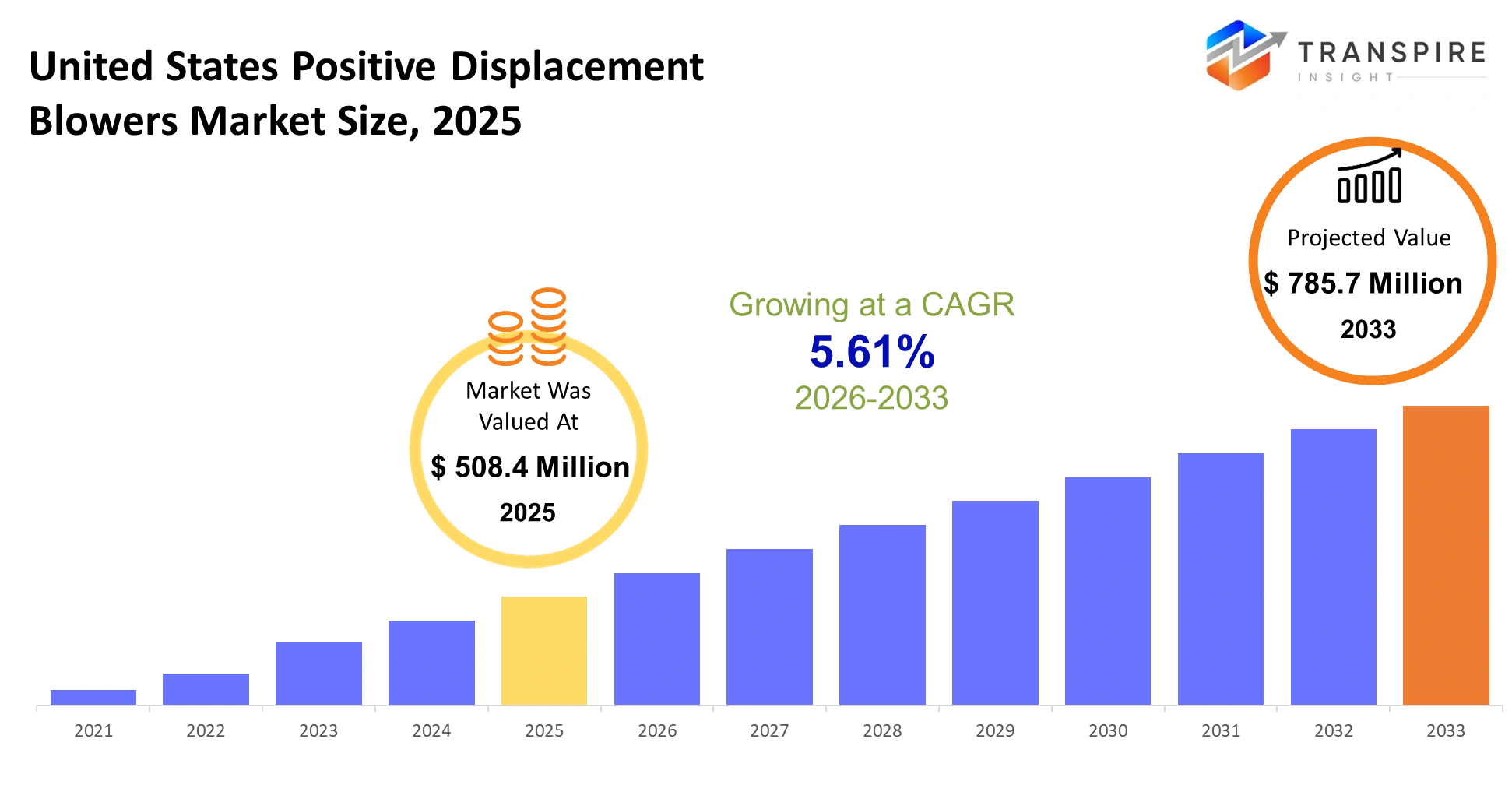
- United States Positive Displacement Blowers Market Size 2025: USD 508.4 Million
- United States Positive Displacement Blowers Market Size 2033: USD 785.7 Million
- United States Positive Displacement Blowers Market CAGR: 5.61%
- United States Positive Displacement Blowers Market Segments: By Product Type (Rotary Lobe Blowers, Screw Blowers, Helical Blowers, Roots Blowers, Centrifugal Blowers, Others); By Pressure Range (Low Pressure, Medium Pressure, High Pressure, Vacuum Systems, Others); By Application (Wastewater Treatment, Pneumatic Conveying, Chemical Processing, Food & Beverage, Power Generation, Others); By End User (Industrial Sector, Municipal Utilities, Manufacturing Industry, Energy Sector, Others)
To learn more about this report,  Download Free Sample Report
United States Positive Displacement Blowers Market Summary
The United States Positive Displacement Blowers Market was valued at USD 508.4 Million in 2025. It is forecast to reach USD 785.7 Million by 2033. That is a CAGR of 5.61% over the period.
Positive displacement blowers (kinda) still matter a lot for pushing air and gas through industrial systems where steadier pressure counts, more than chasing high-speed airflow. In the United States, you see these setups in wastewater treatment plants , pneumatic conveying runs, chemical processing facilities, food manufacturing lines, and also in power generation operations. They let operators hold process stability , lower contamination exposure, and keep energy intensive systems going with less interruption.
Over the last five years , the market has been turning away from plain fixed-speed blower equipment and toward smarter, energy optimized blower systems that get tied into automation platforms and predictive maintenance software. That shift really picked up once stricter industrial emissions rules and energy efficiency requirements nudged plants to refresh aging infrastructure. Then during the pandemic, supply chain disruptions showed how risky equipment downtime can be, so manufacturers and utilities started emphasizing durable, service friendly blower units with lower lifecycle cost.
Now as industrial teams push to reduce energy consumption while still keeping throughput up, blower replacement cycles are getting shorter. As a result, aftermarket service revenue looks stronger and more customers are adopting digitally monitored systems that watch performance in real time.
Key Market Insights
- The Midwest basically dominates the United States Positive Displacement Blowers Market, with something like 34% market share in 2025 because there’s heavy manufacturing concentration.
- Meanwhile Texas and the Gulf Coast industrial corridors keep expanding blower installation, across petrochemical refining and gas processing operations, sort of back to back.
- In terms of type, rotary lobe blowers are leading the market size landscape, holding around 46% market share in 2025.
- This is largely about durability plus low upkeep needs, not just one thing. Twin-screw blowers come in as the second-largest segment , mainly tied to higher efficiency for continuous duty industrial activities.
- Also, high-speed turbo-assisted positive displacement blowers are showing up as the fastest-growing technology during the 2025–2032 forecast period, which makes sense given the push for better throughput and steadier operation.
- Energy-saving blower retrofits showed strong market growth, and industrial operators were pushing for lower lifecycle opex and that sort of thing.
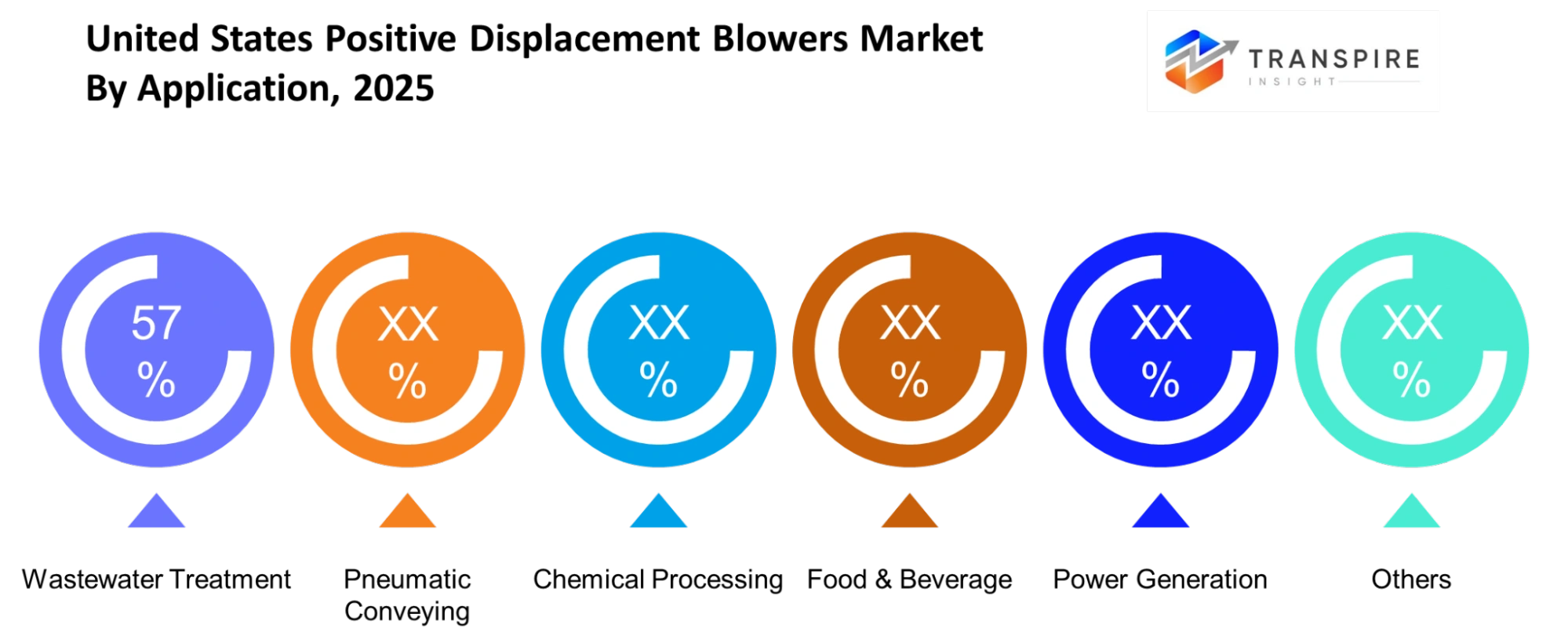
- Wastewater treatment still feels like the main application segment. It accounted for nearly 39% revenue share in the United States Positive Displacement Blowers Market in 2025.
- Pneumatic conveying systems kept seeing meaningful demand in food processing, cement, and bulk material handling.
- In chemical processing, growth picked up at a faster pace, mainly because stricter air quality compliance rules and process reliability expectations got more demanding.
- Meanwhile, hydrogen production and renewable natural gas facilities are turning up as high-potential uses, helping the forward-looking market forecast expansion.
What are the Key Drivers, Restraints, and Opportunities in the United States Positive Displacement Blowers Market?
One of the strongest drivers behind the United States Positive Displacement Blowers Market is the modernization of wastewater treatment infrastructure, especially now that federal and state discharge rules are getting tougher. Municipal utilities and industrial sites are swapping out older aeration setups with energy-saving blower technologies , mainly because electricity is still a big chunk of day to day operating expense in these treatment plants. The move toward variable frequency drive-integrated blowers and digitally monitored systems really picked up after utilities saw energy prices keep climbing from 2021 through 2024. And that change kinda cascaded, boosting equipment replacement timing, expanding aftermarket service agreements, and lifting revenue linked to high-efficiency blower installs.
For the restraint side, the biggest sticking point is the high up front capital cost that comes with industrial retrofitting and all the system integration work. Positive displacement blowers can need facility redesigns, improved piping networks, noise attenuation solutions, and even adjustments for automation compatibility before anything is fully deployed. So those expenses become a more or less structural barrier, since many municipal operators and mid-sized manufacturers still run long procurement timelines, plus tighter capital limits. In practice this means many facilities postpone swap-outs, keep legacy equipment running longer than they should, and that slows down overall market adoption.
A notable opportunity is also building, especially around renewable natural gas projects, hydrogen processing, and carbon capture efforts across the Gulf Coast and Midwest industrial corridors. These kinds of facilities tend to need continuous low-pressure air, plus gas handling systems, with very careful flow regulation. Meanwhile, ongoing investment in cleaner industrial infrastructure is creating demand for oil-free and smart-monitored blower units, basically engineered for high-reliability process environments where downtime is hard to justify.
What Has the Impact of Artificial Intelligence Been on the United States Positive Displacement Blowers Market?
Artificial intelligence plus advanced digital tools are changing the way industrial operators handle positive displacement blower systems, especially across wastewater treatment , chemical processing , and energy plants in the United States. Operators are now leaning on AI-enabled control platforms to automate airflow balancing, pressure regulation, and oxygen tuning inside aeration setups. This cuts down the amount of manual checking, and it also helps keep the process performance steadier when the operating load starts to swing.
At the same time, digital twin methods, along with sensor-driven monitoring, keep a constant eye on vibration, temperature, and pressure patterns. With those streams in place, machine learning models can flag bearing wear, seal deterioration, and airflow inefficiencies way before a mechanical failure shows up in the real world. It feels like the system is noticing small things early, even if humans would only see it later.
Predictive maintenance platforms have also helped lift equipment uptime. They do this by trimming unplanned shutdowns, and by shortening the time it takes to respond to maintenance needs. In fact, some industrial sites have reported energy savings ranging from about 10% to 18% after adding variable frequency drives together with AI-assisted airflow optimization software. On top of that, real-time analytics let operators anticipate emissions output, boost regulatory reporting accuracy, and limit unnecessary power draw in plants that run continuously.
Still, AI rollout has a big snag connected to integration complexity. Many facilities still rely on decades-old blower hardware that doesn’t include compatible digital sensors, nor does it have reliable network connectivity. Retrofitting ends up demanding a higher initial budget, longer downtime windows, and specialized technical knowledge. As a result, deployment moves more slowly for mid-sized industrial operations and for municipal utilities.
Key Market Trends
- From 2021 to 2025, local wastewater plants started using variable frequency drive integrated blowers more and more , which helped cut electricity use by about 15% , give or take.
- In the industrial space, operators began moving past reactive service and toward AI enabled monitoring platforms after pandemic disruptions made expensive stoppages painfully obvious across the continuous process sites.
- Starting around 2023 , oil free blower setups spread through pharmaceutical as well as food processing lines , mostly because contamination control got stricter and product quality demands became less negotiable.
- Manufacturers like Atlas Copco, and Ingersoll Rand, then pushed heavier spending into smart blower systems that combine cloud based performance analytics with remote diagnostics.
- In 2021 and 2022, supply chain wobbles made buyers look more seriously at blower suppliers they could get serviced locally , often choosing vendors with stronger aftermarket support programs, and quicker response.
- Rotary lobe blowers then gradually lost footing in the high efficiency category as twin screw solutions got better, and delivered improved energy performance during continuous duty operations.
- Since 2024, Gulf Coast hydrogen and renewable natural gas projects have been pulling in demand for precision airflow parts plus low pressure gas handling systems, which surprised some planners.
- Meanwhile, wastewater utilities more often treated lifecycle operating cost as the deciding factor instead of the up front equipment price when they signed blower replacement contracts, especially once energy prices really jumped.
United States Positive Displacement Blowers Market Segmentation
By Product Type:
Rotary lobe blowers are still pulling in strong demand in industrial processing and wastewater work, mainly due to a steady airflow delivery and those, kinda simple maintenance needs. Screw blowers are getting even more attention now because some facilities want lower energy consumption and less day-to-day operational noise. Helical blowers, on the other hand, help with setups needing a compact footprint and fairly constant pressure control, especially in today’s production systems.
Roots blowers keep showing up a lot in heavy duty industrial environments, mostly because the construction is tough and the performance stays dependable when they run continuously. Centrifugal blowers tend to fit better when there’s a large scale airflow demand in municipal and manufacturing areas, where high volume air movement is still a big deal. Then you’ve got other blower variations, which handle specialized conditions, meaning custom airflow, pressure balance, and efficiency management across a range of industrial settings inside the United States Positive Displacement Blowers Market .
By Pressure Range:
Low-pressure blowers support water treatment plants, food processing, and pneumatic systems where steady airflow tends to matter more than pushing forceful pressure into the line. Medium-pressure systems keep expanding through industrial manufacturing, since steady pressure performance helps with a variety of processing tasks without adding too much energy use. High-pressure blowers are used in tougher industrial places, where stronger airflow output is needed for combustion units, chemical processing , and heavy production operations.
Vacuum systems are gaining traction in packaging, medical processing, and automated manufacturing , because suction based work usually improves precision, and it helps handling run more efficiently. Then other pressure categories exist for tailored industrial demands where airflow adjustment, process stability, and day to day operational flexibility remain crucial for long term performance reliability.
By Application:
Wastewater treatment still counts as one of the biggest application arenas, mainly because positive displacement blowers help keep aeration efficiency steady and they support environmental compliance levels across municipal sites, or something like that. Pneumatic conveying systems add to the steady demand too, since manufacturing plants need dependable material moving solutions for powders, grains and those industrial feeds that flow through production lines.
Chemical processing plants lean on blower setups for airflow steadiness, gas management and safe operational control during delicate industrial moments. Food and beverage operations use these systems for drying, bagging/packaging, and air-handling or ventilation tasks, where sanitation plus uniformity are sort of key. Power generation facilities keep using blower technologies for combustion assistance and cooling routines, while other end uses build further demand too, from mining, pharmaceutical work, and electronics manufacturing activities.
To learn more about this report, Download Free Sample Report
By End User:
The industrial sector makes up a big portion of market demand since ongoing production activities need airflow systems that are reliable and can run in tough situations , without too much downtime. Municipal utilities keep putting money into blower technologies, because wastewater treatment expansion and infrastructure modernization efforts are still moving forward in multiple parts of the United States.
In the manufacturing world, companies are still looking at advanced blower systems, mostly to boost production efficiency , lower running expenses and keep process consistency stable across large facilities. Meanwhile, the energy sector also backs market growth , driven by wider blower use in power plants, renewable energy sites and industrial energy management arrangements. On top of that, other end users add to expansion by leaning on specialized operating demands, such as ventilation , material handling, and air-quality, environmental control use cases .
What are the Key Use Cases Driving the United States Positive Displacement Blowers Market?
Wastewater treatment is still kind of the main thing driving people to choose positive displacement blower adoption in the United States. Municipal plants use continuous aeration systems so they can keep biological treatment working well, but also so they can manage electricity spending and stay inside regulatory compliance risk.
After that, the secondary use cases are growing in places like food processing, chemical manufacturing, and cement handling operations. Pneumatic conveying setups are more and more swapping toward oil-free blower technology to avoid any contamination issues, and then chemical facilities are deploying blowers with digital monitoring so the airflow stays steady during ongoing production.
Newer ideas are also forming around hydrogen production, renewable natural gas facilities, and carbon capture infrastructure efforts along the Gulf Coast and in the Midwest. Those sites need accurate low-pressure gas handling, they have to run continuously, and they’re doing it under tight process control plus emissions management conditions.
|
Report Metrics |
Details |
|
Market size value in 2025 |
USD 508.4 Million |
|
Market size value in 2026 |
USD 536.2 Million |
|
Revenue forecast in 2033 |
USD 785.7 Million |
|
Growth rate |
CAGR of 5.61% from 2026 to 2033 |
|
Base year |
2025 |
|
Historical data |
2021 - 2024 |
|
Forecast period |
2026 - 2033 |
|
Report coverage |
Revenue forecast, competitive landscape, growth factors, and trends |
|
Geographic scope |
United States of America |
|
Key company profiled |
Atlas Copco, Gardner Denver, Kaeser Kompressoren, Aerzen, Howden, Ingersoll Rand, Tuthill Corporation, Busch Vacuum Solutions, Everest Blowers, Sulzer, Hitachi Industrial Equipment, Shandong Zhangqiu Blower, Spencer Turbine, Elmo Rietschle, Siemens |
|
Customization scope |
Free report customization (country, regional & segment scope). Avail customized purchase options to meet your exact research needs. |
|
Report Segmentation |
By Product Type (Rotary Lobe Blowers, Screw Blowers, Helical Blowers, Roots Blowers, Centrifugal Blowers, Others); By Pressure Range (Low Pressure, Medium Pressure, High Pressure, Vacuum Systems, Others); By Application (Wastewater Treatment, Pneumatic Conveying, Chemical Processing, Food & Beverage, Power Generation, Others); By End User (Industrial Sector, Municipal Utilities, Manufacturing Industry, Energy Sector, Others) |
Which Regions are Driving the United States Positive Displacement Blowers Market Growth?
The Midwest still leads the United States Positive Displacement Blowers Market in a pretty obvious way, sort of, because it has this thick industrial manufacturing backbone plus broad municipal wastewater systems. Places like Illinois, Ohio, Michigan, and Indiana keep spending on blower replacements, aiming to boost energy efficiency across older treatment plants and hard-working industrial lines. On top of that, tighter wastewater discharge rules, compliance checks, and oversight have sped up the move away from fixed-speed legacy setups into digitally controlled blower technologies. You can also see a practical advantage here: the region has an established supplier ecosystem, including industrial equipment makers, engineering contractors, automation providers and even after-market service networks that can handle big continuous operations without much drama.
Meanwhile the Gulf Coast feels more different, since the demand side is more linked to petrochemical processing, refining work and those long-cycle industrial capex decisions. Texas and Louisiana keep a steady need for high-capacity blower systems for chemical runs, gas handling, and continuous production facilities, all while meeting strict reliability requirements. So unlike the Midwest where municipal infrastructure is the main trigger for replacement demand, Gulf Coast momentum leans on industrial output stability and expansion in energy-related manufacturing. Big operators in the region also tend to keep longer equipment service agreements, with dependable maintenance timetables, which ends up generating a steadier revenue stream for blower manufacturers and service providers.
The Southeast is kind of emerging as one of the fastest-growing regional market , mainly because rapid manufacturing expansion, continued population growth, and wastewater infrastructure modernization projects that got started after 2023. States like Georgia , Tennessee, and North Carolina bumped up their investments into industrial parks , food processing plants , and municipal utility upgrades to keep up with expanding urban plus industrial activity. On top of that, federal infrastructure funding along with tighter water management rules at the state level has sped up purchases of energy-efficient aeration setups and pneumatic conveying systems across the region, a thing that keeps rolling. In the end, this overall momentum produces pretty solid opportunities for equipment suppliers, automation firms, and aftermarket service providers looking at longer-term expansion between 2026 and 2033.
Who are the Key Players in the United States Positive Displacement Blowers Market and How Do They Compete?
The United States Positive Displacement Blowers Market stays fairly consolidated, with a handful of multinational industrial equipment companies sort of controlling a large portion of big municipal and industrial contracts. Rivalry nowadays is less about just upfront equipment pricing , and more about energy efficiency, digital monitoring capability, overall lifecycle operating cost, and how quickly the aftermarket service team can respond. Bigger established manufacturers try to hold their ground by pushing predictive maintenance platforms , building localized service networks, and delivering customized blower packages for wastewater, chemical, and food processing plants. Meanwhile smaller engineering-first firms are quietly getting more traction in retrofit work, mainly because they can deliver faster installation timelines and specialized automation integration services that fit existing process lines.
Atlas Copco competes by leaning into high efficiency oil-free blower systems that come with smart monitoring software, so operators can actually trim electricity use and reduce maintenance downtime. Atlas Copco also differentiates itself with strong compatibility for automation stacks and a pretty broad service presence across North America , which matters a lot for continuous-process industries. Ingersoll Rand tends to emphasize lifecycle cost optimization by pairing blower equipment with predictive diagnostics and longer term service agreements. Its more acquisition-driven expansion approach helped strengthen its compressed air and industrial flow technology portfolio, and that in turn lets the company bundle integrated system solutions across manufacturing facilities without too much friction.
Kaeser Kompressoren really puts the focus on energy efficient rotary lobe, and screw blower tech, made for wastewater aeration and also pneumatic conveying tasks where you need steady airflow behavior, not some random swings. They grew their regional footprint by offering more local engineering support, and somehow, with quicker replacement part logistics moving along the big industrial corridors. Aerzen, on the other hand, likes to differentiate using hybrid blower systems, basically a mix of positive displacement and turbo engineering, for less energy demand even when the operating conditions shift around, sometimes a lot. Howden stays pretty solid in heavy industrial processing because they deliver customized high capacity blower systems—specifically tuned for chemical operations, refining plants, and gas handling environments where reliability in day to day use directly controls production output.
Company List
- Atlas Copco
- Gardner Denver
- Kaeser Kompressoren
- Aerzen
- Howden
- Ingersoll Rand
- Tuthill Corporation
- Busch Vacuum Solutions
- Everest Blowers
- Sulzer
- Hitachi Industrial Equipment
- Shandong Zhangqiu Blower
- Spencer Turbine
- Elmo Rietschle
- Siemens
Recent Development News
In January 2026, USA Compression Partners completed the acquisition of J-W Power Company. The approximately $860 million transaction expanded USA Compression’s active horsepower fleet to nearly 4.4 million horsepower, strengthening its position in the U.S. compression and positive displacement equipment market. Sourcehttps://www.nasdaq.com/
In February 2026, Flowco Holdings Inc. announced the acquisition of Valiant Artificial Lift Solutions LLC. The $200 million deal broadened Flowco’s artificial lift and fluid movement portfolio, supporting expanded production optimization capabilities across major U.S. energy basins.Source https://www.nasdaq.com/
What Strategic Insights Define the Future of the United States Positive Displacement Blowers Market?
Over the next five to seven years, the United States Positive Displacement Blowers Market is kind of structurally moving toward digitally managed, energy-optimized airflow systems that get integrated into automated industrial infrastructure. The underlying force driving this transition is not only equipment replacement, but also the growing financial pressure on utilities and manufacturers to cut electricity consumption while still keeping continuous operational reliability . As industrial facilities adopt predictive maintenance platforms and AI-assisted process control, blower systems will increasingly act as connected operational assets rather than standalone mechanical equipment, full stop.
One hidden risk is a gradual substitution threat from high-speed turbo blower technologies in applications where energy efficiency matters more than pressure stability requirements. That shift could compress margins for conventional rotary lobe equipment manufacturers that don’t modernize their product portfolios, or at least not fast enough. At the same time, renewable natural gas and hydrogen processing infrastructure across the Gulf Coast and Midwest is creating an emerging opportunity for specialized low-pressure gas handling systems with advanced monitoring capabilities.
Market participants should prioritize aftermarket digital service ecosystems, like remote diagnostics and predictive maintenance contracts. The reason is simple, long-term recurring service revenue will get more strategically valuable than one-time equipment sales.
United States Positive Displacement Blowers Market Report Segmentation
By Product Type
- Rotary Lobe Blowers
- Screw Blowers
- Helical Blowers
- Roots Blowers
- Centrifugal Blowers
By Pressure Range
- Low Pressure
- Medium Pressure
- High Pressure
- Vacuum Systems
By Application
- Wastewater Treatment
- Pneumatic Conveying
- Chemical Processing
- Food & Beverage
- Power Generation
By End User
- Industrial Sector
- Municipal Utilities
- Manufacturing Industry
- Energy Sector
Frequently Asked Questions
Find quick answers to common questions.
The United States Positive Displacement Blowers Market size is USD 785.7 Million in 2033.
Key segments for the United States Positive Displacement Blowers Market are By Product Type (Rotary Lobe Blowers, Screw Blowers, Helical Blowers, Roots Blowers, Centrifugal Blowers, Others); By Pressure Range (Low Pressure, Medium Pressure, High Pressure, Vacuum Systems, Others); By Application (Wastewater Treatment, Pneumatic Conveying, Chemical Processing, Food & Beverage, Power Generation, Others); By End User (Industrial Sector, Municipal Utilities, Manufacturing Industry, Energy Sector, Others).
Major United States Positive Displacement Blowers Market players are Atlas Copco, Gardner Denver, Kaeser Kompressoren, Aerzen, Howden, Ingersoll Rand, Tuthill Corporation, Busch Vacuum Solutions, Everest Blowers, Sulzer, Hitachi Industrial Equipment, Shandong Zhangqiu Blower, Spencer Turbine, Elmo Rietschle, Siemens.
The United States Positive Displacement Blowers Market size is USD 508.4 Million in 2025.
The United States Positive Displacement Blowers Market CAGR is 5.61% from 2026 to 2033.
- Atlas Copco
- Gardner Denver
- Kaeser Kompressoren
- Aerzen
- Howden
- Ingersoll Rand
- Tuthill Corporation
- Busch Vacuum Solutions
- Everest Blowers
- Sulzer
- Hitachi Industrial Equipment
- Shandong Zhangqiu Blower
- Spencer Turbine
- Elmo Rietschle
- Siemens
Recently Published Reports
-
Apr 2026
Handling and Lifting Equipment Market
Handling and Lifting Equipment Market Size, Share & Analysis Report By Product (Cranes and Hoists, Forklifts, Conveyor Systems, Aerial Work Platforms, Others), By Application (E-Commerce, Automotive and Railway, Food and Beverages, Aviation, Others), and Geography (North America, Europe, Asia-Pacific, Middle East and Africa, South and Central America), 2021 - 2031
-
Apr 2026
HVAC Equipment Market
HVAC Equipment Market Size, Share & Analysis Report By Heating Equipment Type (Boilers and Furnaces, Heat Pumps, and Unitary Heaters), By Ventilation Equipment (Air Handling Units, Humidifiers and Dehumidifiers, Air Filters, and Fan Coiling Units), By Air Conditioning Equipment (Unitary Air Conditioners, Room Air Conditioners, Packaged Terminal Air Conditioners, and Chillers), By End User (Commercial, Residential, Industrial, and others), and Geography (North America, Europe, Asia-Pacific, Middle East and Africa, South and Central America), 2021 – 2031
-
Apr 2026
Refrigeration Valves Market
Refrigeration Valves Market Size, Share & Analysis Report By Type (Solenoid Valves, Expansion Valves, Check Valves, Service Valves, Others), By Application (Commercial Refrigeration, Industrial Refrigeration, Transport Refrigeration, Residential Refrigeration, Air Conditioning Systems), By End User (Food and Beverage Industry, Pharmaceutical Industry, HVAC Industry, Chemical Industry, Others), and Geography (North America, Europe, Asia-Pacific, Middle East and Africa, South and Central America), 2021 – 2031
-
Apr 2026
E-Commerce Packaging Materials Market
E-Commerce Packaging Materials Market By Material Type (Corrugated Boxes, Paper & Paperboard, Foam & Cushioning Materials, Plastic Packaging, Flexible Packaging, Protective Packaging, Others), By Product(Primary Packaging, Secondary Packaging, Tertiary Packaging), By Packaging Function (Protective Packaging, Branding & Presentation Packaging, Transit & Logistic Packaging, Sustainable Packaging, Tamper Evidence Packaging), By End-User (Retail & Consumer Goods, Electronic Appliances, Food & Beverages, Healthcare & Pharmaceutical, Fashion & Apparel, Home & Furnishing, Others); By Industry Analysis, Size, Share, Growth, Trends, and Forecasts 2021-2033