
United States Polyvinyl Chloride (PVC) Compound Market Summary
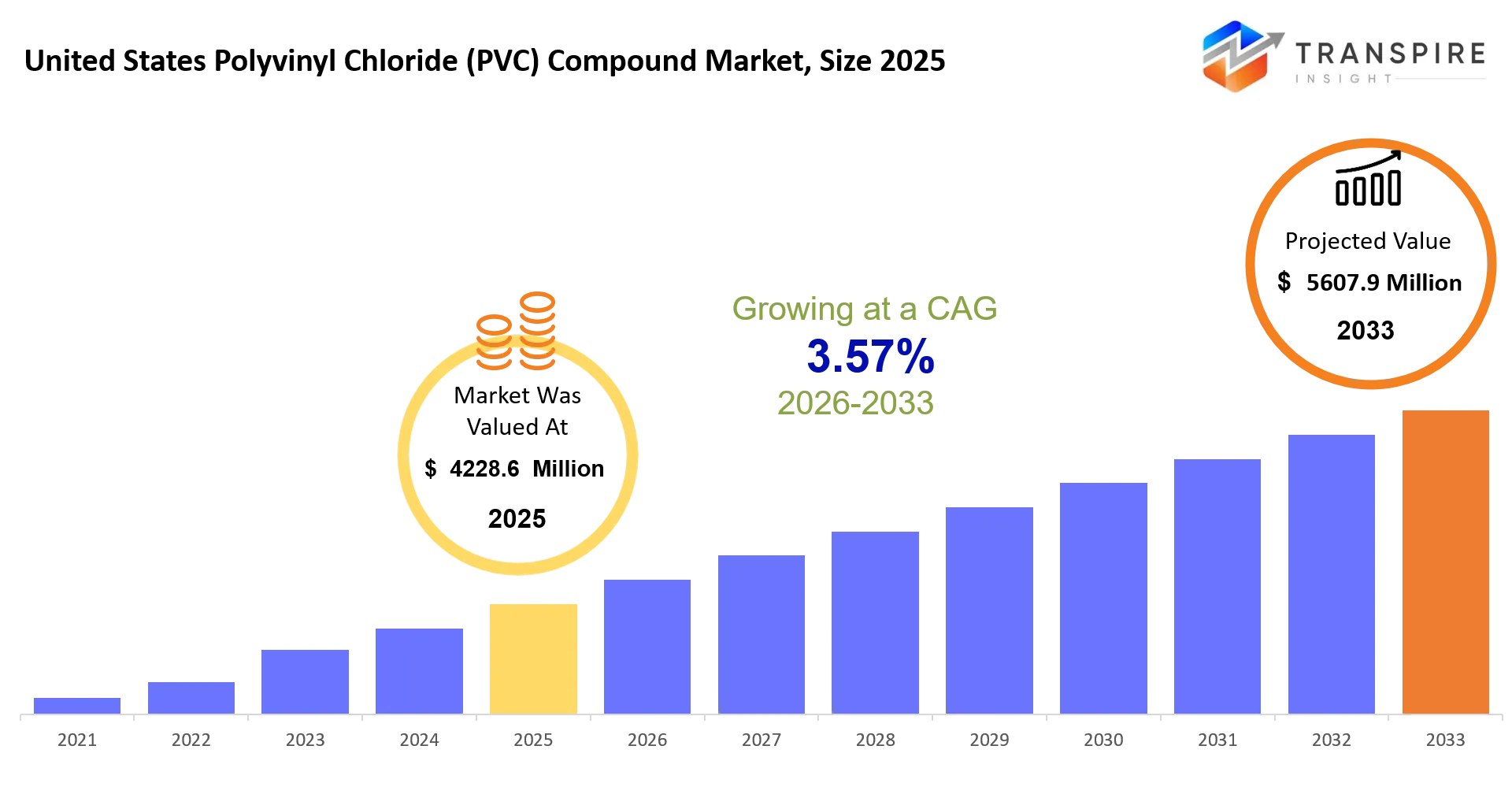
As per Transpire Insight Analysis, the United States Polyvinyl Chloride (PVC) Compound Market size is estimated at USD 4228.6 Million in 2025 and is anticipated to reach USD 5607.9 Million by 2033, growing at a CAGR of 3.57% from 2026 to 2033.
PVC compounds basically take plain PVC resin and make it, you know, ready for use materials, with flexibility that’s controlled but not too much, plus strength, better flame resistance, specific color, and predictable processing behavior, also durability. In practice companies rely on these formulated blends for pipes, cables, medical items, automotive pieces, building materials and even industrial components where performance has to stay consistent and costs need to be managed.
Over roughly the last 3–5 years the market has started moving toward higher performance formulations, because manufacturers are getting pushed by tighter material requirements, recycled-content targets, and updated construction specs. Then during 2020–2022 there was supply chain disruption, which revealed how much everyone depended on resin, additives, and imported chemical inputs. That situation kind of nudged firms toward more domestic sourcing, and more careful inventory strategies.
Right now, growth still looks tied to continued infrastructure spending, the replacement of older utility networks, electrical equipment production, and also specialized medical use. Those uses tend to drive repeat consumption because formulation rules can differ from one product to another, so suppliers are more motivated to develop higher-value grades rather than just chasing commodity PVC volumes.
United States Polyvinyl Chloride (PVC) Compound Market Size & Forecast:
- United States Polyvinyl Chloride (PVC) Compound Market Size 2025: USD 4228.6 Million
- Expected Market Value 2033: USD 5607.9 Million
- Forecast CAGR: 3.57%
- Key Profile: Westlake Corporation, OxyVinyls, Formosa Plastics, Shin-Etsu Chemical, INEOS Inovyn, Mexichem (Orbia), Teknor Apex, Avient Corporation, AlphaGary, Aurora Plastics, Ravago Manufacturing, Benvic Group, Hanwha Solutions, LG Chem, SCG Chemicals
Key Market Insights
- The United States Polyvinyl Chloride (PVC) Compound market is forecast to add USD 1,379.3 million between 2025 and 2033, as infrastructure and “specialty” uses keep expanding, slowly or not so slowly.
- South leads regional consumption, backed up by construction activity, industrial output, electrical manufacturing, and an established PVC processing capability, with steady momentum.
- The West is set up as the fastest-growing area, because modernization of roads, utilities, and specialized manufacturing tends to pull more engineered compounds into the mix.
- Rigid formulations stay in a strong lane for pipes, fittings, profiles, and building products where dimensional stability really matters, plus long service life.
- Flexible formulations still matter too, especially for wires, cables, medical tubing, flooring, automotive parts, and other products that need a controlled softness rather than just “pliable” material.
- Construction still stays a big demand hub, too, with utility replacement, housing development, commercial projects, and wider infrastructure upgrades keeping compound use moving along.
- Electrical and electronics are shifting as well, toward flame-retardant solutions, and higher performance formulations, as equipment makers tighten safety and endurance requirements, little by little.
- In healthcare, premium grade output helps quite a bit, because medical tubing, bags, components, and devices rely on controlled consistency, plus regulatory compliance, even when the conditions get strict.
- Compound producers increasingly set themselves apart with additive optimization, tailored formulations, recycled content solutions, and hands on tech support. It’s not only about commodity resin pricing, it’s more about what they can tailor and how fast they can do it.
- Westlake Corporation, OxyVinyls, Formosa Plastics, Teknor Apex, and Avient Corporation keep the competition pressure really strong, like they stay on top with formulation know-how, production scale, specialty grades, and customer specific material development. It sounds kind of obvious, but it still matters, in a way that actually affects things.
What are the Key Drivers, Restraints, and Opportunities in the United States Polyvinyl Chloride (PVC) Compound Market?
Driver: Infrastructure replacement is a sort of growth engine because old water, sewer, electrical, and building systems basically need durable polymer parts . At the same time, federal and state infrastructure investment keeps construction activity moving, and meanwhile PVC compounds let manufacturers dial in controlled strength, flexibility, chemical resistance, and also processing performance. The pipeline that ends up happening supports recurring asks for pipes, fittings, cable insulation, profiles, flooring, and other finished products. In a practical sense, compound suppliers tend to gain revenue when buyers move away from standard formulations toward application specific grades with tighter performance requirements.
Restraint: Feedstock and additive price volatility stays a structural constraint because the economics of compounding depend on PVC resin , plasticizers, stabilizers, fillers, pigments, and specialty modifiers. Energy costs and periodic supply interruptions can flip production economics fast, so long term price commitments are hard for compound manufacturers to lock in. There is also qualification paperwork, and it slows down material substitution because customers in healthcare, electrical, automotive , and construction typically need testing before approving formulation changes. That kind of testing can stall the adoption of cheaper materials and make it harder to switch suppliers quickly.
Opportunity: Advanced recyclable and low emission formulations feel like a clear path toward higher value growth. Compound producers can grow by making use of recycled PVC , refining additive packages, considering bio based plasticizer options, and building formulations that are designed for easier recovery after use. Digital formulation tools add another angle too, by shortening development cycles through evaluating additive combinations before physical trials.
What Has the Impact of Artificial Intelligence Been on the United States Polyvinyl Chloride (PVC) Compound Market?
Artificial intelligence is more and more supporting PVC compounding through process optimization , not really stepping in to replace the core manufacturing parts. Machine learning models can study production records like melt temperature , torque, screw speed, pressure, moisture, additive loading, and throughput , to find operating settings that line up with steady compound quality . After that, automated process-control systems can use those signals to catch deviations earlier and also support faster course correction during extrusion or mixing . And besides this, predictive maintenance models can look at motor loads, vibration, temperature, plus earlier equipment failures to highlight maintenance needs before an unplanned shutdown finally appears. In practice, these tasks can boost equipment uptime, reduce material waste, and make batch-to-batch outcomes more consistent.
AI supported quality systems can also map lab results back to what actually happened on the line, so they can spot formulation drift and build stronger root cause analysis. Demand forecasting helps too, because manufacturers can stock resin and additives in a more careful way around construction, electrical, automotive, and healthcare orders. Digital twins plus advanced simulation can assist formulation development by shrinking the number of physical trials needed for new grades. Still, uptake is not huge, because the integration costs can be messy, historical datasets are sometimes inconsistent, cybersecurity requirements matter, and it is hard to connect legacy extrusion and compounding equipment with modern analytics platforms. So smaller compounders might begin with a narrow AI use case first, rather than jumping straight into fully integrated manufacturing intelligence systems.
Key Market Trends
- Since 2020 supply disruptions kinda pushed compounders to spread out resin and additive sourcing a bit more , and keep thicker domestic inventory positions , that are more resilient…you know.
- In construction , things have gotten better support since 2021, mostly because infrastructure rehabilitation bumped up needs for pipes, fittings, profiles and also electrical products .
- Since 2022 manufacturers have been expanding formulation optimization to handle moody resin costs, plasticizer and stabilizer prices too, plus energy, and transportation , it’s all tangled up together.
- Digital process monitoring has moved , from basic production tracking into predictive maintenance and automated quality-control systems at bigger compounding facilities , which is pretty important.
- Healthcare-grade PVC development is now shifting toward stricter formulation control , since medical manufacturers want consistent performance, traceability, and regulatory documentation.
- Recycled-content initiatives have gone from small pilot programs to more commercial material development, so suppliers are leaning harder on better processing consistency and contaminant control.
- For electrical uses, flame-retardant compounds are increasingly preferred as manufacturers tighten safety requirements for cables, insulation, connectors and electrical equipment.
- Automotive compound demand is going toward lightweight yet durable formulations , because vehicle manufacturers try to reduce component weight while keeping thermal resistance and production efficiency in check.
- Big suppliers are competing more via customized formulations and technical services, which reduces reliance on standard commodity grades and helps keep customers.
- AI-enabled manufacturing tools are also showing up across larger facilities, allowing compounders to reduce process variation, anticipate equipment failures and improve production planning all at once.
United States Polyvinyl Chloride (PVC) Compound Market Segmentation
By Product Type
Rigid PVC compounds are used for pipes, fittings, profiles, construction panels and various industrial pieces where dimensional stability, and chemical resistance sort of really matter. Flexible PVC compounds go to wires, cables, flooring, tubing, automotive parts, and consumer products that need controlled flexibility, not too stiff, not too soft. Then there are chlorinated PVC compounds, they give higher temperature tolerance as well as stronger chemical resistance, so they’re picked for tough piping tasks and industrial uses where conditions are harsh. Foam PVC compounds, on the other hand, are for lightweight profiles, boards, and construction items, because density can be kept lower. And for high-impact grades, they’re basically chosen to boost toughness in demanding components, while medical-grade PVC supports tubing, bags, and healthcare devices that require consistent formulation control.
Flame-retardant PVC compounds support electrical work and cable systems where fire-performance requirements start steering the choice of material. Transparent PVC compounds show up in packaging, tubing, protective products, and specialized components, mainly so inspection is possible. Specialty PVC compounds handle application driven requirements like better weather resistance, processing stability, low-temperature performance, or chemical resistance, depending on the job. Other grades cover smaller runs too, where customized physical traits and processing characteristics determine what gets selected in the end.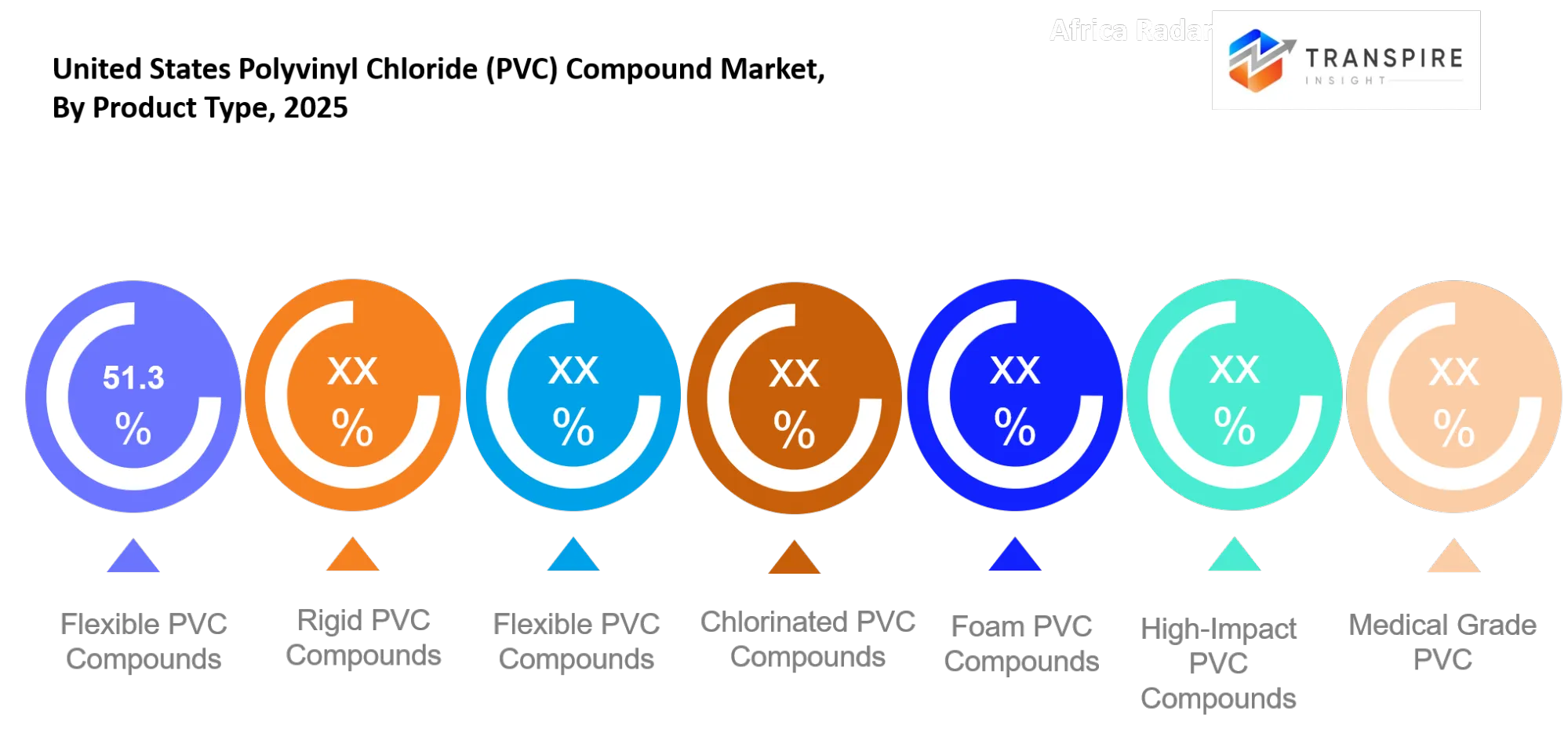
By Additive Type
Plasticizers sort of control flexibility and they are still crucial for cables , flooring, tubing, automotive parts, and those flexible consumer things too. Stabilizers do the job of protecting PVC while it is being processed and later during service, whereas lubricants give better melt flow and they also lower processing friction plus help keep extrusion consistent, like more steady. Fillers help manage cost, stiffness, density, and certain mechanical properties that matter for the target use. Then impact modifiers boost toughness so the product can handle mechanical stress exposure. Flame retardants get used when you need fire performance requirements met, especially in electrical setups and construction uses.
Colorants make the appearance stay controlled across consumer, construction, automotive, and industrial products. UV stabilizers also improve outdoor durability, for longer. Processing aids tend to support smoother extrusion, surface finish, fusion, and overall production consistency. There are other additive categories as well, for example antimicrobial performance, thermal resistance, electrical properties, and weatherability, depending on what the customer wants. In practice, the choice of additives increasingly comes down to finished-product specifications rather than just optimizing cost in a simple way.
By Application
Pipes and fittings kinda count as a big use case because PVC blends offer durability, resistance to corrosion, not so much upkeep, and overall processing that’s easy enough for water and utility systems. Wires and cables instead need formulations with controlled flexibility, insulation performance that stays put, and flame resistance, you know. Medical devices lean on special grades for tubing, fluid bags, and other parts where the material has to behave consistently every time. Automotive parts usually call for flexible, impact-resistant, and temperature-resistant grades, for specific areas like inside, outside, and also under the hood.
Building and construction stuff spreads across profiles, flooring, membranes, panels, and other products where durability, plus processing efficiency, really matters. Packaging applications use picked flexible and transparent grades, to get protection along with functional behavior. Consumer goods tap PVC compounds for both molded and extruded items, while industrial products need grades tuned to mechanical, chemical, and thermal conditions. Electrical components drive demand for flame-retardant and electrically suitable formulations, and other applications are more niche, supporting specialized compound requirements depending on what’s needed.
By End User
Construction is still a big end user sector, because infrastructure jobs, utility networks, housing development, commercial buildings, and the whole renovation side just swallow huge volumes of PVC based items. In the automotive world , manufacturers typically pick particular compounds for gaskets and seals, coatings, inside trim, wiring related things, as well as protective parts. For healthcare, companies ask for controlled grades, especially for medical tubing, fluid handling products and specific devices. Electrical and electronics producers also want insulation and shielding materials with controlled electrical behavior and flame resistance.
On the packaging side, manufacturers lean on flexible , transparent grades for certain packaging products, while industrial makers need compounds for machinery, profiles, seals, and protective components too. Consumer goods include household and recreational products, where people want consistent look, bendability and toughness, more or less. Agriculture uses PVC based products for irrigation, protective elements, and selected farming systems. Beyond that, other end users represent smaller specialized demand, mainly tied to performance targets and processing needs.
By Distribution Channel
Direct sales back large manufacturers, those ones that need steady volumes, some pretty constant technical assistance, plus formulation customization, and yes long term supply arrangements. Chemical distributors are more like a shortcut to multiple grades and additive packages for smaller processors, and also for the regional guys. OEM supply supports manufacturers who take compounds and fold them into standardized components, they usually want material specs that stay consistent, and not kind of consistent but really, consistent. Industrial suppliers are the ones that help smaller production facilities, where faster availability matters, along with technical support that is not too slow. Online B2B channels keep growing, since buyers want quicker product comparisons, better documentation, and a smoother quotation workflow.
Then there are wholesalers, they help with regional reach and smaller volume buys, while specialty suppliers tend to concentrate on medical , electrical, automotive, and other application driven grades. Exporters support cross border distribution, but only when commercial conditions allow it and product approvals are ok. Other routes include agent networks and specialized procurement arrangements, which sounds formal but it is what it is. Overall distribution strategy is increasingly decided by delivery reliability, technical services, minimum order quantities, and whether the supplier can handle customized formulation requirements, not just sell off the shelf and call it done.
What are the Key Use Cases Driving the United States Polyvinyl Chloride (PVC) Compound Market?
Pipes and fittings are a kind of core use case, especially across construction and utility infrastructure. In practice PVC compounds give corrosion resistance, dimensional stability, a longer service life , and they also help with efficient fabrication so the material works well for water distribution, drainage, conduit and similar infrastructure efforts. Because of that infrastructure rehabilitation and new construction keep creating recurring compound requirements, kind of steadily.
Wires and cables are another important adjacent use case across electrical and electronics manufacturing. Flexible and flame-retardant formulations back insulation and protective layers, and automotive production adds extra needs for durable wiring as well as component materials. On top of that medical devices bring specialized demand, for controlled PVC grades used in tubing, fluid bags , and certain healthcare components where consistency matters.
Looking ahead, emerging opportunities show up as higher-recycled-content compounds, more advanced flame-retardant grades, and digitally optimized formulations. Recycling technologies can widen material recovery while still keeping processing characteristics that actually remain workable, and AI-assisted formulation development can cut down trial cycles for specialty grades. Also automotive electrification plus upgraded electrical infrastructure can keep pulling demand for higher-performance insulation and protective compounds through the forecast period.
|
Report Metrics |
Details |
|
Market size value in 2025 |
USD 4228.6 Million |
|
Market size value in 2026 |
USD 4387.5 Million |
|
Revenue forecast in 2033 |
USD 5607.9 Million |
|
Growth rate |
CAGR of 3.57% from 2026 to 2033 |
|
Base year |
2025 |
|
Historical data |
2021 - 2024 |
|
Forecast period |
2026 - 2033 |
|
Report coverage |
Revenue forecast, competitive landscape, growth factors, and trends |
|
Regional scope |
United States |
|
Key company profiled |
Westlake Corporation, OxyVinyls, Formosa Plastics, Shin-Etsu Chemical, INEOS Inovyn, Mexichem (Orbia), Teknor Apex, Avient Corporation, AlphaGary, Aurora Plastics, Ravago Manufacturing, Benvic Group, Hanwha Solutions, LG Chem, SCG Chemicals . |
|
Customization scope |
Free report customization (country, regional & segment scope). Avail customized purchase options to meet your exact research needs. |
|
Report Segmentation |
By Product Type (Rigid PVC Compounds, Flexible PVC Compounds, Chlorinated PVC Compounds, Foam PVC Compounds, High-Impact PVC Compounds, Medical Grade PVC, Flame-Retardant PVC, Transparent PVC Compounds, Specialty PVC Compounds, Others); By Additive Type (Plasticizers, Stabilizers, Lubricants, Fillers, Impact Modifiers, Flame Retardants, Colorants, UV Stabilizers, Processing Aids, Others); By Application (Pipes & Fittings, Wires & Cables, Medical Devices, Automotive Components, Building & Construction, Packaging, Consumer Goods, Industrial Products, Electrical Components, Others); By End User (Construction, Automotive, Healthcare, Electrical & Electronics, Packaging, Industrial Manufacturing, Consumer Goods, Agriculture, Others); By Distribution Channel (Direct Sales, Chemical Distributors, OEM Supply, Industrial Suppliers, Online B2B, Wholesalers, Specialty Suppliers, Exporters, Others) |
Which Regions are Driving the United States Polyvinyl Chloride (PVC) Compound Market Growth?
The Southern United States still feels like the dominant regional market, kind of pushed by a heavy concentration of petrochemical output, PVC resin capacity, construction activity, and general industrial making. Gulf Coast states give access to key chemical feedstocks and really well set logistics, so compound manufacturers get a bit of a leg up for sourcing and transportation. Big producers and compounders also tend to like how close everything is, ports, pipelines, and downstream processors across Texas and Louisiana. In the end this integrated industrial setup keeps the supply of PVC compounds fairly steady, for pipes , construction items, electrical uses, and industrial components.
Then there’s the Midwest, which is the second major contributor, and its growth seems to come more from manufacturing depth rather than full petrochemical integration. Automotive production, electrical equipment making, appliance production, and industrial fabrication build up a wide customer base for flexible, rigid, and specialty compounds. Demand in the region also rides on established processing clusters, those that prefer long-term supplier ties, and application-focused formulations. Compared with the South, the Midwest leans more on closeness to downstream manufacturers and steady industrial output, rather than on feedstock advantages, or those upstream perks.
The West is positioned as the fastest-growing region through 2033, mainly because of infrastructure modernization, renewable energy equipment manufacturing, and a steady expansion in electrical applications. California and nearby states are making room too, for higher-performance plus recycled-content formulations, as companies react to stricter material rules and sustainability requirements.
Who are the Key Players in the United States Polyvinyl Chloride (PVC) Compound Market and How Do They Compete?
The competitive landscape is still sort of concentrated, mainly with integrated chemical producers and specialized compounders, but some regional compounders keep pushing ahead by leaning into customized formulations, (even if it feels slower at times). Cost is still a big deal too since resin, additives, energy, and transportation costs really swing margins, though technical formulation know-how is doing the separating more and more—especially for medical, automotive electrical, and industrial uses. Also, geographic manufacturing networks matter , customers want dependable deliveries and shorter qualification cycles, and that ends up meaning a lot in practice. When a company has integrated resin access it can usually buffer margin pressure during feedstock volatility, while specialty compounders tend to win via application engineering plus quicker product development cycles.
Westlake Corporation is trying to strengthen its compounds platform through acquisitions that kinda stack together, including the January 2026 purchase of ACI's global compounding businesses, which brought in specialty products and extra manufacturing locations. Teknor Apex differentiates by combining custom formulation with technical support, while its April 2026 joint venture with DCM Shriram broadens access to advanced polymer-compound capabilities. Avient Corporation competes more on engineered material solutions and application-specific formulations, not so much on commodity volume. Formosa Plastics leans on upstream manufacturing scale, which supports sharper feedstock economics and helps with supply reliability. Ravago Manufacturing adds more pressure to the field through wide polymer processing and distribution reach, so customers can access options across several application markets.
Company List
• Westlake Corporation
• OxyVinyls
• Formosa Plastics
• Shin-Etsu Chemical
• INEOS Inovyn
• Mexichem (Orbia)
• Teknor Apex
• Avient Corporation
• AlphaGary
• Aurora Plastics
• Ravago Manufacturing
• Benvic Group
• Hanwha Solutions
• LG Chem
• SCG Chemicals
Recent Development News
"In January 2026, Westlake Corporation completed the acquisition of ACI's global compounding solutions businesses. The transaction expanded Westlake Global Compounds into Portugal, Romania, and Tunisia while adding specialty products and advanced technologies for wire and cable applications.http://investors.westlake.com
"In April 2026, Teknor Apex entered a joint venture with DCM Shriram's Shriram Polytech. The PolyTek venture combines Shriram Polytech's vinyl-compound manufacturing capabilities with Teknor Apex's global formulation expertise to develop advanced specialty polymer solutions.http://www.teknorapex.com
"In March 2025, RIKEN TECHNOS completed an expansion of its RIKEN ELASTOMERS production facilities in Kentucky. The new production line increases production efficiency and strengthens RIKEN AMERICAS' competitiveness in North American PVC compound markets, particularly for automotive and profile-extrusion applications.http://www.rikentechnos.co.jp
What Strategic Insights Define the Future of the United States Polyvinyl Chloride (PVC) Compound Market?
The market seems like its structurally heading toward higher-value, application tailored compounds rather than leaning only on volume growth, if that makes sense. Things like replacing aging infrastructure, electrification efforts, healthcare manufacturing, and specialty industrial output should help this swing. At the same time formulation complexity will push the value of technical service, plus material development know how, and that is where more attention is likely to go.
A bit of the risk that is less obvious is that concentration happens around integrated resin and chemical suppliers, because if production gets disrupted or feedstock prices move fast, compound margins can get squeezed quickly and customer contracts can start feeling the pressure. Then there is another risk tied to material substitution in applications where different polymers can offer lighter weight, or some specific performance perks, depending on what the end use is asking for.
On the opportunity side, there is an emerging chance in commercially scalable recycled PVC compounds, with proven performance along with traceability, especially for construction and industrial products. Suppliers that mix recycled feedstock with carefully controlled additive packages can fit sustainability driven specifications without necessarily losing processing consistency. Market players, really should focus on regional manufacturing capacity, lock in diversified resin and additive sourcing and also invest in application specific formulation platforms. The companies that match reliable supply with quicker qualification steps, and documented material performance, will likely be in a stronger place to win premium revenue through 2033.
United States Polyvinyl Chloride (PVC) Compound Market Report Segmentation
By Product Type
• Rigid PVC Compounds
• Flexible PVC Compounds
• Chlorinated PVC Compounds
• Foam PVC Compounds
• High-Impact PVC Compounds
• Medical Grade PVC
• Flame-Retardant PVC
• Transparent PVC Compounds
• Specialty PVC Compounds
• Others
By Additive Type
• Plasticizers
• Stabilizers
• Lubricants
• Fillers
• Impact Modifiers
• Flame Retardants
• Colorants
• UV Stabilizers
• Processing Aids
• Others
By Application
• Pipes & Fittings
• Wires & Cables
• Medical Devices
• Automotive Components
• Building & Construction
• Packaging
• Consumer Goods
• Industrial Products
• Electrical Components
• Others
By End User
• Construction
• Automotive
• Healthcare
• Electrical & Electronics
• Packaging
• Industrial Manufacturing
• Consumer Goods
• Agriculture
• Others
By Distribution Channel
• Direct Sales
• Chemical Distributors
• OEM Supply
• Industrial Suppliers
• Online B2B
• Wholesalers
• Specialty Suppliers
• Exporters
• Others
Frequently Asked Questions
Find quick answers to common questions.
The Expected United States Polyvinyl Chloride (PVC) Compound Market size for the market will be USD 5607.9 Million in 2033.
Key Segments for the United States Polyvinyl Chloride (PVC) Compound Market are By Product Type (Rigid PVC Compounds, Flexible PVC Compounds, Chlorinated PVC Compounds, Foam PVC Compounds, High-Impact PVC Compounds, Medical Grade PVC, Flame-Retardant PVC, Transparent PVC Compounds, Specialty PVC Compounds, Others); By Additive Type (Plasticizers, Stabilizers, Lubricants, Fillers, Impact Modifiers, Flame Retardants, Colorants, UV Stabilizers, Processing Aids, Others); By Application (Pipes & Fittings, Wires & Cables, Medical Devices, Automotive Components, Building & Construction, Packaging, Consumer Goods, Industrial Products, Electrical Components, Others); By End User (Construction, Automotive, Healthcare, Electrical & Electronics, Packaging, Industrial Manufacturing, Consumer Goods, Agriculture, Others); By Distribution Channel (Direct Sales, Chemical Distributors, OEM Supply, Industrial Suppliers, Online B2B, Wholesalers, Specialty Suppliers, Exporters, Others).
Major United States Polyvinyl Chloride (PVC) Compound Market players are Westlake Corporation, OxyVinyls, Formosa Plastics, Shin-Etsu Chemical, INEOS Inovyn, Mexichem (Orbia), Teknor Apex, Avient Corporation, AlphaGary, Aurora Plastics, Ravago Manufacturing, Benvic Group, Hanwha Solutions, LG Chem, SCG Chemicals.
The Current United States Polyvinyl Chloride (PVC) Compound Market size is USD 4228.6 Million in 2025.
The United States Polyvinyl Chloride (PVC) Compound Market CAGR is 3.57% from 2026 to 2033.
• Westlake Corporation
• OxyVinyls
• Formosa Plastics
• Shin-Etsu Chemical
• INEOS Inovyn
• Mexichem (Orbia)
• Teknor Apex
• Avient Corporation
• AlphaGary
• Aurora Plastics
• Ravago Manufacturing
• Benvic Group
• Hanwha Solutions
• LG Chem
• SCG Chemicals
About the Authors

Pankaj Ghogare Patil
I am Pankaj Ghogare Patil, a Senior Research Analyst at Transpire Insight, specializing in the Pharmaceutical, Chemicals & Materials, Healthcare IT, and Biotechnology industry. My expertise lies in conducting comprehensive market research, analyzing industry trends, evaluating competitive landscapes, and translating complex data into actionable insights. At Transpire Insight, I closely follow emerging technologies, regulatory developments, and market innovations to create accurate, well-researched, and informative content that helps businesses and professionals make informed decisions. I am committed to producing credible, evidence-based articles that reflect industry best practices while making technical topics accessible and valuable for a broad audience.

Chakradhar Khansole
Chakradhar serves as the Research Director at Transpire Insight, bringing over 8 years of experience in technology, innovation, and strategic market intelligence. He specializes in transforming complex market data into actionable business insights that enable organizations to make informed, growth-oriented decisions. Recognized for his strategic vision and analytical expertise, Chakradhar leads high-impact research initiatives, delivering comprehensive market assessments, competitive intelligence, and forward-looking industry analysis.
Recently Published Reports
-
May 2026
Healthcare Polymer Packaging Market
Healthcare Polymer Packaging Market Size, Share & Analysis Report By Packaging Type (Syringes, IV Bottles and Pouches, Clamshells, Blisters, Bottles & Jars, Containers, Tubes, IV Parental Packaging, Others), By Type (Regulated, Non-regulated), By Polymer Type (LDPE (Low-Density Polyethylene), HDPE (High-Density Polyethylene), Homo-polymer (Homo), Random Copolymer (Random), Block Copolymer (Block), PET, Polystyrene, Polyvinyl Chloride, Polyamide/EVOH, Others), and Geography (North America, Europe, Asia-Pacific, Middle East and Africa, South and Central America), 2021 - 2031
-
Apr 2026
Hydrophilic Tape (Waterstop) Market
Hydrophilic Tape (Waterstop) Market Size, Share & Analysis Report By Type (Bentonite-Based Hydrophilic Tape, Rubber-Based Hydrophilic Tape), By Application (Residential Buildings, Commercial Buildings, Infrastructure Projects), and Geography (North America, Europe, Asia-Pacific, Middle East and Africa, South and Central America), 2021 - 2031
-
Apr 2026
Metalens Market
Metalens Market Size, Share & Analysis Report By Type (Visible Light Metalens, and Infrared Metalens), By Application (Consumer Electronics, Automotive Electronics, Industrial, Medical, and Others), and Geography (North America, Europe, Asia-Pacific, Middle East and Africa, South and Central America), 2021 - 2031
-
Apr 2026
PBT Resin Market
PBT Resin Market Size, Share & Analysis Report By Type (Reinforced PBT Resin, Unreinforced PBT Resin), By Processing Method (Injection Molding, Extrusion, Blow Molding, Others), By End-User (Automotive, Electrical & Electronics, Consumer Appliances, Industrial Machinery, Medical Devices, Packaging, Others), and Geography (North America, Europe, Asia-Pacific, Middle East and Africa, South and Central America), 2021 - 2031