
United States Memory Foam Mattress Market Size & Forecast:
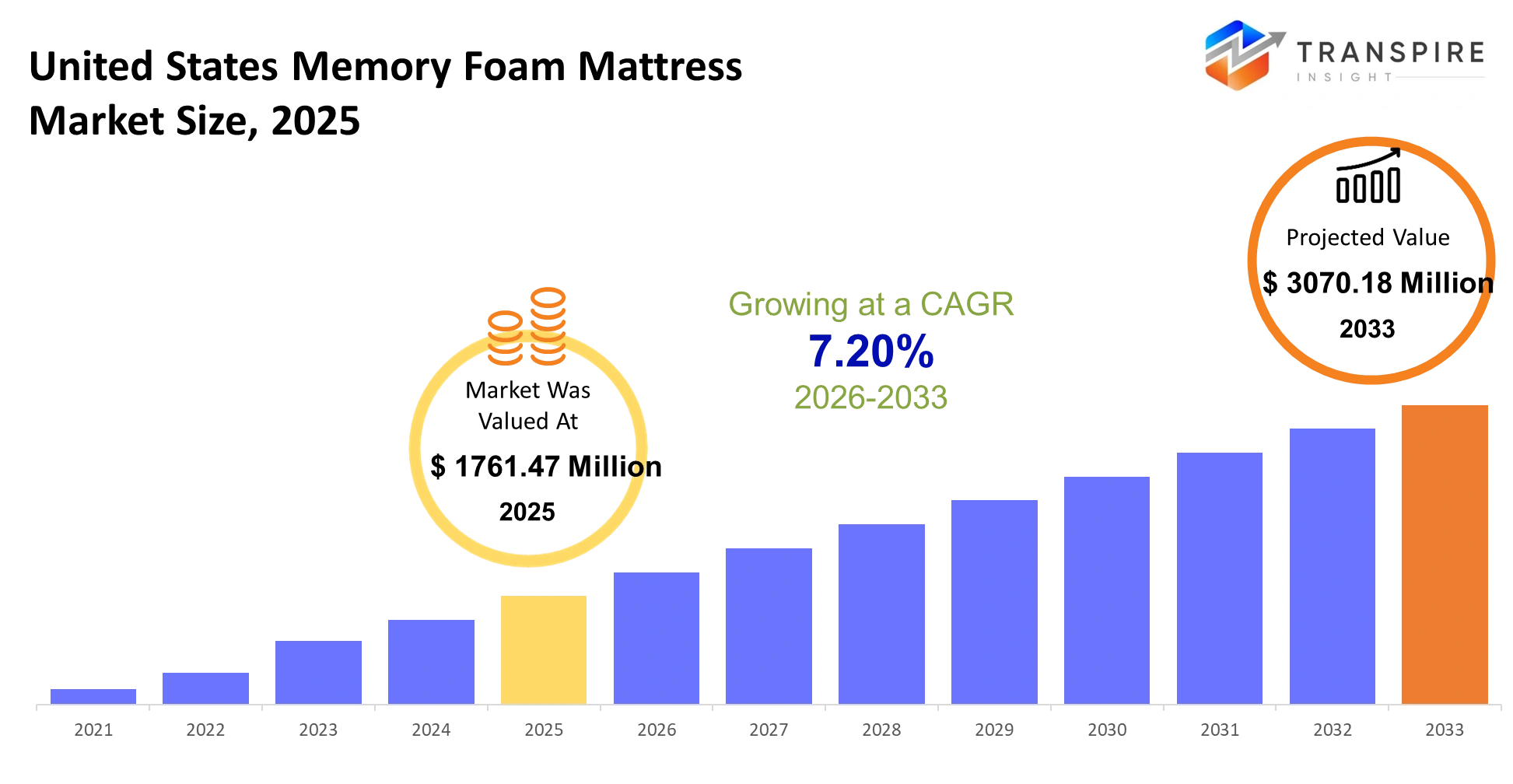
- United States Memory Foam Mattress Market Size 2025: USD 1761.47 Million
- United States Memory Foam Mattress Market Size 2033: USD 3070.18 Million
- United States Memory Foam Mattress Market CAGR: 7.20%
- United States Memory Foam Mattress Market Segments: By Type (Traditional Memory Foam, Gel-infused Foam, Plant-based Foam, Hybrid Foam, High-density Foam, Others), By Application (Residential, Hospitality, Healthcare, Hotels, Luxury Bedding, Others), By End-User (Households, Hotels, Healthcare, Retailers, Others), By Distribution (Online, Retail Stores, Specialty Stores, Direct Sales, Others).
To learn more about this report,  Download Free Sample Report
United States Memory Foam Mattress Market Summary:
The United States Memory Foam Mattress Market size is estimated at USD 1761.47 Million in 2025 and is anticipated to reach USD 3070.18 Million by 2033, growing at a CAGR of 7.20% from 2026 to 2033. The United States memory foam mattress market kind of serves a practical purpose in terms of reducing pressure points, helping spinal alignment, and extending sleep recovery for people dealing with longer work hours, aging-related aches, and day to day lifestyle driven sleep disorders. What once felt like a premium comfort item has started to blend into the wider wellness and home health ecosystem, especially now that consumers are spending more time working, and then resting at home.
In the last three to five years, the market has shifted in a more structural way toward hybrid and cooling focused mattress designs that mix memory foam with gel layers, smart sensors, and temperature regulating materials. This change sped up after the COVID-19 pandemic, because home spending priorities got re-ordered and more people went toward direct to consumer online mattress purchases. On top of that, supply chain disruptions, plus petrochemical price swings, pushed manufacturers to rethink foam sourcing and put more money into domestic production capacity. Since consumers are now looking at mattresses through sleep quality, recovery, and long term health value, rather than just basic affordability, brands that bring advanced material engineering and solid digital retail setup are seeing stronger revenue growth and better customer retention.
Key Market Insights
- In 2025 the Southern United States kind of dominated the United States Memory Foam Mattress Market , holding nearly 36% market share because housing activity stayed pretty high and steady.
- Meanwhile the Western regions are showing the fastest momentum through 2032 , backed by premium wellness spending and smart home product adoption which feels very „present“ in everyday life .
- Urban metropolitan areas are also driving meaningful revenue gains since direct-to-consumer mattress brands go after digitally active buyers , and they do it quite aggressively.
- Plus relocation activity keeps climbing and apartment furnishing demand stays strong , so industry scale keeps strengthening across Texas, Florida, and California.
- Hybrid memory foam mattresses captured more than 42% market share in 2025 , and they basically lead product demand thanks to better cooling alongside ergonomic support.
- Traditional memory foam mattresses stayed in the number two position, mostly because pricing stays competitive and consumers already recognize the feel for residential use.
- Gel infused memory foam mattresses are forecast to be the fastest-growing segment through 2032 , with temperature regulation playing a big role in improving sleep comfort performance.
- Smart mattress integration—like sleep tracking plus AI enabled adjustment functions —is creating this newer pull across premium consumer categories.
- Also the market is seeing deeper penetration from compressed bed in a box distribution models, so delivery and adoption feel easier for many buyers.
- Residential applications made up around 74% share in 2025 since homeowners increasingly invest in long term sleep quality solutions , not just quick upgrades.
- Hospitality applications are growing quickly because hotel renovation cycles continue, and because premium guest experience positioning matters a lot for brand loyalty.
- Healthcare and assisted living facilities are also adopting pressure relief mattress systems to improve patient comfort while cutting down discomfort linked to mobility limits.
What are the Key Drivers, Restraints, and Opportunities in the United States Memory Foam Mattress Market?
The strongest force behind the United States Memory Foam Mattress Market, is kind of the shift toward premium sleep technology that gets bundled with direct-to-consumer retail economics. In the last five years compressed mattress packaging and nationwide e-commerce fulfillment , helped lower distribution costs and it also removed dependence on big showroom networks. That retail structural change let manufacturers scale nationally while still holding higher margins. Meanwhile wearable health monitoring devices plus clinical research that links poor sleep to productivity loss is pushing people toward higher-value mattresses, with cooling layers, orthopedic support, and motion isolation. So overall the premium product groups are growing quicker than entry-level foam mattresses, especially in cities, and among higher-income households.
Still though, volatility in polyurethane foam and petrochemical feedstock pricing is the market’s most stubborn obstacle. Memory foam production relies heavily on petroleum-derived chemicals, so manufacturers get pulled into crude oil swings and global supply disruptions. And this is structural because swapping out those large petrochemical inputs takes a long time—long investment cycles for alternative materials science, plus new manufacturing infrastructure. When raw material costs stay elevated, it keeps squeezing pricing flexibility which ends up delaying mattress replacements among middle-income consumers, and it also limits how far these products can go in price-sensitive retail channels.
Smart sleep ecosystems are basically, the next big growth opportunity. Companies are getting more and more into putting sensors in mattresses, using AI sleep analytics, and even adding temperature-adjusting foam layers into those connected beds. At the same time, the smart home adoption investments across states like California, and Washington are making the ground feel right for premium intelligent mattresses, that blend wellness tracking with personalized sleep tuning. It’s, kind of a momentum moment you can’t really ignore.
What Has the Impact of Artificial Intelligence Been on the United States Memory Foam Mattress Market?
Artificial intelligence along with advanced digital technologies are kind of remaking the United States Memory Foam Mattress Market, in a way that changes how manufacturing precision works, how inventory is handled, and how sleep can be tailored for individuals. In practice, mattress makers are now using AI driven production systems which automate foam density calibration, adhesive placement, and even defect detection across assembly lines. Then, computer vision tools spot material inconsistencies as they happen, so fewer units get wasted and production accuracy tends to improve. A number of bigger bedding companies have also brought predictive analytics into supply chain routines, to anticipate retail demand rhythms, keep warehouse stock more aligned, and cut down excess inventory during seasonal sales periods, not just the usual peak weeks.
At the same time, machine learning is getting embedded into smart mattresses and connected sleep systems. Those platforms can analyze sleep posture, body motion, temperature shifts, and pressure mapping, and from there suggest customized firmness adjustments. The goal is to support better long term product behavior. Also, businesses that use AI based production planning plus predictive maintenance tools have described directional improvements like smoother manufacturing uptime, shorter delivery turns, and reduced operational costs, partly because material waste drops and equipment failures happen less often.
Still, AI adoption is running into a fairly clear constraint, the integration cost can be high, especially for legacy manufacturing sites. Many mid sized mattress producers don’t have the digital setup and connected production environment needed to fully roll out these advanced analytics. As a result, adoption stays mostly within major premium brands, while others remain limited to smaller scale deployments.
Key Market Trends
- Since 2021 online mattress sales have grabbed a bigger market share, as compressed bed in a box shipping kept costs down across the country by close to 25% .
- Hybrid mattress models, mixing memory foam with innerspring support, started to beat the older pure foam designs after shoppers really leaned toward breathability and steadier temperature control features.
- Major brands like Tempur Sealy International, and Sleep Number also expanded AI assisted sleep tracking systems between 2022 and 2025 .
- U.S. manufacturers upped their domestic foam output after the pandemic era supply hiccups showed how much everyone relied on imported chemical feedstocks, plus overseas parts , too.
- Cooling gel foam technologies got more traction when return rates rose for heat holding mattresses during longer work from home stretches.
- Since 2023 retailers have pulled back on physical showroom expansion and re-routed budgets toward digital personalization tools and virtual recommendation platforms, instead.
- CertiPUR-US certified foam products sold more in the premium tier because buyers shifted attention toward materials that are verified low emission, and low odor.
- Hospitality chains moved faster with premium mattress swaps after luxury hotels reported better guest satisfaction , that they tied to sleep quality upgrades.
- Smart mattresses with biometric monitoring showed up beyond the niche lane as wearable health tech became normal, which made people more interested in sleep analytics.
- Private label mattress brands intensified price competition after big e commerce platforms grew exclusive product partnerships and stronger direct fulfillment options.
United States Memory Foam Mattress Market Segmentation
By Type
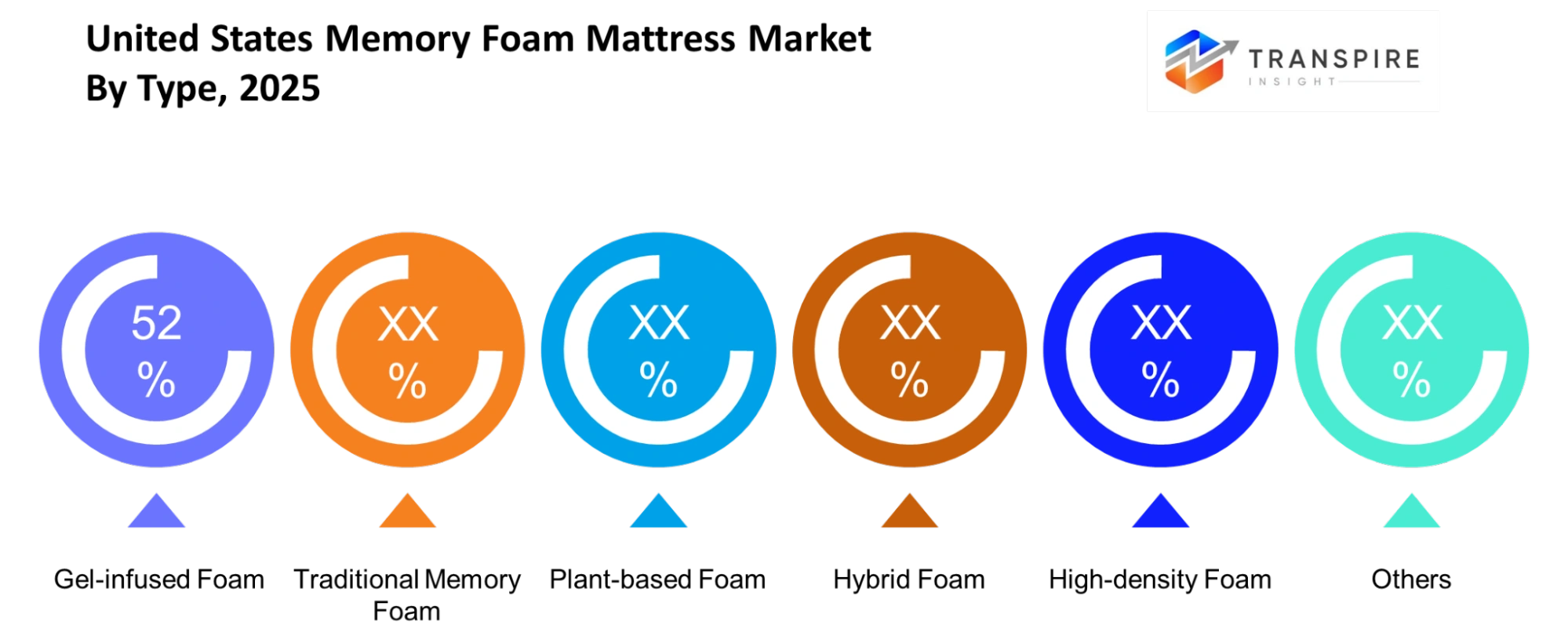
Traditional memory foam mattress options keep holding the biggest chunk inside the type segment because they are, mostly, easy on the wallet, easy to find in regular retail places, and people already kind of know what they are getting, so replacement demand stays steady. Gel infused foam items have quietly picked up more real momentum over the last five years, since temperature management turned into this major buying point, especially in warmer parts of the U.S. Hybrid beds that mix memory foam with innerspring coils are now the quickest moving category, not just for comfort but for better airflow, firmer spinal support, and that more “premium” feel customers tend to pay extra for.
Plant based foam products still sit in a smaller slice of the market though, largely because production costs plus raw material sourcing limits make large scale adoption pretty hard. High density foam mattresses still matter for orthopedic style and luxury bedding too, where longevity, plus pressure relief, are the two usual decision levers. Going forward, fights within the type segment will probably hinge more and more on cooling technology, sustainable material tweaks, and smart sleep integration that feels seamless. Companies putting money into newer foam engineering and more distinctive comfort outcomes are the ones most likely to pull in higher margin shoppers.
To learn more about this report, Download Free Sample Report
By Application
Residential applications sort of dominate the broader application segment , mostly because mattress replacement cycles stay tightly tied to household spending, housing activity and these wellness purchases that people do because of lifestyle. Luxury bedding and hospitality applications have also been growing, more and more, as hotels start using premium sleep experiences to strengthen customer retention , plus help with brand differentiation. On the healthcare side adoption is climbing too, driven by what they actually need in practice, pressure-relief surfaces, especially in rehabilitation centers, assisted living facilities, and long term care institutions.
For hospitality buyers, the priorities usually land on durability, guest comfort ratings, and how easy maintenance really is, while healthcare operators tend to care more about mobility support and patient recovery outcomes. Residential consumers, meanwhile, keep leaning toward cooling options and hybrid mattress systems , since those help with sleep recovery and long term comfort. Looking ahead, the application growth will likely tilt toward specialized performance mattresses meant for wellness, medical support, and even connected sleep monitoring.
Investors and manufacturers are expected to chase hospitality partnerships and healthcare focused product development, where pricing pressure appears a bit lower than what you see in mass market residential retail.
By End-User
Households take the biggest piece of the end user segment, mostly because actual people buying mattresses straight up is what really pushes most replacement demand, both online and in retail. Hotels come next as the second-largest group, since premium lodging operators are upgrading bedding standards more often now, aiming to boost guest satisfaction, and occupancy. Healthcare facilities are also still adding mattress volume, as elderly care needs keep growing and because pressure-management sleep systems are getting more attention. Retailers stay relevant too, not just as a side player, but because showroom partnerships and private-label deals still sway what shoppers pick, even as digital keeps expanding.
When you look at household purchasing lately it feels a bit like wellness-forward spending, where buyers lean toward cooling support, motion isolation, and long-term durability rather than only fixating on entry-level pricing. Looking ahead, extra pull from hotels and healthcare operators could open steadier opportunities for more specialized product lines, like antimicrobial materials, adjustable support systems, and durability that has higher expectations. Firms that can juggle premium innovation with scalable production efficiency should be better positioned to win and keep longer institutional contracts overall.
By Distribution
Online distribution channels kinda just took over the mattress sales growth overall, mainly because after 2020, compressed packaging, doorstep delivery, and longer trial periods changed how people actually shop. Retail stores still have a big footprint though, because a lot of buyers still want to test the physical feel first before they pay for a premium mattress, you know. Specialty stores stay pretty influential too, especially in luxury and orthopedic mattress lines where product education and a more tailored consultation can swing the decision process.
At the same time, direct sales have been growing, since some manufacturers started cutting out the middle, the third party retailers, to protect margins and also tighten up their customer data capture. Online platforms then went further with sharper price competition, which also sped up private-label arrivals, and that basically forced older retailers to weave digital marketing together with an omnichannel fulfillment approach.
Specialty retailers now lean more toward premium framing and individualized sleep consultations, instead of chasing pure volume based pricing wars. Looking ahead, distribution trends will probably revolve around AI-driven suggestion engines, virtual product visualization, and quicker regional fulfillment networks. And companies that put money into integrated digital commerce infrastructure should see better customer retention, plus some real operational efficiency wins.
What are the Key Use Cases Driving the United States Memory Foam Mattress Market?
Residential sleep support still seems like the main reason memory foam mattress adoption keeps moving forward across the United States. In most households, the demand feels the strongest, because pressure relief, motion isolation, and that temperature regulating comfort piece all matter to sleep recovery and to the “do we buy this long term” wellness decisions, like pretty directly.
On the hospitality side and in healthcare, it’s also growing, but a bit steadier. Hotels are upgrading guest set ups, and medical facilities are really putting patient comfort management near the top of the list. A lot of luxury hotel brands have started using hybrid memory foam systems, partly to boost guest satisfaction results. Meanwhile rehab centers tend to lean toward pressure relief mattresses, especially for patients who are mobility sensitive.
There are also newer use cases showing up, like AI-enabled smart mattresses paired with biometric sleep tracking, and then tied into connected home ecosystems. Sports recovery centers, wellness retreats, and even higher-end senior living communities are testing customized memory foam solutions too, aiming for personal posture support and longer duration comfort optimization, which is kind of the whole idea.
|
Report Metrics |
Details |
|
Market size value in 2025 |
USD 1761.47 Million |
|
Market size value in 2026 |
USD 1886.65 Million |
|
Revenue forecast in 2033 |
USD 3070.18 Million |
|
Growth rate |
CAGR of 7.20% from 2026 to 2033 |
|
Base year |
2025 |
|
Historical data |
2021 - 2024 |
|
Forecast period |
2026 - 2033 |
|
Report coverage |
Revenue forecast, competitive landscape, growth factors, and trends |
|
Geographic scope |
United States of America |
|
Key company profiled |
Tempur Sealy, Serta Simmons, Sleep Number, Casper, Purple, Tuft & Needle, Nectar Sleep, Amerisleep, Zinus, IKEA, Sealy, Kingsdown, DreamCloud, Saatva, Helix Sleep |
|
Customization scope |
Free report customization (country, regional & segment scope). Avail customized purchase options to meet your exact research needs. |
|
Report Segmentation |
By Type (Traditional Memory Foam, Gel-infused Foam, Plant-based Foam, Hybrid Foam, High-density Foam, Others), By Application (Residential, Hospitality, Healthcare, Hotels, Luxury Bedding, Others), By End-User (Households, Hotels, Healthcare, Retailers, Others), By Distribution (Online, Retail Stores, Specialty Stores, Direct Sales, Others) |
Which Regions are Driving the United States Memory Foam Mattress Market Growth?
The Southern United States keeps coming out on top as a regional market, kinda because there’s strong housing activity, fast suburban population growth, and a big tangle of retail distribution infrastructure that just works. States like Texas and Florida back high mattress replacement volumes too, mainly because residential construction keeps pushing forward and migration trends keep nudging household formation upward, even if people move around for work. The area also gets a boost from major warehouse networks, reduced logistics costs, and a cluster of e-commerce fulfillment operations that tends to make delivery more efficient for direct-to-consumer mattress brands. There’s also a mature retail ecosystem, supported by national furniture chains, online marketplaces, and domestic manufacturing sites, and this keeps the region dominant across both premium and mid range product categories, pretty consistently.
Meanwhile, the Midwest is more of a steady, reliable contributor to national mattress revenue, because replacement driven demand usually doesn’t react as much to short-term housing swings. In other words, compared with the South, Midwest buying patterns lean more on established retail relationships, value focused product positioning and long lasting household spending behavior. Manufacturing strength across places like Indiana and Ohio adds to supply chain reliability, and it supports production efficiency for several big bedding companies. Plus, steady investment from hotel operators, healthcare facilities, and regional furniture retailers helps keep market performance dependable, even if population growth is a little slower than what you see along coastal regions.
The Western United States shows the most noticeable growth momentum like, technology driven wellness spending and premium smart home adoption are reshaping how people buy mattresses. California, Washington, and Colorado had stronger demand after consumers started prioritizing cooling materials sleep tracking integration, and sustainable foam technologies between 2022 and 2025. At the same time, e commerce penetration kept climbing and higher disposable income levels helped push adoption of hybrid plus AI enabled sleep systems across the cities. This general growth path should open up solid opportunities for premium mattress manufacturers, connected sleep technology providers, and digital first retail brands during the 2026–2033 forecast window.
Who are the Key Players in the United States Memory Foam Mattress Market and How Do They Compete?
The United States memory foam mattress market is still kind of moderately fragmented, so you end up seeing national bedding manufacturers side by side with digitally native direct-to-consumer brands, and private label retailers too. Lately the fight is not only about price—more it’s about cooling tech, sleep personalization, delivery efficiency, and getting customers to stay through warranty backed retention programs. More established manufacturers keep defending their share using domestic production capacity, wide retail distribution, and a bunch of premium product diversification. Meanwhile newer entrants mess with the older retail playbook by leaning into online subscription like purchasing and those compressed shipping formats that make logistics feel faster. Digital marketing efficiency, return policies, and smart sleep integration are now shaping positioning more than showroom presence alone really does.
Tempur Sealy International sets itself apart with proprietary pressure relief foam engineering , plus premium hybrid mattress development aimed at orthopedic comfort and that sort of luxury hospitality vibe. The firm keeps expanding through branded retail stores hotel collaborations, and also by investing in domestic manufacturing resilience so supply chain dependence drops. Sleep Number plays differently, it leans hard on connected sleep technology that mixes biometric tracking, adjustable firmness controls, and AI driven sleep analytics. Their data oriented personalization is strong enough to aim at premium wellness minded consumers who can afford higher average selling prices , and still feel like it’s worth it.
Purple Innovation uses its proprietary GelFlex grid technology, to kinda separate itself from the usual memory foam products, by helping airflow move more freely and cutting back on heat retention. Lately the move into wholesale retail partnerships, plus the addition of premium hybrid product lines, has really expanded the market reach even beyond only online sales. Meanwhile Casper Sleep is more about direct-to-consumer efficiency, with compressed delivery logistics and a simpler lineup of products aimed at digital native buyers. They also rely on strategic partnerships with furniture retailers and online marketplaces, which has boosted customer acquisition while also lowering how much they need standalone physical retail expansion, and not just staying online.
Company List
- Tempur Sealy
- Serta Simmons
- Sleep Number
- Casper
- Purple
- Tuft & Needle
- Nectar Sleep
- Amerisleep
- Zinus
- IKEA
- Sealy
- Kingsdown
- DreamCloud
- Saatva
- Helix Sleep
Recent Development News
In May 2026, Somnigroup Reports Strong Q1 2026 Growth Driven by Mattress Segment Expansion: Somnigroup International posted strong Q1 2026 results with double-digit sales growth, driven by higher mattress demand and synergies from its integrated retail-manufacturing structure. Operating margins improved significantly, reflecting efficiency gains in bedding production and distribution.
Source: https://www.pudaily.com
In January 2026, Sleep Number Launches “ComfortMode” Affordable Adjustable Mattress Line: Sleep Number introduced its new ComfortMode mattress line targeting the mass-market segment with simplified adjustability and lower price points. The launch aims to expand adoption of smart comfort features beyond premium buyers in the U.S. mattress market.
Source: https://www.nasdaq.com
What Strategic Insights Define the Future of the United States Memory Foam Mattress Market?
The United States memory foam mattress market is sort of structurally shifting toward a tech embedded sleep ecosystem, where the mattresses start acting like connected wellness platforms—not just passive home items. Over the next five to seven years, the real growth is gonna lean more and more on biometric monitoring and AI sleep personalization, plus the premium hybrid material innovation angle. And honestly, the biggest underlying driver is that consumers are already tracking health more often, and that behavior is merging with smart home adoption, especially in higher income urban areas, and also for aging populations who are trying to get long-term recovery and mobility help.
There is also a hidden risk , because companies keep relying heavily on petrochemical derived foam inputs, while supply concentration feels tighter and the environmental scrutiny is ramping up. Regulatory pressure tied to chemical emissions and polyurethane disposal could quietly raise compliance costs, and then it may mess with pricing stability for mid sized manufacturers that do not have vertically integrated supply chains.
But at the same time , there is an opportunity too. It’s showing up in senior living and post acute healthcare settings, where pressure management sleep systems plus connected monitoring mattresses are still underpenetrated, even while institutional demand keeps growing. Market players should put priority on investing in sustainable foam alternatives and tying up integrated sleep analytics partnerships, before technology differentiation gets stuck with only a small group of premium brands.
United States Memory Foam Mattress Market Report Segmentation
By Type
- Traditional Memory Foam
- Gel-infused Foam
- Plant-based Foam
- Hybrid Foam
- High-density Foam
- Others
By Application
- Residential
- Hospitality
- Healthcare
- Hotels
- Luxury Bedding
- Others
By End-User
- Households
- Hotels
- Healthcare
- Retailers
- Others
By Distribution
- Online
- Retail Stores
- Specialty Stores
- Direct Sales
- Others
Frequently Asked Questions
Find quick answers to common questions.
The approximate United States Memory Foam Mattress Market size for the market will be USD 3070.18 Million in 2033.
The key segments of the United States Memory Foam Mattress Market are By Type (Traditional Memory Foam, Gel-infused Foam, Plant-based Foam, Hybrid Foam, High-density Foam, Others), By Application (Residential, Hospitality, Healthcare, Hotels, Luxury Bedding, Others), By End-User (Households, Hotels, Healthcare, Retailers, Others), By Distribution (Online, Retail Stores, Specialty Stores, Direct Sales, Others).
Major players in the United States Memory Foam Mattress Market are Tempur Sealy, Serta Simmons, Sleep Number, Casper, Purple, Tuft & Needle, Nectar Sleep, Amerisleep, Zinus, IKEA, Sealy, Kingsdown, DreamCloud, Saatva, Helix Sleep.
The current market size of the United States Memory Foam Mattress Market is USD 1761.47 Million in 2025.
The United States Memory Foam Mattress Market CAGR is 7.20%.
- Tempur Sealy
- Serta Simmons
- Sleep Number
- Casper
- Purple
- Tuft & Needle
- Nectar Sleep
- Amerisleep
- Zinus
- IKEA
- Sealy
- Kingsdown
- DreamCloud
- Saatva
- Helix Sleep
Recently Published Reports
-
Apr 2026
Bottled Water Market
Bottled Water Market Size, Share & Analysis Report By Product Type (Still Bottled Water, Carbonated Bottled Water, Functional Bottled Water, and Others), By Packaging (PET, Cans, and Others), By Sales Channel (Supermarkets/Hypermarkets, Convenience Stores/Drug Stores, Grocery Stores/Club Stores, Foodservice, and Others) and Geography (North America, Europe, Asia-Pacific, Middle East and Africa, South and Central America), 2021 - 2032
-
Apr 2026
Color Cosmetic Packaging Market
Color Cosmetic Packaging Market Size, Share & Analysis Report By Application (Mascara Packaging, Liquid Packaging, and Liquid Face), By Type (Tubes & Bottles, Pens & Markers, Compacts & Containers, and Droppers & Pumps), and Geography (North America, Europe, Asia-Pacific, Middle East and Africa, South and Central America), 2021 - 2031
-
Apr 2026
External Microphone For Camera Market
External Microphone For Camera Market Size, Share & Analysis Report By Type (Shotgun Microphone, Lavalier Microphone, and Others), By Application (Digital Camera, Professional Video Camera, and Others), and Geography (North America, Europe, Asia-Pacific, Middle East and Africa, South and Central America), 2021 - 2031
-
Apr 2026
Foot Orthotic Insoles Market
Foot Orthotic Insoles Market Size, Share & Analysis Report By Type (Pre-fabricated, and Custom-made), By Material (Thermoplastic, Composite Carbon Fiber, and Others), By Distribution Channel (Drug Stores, Hospitals & Clinics, and Others), and Geography (North America, Europe, Asia-Pacific, Middle East and Africa, South and Central America), 2021 - 2031