

United States Liquefied Natural Gas (LNG) Carrier Market Size & Forecast:
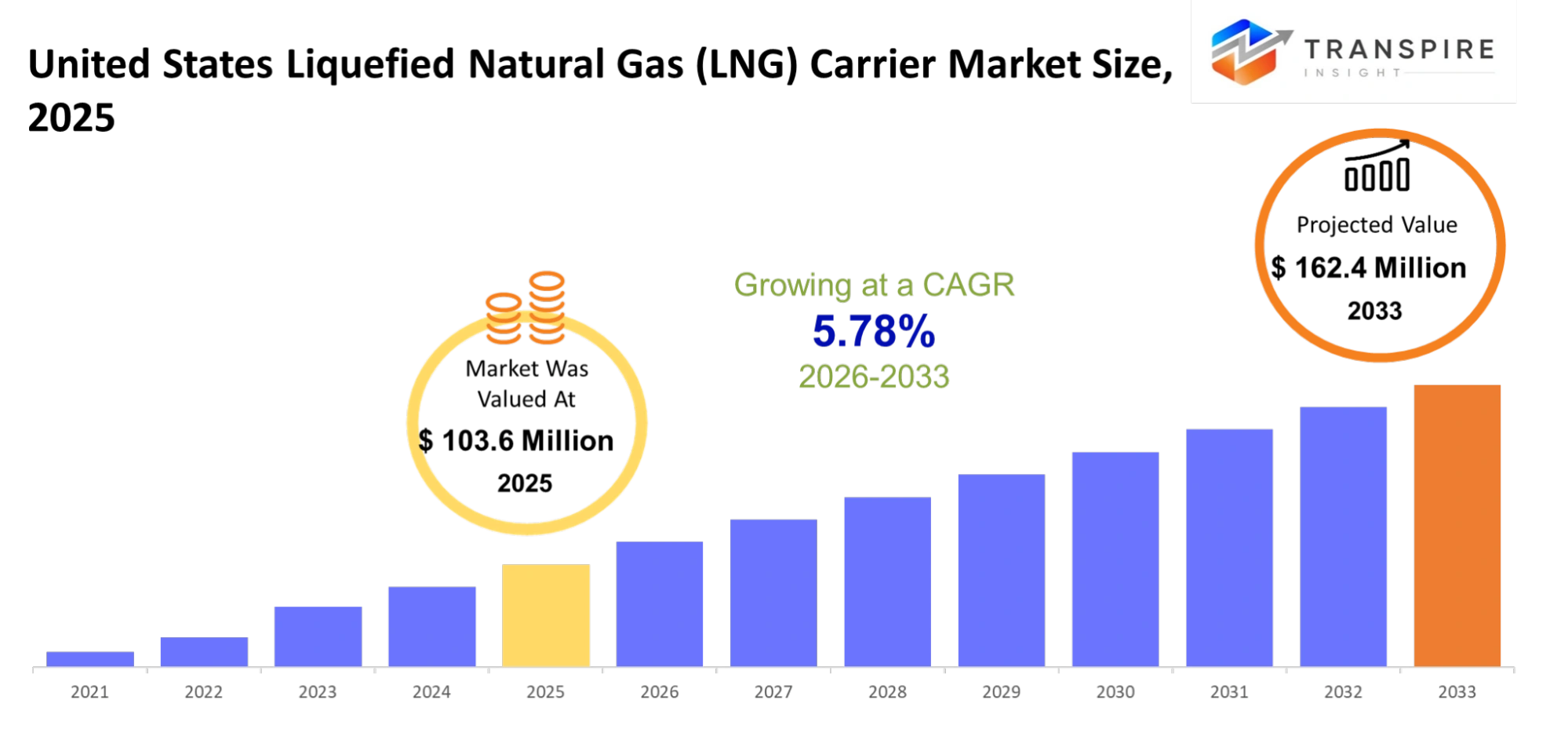
- United States Liquefied Natural Gas (LNG) Carrier Market Size 2025: USD 103.6 Million
- United States Liquefied Natural Gas (LNG) Carrier Market Size 2033: USD 162.4 Million
- United States Liquefied Natural Gas (LNG) Carrier Market CAGR: 5.78%
- United States Liquefied Natural Gas (LNG) Carrier Market Segments:By Vessel Type (Membrane Type LNG Carriers, Moss Type LNG Carriers), By Capacity (Below 125,000 m³, 125,000–175,000 m³, Above 175,000 m³), By Application (Commercial LNG Transport, Government & Strategic Reserves).
To learn more about this report,  Download Free Sample Report
United States Liquefied Natural Gas (LNG) Carrier Market Summary:
The United States Liquefied Natural Gas (LNG) carrier market size is estimated at USD 103.6 million in 2025 and is anticipated to reach USD 162.4 million by 2033, growing at a CAGR of 5.78% from 2026 to 2033. The United States Liquefied Natural Gas (LNG) carrier market shows continuous expansion because both international demand for environmentally friendly energy solutions and United States export capabilities are increasing. The implementation of advanced shipbuilding technologies together with efficient carrier design will improve transportation systems by making them more reliable and affordable.The market expansion receives additional support from strong trade partnerships and regulatory frameworks that create favourable conditions for business growth. The United States has emerged as a leading force in the international LNG shipping industry because the rising demand for sustainable practices and reduced emissions has resulted in new innovations for LNG carriers.
Key Market Trends & Insights:
- The US energy needs for exporting LNG experience strong growth because European and Asian countries need additional energy resources. The surge in demand for LNG leads to increased requirements for LNG carriers, which must deliver global supplies in a dependable manner.
- The LNG carriers of today use advanced fuel-efficient engines together with better containment systems. The new technology reduces fuel consumption while lowering emissions and improving operational performance.
- The new and existing LNG export terminals along the US Gulf Coast increase shipping activities. The new infrastructure demands an ongoing requirement for enhanced carrier fleets which operate with more advanced capabilities.
- The energy industry is moving towards long-term shipping contracts which help companies maintain their supply networks. The trend creates predictable income streams for LNG carrier operators, which motivates them to expand their fleets.
- Environmental sustainability has become a major trend in the shipping industry. LNG carriers now undergo design changes to comply with international emission standards which support global climate objectives.
- The US government is building stronger energy connections with various nations to boost LNG trade routes. The partnerships lead to a steady increase in the number of carriers which operate and the extent to which they are used.
- LNG shipping rates experience changes based on seasonal demand patterns and geopolitical events. The situation provides market participants with chances to handle operational expenses while also presenting dangers.
- The US domestic capacity to construct LNG carriers faces limitations which force the country to depend on foreign shipbuilding facilities. The restriction creates challenges for expanding the fleet and affects the competitive abilities of the business.
United States Liquefied Natural Gas (LNG) Carrier Market Segmentation
By Vessel Type
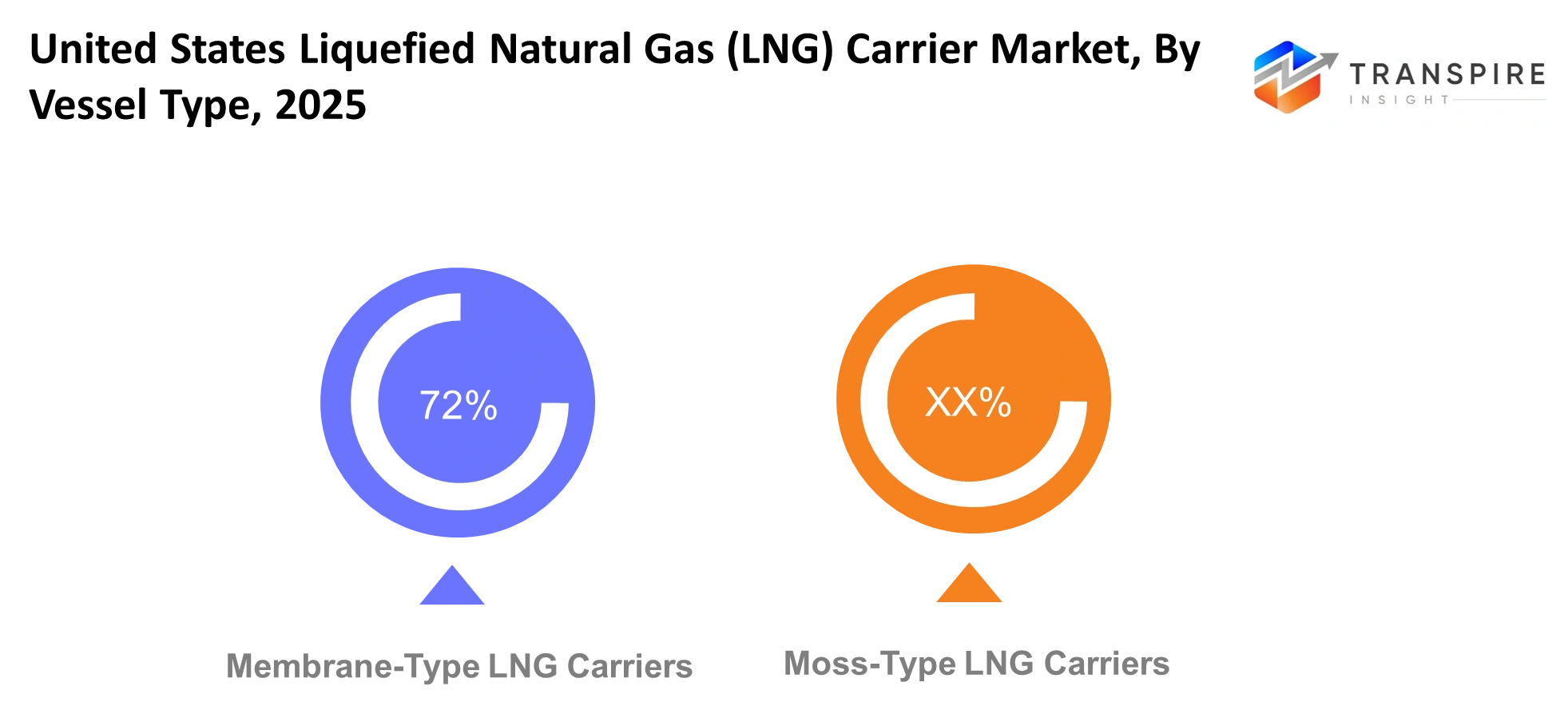
- Membrane-Type LNG Carriers: Membrane-type LNG carriers dominate the market because their design enables maximum payload capacity together with minimal aircraft weight requirements. The system enables operators to multiply their storage capabilities while maintaining existing vessel dimensions, which results in operational cost savings during extended voyages. The system enhances operational efficiency by reducing LNG evaporation through its advanced thermal insulation equipment.
- Moss-Type LNG Carriers: Moss-type LNG carriers use spherical tank systems because these tanks provide optimal structural integrity together with safe operational characteristics. The system carries less payload than membrane systems but provides operators with dependable performance and simple maintenance solutions. The carriers serve best in situations which require both robust performance and secure operational conditions.
To learn more about this report, Download Free Sample Report
By Capacity
- Below 125,000 m³: The shipment delivery process finished when the total shipment volume reached 125,000 cubic metres. The shipping industry uses smaller LNG carriers which have limited capacity to meet both regional transportation needs and specific market demands. The shipping company operates ships that can navigate through ports with restricted space, which they use for their short-distance shipping operations. The ships operate to establish LNG systems which supply emerging markets and deliver energy to local areas.
- 125000–175000 m³: This segment represents the most commonly used LNG carriers which operate at maximum efficiency. The ships operate across all international trade routes which require medium to long-distance transportation. Energy companies prefer these systems because their operational capacity provides energy companies with multiple operational choices.
- Above 175,000 m³: The design of large capacity LNG carriers enables them to transport massive quantities of cargo over extensive distances. The shipping industry utilises these vessels to transport bulk cargo from the United States to important international markets. The vessels provide shipping companies with cost benefits which result from their ability to transport goods at lower expenses for each unit. The vessels have seen increased demand because worldwide LNG consumption has risen.
By Application
- Commercial LNG Transport: Commercial LNG transport accounts for the majority of carrier usage, driven by global trade demand. Energy companies use these vessels to maintain their supply operations throughout worldwide markets. The segment continues to expand as more countries shift toward LNG as a cleaner energy alternative.
- Government & Strategic Reserves: This segment uses LNG carriers to establish national energy security and maintain emergency reserves. Governments use these systems to create backup energy supplies which help prevent energy shortages during emergencies. This segment, although smaller, serves an essential function for both energy durability and strategic energy planning purposes.
Country Insights
The United States Liquefied Natural Gas (LNG) Carrier Market shows how the country has increased its power to control worldwide energy transactions. The U.S. has emerged as a major LNG exporter because it possesses vast natural gas reserves and develops new export terminals throughout the Gulf Coast region. The export increase has created a strong need for modern LNG carriers, which will maintain safe and effective shipment operations.
The market exists because of powerful infrastructure development together with regulatory policies that support the industry and domestic plus international investors who commit their financial resources. The U.S. depends on foreign shipyards to build its LNG carriers, yet the country establishes strategic partnerships which improve its fleet operational capacity. The search for cleaner energy sources drives new innovations in carrier design which support sustainability objectives. The U.S. LNG carrier market experiences fast development because of active trading patterns and ongoing efforts to protect future energy resources.
Recent Development News
In April 2026, US LNG exports hit a record high amid global supply disruptions: The U.S. recorded historic LNG export volumes, increasing the need for more LNG carriers to handle global shipments efficiently.
In March 2026, Golden Pass LNG produces first gas at Texas facility: A major U.S. LNG terminal started producing LNG, signalling increased cargo movement and higher reliance on carrier fleets.
|
Report Metrics |
Details |
|
Market size value in 2025 |
USD 103.6 Million |
|
Market size value in 2026 |
USD 109.6 Million |
|
Revenue forecast in 2033 |
USD 162.4 Million |
|
Growth rate |
CAGR of 5.78% from 2026 to 2033 |
|
Base year |
2025 |
|
Historical data |
2021 – 2024 |
|
Forecast period |
2026 – 2033 |
|
Report coverage |
Revenue forecast, competitive landscape, growth factors, and trends |
|
Country scope |
United States |
|
Key company profiled |
Hyundai Heavy Industries Co. Ltd., Samsung Heavy Industries Co. Ltd., Daewoo Shipbuilding & Marine Engineering Co. Ltd., Mitsubishi Heavy Industries Ltd., Kawasaki Heavy Industries Ltd., China State Shipbuilding Corporation, Hudong-Zhonghua Shipbuilding Co. Ltd., STX Offshore & Shipbuilding Co. Ltd., Fincantieri S.p.A., General Dynamics NASSCO, Tsuneishi Shipbuilding Co. Ltd., Imabari Shipbuilding Co. Ltd., Navantia S.A., DSME Shipyard, Japan Marine United Corporation. |
|
Customization scope |
Free report customization (country, regional & segment scope). Avail customized purchase options to meet your exact research needs. |
|
Report Segmentation |
By Vessel Type (Membrane Type LNG Carriers, Moss Type LNG Carriers), By Capacity (Below 125,000 m³, 125,000–175,000 m³, Above 175,000 m³), By Application (Commercial LNG Transport, Government & Strategic Reserves). |
Key United States Liquefied Natural Gas (LNG) Carrier Company Insights
The United States Liquefied Natural Gas (LNG) Carrier Market operates through international shipping companies, energy enterprises, and dedicated ship operators who provide specialised services. The primary market players focus on fleet capacity expansion by acquiring new ships because modern vessels will enhance their operational capabilities to meet rising export demands. The common methods used by businesses to stay competitive include forming strategic partnerships, establishing permanent charter contracts, and funding environmentally sustainable product development. The companies are now focusing their attention on digital technologies and optimisation of transportation routes to achieve better results in their daily operations. The market exists as an active system which organisations power through their innovative work and collaborative efforts to meet changing requirements of global energy consumption.
Company List
- Hyundai Heavy Industries Co. Ltd.
- Samsung Heavy Industries Co. Ltd.
- Daewoo Shipbuilding & Marine Engineering Co. Ltd.
- Mitsubishi Heavy Industries Ltd.
- Kawasaki Heavy Industries Ltd.
- China State Shipbuilding Corporation
- Hudong-Zhonghua Shipbuilding Co. Ltd.
- STX Offshore & Shipbuilding Co. Ltd.
- Fincantieri S.p.A.
- General Dynamics NASSCO
- Tsuneishi Shipbuilding Co. Ltd.
- Imabari Shipbuilding Co. Ltd.
- Navantia S.A.
- DSME Shipyard
- Japan Marine United Corporation.
United States Liquefied Natural Gas (LNG) Carrier Market Report Segmentation
By Vessel Type
- Membrane Type LNG Carriers
- Moss Type LNG Carriers
By Capacity
- Below 125,000 m³
- 125,000–175,000 m³
- Above 175,000 m³
By Application
- Commercial LNG Transport
- Government & Strategic Reserves
Frequently Asked Questions
Find quick answers to common questions.
The approximate United States Liquefied Natural Gas (LNG) Carrier Market size for the market will be USD 162.4 million in 2033.
The key segments of the United States Liquefied Natural Gas (LNG) Carrier Market are By Vessel Type (Membrane Type LNG Carriers, Moss Type LNG Carriers), By Capacity (Below 125,000 m³, 125,000–175,000 m³, Above 175,000 m³), By Application (Commercial LNG Transport, Government & Strategic Reserves).
Major players in the United States Liquefied Natural Gas (LNG) Carrier Market are Hyundai Heavy Industries Co. Ltd., Samsung Heavy Industries Co. Ltd., Daewoo Shipbuilding & Marine Engineering Co. Ltd., Mitsubishi Heavy Industries Ltd., Kawasaki Heavy Industries Ltd., China State Shipbuilding Corporation, Hudong-Zhonghua Shipbuilding Co. Ltd., STX Offshore & Shipbuilding Co. Ltd., Fincantieri S.p.A., General Dynamics NASSCO, Tsuneishi Shipbuilding Co. Ltd., Imabari Shipbuilding Co. Ltd., Navantia S.A., DSME Shipyard, Japan Marine United Corporation.
The current market size of the United States Liquefied Natural Gas (LNG) Carrier Market is USD 103.6 million in 2025.
The United States Liquefied Natural Gas (LNG) Carrier Market CAGR is 5.78%.
- Hyundai Heavy Industries Co. Ltd.
- Samsung Heavy Industries Co. Ltd.
- Daewoo Shipbuilding & Marine Engineering Co. Ltd.
- Mitsubishi Heavy Industries Ltd.
- Kawasaki Heavy Industries Ltd.
- China State Shipbuilding Corporation
- Hudong-Zhonghua Shipbuilding Co. Ltd.
- STX Offshore & Shipbuilding Co. Ltd.
- Fincantieri S.p.A.
- General Dynamics NASSCO
- Tsuneishi Shipbuilding Co. Ltd.
- Imabari Shipbuilding Co. Ltd.
- Navantia S.A.
- DSME Shipyard
- Japan Marine United Corporation.
Recently Published Reports
-
Apr 2026
Active Power Filter Market
Active Power Filter Market Size, Share & Analysis Report By Type (Shunt Active Power Filters, Series Active Power Filter, Hybrid Active Power Filter), By Application (Harmonics Mitigation, Reactive Power Compensation, Voltage Regulation, Power Factor Correction), By Phase (Single Phase, Three Phase), By End-User Industry (Manufacturing, Healthcare, Commercial, Automotive, Oil and Gas, Others), and Geography (North America, Europe, Asia-Pacific, Middle East and Africa, South and Central America), 2021 - 2031
-
Apr 2026
Electrical Transformer Market
Electrical Transformer Market Size, Share & Analysis Report By Core (Closed, Shell, and Berry), By Insulation (Gas, Oil, Solid, Air, and Other), By Phase (Single, and Three), By Rating (100 MVA to 500 MVA, 501 MVA to 800 MVA, and 801 MVA to 1200 MVA), and Geography (North America, Europe, Asia-Pacific, Middle East and Africa, South and Central America), 2021 – 2031
-
Apr 2026
Hydraulic Piston Pumps Market
Hydraulic Piston Pumps Market Size, Share & Analysis Report By Type (Axial Piston Pumps, Radial Piston Pumps), By Operating Pressure (Low Pressure, Medium Pressure, High Pressure), By Application (Construction, Mining, Agriculture, Automotive, Oil & Gas, Industrial Machinery, Others), By End-User (OEMs, Aftermarket), and Geography (North America, Europe, Asia-Pacific, Middle East and Africa, South and Central America), 2021 – 2031
-
Apr 2026
Laboratory Gas Generators Market
Laboratory Gas Generators Market Size, Share & Analysis Report By Product (Nitrogen Gas Generator, Hydrogen Gas Generator, Zero Air Gas Generator, Purge Gas Generator, TOC Gas Generators, Others), By Application (Gas Chromatography, Liquid Chromatography-mass Spectrometry (LC-MS), Gas Analyzers, Others), By End-user (Life Science, Chemical & Petrochemical, Food & Beverage, Others), and Geography (North America, Europe, Asia-Pacific, Middle East and Africa, South and Central America), 2021 – 2031