
United States Electric Truck Market Summary
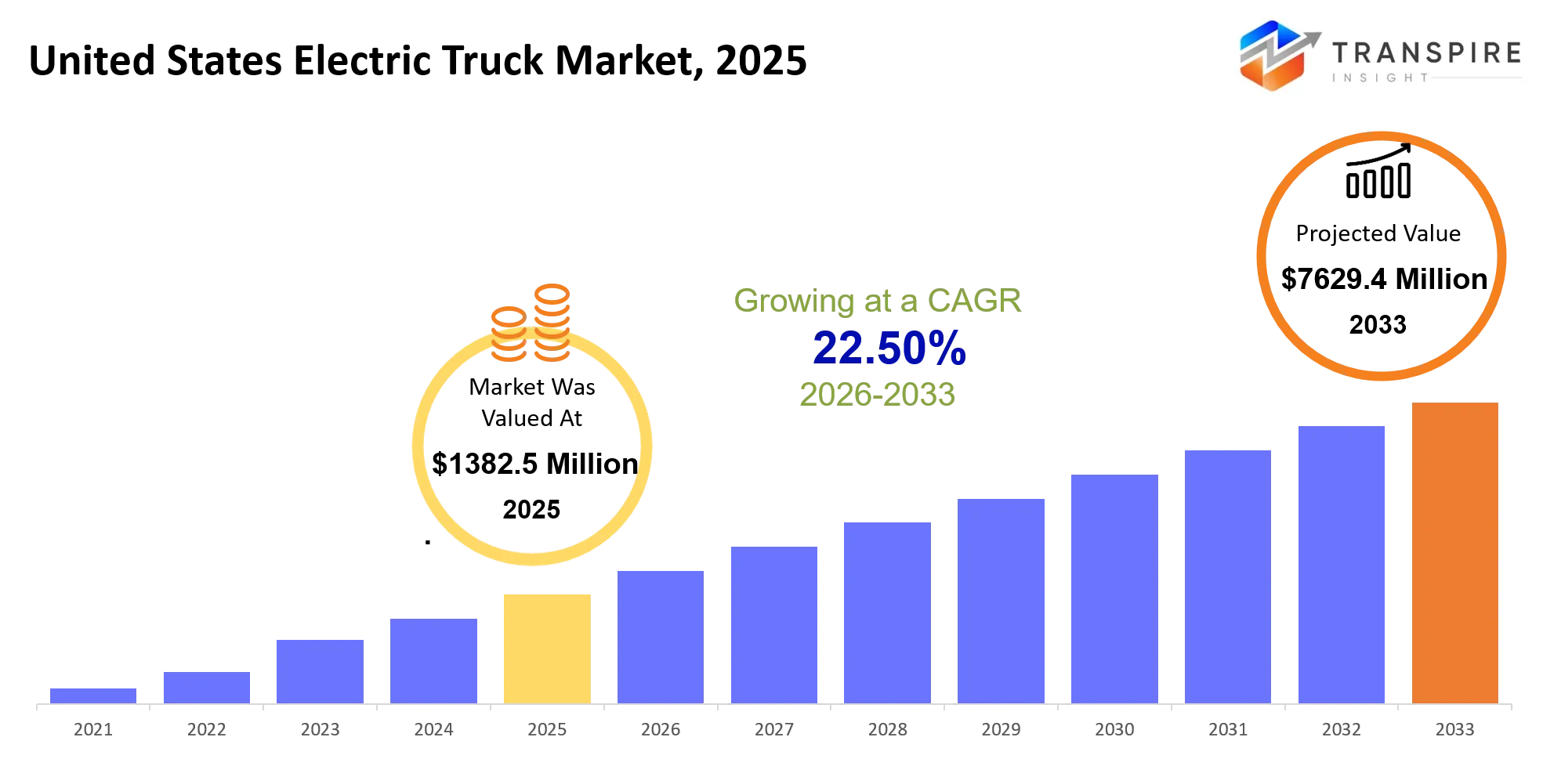
As per Transpire Insight Analysis the United States Electric Truck Market size is estimated at USD 1382.5 Million in 2025 and is anticipated to reach USD 7629.4 Million by 2033, growing at a CAGR of 22.50% from 2026 to 2033.
The United States electric truck market is there to help freight and distribution crews , plus construction, municipal ,and utility fleets swap out diesel vehicles on routes where the duty cycle is predictable enough that charging stays practical. Battery-electric trucks do two big things: they cut tailpipe emissions and they can lower overall energy and maintenance costs. That’s especially true for high-utilization city and regional work, where trucks are used a lot and downtime is expensive.
Over the past 3–5 years the scene has moved from small pilot deployments toward real commercial fleet programs , kinda like people stopped testing and started scaling. This momentum is linked to better battery systems, more workable charging solutions, and a wider set of vehicles that are actually available. California has stayed a major deployment hub, but in 2025 U.S. zero-emission truck deployments really sped up in the second half. In that period 12,996 vehicles were added , which is nearly double what showed up in the first half. Then in February 2026, a major policy change landed when the EPA rescinded federal GHG standards for on-road vehicles, and that created extra policy uncertainty . Even with that , state programs, fleet economics, and the continued growth of commercial vehicle portfolios keep pushing adoption forward.
United States Electric Truck Market Size & Forecast:
- United States Electric Truck Market Size 2025: USD 1382.5 Million
- Expected Market Value 2033: USD 7629.4 Million
- Forecast CAGR: 22.50%
- Leading region in 2025:Western United States, led by California
- Fastest Growing region:Northeast and West Coast states
- Key Profile: Pfizer Inc., Johnson & Johnson, Merck & Co., AbbVie Inc., Bristol Myers Squibb, Eli Lilly and Company, Amgen Inc., Gilead Sciences, AstraZeneca, Novartis AG, Sanofi, Roche Holding AG, Viatris Inc., Teva Pharmaceutical Industries, Biogen Inc
Key Market Insights
- Western states keep dominating, kind of, on deployment numbers, and California alone is at 60.5% of the U.S. zero-emission medium-duty truck registrations for 2025 .
- In the second half of 2025 there were 12,996 zero-emission truck deployments, which is nearly two times what got added in the first half 6,526 .
- Battery-electric trucks are still leading the commercial electrification push, particularly across those familiar urban , regional , delivery , refuse, and vocational work cycles.
- By 2025, medium-duty zero-emission registrations jumped 61.7% , and that kind of growth suggests fleet adoption is moving faster than what we’re seeing in some of the heavier vehicle categories.
- For 2025, Class 6 vehicles made up 71.3% of all zero-emission medium-duty registrations, showing they fit regional commercial operations really well.
- Heavy-duty adoption though is kind of uneven, with only 875 zero-emission registrations in 2025. That’s down 20.7% compared with 2024 , and it seems long-haul economics are still pretty hard to make pencil out.
- Charging infrastructure is becoming a strategic buying factor now, so manufacturers are getting pushed toward bundled, turnkey arrangements covering planning, installation, financing and ongoing service.
- Also Tesla is starting high volume electric truck production in 2026, and that likely increases competition across the Class 8 space.
- Then in 2026 , federal policy kinda shifted after the EPA rescinded the federal GHG standards, so the state level rules and the way fleets actually calculate costs are getting way more attention.
- Finally, fleet software is becoming like part of the electrification backbone, using battery health, range, charging patterns and energy data, so fleets can pick vehicles and make day to day operating decisions more accurately.
What are the Key Drivers, Restraints, and Opportunities in the United States Electric Truck Market?
Driver: Fleet economics and state-level zero-emission policies stay a big adoption push, sort of quietly but consistently. California and several Advanced Clean Trucks states have built tighter commercial incentives, for manufacturers and fleet operators, to actually bring zero-emission vehicles online. In 2025 California was 60.5% of all U.S. zero-emission medium-duty truck registrations, while ACT states made up 80.1% of those registrations. When routes are predictable, fleets can plan depot charging more neatly, cut their energy exposure, and benefit from lower maintenance needs, so the business case for electric replacements feels a lot more realistic.
Restraint: Charging infrastructure is still the biggest hard limit for heavy-duty rollout. Megawatt-scale charging may mean meaningful distribution upgrades, plus the whole permitting story, utility interconnection, site build-out, and high-power hardware lead times that can stretch things out. Studies also point to voltage, and distribution-system issues linked with large medium- and heavy-duty charging demand. All these “infrastructure asks” translate into higher upfront costs, and they can delay fleet switching even if the vehicle economics look attractive on paper.
Opportunity: Fleet charging optimization along with integrated energy management is where the next phase looks pretty promising. Software can line up charging windows with route needs, electricity pricing, battery condition, and grid capacity. Volvo’s expanded turnkey charging program shows this shift toward bundled infrastructure services, not just vehicles, and connected platforms are increasingly giving battery-health and range analytics in the same package.
What Has the Impact of Artificial Intelligence Been on the United States Electric Truck Market?
Artificial intelligence is kind of drifting electric truck fleet management away from simple telematics into more predictive, operating choices. With linked platforms, fleets can bring together battery state of charge, state of health, charging history, route conditions, energy consumption, and also how the vehicle itself ends up behaving, so they can try to recognize which electric vehicles fit a certain duty cycle. Geotab, for example, provides EV analytics that monitors battery health, charging habits, energy use, and real world range ability, which helps fleet managers when picking vehicles and matching them to the daily schedule. Then, machine learning approaches can support predictive maintenance too, by flagging strange battery signals, thermal management changes, braking patterns, or powertrain behavior before something actually fails and leads to that annoying unplanned downtime. Studies on AI driven predictive maintenance for electric vehicles show how real-time vehicle data can support focused fault forecasting, not just general alerts.
AI enabled charging optimization can also coordinate charging windows with route timing, electricity prices, battery condition, plus grid limits. In practice, these systems can lower pointless peak-power demand and help raise overall vehicle availability. Still, a main roadblock is data quality and real-world validation, because vehicle types, battery chemistries, weather conditions, payload ranges, and driving styles vary quite a lot. Because of that, today’s predictive models often need bigger fleet datasets AND additional field checks before operators can really depend on automated suggestions for mission-critical choices.
Key Market Trends
- U.S. deployments of zero-emission trucks really picked up in 2025, and by the second half it looks like they almost doubled vs the first half, which is pretty notable.
- Medium-duty electrification also got stronger in 2025 with registrations up 61.7% , fleet operators pushed more into commercial delivery and vocational use cases.
- California stayed out in front when it came to zero-emission truck deployments, but Texas, New York, New Jersey, and Pennsylvania all showed more momentum too, kind of at the same time.
- Manufacturers meanwhile started bundling charging design, installation, financing backing, and maintenance services together instead of just selling electric trucks on their own, like previously.
- Fleet buyers are also looking at battery condition and real-world range alongside sticker price. That makes connected-vehicle analytics more important during procurement, not just the marketing numbers.
- And Tesla’s 2026 high-volume Semi output adds a fresh competitive element to the U.S. Class 8 electric truck scene.
- On the policy side, federal emissions rules became harder to guess in 2026, after the EPA rescinded federal GHG standards for on-road vehicles.
- Because of that, state-level regulation feels more strategic now, since California and several other places continued shaping how zero-emission commercial vehicles actually roll out.
- Overall, fleet electrification seems to be moving toward integrated energy management, because charging capacity, electricity rates, and grid distribution constraints can really change operating economics.
- At the same time, software-led fleet planning is growing in importance, operators rely on vehicle data to align electric trucks with routes payload needs, and charging availability, rather than guessing.
United States Electric Truck Market Segmentation
By Vehicle Type
Light-Duty Trucks are used for city deliveries, service operations, and short range business transportation, since normal routes can handle overnight charging. Medium-Duty Trucks cover distribution, utility work, and vocational loads, they’re also well tuned for dependable regional drives. Heavy-Duty Trucks go after freight and more demanding commercial duty, while Pickup Trucks lean into construction, upkeep, and field service. Box Trucks help with retail plus parcel distribution, on pretty stable delivery routines, and Semi-Trucks aim at regional haulage and longer commercial corridors.
Dump Trucks are for construction, quarry work, and municipal tasks, where repeat cycles make planned charging feel realistic. Utility Trucks back maintenance crews, infrastructure services, and public works tasks. Refrigerated Trucks handle temperature managed logistics, but they also need extra energy management for the cooling gear. “Others” covers niche vocational trucks and built-for-purpose commercial vehicles, designed around certain operating conditions that show up again and again.
By Propulsion
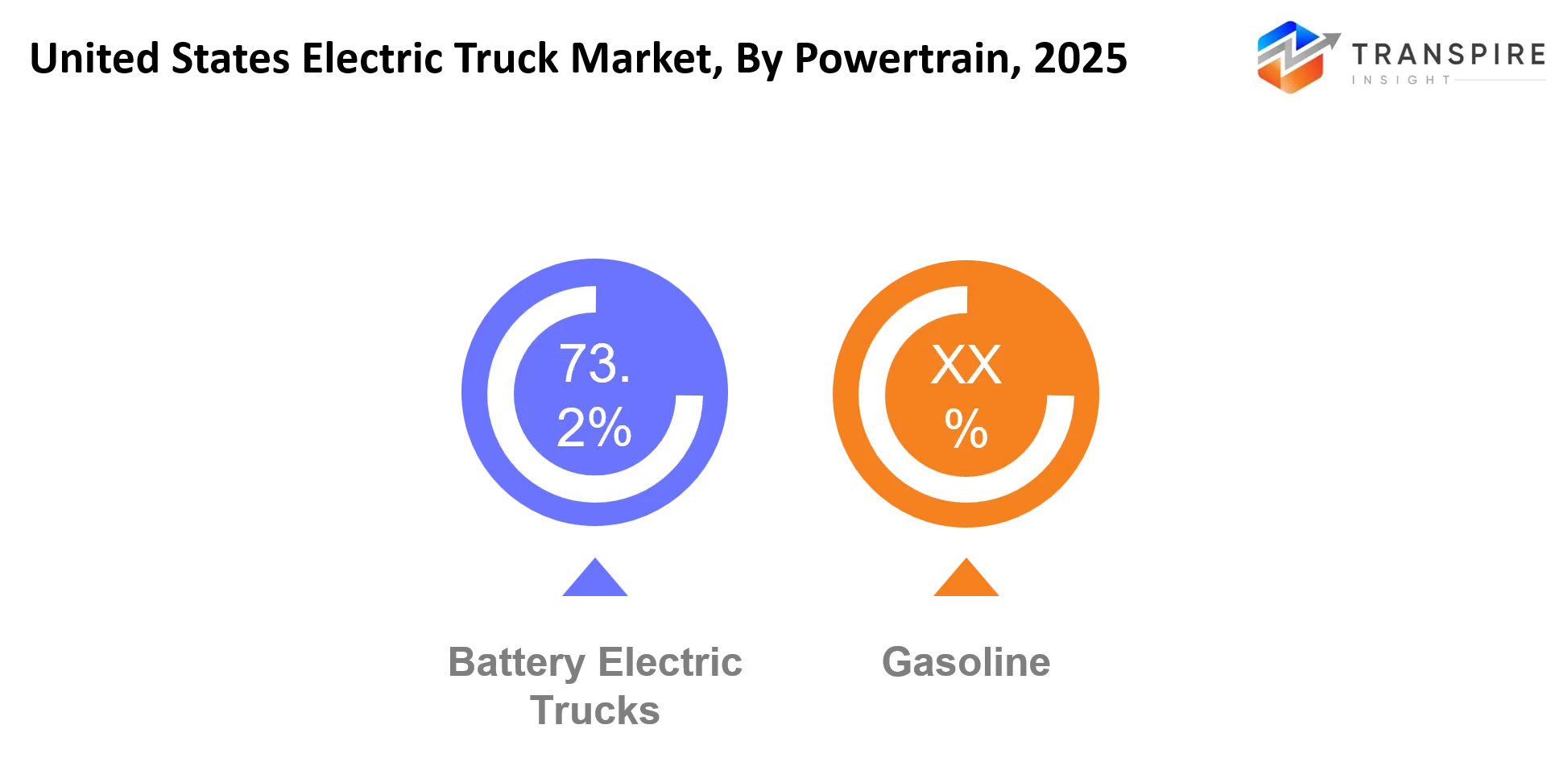
Battery Electric Trucks count as the main propulsion option, largely because battery systems let them run with zero tailpipe emissions for urban routes, regional work, and even certain heavy-duty journeys. Fuel Cell Electric Trucks are aimed at longer hauls, where fast refueling plus greater operating distance can keep up with stricter freight calendars. Plug-in Hybrid Trucks blend electric driving with a conventional source, so they’re more adaptable when charging access is limited. Hybrid Electric Trucks rely on electric assistance to lower fuel use during selected working conditions, kinda like when stop and go is common.
Range-Extended Electric Trucks stretch the useful distance by using an extra energy source, which helps when routes go beyond the usual battery ceiling. Others cover electric propulsion designs that are still emerging, built around alternative powertrain architectures. When fleets are being picked, the final call usually depends on route distance, payload needs, charging availability, vehicle cost, day to day operating needs, and the infrastructure that’s actually around.
By Battery Type
Lithium Ion Batteries are still the main battery tech for commercial electric trucks because, established production kinda keeps things available and helps the vehicle development move faster. LFP Batteries deliver long cycle life thermal stability and also less dependence on a few pricey materials, so LFP fits really well for high utilization fleet work. Solid State Batteries can bring improvements in energy density and safety, but they still need more manufacturing development before things feel truly ready. NMC Batteries give high energy density, which matters where range and payload efficiency have to stay strong.
Sodium Ion Batteries are getting more attention, since abundant raw materials could mean lower production costs. But their lower energy density means they may not work as well for some truck uses. Lead Acid Batteries still show up only in limited roles as auxiliary systems, because the extra mass is not ideal for primary propulsion. Other options include newer chemistry routes aimed at faster charging, longer service life higher energy density, or better material availability.
By Application
Logistics & Freight is a major application maybe because repeat routes, centralized depots, and high vehicle utilization help keep charging schedules efficient, in practice it just works. Construction uses electric trucks for moving materials, site operations, and shorter hauls, especially where local emissions and noise limits end up deciding what vehicle to pick, not always but often. Municipal Services rely on electric trucks for public works, upkeep, and recurring service runs. Mining operations can also bring in electric trucks inside fenced or controlled sites, where dedicated charging infrastructure supports those repeated vehicle cycles and fewer surprises.
Retail Distribution gets a clear boost from electric trucks that run between warehouses and stores, through planned schedules, mostly. Waste Management shows strong electrification upside because collection vehicles come back to fixed facilities and heavy duty truck keep repeating the same kind of routes. Utilities use electric trucks for infrastructure maintenance and out in the field services, while Agriculture supports farm logistics and short-distance material hauling, basically. Defense, along with Others, covers specialized uses where operating conditions, energy security, and overall vehicle performance shape the fleet choices, quietly but decisively.
By End User
Fleet Operators are a big end-user group, because centralized fleet management, well it helps with route planning, charging coordination, maintenance scheduling, and even lifecycle cost analysis, kind of all at once. Logistics Companies choose electric trucks for repeat deliveries and for regional freight routes, where yearly mileage can really help the vehicle economics. Retail Chains may put charging infrastructure at distribution centers and then fold electric trucks into warehouse-to-store operations, so it flows more smoothly. Government Agencies use electric trucks for public works, maintenance transportation, and a bunch of other fleet services.
Construction Companies lean on electric trucks for material hauling and for certain vocational tasks at job sites. Municipal Corporations can deploy electric trucks for refuse collection, maintenance, and public service routines. Utility Companies rely on electric work trucks for infrastructure inspection, repair work, and ongoing field maintenance. Defense Organizations can also bring electric trucks into selected logistics and base-support operations, while Others covers specialized commercial and institutional fleet operators.
What are the Key Use Cases Driving the United States Electric Truck Market?
Logistics and regional freight, sort of represent major use case(s) because fleet operators can match electric trucks with fairly predictable routes and centralized depots plus high annual mileage . With depot charging , there is less reliance on public infrastructure, while lower energy costs and reduced maintenance needs can , in practice, improve operating economics. Medium-duty delivery vehicles are especially compatible for repeated urban or regional runs, because the cadence is consistent.
Municipal services , waste collection, utilities , and retail distribution are also growing because fixed routes make charging easier, and fleet scheduling more orderly. Municipal corporations can roll out electric trucks for refuse pickup and public works , while utility companies deploy electric work trucks along recurring service routes. Retail chains can even integrate charging at distribution centers, so drivers do not keep relying on ad hoc stops .
New chances are showing up in regional heavy-duty freight, construction logistics, mining support, and certain specialized vocational operations. Megawatt-scale charging , plus better battery systems, could help electric truck deployment stretch into longer routes. Software based route planning and charging optimization will further raise utilization as electrification, across fleets , keeps growing.
|
Report Metrics |
Details |
|
Market size value in 2025 |
USD 1382.5 Million |
|
Market size value in 2026 |
USD 1842.3 Million |
|
Revenue forecast in 2033 |
USD 7629.4 Million |
|
Growth rate |
CAGR of 22.50%from 2026 to 2033 |
|
Base year |
2025 |
|
Historical data |
2021 - 2024 |
|
Forecast period |
2026 - 2033 |
|
Report coverage |
Revenue forecast, competitive landscape, growth factors, and trends |
|
Regional scope |
United States |
|
Key company profiled |
Tesla Inc., Rivian Automotive, Ford Motor Company, General Motors, Volvo Trucks, Daimler Truck, PACCAR Inc., Nikola Corporation, Lion Electric, BYD Company, Isuzu Motors, Hino Motors, Freightliner, Mack Trucks, Orange EV |
|
Customization scope |
Free report customization (country, regional & segment scope). Avail customized purchase options to meet your exact research needs. |
|
Report Segmentation |
By Vehicle Type (Light-Duty Trucks, Medium-Duty Trucks, Heavy-Duty Trucks, Pickup Trucks, Box Trucks, Semi-Trucks, Dump Trucks, Utility Trucks, Refrigerated Trucks, Others); By Propulsion (Battery Electric Trucks, Fuel Cell Electric Trucks, Plug-in Hybrid Trucks, Hybrid Electric Trucks, Range-Extended Electric Trucks, Others); By Battery Type (Lithium-Ion Batteries, LFP Batteries, Solid-State Batteries, NMC Batteries, Sodium-Ion Batteries, Lead-Acid Batteries, Others); By Application (Logistics & Freight, Construction, Municipal Services, Mining, Retail Distribution, Waste Management, Utilities, Agriculture, Defense, Others); By End User (Fleet Operators, Logistics Companies, Retail Chains, Government Agencies, Construction Companies, Municipal Corporations, Utility Companies, Defense Organizations, Others) |
Which Regions are Driving the United States Electric Truck Market Growth?
The Western United States stays the main regional market, with California giving the most meaningful policy push and the biggest deployment base for zero emission commercial vehicles. California’s Advanced Clean Trucks framework sort of pushed manufacturers and fleets toward zero emission sales, and the long standing freight corridors, plus big distribution networks and heavy commercial vehicle activity, all help adoption keep moving. The region also gets a lift from charging investments near big logistics centers and ports, so you end up with an ecosystem that links vehicle deployment with infrastructure building, kind of like hand in hand.
Meanwhile the Northeastern United States is going down a slightly different growth path, supported by dense urban freight networks, emissions rules at the state level, and very concentrated delivery activity. Compared with the West, this region leans more on urban and regional distribution loops where routes are shorter, so depot charging feels commercially practical. New York, New Jersey, Massachusetts, and a few nearby states deliver a steady policy environment that helps fleets swap out equipment without betting everything on just one state market. Put simply, dense freight demand and coordinated state programs together make more reliable revenue opportunities for manufacturers and charging providers.
The Southern United States is starting to look like a higher momentum area as manufacturers widen output and expand battery supply chains across Texas, Georgia, Tennessee, and Mississippi. Big industrial sites, lower cost land, growing logistics activity, and fresh battery manufacturing investments are building the conditions for wider commercial use.
Who are the Key Players in the United States Electric Truck Market and How Do They Compete?
In the U.S. electric truck market, competition is start ing to feel way more technology-driven, and it’s also being measured by total operating cost , not just the sticker price of the vehicle. The big, established commercial vehicle manufacturers are keeping their customer relationships solid by leaning on wide dealer and service networks. Meanwhile newer companies are pushing back on the “usual” way of doing things, by betting on dedicated electric platforms, kinda like a clean sheet approach. Stuff like battery cost, actual driving range, charging support , how often the truck is actually available (vehicle uptime), plus financing terms and fleet integration are now part of the buying decision, not “later” considerations. So the race is moving toward integrated vehicle-and-energy solutions, instead of only standalone truck sales.
Volvo Group is trying to hold and grow its position with regional-haul, drayage, and distribution vehicles, and it’s also broadening turnkey charging help for fleets. Its next-generation VNL Electric is being built around a platform that can support more than one powertrain option, which gives Volvo that extra wiggle room as fleet requirements shift over time. Daimler Truck, on the other hand, blends Freightliner’s market coverage with battery know-how and charging partnership agreements, trying to keep momentum from both sides. PACCAR benefits from Kenworth and Peterbilt distribution reach and it also shares the battery investment model through Amplify Cell Technologies.
Tesla is going for a different track, scaling the Semi using a dedicated electric layout and high-volume manufacturing. That first Semi rolled out of Tesla’s high-volume production line in April 2026, which is being treated as a major milestone toward real commercial-scale competition in heavy-duty trucking. Ford Motor Company looks more selective after it restructured several EV investments, and instead of spreading out everywhere, it’s shifting attention toward more affordable EVs plus hybrids.
Company List
- Volvo Group
- Daimler Truck Holding AG
- PACCAR Inc.
- Tesla, Inc.
- Ford Motor Company
- General Motors
- Nikola Corporation
- BYD Company Limited
- Rivian Automotive, Inc.
- Workhorse Group Inc.
- Peterbilt Motors Company
- Kenworth Truck Company
- Freightliner Trucks
- Mack Trucks
- International Motors, Inc.
Recent Development News
"In April 2026, Tesla began high-volume production of the Semi. The first Semi rolled off the new production line, marking Tesla's transition toward large-scale electric heavy-duty truck manufacturing and increasing competitive pressure in the U.S. commercial truck market.https://www.reuters.com/business/autos-transportation/first-tesla-semi-rolls-off-high-volume-production-line-2026-04-30/ (Reuters)."
"In April 2026, Volvo Trucks expanded its electric-truck technology portfolio and showcased new electromobility solutions at ACT Expo. The company highlighted next-generation powertrain technologies and integrated fleet solutions, strengthening its commercial electrification strategy for North American customers.https://www.volvotrucks.us/news-and-stories/press-releases/2026/april/volvo-trucks-advances-together-towards-zero-with-new-innovations-at-act-expo/ (Volvo Trucks North America)."
"In June 2025, Daimler Truck and Volvo Group launched Coretura. The joint venture is developing a software-defined vehicle platform designed to establish a new commercial-vehicle software standard and support future connected truck technologies.https://www.daimlertruck.com/en/newsroom/pressrelease/daimler-truck-and-volvo-group-launch-coretura-a-joint-venture-to-unlock-the-digital-future-of-commercial-vehicles-53102649 (Daimler Truck)."
What Strategic Insights Define the Future of the United States Electric Truck Market?
The U.S. electric truck industry is kind of structurally leaning toward fleet specific electrification , where you dont just “buy vehicles” but the whole package—vehicle choices, charging infrastructure, software, energy management—gets treated like one integrated operating system. You can expect the steadiest growth from uses with predictable routes and centralized depots first , before electrification really spreads out into long-haul freight.
There’s a less obvious danger too: policy fragmentation. Like, even if individual states keep adding more zero-emission requirements, federal regulatory shifts can still lower investment certainty, and that creates a weird kind of drag. Another concern sits in battery supply concentration, especially if manufacturers start relying on a narrow slice of domestic cell production while fleets are expanding fast.
On the upside, there’s a promising chance around megawatt scale charging for regional and heavy duty freight corridors, and this can be backed by localized battery production plus utility partnerships. So market participants should emphasize route specific deployment rather than broad fleet conversion , pulling together vehicle procurement with charging capacity, grid planning, financing, and software right from the first project stage.
United States Electric Truck Market Report Segmentation
By Vehicle Type
• Light-Duty Trucks
• Medium-Duty Trucks
• Heavy-Duty Trucks
• Pickup Trucks
• Box Trucks
• Semi-Trucks
• Dump Trucks
• Utility Trucks
• Refrigerated Trucks
• Others
By Propulsion
• Battery Electric Trucks
• Fuel Cell Electric Trucks
• Plug-in Hybrid Trucks
• Hybrid Electric Trucks
• Range-Extended Electric Trucks
• Others
By Battery Type
• Lithium-Ion Batteries
• LFP Batteries
• Solid-State Batteries
• NMC Batteries
• Sodium-Ion Batteries
• Lead-Acid Batteries
• Others
By Application
• Logistics & Freight
• Construction
• Municipal Services
• Mining
• Retail Distribution
• Waste Management
• Utilities
• Agriculture
• Defense
• Others
By End User
• Fleet Operators
• Logistics Companies
• Retail Chains
• Government Agencies
• Construction Companies
• Municipal Corporations
• Utility Companies
• Defense Organizations
• Others
Frequently Asked Questions
Find quick answers to common questions.
The expected United States Electric Truck Market size for the market will be USD 7629.4 Million in 2033.
Key segments for the United States Electric Truck Market are By Vehicle Type (Light-Duty Trucks, Medium-Duty Trucks, Heavy-Duty Trucks, Pickup Trucks, Box Trucks, Semi-Trucks, Dump Trucks, Utility Trucks, Refrigerated Trucks, Others); By Propulsion (Battery Electric Trucks, Fuel Cell Electric Trucks, Plug-in Hybrid Trucks, Hybrid Electric Trucks, Range-Extended Electric Trucks, Others); By Battery Type (Lithium-Ion Batteries, LFP Batteries, Solid-State Batteries, NMC Batteries, Sodium-Ion Batteries, Lead-Acid Batteries, Others); By Application (Logistics & Freight, Construction, Municipal Services, Mining, Retail Distribution, Waste Management, Utilities, Agriculture, Defense, Others); By End User (Fleet Operators, Logistics Companies, Retail Chains, Government Agencies, Construction Companies, Municipal Corporations, Utility Companies, Defense Organizations, Others)
Major United States Electric Truck Market players are Tesla Inc., Rivian Automotive, Ford Motor Company, General Motors, Volvo Trucks, Daimler Truck, PACCAR Inc., Nikola Corporation, Lion Electric, BYD Company, Isuzu Motors, Hino Motors, Freightliner, Mack Trucks, Orange EV
The United States Electric Truck Market size is USD 1382.5 Million in 2025.
The United States Electric Truck Market CAGR is 22.50% from 2026 to 2033.
- Volvo Group
- Daimler Truck Holding AG
- PACCAR Inc.
- Tesla, Inc.
- Ford Motor Company
- General Motors
- Nikola Corporation
- BYD Company Limited
- Rivian Automotive, Inc.
- Workhorse Group Inc.
- Peterbilt Motors Company
- Kenworth Truck Company
- Freightliner Trucks
- Mack Trucks
- International Motors, Inc.
About the Authors

Mayur Shinde
I am Mayur Shinde, a Senior Research Analyst at Transpire Insight, specializing in the Automotive & Transportation and Information & Communication Technology (ICT) Industry. My work focuses on analyzing emerging market trends, technological advancements, competitive landscapes, and industry developments to deliver accurate, data-driven insights. I am passionate about transforming complex market information into clear, actionable content that helps businesses, professionals, and decision-makers stay informed and make confident strategic decisions.

Chakradhar Khansole
Chakradhar serves as the Research Director at Transpire Insight, bringing over 8 years of experience in technology, innovation, and strategic market intelligence. He specializes in transforming complex market data into actionable business insights that enable organizations to make informed, growth-oriented decisions. Recognized for his strategic vision and analytical expertise, Chakradhar leads high-impact research initiatives, delivering comprehensive market assessments, competitive intelligence, and forward-looking industry analysis.
Recently Published Reports
-
Apr 2026
ATV & UTV Market
ATV & UTV Market Size, Share & Analysis Report By Type (ATV, and UTV), By Variants (Less Than 400 CC, 400 CC To 800 CC, and More Than 800 CC), and Geography (North America, Europe, Asia-Pacific, Middle East and Africa, South and Central America), 2021 - 2031
-
Apr 2026
Automotive Central Gateway Module Market
Automotive Central Gateway Module Market Size, Share & Analysis Report By Type (Ethernet Central Gateway Module, CAN Central Gateway Module, LIN Central Gateway Module, and FlexRay), By Application (Powertrain Control, Body Control, Infotainment System, Advanced Driver Assistance Systems (ADAS), and Others), By End User (Passenger Vehicles, and Commercial Vehicles), and Geography (North America, Europe, Asia-Pacific, Middle East and Africa, South and Central America), 2021 - 2031
-
Apr 2026
Automotive Engine Oil Filter Market
Automotive Engine Oil Filter Market Size, Share & Analysis Report By Filter Type (Fuel Filter, Engine Oil Filter, Hydraulic Oil Filter, and Others), By Filter Media (Cellulose, Synthetic, and Micro), By Sales Channel (OEMs, and Aftermarket), By Vehicle Type (Passenger Cars, Light Commercial Vehicles, Heavy Duty Trucks, Buses and Coaches, and Off-road Vehicles), and Geography (North America, Europe, Asia-Pacific, Middle East and Africa, South and Central America), 2021 - 2031
-
Apr 2026
Automotive Parts Aluminium Die Casting Market
Automotive Parts Aluminium Die Casting Market Size, Share & Analysis Report By Production Process (Pressure Die Casting, Vacuum Die Casting, Squeeze Die Casting, Gravity Die Casting), By Application (Body Parts, Engine Parts, Transmission Parts, Battery And Related Components, Other Application Types), and Geography (North America, Europe, Asia-Pacific, Middle East and Africa, South and Central America), 2021 - 2031
Our Clients