
United States Digital Experience Platform Market Size & Forecast:
United States Digital Experience Platform Market Size 2025: USD 4901.8 Million
United States Digital Experience Platform Market Size 2026: USD 5484.9 Million
United States Digital Experience Platform Market Size 2033: USD 12197.6 Million
United States Digital Experience Platform Market CAGR: 12.10%
United States Digital Experience Platform Market Segments: By Deployment (Cloud, On-premise), By Component (Platform, Services), By End Use (BFSI, Retail, Healthcare, IT & Telecom, Manufacturing, Government, Energy & Utilities, Retail & E-commerce, Media & Entertainment, Automotive, Discrete Manufacturing, Government & Education, Others)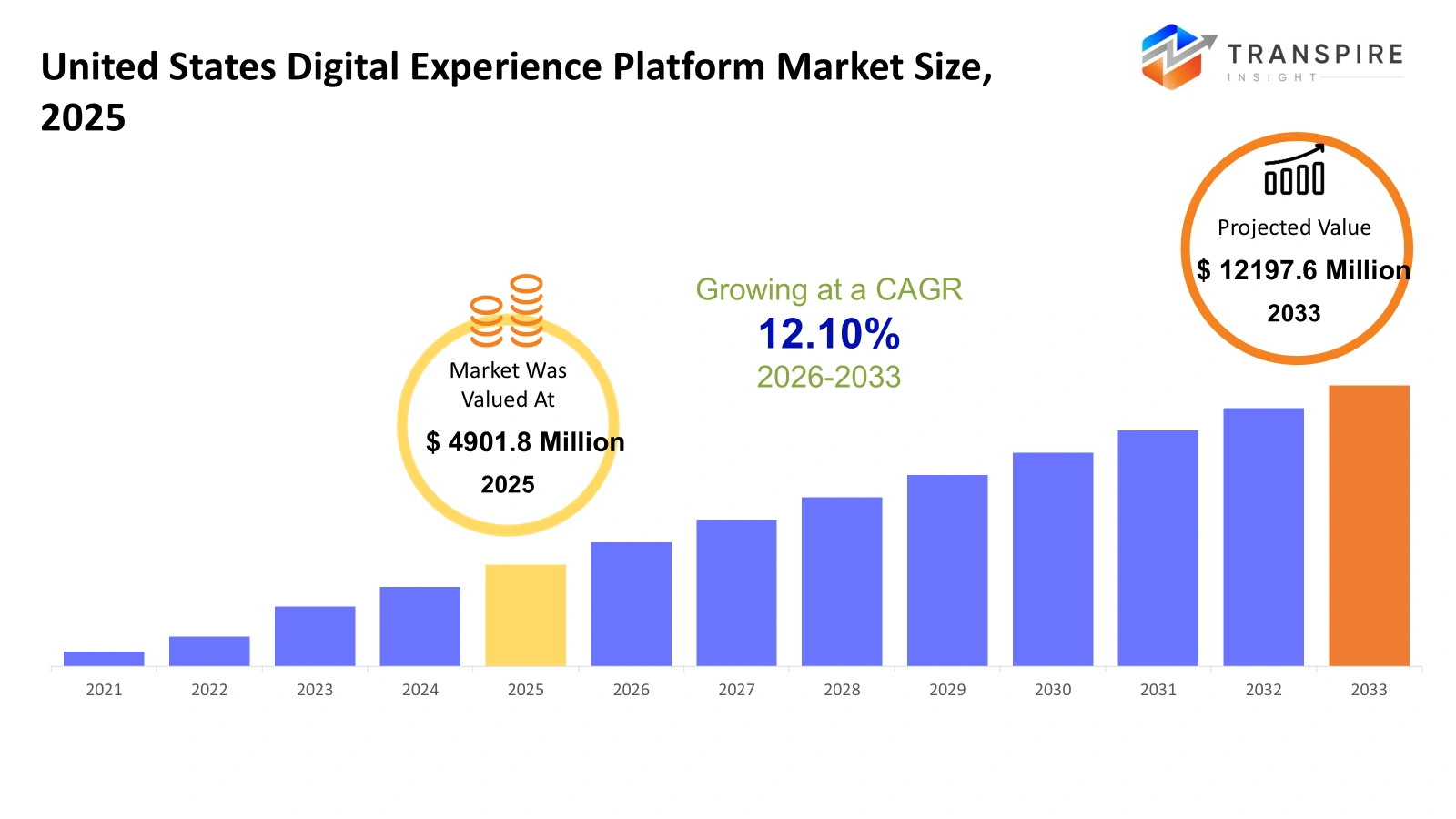
To learn more about this report,  Download Free Sample Report
United States Digital Experience Platform Market Summary:
The United States Digital Experience Platform Market size is estimated at USD 4901.8 million in 2025 and is expected to reach USD 12197.6 million by 2033, growing at a CAGR of 12.10% from 2026 to 2033.
Digital transformation and customer engagement have become essential business needs for organizations throughout the United States. Digital experience platforms (DXPs) help enterprises deliver personalized, consistent, and seamless experiences through their websites and mobile applications and e-commerce platforms and social media channels. Companies across multiple industries are adopting DXP solutions to enhance customer journeys, improve content management, and boost their digital marketing efforts. The increasing adoption of artificial intelligence together with cloud computing and advanced analytics enables businesses to analyze user behavior for creating customized digital experiences. The growth of e-commerce together with digital banking and online healthcare services and remote customer engagement has created a rising need for digital experience platforms throughout the United States.
Key Market Trends & Insights:
- The businesses throughout the United States now view omnichannel digital engagement as an important business area which requires them to adopt advanced digital experience platforms that enable customer interactions through web and mobile and social media platforms.
- Companies demonstrate a strong preference for cloud-based digital experience platforms because these solutions provide businesses with the ability to expand their operations while maintaining budget control and operational adaptability and enabling employees to access remote work environments through real-time content management.
- DXPs use artificial intelligence and machine learning technologies to deliver customers with highly personalized experiences which include predictive analytics capabilities and automatic customer communication systems.
- The e-commerce and retail sectors drive vendors to enhance their content management and digital commerce and customer data integration solutions.
- Companies allocate substantial financial resources to customer experience management because they want to strengthen brand loyalty and improve customer retention and develop their digital service operations.
United States Digital Experience Platform Market Segmentation
By Deployment
Cloud: The United States markets utilize cloud-based digital experience platforms because these platforms provide businesses with scalable and flexible solutions that work at economical costs. Organizations can easily deploy, manage, and update digital content through cloud environments without investing heavily in on-premise infrastructure. The cloud deployment model now empowers companies to connect their artificial intelligence systems and analytics tools and customer data platforms in order to provide customized digital experiences.
On-Premise: Organizations that need complete control over their data security and compliance with regulations choose on-premise digital experience platforms as their main solution. Organizations in banking and government and healthcare sectors choose on-premise solutions because these systems enable them to handle protected data within their own facilities while implementing strict security measures.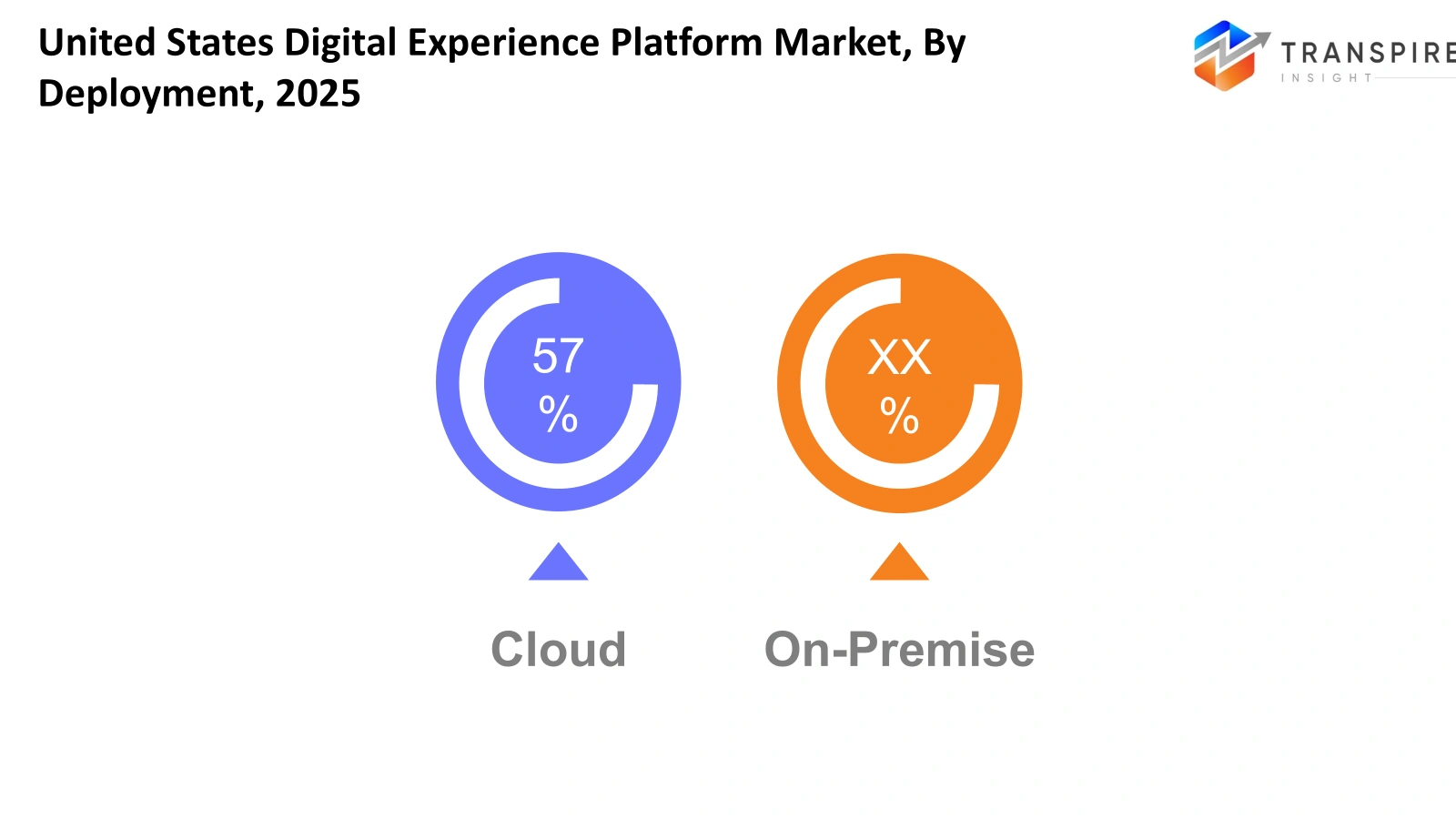
To learn more about this report, Download Free Sample Report
By Component
Platform: The platform segment includes core software solutions which deliver content management functions together with digital marketing tools and customer data management capabilities and personalization functions. The platforms enable organizations to manage their websites and mobile applications and digital campaigns through a single interface which enhances their operational efficiency and user interaction with their systems.
Services: The digital experience platforms provide various services which include implementation and consulting and integration and support services. The majority of enterprises depend on service providers to connect their digital experience platforms with their current enterprise systems which include CRM and ERP and analytics platforms to maintain smooth digital business operations and achieve maximum efficiency.
By End Use
BFSI: The BFSI sector uses digital experience platforms to enable banks and financial institutions to deliver better digital banking services which result in improved customer interaction and customized financial products through their mobile and online services.
Retail: Retail companies use digital experience platforms to develop unified shopping experiences that customers can access through their websites and mobile applications and e-commerce sites while increasing customer retention and making product discovery easier.
Healthcare: Healthcare providers implement digital experience platforms to manage patient portals, telehealth services, appointment systems, and personalized health content.
IT & Telecom: Digital experience platforms assist telecommunication and IT companies in handling their digital operations while building better customer self-service systems and making their digital customer interactions more efficient.
Manufacturing: The manufacturing industry uses digital experience platforms to improve their B2B interactions and product catalog management and customer support operations.
Government: Government organizations adopt DXPs to modernize public service portals, improve citizen engagement, and streamline digital communication.
Energy & Utilities: Energy companies use digital platforms to provide online billing, customer support, and energy consumption insights.
Retail & E-commerce: This segment represents a major driver of the market as companies continuously enhance digital shopping experiences through personalization, targeted marketing, and integrated payment systems.
Media & Entertainment: Media organizations deploy digital experience platforms to deliver streaming content, digital subscriptions, and personalized media recommendations.
Automotive: Automotive companies use DXPs to improve digital marketing, online vehicle configuration tools, and connected customer experiences.
Discrete Manufacturing:Discrete manufacturers rely on DXPs to manage digital product information and improve B2B digital engagement.
Government & Education: Educational institutions and public sector organizations use DXPs to manage online learning platforms and digital communication systems.
Others: Other industries adopting digital experience platforms include travel, hospitality, and professional services.
Country Insights
The United States represents one of the largest markets for digital experience platforms due to its strong digital infrastructure, high technology adoption rates, and presence of major technology vendors. Organizations across retail banking healthcare and media sectors are spending money on advanced digital experience technologies which help them to better engage customers while they improve their operational efficiency. The rise of mobile commerce, online services, and digital content consumption continues to drive demand for sophisticated digital experience platforms. American businesses dedicate most of their resources toward developing personalized customer experiences through data-backed marketing techniques. Digital experience platforms enable businesses to gather and examine customer data which they use to create customized content and services.
Recent Development News
Increasing Demand for AI-Driven Customer Experience Solutions Accelerates Adoption of Digital Experience Platforms in the United States
Major Technology Vendors Expand Cloud-Based Digital Experience Platform Capabilities for Enterprise Customers
|
Report Metrics |
Details |
|
Market size value in 2025 |
USD 4901.8 Million |
|
Market size value in 2026 |
USD 5484.9 Million |
|
Revenue forecast in 2033 |
USD 12197.6 Million |
|
Growth rate |
CAGR of 12.10% from 2026 to 2033 |
|
Base year |
2025 |
|
Historical data |
2021 - 2024 |
|
Forecast period |
2026 - 2033 |
|
Report coverage |
Revenue forecast, competitive landscape, growth factors, and trends |
|
Country scope |
United States |
|
Key company profiled |
Adobe, Salesforce, Oracle, SAP, IBM, Microsoft, Acquia, Sitecore, Liferay, OpenText, Bloomreach, Optimizely, Crownpeak, Progress Software, Episerver. |
|
Customization scope |
Free report customization (country, regional & segment scope). Avail customized purchase options to meet your exact research needs. |
|
Report Segmentation |
By Deployment (Cloud, On-premise) Component (Platform, Services), By End Use (BFSI, Retail, Healthcare, IT & Telecom, Manufacturing, Government, Energy & Utilities, Retail & E-commerce, Media & Entertainment, Automotive, Discrete Manufacturing, Government & Education, Others) |
Key United States Digital Experience Platform Company Insights
The United States Digital Experience Platform Market belongs to major technology companies which provide complete solutions that integrate content management and analytics and digital marketing and customer experience tools.
Companies are investing heavily in research and development to integrate artificial intelligence, automation, and advanced analytics into digital experience platforms. Through these advancements, businesses can provide their customers with customized experiences that span various online platforms.
Market participants use strategic partnerships and acquisitions and product innovations as their primary methods to enhance their operational abilities and boost their market competitiveness.
Company List
Adobe
Salesforce
Oracle
SAP
IBM
Microsoft
Acquia
Sitecore
Liferay
OpenText
Bloomreach
Optimizely
Crownpeak
Progress Software
Episerver
United States Digital Experience Platform Market Report Segmentation
By Deployment
- Cloud
· On-premise
By Component
- Platform
· Services
By End Use
- BFSI
· Retail
· Healthcare
· IT & Telecom
· Manufacturing
· Government
· Energy & Utilities
· Retail & E-commerce
· Media & Entertainment
· Automotive
· Discrete Manufacturing
· Government & Education
· Others
Frequently Asked Questions
Find quick answers to common questions.
The United States Digital Experience Platform Market is expected to reach approximately USD 12197.6 million by 2033.
The key segments include Deployment (Cloud, On-premise), Component (Platform, Services), and End Use industries.
Major companies include Adobe, Salesforce, Oracle, SAP, IBM, Microsoft, Acquia, Sitecore, Liferay, OpenText, Bloomreach, Optimizely, Crownpeak, Progress Software, and Episerver.
The United States Digital Experience Platform Market size is USD 4901.8 million in 2025.
The United States Digital Experience Platform Market is projected to grow at a CAGR of 12.10% from 2026 to 2033.
Adobe
Salesforce
Oracle
SAP
IBM
Microsoft
Acquia
Sitecore
Liferay
OpenText
Bloomreach
Optimizely
Crownpeak
Progress Software
Episerver
Recently Published Reports
-
Apr 2026
3D Optical Profiler Market
3D Optical Profiler Market Size, Share & Analysis Report By Type (Desktop 3D Optical Profiler, and Portable 3D Optical Profiler), By Technology (Confocal Technology, and White Light Interference), By End-Use Industry (Manufacturing, Research Institutions, Automotive, Aerospace and Defense, Medical Devices, and Other), and Geography (North America, Europe, Asia-Pacific, Middle East and Africa, South and Central America), 2021 - 2031
-
Apr 2026
Depth Sensor Market
Depth Sensor Market Size, Share & Analysis Report By Type (Infrared Depth Sensors, Time-of-Flight (ToF) Sensors, Stereo Vision Sensors, Structured Light Sensors, Ultrasonic Depth Sensors), By Application (Automotive, Robotics, Gaming, Consumer Electronics, Industrial Automation, Healthcare, Security & Surveillance, Others), By End Users (Automotive Manufacturers, Consumer Electronics Companies, Healthcare Providers, Industrial Companies, Security Agencies, Gaming Companies, Robotics Companies, Others), and Geography (North America, Europe, Asia-Pacific, Middle East and Africa, South and Central America), 2021 – 2031
-
Apr 2026
Digital Manufacturing Market
Digital Manufacturing Market Size, Share & Analysis Report By Component (Hardware, Software, and Services), By Technology (Robotics, 3D Printing, Internet of Things (IoT), and Others), By Application (Automotive and Transportation, Aerospace and Defense, Consumer Electronics, Industrial Machinery, and Others), By Process Type (Computer-Based Designing, Computer-Based Simulation, Computer 3D Visualization, Analytics, and Others), and Geography (North America, Europe, Asia-Pacific, Middle East and Africa, South and Central America), 2021 – 2031
-
Apr 2026
Digital Visa Services Market
Digital Visa Services Market Size, Share & Analysis Report By Type (Individual Travelers, Group Travelers), By Application (Tourism, Business Travel, Others), and Geography (North America, Europe, Asia-Pacific, Middle East and Africa, South and Central America), 2021 – 2031