
United States Commercial Air Conditioner Market Size & Forecast:
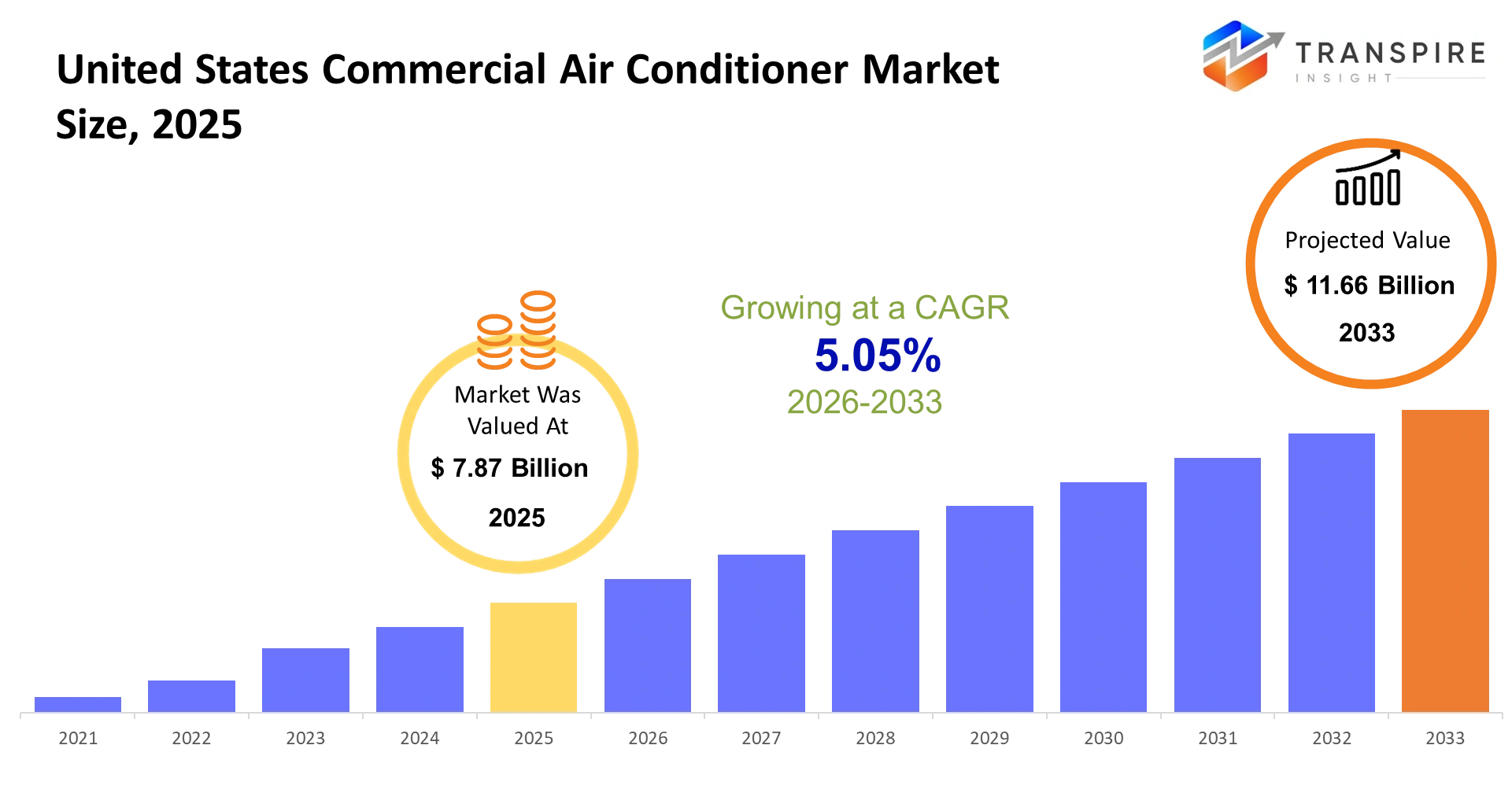
- United States Commercial Air Conditioner Market Size 2025: USD 7.87 Billion
- United States Commercial Air Conditioner Market Size 2033: USD 11.66 Billion
- United States Commercial Air Conditioner Market CAGR: 5.05%
- United States Commercial Air Conditioner Market Segments:By Type (Split, VRF, Chillers, Rooftop, Packaged, Ducted, Portable), By Capacity (Below 5, 5–20, 20–50, 50–100, >100, Modular, Variable), By Application (Offices, Retail, Healthcare, Hospitality, Education, Data Centers, Industrial), By Technology (Inverter, Non-inverter, Smart, IoT, Efficient, Hybrid, Solar), By End-User (Commercial, Industrial, Govt, Retail, Hotels, Hospitals, Institutions).
To learn more about this report,  Download Free Sample Report
United States Commercial Air Conditioner Market Summary:
The United States commercial air conditioner market size is estimated at USD 7.87 billion in 2025 and is anticipated to reach USD 11.66 billion by 2033, growing at a CAGR of 5.05% from 2026 to 2033. The United States commercial air conditioner market keeps growing because businesses require cooling systems that deliver both energy efficiency and reliable operation. The development of new HVAC technology solutions which include advanced controls and environmentally safe refrigerants arises from demand coming from office spaces, retail spaces and industrial facilities. The need for sustainability and cost reductions has become a primary business goal which drives organisations to replace their outdated systems with new technology. The market will expand when extreme weather patterns and indoor comfort requirements create fresh business opportunities for equipment manufacturers and service providers.
Key Market Trends & Insights:
- Businesses are increasingly purchasing air conditioners which have higher energy efficiency ratings because it helps them to achieve lower operational costs and meet their environmental sustainability requirements. The demand for smart HVAC systems which enhance energy efficiency through their optimization features is increasing.
- Organizations can monitor their systems remotely through IoT-enabled controls and sensors which also enable them to conduct predictive maintenance. Commercial spaces experience operational efficiency improvements because this trend decreases their downtime.
- Companies now adopt AC systems which use low-GWP refrigerants to comply with stricter environmental regulations. The method enables businesses to decrease their carbon emissions while their cooling systems maintain operational efficiency.
- The growing demand for advanced cooling solutions comes from the expansion of office complexes and retail centers and hospitality sectors. Commercial environments need cooling systems which provide comfortable temperatures without consuming too much electricity.
- Many businesses are replacing their old AC systems with energy-efficient technology. Retrofitting equipment with energy-saving technology increases its operational lifespan while decreasing all related maintenance expenses.
- Clients now choose HVAC systems which provide superior air filtration together with effective humidity management. Health concerns and the need for safe indoor environments drive this trend.
- Manufacturers are developing AI-powered inverter-based air conditioning systems which change their cooling functions according to actual user needs. These technological advancements lead to enhanced performance capabilities which also decrease energy usage while providing users with improved convenience.
United States Commercial Air Conditioner Market Segmentation
By Component
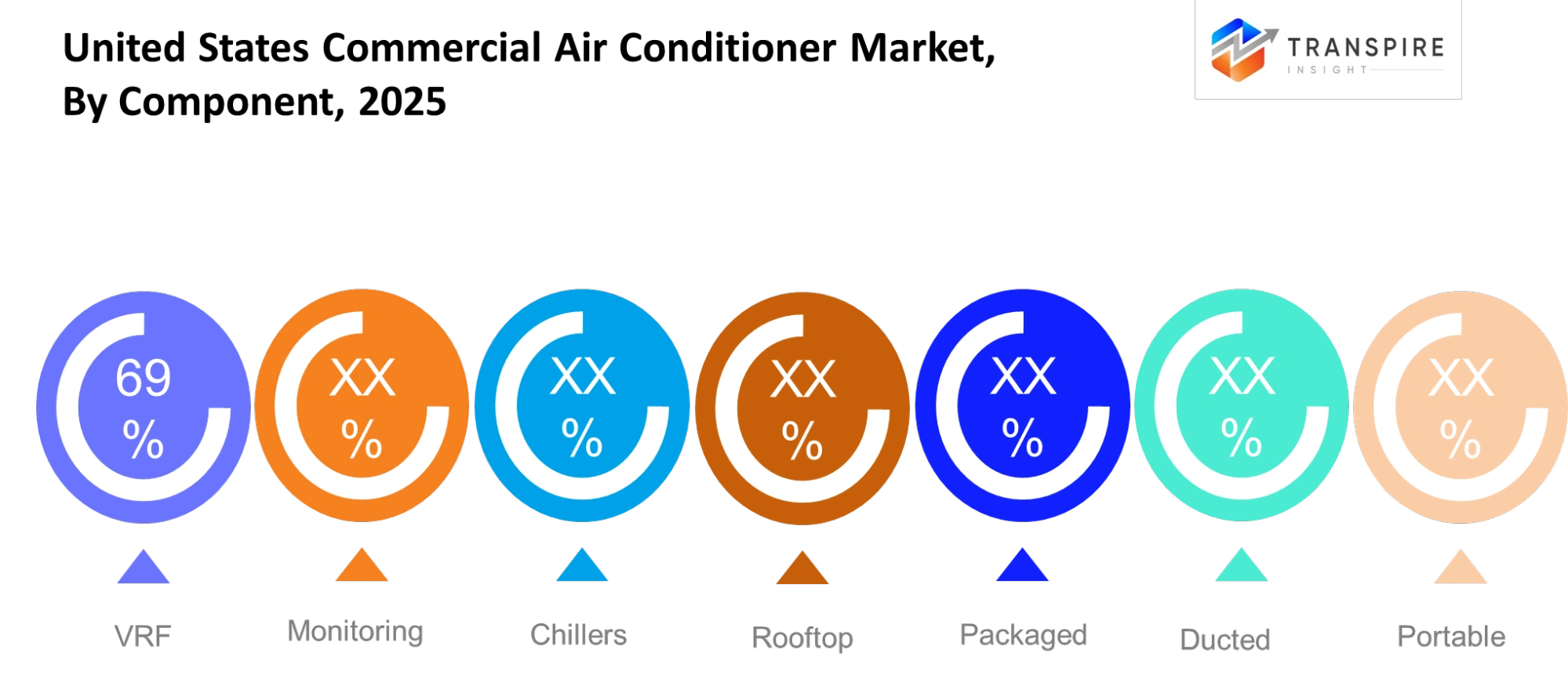
- Monitoring: The system provides cooling to both offices and small commercial spaces because it operates silently and delivers efficient cooling solutions. The system provides businesses with an effective solution because it enables flexible installation and dedicated climate management for energy-saving purposes.
- VRF: VRF systems are gaining traction in large commercial buildings for their precise temperature control and energy efficiency. The systems provide capacity for simultaneous cooling and heating to multiple zones which decreases energy consumption while delivering adaptable solutions to handle complex systems.
- Chillers: Chillers serve as fundamental cooling systems that deliver substantial cooling capacity to both industrial and institutional facilities. These systems provide dependable operation through their ability to work with centralized HVAC systems which makes them suitable for hospitals, data centers and manufacturing units.
- Rooftop: Rooftop units function as space-efficient solutions which require minimal upkeep and they are frequently utilized in both retail spaces and industrial environments. The system delivers dependable cooling across extensive areas which enables businesses to achieve cost-effective operations while maintaining customer satisfaction.
- Packaged: Packaged air conditioners combine components in one unit which provides users with operational simplicity and fast installation. The system provides effective performance to commercial spaces through its simple maintenance needs which reduces the need for extensive infrastructure work.
- Ducted: Ducted systems provide uniform cooling across multiple rooms or areas through centralized ductwork. The system works best in hotels, educational institutions and office spaces which require silent background climate control that operates without visible equipment in each separate room.
- Portable: Portable air conditioners provide flexible cooling solutions which commercial spaces require because they need cooling in small areas that require temporary cooling. The system can be easily transported and needs only basic installation work which makes it appropriate for short-term cooling needs in offices and shops and industrial facilities.
To learn more about this report, Download Free Sample Report
By Capacity
- Cloud: The areas of larger commercial spaces and offices need systems that operate below 5 tons because these systems provide budget-friendly cooling solutions which consume less energy. The units function as perfect solutions for small spaces which need to deliver effective results without needing large building systems.
- 5–20 Ton: The retail outlets and small hospitals which serve as mid-sized commercial establishments choose 5-20 ton systems because these systems provide suitable operational power. The units deliver dependable cooling services which function at effective energy usage throughout their operation period.
- 20–50 Ton: The 20-50 ton capacity AC systems fulfill the cooling needs of data centers and industrial facilities. The systems provide consistent temperature management throughout their large areas which businesses require to maintain constant cooling operations.
- 50–100 Ton: The major commercial centers and airports and factories use high-capacity AC systems which operate between this range. The systems provide strong cooling capabilities for their extensive operations while maintaining proper indoor temperature conditions which supports continuous business activities.
- >100: The AC systems which operate above 100 tons serve ultra-large commercial facilities and industrial facilities. The units function as energy-efficient systems which maintain operational efficiency throughout their lifespan to meet the cooling needs of high-demand work environments.
- Modular: The modular systems provide businesses with flexible cooling solutions which can expand to meet their future growth requirements. The system permits commercial establishments to expand their air conditioning capacity through unit additions which deliver flexible energy-saving solutions at lower initial expenses.
- Variable: The variable capacity systems use real-time demand data to control system output which results in lower energy waste. The system operates best in spaces which experience changing occupancy rates because it enables users to feel more comfortable while decreasing their operational costs.
By Application
- Offices: The design of office spaces aims to create comfortable environments which maintain silent operations while using energy-efficient systems. The implementation of commercial air conditioning systems enables businesses to achieve stable temperature management, which results in enhanced employee efficiency and decreased power expenses.
- Retail: Retail spaces design their layout to create a pleasant shopping atmosphere which also helps to decrease power consumption. Air conditioners create a comfortable environment which improves the shopping experience in stores that operate during extended business hours.
- Healthcare: Hospitals and clinics require precise temperature and humidity control for patient safety and equipment protection. Healthcare AC systems operate through three essential functions, which include dependable performance and quality air distribution and 24-hour system availability.
- Hospitality: Hotels and resorts require efficient cooling systems to maintain optimal guest temperatures. The air conditioning systems in this sector operate with three main design elements, which include energy-efficient functions and silent operation and temperature management for specific areas to improve customer satisfaction.
- Education: Air conditioning systems in educational institutions provide students with comfortable spaces which support their academic activities. The systems provide silent operation, which enables efficient cooling for all areas in classrooms, auditoriums and administrative spaces.
- Data Centers: Equipment requires overheating protection, which means there are cooling solutions needed within the system. To maintain operational continuity while reducing equipment failure rates, high-performance air conditioning systems offer precise temperature and moisture control.
- Industrial: The industrial sector requires powerful air conditioning systems which maintain operating conditions for both machinery and employees. The systems work through their design to operate successfully in environments which require high-capacity functions under continuous operation.
By Technology
- Inverter: Inverter technology enables compressors to operate at different speeds, which results in better energy efficiency and maintains constant temperature levels. The system helps in reducing electricity expenses while it increases the operational life of the equipment.
- Non-Inverter: Non-inverter systems operate at fixed speeds, which enables them to provide continuous cooling in spaces that require basic cooling solutions with minimal upkeep. The system proves to be dependable for basic commercial operations.
- Smart: Smart systems provide three main functions, which include remote monitoring, automated scheduling and app-based control. The system provides modern workplaces with three advantages, which include better convenience and energy efficiency and better adaptability.
- IoT-Enabled: IoT integration enables facilities to monitor data in real time while they perform predictive maintenance and connect with building management systems. The system has gained popularity among large commercial organisations.
- Energy-Efficient: Energy-efficient AC systems decrease electricity usage while they sustain their peak operational capacity. The systems meet sustainability objectives and comply with environmental regulations, which leads to cost reductions throughout their operational lifetime.
- Hybrid: Hybrid systems use multiple cooling technologies to achieve maximum energy efficiency. The systems provide operational flexibility, which makes them suitable for facilities that require different cooling capacities.
- Solar: Solar-powered ACs use renewable energy sources to cut down their operational expenses. The system provides a sustainable cooling option which meets the requirements of environmentally friendly businesses.
By End-User
- Commercial: A commercial business sector which includes offices and malls and retail stores uses air conditioning systems to create comfortable environments for customers while maintaining their business operations. The systems were designed to achieve dependable operation and to minimise energy consumption and to facilitate simple system upkeep.
- Industrial: The industrial sector requires AC systems which provide both high cooling capacities and strong durability to safeguard their equipment and maintain a secure workplace. The segment depends on its vital requirement for robust performance.
- Government: Energy-efficient AC systems which require minimal upkeep are installed in government buildings to serve their public offices and administrative centres and civic facilities, which will function efficiently for an extended period.
- Retail: Retailers use air conditioning systems which deliver comfortable environments to customers while maintaining a balance between system performance and operational expenses. The business depends on efficient cooling systems which meet customer demands to achieve success.
- Hotels: The AC systems used in hotels provide three main functions, which include delivering guest comfort and operating silently and enabling multiple areas to be controlled independently. The energy-efficient systems help control operational expenses.
- Hospitals: Hospitals require precise temperature control and air quality management because these elements protect patient well-being and guarantee proper medical equipment operation. The system needs to function without interruption throughout its entire operational period.
- Institutions: Educational and research institutions choose air conditioning systems which deliver silent operation and energy-efficient performance and dependable functioning results to establish comfortable spaces for their students and staff members and visitors.
Country Insights
The United States commercial air conditioner market is experiencing steady growth because businesses in multiple sectors require energy-efficient cooling systems that provide reliable performance. Advanced HVAC systems have become standard equipment in offices and retail spaces and healthcare facilities and data centres because they provide comfort and operational efficiency and help organisations meet compliance requirements. The growth of urban areas and commercial building development has created demand for modern AC systems which use inverter technology and smart functions and Internet of Things capabilities. Businesses are pursuing sustainability by choosing environmentally safe refrigerants and energy-efficient equipment which helps them decrease carbon emissions and cut operational expenses. The adoption of various air conditioning systems shows regional differences because high-density urban areas prefer centralised VRF and chiller systems, while smaller commercial enterprises choose between split and rooftop units. The combination of extreme weather patterns and indoor air quality requirements has increased system upgrades and retrofits, which creates opportunities for new commercial cooling innovations in the U.S. market.
Recent Development News
In March 2026, U.S. HVAC Market Shows Multi-Year Growth: The U.S. heating, ventilation, and air conditioning market continues solid growth, driven by energy efficiency adoption and construction activity
In February 2026, Mitsubishi Electric Trane Showcases New AC Tech at AHR Expo: The latest all-electric and VRF heat pump HVAC technologies are highlighted at a major U.S. industry expo.
|
Report Metrics |
Details |
|
Market size value in 2025 |
USD 7.87 Billion |
|
Market size value in 2026 |
USD 8.26 Billion |
|
Revenue forecast in 2033 |
USD 11.66 Billion |
|
Growth rate |
CAGR of 5.05% from 2026 to 2033 |
|
Base year |
2025 |
|
Historical data |
2021 – 2024 |
|
Forecast period |
2026 – 2033 |
|
Report coverage |
Revenue forecast, competitive landscape, growth factors, and trends |
|
Country scope |
United States |
|
Key company profiled |
Daikin, Carrier, Trane, Johnson Controls, LG, Mitsubishi, Panasonic, Samsung, Lennox, Bosch, Hitachi, Fujitsu, Blue Star, Voltas, Gree |
|
Customization scope |
Free report customization (country, regional & segment scope). Avail customized purchase options to meet your exact research needs. |
|
Report Segmentation |
By Type (Split, VRF, Chillers, Rooftop, Packaged, Ducted, Portable), By Capacity (Below 5, 5–20, 20–50, 50–100, >100, Modular, Variable), By Application (Offices, Retail, Healthcare, Hospitality, Education, Data Centers, Industrial), By Technology (Inverter, Non-inverter, Smart, IoT, Efficient, Hybrid, Solar), By End-User (Commercial, Industrial, Govt, Retail, Hotels, Hospitals, Institutions). |
Key United States Industrial Coating Company Insights
Leading companies in the United States commercial air conditioner market are focusing on innovation, energy efficiency and sustainability to maintain their competitive position. Manufacturers are investing in smart IoT-enabled inverter-based systems to meet the evolving demands of multiple sectors, which include offices and retail and healthcare and industrial sectors. Companies are also prioritising eco-friendly refrigerants and modular solutions to reduce their operational expenses and environmental footprint. The market presence of businesses expands through three main strategies, which include forming strategic partnerships, upgrading products and entering new geographic markets. The future of commercial cooling in the U.S. market is being shaped by businesses which focus on delivering reliable and efficient solutions that meet customer needs.
Company List
- Daikin
- Carrier
- Trane
- Johnson Controls
- LG
- Mitsubishi
- Panasonic
- Samsung
- Lennox
- Bosch
- Hitachi
- Fujitsu
- Blue Star
- Voltas
- Gree
United States Commercial Air Conditioner Market Report Segmentation
By Type
- Split
- VRF
- Chillers
- Rooftop
- Packaged
- Ducted
- Portable
By Capacity
- Below 5
- 5–20
- 20–50
- 50–100
- >100
- Modular
- Variable
By Application
- Offices
- Retail
- Healthcare
- Hospitality
- Education
- Data Centers
- Industrial
By Technology
- Inverter
- Non-inverter
- Smart
- IoT
- Efficient
- Hybrid
- Solar
By End-User
- Commercial
- Industrial
- Govt
- Retail
- Hotels
- Hospitals
- Institutions
Frequently Asked Questions
Find quick answers to common questions.
The Approximate United States Commercial Air Conditioner Market size for the Market will be USD 11.66 Billion in 2033.
The key Segments of the United States Commercial Air Conditioner Market are By Type (Split, VRF, Chillers, Rooftop, Packaged, Ducted, Portable), By Capacity (Below 5, 5–20, 20–50, 50–100, >100, Modular, Variable), By Application (Offices, Retail, Healthcare, Hospitality, Education, Data Centers, Industrial), By Technology (Inverter, Non-inverter, Smart, IoT, Efficient, Hybrid, Solar), By End-User (Commercial, Industrial, Govt, Retail, Hotels, Hospitals, Institutions).
Major Players in the United States Commercial Air Conditioner Market are Daikin, Carrier, Trane, Johnson Controls, LG, Mitsubishi, Panasonic, Samsung, Lennox, Bosch, Hitachi, Fujitsu, Blue Star, Voltas, Gree.
The Current Market size of the United States Commercial Air Conditioner Market is USD 7.87 Billion in 2025.
The United States Commercial Air Conditioner Market CAGR is 5.05%.
- Daikin
- Carrier
- Trane
- Johnson Controls
- LG
- Mitsubishi
- Panasonic
- Samsung
- Lennox
- Bosch
- Hitachi
- Fujitsu
- Blue Star
- Voltas
- Gree
Recently Published Reports
-
Apr 2026
Bottled Water Market
Bottled Water Market Size, Share & Analysis Report By Product Type (Still Bottled Water, Carbonated Bottled Water, Functional Bottled Water, and Others), By Packaging (PET, Cans, and Others), By Sales Channel (Supermarkets/Hypermarkets, Convenience Stores/Drug Stores, Grocery Stores/Club Stores, Foodservice, and Others) and Geography (North America, Europe, Asia-Pacific, Middle East and Africa, South and Central America), 2021 - 2032
-
Apr 2026
Color Cosmetic Packaging Market
Color Cosmetic Packaging Market Size, Share & Analysis Report By Application (Mascara Packaging, Liquid Packaging, and Liquid Face), By Type (Tubes & Bottles, Pens & Markers, Compacts & Containers, and Droppers & Pumps), and Geography (North America, Europe, Asia-Pacific, Middle East and Africa, South and Central America), 2021 - 2031
-
Apr 2026
External Microphone For Camera Market
External Microphone For Camera Market Size, Share & Analysis Report By Type (Shotgun Microphone, Lavalier Microphone, and Others), By Application (Digital Camera, Professional Video Camera, and Others), and Geography (North America, Europe, Asia-Pacific, Middle East and Africa, South and Central America), 2021 - 2031
-
Apr 2026
Foot Orthotic Insoles Market
Foot Orthotic Insoles Market Size, Share & Analysis Report By Type (Pre-fabricated, and Custom-made), By Material (Thermoplastic, Composite Carbon Fiber, and Others), By Distribution Channel (Drug Stores, Hospitals & Clinics, and Others), and Geography (North America, Europe, Asia-Pacific, Middle East and Africa, South and Central America), 2021 - 2031