

United States Center Pivot Irrigation Systems Market Size & Forecast:
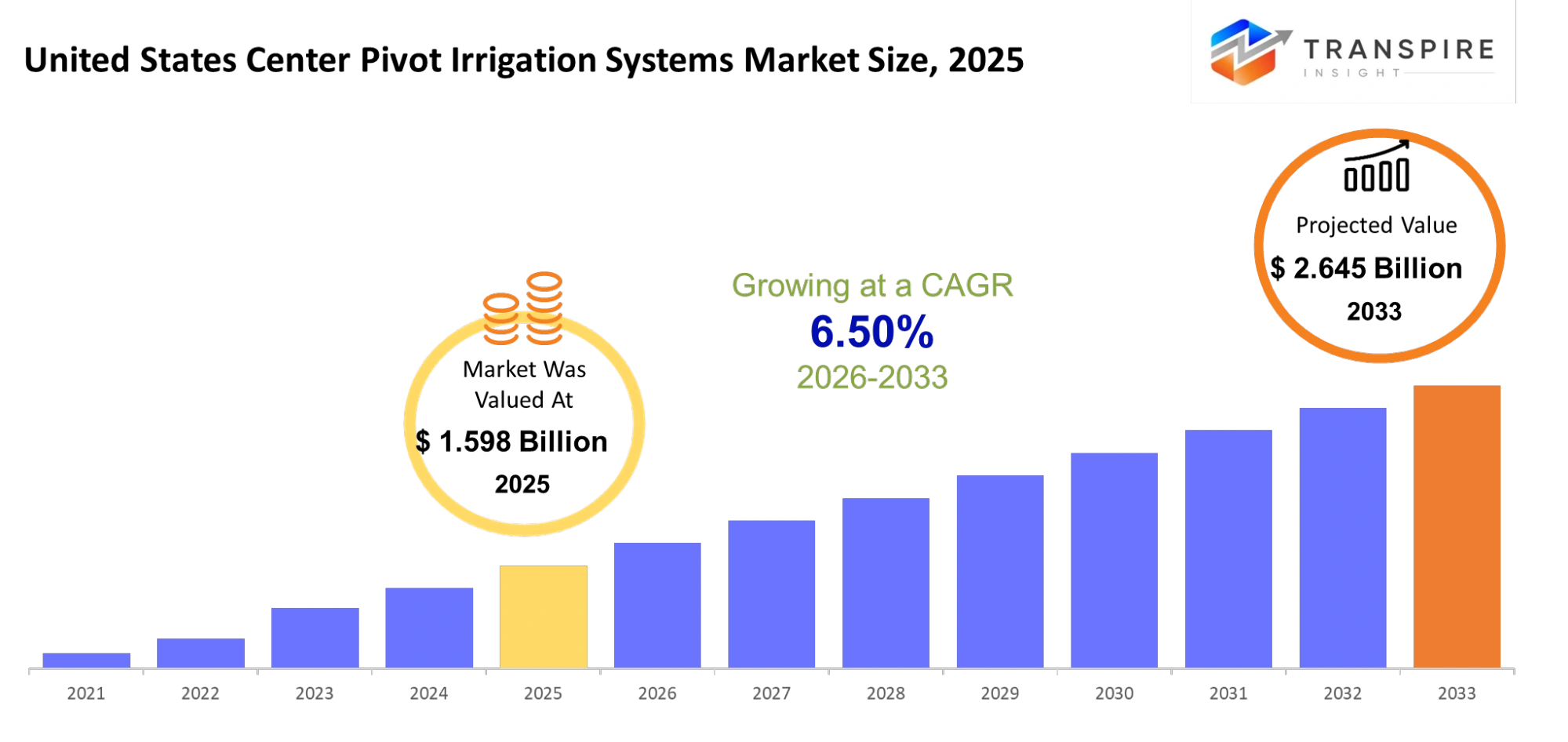
- United States Center Pivot Irrigation Systems Market Size 2025: USD 1.598 Billion
- United States Center Pivot Irrigation Systems Market Size 2033: USD 1.598 Billion
- United States Center Pivot Irrigation Systems Market CAGR: 6.50%
- United States Center Pivot Irrigation Systems Market Segments:By Type (Fixed, Towable, Lateral, Corner, Mobile, Automated, Hybrid), By Component (Panels, Sprinklers, Pumps, Pipes, Sensors, Motors, Valves), By Application (Agriculture, Horticulture, Turf, Greenhouse, Research, Landscaping, Golf), By Crop (Grains, Vegetables, Fruits, Oilseeds, Forage, Cash Crops, Specialty), By End-User (Farmers, Agribusiness, Govt, Cooperatives, Contractors, Research, Private Farms).
To learn more about this report,  Download Free Sample Report
United States Center Pivot Irrigation Systems Market Summary:
The United States Center Pivot Irrigation Systems Market size is estimated at USD 1.598 billion in 2025 and is anticipated to reach USD 2.645 billion by 2033, growing at a CAGR of 6.50% from 2026 to 2033. The USA center pivot irrigation market will experience continuous growth because farmers need better methods to manage water resources and they require increased agricultural production. Farmers use center pivot irrigation systems to achieve maximum crop production while they face changing weather conditions and need to save water and other natural resources. The latest technological advancements which focus on enhancing system performance will assist in upgrading water management systems or they will address customer issues regarding the land requirements for constructing irrigation systems. Government agencies which support sustainable agricultural practices and sustainable food production methods have provided extensive assistance to the USA Center Pivot Irrigation Systems Market which has resulted in its current growth.
Key Market Trends & Insights:
- Farmers in the United States now concentrate their efforts on water conservation projects because rising water shortages and unpredictable climate patterns have become a major problem. The centre pivot systems deliver precise water distribution which leads to reduced water consumption and improved agricultural yield results.
- Modern irrigation systems now use sensor technology and GPS systems together with remote monitoring equipment for their complete agricultural development. The smart features enable farmers to operate their systems through real-time control, which leads to greater operational efficiency while decreasing their required work time.
- Farmers are now developing trustworthy irrigation systems because they need to satisfy rising food production requirements. Centre pivot systems deliver equal water distribution, which results in higher crop yields and stable crop quality production.
- Federal and state initiatives create different programs which support farmers in implementing modern irrigation techniques. The financial incentives together with educational programs enable small and mid-sized farms to access these systems.
- The United States agriculture sector now shows a strong shift toward sustainable farming practices. The centre pivot irrigation method helps this movement by using minimal water resources and promoting better land usage practices.
- Manufacturers create upgraded systems which offer their users both long-lasting performance and adaptable operational capabilities. The current system designs enable straightforward installation processes which require minimal upkeep needs while matching various agricultural environments.
- Centre pivot systems now become popular among large agricultural operations because they enable farmers to efficiently irrigate their vast land holdings. The systems provide automated irrigation, which maintains constant water distribution throughout large agricultural areas while decreasing the need for manual operation.
United States Center Pivot Irrigation Systems Market Segmentation
By Type
-
Fixed Systems: The fixed centre pivot systems establish permanent installations which deliver dependable operational performance throughout their entire operational lifespan. The system provides effective irrigation solutions for extensive agricultural operations which maintain constant field conditions because it needs minimal equipment relocation between different farm areas. The system maintains its appeal to farmers because it delivers extended operational life with reduced need for equipment updates throughout its service period.
-
Towable Systems: The systems enable farmers to move between multiple fields because they maintain operational independence. The system provides effective irrigation solutions for agricultural operations which have multiple field locations and different water requirements. The equipment enables operations in multiple regions without additional expenses, although it needs extra workforce and time to move between locations.
-
Lateral Systems: Lateral irrigation systems operate straight lines which function effectively throughout rectangular land areas. The system delivers equal water distribution throughout extensive land surfaces. The system provides farmers with efficient water distribution systems that operate best under particular field configurations, although farmers need to conduct thorough land levelling to achieve maximum efficiency.
-
Corner Systems: Farmers use corner systems to provide water for field areas which traditional pivots cannot reach. This method enables farmers to achieve their maximum land potential while decreasing the areas of their fields that remain uncultivated. All farmers achieve better crop results and improved agricultural output through this method, which enables them to use every part of their fields that have irregular shapes.
-
Mobile Systems: Mobile systems enable farmers to move their systems between different farm locations throughout their valuable operational time. The system functions effectively for locations which experience seasonal agricultural production and temporary land use. Farmers value the system because it delivers affordable solutions however they must spend extra time to set up the system than they need for permanent systems.
-
Automated Systems: Automated systems use advanced control systems that allow operators to control their systems from remote locations and schedule their operations. The systems decrease the need for human operators while they deliver accurate results for water distribution. Farmers increasingly adopt them for their ability to simplify work processes while they reduce costs and enable better agricultural management through data-driven decision-making.
-
Hybrid Systems : The irrigation system combines different types of irrigation systems, providing greater operational flexibility and better water distribution efficiency. The system was created to fulfil the various agricultural needs of different users. Farmers use hybrids. systems because they provide effective performance together with operational flexibility at an economical price for complex farming situations.
By Component
-
Panels: The brain of irrigation systems operates through control panels which handle all system functions while tracking system performance data. The current generation of panels features both digital control systems and automated operational capabilities. The system provides farmers with operational control, which helps them manage water resources while they can quickly fix system issues.
-
Sprinklers: The proper function of agricultural systems depends on sprinklers because they distribute water to all areas of the field. The latest sprinkler systems optimise water usage while they decrease water that turns into vapour. Farmers select various sprinkler types according to their specific crop needs to achieve proper moisture levels which support plant growth and consistent crop production.
-
Pumps: The irrigation system uses pumps to create water movement which enables proper system pressure and water distribution. Pump systems which meet high standards provide dependable operation and effective performance. Farmers choose pumps which can withstand long-term use because they need to keep their irrigation systems running in areas with inconsistent water supply.
-
Pipes: The irrigation system uses pipes as the main water distribution system which connects all its different parts. The use of strong materials that resist corrosion provides pipes with extended operational life and requires less upkeep. Farmers need efficient piping systems which prevent leaks to deliver water resources throughout their agricultural fields.
-
Sensors: The sensors monitor three environmental conditions which include soil moisture levels and weather patterns and system operational status. The system provides farmers with real-time data which helps them implement accurate irrigation procedures. Farmers use sensor-based insights to their advantage by managing water resources more efficiently which results in lower wastage and better decision-making that improves crop health.
-
Motors: Pivot systems rely on motors to create movement, which helps their operations to function properly. The operation of irrigation systems depends on reliable motor systems. Farmers select energy-saving pump designs which decrease their running expenses while delivering irrigation performance that lasts throughout extended watering periods.
-
Valves: The system uses valves to control both water movement and pressure throughout its entire network. The system uses valves to manage irrigation zones while the system prevents excessive watering. Farmers use high-quality valves to maintain system efficiency and ensure precise water distribution tailored to specific crop requirements.
By Application
-
Agriculture: Farmers use centre pivot systems as their main tool for large-scale farming operations, which remain their primary agricultural application. These systems which enhance water use efficiency and crop yield stability have become essential equipment for contemporary agricultural operations that exist throughout the United States.
-
Horticulture: The exact watering needs of horticulture must be met because its cultivation of fruits and flowers and decorative plants requires this precise approach. The centre pivot systems enable growers to maintain ideal moisture levels which results in better plant development and higher quality agricultural output. The growers receive advantages from irrigation systems which provide continuous water supply that meets the specific needs of their delicate plants.
-
Turf: Turf applications include sports fields and lawns which require uniform irrigation to maintain healthy grass growth. Centre pivot systems deliver uniform water distribution which results in better turf aesthetics and increased turf resilience. The system enables efficient turf area maintenance across extensive fields.
-
Greenhouse: Greenhouse irrigation needs controlled water distribution to create perfect development conditions for plants. Centre pivot systems work together with automated systems to manage moisture control. Growers use them to improve plant health and maximise productivity in enclosed environments.
-
Research: Research institutions use these systems for agricultural experiments and crop studies. The system enables researchers to conduct precise irrigation tests that yield accurate results for their research. This technology supports the creation of new farming methods that will improve agricultural production.
-
Landscaping: Efficient irrigation systems help landscaping projects sustain their plant life and green spaces. Centre pivot systems help cover large landscaped areas which ensures constant irrigation. The system provides excellent support for watering requirements in both commercial and public outdoor areas.
-
Golf: The maintenance of golf courses depends on their need for properly maintained greens and fairways. The turf quality improves through centre pivot systems which deliver consistent water distribution across the field. The course managers use these systems to keep the golf course looking good and playable while they control their water usage.
By Crop
-
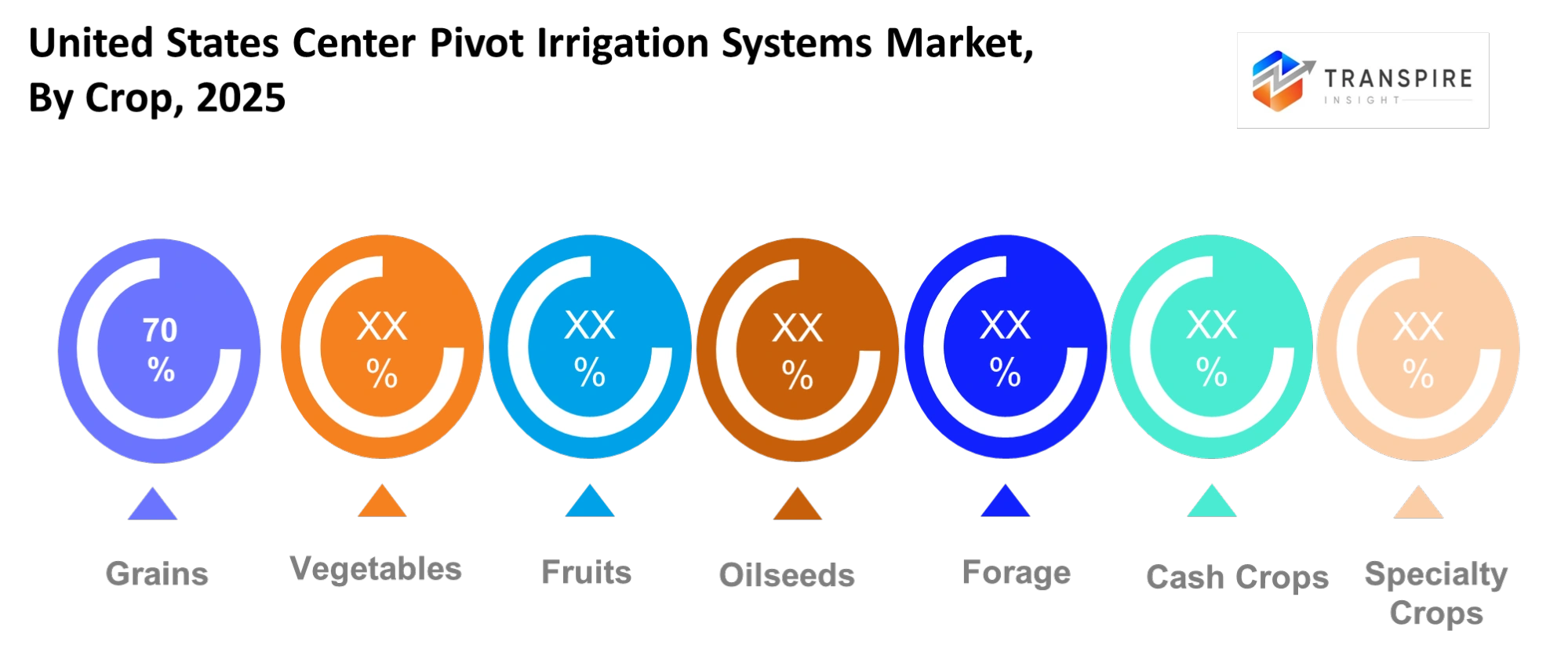
Grains: Grain crops like corn and wheat benefit from consistent irrigation provided by pivot systems. The proper water distribution system delivers better yield and quality results. The systems enable farmers to handle their extensive grain fields through efficient operations.
-
Vegetables: The growth of vegetables needs specific moisture levels to achieve their best development. The center pivot systems deliver controlled irrigation which helps plants experience less water stress. The system enables farmers to produce better crops while decreasing their total product losses.
-
Fruits: Fruit cultivation requires balanced irrigation because it affects fruit size and flavor development. Pivot systems deliver consistent water distribution which enables orchards to achieve maximum productivity. The improved harvest outcomes lead to better results for growers.
-
Oilseeds: Oilseed crops such as soybeans need continuous irrigation to achieve their best oil production results. The center pivot systems create conditions that enable plants to grow throughout all stages. Farmers utilize these systems to enhance their yield results while increasing their business earnings.
-
Forage: Livestock need regular watering to support the healthy development of their forage crops. Pivot systems provide farmers with a system that delivers constant water supply for their feed production needs. The farmers achieve dependable forage production through this system.
-
Cash Crops: Cash crops require farmers to produce high-quality products which determine their market value. The efficient irrigation systems provide farmers with a solution that helps them maintain their crop health while ensuring consistent results. Farmers implement pivot systems because they lead to higher profits and decreased business threats.
-
Specialty Crops: Specialty crops require farmers to create customized irrigation systems which meet their specific growth requirements. The center pivot systems enable farmers to control their water distribution methods. The agricultural system enables farmers to produce specialized products for specific markets.
To learn more about this report, Download Free Sample Report
By End-User
-
Farmers: Farmers use pivot systems to enhance their operational efficiency and their agricultural productivity. The systems function as critical components of agricultural operations because they assist farmers in decreasing their work requirements while achieving better irrigation efficiency.
-
Agribusiness: Agribusiness companies construct advanced irrigation systems to handle their vast farming operations. The center pivot system enables agricultural businesses to expand their operations while increasing productivity through its system.
-
Government: Government organizations implement these systems in their agricultural research projects and their demonstration farms. The systems establish effective irrigation methods while they support practices that promote agricultural sustainability.
-
Cooperatives: Farming cooperatives adopt shared irrigation systems to reduce costs. The center pivot system enables members to share advanced technological resources which enhances their collective productivity.
-
Contractors: The agricultural contractors use pivot systems to provide irrigation services on multiple farms. The systems support both efficient operations and stable service performance.
-
Research: Research organizations utilize pivot systems for controlled experiments. The systems support studies aimed at improving irrigation methods and crop performance.
-
Private Farms: Private farms, which include estates and specialty growers, use these systems to achieve their irrigation needs. The systems enable them to enhance their agricultural practices while achieving better usage of their resources.
Country Insights
The United States centre pivot irrigation systems market demonstrates the country's dedication to advancing modern agricultural methods which enhance farming efficiency. The agricultural systems in Nebraska, Kansas and Texas enable farmers to use these technologies for precise water control, which results in stable crop production. Farmers adopt precision irrigation systems because of climate changes which include droughts and extreme weather events.
The market expansion receives support from existing agricultural facilities and access to contemporary farming technology. Government initiatives that encourage sustainable water management together with agricultural productivity improvements drive market development. Farmers use automated systems together with smart monitoring technology to make better decisions. The market combines traditional farming practices with contemporary technological advancements which will enhance irrigation methods throughout the United States.
Recent Development News
In April 2026, Epic winter drought threatens U.S. agriculture and food supply: severe drought conditions across the U.S. are pushing farmers to adopt efficient irrigation technologies like centre pivot systems. Water scarcity is becoming a critical driver for modern irrigation adoption.
In April 2026, AI reshaping modern farming and irrigation practices in the U.S. : The rise of AI and automation in U.S. agriculture is accelerating the use of smart irrigation systems. Centre pivot technologies are increasingly integrated with data-driven tools.
|
Report Metrics |
Details |
|
Market size value in 2025 |
USD 1.598 Billion |
|
Market size value in 2026 |
USD 1.702 Billion |
|
Revenue forecast in 2033 |
USD 2.645 Billion |
|
Growth rate |
CAGR of 6.50% from 2026 to 2033 |
|
Base year |
2025 |
|
Historical data |
2021 – 2024 |
|
Forecast period |
2026 – 2033 |
|
Report coverage |
Revenue forecast, competitive landscape, growth factors, and trends |
|
Country scope |
United States |
|
Key company profiled |
Valmont, Lindsay, T-L, Reinke, Rain Bird, Netafim, Jain, Toro, Alkhorayef, Nelson, Bauer, Rivulis, EPC, Hunter, Komet |
|
Customization scope |
Free report customization (country, regional & segment scope). Avail customized purchase options to meet your exact research needs. |
|
Report Segmentation |
By Type (Fixed, Towable, Lateral, Corner, Mobile, Automated, Hybrid), By Component (Panels, Sprinklers, Pumps, Pipes, Sensors, Motors, Valves), By Application (Agriculture, Horticulture, Turf, Greenhouse, Research, Landscaping, Golf), By Crop (Grains, Vegetables, Fruits, Oilseeds, Forage, Cash Crops, Specialty), By End-User (Farmers, Agribusiness, Govt, Cooperatives, Contractors, Research, Private Farms). |
Key United States Industrial Coating Company Insights
The United States center pivot irrigation systems market is shaped by a mix of established manufacturers and emerging innovators who develop more efficient and reliable systems. Companies are investing in advanced technologies which include automation and precision controls and data-driven irrigation solutions to satisfy the changing needs of farmers. The three main requirements for the product include durability and simple operation and water saving capabilities. Many businesses provide personalized products together with post-purchase assistance which helps them build stronger connections with their clients. The market requires businesses to develop innovative products while pursuing environmentally sustainable development practices which they use as their main approach to achieve long-term success.
Company List
- Valmont
- Lindsay
- T-L
- Reinke
- Rain Bird
- Netafim
- Jain
- Toro
- Alkhorayef
- Nelson
- Bauer
- Rivulis
- EPC
- Hunter
- Komet
United States Center Pivot Irrigation Systems Market Report Segmentation
By Type
- Fixed
- Towable
- Lateral
- Corner
- Mobile
- Automated
- Hybrid
By Component
- Panels
- Sprinklers
- Pumps
- Pipes
- Sensors
- Motors
- Valves
By Application
- Agriculture
- Horticulture
- Turf
- Greenhouse
- Research
- Landscaping
- Golf
By Crop
- Grains
- Vegetables
- Fruits
- Oilseeds
- Forage
- Cash Crops
- Specialty
By End-User
- Farmers
- Agribusiness
- Govt
- Cooperatives
- Contractors
- Research
- Private Farms
Frequently Asked Questions
Find quick answers to common questions.
The approximate United States Center Pivot Irrigation Systems Market size for the market will be USD 2.645 Billion in 2033.
The key segments of the United States Center Pivot Irrigation Systems Market are By Type (Fixed, Towable, Lateral, Corner, Mobile, Automated, Hybrid), By Component (Panels, Sprinklers, Pumps, Pipes, Sensors, Motors, Valves), By Application (Agriculture, Horticulture, Turf, Greenhouse, Research, Landscaping, Golf), By Crop (Grains, Vegetables, Fruits, Oilseeds, Forage, Cash Crops, Specialty), By End-User (Farmers, Agribusiness, Govt, Cooperatives, Contractors, Research, Private Farms).
Major players in the United States Center Pivot Irrigation Systems Market are Valmont, Lindsay, T-L, Reinke, Rain Bird, Netafim, Jain, Toro, Alkhorayef, Nelson, Bauer, Rivulis, EPC, Hunter, Komet.
The current market size of the United States Center Pivot Irrigation Systems Market is USD 1.598 Billion in 2025.
The United States Center Pivot Irrigation Systems Market CAGR is 6.50%
- Valmont
- Lindsay
- T-L
- Reinke
- Rain Bird
- Netafim
- Jain
- Toro
- Alkhorayef
- Nelson
- Bauer
- Rivulis
- EPC
- Hunter
- Komet
Recently Published Reports
-
May 2026
Biosimilars Market
Biosimilars Market By Product Type (Monoclonal Antibodies, Recombinant Hormones, Erythropoietin, G-CSF, Others), By Indication (Oncology, Autoimmune Diseases, Blood Disorders, Diabetes, Others), By Manufacturing Type (In-House Manufacturing, Contract Manufacturing), By Distribution Channel (Hospital Pharmacies, Retail Pharmacies, Online Pharmacies), By Industry Analysis, Size, Share, Growth, Trends, and Forecasts 2021-2033
-
Apr 2026
Gastrointestinal Endoscopy Market
Gastrointestinal Endoscopy Market By Type (Rigid Gastrointestinal Endoscope, Flexible Gastrointestinal Endoscopes, Disposable Gastrointestinal Endoscope), By Procedure Type (Colonoscopy, Gastroscopy, Duodenoscopy, Enteroscopy, Flexible Sigmoidoscopy, Others), By Application (Diagnosis, Treatment), By End-Users (Hospitals, Ambulatory Surgical Centers, Specialty Clinics, Laboratories, Others), By Industry Analysis, Size, Share, Growth, Trends, and Forecasts 2021-2033
-
Apr 2026
Rare Inherited Metabolic Disorder Drug Market
Rare Inherited Metabolic Disorder Drug Market By Drug Class (Enzyme Replacement Drugs, Gene Therapy Drugs, Substrate Reduction Drugs, Small Module Drugs, Protein Drugs), By Route of Administration(Parenteral, Oral, Intrathecal), By Clinical Development (Marketed Drugs, Late Stage Clinical Phase III, Early Stage Clinical Phase I-II, Preclinical Candidates), By Indication (Lysosomal Storage Disorders, Urea Cycle Disorders, Amino Acid Metabolic Disorders, organic Acidemias, Peroximal Disorders), By Industry Analysis, Size, Share, Growth, Trends, and Forecasts 2021-2033
-
Jan 2026
Pharmaceutical Cleanroom Technology Market
Pharmaceutical Cleanroom Technology Market By Product (Equipment, Consumables, Services); By Cleanroom Type (Standard Cleanrooms, Modular Cleanrooms); By End Use (Pharmaceutical Companies, Biotechnology Companies), By Industry Analysis, Size, Share, Growth, Trends, and Forecasts 2021-2033