
United States Body Piercing Jewelry Market Size & Forecast:
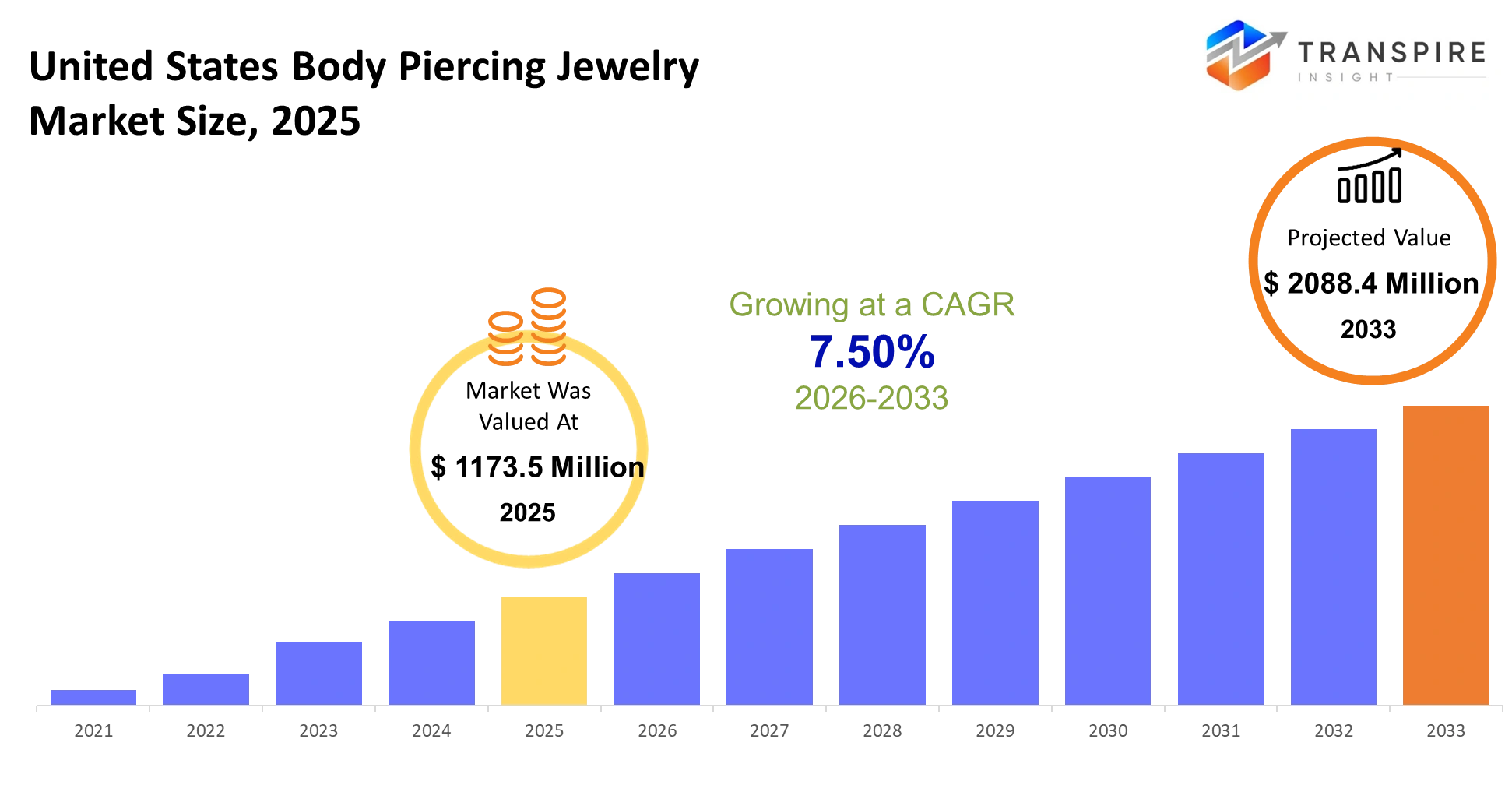
- United States Body Piercing Jewelry Market Size 2025: USD 1173.5 Million
- United States Body Piercing Jewelry Market Size 2033: USD 2088.4 Million
- United States Body Piercing Jewelry Market CAGR: 7.50%
- United States Body Piercing Jewelry Market Segments: By Product Type (Rings, Barbells, Studs, Captive Bead Rings, Circular Barbells, Nose Pins, Navel Jewelry), By Material (Surgical Stainless Steel, Titanium, Gold, Silver, Bioplast, Acrylic, Platinum), By Application (Ear Piercing, Nose Piercing, Lip Piercing, Eyebrow Piercing, Navel Piercing, Tongue Piercing, Industrial Piercing), By Distribution Channel (Online Retail, Specialty Stores, Jewelry Stores, Tattoo & Piercing Studios, Department Stores, Brand Outlets, E-commerce Platforms).
To learn more about this report,  Download Free Sample Report
United States Body Piercing Jewelry Market Summary:
The United States Body Piercing Jewelry Market size is estimated at USD 1173.5 Million in 2025 and is anticipated to reach USD 2088.4 Million by 2033, growing at a CAGR of 7.50% from 2026 to 2033. The United States body piercing jewelry market kind of plays a practical role more than just fashion, because it offers biocompatible, tough accessories that help safe healing and long term wear, plus it supports self expression. You see it across professional piercing studios, medical piercing spaces, and specialty retail, not just in storefronts either. Over the past five years, the whole market has moved away from cheaper alloy pieces, and toward implant grade titanium, niobium, and gold jewelry, since consumers and piercing professionals started caring more about skin compatibility, traceability, and hygiene rules.
That shift really picked up after pandemic era health concerns, plus some supply chain disruptions, which basically showed quality inconsistencies in a lot of imported jewelry. So studios ended up preferring domestic, or at least certified, suppliers. Because of that, premiumization became more than a buzz word, it turned into a revenue driver. People also tend to swap jewelry more often now, to stay aligned with aesthetics, their daily lifestyles and even social media moods. At the same time, piercing studios are bundling higher end jewelry with their services, which pushes up average transaction values. In turn, that strengthened recurring sales in both online channels and in person studio based distribution.
Key Market Insights
- In the United States, body piercing jewelry is kind of shifting toward implant-grade titanium plus 14K gold products, and together they took almost 48% of the market share in 2025.
- Meanwhile, most of the industry size is tied up in Western United States regions, with roughly 34% revenue share, largely because there are a lot of studios nearby and the whole thing is driven by fashion led demand.
- In the South, the United States states are showing the quickest momentum through 2030, supported by specialty piercing chains expanding, plus younger shoppers being more willing to try new looks.
- As for what people actually buy, rings and barbells stayed on top in 2025, making up close to 41% of total revenue.
- Studs came in as the second biggest category, partly because professional piercing studios more and more suggest flat-back designs, especially for healing focused uses.
- Customized pieces and jewelry set with gemstones grew at the fastest pace from 2023 to 2026, since consumers keep pushing for personalized visual upgrades, you know, the little extras.
- Online retail channels generated over 38% market share in 2025, which points to stronger direct to consumer sales and better digital discovery of products.
- Even so, professional piercing studios are still the main application driver with about 52% share, because many consumers now look for certified, cleaner, more hygienic piercing spaces.
- Medical plus dermatologist supported piercing services are an emerging application segment, and parents especially prefer clinically supervised ear piercing procedures for minors.
- By end user, Millennials and Gen Z make up the leading group, contributing more than 60% of recurring jewelry replacement purchases in 2025.
- Finally, male consumers are becoming a faster growing end-user segment too, as gender-neutral jewelry assortments, and minimalist piercing styles, are getting more mainstream acceptance, slowly but surely.
What are the Key Drivers, Restraints, and Opportunities in the United States Body Piercing Jewelry Market?
The biggest force pushing the United States Body Piercing Jewelry Market forward is basically this move toward implant-grade materials and piercing rules that are, well, more medically safer. That change really picked up pace after the pandemic era, when hygiene concerns made people and piercing studios pay attention and in general avoid cheaper alloy jewelry, you know, the stuff that’s often tied to irritation and slower healing. Then professional studios started leaning into ASTM-certified titanium and also nickel-free gold jewelry, and this quietly lifted the average selling price. It also helped fuel repeat buying, because replacement cycles became more frequent. Once premium jewelry got baked into piercing service packages, studios saw more revenue per customer and brands could protect margins via customization and these limited-edition drops.
Counterfeit and low quality imported jewelry is still the big structural obstacle. It’s mainly because supply is fragmented, so enforcement turns into a struggle across online marketplaces, and independent distributors too. A lot of consumers keep buying inexpensive pieces without checking for any material certification, which leads to recurring allergic reactions and even failed piercings that hurt overall confidence in the category. Because of that, premium purchases stall, especially for first time buyers, and revenue conversion also slows down for established manufacturers that spend a lot on compliance testing and certified sourcing.
The next growth phase, will probably come from digitally integrated custom platforms and medically supervised piercing retail concepts, kind of. Some companies are mixing virtual jewelry visualization with AI driven style suggestions , plus appointment based piercing services, and this combo is boosting conversion rates with younger consumers. They’re also expanding those luxury piercing studios into more mid size United States cities like Austin , Nashville , and Charlotte , and that opens up new premium revenue channels away from the usual coastal fashion markets.
What Has the Impact of Artificial Intelligence Been on the United States Body Piercing Jewelry Market?
Artificial intelligence and newer digital technologies are kind of changing the United States body piercing jewelry industry, by making inventory forecasting faster, smoothing customization workflows a bit, and boosting how well customers convert. A lot of jewelry brands, plus piercing studios, are starting to use AI powered recommendation engines that watch purchase behavior, track piercing placement preferences, and even take note of metal sensitivities in real time. What ends up happening is that product matching gets automated for titanium gold, and gemstone jewelry, and online retailers generally see fewer people abandoning carts and more repeat purchases. Some premium brands are also using computer vision tools and augmented reality features, so shoppers can preview jewelry looks in a virtual sense before they book an appointment at a studio.
Meanwhile machine learning models increasingly back demand forecasting and the overall operations planning across manufacturing and distribution channels. Predictive analytics platforms allow suppliers to time production cycles for threadless jewelry, flat back studs, and other custom pieces, using regional fashion shifts plus social media engagement cues. This approach has lowered excess inventory expenses while also improving fulfillment speed for high margin customized products. Also digital studio management systems help with appointment scheduling, sterilization tracking, and client aftercare messages, and that tends to improve retention, and keep operational routines more consistent.
But, AI adoption still hits walls in practice, mainly because lots of independent piercing studios don’t yet have the integrated digital infrastructure, or any standardized customer data. Smaller operators often feel stuck with software integration costs, and fragmented inventory setups, plus limited technical know how. Because of that, large scale deployment across the wider market can get slowed down, even when the benefits sound obvious.
Key Market Trends
- Since 2021, implant-grade titanium jewelry adoption went up kinda sharply, as studios traded out cheaper alloy pieces that were tied to irritation and kinda failed healing results , overall they swapped in more reliable stuff.
- Online jewelry customization platforms have been growing fast too , up more than 30% since 2022. Now shoppers can set things like gemstones, threading styles, and metal finishes before purchase, it feels pretty personal for a lot of people.
- After 2020 , professional piercing studios started bundling premium jewelry with their services, and that move lifted average transaction values , while also making customers come back at better rates.
- Domestic manufacturing partnerships picked up steam after pandemic-era shipping delays messed with imported jewelry supply, and independent United States piercing studios had to adjust, like quickly.
- Maria Tash and BVLA then accelerated regional studio collaborations between 2022 and 2025, in a way that strengthened luxury market positioning and kept the brand momentum.
- Flat-back studs and threadless jewelry systems are now more common, in part because studios pushed safer healing mechanics and quicker jewelry replacement procedures, less drama, more smooth aftercare.
- Social commerce platforms really changed the way people buy after 2023, with TikTok driven piercing trends pushing impulse purchases among Gen Z consumers , almost like it became a scroll-to-cart thing.
- Male consumers became one of the fastest evolving buyer segments since 2021, as minimalist and gender-neutral jewelry collections expanded across retail channels , not just boutique corners.
- ASTM-certified titanium sourcing turned into a real competitive differentiator after regulatory attention around nickel exposure increased, so manufacturers and online marketplaces felt more pressure to prove compliance.
- Independent piercing studios have been adopting AI-enabled scheduling and inventory systems since 2024 , to improve appointment utilization and also reduce stock shortages for premium collections , so the right pieces are there when clients arrive.
United States Body Piercing Jewelry Market Segmentation
By Product Type
Rings, barbells, and studs still hold the strongest kind of position within product type segmentation, because most professional piercing studios seem to favor standardized designs, with consistent healing results and easy styling matching. Flat-back studs along with threadless barbells picked up bigger commercial traction after 2021, since studios started pushing for quicker insertion procedures and trying to lower irritation risks, a lot. Nose pins and navel jewelry also kept showing stronger sales momentum thanks to fashion pushed social media waves, plus those repeat replacement cycles people do when they want “fresh” pieces. Captive bead rings and circular barbells stayed pretty steady in demand among more seasoned piercing consumers, who prefer switchable look options instead of just getting something entry level.
Product innovation is increasingly leaning toward modular attachments, gemstone personalization, and lighter construction that helps comfort last through long wear stretches. Manufacturers are now putting more investment into premium finishing methods and quick-lock threading systems, to create sharper brand differentiation, not just “another” version. Looking ahead, growth in this segment will probably depend on how fast customization can happen, how well studios partner with brands, and limited edition collections that help support higher pricing power across premium retail channels.
By Material
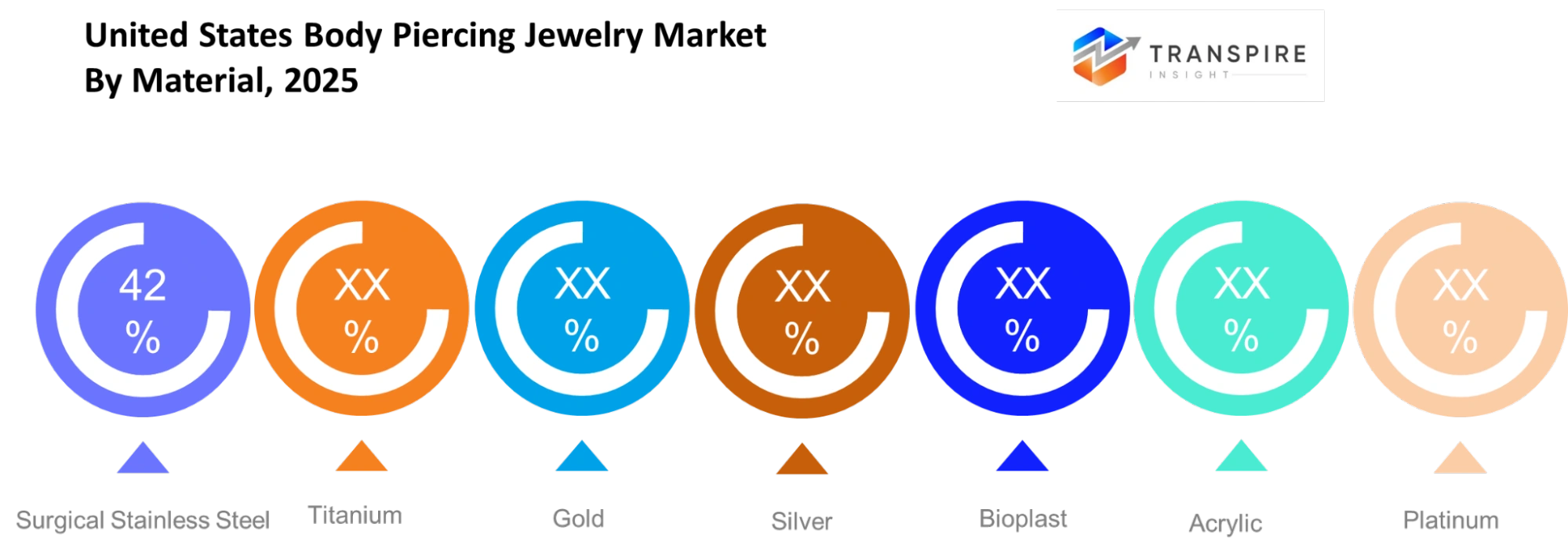
Titanium kinda came out on top as the leading material segment, mainly because piercing studios increasingly recommend implant-grade metals with lower allergy risks and—overall, better healing performance. Meanwhile, surgical stainless steel is still holding a pretty big share, mostly because it’s affordable and you can find it pretty much everywhere across entry-level product lines, so it just works for a lot of setups. Gold and platinum jewelry gained real traction in premium urban retail channels, since luxury piercing studios expanded curated styling services, plus those high-margin customization packages that people seem to like. Silver, on the other hand, is moving more slowly, tarnishing worries and extra maintenance needs make it less attractive for long-term wear, especially once the piercing is healing.
Bioplast and acrylic materials picked up attention too, but more within flexible jewelry categories, like temporary wear options, workplace compliance use cases, and even medical imaging compatibility. Material sourcing standards started mattering more after the pandemic-era supply disruptions showed quality inconsistencies among imported jewelry products. Going forward, competition will probably lean harder on certified metal sourcing, traceability, and those hypoallergenic performance claims. Investors and manufacturers now also treat material transparency and compliance testing as a critical tool, basically for keeping consumer trust steady, and for supporting premium pricing structures.
To learn more about this report, Download Free Sample Report
By Application
Ear piercing application use keeps pretty much dominating the industry revenue, because when people choose several piercing locations, it also sets up these repeat jewelry swaps, across a wide mix of consumers. Nose piercing kinda followed with extra commercial weight too, mainly from younger buyers and those fashion led shoppers who like the minimalist vibe options. Navel and tongue categories did show demand but it’s more selective, it seems tied to seasonal fashion cycles and everyday lifestyle preferences, rather than just general hype. Meanwhile eyebrow and industrial piercing stayed in that smaller but steady crowd, you know the niche communities that don’t really vanish.
Lip piercing applications got more noticeable momentum after social commerce platforms started boosting alternative fashion looks, and creator based styling posts helped normalize the trend. On the studio side, professional piercing places are increasingly standardizing aftercare steps, and also how they suggest jewelry, depending on where it’s placed anatomically, how long the healing usually takes, and whether the material actually fits properly. Right now application specific jewelry design matters a lot more for buying decisions than generic fashion trends alone, in many cases. Manufacturers that lean into anatomy aware sizing systems, and ergonomic design choices, are probably the ones that end up with better long term positioning. Going forward, growth should favor brands that can balance aesthetic personalization with medically informed product development and also with studio education initiatives.
By Distribution Channel
Tattoo and piercing studios still end up being the main distribution route, because most people seem to care more about proper fitting, sterilization rules, and a sort of hand held jewelry consultation, right during the buying choice. Specialty shops and brand outlets also hold their ground especially in premium city neighborhoods, where curated assortments and that luxury styling vibe push buyers to spend more . Online retail and e-commerce, though , grew the quickest after 2020, since consumers started buying replacement jewelry, custom-made pieces , and limited-edition drops through digital store fronts more and more. Department stores kept moving slower, partly because their usual inventory setups don’t really match up well with the deeper product knowledge and the broader personalization options you can find in niche retailers.
Jewelry stores responded by rolling out collections that focus on piercings, plus appointment based consultations, so it feels closer to the premium studio experience. Distribution plans are now mixing digital visualization tools with influencer collaborations and direct-to-consumer delivery systems, mainly to shrink the time between seeing something and actually buying it. What happens next in channel competition will likely revolve around online-to-offline setups that feel integrated, with virtual customization paired to certified in studio piercing and fast fulfillment.
What are the Key Use Cases Driving the United States Body Piercing Jewelry Market?
Professional ear and nose piercing services stay kind of the main go-to thing, mostly because piercing studios make that recurring money, from jewelry upgrades , healing replacements and those curated styling consults or whatever. Implant-grade titanium studs and barbells basically lead the pack in these sessions because people expect tighter hygiene standards, and there’s also a lower chance of irritation, so yeah.
Luxury styling plus personalized fashion uses are picking up more steam with Gen Z and millennial buyers, especially those who grab gemstone nose pins, layered ear pieces, and limited-edition collections. They’re buying through premium studio chains, but also through e-commerce platforms that feel more polished. At the same time, medically supervised ear piercing for minors has grown too, since a lot of parents now prefer a sterile clinical setup compared with the more traditional retail kiosk vibe.
Some newer and emerging use cases are starting to show up, like smart customization platforms. These mix virtual piercing visualization with AI based jewelry recommendations, before someone even shows up for the appointment. There’s also flexible bioplast jewelry, made for workplace compliance, sports participation, and even medical imaging procedures, and it seems like it could have solid long term value for niche consumer groups.
|
Report Metrics |
Details |
|
Market size value in 2025 |
USD 1173.5 Million |
|
Market size value in 2026 |
USD 1259.2 Million |
|
Revenue forecast in 2033 |
USD 2088.4 Million |
|
Growth rate |
CAGR of 7.50% from 2026 to 2033 |
|
Base year |
2025 |
|
Historical data |
2021 - 2024 |
|
Forecast period |
2026 - 2033 |
|
Report coverage |
Revenue forecast, competitive landscape, growth factors, and trends |
|
Geographic scope |
United States of America |
|
Key company profiled |
BVLA, Anatometal, Industrial Strength, Maria Tash, Body Vision Los Angeles, NeoMetal, LeRoi Fine Jewelry, Invictus Body Jewelry, Painful Pleasures, Body Circle Designs |
|
Customization scope |
Free report customization (country, regional & segment scope). Avail customized purchase options to meet your exact research needs. |
|
Report Segmentation |
By Product Type (Rings, Barbells, Studs, Captive Bead Rings, Circular Barbells, Nose Pins, Navel Jewelry), By Material (Surgical Stainless Steel, Titanium, Gold, Silver, Bioplast, Acrylic, Platinum), By Application (Ear Piercing, Nose Piercing, Lip Piercing, Eyebrow Piercing, Navel Piercing, Tongue Piercing, Industrial Piercing), By Distribution Channel (Online Retail, Specialty Stores, Jewelry Stores, Tattoo & Piercing Studios, Department Stores, Brand Outlets, E-commerce Platforms) |
Which Regions are Driving the United States Body Piercing Jewelry Market Growth?
The Western United States kinda leads the body piercing jewelry market , mostly because big fashion hubs like California , Washington and Nevada back up dense networks of top tier piercing studios, luxury retailers, and well connected buyers who are pretty trend driven. I mean, the whole social media thing, plus celebrity kinda curated piercing looks, pushed interest faster for implant-grade titanium, gold , and even customized gemstone pieces across urban spots like Los Angeles and San Francisco. On top of that, the region has this already built ecosystem of piercing associations, certified studios, and domestic jewelry makers which kind of re enforce quality expectations and that premium pricing structure too. So between people spending on self expression and doing recurring upgrades to their jewelry, the West stays dominant through both physical retail and online commerce too.
Meanwhile the Northeastern United States is the second biggest regional contributor but it behaves a little differently than the West, like the buying patterns lean more toward steady luxury spending and medically supervised piercing services. New York and Boston keep demand pretty consistent, largely driven by higher income customers who want minimalist fine jewelry and appointment based styling consultations that feel more controlled. The area also grows because certified materials get adopted more quickly, and studios tend to follow stricter hygiene standards, so premium product sales keep going even when the economy feels shaky. Plus established jewelry retailers and older specialty piercing chains give steady recurring income, which helps the market stay stable over time.
The Southern United States is starting to look like the fastest-growing regional market, with that rapid expansion of specialty piercing studios and fashion forward retail concepts across Texas, Florida, Tennessee, and North Carolina. Lower commercial operating costs, plus steady population growth, kind of pushed independent studio operators and premium jewelry brands to expand pretty aggressively after 2022, or around there. At the same time, social commerce platforms, influencer-led piercing trends, and a general buzz around jewelry among younger consumers helped speed up purchases especially in secondary metro areas like Austin Nashville, and Charlotte. All this regional momentum, honestly, opens up solid opportunities for manufacturers, investors, and digital retailers who want to scale between 2026 and 2033, particularly in premium titanium jewelry , customization services, and online-to-offline retail models.
Who are the Key Players in the United States Body Piercing Jewelry Market and How Do They Compete?
The United States body piercing jewelry market stays kind of moderately fragmented ,you know, because small independent piercing studios plus boutique jewelry designers, and even premium manufacturers, all compete while big online retailers are still there too. These days the competition seems to be more about material certification, customization ability, and partnerships with studios rather than just trying to win on low-cost volume. The well-known brands keep trying to protect premium market share with ASTM-certified titanium, threadless style jewelry systems, and carefully curated luxury experiences. At the same time, digital-first entrants kinda disrupt older retail models by shrinking customization and fulfillment timelines. Also it matters that fashion-centered urban hubs like Los Angeles, New York, and Austin shape how companies position themselves, because local studio networks strongly sway how consumers buy, and how visible brands feel.
Maria Tash sets itself apart with luxury-tilted piercing studios where fine jewelry styling consultations run alongside medically informed piercing services. The company also leans into stronger pricing power using exclusive gemstone collections, high-end gold jewelry, and a direct retail push in premium urban shopping districts. BVLA competes more through handcrafted customization and domestically made gold jewelry, made to fit professional piercing studios specifically. They also rely on relationships with elite piercing artists and limited production releases, which helps keep everything feeling rare and upscale.
Anatometal zooms in on implant-grade titanium plus internally threaded jewelry systems, it really keeps healing safety as the big deal and also tries to make long-term wear dependable. The company keeps a kind of edge with strict material certification rules ,and also by leaning on extensive studio distribution partnerships across North America. NeoMetal then expanded market pull via threadless jewelry technology, it made insertion steps feel simpler and it cuts down on handling time for professional piercers. Industrial Strength helped further regional penetration by shipping precision-machined titanium items with wider anatomical sizing choices ,these were tailored for advanced piercing needs and specialty studio operators.
Company List
- BVLA
- Anatometal
- Industrial Strength
- Maria Tash
- Body Vision Los Angeles
- NeoMetal
- LeRoi Fine Jewelry
- Invictus Body Jewelry
- Painful Pleasures
- Body Circle Designs
Recent Development News
In March 2026, Signet Jewelers Reports Strong Fiscal 2026 Results Amid Jewelry Demand Recovery: Jewelry retailer Signet Jewelers announced improved fiscal 2026 financial performance, supported by growth across brands including piercing and fashion jewelry categories sold through Kay, Zales, and Jared. The company highlighted stronger holiday sales momentum and continued consumer demand in fashion accessories.
Source: https://www.businesswire.com
In May 2026, Signet Jewelers Adds Jeffrey Gennette to Board in Strategic Leadership Move: Signet Jewelers appointed former Macy’s CEO Jeffrey Gennette to its board of directors. The leadership addition is expected to strengthen the company’s retail expansion and merchandising strategy across jewelry and accessories businesses, including fashion and piercing-related segments.
Source: https://www.stocktitan.net
What Strategic Insights Define the Future of the United States Body Piercing Jewelry Market?
The United States body piercing jewelry market is sort of leaning, more and more toward a premium medically aligned retail style, where certified materials, digital customization, and sort of studio led experiences will likely take up a bigger chunk of total revenue in the next five to seven years. The main reason looks simple on the surface, consumers are start treating body jewelry less like a cheap accessory, and more like a long run personal styling choice, tied to safety, comfort, and identity expression. But there is also a quieter issue, raw material concentration, especially with implant grade titanium and precious metals. Supply swings and certification slowdowns, could end up squeezing margins for independent producers and smaller studio teams even if the demand stays steady.
There is a real upcoming opportunity that feels tied to AI enabled customization tools, connected with appointment based piercing networks in fast growing Southern United States cities. Companies that blend virtual styling, quick manufacturing, and local studio partnerships may see better repeat buying, plus stronger retention. Market players should probably focus on vertically connected supply chains and certified material sourcing sooner, rather than later, because compliance expectations and higher end consumer standards can tighten across both online shopping and in studio retail.
United States Body Piercing Jewelry Market Report Segmentation
By Product Type
- Rings
- Barbells
- Studs
- Captive Bead Rings
- Circular Barbells
- Nose Pins
- Navel Jewelry
By Material
- Surgical Stainless Steel
- Titanium
- Gold
- Silver
- Bioplast
- Acrylic
- Platinum
By Application
- Ear Piercing
- Nose Piercing
- Lip Piercing
- Eyebrow Piercing
- Navel Piercing
- Tongue Piercing
- Industrial Piercing
By Distribution Channel
- Online Retail
- Specialty Stores
- Jewelry Stores
- Tattoo & Piercing Studios
- Department Stores
- Brand Outlet
- E-commerce Platforms
Frequently Asked Questions
Find quick answers to common questions.
The approximate United States Body Piercing Jewelry Market size for the market will be USD 2088.4 Million in 2033.
The key segments of the United States Body Piercing Jewelry Market are By Product Type (Rings, Barbells, Studs, Captive Bead Rings, Circular Barbells, Nose Pins, Navel Jewelry), By Material (Surgical Stainless Steel, Titanium, Gold, Silver, Bioplast, Acrylic, Platinum), By Application (Ear Piercing, Nose Piercing, Lip Piercing, Eyebrow Piercing, Navel Piercing, Tongue Piercing, Industrial Piercing), By Distribution Channel (Online Retail, Specialty Stores, Jewelry Stores, Tattoo & Piercing Studios, Department Stores, Brand Outlets, E-commerce Platforms).
Major players in the United States Body Piercing Jewelry Market are BVLA, Anatometal, Industrial Strength, Maria Tash, Body Vision Los Angeles, NeoMetal, LeRoi Fine Jewelry, Invictus Body Jewelry, Painful Pleasures, Body Circle Designs.
The current market size of the United States Body Piercing Jewelry Market is USD 1173.5 Million in 2025.
The United States Body Piercing Jewelry Market CAGR is 7.50%.
- BVLA
- Anatometal
- Industrial Strength
- Maria Tash
- Body Vision Los Angeles
- NeoMetal
- LeRoi Fine Jewelry
- Invictus Body Jewelry
- Painful Pleasures
- Body Circle Designs
Recently Published Reports
-
Apr 2026
Bottled Water Market
Bottled Water Market Size, Share & Analysis Report By Product Type (Still Bottled Water, Carbonated Bottled Water, Functional Bottled Water, and Others), By Packaging (PET, Cans, and Others), By Sales Channel (Supermarkets/Hypermarkets, Convenience Stores/Drug Stores, Grocery Stores/Club Stores, Foodservice, and Others) and Geography (North America, Europe, Asia-Pacific, Middle East and Africa, South and Central America), 2021 - 2032
-
Apr 2026
Color Cosmetic Packaging Market
Color Cosmetic Packaging Market Size, Share & Analysis Report By Application (Mascara Packaging, Liquid Packaging, and Liquid Face), By Type (Tubes & Bottles, Pens & Markers, Compacts & Containers, and Droppers & Pumps), and Geography (North America, Europe, Asia-Pacific, Middle East and Africa, South and Central America), 2021 - 2031
-
Apr 2026
External Microphone For Camera Market
External Microphone For Camera Market Size, Share & Analysis Report By Type (Shotgun Microphone, Lavalier Microphone, and Others), By Application (Digital Camera, Professional Video Camera, and Others), and Geography (North America, Europe, Asia-Pacific, Middle East and Africa, South and Central America), 2021 - 2031
-
Apr 2026
Foot Orthotic Insoles Market
Foot Orthotic Insoles Market Size, Share & Analysis Report By Type (Pre-fabricated, and Custom-made), By Material (Thermoplastic, Composite Carbon Fiber, and Others), By Distribution Channel (Drug Stores, Hospitals & Clinics, and Others), and Geography (North America, Europe, Asia-Pacific, Middle East and Africa, South and Central America), 2021 - 2031