
United States Automotive Skid Plate Market Size & Forecast:
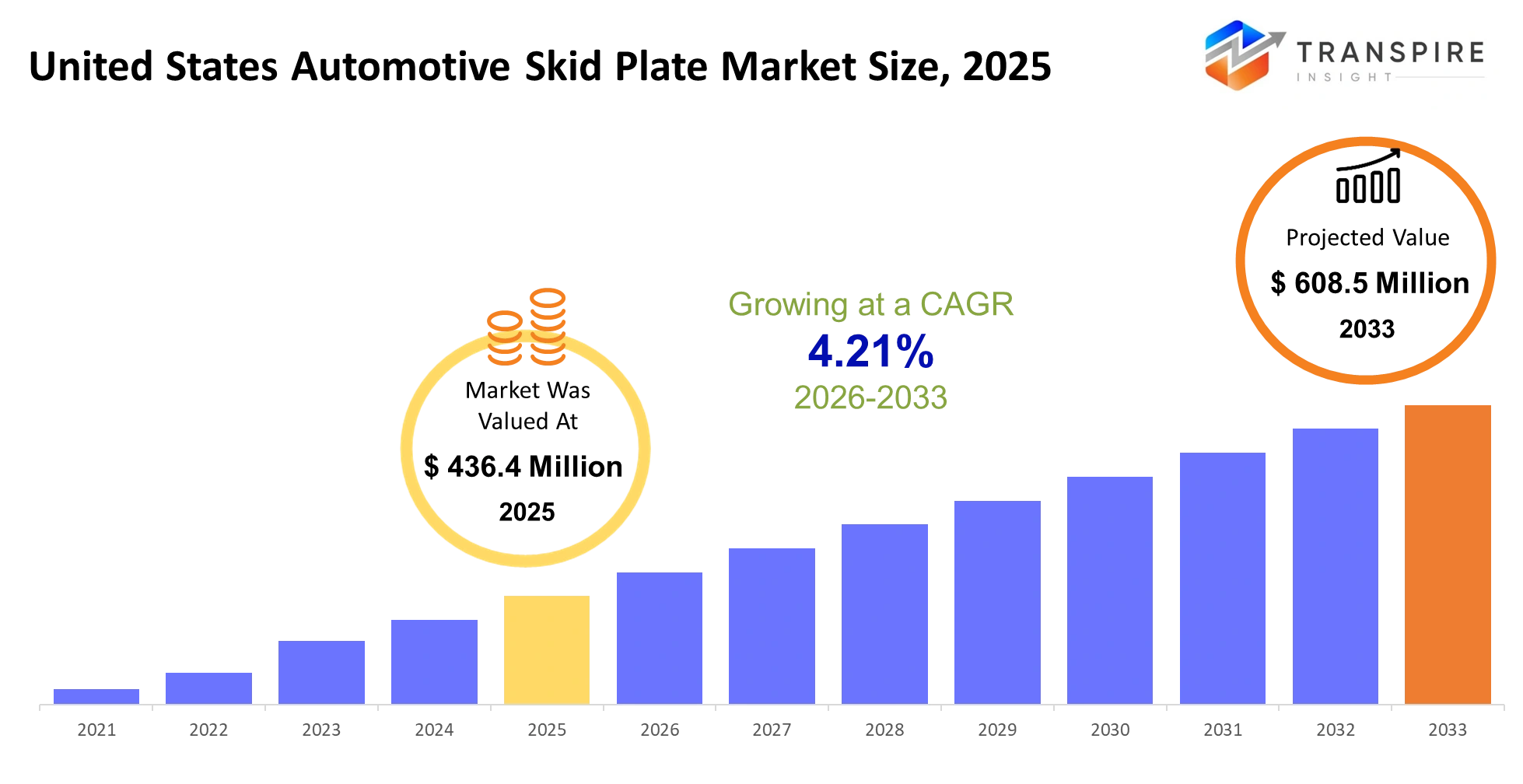
- United States Automotive Skid Plate Market Size 2025: USD 436.4 Million
- United States Automotive Skid Plate Market Size 2033: USD 608.5 Million
- United States Automotive Skid Plate Market CAGR: 4.21%
- United States Automotive Skid Plate Market Segments: By Material (Steel, Aluminum, Plastic, Carbon Fiber, Composite Materials, Rubber-coated Plates, Others), By Vehicle Type (Passenger Cars, SUVs, Commercial Vehicles, Electric Vehicles, Off-road Vehicles, Others), By Sales Channel (OEMs, Aftermarket, Online Retail, Automotive Dealers, Specialty Stores, Others), By Application (Engine Protection, Transmission Protection, Fuel Tank Protection, Off-road Protection, Chassis Protection, Others).
To learn more about this report,  Download Free Sample Report
United States Automotive Skid Plate Market Summary:
The United States Automotive Skid Plate Market size is estimated at USD 436.4 Million in 2025 and is anticipated to reach USD 608.5 Million by 2033, growing at a CAGR of 4.21% from 2026 to 2033. Automotive skid plates actually do a practical job, they kind of shield the key underside pieces like oil pans , transmissions , battery packs and fuel systems from road grit, off-road bumps, and that rough terrain kind of exposure that nobody really wants. In the United States, the market has drifted away from its older association with pickup trucks and off-road SUVs, and now it shows up across a wider set of rides, even including electric vehicles, commercial fleets, and performance driven utility models. Over the last 3 to 5 years, there’s been a noticeable structural change, where automakers are redesigning their platforms using lighter materials and EV centered architectures, and that forces skid plate makers to balance impact resistance with weight trimming, plus thermal management requirements, all at once, sort of.
One major catalyst for demand was the pandemic era supply chain disruption alongside semiconductor shortages, which basically caused OEMs and fleet owners to keep vehicles running longer instead of sticking to rapid replacement cycles. As a result, spending increased on protective aftermarket add-ons and sturdier underbody assemblies. At the same time, growth connected to outdoor recreation, construction activity, and fleet logistics has pushed more vehicles into harsh, daily conditions, so adoption rises and aftermarket revenue increases too, especially when customers look for reinforced protection components.
Key Market Insights
- The United States Automotive Skid Plate Market seems to be riding along with growing demand for pickup trucks , SUVs and those all terrain vehicles which get used in construction , recreation, and logistics sort of everyday things.
- OEMs are now putting in advanced skid protection systems more often, mainly to help with vehicle durability and also cut down maintenance costs, plus it improves off road performance capabilities, in a very practical way.
- At the same time electric vehicle manufacturers are speeding up the use of lightweight aluminum skid plates , so they can guard battery packs and also thermal management systems from impact damage , even when conditions get rough.
- And the aftermarket customization trend, you know the one where people upgrade for style and function , helped contribute to nearly 38% of the revenue share in 2025. that was pushed by off-road enthusiasts plus performance vehicle upgrades, generally.
- Looking ahead, advanced composite materials are showing up as the fastest-growing product type between 2025 and 2031 , largely because they resist corrosion better and also reduce weight.
- Region wise, the Southern United States led the market with nearly 34% share in 2025, mostly due to strong pickup truck ownership and a lot of rugged usage patterns.
- Meanwhile Western states are the fastest growing area through 2031, driven by outdoor recreation and off-road tourism, along with expanding EV adoption rates that keep climbing.
- Texas and California still stay high value markets for automotive skid plates , because there are big SUV fleets, the terrain is tough, and the aftermarket modification culture is pretty active there.
- Aluminum skid plates made up roughly 41% of the market in 2025, since automakers prioritize lightweight protection alongside some upgrades for fuel efficiency, and well, you know, the usual focus.
- Steel skid plates stayed in the second-largest spot, driven by affordability and solid durability, and then steady consumer demand for heavy duty commercial vehicles, where budgets and toughness often need to match, pretty much every time.
What are the Key Drivers, Restraints, and Opportunities in the United States Automotive Skid Plate Market?
The main growth engine in the United States Automotive Skid Plate Market is basically the quick spread of electric trucks, SUVs and off road utility vehicles , kind of all at once. Automakers started reworking vehicle platforms once tougher fuel efficiency rules and tighter battery safety requirements forced the sector toward lighter weight layouts and tougher underbody protection . That shift really boosts demand for aluminum and composite skid plates because these parts protect battery packs, cooling lines, and the drivetrain bits from impact hits. When EV makers scale output, skid plate installation is moving from a after market add on to a OEM fitted element, and that move tends to unlock steady revenue chances across both passenger rides and commercial models.
The biggest block inside the market is still the expensive price tag, plus the engineering difficulty tied to advanced lightweight materials. Composite and aerospace grade aluminum skid plates typically need specialized fabrication, precision tooling and vehicle specific matching processes, and not many smaller suppliers can scale that efficiently . So adoption slows in budget conscious vehicle groups and the reach often stops around premium SUVs and high performance utility vehicles. In practice this means delayed aftermarket growth and tighter revenue expansion for mid range categories.
A huge chance is kind of emerging from fleet electrification mixed with broader industrial logistics growth across the Southern, and Western United States. Delivery operators together with utility fleets are putting money into electric vans, plus work trucks that still run through demanding roadway conditions, daily. That situation is quietly shaping a bigger demand for modular skid protection systems, tied in with battery thermal management and sensor shielding tools.
What Has the Impact of Artificial Intelligence Been on the United States Automotive Skid Plate Market?
Artificial intelligence plus advanced digital engineering tools are kinda reshaping the United States Automotive Skid Plate Market, mostly by pushing manufacturing precision , upgrading vehicle diagnostics, and helping with lifecycle performance management in a more managed way. More and more manufacturers are leaning into AI-guided design software and digital twin simulations to fine tune skid plate geometry, weight placement, and impact survivability before any physical production really starts. In practice this shortens the back and forth of prototyping, and it also cuts down on material waste during fabrication. On top of that automated CNC machining systems, when they’re paired with machine vision tech, help tighten dimensional accuracy and boost production throughput for aluminum and composite underbody protection units.
Meanwhile machine learning models are also feeding predictive maintenance approaches in commercial fleets and electric vehicle setups. Vehicle sensors keep watching vibration signatures, underbody impact pressure, corrosion exposure, and temperature behavior around battery housings. The AI layer then sifts through that operational information to estimate fatigue trends and suggest replacement windows before structural failure can show up. Fleet operators often see fewer surprise stoppages, smaller repair budgets, and a longer service life for the vehicles. Some logistics operators even mention real maintenance cost decreases , plus better vehicle uptime, once they connect diagnostics together with underbody protection monitoring systems.
Still, AI adoption has a pretty notable snag. A lot of aftermarket installers and smaller manufacturers do not have access to standardized vehicle data frameworks, so real time analytics integration becomes costly, and frankly difficult, across the many fragmented vehicle platforms.
Key Market Trends
- Since 2022, automakers like Ford Motor Company have been leaning into more factory-installed skid plates on electric trucks, sorta to tighten up battery enclosure defense, not that it’s just one thing, you know.
- Aluminum skid plates picked up almost 12% more penetration compared with 2021 as makers tried to lighten up the vehicles , to stay within fuel efficiency compliance targets.
- Composite materials started rolling in faster after 2023, mainly because EV platforms needed corrosion-resistant underbody shielding, while also keeping the driving range performance intact, so it wouldn’t hurt the daily commute.
- During the pandemic, semiconductor shortages basically forced fleet operators to keep vehicles longer, and that move quietly pushed aftermarket skid plate replacement and retrofit spending upward through 2024, like it was inevitable.
- In the Western U.S. states, off-road accessory sales looked stronger after 2022, helped by overlanding culture spreading a bit more, along with more recreational utility vehicle ownership going on.
- AI-based digital twin simulations shortened prototype development timelines by close to 20% for several underbody protection suppliers between 2023 and 2025, which sounds big and honestly it is.
- Suppliers also started manufacturing nearer to North American assembly plants after global logistics disruptions showed how dependent everyone was on overseas metal fabrication networks, and they didn’t like that exposure.
- After 2021, online automotive accessory platforms expanded aftermarket visibility a lot, letting smaller skid plate manufacturers show up and compete with long-running OEM suppliers.
- Commercial delivery fleets began adding reinforced underbody systems after EV maintenance data pointed to higher chances of battery casing impact damage, kind of like a warning signal.
- Companies including Toyota Motor Corporation and General Motors added more modular accessory options, aiming to catch the premium off-road vehicle customization revenue that people seem willing to pay for.
United States Automotive Skid Plate Market Segmentation
By Material
Steel skid plates keep the top spot in the material space, mostly because heavy-duty pickup trucks, utility vehicles and commercial fleets tend to value durability ,and impact resistance more than saving a few pounds. You can see strong uptake tied to construction, agriculture and logistics, since those industries live in high-load operating environments and they still want reliable underbody protection.
Aluminum has also picked up serious momentum over the last five years, basically as automakers chase lighter vehicle structures, to squeeze better fuel economy and electric vehicle range efficiency . Meanwhile carbon fiber and other composites are still smaller in share, but they’re probably the fastest-growing slice, since premium SUVs and electric platforms keep getting deeper integration.
Rubber-coated plates plus plastic variants usually land in low-impact urban use where corrosion resistance and cost control feel more important than extreme ruggedness. Looking ahead, the competition is going to tilt more toward lightweight engineering, improved coatings, and modular fabrication methods, so makers can balance structural strength with thermal management plus overall efficiency needs, without overcomplicating everything.
By Vehicle Type
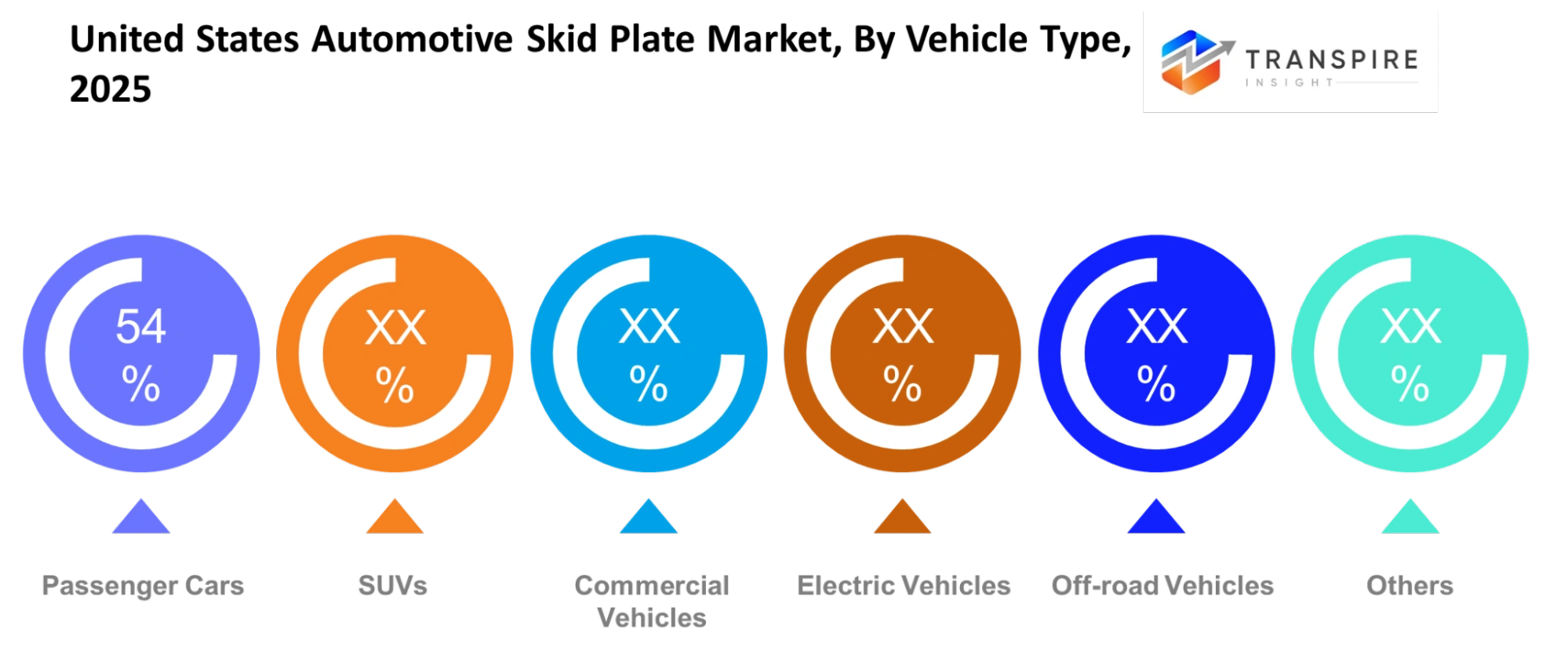
SUVs are basically the leading kind of vehicle segment , because more people are getting into outdoor recreation and the ownership of utility vehicles keeps rising, so there is more need for reinforced protection underneath . Passenger cars hold fairly steady in volume demand, but because the ground clearance stays limited , the push for heavy-duty skid systems is less, especially in city driving. Commercial vehicles still take up a big portion as well, since they are exposed to rougher roads, loading areas , and they run long-distance routes, which really speeds up underbody wear.
Electric vehicles are moving fastest now, partly because battery protection has become a core engineering must across new platform designs. Off-road vehicles keep pulling strong aftermarket interest through the customization culture and participation in recreational motorsports. Overall, the market is shifting toward vehicle-specific skid plate systems , built around the battery layout, drivetrain positioning , and also aerodynamic behavior. Manufacturers that focus on precise fitment, lightweight alloys, and protection systems that play nicely with sensors will end up in a better place as platforms get more specialized and deeply electronic.
To learn more about this report, Download Free Sample Report
By Sales Channel
OEM sales channels, at least right now, are still pulling in most of the industry revenue because automakers keep integrating skid protection systems straight into what they ship from the factory, in those ready made vehicle packages. This in place installation tends to give better fitment accuracy , it also helps warranty coverage feel more secure and consistent, and it matches what consumers seem to want, meaning quick to use utility setups, even the off road leaning ones.
Meanwhile the aftermarket side is not slowing down. It keeps growing quickly, mostly because SUV owners and people into overlanding are into tailoring things, and commercial fleet operators as well, they just want to stretch vehicle service life longer. Online retail has also changed how people buy, since it makes it easier to compare products, see what’s available, and reach nationwide distribution for smaller brands that otherwise might feel kind of out of reach.
Automotive dealers still matter a lot, especially for premium utility vehicles, where bundled accessory packs can create extra margins, like real add on money. Specialty stores also keep showing up for the niche off road communities that care about technical customization and performance improvements, not just generic upgrades.
Going forward, the fight between channels will likely hinge on digital sales integration, faster delivery capability, and data driven compatibility tools that tell you what works with which vehicle, before anyone even orders. Suppliers who can juggle OEM commitments while also building scalable direct to consumer operations will probably land stronger long term revenue diversification.
By Application
Engine protection still feels like the main priority in practice, mostly because oil pans, cooling circuits, and drivetrain parts are always getting hit by debris, rough patches, and that usual road impact kind of harm. Meanwhile transmission protection keeps pulling a lot of attention too, especially on commercial vehicles and off road platforms that run under heavy mechanical stress conditions. Fuel tank protection systems also stay important in heavy-duty trucks and utility fleets, since day to day reliability turns into very real maintenance costs, plus the extra pressure from vehicle downtime.
Off road protection applications have grown rather quickly, partly tied to more recreational vehicle ownership and the steady climb in adventure tourism across Western and Southern states. Chassis protection is gaining strategic weight in electric vehicles as well, because the underbody structures now have battery housings, thermal routing, and integrated electronics, and all of that can be hurt by impact damage even when the hit seems minor.
Looking ahead, application development will likely lean toward multi functional skid systems, so it is not only abrasion resistance but also structural guarding, thermal shielding, aerodynamic tuning and even sensor integration. This shift should lead to more investment in smart materials, modular assemblies, and digitally designed underbody protection technologies, because it’s easier to adjust and upgrade over time, without having to redo everything from scratch.
What are the Key Use Cases Driving the United States Automotive Skid Plate Market?
Engine plus transmission safeguarding is still basically the main thing pushing skid plate use on pickup trucks, SUVs, and commercial utility vehicles. In practice, construction fleets, agricultural operators, and off-road owners often depend on reinforced underbody setups to keep drivetrain damage from happening during rough terrain runs and unpaved job sites … even when everything feels messy out there.
Then you get secondary roles that are growing, especially in electric delivery fleets and recreational overlanding vehicles. Logistics teams are more and more putting in light weight aluminum shielding modules to cover battery enclosures from road clutter , and the niche off-road communities keep funding aftermarket improvements for harsh trail capability and long-range trip reliability.
More fresh use cases are starting to appear too , like sensor-protected skid systems meant for autonomous driving platforms and thermal shielding underbody protection aimed at next-generation electric trucks. Defense utility vehicles, as well as disaster-response fleets, are also showing early adoption signs where vehicle survivability and operational continuity are becoming strategically important, more than people expect at first.
|
Report Metrics |
Details |
|
Market size value in 2025 |
USD 436.4 Million |
|
Market size value in 2026 |
USD 455.8 Million |
|
Revenue forecast in 2033 |
USD 608.5 Million |
|
Growth rate |
CAGR of 4.21% from 2026 to 2033 |
|
Base year |
2025 |
|
Historical data |
2021 - 2024 |
|
Forecast period |
2026 - 2033 |
|
Report coverage |
Revenue forecast, competitive landscape, growth factors, and trends |
|
Geographic scope |
United States of America |
|
Key company profiled |
Magna International, Hyundai Mobis, Toyota Boshoku, Faurecia, Yanfeng Automotive Interiors, Grupo Antolin, Plastic Omnium, Samvardhana Motherson, Tata AutoComp, AISIN Corporation, Calsonic Kansei, Denso, Bosch, Continental AG, Valeo. |
|
Customization scope |
Free report customization (country, regional & segment scope). Avail customized purchase options to meet your exact research needs. |
|
Report Segmentation |
By Material (Steel, Aluminum, Plastic, Carbon Fiber, Composite Materials, Rubber-coated Plates, Others), By Vehicle Type (Passenger Cars, SUVs, Commercial Vehicles, Electric Vehicles, Off-road Vehicles, Others), By Sales Channel (OEMs, Aftermarket, Online Retail, Automotive Dealers, Specialty Stores, Others), By Application (Engine Protection, Transmission Protection, Fuel Tank Protection, Off-road Protection, Chassis Protection, Others). |
Which Regions are Driving the United States Automotive Skid Plate Market Growth?
The Southern United States is still sort of the leading regional market , mainly because pickup truck ownership stays high, industrial vehicles get used a lot, and the whole logistics machine is big and nonstop. You see places like Texas and Florida keep pushing for a strong skid plate demand, mostly because all the heavy construction stuff, energy sector hauling, and off-road recreation riding. It’s kinda like, once the trucks roll, the underbody protection has to be there you know, and people don’t really wait around. Big OEM assembly plants plus aftermarket distribution hubs end up forming an integrated supply loop, which helps regional manufacturing and makes product availability feel steady. And there’s also a clear consumer pull toward utility vehicles , so automakers tend to add factory-installed underbody protection systems across their more premium truck and SUV lines.
Meanwhile the Midwest remains the second-largest contributor, but the growth story looks different from the South, because the demand leans more toward commercial durability and manufacturing stability. Agricultural transport fleets, industrial service vehicles , and long-distance freight operators keep putting money into reinforced underbody systems so maintenance expenses don’t spike during year-round schedules. The area also has a solid supplier web and steady OEM production, which basically supports consistent replacement demand over time. Plus the economic resilience seen in industrial states like Michigan and Ohio gives suppliers—especially those working on steel and heavy-duty protection solutions—more predictable conditions.
As for the Western United States , it is moving up quickly and showing the fastest growth, largely from more electric vehicle adoption plus the rapid rise in outdoor recreation. California, Colorado , and Arizona have increased investment in EV infrastructure and utility vehicle modernization programs since 2023, which has translated into stronger demand for lightweight aluminum and composite skid systems.
Who are the Key Players in the United States Automotive Skid Plate Market and How Do They Compete?
The United States Automotive Skid Plate Market stays fairly moderately fragmented, with rivalry split between OEM-in tegrated providers, specialist off-road accessory manufacturers, and aftermarket performance brands that sort of lean more aggressively. Big automakers keep trying to hold ground via factory-installed underbody protection packages , while smaller players push through customization , lighter materials and pretty fast digital distribution channels. Lately, tech innovation feels more important than plain price fighting, specially because electric vehicle platforms need improved thermal shielding, plus battery-specific protection systems. Where suppliers can move inventory matters too, since companies with regional warehousing and quick delivery routes get more traction with aftermarket installers and commercial fleet operators , overall.
Ford Motor Company boosts its competitive posture by getting skid protection straight into OEM integration, across its truck and off-road lineups like the Bronco and the F-Series , basically. Their factory-engineered fitment and warranty backed accessory packages make it harder for generic aftermarket alternatives to keep pace , right. Toyota Motor Corporation on the other hand differentiates via rugged off-road vehicle ecosystems connected to the Tacoma and 4Runner platforms , where modular accessory compatibility lets them push higher margin customization options .
Both firms also keep expanding premium off-road trims, plus dealer installed protection offerings, to ride the overlanding wave that keeps rising across Western and Southern states. ARB Corporation plays a more niche game, focusing on heavy-duty off-road protection systems, aimed at extreme terrain capability and expedition travel.
Company List
- Magna International
- Hyundai Mobis
- Toyota Boshoku
- Faureci
- Yanfeng Automotive Interiors
- Grupo Antolin
- Plastic Omnium
- Samvardhana Motherson
- Tata AutoCom
- AISIN Corporation
- Calsonic Kansei
- Denso
- Bosch
- Continental AG
- Valeo
Recent Development News
In January 2026, JSPORT USA Launches 2026 Honda Passport Rear Differential Skid Plate: A U.S.-based aftermarket manufacturer introduced a heavy-duty aluminum rear differential skid plate for the 2026 Honda Passport. The product focuses on lightweight protection and direct-fit installation for off-road durability.
Source: https://www.jsportusa.com
In April 2026, ASFIR 4x4 Introduces New Skid Plate System for 6th Gen Toyota 4Runner: ASFIR announced its aluminum skid plate protection system for the newly released 2026+ Toyota 4Runner platform in the U.S. market, targeting both OEM and aftermarket off-road segments.
Source: https://www.4runner6g.com
What Strategic Insights Define the Future of the United States Automotive Skid Plate Market?
Over the next five to seven years, the United States Automotive Skid Plate Market is slowly but very clearly moving toward more integrated underbody protection systems that are made, sort of, for electric, connected, and software-defined vehicles. Underneath all of that shift is this bigger push around battery safety , sensor guarding , and lightweight vehicle engineering , not only the usual “go off road and don’t get wrecked” durability logic. Because of that, skid plates will be more and more treated as multi-purpose structural pieces , helping with thermal shielding and aerodynamics too, while also carrying embedded sensor protection inside newer vehicle blueprints.
There’s also a less obvious risk, and it’s tied to raw material concentration plus how much the supply chain depends on aluminum and specialty composite processing. If prices swing a lot and domestic processing capacity stays tight, manufacturers aiming for lightweight designs at scale could see their margins get squeezed. In contrast, an opportunity is also forming. It’s showing up with autonomous commercial fleets, and even robotic delivery vehicles, especially when they run through dense urban logistics zones, where underbody sensor shielding and impact protection turn into daily requirements, not just optional add-ons.
So market players should focus on modular, vehicle-specific protection platforms , backed by digital fitment tools, and supported by regional manufacturing capacity. That way they can reduce supply risk , and respond faster when OEM requirements start changing again, rather than waiting and hoping.
United States Automotive Skid Plate Market Report Segmentation
By Material
- Steel
- Aluminum
- Plastic
- Carbon Fiber
- Composite Materials
- Rubber-coated Plates
- Others
By Vehicle Type
- Passenger Cars
- SUVs
- Commercial Vehicles
- Electric Vehicles
- Off-road Vehicles
- Others
By Sales Channel
- OEMs
- Aftermarket
- Online Retail
- Automotive Dealers
- Specialty Stores
- Others
By Application
- Engine Protection
- Transmission Protection
- Fuel Tank Protection
- Off-road Protection
- Chassis Protection
- Others
Frequently Asked Questions
Find quick answers to common questions.
The approximate United States Automotive Skid Plate Market size for the market will be USD 608.5 Million in 2033.
The key segments of the United States Automotive Skid Plate Market are By Material (Steel, Aluminum, Plastic, Carbon Fiber, Composite Materials, Rubber-coated Plates, Others), By Vehicle Type (Passenger Cars, SUVs, Commercial Vehicles, Electric Vehicles, Off-road Vehicles, Others), By Sales Channel (OEMs, Aftermarket, Online Retail, Automotive Dealers, Specialty Stores, Others), By Application (Engine Protection, Transmission Protection, Fuel Tank Protection, Off-road Protection, Chassis Protection, Others).
Major players in the United States Automotive Skid Plate Market are Magna International, Hyundai Mobis, Toyota Boshoku, Faurecia, Yanfeng Automotive Interiors, Grupo Antolin, Plastic Omnium, Samvardhana Motherson, Tata AutoComp, AISIN Corporation, Calsonic Kansei, Denso, Bosch, Continental AG, Valeo.
The current market size of the United States Automotive Skid Plate Market is USD 436.4 Million in 2025.
The United States Automotive Skid Plate Market CAGR is 4.21%.
- Magna International
- Hyundai Mobis
- Toyota Boshoku
- Faureci
- Yanfeng Automotive Interiors
- Grupo Antolin
- Plastic Omnium
- Samvardhana Motherson
- Tata AutoCom
- AISIN Corporation
- Calsonic Kansei
- Denso
- Bosch
- Continental AG
- Valeo
Recently Published Reports
-
Apr 2026
ATV & UTV Market
ATV & UTV Market Size, Share & Analysis Report By Type (ATV, and UTV), By Variants (Less Than 400 CC, 400 CC To 800 CC, and More Than 800 CC), and Geography (North America, Europe, Asia-Pacific, Middle East and Africa, South and Central America), 2021 - 2031
-
Apr 2026
Automotive Central Gateway Module Market
Automotive Central Gateway Module Market Size, Share & Analysis Report By Type (Ethernet Central Gateway Module, CAN Central Gateway Module, LIN Central Gateway Module, and FlexRay), By Application (Powertrain Control, Body Control, Infotainment System, Advanced Driver Assistance Systems (ADAS), and Others), By End User (Passenger Vehicles, and Commercial Vehicles), and Geography (North America, Europe, Asia-Pacific, Middle East and Africa, South and Central America), 2021 - 2031
-
Apr 2026
Automotive Engine Oil Filter Market
Automotive Engine Oil Filter Market Size, Share & Analysis Report By Filter Type (Fuel Filter, Engine Oil Filter, Hydraulic Oil Filter, and Others), By Filter Media (Cellulose, Synthetic, and Micro), By Sales Channel (OEMs, and Aftermarket), By Vehicle Type (Passenger Cars, Light Commercial Vehicles, Heavy Duty Trucks, Buses and Coaches, and Off-road Vehicles), and Geography (North America, Europe, Asia-Pacific, Middle East and Africa, South and Central America), 2021 - 2031
-
Apr 2026
Automotive Parts Aluminium Die Casting Market
Automotive Parts Aluminium Die Casting Market Size, Share & Analysis Report By Production Process (Pressure Die Casting, Vacuum Die Casting, Squeeze Die Casting, Gravity Die Casting), By Application (Body Parts, Engine Parts, Transmission Parts, Battery And Related Components, Other Application Types), and Geography (North America, Europe, Asia-Pacific, Middle East and Africa, South and Central America), 2021 - 2031
Our Clients