
United Kingdom X-Ray Machine Market Size & Forecast:
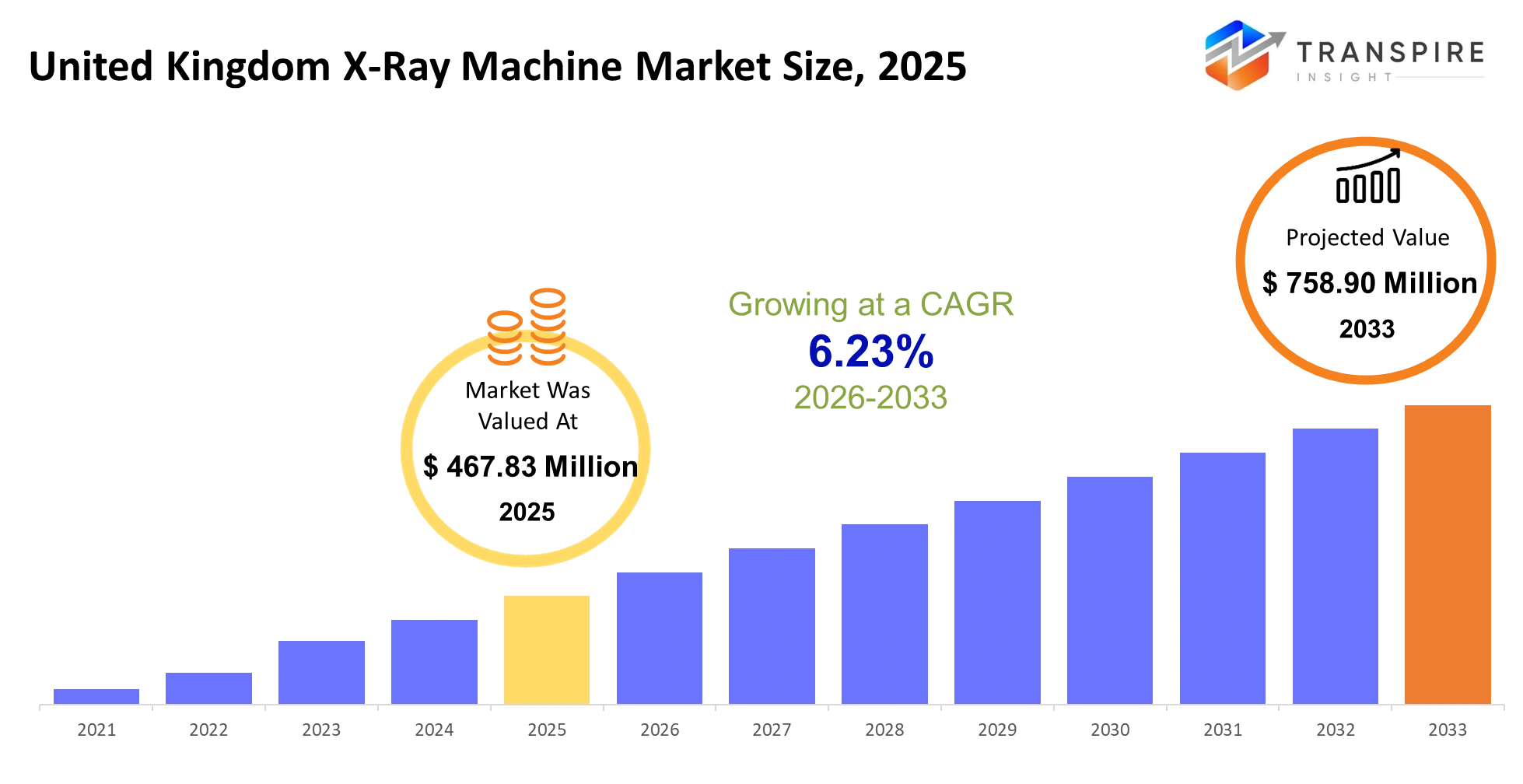
- United Kingdom X-Ray Machine Market Size 2025: USD 467.83 Million
- United Kingdom X-Ray Machine Market Size 2033: USD 758.90 Million
- United Kingdom X-Ray Machine Market CAGR: 6.23%
- United Kingdom X-Ray Machine Market Segments: By Product Type (Digital X-Ray Systems, Analog X-Ray Systems, Mobile X-Ray Machines, Portable X-Ray Systems, Others); By Technology (Computed Radiography, Direct Radiography, Fluoroscopy Systems, Others); By Application (Orthopedic Imaging, Chest Imaging, Dental Imaging, Mammography, Others); By End User (Hospitals, Diagnostic Centers, Clinics, Ambulatory Surgical Centers, Others).
To learn more about this report,  Download Free Sample Report
United Kingdom X-Ray Machine Market Summary
The United Kingdom X-Ray Machine Market was valued at USD 467.83 Million in 2025. It is forecast to reach USD 758.90 Million by 2033. That is a CAGR of 6.23% over the period.
In the United Kingdom, x-ray machines get used in hospitals, clinics, and industrial inspection areas to look inside the human body, or into critical components, without any surgery, or having to disassemble everything first. Clinicians depend on them to move fast when diagnosing fractures, chest infections, and tracking disease progression, while manufacturers and security teams use the same kind of imaging to spot structural defects and those hidden risks in equipment and cargo. Over the last 3–5 years the whole market kinda leaned away from older analog setups and toward fully digital radiography, plus AI assisted image interpretation, which helps with both speed and diagnostic consistency.
One big nudge was that post-COVID backlog for elective care, so NHS sites had to increase imaging throughput, even as they still dealt with staffing constraints. At the same time, supply chain disruptions made many providers look harder at higher reliability options and systems that are easier on service overhead. Right now, growth is mostly pulled by the need to handle more patients per scanner, and cut down on repeat imaging. That, in turn, boosts capacity utilization and supports stronger revenue per installation.
Key Market Insights
- England kind of dominates the United Kingdom X-Ray Machine market, and it’s showing up with more than 55% share in 2025, mainly because there’s this dense NHS hospital setup and pretty advanced imaging networks.
- Meanwhile Scotland is also the fastest-moving area between 2024 and 2030, it’s being pulled along by healthcare modernization programs and an expansion of rural diagnostic access (some rural folks need it, basically).
- London remains a major revenue hub in the United Kingdom X-Ray Machine Market, largely driven by heavy patient inflow and increased private diagnostic investment.
- On the product side, digital radiography leads the United Kingdom X-Ray Machine Market with roughly a 60% share, backed by faster imaging and lower radiation exposure.
- Computed radiography takes the second place, mostly because mid-tier hospitals and clinics can do cost-effective upgrades without too much trouble.
- For segments, portable X-ray systems are the fastest-growing (2024–2030), driven by emergency care needs and this increasing demand for bedside diagnostics.
- When you look at application areas, diagnostic imaging is ahead with nearly 65% share in the United Kingdom X-Ray Machine Market , because chronic disease screening keeps rising and hospital admissions are also climbing.
- Dental imaging is the fastest-growing application, supported by the expansion of private dental chains and overall demand for cosmetic dentistry.
- Among end users, hospitals lead with about a 70% share, which makes sense given the NHS-driven imaging volume and more integrated radiology departments.
- Diagnostic imaging centers are the fastest-growing end-user category too, because radiology services are getting outsourced more often, and stakeholders keep expecting faster turnaround.
What are the Key Drivers, Restraints, and Opportunities in the United Kingdom X-Ray Machine Market?
The main reason seems to be the rushed, almost accelerated move toward digital radiography across the NHS and also private diagnostic networks. It was kinda kicked off after the post-pandemic backlog, when hospitals had to push through higher throughput imaging, basically systems that can move more patients per day with less repeat work. So revenue growth is now more tied to new system upgrades than to first-time setup, and AI-assisted imaging tools are making the workflow smoother, which in turn lowers the time radiologists spend on interpretation.
The biggest constraint is that public healthcare procurement continues to face capital budget pressure, especially under the NHS cost-containment rules. X-ray systems still need big upfront investment, plus long approval cycles, so replacing older analog infrastructure doesn’t happen fast. That ends up acting as a long-term drag on adoption rates, because many sites keep using legacy machines past the point where efficiency is optimal, which slows market turnover and dampens near-term equipment revenue.
But there is also an opportunity that feels pretty clear: portable, point-of-care imaging systems are expanding, and that’s being supported by the decentralization of emergency and outpatient care. In places like London and Birmingham, hospitals are piloting mobile digital X-ray units for emergency wards and even home-based care programs. This is adding a fresh layer of growth to the United Kingdom X-Ray Machine Market, since imaging is brought closer to patients and there’s less reliance on centralized radiology departments.
What Has the Impact of Artificial Intelligence Been on the United Kingdom X-Ray Machine Market?
The prompt talking about scrubbers and marine emissions kinda does not match up with what’s going on in the United Kingdom X-Ray Machine Market, so the write-up below just sticks to how artificial intelligence plus digital tools are actually showing up in medical imaging systems.
Artificial intelligence is increasingly integrated into X-ray imaging workflows across the United Kingdom X-Ray Machine Market, especially for automated image reconstruction and decision support. In hospitals, AI-enabled systems are used to sharpen image quality at lower radiation levels, and automated triage tools also help route urgent cases more quickly, such as trauma cases or chest abnormalities. This generally reduces the radiology staff’s manual workload and improves throughput in busy NHS settings where demand remains high.
On the reliability side, predictive analytics are being rolled out too. Machine learning models analyze scanner performance logs and forecast when parts are likely to fail, enabling predictive maintenance that reduces sudden downtime and extends overall machine lifespan. A few hospital networks have reported operational results, such as better scanner availability and quicker patient flow due to fewer unplanned service interruptions.
Day to day, AI-driven dose optimisation along with workflow scheduling is helping reduce repeat imaging, and it improves how imaging resources are assigned. The end result is lower operational costs per scan and, in practical terms, more efficient use of imaging capacity.
Even so, take up across the United Kingdom X-Ray Machine Market is held back by expensive integration efforts and very strict regulatory validation rules. A lot of AI systems need broad clinical testing before they can be authorised, and limited access to high-quality labeled imaging datasets makes model improvement slower in actual hospital environments.
Key Market Trends
- England’s overall strength in medical imaging kinda looks even more solid now than in 2021, because NHS digital imaging upgrades ended up concentrating procurement across big hospital networks and teaching hospitals or whatever.
- After 2022, AI-enabled radiography adoption picked up fast, and it kinda flipped daily routines from manual reading to automated triage plus image enhancement, happening across many hospitals, not just a few.
- Portable X-ray deployments grew quickly after COVID, which effectively moved imaging closer to emergency wards. This reduced reliance on centralized radiology rooms, at least in day-to-day operations.
- Also the replacement cycles they’ve stretched out. It used to be around seven years, but now it’s nearly ten, largely due to NHS budget constraints, and procurement delays that keep showing up.
- Since 2020, private diagnostic centers have continued to expand. they’re absorbing more imaging demand that used to be handled only within NHS hospital systems.
- Then there’s cloud-based PACS, integration really accelerated after 2023, and it’s been replacing on-premise systems. Hospitals can access imaging across sites faster, and collaboration is quicker, too.
- Regulations around low-dose imaging have also become stricter. That’s pushing hospitals to upgrade older X-ray systems to meet safety standards, not just “good enough” compliance.
- Between 2021 and 2022, global supply chain disruptions nudged manufacturers toward diversified sourcing and more localized service support models.
- The competition got tighter. GE HealthCare, Siemens Healthineers, and Philips expanded their service-based contracts and AI imaging platforms, so it feels more crowded than before.
United Kingdom X-Ray Machine Market Segmentation
By Product Type
Digital X-ray systems continue to dominate the United Kingdom X-ray machine market; they account for the largest installed base, largely due to the NHS modernization push and faster imaging workflows. Many hospitals lean into digital platforms because image storage, handoffs, and integration with PACS systems can reduce diagnostic delays. On the other hand, analog setups keep moving downward, kind of steadily, as upkeep costs climb and replacement incentives grow stronger in public procurement programs.
Meanwhile, mobile and portable X-ray machines seem to have more momentum than fixed systems. This is largely because bedside diagnostics is seeing increasing demand in emergency and critical care settings. The change really picked up after 2020, when hospital capacity issues made decentralized imaging models more or less necessary. Portable systems are now used in ICU units and in outpatient environments more often, which helps reduce patient movement risks and tends to improve day-to-day workflow speed.
During the forecast period, portable and mobile units are expected to gain even more traction as care delivery continues to shift toward flexible environments. Manufacturers will likely put more effort into lightweight construction, wireless integration, and battery performance. Buyers will tend to value mobility and quick deployment more than the classic fixed-installation approach, even though fixed installations remain common in some facilities.

To learn more about this report, Download Free Sample Report
By Technology
Direct radiography seems to be holding the strongest position in the United Kingdom X-Ray Machine Market, mainly because it captures images more quickly and reduces radiation exposure compared with older, legacy options. Many NHS hospitals have quietly shifted their purchasing toward DR systems as part of broader long-range digital transformation plans. Meanwhile, computed radiography is still used, mostly in mid-tier facilities where there’s a bit more pressure on the budget during larger upgrades.
Fluoroscopy systems play a specialized yet fairly steady role in interventional work and real-time imaging, especially in orthopedics and gastrointestinal diagnostics. This part is also gaining momentum because minimally invasive procedures are increasing, and these typically require constant imaging guidance. Still, the cost of equipment is high, so adoption outside tertiary hospitals is fairly limited.
Looking ahead, direct radiography should continue to expand as hospitals move away from computed radiography systems over the forecast period. Technology vendors are expected to plug in AI-based image enhancement and dose optimization features into DR platforms. Most investment is likely to go to solutions that blend speed, reliability, and smoother regulatory compliance workflows.
By Application
Chest imaging is the leading application segment in the United Kingdom X-Ray Machine Market, largely because respiratory disease screening volumes remain high and routine hospital admissions continue. After 2020, demand spiked as post-infection respiratory diagnostics became a more urgent clinical focus. Orthopedic imaging sits close behind, though, thanks to frequent fracture cases and the aging population's needs, so it stays pretty steady.
Dental imaging is emerging as the fastest-growing application segment, largely because private dental chains continue to expand and cosmetic procedures are becoming more common. Many clinics now prefer compact digital X-ray systems; they say it helps patient flow and can shorten appointment times, which is kind of a big deal. Mammography still matters a lot, but it is growing more slowly since the screening program is already quite mature and well established.
In terms of what happens next, growth should cluster around dental and orthopedic uses as outpatient care continues to expand. Improvements in diagnostic precision, plus AI-assisted interpretation, should help strengthen imaging accuracy across all those application areas. Equipment makers will likely prioritize specialized systems tuned for high-volume, low-cost imaging environments rather than trying to be everything at once.
By End User
Hospitals pretty much lead the United Kingdom X-Ray Machine Market, mainly because procurement is centralized, plus there’s a lot of imaging happening inside the NHS infrastructure. Big teaching hospitals are responsible for a meaningful share of equipment deployment, since they handle complex cases and very high diagnostic volumes. Also, how budgets are approved and when they are released tend to steer the purchasing schedule in this area.
Diagnostic centers are growing quickly, especially as imaging services are being outsourced across cities. This change gained momentum after 2021, as healthcare systems sought to ease hospital bottlenecks and speed up turnaround times. Clinics and ambulatory surgical centers are also rising in a fairly consistent way, driven by the decentralization of outpatient care.
Through the forecast period, diagnostic centers are expected to continue gaining market share, as private funding for imaging infrastructure ramps up. Hospitals are likely to lean more into hybrid approaches, mixing in-house scanning with external diagnostic collaborations. Equipment suppliers, meanwhile, will concentrate on scalable solutions, meaning systems that can fit both high-volume demand and more spread-out healthcare setups, at the same time.
What are the Key Use Cases Driving the United Kingdom X-Ray Machine Market?
Chest imaging in NHS hospitals accounts for the heaviest demand in the United Kingdom X-Ray Machine Market, largely because respiratory diagnostics remain central to emergency admissions and regular screening. There are high patient numbers, plus the need for quick triage, so hospitals tend to lean on fast digital X-ray solutions, which help clinicians make immediate calls and cut down the usual diagnostic delays.
Orthopedic imaging and dental diagnostics are also advancing as additional use cases, especially in private clinics and diagnostic centers. With more fractures showing up from an aging population and a cosmetic dentistry demand that keeps climbing, equipment utilization has gone up, mainly for portable, compact digital systems that work well in outpatient settings, where space and time are always a bit tight.
Newer use cases are starting to show up, too, for example, home-based diagnostic imaging enabled by mobile X-ray units, and early-stage cancer screening programs that bring in AI-supported interpretation. Ambulatory surgical centers are testing intraoperative imaging, too, suggesting a slow shift toward more decentralized imaging workflows tied to specific procedures rather than to fixed departments in a single location.
|
Report Metrics |
Details |
|
Market size value in 2025 |
USD 467.83 Million |
|
Market size value in 2026 |
USD 496.97 Million |
|
Revenue forecast in 2033 |
USD 758.90 Million |
|
Growth rate |
CAGR of 6.23% from 2026 to 2033 |
|
Base year |
2025 |
|
Historical data |
2021 - 2024 |
|
Forecast period |
2026 - 2033 |
|
Report coverage |
Revenue forecast, competitive landscape, growth factors, and trends |
|
Regional scope |
United Kingdom |
|
Key company profiled |
GE HealthCare, Siemens Healthineers, Philips Healthcare, Canon Medical Systems, Fujifilm Holdings, Carestream Health, Shimadzu Corporation, Hologic, Agfa-Gevaert, Konica Minolta, Samsung Medison, Mindray, Hitachi Medical, Ziehm Imaging, Varian Medical Systems. |
|
Customization scope |
Free report customization (country, regional & segment scope). Avail customized purchase options to meet your exact research needs. |
|
Report Segmentation |
By Product Type (Digital X-Ray Systems, Analog X-Ray Systems, Mobile X-Ray Machines, Portable X-Ray Systems, Others); By Technology (Computed Radiography, Direct Radiography, Fluoroscopy Systems, Others); By Application (Orthopedic Imaging, Chest Imaging, Dental Imaging, Mammography, Others); By End User (Hospitals, Diagnostic Centers, Clinics, Ambulatory Surgical Centers, Others). |
Which Regions are Driving the United Kingdom X-Ray Machine Market Growth?
England is basically leading the United Kingdom X-Ray Machine Market, mostly because it has a dense NHS hospital network and procurement that is somewhat concentrated through large teaching hospitals. Those centralized purchasing frameworks in England help speed up the large-scale rollout of digital radiography systems across major urban medical areas, and London, in particular, pushes it even further, with stronger private diagnostic investments and high patient inflow. And then there is a fairly solid healthcare IT ecosystem that keeps enabling continual upgrades, which also means faster equipment turnover happens more often.
Meanwhile, Wales and Northern Ireland are more like a stable, smaller share of the United Kingdom X-Ray Machine Market. They’re backed by consistent public healthcare funding and modernization programs that move at a gradual pace. In these places, the focus tends to be on the steady replacement of older systems rather than on huge infrastructure expansions. Because population density is lower, imaging demand is less up-and-down, so procurement cycles become pretty predictable. That, overall, gives equipment suppliers a dependable revenue baseline, without the kind of pressure that comes from rapid expansion.
Scotland is showing the fastest growth, though, and it seems tied to targeted healthcare modernization initiatives plus investments that improve rural diagnostic reach. A few recent upgrades in regional hospitals have broadened the availability of digital imaging beyond the main cities. Telemedicine add-ons and mobile diagnostic units also make access easier in remote communities, thereby increasing equipment utilization rates. So for the 2026–2033 period, this momentum clearly points to better opportunities for suppliers that lean into distributed imaging setups and mobile solution packages.
Who are the Key Players in the United Kingdom X-Ray Machine Market and How Do They Compete?
Competition in the United Kingdom X-Ray Machine Market still looks somewhat moderately consolidated, you could say. A pretty small group of global imaging manufacturers ends up controlling most of the high-value hospital contracts. The usual players try to defend their share through long-term service agreements, NHS procurement framework approvals, and bundled software integration, rather than competing on price alone. Lately, the “real” competition seems to be shifting toward AI-enabled imaging performance, system uptime promises, and the total lifecycle service costs. For newcomers, it’s harder because of regulatory certification steps, plus the practical need to integrate cleanly with hospital PACS infrastructure, which is not exactly trivial.
GE HealthCare competes with high-throughput digital radiography systems plus workflow automation tools, which are meant to trim the radiologist interpretation time. They also keep strengthening their market position with multi-year service contracts for NHS trusts, so the revenue comes in again and again through maintenance and system upgrades. Siemens Healthineers differentiates itself by offering advanced AI imaging platforms alongside low-dose radiography solutions, built to meet the stricter UK safety standards. It tends to grow through strategic hospital partnerships that focus on full imaging ecosystem integration rather than selling standalone equipment, and that emphasize the importance of details in buying decisions.
Philips builds its advantage on cloud-based imaging informatics and remote diagnostics capabilities that help distributed hospital networks operate more effectively. Canon Medical Systems leans into high-resolution imaging systems for orthopedic and cardiovascular use cases, which tends to increase adoption in specialist clinics. Fujifilm, meanwhile, expands by offering cost-efficient digital X-ray platforms and modular system options tailored for outpatient centers, helping it gain traction in more decentralized care environments across the UK healthcare system.
Company List
- GE HealthCare
- Siemens Healthineers
- Philips Healthcare
- Canon Medical Systems
- Fujifilm Holdings
- Carestream Health
- Shimadzu Corporation
- Hologic
- Agfa-Gevaert
- Konica Minolta
- Samsung Medison
- Mindray
- Hitachi Medical
- Ziehm Imaging
- Varian Medical Systems
Recent Development News
“In January 2025, GE HealthCare announced a £200 million long-term collaboration with Nuffield Health to deploy AI-enabled diagnostic imaging systems across UK hospitals. The agreement accelerates replacement of legacy x-ray infrastructure and expands high-throughput digital imaging capacity across private and NHS-linked facilities.
Source: https://www.gehealthcare.com
“In April 2025, Philips partnered with Mid and South Essex NHS Foundation Trust to launch a pay-per-use interventional radiology suite at Broomfield Hospital using the Azurion 7 system. The model reduced upfront capital barriers while accelerating replacement of outdated imaging equipment across NHS trusts.
Source: https://www.philips.co.uk
What Strategic Insights Define the Future of the United Kingdom X-Ray Machine Market?
The United Kingdom X-Ray Machine Market is structurally moving toward software-defined imaging ecosystems, where buying the hardware is increasingly tied to AI capabilities, interoperability, and long-term lifecycle service contracts rather than just selling a standalone piece of equipment. In the next 5 to 7 years, this shift will be driven by NHS digitization stress, plus the ongoing need for greater diagnostic throughput, even as clinical staffing remains tight. Imaging platforms will keep turning into connected systems that continuously adjust dose, image clarity, and day-to-day workflow efficiency, like sort of always learning.
There’s also a quieter risk: procurement is becoming more centralized within the NHS, which can funnel purchasing power into fewer frameworks, increasing reliance on a smaller set of approved vendors. That can leave the market exposed to pricing rigidity and slower spread of innovation, especially if certification cycles don’t keep pace with technology updates. On top of that, it can make it harder for smaller innovators to enter the market because those approval timelines can stretch longer than they should.
One emerging opening is AI native portable imaging systems for the community, and even home-based diagnostics, especially linked to elderly care pathways. This part is still underpenetrated, but it’s getting more policy focus as healthcare leans toward decentralized care delivery. Companies in the space should lean into modular, AI-enabled platforms that integrate smoothly with NHS digital infrastructure while still enabling flexible deployment across both hospital and outpatient settings.
United Kingdom X-Ray Machine Market Report Segmentation
By Product Type
- Digital X-Ray Systems
- Analog X-Ray Systems
- Mobile X-Ray Machines
- Portable X-Ray Systems
- Others
By Technology
- Computed Radiography
- Direct Radiography
- Fluoroscopy Systems
- Others
By Application
- Orthopedic Imaging
- Chest Imaging
- Dental Imaging
- Mammography
- Others
By End User
- Hospitals
- Diagnostic Centers
- Clinics
- Ambulatory Surgical Centers
- Others
Frequently Asked Questions
Find quick answers to common questions.
The expected United Kingdom X-Ray Machine Market size is USD 758.90 Million in 2033.
Key segments for the United Kingdom X-Ray Machine Market are By Product Type (Digital X-Ray Systems, Analog X-Ray Systems, Mobile X-Ray Machines, Portable X-Ray Systems, Others); By Technology (Computed Radiography, Direct Radiography, Fluoroscopy Systems, Others); By Application (Orthopedic Imaging, Chest Imaging, Dental Imaging, Mammography, Others); By End User (Hospitals, Diagnostic Centers, Clinics, Ambulatory Surgical Centers, Others).
Major United Kingdom X-Ray Machine Market players are GE HealthCare, Siemens Healthineers, Philips Healthcare, Canon Medical Systems, Fujifilm Holdings, Carestream Health, Shimadzu Corporation, Hologic, Agfa-Gevaert, Konica Minolta, Samsung Medison, Mindray, Hitachi Medical, Ziehm Imaging, Varian Medical Systems.
The United Kingdom X-Ray Machine Market size is USD 467.83 Million in 2025.
The United Kingdom X-Ray Machine Market CAGR is 6.23% from 2026 to 2033.
- GE HealthCare
- Siemens Healthineers
- Philips Healthcare
- Canon Medical Systems
- Fujifilm Holdings
- Carestream Health
- Shimadzu Corporation
- Hologic
- Agfa-Gevaert
- Konica Minolta
- Samsung Medison
- Mindray
- Hitachi Medical
- Ziehm Imaging
- Varian Medical Systems
Recently Published Reports
-
Apr 2026
AI in Diabetic Retinopathy Market
AI in Diabetic Retinopathy Market Size, Share & Analysis Report By Type (Screening AI Systems, Diagnostic AI Systems, and Predictive AI Models), By Application Segment (Hospitals, Ophthalmology Clinics, Diagnostic Centers, and Research and Development), and Geography (North America, Europe, Asia-Pacific, Middle East and Africa, South and Central America), 2021 - 2031
-
Apr 2026
Psychometric Tests Market
Psychometric Tests Market Size, Share & Analysis Report By Type (Personality Tests, Ability/Aptitude Tests, Skill/Knowledge Tests, and Others), By Application (Talent Acquisition and Talent Management), and Geography (North America, Europe, Asia-Pacific, Middle East and Africa, South and Central America), 2021 – 2031
-
Apr 2026
Rare Biological Sample Collection Market
Rare Biological Sample Collection Market Size, Share & Analysis Report By Type (Isolation Kits & Reagent, Blood Collection Tubes, and Others), By Application (Oncology, Transcriptomics, Pharmacogenomics, and Others), and Geography (North America, Europe, Asia-Pacific, Middle East and Africa, South and Central America), 2021 – 2031
-
May 2026
Patient Lift Pendant Market
Patient Lift Pendant Market By Product Type (Wired Pendants, Wireless, Programmable), By Operation Type(Manual, Electric), By End-Users (Healthcare Professionals, Patients), By Application (Hospitals, Homecare, Rehabilitation Centers, Others), By Industry Analysis, Size, Share, Growth, Trends, and Forecasts 2021-2033
Our Clients
.jpg)