

United Kingdom Tipper Truck Market Summary
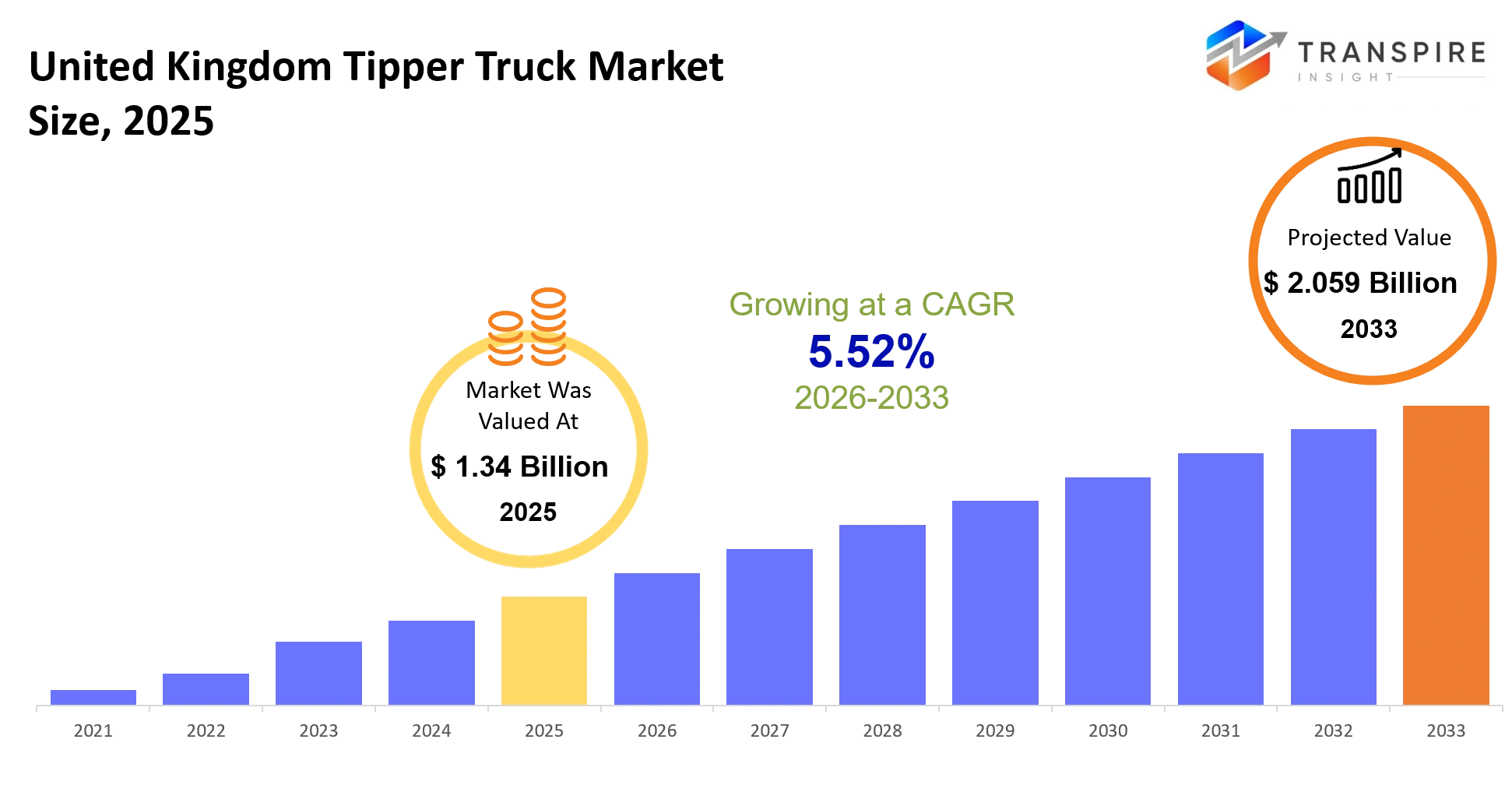
As per Transpire Insight Analysis the United Kingdom Tipper Truck Market size is estimated at USD 1.34 Billion in 2025 and is anticipated to reach USD 2.059 Billion by 2033, growing at a CAGR of 5.52% from 2026 to 2033.
The United Kingdom tipper truck market keeps the movement of bulk stuff going, basically supporting construction sites, quarries, mining operations, waste management facilities and all kinds of infrastructure work so things stay on schedule. Tipper trucks limit a lot of the manual handling, they can cut the unloading time , and they boost daily efficiency especially when big volumes of aggregates, soil, demolition waste, and construction materials need to move fast between different locations. When a fleet performs reliably, it really affects project timelines, operating expenses, and how productive contractors can be
In the last three to five years the whole market has been veering toward lower-emission vehicles and digitally linked fleet operations, pushed by tougher environmental rules and ongoing investment in transport infrastructure. After the COVID-19 pandemic, supply chain disruptions surfaced equipment shortages and those shortages stretched out vehicle replacement schedules, so fleet operators started leaning harder toward durable fuel efficient units with telematics and predictive maintenance abilities. Now, as infrastructure spending continues, urban redevelopment ramps up, and quarry activity carries on, fleet modernization is feeding into more active procurement, better utilization levels , and stronger demand for tech enhanced tipper trucks that can show real lifecycle cost reductions across time.
United Kingdom Tipper Truck Market Size & Forecast:
- United Kingdom Tipper Truck Market Size 2025: USD 1.34 Billion
- Expected Market Value 2033: USD 2.059 Billion
- Forecast CAGR: 5.52%
- Leading region in 2025: England
- Fastest Growing region: Scotland
- Key Profile: Volvo Trucks, Scania, Mercedes-Benz Trucks, MAN Truck & Bus, DAF Trucks, Iveco, Renault Trucks, Tata Motors, Ashok Leyland, Isuzu, Mack Trucks, Kenworth, Peterbilt, Dongfeng, JCB
Key Market Insights
- England pretty much ran the show in 2025, taking around 82% of the market, backed by big , wide scale infrastructure, quarrying work and also urban redevelopments that are kinda hard to ignore.
- Scotland meanwhile is set to grow the quickest across 2025 to 2032, because renewable energy keeps pulling demand, plus road upgrades and general public infrastructure spend.
- In terms of product, rear tipper trucks were the clear favorite, grabbing about 61% market share in 2025, and that seems linked to how often they’re used for construction, also for aggregates hauling in general.
- Side tipper trucks came in next, sitting as the second-largest slice, and they’re growing as specialized bulk materials get moved, and waste handling needs keep rising.
- Electric tipper trucks are forecast to be the fastest-growing segment during 2025–2032, pushed by fleet decarbonization goals and zero emission purchasing rules that many operators are following.
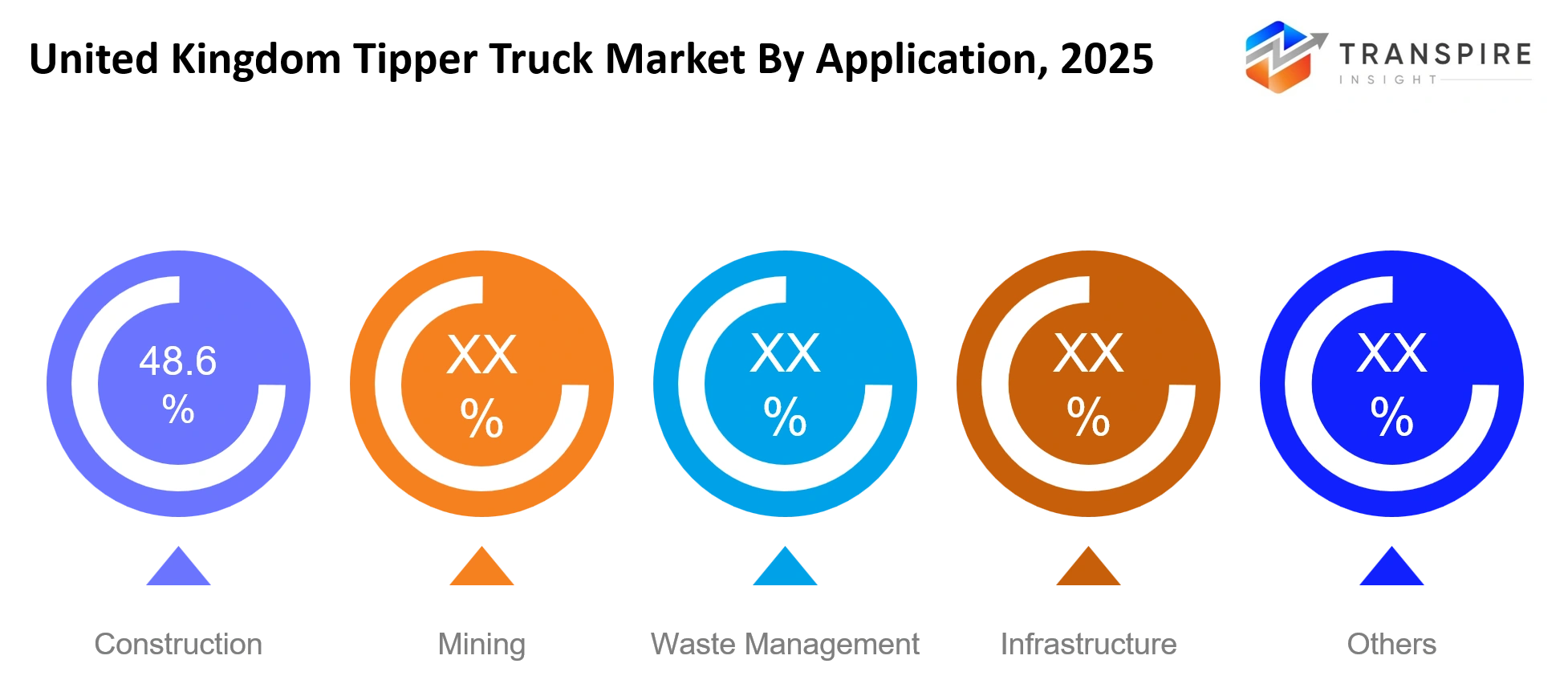
- For applications, construction was on top in 2025 with roughly 56% of the share, powered by transport infrastructure and commercial development projects , basically the usual backbone of growth there.
- Waste management is projected to post the fastest application growth across the forecast window, supported by circular economy initiatives and new recycling investments.
- On the end-user side, construction contractors stayed #1 in 2025, holding close to 53% market share, and that keeps fleet utilization high across national infrastructure endeavors.
- Municipal authorities alongside environmental service providers are expected to become the fastest-growing end-user group by 2032, largely due to cleaner fleet procurement choices.
What are the Key Drivers, Restraints, and Opportunities in the United Kingdom Tipper Truck Market?
Market expansion in the primary space is kinda being pulled forward by long term infrastructure spending ,and also by tightening emissions rules that just keep getting more strict. Upgrades to public transit, new road works, housing projects, and even quarry output have pushed fleet utilization a lot past earlier norms. Contractors, in practice, now swap out older vehicles faster because fuel efficiency ,more uptime, and meeting emissions requirements directly touch how profitable a job is, and whether they even qualify for tenders. With better output and reduced running costs procurement activity keeps looking healthier and that in turn supports steadier industry income. Fleet renewal has turned into a business requirement, not some optional decision you can postpone.
Still, the biggest structural drag is the big acquisition bill for advanced diesel, electric, and connected heavy-duty vehicles. Battery availability, charging infrastructure, and those long delivery lead times can’t really be fixed overnight ,because production capacity is still mostly stuck with a small group of suppliers. From a Transpire Insight review of regional purchasing announcements and vehicle launch timing, the supply chain getting concentrated is still the main execution risk. When deliveries slip, the fleet renewal cycle stalls, equipment sales get suppressed, and older trucks are kept running longer ,which ultimately slows the overall pace of market growth.
The best long run chance is in intelligent fleet ecosystems, kind of mixing electric propulsion with telematics, predictive upkeep, and those connected construction places. With government-backed investments in charging plus real digital infrastructure , it gets easier to roll things out and not just stay on paper. Fleet operators that use an integrated data platform, can fine-tune routes, cut down on unnecessary waiting, and boost overall asset productivity. Meanwhile manufacturers that bundle software enabled fleet services, right along with the vehicles, should earn recurring income while keeping customers for longer… basically sticking around.
What Has the Impact of Artificial Intelligence Been on the United Kingdom Tipper Truck Market?
Artificial intelligence and more advanced digital technologies are kind of reshaping the United Kingdom tipper truck sector, mostly by boosting fleet visibility, giving tighter operational control, and making maintenance planning feel a lot more proactive. Fleet operators are using AI-enabled telematics more and more, to keep track of vehicle location, payload utilization, driver behavior, fuel burn, and even emissions compliance, all in real time. At the same time, automated analytics support dispatch teams, so they can improve routing by factoring in traffic patterns, project timelines, and loading efficiency. As a result, there’s usually less wasted operating time, not just delays.
Machine learning is also changing maintenance routines. Rather than sticking to fixed service intervals, predictive algorithms look at engine performance, braking systems, hydraulic parts, and transmission data. They then spot faults that are still forming, before a breakdown becomes a full incident. This method tends to raise vehicle availability, reduce maintenance spending, and help avoid expensive project setbacks. AI-supported forecasting is likewise helping manufacturers and fleet managers estimate replacement needs, spare parts volume, and workshop capacity with better precision.
Digital fleet platforms have already produced noticeable operational wins, through better equipment utilization, shorter downtime, lower fuel usage, and improved regulatory adherence. Still, broad AI rollouts are slowed by integration costs that can be significant and by inconsistent data quality across mixed-age fleets. Older trucks often don’t have compatible sensors or connected systems, and remote quarry and construction sites can face connection gaps that weaken real-time analytics. Because of that, automated decision-making may not perform as well in those conditions.
Key Market Trends
- Electric heavy-duty tipper truck deployments got more momentum after 2023 , kind of fueled by tougher fleet decarbonization targets, and also those charging infrastructure investments kept growing .
- AI-enabled telematics kept showing up more often across commercial fleets in 2024–2025 , it helped with route planning , better fuel use, and in turn vehicle utilization felt higher than before.
- Predictive maintenance platforms started to cut down on surprise downtime too, because they monitored hydraulic systems, engines, and braking performance early , before the failures could really show up.
- Infrastructure investment programs also nudged procurement toward higher-capacity, digitally connected tipper trucks , so projects could keep running more or less continuously, even when schedules were tight.
- Volvo Trucks and Scania expanded their battery-electric heavy-duty portfolios, which basically made the zero-emission construction transport space more competitive.
- After 2024, fleet operators increasingly picked connected service contracts; they were bundled like maintenance , diagnostics, and remote monitoring tied to new vehicle purchases , not as separate add-ons.
- Digital compliance reporting replaced manual documentation across bigger commercial fleets , and this improved emissions reporting accuracy and reduced the admin workload.
- Manufacturers also put money into lightweight chassis materials and fuel-efficient drivetrains, aiming to raise payload capacity while lowering lifecycle operating costs, which sounds simple but it isn’t.
- Waste management operators moved faster on retiring older fleets as circular economy policies expanded recycling and material recovery infrastructure across the United Kingdom.
United Kingdom Tipper Truck Market Segmentation
By Vehicle Type :
Heavy-duty tipper trucks still seem to hold the leading position, mostly because big construction projects, quarry operations, and infrastructure contracts need a greater payload capacity and performance that stays reliable even when the job gets nasty. Since there is continuous investment in highways, commercial developments , and public infrastructure, this should keep a steady stream of orders for heavy-duty models. Also, with better durability, improved fuel efficiency, and safety features that are more advanced, fleet operators get longer-term benefits. Medium-duty models, meanwhile, keep a solid foothold in regional construction projects and municipal transport tasks where operational flexibility matters, quite a bit.
Light-duty tipper trucks will likely get used more in urban projects, landscaping work, and for smaller material hauling, because compact dimensions make access easier in tight places. Electric and hybrid choices within the lighter truck groups will slowly become more normal, as fleet operators try to cut operating expenses and meet stricter emission compliance. Beyond that, other specialized vehicle types will cover specific needs across utility maintenance and customized industrial uses. In general, product diversification should help manufacturers respond to different operational demands across multiple industries.
By Propulsion :
Diesel-powered tipper trucks keep on leading the market for reasons that are kinda obvious, like long operating hours, big payload capacity, and the already built refueling network that is still pretty important for heavy industrial work. The strong engine output and proven reliability help diesel stay in favor across construction, mining, and infrastructure tasks even while environmental rules keep getting tighter. Ongoing upgrades in engine efficiency and emission control systems will keep driving replacement demand, basically, people will keep swapping in newer units. Fleet operators also keep choosing modern diesel vehicles to raise day to day output , and to cut down fuel consumption
Electric tipper trucks should see the quickest expansion as battery performance improves and charging infrastructure grows across commercial transport corridors. Decarbonization programs with government support , plus fleet sustainability goals, will push spending into zero-emission models for municipal and city use. Hybrid versions will likely act as a workable “in-between” choice where flexibility and longer driving reach are still needed. Other alternative propulsion approaches will keep covering certain jobs where they fit best, but wider rollout for the whole commercial market will probably develop slower than people want.
By Capacity :
Over 20-ton capacity tipper trucks take up the biggest slice, sort of because bulk material movement, quarry output, and big infrastructure work all push for maximum payload efficiency, which is kind of the whole point. When the carrying ability is higher it tends to cut down transportation cycles, and that, in turn, lifts project productivity on those large construction sites. Fleet operators keep putting money into larger vehicles to tune operating expenses and also improve how well the assets get used. Plus, with advanced suspension setups and a more rigid chassis design, the truck’s overall performance stays steadier even when the conditions are rough.
The 10–20-ton class also matters, since it suits medium-scale construction, municipal services, and industrial material transport, where operational flexibility is still a big requirement. Vehicles under 10-ton will keep showing up for urban construction tasks, landscaping , and maintenance runs, basically because they’re easier to handle and navigate. Then the other tailored capacity categories will cover customized industrial needs and transport situations that are specific to each project. By diversifying capacity options, manufacturers end up serving a wider customer base spanning multiple sectors.
By Application :
Construction is still the biggest use case because residential, commercial, and public works keep needing a steady flow of aggregates, sand, soil, and demolition material, sort of on loop. With the ongoing investment in transport projects and urban redevelopment, equipment utilization should improve across construction fleets, even when things slow a bit. If material transport runs reliably, it basically helps the schedule, keeps costs in line, and boosts day to day operations. So with higher infrastructure spending, procurement activity should stay pretty stable, for a while.
Mining stays in strong demand, mainly where moving heavy payloads through rough operating conditions means you need tough equipment and high throughput productivity. Waste management should keep climbing too, because recycling facilities and newer environmental rules are changing how cities do collection and disposal. At the same time infrastructure maintenance work will keep supplying dependable vehicle needs across road upgrades and utility installation tasks. There are also other industrial uses that can create extra revenue, especially through more specialized hauling related activities.
By End User :
Contractors are kind of the primary end-user slice, since construction companies keep really large fleets moving, they do this to back infrastructure development , commercial work, and also residential build activities. If the project queue stays steady, then they are more likely to cycle out vehicles routinely, plus do tech upgrades, to boost efficiency and bring down daily operating costs. With digital fleet management paired with predictive maintenance tools, overall operations should look better too. Good equipment utilization basically keeps the purchasing mood alive across contractor fleets.
Mining companies keep putting money into high-capacity machines made for the tough extraction setting, and for nonstop bulk material hauling. Municipalities will likely buy more “cleaner and connected” tipper trucks, mainly for waste pickup, recycling , and infrastructure upkeep programs. Other industrial customers also add demand, usually via specialized logistics and material handling tasks. When fleet modernization starts spreading wider, end-user groups should adopt advanced vehicle technologies more quickly.
By Sales Channel :
OEM sales are still going to dominate, because more fleet operators are leaning toward factory-supported vehicles that come with newer tech, warranty coverage, and sort of a stitched-together maintenance service. When they buy straight from manufacturers, the hope is for better long term reliability, and also easier access to digital fleet management tools. Ongoing product innovation plus regulatory compliance will matter too, because it helps OEMs stay competitive when commercial vehicle procurement keeps moving forward. And yeah, long term ownership expenses stay a big purchasing thing for the larger fleets.
Meanwhile the aftermarket side should keep a steady growth pace via replacement components, maintenance services, and upgrades that keep older commercial fleets running. Dealer networks are still broadening their service abilities, mainly to make customer support smoother and to cut down on equipment downtime, not just a little. Then there are other sales channels that will handle more specialized procurement needs for certain industries and regional markets, depending on local conditions. Basically, strong service availability will keep being a key reason behind buying decisions across the whole forecast period.
What are the Key Use Cases Driving the United Kingdom Tipper Truck Market?
Construction still feels like the main go-to, because those large quantities of aggregates, soil, asphalt, and demolition material have to be shuttled quickly, back and forth between suppliers and job locations. In practice, the contractors are where the most buying heat is coming from, since dependable hauling really does steer the project timing, the equipment being used, and the day-to-day operating expenses across both public and private infrastructure work.
Waste handling and infrastructure upkeep are also getting bigger, more active, year over year. Cities and municipalities are bringing in modern tipper trucks, not only for recycling programs, but for road maintenance and utility repair efforts, too. At the same time, infrastructure operators lean on these vehicles to shift excavation material and construction waste in a smoother manner during transport network upgrades.
More new scenarios are starting to show up as well: for example, electric tipper trucks for low-emission building zones, plus renewable energy projects like wind farm buildouts and battery storage installations. Then there’s the whole digital fleet side, which is opening additional opportunities. Buyers are increasingly choosing connected vehicles, so compliance reporting becomes simpler, material movement can be optimized, and fleet planning improves, even as environmental rules and procurement requirements get more and more strict.
|
Report Metrics |
Details |
|
Market size value in 2025 |
USD 1.34 Billion |
|
Market size value in 2026 |
USD 1.414 Billion |
|
Revenue forecast in 2033 |
USD 2.059 Billion |
|
Growth rate |
CAGR of 5.52% from 2026 to 2033 |
|
Base year |
2025 |
|
Historical data |
2021 - 2024 |
|
Forecast period |
2026 - 2033 |
|
Report coverage |
Revenue forecast, competitive landscape, growth factors, and trends |
|
Regional scope |
United Kingdom (England, Scotland, Wales, Northern Ireland) |
|
Key company profiled |
Volvo Trucks, Scania, Mercedes-Benz Trucks, MAN Truck & Bus, DAF Trucks, Iveco, Renault Trucks, Tata Motors, Ashok Leyland, Isuzu, Mack Trucks, Kenworth, Peterbilt, Dongfeng, JCB . |
|
Customization scope |
Free report customization (country, regional & segment scope). Avail customized purchase options to meet your exact research needs. |
|
Report Segmentation |
By Vehicle Type (Light Duty, Medium Duty, Heavy Duty, Others); By Propulsion (Diesel, Electric, Hybrid, Others); By Capacity (Below 10 Tons, 10–20 Tons, Above 20 Tons, Others); By Application (Construction, Mining, Waste Management, Infrastructure, Others); By End User (Contractors, Mining Companies, Municipalities, Others); By Sales Channel (OEM, Aftermarket, Dealers, Others) |
Which Regions are Driving the United Kingdom Tipper Truck Market Growth?
England takes up the biggest part of the market, and it contributes about 82% of national demand via broad construction, quarrying, and infrastructure work. Over the longer term, government money going into transport systems, housing plans, and urban renewal keeps feeding steady fleet procurement and ongoing replacement, so things stay pretty consistent. There’s also a busy “commercial circle” made up of vehicle manufacturers, dealers, equipment providers, and construction contractors, and it works like an efficient ecosystem, helping keep equipment in use. With solid project pipelines, plus continuous fleet modernization, England is likely to keep its market leadership all through the forecast period.
Wales comes in next as the second-largest regional contributor, mainly because demand is more tied to public infrastructure upkeep, quarry operations, and municipal services, not so much to those big, metropolitan building surges. Investment remains fairly steady, planning rules are relatively predictable, and the aggregates sector stays resilient, so purchasing keeps happening at a regular pace across commercial fleets. Local contractors keep swapping out older assets to push better operating efficiency , and to align with the stricter emissions requirements that keep tightening. This kind of balanced investment rhythm means Wales stays a dependable source of repeat income for manufacturers, distributors, and dealers.
Scotland is set to see the quickest kind of expansion following higher investment in renewable energy schemes, road improvements and public infrastructure being pushed along, which is already speeding up fleet replacement. At the same time, new environmental targets, plus industrial modernization efforts have basically nudged buyers toward cleaner and more connected commercial vehicles for both building sites and municipal operations. Meanwhile, the ongoing commitment to wind energy projects, and also broader transport upgrades , keeps feeding fresh demand for high capacity material hauling equipment. Put together, these circumstances should open pretty attractive openings for manufacturers, technology providers and fleet service companies who are aiming for growth through the 2026–2033 window.
Who are the Key Players in the United Kingdom Tipper Truck Market and How Do They Compete?
Competition across the United Kingdom tipper truck market looks moderately consolidated, kind of split between global commercial vehicle makers, regional distributors and those specialist body builders. In practice, the big differentiators are less about sticker price, and more about tech, day to day operating efficiency, lifecycle costs, plus aftersales support that actually shows up when it matters. Bigger, established manufacturers keep holding share by pushing connected fleet services, alternative-fuel vehicles , and wider maintenance networks. At the same time, specialist firms tend to gain ground through customized vehicle solutions and application specific engineering, sometimes leaning into very narrow use cases.
Volvo Trucks stands out with battery-electric heavy-duty vehicles, a set of advanced safety systems, and connected fleet management platforms. These help improve operational efficiency, and can even support smoother regulatory compliance. Scania leans into fuel-efficient powertrains, digital fleet optimization, and modular vehicle configurations, so operators can configure setups for demanding construction sites or quarry operations. Mercedes-Benz Trucks improves competitiveness by combining predictive maintenance, driver assistance capabilities, and comprehensive service contracts that aim to reduce fleet downtime and ownership expenses.
DAF Trucks competes on fuel-efficient drivetrains, durable chassis platforms, and an extensive dealer network. That network helps keep service coverage strong across the country. MAN Truck & Bus emphasizes digital fleet services and continues developing alternative powertrains, while also expanding support for connected commercial vehicle operations. IVECO keeps strengthening its presence through alternative-fuel vehicle development, broader product offerings, and ongoing investment in sustainable transport solutions, which line up with the way fleets are moving toward decarbonization targets.
Company List
- Volvo Trucks
- Scania
- Mercedes-Benz Trucks
- MAN Truck & Bus
- DAF Trucks
- Iveco
- Renault Trucks
- Tata Motors
- Ashok Leyland
- Isuzu
- Mack Trucks
- Kenworth
- Peterbilt
- Dongfeng
- JCB
Recent Development News
In April 2026, Volvo Trucks launched the FH Aero Electric and upgraded FH, FM, and FMX Electric models with driving ranges of up to 700 km and enhanced power take-off capability for applications including tipper bodies. The launch expanded zero-emission options for construction and heavy-duty operators, supporting fleet electrification in the United Kingdom.
Source https://www.volvotrucks.co.uk/
In September 2025, DAF Trucks started series production of the New Generation XD and XF Electric trucks. The introduction of electric heavy-duty models with operating ranges exceeding 500 km strengthened zero-emission vehicle availability for construction, municipal, and tipper fleet operators across the United Kingdom. Source https://www.daf.co.uk/en-gb/
What Strategic Insights Define the Future of the United Kingdom Tipper Truck Market?
Over the next five to seven years, the United Kingdom tipper truck market is going to lean more and more toward connected, lower-emission, and data-led fleet operations. Procurement choices will increasingly look at total lifecycle value rather than just the purchase price, like, sort of as the only deciding factor. This shift, the whole structural thing, will be backed by infrastructure funding, tougher fleet emissions rules, and a broader embrace of digital asset handling across construction sites and municipal day to day work.
There’s also a risk that is quieter, less visible, and it’s kind of about how battery materials, electronic parts, and specialized vehicle manufacturing are concentrated. That kind of bottleneck could stretch delivery schedules and cause fleet renewal to lag, even while order books are still looking healthy.
At the same time there’s an opportunity starting to show up: electric tipper trucks that are tuned for city construction zones. In those areas, local air-pollution limits and public buying policies should push zero-emission equipment forward. Firms that put money in early on charging alliances, predictive maintenance platforms, and flexible financing arrangements will likely land in a better spot to win long-term contracts. They should also see their recurring service revenue hold up stronger as buying priorities continue to move away from upfront costs.
United Kingdom Tipper Truck Market Report Segmentation
By Vehicle Type
- Light Duty
- Medium Duty
- Heavy Duty
By Propulsion
- Diesel
- Electric
- Hybrid
By Capacity
- Below 10 Tons
- 10–20 Tons
- Above 20 Tons
By Application
- Construction
- Mining
- Waste Management
- Infrastructure
By End User
- Contractors
- Mining Companies
- Municipalities
By Sales Channel
- OEM
- Aftermarket
- Dealers
Frequently Asked Questions
Find quick answers to common questions.
The expected United Kingdom Tipper Truck Market size for the market will be USD 2.059 Billion in 2033.
Key segments for the United Kingdom Tipper Truck Market are By Vehicle Type (Light Duty, Medium Duty, Heavy Duty, Others); By Propulsion (Diesel, Electric, Hybrid, Others); By Capacity (Below 10 Tons, 10–20 Tons, Above 20 Tons, Others); By Application (Construction, Mining, Waste Management, Infrastructure, Others); By End User (Contractors, Mining Companies, Municipalities, Others); By Sales Channel (OEM, Aftermarket, Dealers, Others).
Major United Kingdom Tipper Truck Market players are Volvo Trucks, Scania, Mercedes-Benz Trucks, MAN Truck & Bus, DAF Trucks, Iveco, Renault Trucks, Tata Motors, Ashok Leyland, Isuzu, Mack Trucks, Kenworth, Peterbilt, Dongfeng, JCB.
The United Kingdom Tipper Truck Market size is USD 1.34 Billion in 2025.
The United Kingdom Tipper Truck Market CAGR is 5.52% from 2026 to 2033.
- Volvo Trucks
- Scania
- Mercedes-Benz Trucks
- MAN Truck & Bus
- DAF Trucks
- Iveco
- Renault Trucks
- Tata Motors
- Ashok Leyland
- Isuzu
- Mack Trucks
- Kenworth
- Peterbilt
- Dongfeng
- JCB
About the Authors

Kartik bhong
I am Kartik Bhong, a Senior Research Analyst at Transpire Insight, specializing in the Packaging, Manufacturing, and Construction industry. My work focuses on analyzing market trends, emerging technologies, industry regulations, and competitive landscapes to deliver accurate, data-driven insights. I am passionate about transforming complex industry information into clear, practical content that helps businesses, professionals, and decision-makers stay informed and make confident strategic decisions. Through continuous research and a strong commitment to accuracy, I strive to create reliable, well-researched content that reflects the latest developments across these dynamic industries and supports the vision of Transpire Insight in delivering valuable market intelligence.

Chakradhar Khansole
Chakradhar serves as the Research Director at Transpire Insight, bringing over 8 years of experience in technology, innovation, and strategic market intelligence. He specializes in transforming complex market data into actionable business insights that enable organizations to make informed, growth-oriented decisions. Recognized for his strategic vision and analytical expertise, Chakradhar leads high-impact research initiatives, delivering comprehensive market assessments, competitive intelligence, and forward-looking industry analysis.
Recently Published Reports
-
Apr 2026
Handling and Lifting Equipment Market
Handling and Lifting Equipment Market Size, Share & Analysis Report By Product (Cranes and Hoists, Forklifts, Conveyor Systems, Aerial Work Platforms, Others), By Application (E-Commerce, Automotive and Railway, Food and Beverages, Aviation, Others), and Geography (North America, Europe, Asia-Pacific, Middle East and Africa, South and Central America), 2021 - 2031
-
Apr 2026
HVAC Equipment Market
HVAC Equipment Market Size, Share & Analysis Report By Heating Equipment Type (Boilers and Furnaces, Heat Pumps, and Unitary Heaters), By Ventilation Equipment (Air Handling Units, Humidifiers and Dehumidifiers, Air Filters, and Fan Coiling Units), By Air Conditioning Equipment (Unitary Air Conditioners, Room Air Conditioners, Packaged Terminal Air Conditioners, and Chillers), By End User (Commercial, Residential, Industrial, and others), and Geography (North America, Europe, Asia-Pacific, Middle East and Africa, South and Central America), 2021 – 2031
-
Apr 2026
Refrigeration Valves Market
Refrigeration Valves Market Size, Share & Analysis Report By Type (Solenoid Valves, Expansion Valves, Check Valves, Service Valves, Others), By Application (Commercial Refrigeration, Industrial Refrigeration, Transport Refrigeration, Residential Refrigeration, Air Conditioning Systems), By End User (Food and Beverage Industry, Pharmaceutical Industry, HVAC Industry, Chemical Industry, Others), and Geography (North America, Europe, Asia-Pacific, Middle East and Africa, South and Central America), 2021 – 2031
-
Apr 2026
E-Commerce Packaging Materials Market
E-Commerce Packaging Materials Market By Material Type (Corrugated Boxes, Paper & Paperboard, Foam & Cushioning Materials, Plastic Packaging, Flexible Packaging, Protective Packaging, Others), By Product(Primary Packaging, Secondary Packaging, Tertiary Packaging), By Packaging Function (Protective Packaging, Branding & Presentation Packaging, Transit & Logistic Packaging, Sustainable Packaging, Tamper Evidence Packaging), By End-User (Retail & Consumer Goods, Electronic Appliances, Food & Beverages, Healthcare & Pharmaceutical, Fashion & Apparel, Home & Furnishing, Others); By Industry Analysis, Size, Share, Growth, Trends, and Forecasts 2021-2033