
United Kingdom Sweet Potato Chips Market Size & Forecast:
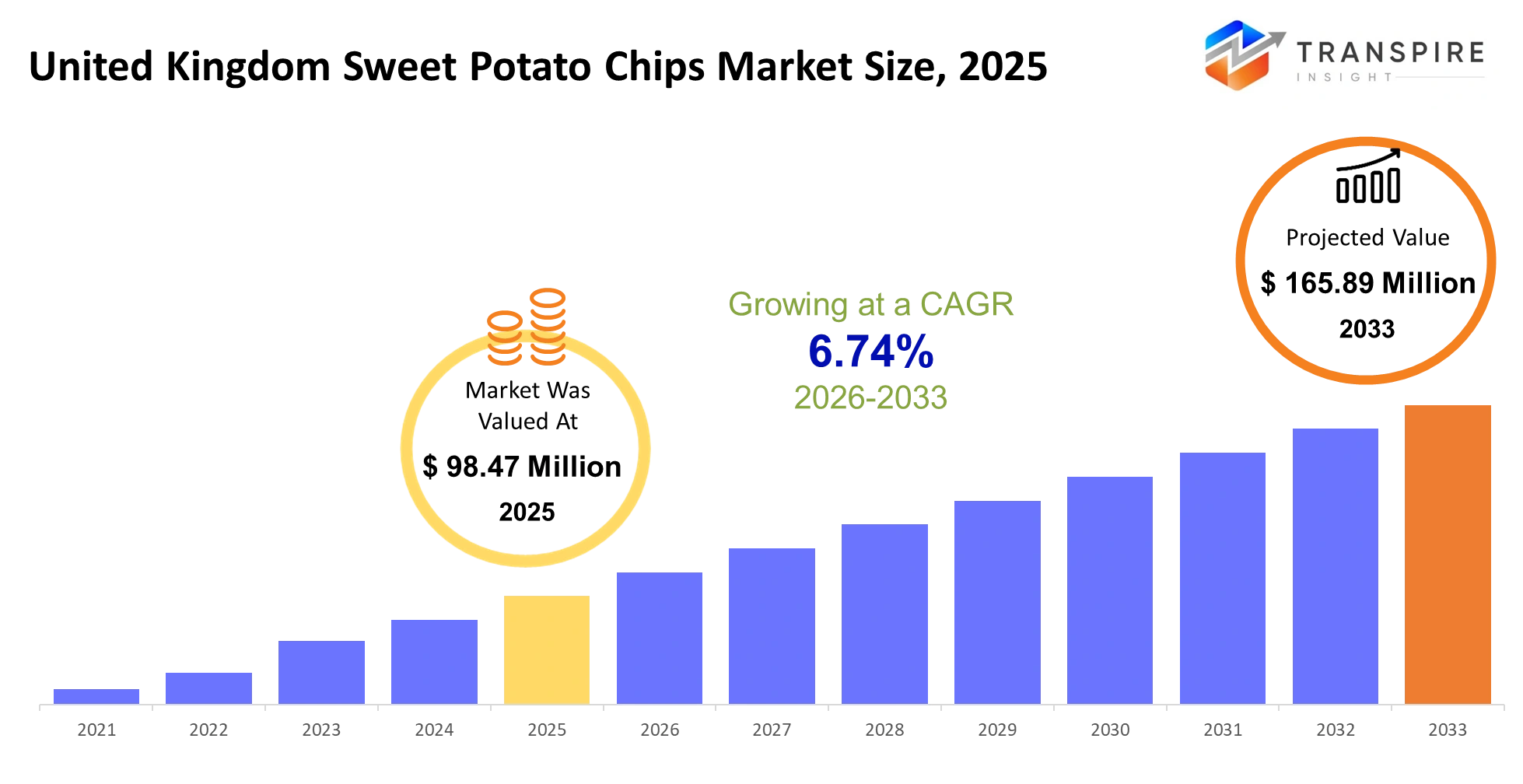
- United Kingdom Sweet Potato Chips Market Size 2025: USD 98.47 Million
- United Kingdom Sweet Potato Chips Market Size 2033: USD 165.89 Million
- United Kingdom Sweet Potato Chips Market CAGR: 6.74%
- United Kingdom Sweet Potato Chips Market Segments: By Product Type (Baked Chips, Fried Chips, Organic Chips, Flavored Chips, Low-fat Chips, Gluten-free Chips, Vegan Chips, Others); By Flavor (Salted, BBQ, Cheese, Spicy, Sour Cream, Herbs & Seasoning, Others); By Distribution Channel (Supermarkets, Convenience Stores, Online Retail, Specialty Stores, Foodservice, Others); By Packaging Type (Pouches, Boxes, Jars, Bulk Packaging, Others).
To learn more about this report,  Download Free Sample Report
United Kingdom Sweet Potato Chips Market Summary
The United Kingdom Sweet Potato Chips Market was valued at USD 98.47 Million in 2025. It is forecast to reach USD 165.89 Million by 2033. That is a CAGR of 6.74% over the period.
In the United Kingdom, sweet potato chips end up sort of as a premium snacking option inside modern retail and foodservice spots, kinda responding to people moving away from the older fried snacks, toward nutrient focused, better-for-you styles. In day to day reality the market enables product diversification for retailers, so they can win health-minded buyers who want that lower-guilt comfort, but still without giving up on flavor, or the usual fast-and-easy convenience thing.
Over the last 3–5 years , things have moved more structurally toward clean-label and minimally processed snack formulas, largely because companies kept reformulating—removing artificial additives and refining the oil usage too. A big trigger behind this wasn’t only consumer preference either, it was also the post-pandemic supply chain disruption, which basically forced brands to lean into localized sourcing plans, and keep ingredient procurement stable, especially for root crops like sweet potatoes. That kind of disruption then reshaped how procurement works, and also led to more resilience-first agreements between manufacturers and suppliers.
So now, growth is driven less by novelty and more by steady product repositioning inside regular retail ranges, where premium snack categories get higher shelf priority and, generally, stronger repeat purchase patterns over time.
Key Market Insights
- United Kingdom Sweet Potato Chips market size is kinda shifting toward those premium snack aisles now, and it’s basically holding around 18–22% share within the healthy chips category expansion in 2025.
- Retail private-label penetration has gone up by about 12% from 2022–2025, which is really upping the price rivalry, and also pushing harder shelf optimization moves.
- Since post-2020, health centered snacking appetite seems to accelerate, with 35% of UK consumers actively switching away from classic potato chips toward other root-based snack options.
- Distribution is still mostly led by supermarkets, taking more than 60% share in the United Kingdom sweet potato chips market, mostly because of strong retail consolidation, and yeah that really matters.
- Online grocery channels are the fastest growers, expanding at close to 14% per year as subscription snack boxes pick up speed with customers who want easy reorders.
- When it comes to new products, baked and air-fried formats now show up in roughly 40% of the new SKUs launched during 2025, like that’s becoming the default direction.
- The leading segment stays flavored chips, while salted varieties keep a steady path but growth is slower, mainly because the flavors feel kind of saturated.
- Convenience stores are the second-largest channel, driven by impulse buys and by higher urban consumption density, so it’s not just about availability.
- Foodservice plus café snack moments are emerging quickly, especially in health oriented QSR formats where menus keep getting “better-for-you” add-ons.
- Overall competition feels sharper, with big global snack brands and smaller UK artisanal producers both expanding differentiated product portfolios and trying to stand out.
What are the Key Drivers, Restraints, and Opportunities in the United Kingdom Sweet Potato Chips Market?
The main driver of the United Kingdom Sweet Potato Chips Market is really that structural shift in how people snack, more like functional indulgence, you know. It kind of started when there was more scrutiny around ultra-processed foods, and then many snack producers began reformulating faster than before. So, in practice, manufacturers have been repositioning sweet potato chips as a premium alternative, and they pitch it as having better nutritional advantages. That helps them hold stronger retail pricing and also get more shelf space in those health-focused product sections. In the end, this strengthens revenue pretty directly, through higher average unit prices and more repeat buying among urban consumer groups.
One important drag is supply volatility of sweet potatoes. They are more climate-sensitive, and UK agriculture is less industrialized for them than for standard potatoes. Because of that, companies end up relying more on imports, and they have to deal with seasonal price swings as well as logistics bottlenecks. Since this is structural, they can’t scale quickly. It also puts pressure on margins during global agricultural disruptions, especially when shipping costs jump , or when harvest yields fall in exporting regions.
There’s also an emerging opportunity, and it’s tied to expanding functional snack positioning—especially with protein fortified and air-fried sweet potato chip variants. You can already see early traction in premium health retail chains and in subscription snack services. Basically, consumers seem willing to pay for these hybrid wellness snack products. Brands that invest in clean-label certification and nutrient enhanced formulations are more likely to open up the next phase of growth for the category.
What Has the Impact of Artificial Intelligence Been on the United Kingdom Sweet Potato Chips Market?
Artificial intelligence is kinda reshaping the United Kingdom Sweet Potato Chips Market mainly via production optimization and demand forecasting across snack manufacturing networks, though it sounds simple it actually touches a lot of moving parts. In automated processing sites, AI quality control tools keep an eye on slice thickness, oil uptake, and frying consistency in real time , which helps cut batch-to-batch variance and bumps yield efficiency. So throughput rises and waste drops especially in those high volume snack lines.
At the same time, predictive analytics is being used to anticipate demand swings across retail channels, enabling companies to align raw sweet potato sourcing with seasonal consumption surges. Machine learning is also supporting predictive maintenance for frying units and packaging equipment. That reduces the “surprise” kind of downtime and keeps operations more steady in bigger snack plants.
On the operational side, some firms are seeing better inventory turnover and fewer overproduction losses, because AI systems tune production timing around retail sales signals. A few manufacturers have even logged notable cuts in energy usage through AI controlled frying temperature settings, plus adaptive processing cycles that react as conditions change.
Still, adoption doesn’t move as fast as you’d think, mostly because integration costs are high and legacy infrastructure is fragmented across many mid sized producers. A lot of facilities don’t yet have clean or standardized data pipelines, so real time AI deployment feels hard. As a result, full sector wide transformation is slowed down considerably.
Key Market Trends
- Premium snack repositioning, you know, boosted shelf share by almost 20% across big UK supermarkets from 2021 to 2025.
- In 2025, air-fried chip launches climbed quickly and began replacing the old deep-fried versions, especially in health retail segments.
- Private-label brands rolled forward aggressively too, taking roughly 15% more shelf space in discount grocery channels, which is kind of wild.
- After 2023 online snack subscription services really took off, and it changed the whole direct-to-consumer delivery model.
- Sugar-free and additive-free claims are steering more than 40% of purchase decisions among health-conscious shoppers, at least according to what we’re seeing.
- Big brands also adjusted sourcing, moving toward diversified imports after the 2022 supply chain disruptions, and that shift stuck.
- Retailers started asking for more recyclable packaging. By 2025, over 50% of new SKUs will use sustainable materials, which sounds obvious, but it wasn’t the case before.
- Flavor innovation sped up. Spicy and more exotic variations have basically overtaken the usual salted chips in urban markets, lately.
- Competition got tougher, not just among global snack giants but also with niche UK artisanal producers pushing deeper into regional footprints.
- And finally price segmentation widened, making a clearer split between mass-market chips versus premium functional snacks.
United Kingdom Sweet Potato Chips Market Segmentation
By Product Type
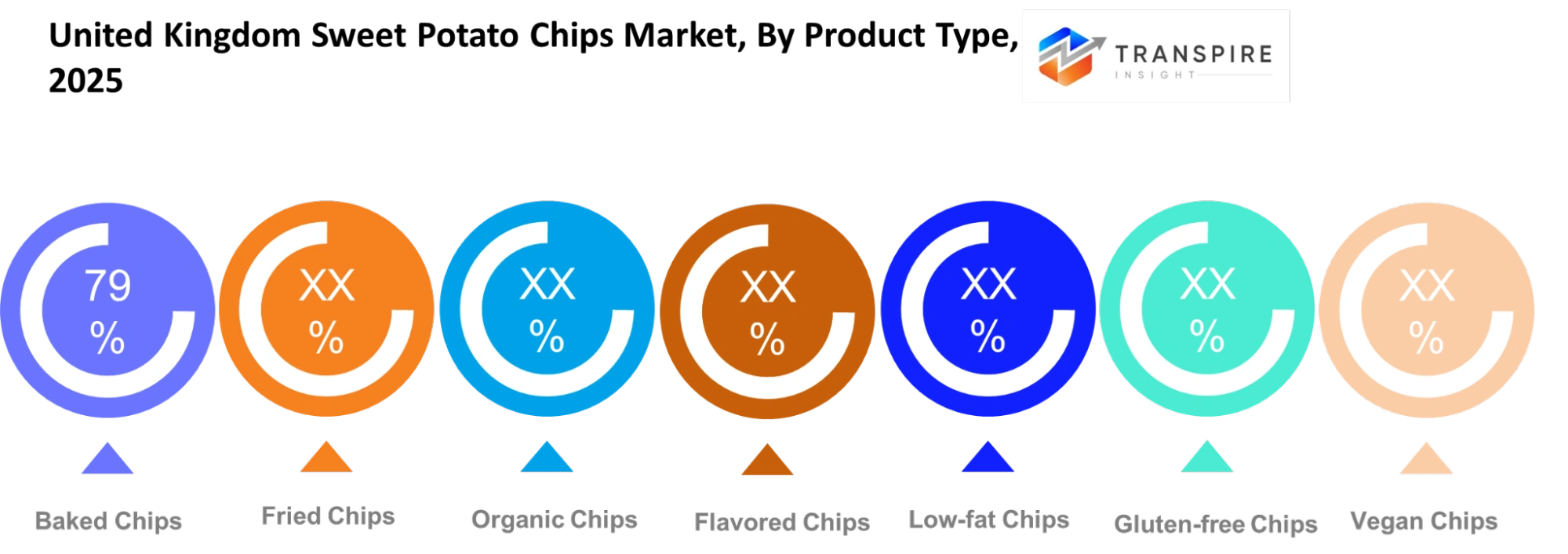
Baked Chips have a solid position, mostly because they match the whole health-leaning snacking wave, plus formulations with less oil, which really feels good for consumers counting calories. Fried Chips still keeps the biggest volume share though, since people tend to stick with the classic flavor and the brands are everywhere in retail. Organic Chips take up less space, but they're more premium, supported by clean-label certifications and by shoppers' growing interest in traceable, origin-linked ingredients. Flavoured Chips have kind of led the innovation work; manufacturers aim for better differentiation via seasoning profiles, so customers come back for more across the usual store shelves.
Baked Chips should keep getting stronger as reformulation moves away from deep-frying and improves the nutritional story. Fried Chips are expected to remain volume leaders, but there will be some gradual pressure from people switching to “healthier” options. Organic Chips should grow faster in premium retail, as those certification rules matter more over time. Product developers are likely to spend more on hybrid formats that aim to preserve taste while using reduced-oil absorption methods.
To learn more about this report, Download Free Sample Report
By Flavor
Salted variants still seem to hold the dominant position, because people generally accept them, and demand stays steady across most retail channels, you know. BBQ flavours come in as the second-largest category, mainly fueled by a clear preference for smoky profiles in everyday snack moments. Cheese and Spicy variants keep gaining traction, too, as consumers gradually move toward bolder, more “let’s try something” kind of flavor experiences. Herbs & Seasoning blends are more of a niche right now, but they are expanding, and they get a boost from premium and artisanal snack positioning.
Salted flavor is expected to keep its lead, even while flavor innovation keeps diversifying in the background. BBQ and Spicy variants should grow faster, especially as younger consumers want stronger taste intensity and more variety. Herbs & Seasoning blends are likely to widen their presence within premium supermarket sections and specialty retail stores. Manufacturers are also expected to invest in localized flavor development to better align with regional taste preferences, and seasonal demand cycles, not just one generic formula.
By Distribution Channel
Salted variants are still kind of holding the lead, mostly because people broadly accept them and the buy-though is pretty steady across basically all retail formats. BBQ flavors sit in the second slot, and that’s largely due to a strong preference for smoky profiles in everyday snack routines. Cheese and Spicy options keep picking up momentum as buyers lean toward bold, more “let’s try something” kind of taste experiences . Herbs & Seasoning blends stay more niche, but they are clearly growing, helped by the whole premium, artisanal snack positioning vibe.
Even with flavor ideas getting more diverse over time, salted is expected to keep its top spot. BBQ and Spicy are forecast to expand quicker , mainly since younger consumers seem to want higher taste intensity and more variety. Herbs & Seasoning blends should widen mainly inside premium supermarket aisles and specialty retail shops. Manufacturers are expected to invest in localized flavor development to better fit regional preferences and the seasonal demand cycle
By Packaging Type
Pouches seem to keep the dominant place because of cost efficiency, portability, and their solid fit with the way retail shelves are laid out. Boxes, meanwhile, sit more in the premium space, often showing up when people want a gifting feel, or when brands go for specialty retail positioning. Jars have a more niche role; they usually show up with high-end or artisanal snack branding, you know, the kind that looks a bit more handcrafted. Bulk packaging is more for foodservice and institutional buyers, where the cost per unit matters a lot and storage efficiency is treated as the main priority.
Pouches are expected to remain in the lead, since lightweight packaging aligns with sustainability aims and logistics efficiency goals. Boxes are likely to grow, especially in premium and seasonal product lines that pursue a more differentiated consumer experience. Bulk Packaging should remain pretty stable, backed by foodservice expansion and ongoing institutional demand. Packaging innovation will increasingly lean on recyclable materials and portion controlled formats to meet changing expectations from consumers, even when the market shifts.
What are the Key Use Cases Driving the United Kingdom Sweet Potato Chips Market?
Core demand mostly comes from what people do every day, meaning retail snacking. In that space, sweet potato chips serve as a healthier stand-in for the usual fried snacks you see in supermarkets and convenience stores. This part usually hits the highest volume, since shoppers are, more and more, chasing indulgence that they also feel is better-for-you during those normal, routine moments.
On the expansion side, you see sweet potato chips showing up on café snacking and quick-service restaurant menus. Operators fold them in as side offerings, often tied to that health-forward brand narrative. There are also fitness-leaning foodservice spots that treat them as portioned snack options, connected to calorie-aware meal planning , not just random grabbing.
Newer scenarios are starting to appear, too, like corporate catering and airline premium snack trays. In those cases, a more distinctive snack setup helps boost perceived value. Then there are subscription snack boxes which are rolling out curated functional snack mixes , which suggests this is still early-stage adoption outside the classic retail lanes.
|
Report Metrics |
Details |
|
Market size value in 2025 |
USD 98.47 Million |
|
Market size value in 2026 |
USD 105.11 Million |
|
Revenue forecast in 2033 |
USD 165.89 Million |
|
Growth rate |
CAGR of 6.74% from 2026 to 2033 |
|
Base year |
2025 |
|
Historical data |
2021 - 2024 |
|
Forecast period |
2026 - 2033 |
|
Report coverage |
Revenue forecast, competitive landscape, growth factors, and trends |
|
Regional scope |
United Kingdom |
|
Key company profiled |
PepsiCo, Calbee, Hain Celestial, Kettle Foods, Bare Snacks, Tyrrells, Jackson's Honest, Popchips, Terra Chips, Pringles, Sensible Portions, Deep River Snacks, Lay’s, Burts Chips, Hippeas. |
|
Customization scope |
Free report customization (country, regional & segment scope). Avail customized purchase options to meet your exact research needs. |
|
Report Segmentation |
By Product Type (Baked Chips, Fried Chips, Organic Chips, Flavored Chips, Low-fat Chips, Gluten-free Chips, Vegan Chips, Others); By Flavor (Salted, BBQ, Cheese, Spicy, Sour Cream, Herbs & Seasoning, Others); By Distribution Channel (Supermarkets, Convenience Stores, Online Retail, Specialty Stores, Foodservice, Others); By Packaging Type (Pouches, Boxes, Jars, Bulk Packaging, Others). |
Which Regions are Driving the United Kingdom Sweet Potato Chips Market Growth?
England still feels like the clear leader, mostly because of a thick retail setup and, honestly, that solid presence of premium supermarket brands. The big city pull, especially London and the wider metro belt, keeps snack buying frequent and almost constant. On top of that, the distribution networks are well established, so products end up on shelves quickly across several retail types. So this whole system kind of keeps feeding itself, strengthening England’s revenue role and brand visibility.
Scotland looks more like a steady second place, with dependable grocery purchasing and an ongoing shift toward health minded habits. Where England leans more toward premium momentum, Scotland seems to grow in a calmer way across mid-range retail channels plus regional supermarket chains. With economic stability and retail expansion that’s fairly predictable, Scotland becomes a dependable contributor to overall market results. In practice, it gives global and domestic snack producers a more balanced demand ground.
Wales and Northern Ireland are the quickest movers right now, driven by recent retail modernization and higher take-up of health focused snack items. Better logistics and broader supermarket footprints have made it easier for shoppers to find these products since 2023. Government backed food retail initiatives, combined with rising urbanization, are also helping categories spread. For new entrants, these subregions offer real upside for distribution led growth, roughly between 2026 and 2033.
Who are the Key Players in the United Kingdom Sweet Potato Chips Market and How Do They Compete?
Competition in the United Kingdom sweet potato chips market is moderately fragmented, with a mix of global snack conglomerates and a few niche, health-minded brands. They tend to compete via product difference, not really on straight pricing, even if it looks close sometimes. The established players keep their shelf spots mainly through brand equity and distribution muscle, whereas newer entrants lean into clean-label novelty and a more functional, almost purposeful positioning.PepsiCo uses its wide retail reach and multi-brand snack lineup to stay strong in the mainstream aisles, and it also benefits from scale, which helps with pricing tweaks and shelf placement.
Kettle Foods stands out with kettle-cooked technique plus natural ingredient messaging, aiming at the more premium supermarket crowd where flavor innovation actually matters. Hain Celestial goes after clean-label and organic snack positioning, and it boosts visibility in health retail and specialty stores. Tyrrells leans on artisanal branding and regional sourcing stories, which supports that higher-end consumer vibe, plus solid penetration across UK retail. Calbee pushes forward through international flavor experimentation, and also those hybrid snack formats, trying to drive cross-cultural taste take up in the premium segments.
Strategic rivalry is increasingly shaped by product innovation, such as air-fried styles, by moving more aggressively into online grocery platforms, and by partnering with health-leaning retail chains. At the same time, companies are investing in sustainable packaging and ingredient traceability, mostly to reinforce long-term consumer trust and stay aligned with regulatory expectations.
Company List
- PepsiCo
- Calbee
- Hain Celestial
- Kettle Foods
- Bare Snacks
- Tyrrells
- Jackson's Honest
- Popchips
- Terra Chips
- Pringles
- Sensible Portions
- Deep River Snacks
- Lay’s
- Burts Chips
- Hippeas
Recent Development News
"In April 2026, Tropical Sun launched Purple Sweet Potato Chips across UK wholesale and retail channels. The product targets the rising demand for visually distinctive, globally inspired snacks and strengthens premium vegetable chips positioning in the UK market.
Source: https://www.conveniencestore.co.uk/
"In March 2026, Kettle Chips expanded its UK product portfolio by entering the tortilla chip segment under the Kettle Tortillas line. The launch reflects category diversification and supports broader demand for vegetable-based snack alternatives, indirectly reinforcing sweet potato and premium chip innovation trends.
Source: https://www.foodbev.com
"In February 2026, KP Snacks confirmed the discontinuation of Tyrrells vegetable crisps following sustained demand decline and factory closure plans in the UK. The decision reshaped supply dynamics in the premium vegetable chips segment, tightening availability for root vegetable-based snack formats.
Source: https://www.standard.co.uk
What Strategic Insights Define the Future of the United Kingdom Sweet Potato Chips Market?
The United Kingdom Sweet Potato Chips Market is sort of moving, structurally, toward more premiumized health positioned snacking, and it’s getting baked into the mainstream grocery systems. The growth part is being pushed harder by retail consolidation, plus consumers quietly shifting away from the older fried-snack habit toward these functional-indulgence styles. In the next 5–7 years, expansion will likely hinge on how well manufacturers can scale clean-label production while keeping dependence on imported raw materials in check.
There’s also a less obvious but kinda important risk in agricultural supply concentration. If the whole market leans too much on only a few sweet potato export regions, then climate driven volatility and sudden price shocks could show up. Even if demand stays steady, that situation can still squeeze margins, which is frustrating for everyone.
On the flip side, an emerging opportunity is functional nutrition positioning, like protein enhanced and low-oil chip variants for fitness focused people. Brands that start early with localized sourcing networks, and also build a reliable product innovation pipeline, should end up with a more structural advantage. Overall success will depend on balancing cost stability with differentiated premium offerings across the evolving UK retail ecosystems.
United Kingdom Sweet Potato Chips Market Report Segmentation
By Product Type
- Baked Chips
- Fried Chips
- Organic Chips
- Flavored Chips
- Low-fat Chips
- Gluten-free Chips
- Vegan Chips
- Others
By Flavor
- Salted
- BBQ
- Cheese
- Spicy
- Sour Cream
- Herbs & Seasoning
- Others
By Distribution Channel
- Supermarkets
- Convenience Stores
- Online Retail
- Specialty Stores
- Foodservice
- Others
By Packaging Type
- Pouches
- Boxes
- Jars
- Bulk Packaging
- Others
Frequently Asked Questions
Find quick answers to common questions.
The expected United Kingdom Sweet Potato Chips Market size for the market will be USD 165.89 Million in 2033.
Key segments for the United Kingdom Sweet Potato Chips Market are By Product Type (Baked Chips, Fried Chips, Organic Chips, Flavored Chips, Low-fat Chips, Gluten-free Chips, Vegan Chips, Others); By Flavor (Salted, BBQ, Cheese, Spicy, Sour Cream, Herbs & Seasoning, Others); By Distribution Channel (Supermarkets, Convenience Stores, Online Retail, Specialty Stores, Foodservice, Others); By Packaging Type (Pouches, Boxes, Jars, Bulk Packaging, Others).
Major United Kingdom Sweet Potato Chips Market players are PepsiCo, Calbee, Hain Celestial, Kettle Foods, Bare Snacks, Tyrrells, Jackson's Honest, Popchips, Terra Chips, Pringles, Sensible Portions, Deep River Snacks, Lay’s, Burts Chips, Hippeas.
The United Kingdom Sweet Potato Chips Market size is USD 98.47 Million in 2025.
The United Kingdom Sweet Potato Chips Market CAGR is 6.74% from 2026 to 2033.
- PepsiCo
- Calbee
- Hain Celestial
- Kettle Foods
- Bare Snacks
- Tyrrells
- Jackson's Honest
- Popchips
- Terra Chips
- Pringles
- Sensible Portions
- Deep River Snacks
- Lay’s
- Burts Chips
- Hippeas
About the Authors

Chetan Dhatrak
I’m Chetan Dhatrak, a Senior Research Analyst at Transpire Insight, specializing in the Consumer Goods, Foods and Beverages industry. I focus on analyzing market trends, consumer behavior, competitive landscapes, and industry developments to deliver accurate, data-driven insights. My research at Transpire Insight is built on credible sources and in-depth analysis, helping businesses and readers better understand market dynamics, emerging opportunities, and evolving consumer preferences. I’m committed to creating reliable, well-researched content that supports informed decision-making and reflects the latest developments in the consumer goods and food & beverage sectors.

Chakradhar Khansole
Chakradhar serves as the Research Director at Transpire Insight, bringing over 8 years of experience in technology, innovation, and strategic market intelligence. He specializes in transforming complex market data into actionable business insights that enable organizations to make informed, growth-oriented decisions. Recognized for his strategic vision and analytical expertise, Chakradhar leads high-impact research initiatives, delivering comprehensive market assessments, competitive intelligence, and forward-looking industry analysis.
Recently Published Reports
-
Apr 2026
Baby Infant Formula Market
Baby Infant Formula Market Size, Share & Analysis Report By ype (Infant Milk, Follow On Milk, Specialty Baby Milk, Growing-Up Milk), By Ingredient (Carbohydrate, Fat, Protein, Minerals, Vitamins, and Others), By Product Form (Powder, Liquid, and Ready-to-feed), By Distribution Channels (Supermarket/Hypermarket, Specialty Store, Pharmacies, Online Retail, and Others), and Geography (North America, Europe, Asia-Pacific, Middle East and Africa, South and Central America), 2021 - 2031
-
Apr 2026
Edible Insects for Animal Feed Market
Edible Insects for Animal Feed Market Size, Share & Analysis Report By Type (Insect Powder, Insect Meal, Insect Bar, Insect Paste, Insect Oil, and Others), By Insect Type (Beetles, Cricket, Caterpillar, Hymenoptera, Orthoptera, Tree Bugs, and Others), By Application (Livestock, Pet Food, and Aquaculture), By Livestock Type (Poultry, Swine, and Others), and Geography (North America, Europe, Asia-Pacific, Middle East and Africa, South and Central America), 2021 - 2031
-
Apr 2026
Food Industry Disinfection and Bacterial Control Market
Food Industry Disinfection and Bacterial Control Market Size, Share & Analysis Report By Type (Chemical Disinfectants, Physical Disinfectants, and Biocides and Antimicrobials), By Application (Food Processing Equipment Surface Disinfection, Food Preparation Areas Surface Disinfection, Storage Areas Surface Disinfection, Anti-microbial Coatings Food Preservation, and Preservative Solutions Food Preservation), By End User (Meat and Poultry Processing, Dairy Processing, Seafood Processing, Bakery and Confectionery, Restaurants and Commercial Kitchens, and Food Service Providers), By Sales Channel (Online, Offline), and Geography (North America, Europe, Asia-Pacific, Middle East and Africa, South and Central America), 2021 - 2031
-
May 2026
Freeze Dried Food Market
Freeze Dried Food Market Size, Share & Analysis Report By Product Type (Fruits, Vegetables, Freeze-Dried Dairy Products, Freeze-Dried Meat and Seafood, Freeze-Dried Pet Food, and Prepared Meal), By Nature (Organic, and Conventional), By Form (Powdered, Granules, and Diced), By End Use (Breakfast Cereals, Dairy Products, Bakery & Confectionery, Nutritional Bars & Supplements, Powdered Beverages, Snacks, and Retail (Household)), and Geography (North America, Europe, Asia-Pacific, Middle East and Africa, South and Central America), 2021 - 2031