

United Kingdom Sports Shoe Insoles Market Size & Forecast:
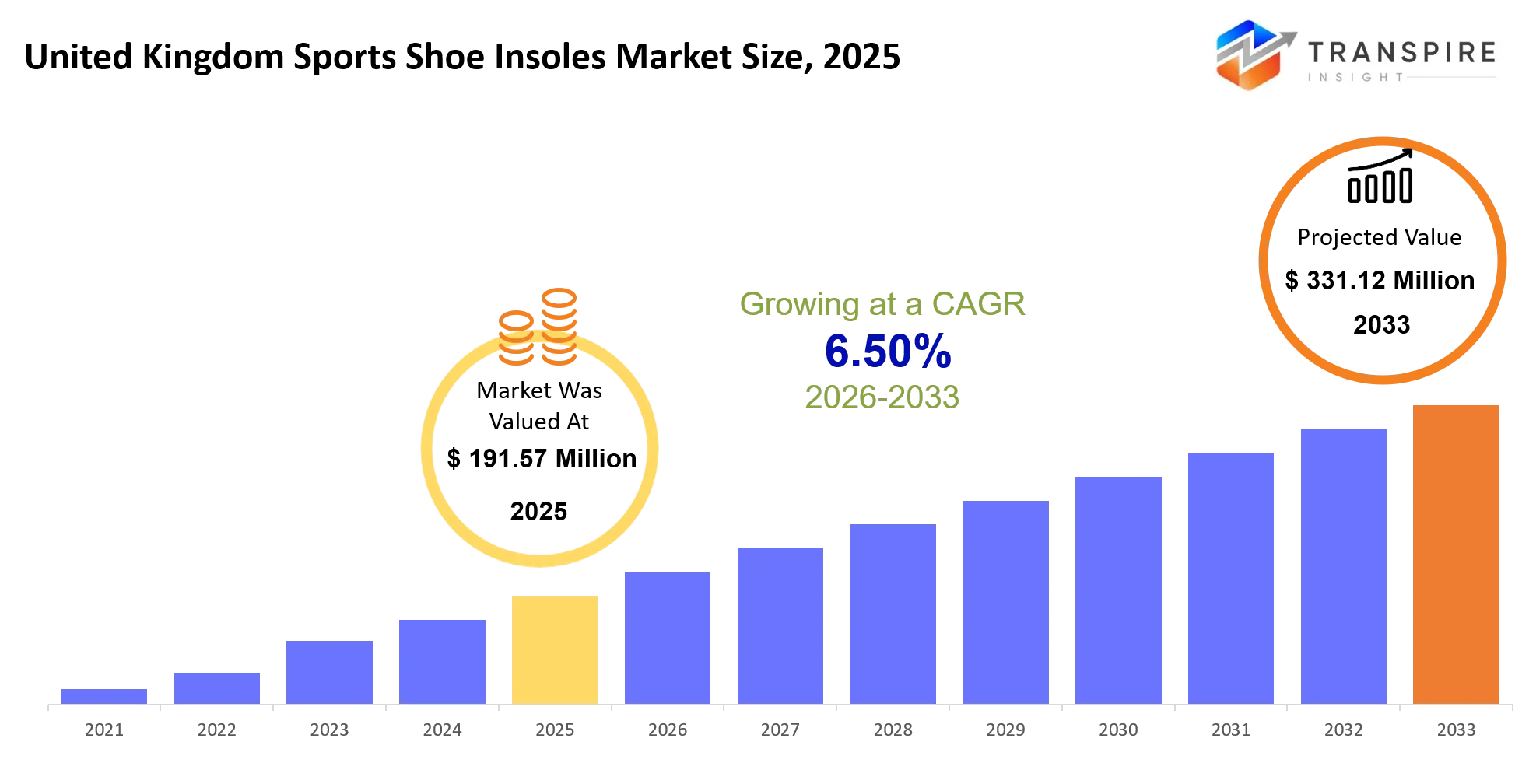
- United Kingdom Sports Shoe Insoles Market Size 2025: USD 191.57 Million
- United Kingdom Sports Shoe Insoles Market Size 2033: USD 331.12 Million
- United Kingdom Sports Shoe Insoles Market CAGR: 7.08%
- United Kingdom Sports Shoe Insoles Market Segments: By Product Type (Gel Insoles, Foam Insoles, Orthotic Insoles, Arch Support Insoles, Shock Absorption Insoles, Heated Insoles, Custom Insoles, Others); By Application (Running Shoes, Football Shoes, Hiking Shoes, Gym Shoes, Cycling Shoes, Others); By Material (Silicone Insoles, EVA Insoles, PU Insoles, Carbon Fiber Insoles, Others); By End User (Athletes, Fitness Enthusiasts, Casual Users, Medical Users, Others)
To learn more about this report,  Download Free Sample Report
United Kingdom Sports Shoe Insoles Market Summary
The United Kingdom Sports Shoe Insoles Market was valued at USD 191.57 Million in 2025. It is forecast to reach USD 331.12 Million by 2033. That is a CAGR of 7.08% over the period.
The United Kingdom sports shoe insoles market is mostly about making things feel better underfoot, keep users more steady , and help prevent injuries for runners, gym regulars, and day to day athletes too. The idea is that by tweaking foot alignment and improving how pressure gets spread inside the footwear, people get less discomfort overall. In real life, these insoles tend to lessen the load on joints , support recovery during rehabilitation for common issues like plantar fasciitis, and also make athletic output more efficient when the activity is high impact.
Over the past five years, what’s been happening is a clear move away from basic foam inserts and toward insoles that are digitally made, biomechanically tuned, and more closely matched to someone’s walking patterns. This shift is driven by 3D foot scanning plus data focused gait analysis. At the same time, the post-COVID fitness upswing mixed with troubles in older retail supply chains, made it easier for brands to push direct to consumer options. So, adoption grew faster via online fitting tools and home assessment kits that people can use by themselves, more or less.
Because of that, manufacturers aren’t just competing on cost anymore , they’re leaning harder into personalization and clinical validation. And that has led to more repeat purchases, while also widening how far these insoles reach across both recreational runners and professional sports users throughout the UK.
Key Market Insights
- South East England sort of dominates the United Kingdom Sports Shoe Insoles Market, with about 32–35% share, mainly because sports participation is high and retail density stays strong.
- Scotland comes in as the fastest mover for 2025–2030, pushed by a growing fitness mindset, plus more demand for sports injury rehabilitation , kind of like people needing recovery support sooner.
- Custom orthotic insoles are leading overall, at roughly 40% share, largely because of biomechanical performance, and also because clinical uptake is getting more common.
- Foam-based sports insoles still sit as the second biggest slice, and they’re commonly used across mass-market athletic and everyday footwear styles.
- 3D-printed and sensor-enabled insoles are the fastest expanding segment, growing fast through 2026–2030 , helped by digital gait analysis being integrated into the workflow.
- For application, running and endurance sports take the largest share at nearly 38%, backed by strong UK marathon interest and general fitness training participation.
- Meanwhile injury rehabilitation and physiotherapy represent the fastest-growing application angle, since orthopedic referrals are rising, and sports medicine adoption keeps increasing.
- On the end-user side, recreational athletes and fitness consumers lead, holding around 45% share in the United Kingdom Sports Shoe Insoles Market.
- Professional sports clubs, along with elite athletes, are the fastest-growing category too, driven by performance fine-tuning and injury prevention spending.
What are the Key Drivers, Restraints, and Opportunities in the United Kingdom Sports Shoe Insoles Market?
The United Kingdom Sports Shoe Insoles Market is being shaped by a kind of noticeable shift toward performance-first, customized comfort, with affordability tightness and new digital health links all kind of moving together, kind of.
The main driver is the fast rollout of biomechanical, data-driven customization of footwear. Retailers and sports clinics have been expanding 3D foot scanning, so they can do more exact gait adjustment and pressure mapping, which makes people less dependent on ordinary generic insoles. This change seems to be pushed by better low-cost scanning tools and also by broader blending of sports medicine know-how into everyday consumer shoes. Because of that, more runners and fitness users are adopting these solutions, they want measurable performance lift and injury avoidance, and that is directly boosting premium sales.
The biggest restraint is still the steep upfront price of advanced orthotics and sensor-enabled insoles. That cost is hard to cut down in a structural way, since the materials stay specialized and the R&D work stays intensive. So the price barrier blocks deeper penetration in value-focused consumer groups, and it also slows down how often people replace insoles, especially across mass retail locations. It even limits growth in unit terms, even while awareness keeps rising among casual recreational users.
One strong opportunity is the merging of wearable sensor insoles with digital health ecosystems, especially those used inside physiotherapy and rehab programs. Clinics in several urban UK areas are now trialing connected insoles that monitor load distribution and recovery progress in real time, and this helps insurers as well as sports doctors push preventive care frameworks more effectively.
What Has the Impact of Artificial Intelligence Been on the United Kingdom Sports Shoe Insoles Market?
Artificial intelligence plus newer digital technologies are quietly reshaping the United Kingdom sports shoe insoles market, sort of by making it possible to do highly personalized design, more automated fitting processes, and performance tuning off real world biomechanical measurements. In day to day retail setups and sports clinics, AI foot scanning tools can automatically grab pressure mapping, arch shape, and gait differences, which cuts down the time for hand based checks. That ends up making custom insoles fit better, not just “close enough”. Because of that, stores focused on performance footwear, plus physiotherapy centers, can handle more customers without having to hire extra specialists right away, or at all.
At the same time, machine learning approaches are being used to forecast injury risk, and also to refine insole geometry by looking at older gait records and patterns from user activity. These forecasting systems help with ongoing product upgrades, and they support better alignment correction and shock dampening across both running and training situations. A few sports brands in the UK say they’ve seen noticeable directionally positive changes in comfort feedback scores, and also fewer returns, once they started using AI powered suggestion engines inside digital fitting platforms.
From an operations angle, AI enabled design systems can shrink prototyping cycles, from weeks down to days, which improves time to market, while also lowering development spend for premium insoles. Still, adoption is held back by the lack of enough high quality biomechanical datasets. That shortage limits how accurate the models stay when dealing with wider ranges of foot anatomy, and different activity categories. So the whole “full scale automation” idea keeps moving slowly, especially if someone is trying to push mass market deployment across the United Kingdom sports shoe insoles market.
Key Market Trends
- Starting from 2022, UK retailers sorta quickly rolled out 3D foot scanning systems, and in practice it meant less manual fitting, but also better personalization accuracy, especially for the more premium insole buys.
- After 2020, when supply chains got messy, online direct-to-consumer insole sales kinda jumped fast, and brands started using virtual fitting tools so they could keep conversion rates from dipping.
- Between 2021 and 2025 custom orthotic insoles gained ground over plain foam variants, mainly because referrals for sports injury rehabilitation have been climbing, which is what people keep saying anyway.
- Then after 2023, sensor enabled smart insoles started showing up more, these let you do real time gait tracking, and that shift pushed customer demand toward performance footwear that’s more data driven rather than just “comfortable”.
- Since 2021, the post pandemic fitness participation upswing helped boost running related insole adoption, especially among recreational athletes and those marathon training communities, you know the ones who plan everything.
- Brands like Superfeet and Sidas also moved toward clinically validated product lines, so they competed not only on cost, but with biomechanical performance differentiation, like a more nuanced angle.
- Meanwhile 3D printing adoption in UK insole manufacturing sped up after 2022, and that cut the prototyping time, from weeks to under five days, pretty dramatically.
- Retail pricing pressure between 2023 and 2026 pushed premium insoles toward subscription style plans plus replacement cycles, and that improved how steady repeat purchases can be.
United Kingdom Sports Shoe Insoles Market Segmentation
By Product Type:
Gel insoles offer cushioning that helps take the hit off , reducing strain while you are running or doing sports stuff. Foam insoles keep things comfy for everyday use, mostly because they are light and simple in structure , but orthotic insoles go more toward medical correction and long term alignment support. Arch support insoles help with stability during movement heavy sports, like those quick change direction moments.
Then there are shock absorption insoles , which cut down pressure when the impact is stronger, especially during training or when you’re in running shoes that take a lot of force. Custom insoles take it further with digital scanning so the fit is precise, and that usually means better comfort along with better performance. Heated insoles are for colder weather situations too , good for outdoor sports and winter training settings. Overall product demand is leaning more toward personalized solutions and corrective types, not just generic comfort.
By Application:
Running shoes stay the biggest application area, mainly because more people are getting into fitness and marathon culture keeps expanding. Football shoes also include insoles for traction balance and for lowering injury risk during intense gameplay. Hiking shoes depend on durable support insoles to handle uneven terrain and to keep you going through long endurance sessions.
Gym shoes are seeing steady adoption, helped by the growth in indoor fitness and weight training. Cycling shoes, on the other hand, use performance oriented insoles to improve foot stability over long rides. Other uses show up in casual sports and even school athletics , where comfort focused designs are being picked more often than standard flat inserts.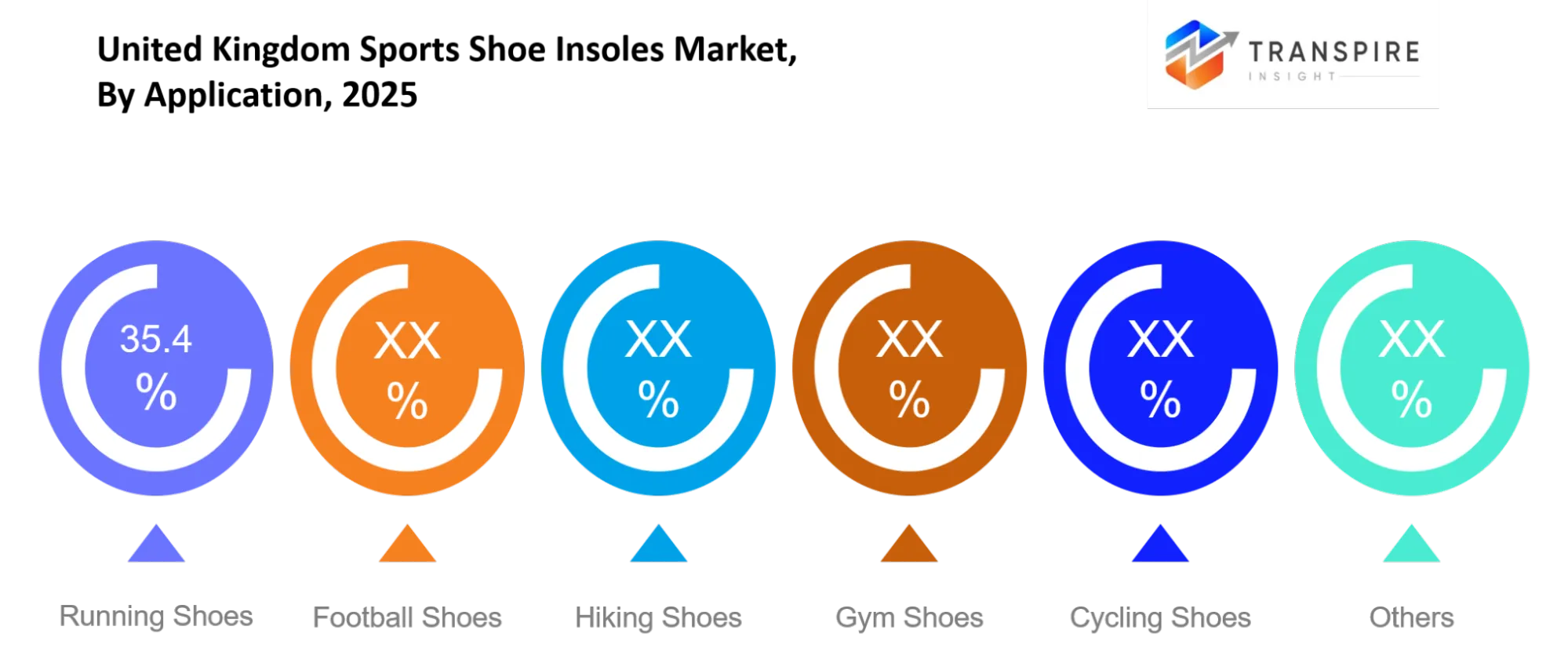
To learn more about this report, Download Free Sample Report
By Material:
Silicone insoles give flexibility plus shock reduction, for broad sports use , not like super specialist stuff. EVA insoles kind of rule the market because they are light weight in structure and also cost efficient for mass market shoes. PU insoles tend to last longer, they bring stronger durability and more time staying cushioned, usually in mid-range performance footwear.
Carbon fiber insoles back serious athletic routines, they feel rigid in a controlled way and they return energy as you move. Meanwhile other blended materials are starting to get more attention for hybrid performance needs, like mixed cushioning and support. Material innovation is leaning more toward longer durability cycles and better energy absorption within sports footwear systems.
By End User:
Athletes are a big group buying performance-focused insoles, mainly for injury prevention and better training flow. Fitness enthusiasts grab insoles for gym sessions and running support , that pushes demand for mid-range solutions. Casual users usually choose comfort-based insoles for everyday walking and general shoe comfort.
Medical users rely on orthotic insoles for foot correction and rehabilitation support, typically under clinical direction. Other users include students and outdoor workers who want simple reliable support for long activity hours. Market behavior is moving toward structured comfort and corrective functionality, across basically all user categories.
What are the Key Use Cases Driving the United Kingdom Sports Shoe Insoles Market?
Running, endurance, those kinds of sports really stay as the main use case in the United Kingdom Sports Shoe Insoles Market, mostly because lots of people take part in jogging, marathon prep and club track events. Interest keeps climbing too, like, users want extra shock absorption, less injury risk, and genuine long distance comfort that doesn't quit halfway.
Gym workouts and football scenarios are also growing fast, especially with fitness hobbyists and recreational players. Insoles, they help with stability during weight training, and they cut down on foot fatigue when sessions get intense. For football, players use them for better traction and balance, plus to ease ankle strain when they are in the middle of a match.
There are newer angles that are starting to show up more, like rehabilitation oriented insoles used inside physiotherapy clinics. At the same time smart insoles, with built in sensors for gait tracking, are getting more attention. You see this in sports medicine and preventive care programs, because continuous movement data can help refine recovery results and keep long term foot health management on track.
|
Report Metrics |
Details |
|
Market size value in 2025 |
USD 191.57 Million |
|
Market size value in 2026 |
USD 205.14 Million |
|
Revenue forecast in 2033 |
USD 331.12 Million |
|
Growth rate |
CAGR of 7.08% from 2026 to 2033 |
|
Base year |
2025 |
|
Historical data |
2021 - 2024 |
|
Forecast period |
2026 - 2033 |
|
Report coverage |
Revenue forecast, competitive landscape, growth factors, and trends |
|
Regional scope |
Middle East and Africa (Saudi Arabia, United Arab Emirates, South Africa, Rest of Middle East and Africa) |
|
Key company profiled |
Dr. Scholl’s, Superfeet, Bauerfeind, Currex, Sole Active, Spenco, Powerstep, Sorbothane, Sidas, Tread Labs, FootActive, Ortholite, Nike, Adidas, Puma |
|
Customization scope |
Free report customization (country, regional & segment scope). Avail customized purchase options to meet your exact research needs. |
|
Report Segmentation |
By Product Type (Gel Insoles, Foam Insoles, Orthotic Insoles, Arch Support Insoles, Shock Absorption Insoles, Heated Insoles, Custom Insoles, Others); By Application (Running Shoes, Football Shoes, Hiking Shoes, Gym Shoes, Cycling Shoes, Others); By Material (Silicone Insoles, EVA Insoles, PU Insoles, Carbon Fiber Insoles, Others); By End User (Athletes, Fitness Enthusiasts, Casual Users, Medical Users, Others) |
Which Regions are Driving the United Kingdom Sports Shoe Insoles Market Growth?
South East England still looks like the leading pocket in the United Kingdom Sports Shoe Insoles Market, mostly because of its thick retail network, plus a high share of sports participation going on there. London and all the nearby urban zones keep pulling demand from running clubs, gyms, and professional training centres. Also, there are advanced physiotherapy clinics and sports science facilities nearby, so customers adopt custom- type and sensor-based insoles early. On top of that, a pretty well-developed retail and e-commerce ecosystem keeps products moving smoothly, giving consumers quick, almost constant access.
The Midlands, and the North West, act more like a steadier, consistent contributor to the same market. This is tied to a solid manufacturing base, and also to community level sports engagement that doesn’t really drop off. In contrast with the South East, the demand here seems more about affordability and durability, not as much about premium customization, and that difference matters. Local sports clubs, along with school athletics programmes create regular buy cycles, especially for mid-range insoles. Then the economic resilience in industrial cities helps keep spending on performance and comfort footwear products from wobbling too much.
Scotland is the fastest-growing area, mainly as a result of more public health campaigns, plus extra investment in sports infrastructure and rehabilitation services. Lately, upgrades in community fitness centres and running facilities have expanded participation in endurance sports, and outdoor practice too. Physiotherapy-led adoption of orthotic insoles is rising as well, because people are becoming more aware about injury prevention, bit by bit. For market entrants and investors, this is basically a signal of strong long-term potential in value-driven and clinical insole segments over the period 2026 to 2033.
Who are the Key Players in the United Kingdom Sports Shoe Insoles Market and How Do They Compete?
The United Kingdom Sports Shoe Insoles Market looks kind of moderately fragmented, like global sportswear brands run alongside specialized orthotic manufacturers. Here competition isn’t pushed just by being big , it’s more about biomechanical effectiveness, the precision of customization, and how far they can reach through both retail and clinical routes. The established players defend their share with product upgrades and also digital fitting options, and then smaller specialists sometimes get more attention by leaning into medical-grade corrections and designs tuned for specific sports. These days, technology moving into gait analysis and material engineering pretty much shapes competitive position more than raw price alone.
Nike and Adidas seem to lean on ecosystem-led plans, like they try to connect footwear, apps, and performance monitoring into one loop. Both companies weave in foot scanning and movement analytics into the in-store experience, so they can push personalization further, and hopefully lower the whole rate of returns. Their edge comes from pairing athletic footwear data with direct-to-consumer platforms, which lets them iterate faster on products and helps build steadier brand loyalty. In the UK , expansion typically happens through scaling digital retail and through partnerships with sports performance platforms that are already active across the local fitness ecosystem.
Then there are specialist players Superfeet , Sidas, Dr Scholl's, and Sorbothane—who compete more heavily through materials science plus orthotic accuracy. They tend to separate themselves using clinical validation, shock absorption engineering, and a solid footprint in physiotherapy and rehabilitation channels. For growth, they often go through partnerships with clinics, expand into sports medicine networks, and develop corrective insole lines that are tailored for different sports. Their advantage is more trust in actual performance outcomes, not lifestyle branding, which makes adoption easier among medical users and also high-performance athletes.
Company List
- Dr. Scholl’s
- Superfeet
- Bauerfeind
- Currex
- Sole Active
- Spenco
- Powerstep
- Sorbothane
- Sidas
- Tread Labs
- FootActive
- Ortholite
- Nike
- Adidas
- Puma
Recent Development News
In May 2026, Marks & Spencer launched 47 new or revamped frozen food products and accelerated expansion of its frozen range. The move strengthens its position in the UK frozen food and bakery-related convenience segment by broadening consumer choice and increasing competition with major grocery retailers. Source https://www.thetimes.com/
In September 2025, Associated British Foods announced the acquisition of Hovis for approximately £70 million. The transaction creates one of the largest bakery businesses in the United Kingdom, potentially improving manufacturing scale, distribution efficiency, and product innovation across the bakery sector. Source https://www.thetimes.com/
What Strategic Insights Define the Future of the United Kingdom Sports Shoe Insoles Market?
The United Kingdom Sports Shoe Insoles Market is moving, in a structural sense, toward precision-led and data-driven footwear support systems over the next five to seven years. Growth will depend more and more on a tight integration between biomechanical diagnostics , digital retail fitting platforms and sports medicine inputs. People are basically asking for measurable performance outcomes, not just generic “feels good” comfort products, plus there is broader uptake of personalized health technologies in sports and also rehabilitation settings.
There is another risk that is less visible, but it matters, like when companies lean too hard on digital fitting ecosystems that are built on only limited biomechanical datasets. If the data quality stays uneven across different user groups, the product accuracy might end up plateauing. When that happens, trust in advanced orthotic and sensor-enabled insoles can soften, and you can see adoption fatigue showing up in premium segments, even if the early momentum looks strong.
On the other hand there is a real opportunity, emerging now, around the use of insole-generated gait data inside preventive healthcare programs. In the UK, those programs can be supported via physiotherapy networks and sometimes even private insurers. That opens a pathway for reimbursed or subsidized orthotic adoption, not only for sports but beyond it. Market participants should put money into validated clinical partnerships , plus interoperable sensor platforms, so they can lock in long-term positioning early, before regulatory and healthcare integration standards get clearly defined.
United Kingdom Sports Shoe Insoles Market Report Segmentation
By Product Type
- Gel Insoles
- Foam Insoles
- Orthotic Insoles
- Arch Support Insoles
- Shock Absorption Insoles
- Heated Insoles
- Custom Insoles
By Application
- Running Shoes
- Football Shoes
- Hiking Shoes
- Gym Shoes
- Cycling Shoes
By Material
- Silicone Insoles
- EVA Insoles
- PU Insoles
- Carbon Fiber Insoles
By End User
- Athletes
- Fitness Enthusiasts
- Casual Users
- Medical Users
Frequently Asked Questions
Find quick answers to common questions.
The United Kingdom Sports Shoe Insoles Market size is USD 331.12 Million in 2033.
Key Segments for the United Kingdom Sports Shoe Insoles Market are By Product Type (Gel Insoles, Foam Insoles, Orthotic Insoles, Arch Support Insoles, Shock Absorption Insoles, Heated Insoles, Custom Insoles, Others); By Application (Running Shoes, Football Shoes, Hiking Shoes, Gym Shoes, Cycling Shoes, Others); By Material (Silicone Insoles, EVA Insoles, PU Insoles, Carbon Fiber Insoles, Others); By End User (Athletes, Fitness Enthusiasts, Casual Users, Medical Users, Others).
Major United Kingdom Sports Shoe Insoles Market players are Dr. Scholl’s, Superfeet, Bauerfeind, Currex, Sole Active, Spenco, Powerstep, Sorbothane, Sidas, Tread Labs, FootActive, Ortholite, Nike, Adidas, Puma.
The Current United Kingdom Sports Shoe Insoles Market size is USD 191.57 Million in 2025.
The United Kingdom Sports Shoe Insoles Market CAGR is 7.08% from 2026 to 2033.
- Dr. Scholl’s
- Superfeet
- Bauerfeind
- Currex
- Sole Active
- Spenco
- Powerstep
- Sorbothane
- Sidas
- Tread Labs
- FootActive
- Ortholite
- Nike
- Adidas
- Puma
About the Authors

Chetan Dhatrak
I’m Chetan Dhatrak, a Senior Research Analyst at Transpire Insight, specializing in the Consumer Goods, Foods and Beverages industry. I focus on analyzing market trends, consumer behavior, competitive landscapes, and industry developments to deliver accurate, data-driven insights. My research at Transpire Insight is built on credible sources and in-depth analysis, helping businesses and readers better understand market dynamics, emerging opportunities, and evolving consumer preferences. I’m committed to creating reliable, well-researched content that supports informed decision-making and reflects the latest developments in the consumer goods and food & beverage sectors.

Chakradhar Khansole
Chakradhar serves as the Research Director at Transpire Insight, bringing over 8 years of experience in technology, innovation, and strategic market intelligence. He specializes in transforming complex market data into actionable business insights that enable organizations to make informed, growth-oriented decisions. Recognized for his strategic vision and analytical expertise, Chakradhar leads high-impact research initiatives, delivering comprehensive market assessments, competitive intelligence, and forward-looking industry analysis.
Recently Published Reports
-
Apr 2026
Bottled Water Market
Bottled Water Market Size, Share & Analysis Report By Product Type (Still Bottled Water, Carbonated Bottled Water, Functional Bottled Water, and Others), By Packaging (PET, Cans, and Others), By Sales Channel (Supermarkets/Hypermarkets, Convenience Stores/Drug Stores, Grocery Stores/Club Stores, Foodservice, and Others) and Geography (North America, Europe, Asia-Pacific, Middle East and Africa, South and Central America), 2021 - 2032
-
Apr 2026
Color Cosmetic Packaging Market
Color Cosmetic Packaging Market Size, Share & Analysis Report By Application (Mascara Packaging, Liquid Packaging, and Liquid Face), By Type (Tubes & Bottles, Pens & Markers, Compacts & Containers, and Droppers & Pumps), and Geography (North America, Europe, Asia-Pacific, Middle East and Africa, South and Central America), 2021 - 2031
-
Apr 2026
External Microphone For Camera Market
External Microphone For Camera Market Size, Share & Analysis Report By Type (Shotgun Microphone, Lavalier Microphone, and Others), By Application (Digital Camera, Professional Video Camera, and Others), and Geography (North America, Europe, Asia-Pacific, Middle East and Africa, South and Central America), 2021 - 2031
-
Apr 2026
Foot Orthotic Insoles Market
Foot Orthotic Insoles Market Size, Share & Analysis Report By Type (Pre-fabricated, and Custom-made), By Material (Thermoplastic, Composite Carbon Fiber, and Others), By Distribution Channel (Drug Stores, Hospitals & Clinics, and Others), and Geography (North America, Europe, Asia-Pacific, Middle East and Africa, South and Central America), 2021 - 2031