
United Kingdom Nucleic Acid Isolation and Purification Kits Market Size & Forecast:
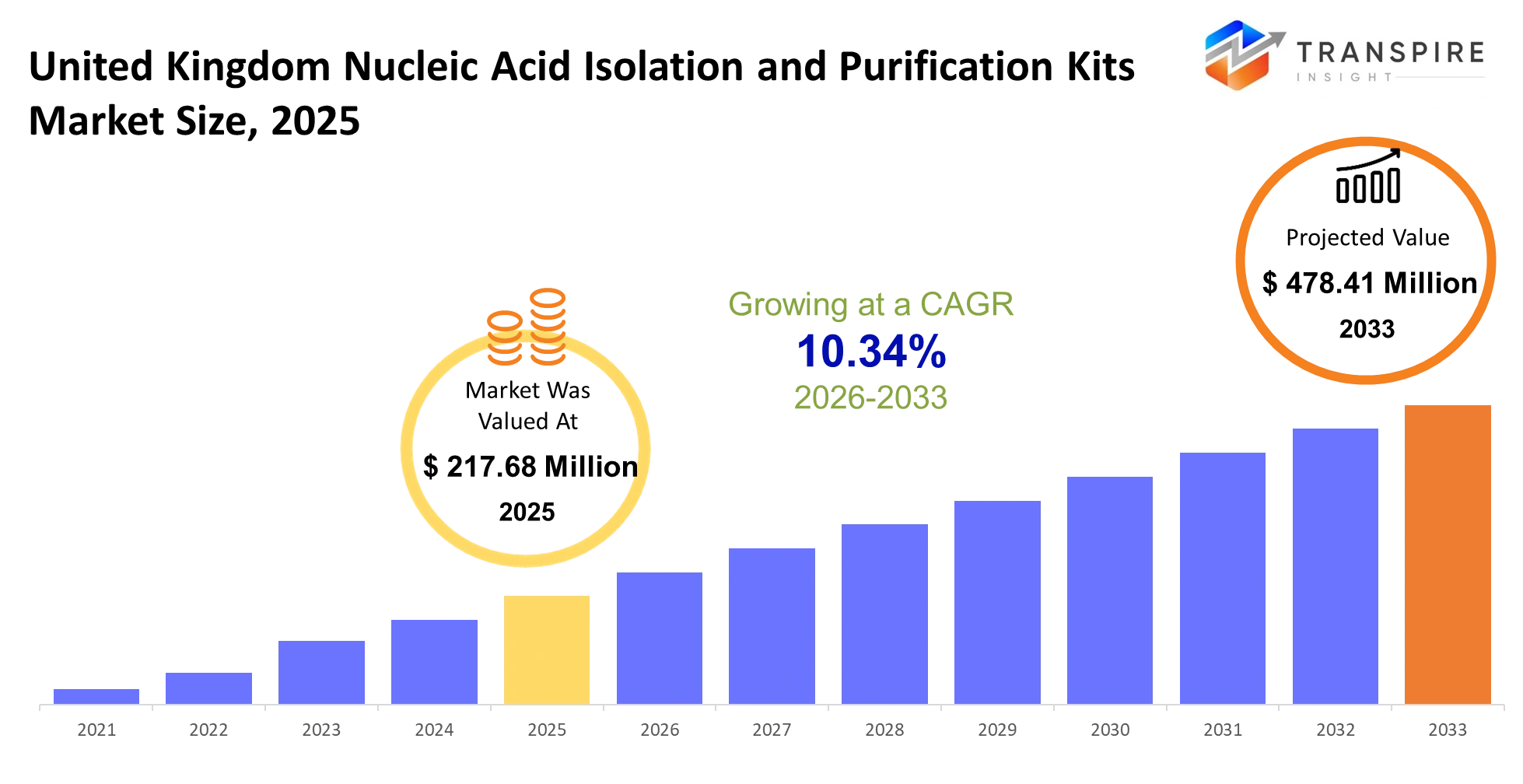
- United Kingdom Nucleic Acid Isolation and Purification Kits Market Size 2025: USD 217.68 Million
- United Kingdom Nucleic Acid Isolation and Purification Kits Market Size 2033: USD 478.41 Million
- United Kingdom Nucleic Acid Isolation and Purification Kits Market CAGR: 10.34%
- United Kingdom Nucleic Acid Isolation and Purification Kits Market Segments: By Product Type (DNA Isolation Kits, RNA Isolation Kits, Plasmid Purification Kits, Magnetic Bead Kits, Others); By Application (Clinical Diagnostics, Research Applications, Drug Discovery, Forensic Testing, Others); By Technology (Column-based Isolation, Magnetic Bead-based Isolation, Reagent-based Isolation, Others); By End User (Hospitals, Diagnostic Laboratories, Research Institutes, Biotechnology Companies, Others).
To learn more about this report,  Download Free Sample Report
United Kingdom Nucleic Acid Isolation and Purification Kits Market Summary
The United Kingdom Nucleic Acid Isolation and Purification Kits Market was valued at USD 217.68 Million in 2025. It is forecast to reach USD 478.41 Million by 2033. That is a CAGR of 10.34% over the period.
The United Kingdom Nucleic Acid Isolation and Purification Kits Market really supports today’s diagnostic and life sciences routines by letting labs, hospitals, and research centers pull out clean DNA and RNA from real biological samples, pretty quickly, and with good consistency. In day to day use, these kits basically become the core of PCR based testing, genomic sequencing efforts, cancer profiling work, and infectious disease detection, because if the sample preparation isn’t right, it can undermine the whole diagnostic chain even before the main analysis starts. Over the past 3–5 years, the industry has been moving away from more manual extraction methods, toward automated high throughput purification platforms that get built into molecular diagnostic systems.
The COVID-19 pandemic was a big trigger too, it showed where lab scalability was weak and it sped up funding for decentralized testing setups and genomic monitoring capacity. As a result, demand kept rising for extraction consumables, plus for kits that actually work well with automation, and that’s true for both public and private labs. Right now, market growth is also linked to broader adoption of precision medicine, oncology testing routines, and pathogen sequencing programs, all of which require repeatable nucleic acid preparation steps. Those standardized workflows help labs deliver faster turnaround times, meet regulatory requirements, and generate reproducible clinical outcomes, not just one off results.
Key Market Insights
- England dominates the United Kingdom Nucleic Acid Isolation and Purification Kits Market, with almost 72% in 2025, largely due to its robust clinical laboratory infrastructure.
- Meanwhile, Scotland looks like the quicker mover over 2026–2030 , it’s backed by a genomic medicine push, plus more biotechnology investment programs are landing there.
- Cambridge–Oxford innovation hubs keep pulling in molecular diagnostics startups and also sequencing technology partnerships which feels pretty important.
- Looking at the product side, RNA isolation kits still take the largest share in 2025, mainly due to infectious disease testing and the continued expansion of transcriptomics research.
- DNA purification kits sit next , as the second larger segment, and that’s tied to oncology diagnostics and forensic testing needs.
- On top of that, automated magnetic bead based extraction systems are the fastest-growing category through 2030, mainly since they boost throughput and help with reproducibility in clinical labs, in a pretty direct way.
- When you focus on applications, molecular diagnostics is the main driver for the United Kingdom Nucleic Acid Isolation and Purification Kits Market , roughly 48% in 2025.
- Precision oncology seems to be the one that grows fastest, due to the rising uptake of companion diagnostics and genomic biomarker profiling.
- Also, next generation sequencing workflows are leaning more and more on standardized nucleic acid extraction protocols , for clinical-grade accuracy that people can trust.
- Finally, hospitals and diagnostic laboratories together account for around 55% of the market, and this is supported by large scale PCR and sequencing workflows.
What are the Key Drivers, Restraints, and Opportunities in the United Kingdom Nucleic Acid Isolation and Purification Kits Market?
The main thing driving the United Kingdom Nucleic Acid Isolation and Purification Kits Market is basically the fast pull toward putting molecular diagnostics into everyday clinical work. After all the COVID-19 pandemic, PCR and sequencing based testing became more normal, and at the same time the NHS genomic medicine programs kept expanding. That combination pushed many labs to automate sample prep at scale, and once that happens they keep buying extraction kits, magnetic bead reagents, and all those automated purification consumables, because high throughput diagnostic systems really depend on consistent nucleic acid quality to not mess up clinical accuracy, and also keep turnaround times snappy. In oncology profiling and infectious disease surveillance, labs are also moving away from batch style manual extraction toward more continuous automated workflows, so it kind of reinforces the consumables side of revenue, month after month.
The biggest holdback, though, is the operational expense of automation extraction infrastructure plus the need for tight reagent standardization. Automated purification platforms usually demand specific instruments, extensive validation, and trained molecular laboratory staff, and that can block smaller diagnostic centers, or regional healthcare facilities from adopting at all. On top of that, there are also compatibility issues between proprietary extraction chemistries and the sequencing systems, so platform interoperability moves slowly. This kind of fragmentation stretches out adoption timelines, and it tends to limit wider market reach outside big urban healthcare networks
Still, a real opportunity is starting to show up with decentralized molecular diagnostics and point-of-care genomic testing setups. Microfluidic extraction technologies, when they’re bundled into compact device formats, are getting attention and investment across the UK biotech areas, especially around Cambridge and Oxford.These systems could, sort of expand testing access beyond centralized laboratories, and then open new commercial pathways in fast oncology screening, for infectious disease monitoring, and even for community based genomic diagnostics, which is kind of a bigger deal than it sounds.
What Has the Impact of Artificial Intelligence Been on the United Kingdom Nucleic Acid Isolation and Purification Kits Market?
Artificial intelligence and advanced digital technologies are now, sort of, changing nucleic acid isolation plus purification workflows in UK diagnostic labs, genomics centers , and also in biotech spaces. With AI enabled lab automation systems in place, sample tracing, reagent distribution, contamination control, and robotic extraction sequencing get handled with very little hands-on activity. Automated magnetic bead purification platforms that are paired with machine vision can notice pipetting inconsistencies and extraction weirdness in real time , which in turn helps make PCR and next-generation sequencing runs more consistent. Overall, these setups cut down on processing delays and let bigger labs manage much higher daily sample numbers without a matching rise in staffing.
Machine learning models are also used to estimate equipment upkeep schedules, watch extraction performance, and fine tune how much reagent gets consumed by automated purification systems. A number of high throughput molecular labs say they see tangible decreases in workflow stoppages and reagent wastage after they add predictive analytics into their extraction pipelines. On top of that, AI supported laboratory information management tools speed up turnaround by triaging urgent oncology and infectious disease samples according to diagnostic urgency, instead of treating everything the same.
Still, uptake can be slowed by pricey integration efforts and a patchwork of laboratory infrastructure. A lot of NHS linked facilities keep running mixed equipment that has incompatible software designs, so seamless AI deployment becomes difficult. Also, limited availability of standardized genomic workflow datasets can impact how accurate predictive models are across different lab environments, and across different sample types too.
Key Market Trends
- After 2022, NHS labs began replacing many of those manual extraction protocols with automated purification systems, mainly to increase sequencing throughput and shorten diagnostic turnaround times, though only slightly.
- Magnetic bead-based extraction kits picked up a big share since 2021, mostly because they give higher RNA recovery rates and they fit pretty well with automation in PCR workflows.
- Oncology testing labs, meanwhile, moved toward more standardized nucleic acid preparation platforms as companion diagnostics got wider adoption across UK precision medicine programs.
- QIAGEN and Thermo Fisher Scientific also kept expanding portfolios that focus on automation, so they could back large scale molecular diagnostics capacity upgrades.
- During the COVID-19 period there were supply chain disruptions, so UK labs ended up diversifying reagent sourcing, and reducing the reliance on single vendor extraction chemistries.
- In academia, genomics centers began integrating AI-enabled laboratory information systems after 2023, to make sample tracking smoother and improve extraction workflow efficiency, not always perfectly but still helpful.
- Overall demand shifted too, from centralized hospital testing, toward decentralized molecular diagnostics, which then nudged investment into more compact extraction purification platforms.
- And there were interoperability issues caused by proprietary reagent platform ecosystems, so in procurement decisions labs started prioritizing extraction kits that are flexible and automation compatible.
- Finally, between 2024 and 2026, biotechnology clusters around Cambridge and Oxford pulled in more investment for microfluidic nucleic acid extraction technologies.
United Kingdom Nucleic Acid Isolation and Purification Kits Market Segmentation
By Product Type
RNA isolation kits have the strongest market position, largely because they are used across infectious disease diagnostics, transcriptomics, and oncology testing routines. After the big PCR testing rollouts, demand for RNA extraction went up fast, and it didn’t really slow down with ongoing genomic surveillance across UK health systems. DNA isolation kits still hold a meaningful share as cancer profiling, hereditary disease screening, and forensic analysis need very clean genomic material. Magnetic bead kits are the quickest to grow, it seems, since labs care more and more about automation compatibility , and high throughput processing efficiency in practice.
RNA isolation growth tracks with the expansion of molecular diagnostics infrastructure and the wider adoption of clinical sequencing. Magnetic bead kits are getting more traction too because automated extraction platforms increasingly lean on bead based chemistries for contamination control and for workflow scalability. Plasmid purification kits do keep a niche role in gene therapy development and biotechnology research, even if uptake stays mostly in more advanced research settings .
Looking ahead, future investment will keep moving toward extraction products that are automation friendly, and also match digital workflow needs. Product teams are focusing on higher yield recovery rates , better contamination reduction, and easier sample preparation protocols, so decentralized molecular diagnostics can expand without too much friction.
By Application
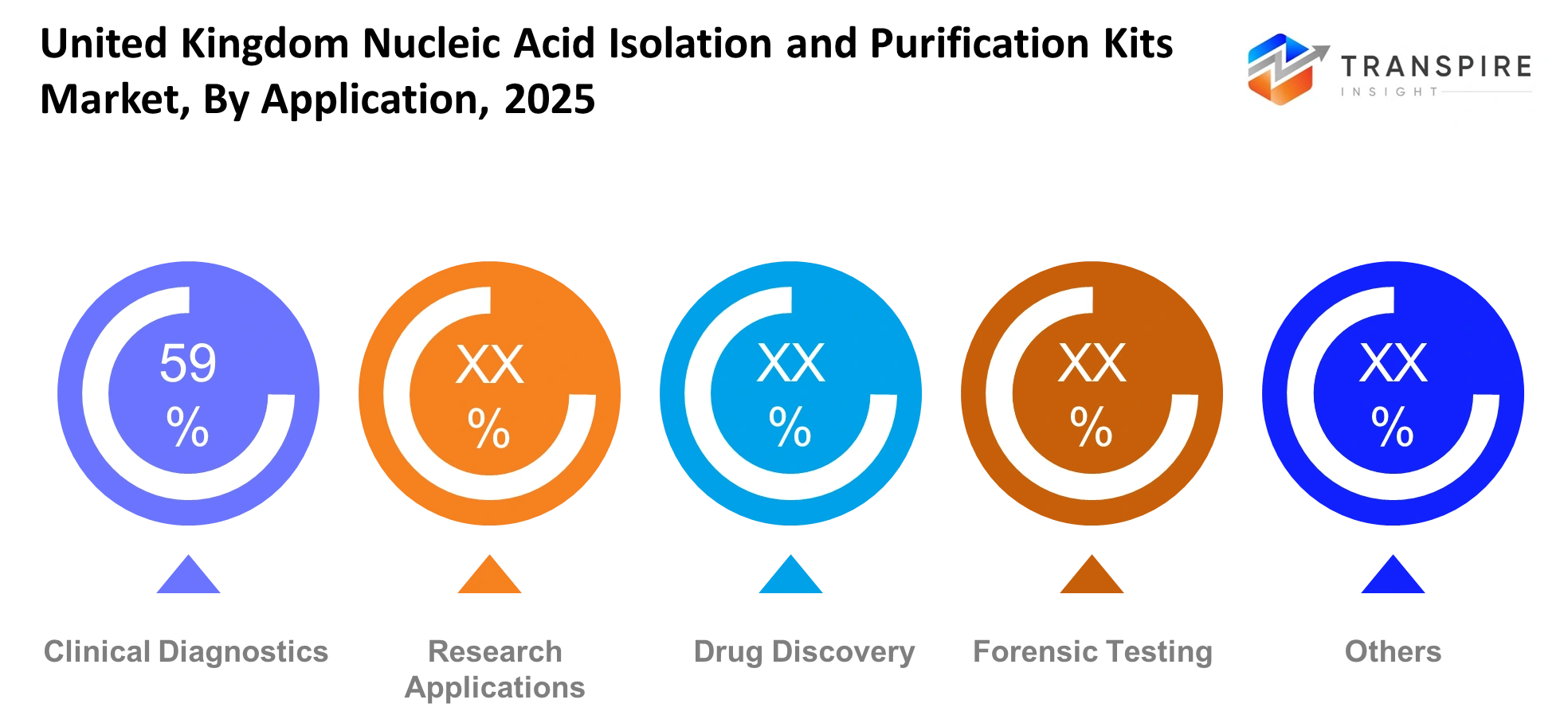
Clinical diagnostics basically leads the application segment because hospitals and diagnostic centers need consistent nucleic acid extraction for PCR testing , oncology profiling , and infectious disease detection .Research applications are still the second-largest slice, basically backed by solid genomics spending and those academic sequencing initiatives that keep running. Drug discovery work keeps stretching out too, since biotechnology firms are merging molecular screening into their targeted therapy pipeline, and it kind of becomes a default step.
Clinical diagnostics growth comes from the growing reliance on molecular medicine inside everyday healthcare. Research labs, more and more, push for careful extraction accuracy along with reproducibility, because they need trustworthy results for genomic sequencing and biomarker validation projects. Forensic testing stays about the same, yet it is somewhat constrained in volume, because uptake leans heavily on public-sector lab budgets and the amount of legal investigation work that shows up each year.
Looking ahead, the expansion should stay mostly clustered in clinical and translational medicine use cases. Drug discovery processes are likely to generate better long-term revenue, since precision medicine programs keep demanding higher nucleic acid purification standards, plus extraction capabilities that scale without slowing everything down.
To learn more about this report, Download Free Sample Report
By Technology
Column-based isolation technology is currently in front, largely because labs still prefer reliability, straightforward operation, and well proven validation routines. Magnetic bead-based isolation is next, and it is gaining quickly too, mostly due to how well it fits automated extraction instruments. Reagent-based isolation is smaller, mostly because manual handling becomes a bottleneck , so it doesn’t keep up as cleanly with high-throughput clinical settings.
Column based systems still show up in a lot of research labs , mainly because they’re cost efficient and people already know the workflows, even if automation is not the main focus. Magnetic bead approaches are getting more attention too , especially since healthcare networks care more about quicker turnaround, lower chance of contamination, and the ability to keep running samples without big pauses. Meanwhile reagent based methods can hit a wall in big diagnostic settings, because the manual extraction variability can lower reproducibility and also mess with throughput consistency.
Looking ahead, the next round of technology money will probably go toward magnetic bead isolation systems that are linked with robotic lab automation platforms. Equipment makers are expected to emphasize interoperability , so the extraction unit, sequencing equipment, and the lab information management software can all work together smoothly, that way operational efficiency gets a real push .
By End User
Hospitals and diagnostic laboratories are the biggest end user segment. This is mostly because high volume molecular testing and genomic diagnostics need ongoing nucleic acid extraction capacity. Research institutes stay active due to academic sequencing efforts and government funded genomics programs. Biotechnology firms are also growing quickly , since drug development pipelines now depend more on molecular analysis plus biomarker driven clinical research.
Hospital based demand ramped up after healthcare systems expanded their PCR infrastructure and rolled out precision oncology programs a bit more quickly than before. Diagnostic labs keep investing in automated purification routines, just to push sample throughput higher and, well, cut down on the operational logjams that slow everything down. Biotechnology companies are also going for newer extraction platforms more often, since gene therapy , mRNA research, and cell based therapeutic development really need highly purified nucleic acid inputs.
Looking ahead, demand should drift more toward biotechnology and translational medicine settings where workflows are more complex and timelines matter. Most buyers will likely lean on scalable automation systems, regulatory compliant extraction chemistries, and digital laboratory environments that are tightly integrated, so decentralized genomic testing models can actually run smoothly.
What are the Key Use Cases Driving the United Kingdom Nucleic Acid Isolation and Purification Kits Market?
Clinical molecular diagnostics still pretty much the main reason people adopt these systems, especially when it comes to PCR testing , oncology profiling and infectious disease detection across NHS hospitals plus diagnostic labs. With high testing volumes, teams need fast, standardized nucleic acid extraction workflows, so the results stay reliable and the whole thing meets regulatory requirements.
On the other side, drug discovery and translational research are growing at a steady pace, mainly inside biotechnology companies and academic research institutes. Genomic sequencing, biomarker validation, and cell therapy development increasingly depend on automated purification systems that can handle large numbers of samples , while also keeping contamination risk low.
There are also new use cases showing up. Decentralized genomic testing and point of care molecular diagnostics are getting more attention, often backed by small microfluidic extraction platforms. You can even see early adoption in personalized medicine programs, where quick nucleic acid prep helps enable earlier companion diagnostic , and then more targeted therapy decisions, in community healthcare settings.
|
Report Metrics |
Details |
|
Market size value in 2025 |
USD 217.68 Million |
|
Market size value in 2026 |
USD 240.18 Million |
|
Revenue forecast in 2033 |
USD 478.41 Million |
|
Growth rate |
CAGR of 10.34% from 2026 to 2033 |
|
Base year |
2025 |
|
Historical data |
2021 - 2024 |
|
Forecast period |
2026 - 2033 |
|
Report coverage |
Revenue forecast, competitive landscape, growth factors, and trends |
|
Regional scope |
United Kingdom |
|
Key company profiled |
Qiagen, Thermo Fisher Scientific, Roche Diagnostics, Agilent Technologies, Bio-Rad Laboratories, Promega Corporation, Merck KGaA, Takara Bio, Danaher Corporation, PerkinElmer, Illumina, Beckman Coulter, Omega Bio-tek, Zymo Research, Norgen Biotek. |
|
Customization scope |
Free report customization (country, regional & segment scope). Avail customized purchase options to meet your exact research needs. |
|
Report Segmentation |
By Product Type (DNA Isolation Kits, RNA Isolation Kits, Plasmid Purification Kits, Magnetic Bead Kits, Others); By Application (Clinical Diagnostics, Research Applications, Drug Discovery, Forensic Testing, Others); By Technology (Column-based Isolation, Magnetic Bead-based Isolation, Reagent-based Isolation, Others); By End User (Hospitals, Diagnostic Laboratories, Research Institutes, Biotechnology Companies, Others). |
Which Regions are Driving the United Kingdom Nucleic Acid Isolation and Purification Kits Market Growth?
England still appears to be the leading region for nucleic acid isolation and purification kit sales across the United Kingdom. A big reason is the heavy concentration of NHS genomic laboratories, plus biotechnology clusters, and also that solid diagnostic setup that’s already in place. In practice, London, Cambridge, and Oxford back up large sequencing programs, precision oncology work, and high-throughput molecular testing networks all together. On top of that, strong government funding through Genomics England, plus the ongoing modernization of NHS labs, keeps making sure procurement happens again and again for extraction kits, and even for automation systems. There’s also this kind of tight, day to day kind of collaboration between universities, pharma companies, and clinical testing sites which makes the adoption of molecular diagnostics feel more mature, and not as risky.
Scotland takes the next spot, but the way it grows is a little different, it is not exactly the same push as England. Here it leans more on public health genomics and longer term research investment, rather than relying on big commercial diagnostic volumes. Government-backed life sciences funding stays relatively steady, and universities keep producing strong research groups, so demand does not really dip for sequencing reagents and purification technologies. Edinburgh and Glasgow keep expanding their biotech incubation and translational medicine capabilities, mostly by doing collaborative research projects. That “stable innovation” feel helps Scotland stay in the market more reliably, even when healthcare budgets get tight, and everyone starts watching costs more.
Wales is starting to move faster than the rest, mainly because there’s been added investment in regional diagnostic infrastructure. Since after 2023, decentralized molecular testing capabilities have also been expanding, and that shift seems to be pushing growth.So basically the expansion of community health care genomics programs and more local infectious disease surveillance has made things a bit different, like new demand for compact, automated extraction platforms came out of nowhere… not exactly, but you know what I mean. Also, government-backed laboratory modernization initiatives helped improve access to molecular testing beyond the big metropolitan hubs. Between 2026 and 2033, this regional growth is expected to open up appealing opportunities for suppliers that are focused on portable extraction technologies , automation friendly consumables, and diagnostic workflows that can actually run in decentralized settings.
Who are the Key Players in the United Kingdom Nucleic Acid Isolation and Purification Kits Market and How Do They Compete?
The competitive terrain in the United Kingdom nucleic acid isolation and purification kits market is, in a way, moderately consolidated, with multinational diagnostics firms holding a sizable portion because they run integrated molecular testing ecosystems. Lately, rivalry seems to hinge less on simple reagent pricing and more on things like how well the process plays with automation, extraction accuracy, consistency of the reagents, and how smoothly the whole workflow slots in. Existing suppliers keep pushing back on competitors by leaning on proprietary extraction chemistries and long-running laboratory agreements, while smaller, more niche biotechnology companies try to win attention through rapid turnaround technologies, and flexible automation platforms that are better suited for decentralized testing settings.
QIAGEN stands out with automation-minded extraction systems that are woven into PCR and sequencing workflows, which are already common across NHS-linked laboratories. The strong fit between its own extraction kits and automated instruments tends to drive repeat purchases, and that also supports better customer retention. Thermo Fisher Scientific goes after a different angle, by positioning itself around a wide-ranging lab ecosystem, blending nucleic acid purification products with sequencing platforms, cloud-based laboratory analytics, and diagnostic software features. It also expands through partnerships with genomic medicine programs, which helps it reach deeper into clinical research, and oncology testing environments.
Roche zeroes in on high-throughput molecular diagnostics platforms built for hospital testing networks, where standardized clinical validation is expected. Danaher Corporation, through its subsidiaries, leans into genomic workflows and automation technologies, which lets it scale extraction solutions for pharmaceutical work and biotechnology research applications. Merck KGaA differentiates through specialized reagent purity and advanced life sciences research support, particularly within translational medicine and cell therapy development programs.
Company List
- Qiagen
- Thermo Fisher Scientific
- Roche Diagnostics
- Agilent Technologies
- Bio-Rad Laboratories
- Promega Corporation
- Merck KGaA
- Takara Bio
- Danaher Corporation
- PerkinElmer
- Illumina
- Beckman Coulter
- Omega Bio-tek
- Zymo Research
- Norgen Biotek
Recent Development News
In April 2025, QIAGEN announced plans to launch three new sample preparation instruments, including QIAsymphony Connect, to improve automated nucleic acid extraction workflows. The expansion strengthens high-throughput laboratory automation capabilities for oncology, genomics, and clinical diagnostics applications across European and UK healthcare networks.
Source: https://www.businesswire.com
In February 2025, Roche Diagnostics launched its sequencing by expansion (SBX) technology platform for next-generation sequencing applications. The technology reduced sequencing turnaround times from days to hours, strengthening demand for advanced nucleic acid extraction and purification workflows in clinical genomics and translational research environments.
Source: https://www.roche.com
What Strategic Insights Define the Future of the United Kingdom Nucleic Acid Isolation and Purification Kits Market?
The United Kingdom Nucleic Acid Isolation and Purification Kits Market is kinda shifting, toward more and more fully automated, decentralized molecular testing ecosystems , that are plugged into genomic medicine and AI based diagnostics. As precision oncology programs keep expanding, and as rapid sequencing workflows become more routine, plus community based molecular testing roles grow, the value part won’t sit only in “standalone extraction kits” anymore. It will slide toward integrated automation platforms and those recurring consumables revenue models. In the next 5–7 years, most labs are expected to put interoperability first, meaning extraction technologies and sequencing systems, plus the digital lab infrastructure should work together in a smooth way.
There’s also a quieter risk that doesn’t get talked about as much. The market can start concentrating around proprietary reagent platform ecosystems, basically run by a small group of large multinational diagnostics companies. If the compatibility is limited between extraction chemistries and downstream sequencing instruments, then procurement flexibility can get squeezed. And that can mean higher long term operational costs for healthcare networks, like even when prices are “okay” up front.
On the opportunity side, things are emerging around microfluidic sample preparation systems, meant for decentralized genomic diagnostics in regional healthcare environments. The investment buzz coming out of the Cambridge and Oxford biotechnology clusters, suggests a strong upside for portable extraction technologies that support rapid oncology screening and infectious disease monitoring. Market players should focus on partnerships, especially with digital diagnostics vendors and automation software developers, to lock in positioning within integrated molecular testing networks and not get stuck later when the ecosystem decides for them.
United Kingdom Nucleic Acid Isolation and Purification Kits Market Report Segmentation
By Product Type
- DNA Isolation Kits
- RNA Isolation Kits
- Plasmid Purification Kits
- Magnetic Bead Kits
- Others
By Application
- Clinical Diagnostics
- Research Applications
- Drug Discovery
- Forensic Testing
- Others
By Technology
- Column-based Isolation
- Magnetic Bead-based Isolation
- Reagent-based Isolation
- Others
By End User
- Hospitals
- Diagnostic Laboratories
- Research Institutes
- Biotechnology Companies
- Others
Frequently Asked Questions
Find quick answers to common questions.
The expected United Kingdom Nucleic Acid Isolation and Purification Kits Market size is USD 478.41 Million in 2033.
Key segments for the United Kingdom Nucleic Acid Isolation and Purification Kits Market are By Product Type (DNA Isolation Kits, RNA Isolation Kits, Plasmid Purification Kits, Magnetic Bead Kits, Others); By Application (Clinical Diagnostics, Research Applications, Drug Discovery, Forensic Testing, Others); By Technology (Column-based Isolation, Magnetic Bead-based Isolation, Reagent-based Isolation, Others); By End User (Hospitals, Diagnostic Laboratories, Research Institutes, Biotechnology Companies, Others).
Major United Kingdom Nucleic Acid Isolation and Purification Kits Market players are Qiagen, Thermo Fisher Scientific, Roche Diagnostics, Agilent Technologies, Bio-Rad Laboratories, Promega Corporation, Merck KGaA, Takara Bio, Danaher Corporation, PerkinElmer, Illumina, Beckman Coulter, Omega Bio-tek, Zymo Research, Norgen Biotek.
The United Kingdom Nucleic Acid Isolation and Purification Kits Market size is USD 217.68 Million in 2025.
The United Kingdom Nucleic Acid Isolation and Purification Kits Market CAGR is 10.34% from 2026 to 2033.
- Qiagen
- Thermo Fisher Scientific
- Roche Diagnostics
- Agilent Technologies
- Bio-Rad Laboratories
- Promega Corporation
- Merck KGaA
- Takara Bio
- Danaher Corporation
- PerkinElmer
- Illumina
- Beckman Coulter
- Omega Bio-tek
- Zymo Research
- Norgen Biotek
Recently Published Reports
-
Apr 2026
Cord Blood Banking Services Market
Cord Blood Banking Services Market Size, Share & Analysis Report By Type of Service (Collection, Processing, Storage), By Bank Type (Private Banks, Public Banks, and Hybrid Banks), By Component (Cord Blood, and Cord Tissue), By End User (Hospitals, Research Institutions, Biotechnology Companies, and Others) and Geography (North America, Europe, Asia-Pacific, Middle East and Africa, South and Central America), 2021 - 2031
-
Apr 2026
ELISA Processors Market
ELISA Processors Market Size, Share & Analysis Report By Type (Optical Filter ELISA Analyzer, and Optical Grating ELISA Analyzers), By Mode (Automated ELISA Analyzers, and Semi-Automated ELISA Analyzers), By Applications (Immunology, Vaccine development, Drug Monitoring, and Others), By End Users (Biotechnology Companies, Pharmaceutical Companies, Contract Research Organization, and Diagnostic Laboratories) and Geography (North America, Europe, Asia-Pacific, Middle East and Africa, South and Central America), 2021 - 2031
-
May 2026
Microscope Slide Scanner Market
Microscope Slide Scanner Market Size, Share & Analysis Report By Type (Portable Microscope Slide Scanner, and Desktop Microscope Slide Scanner), By Application (Biological Research, Medicine, Veterinary, and Other) and Geography (North America, Europe, Asia-Pacific, Middle East and Africa, South and Central America), 2021 - 2031
-
Apr 2026
Microwave Cookware Market
Microwave Cookware Market Size, Share & Analysis Report By Material Type (Plastic, Glass, Ceramic, Silicone, and Metal), By Application (Cooking, Reheating, and Defrosting), By End User (Household, Commercial (Restaurants, Hotels, and Cafes), and Food Service Industry), By Sales Channel (Online Retail, Offline Retail (Supermarkets, Hypermarkets, Specialty Stores), and Direct Sales (Company Outlets)) and Geography (North America, Europe, Asia-Pacific, Middle East and Africa, South and Central America), 2021 - 2031