
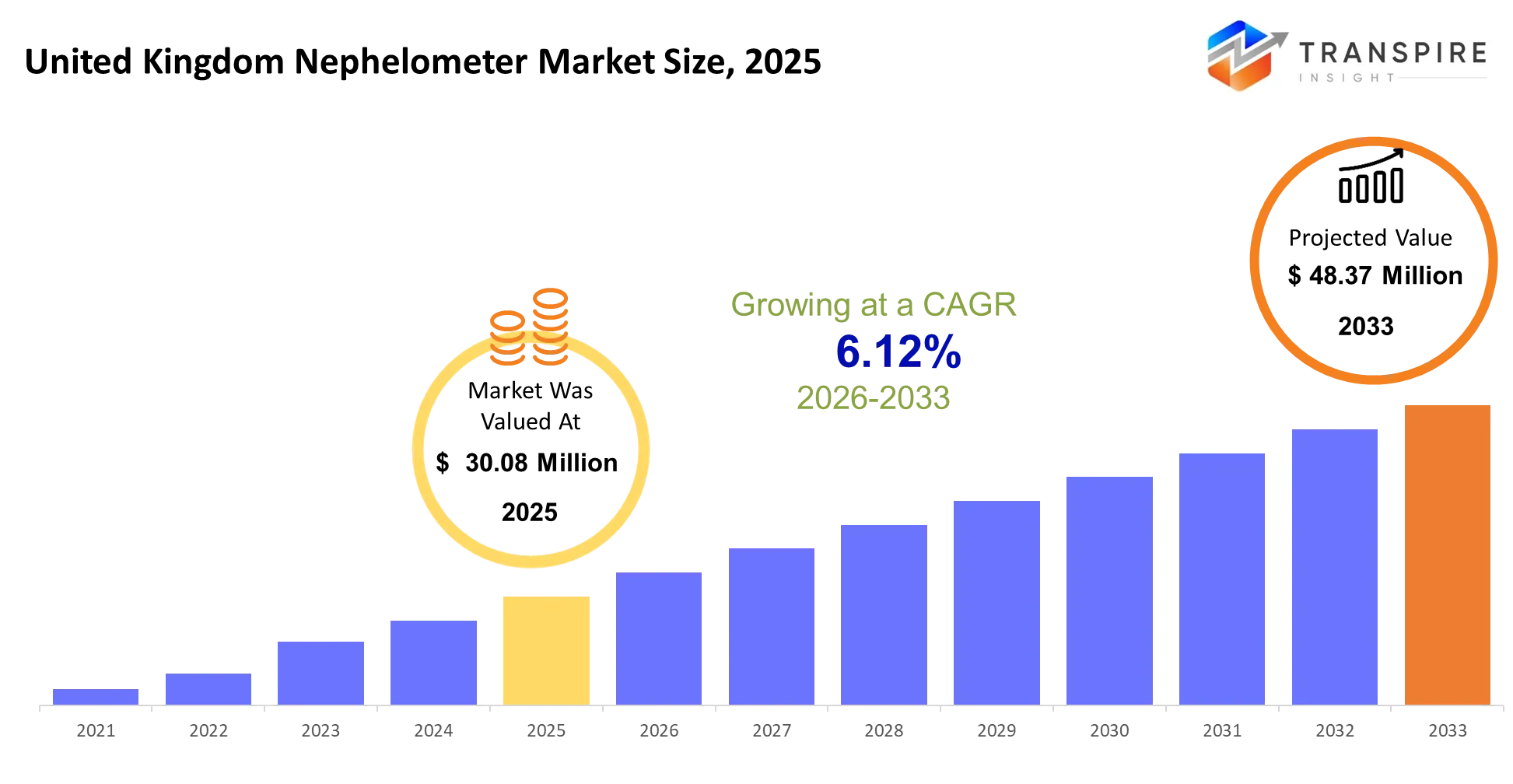
United Kingdom Nephelometer Market Size & Forecast:
- United Kingdom Nephelometer Market Size 2025: USD 30.08 Million
- United Kingdom Nephelometer Market Size 2033: USD 48.37 Million
- United Kingdom Nephelometer Market CAGR: 6.12%
- United Kingdom Nephelometer Market Segments: By Product Type (Portable Nephelometers, Benchtop Nephelometers, Online Nephelometers, Digital Nephelometers, Others); By Application (Water Testing, Air Quality Monitoring, Clinical Diagnostics, Industrial Processing, Others); By Technology (Laser-based Nephelometers, LED-based Nephelometers, Infrared Nephelometers, Others); By End User (Laboratories, Environmental Agencies, Hospitals, Industrial Facilities, Others)
To learn more about this report,  Download Free Sample Report
United Kingdom Nephelometer Market Summary
The United Kingdom Nephelometer Market was valued at USD 30.08 Million in 2025. It is forecast to reach USD 48.37 Million by 2033. That is a CAGR of 6.12% over the period.
In the United Kingdom, the nephelometer market does something pretty practical, namely it helps people keep an eye on water clarity, particulate concentration, and air quality around wastewater treatment plants, pharmaceutical production sites, marine research operations, and industrial process locations. In day to day work, these instruments let operators spot contamination sooner, hang on to environmental discharge compliance, and keep production results steady in areas where suspended particle levels really touch operational safety and product uniformity.
Over the last five years, the whole market has kind of moved away from standalone lab units and toward connected real-time monitoring setups that plug into digital control platforms. That shift got faster after tighter post-Brexit environmental compliance expectations, and when stricter water quality monitoring duties piled pressure on utilities and industrial operators to deliver continuous reporting data, even when conditions change. At the same time, the COVID-19 period also caused supply chain disruptions, and it showed how fragile manual sampling can be, which in turn pushed companies to invest in more automated monitoring infrastructure. Now as facilities modernize and predictive maintenance routines expand, nephelometers are shifting from occasional compliance verification to ongoing operational surveillance, and that tends to open up steadier recurring revenue for equipment vendors as well as calibration and servicing partners.
Key Market Insights
- The United Kingdom Nephelometer Market is seeing ongoing investment in smart water infrastructure ,along with industrial emission tracking technologies, since 2021.
- England seems to lead the regional picture, with about 68% market share in 2025, mainly because industrial plus municipal water treatment centers are more concentrated there.
- Online nephelometers make up roughly 54% of the overall industry size in 2025, since utilities lean toward continuous, real time turbidity observation systems.
- Portable nephelometer units take the second-largest share too , because on site inspection teams need adaptable ,quick contamination screening tools.
- Digital, IoT enabled nephelometers are growing the quickest product category between 2025 and 2030, driven by the growing adoption of predictive maintenance, integration.
- In the United Kingdom Nephelometer Market during 2025, Wastewater treatment applications basically dominate, with nearly 41% revenue share , though it’s not the only area.
- In the same time frame, Pharmaceutical manufacturing shows up as the fastest growing application segment because contamination control standards get more strict after 2020, you know , the timing matters.
- For end users, Municipal utilities are still in the lead, hovering around 46% market share , and that is mostly backed by long term infrastructure modernization efforts that keep running year after year.
- Meanwhile , Biotechnology and life sciences firms are becoming a quick rising end user group, propelled by needs for precise particle analysis, not just general monitoring.
- Also, the supply chain disruptions during 2020–2022 pushed many facilities to put money into automated nephelometer solutions, which help cut down on labor dependence, and even lower operational downtime a bit.
What are the Key Drivers, Restraints, and Opportunities in the United Kingdom Nephelometer Market?
Stricter regulations on continuous water quality monitoring for municipalities, pharmaceutical manufacturing, and industrial discharge processes is the biggest trend. Regulations increased post-Brexit after the UK updated its environmental reporting regime and conducted reviews of sewage overflow events, thereby making it imperative for utilities and industrial operators to improve turbidity monitoring to avoid non-compliance fines and the associated penalties. Utilities and industrial operators are now upgrading from manual water quality checks to automated nephelometer systems that provide real-time particle detection and the ability to electronically record, store, and share measurement data for compliance purposes. This upgrade presents significant opportunities for recurring revenue from calibration and calibration services, software integration, and annual maintenance contracts.
The main trend limiting market growth is the cost of integrating new nephelometers into old industrial facilities. Older supervisory control systems that do not interface with sensor networks are found in most UK water plants and industrial processes. Integrating a new nephelometer into the existing system entails the investment cost of purchasing the unit as well as requiring extensive capital, planning, and expert engineering support to install. Infrastructure constraints are built into long asset replacement cycles that limit adoption particularly among smaller municipal water utilities with tight capital budgets.
A substantial opportunity lies with smart water infrastructure investments taking place across England and Scotland. Utilities are incorporating AI-integrated monitoring platforms that integrate nephelometers and predictive modeling to detect contamination prior to reaching violation limits, therefore paving the way for cloud-compatible and remotely accessible monitoring systems.
What Has the Impact of Artificial Intelligence Been on the United Kingdom Nephelometer Market?
In the United Kingdom, a transition from conventional nephelometers to an AI-powered continuous monitoring system in marine emission control systems, industrial wastewater plants, and exhaust gas cleaning systems is emerging. More facilities are linking their nephelometers to a Supervisory Control and Data Acquisition (SCADA) system, which monitors the turbidity, the rate of particulate discharge and the status of scrubber water in real time and analyzes the data based on AI. In terms of maritime operations, they can now automate scrubber inspection and provide automatically tuned wash water treatments and compliance warnings if discharge levels will exceed thresholds. Operators do not need to visually check their systems and ship operators benefit from better fleetwide reports and performance compliance reporting under new stricter IMO emission regulations.
Machine learning is also developing predictive maintenance for nephelometers. Operators are beginning to utilize models that assess data such as historical sensor drift, trend of particle concentrations and vibration of equipment, so that calibration failures or filter deterioration can be discovered and resolved prior to deterioration in performance. There have been various industrial facilities and connected monitoring platform users reporting lower unplanned downtime and less frequent maintenance interventions with predictive diagnostics implemented. Moreover, remote diagnostic tools can now assist utilities in optimized chemical dosage and filtration efficiency thereby lowering operation and maintenance costs.
Despite the widespread application of AI-based continuous monitoring technology, challenges remain in practical implementations. One problem is the lack of digital infrastructure at many older facilities or vessels, which prohibits continuous and high volume data transmission at high speeds. Irregular connections and sparse data records in offshore and maritime settings will reduce the precision of the models especially for rapidly changing operating conditions or fluctuating water conditions.
Key Market Trends
- Between 2021 and 2025, UK water companies invested in an increased number of inline nephelometers for enhanced accuracy and recording compliance evidence of overflow events.
- Pharmaceutical companies invested in automated turbidity detection after stricter process audits led to increased validation requirements.
- Both Hach and Thermo Fisher Scientific expanded their portfolio of cloud connected monitoring for industrial UK installations post-2022.
- Demand for portable nephelometers reduced on site across large scale water and wastewater treatment sites as operators favoured permanent network linked monitoring infrastructure.
- UK water companies are under increased scrutiny from environmental compliance legislation post-Brexit for auditable evidence of real time water quality monitoring data.
- Energy price increases since 2022 have driven wastewater operators to integrate nephelometers into automated process optimisation solutions to minimize chemical usage and filtration costs.
- A shift in procurement toward regionally manufactured water quality instruments resulted from global semiconductor shortages disrupting supply of imports during COVID-19, increasing availability from suppliers of domestically manufactured nephelometers.
- The UK food and beverage sector boosted usage of water nephelometers to improve particulate monitoring quality during high volume periods in 2023 and 2025.
United Kingdom Nephelometer Market Segmentation
By Product Type :
Portable nephelometers continue to be appropriate for field-based monitoring actions where quick turbidity determination is needed in various water treatment locations and in environmental inspection programs. The convenience of their small size, portability, and the speed with which measurements can be made continue to favor them in temporary testing situations. Benchtop nephelometers are still predominantly found in laboratory settings where the ease of calibration, consistency in testing conditions and greater measurement accuracy allow for in-depth particle determination and legal documentation purposes.
The advantages of inline nephelometers continue to draw interest in industrial facilities and municipal treatment plants as it allows for an immediate response to contaminations and instability in the operational system through real-time data. Digital nephelometers can facilitate automated documentation and remote viewing through integrated software for the facilitation of operational awareness. Other types of nephelometers exist to serve research institutions and custom industrial applications where the typical scope of a certain product might be insufficient.
By Application :
Water testing applications are the best known because the water and industrial plants need to measure turbidities in a continuous way, to maintain efficiency of the process and satisfy regulations reporting rules. The nephelometers are used for the detection of particulate concentration modification before this phenomena impacts on process performance. Environment testing is another growing field with increasing testing applications on rivers, reservoirs, waste water outflow systems for pollution tracking.
Air quality applications are still evolving with an increasing use in industry, both by facilities and by agencies, to track particulates level in air under the operating parameters. In the clinical diagnostic field the nephelometers are applied in laboratory tests for protein, immune response testing in clinical laboratories in order to support the diagnostic interpretation. The industrial processes applications maintain process efficiency by detecting the particulates concentration level, which has a big influence on food, pharmaceutical, chemical processing and so on.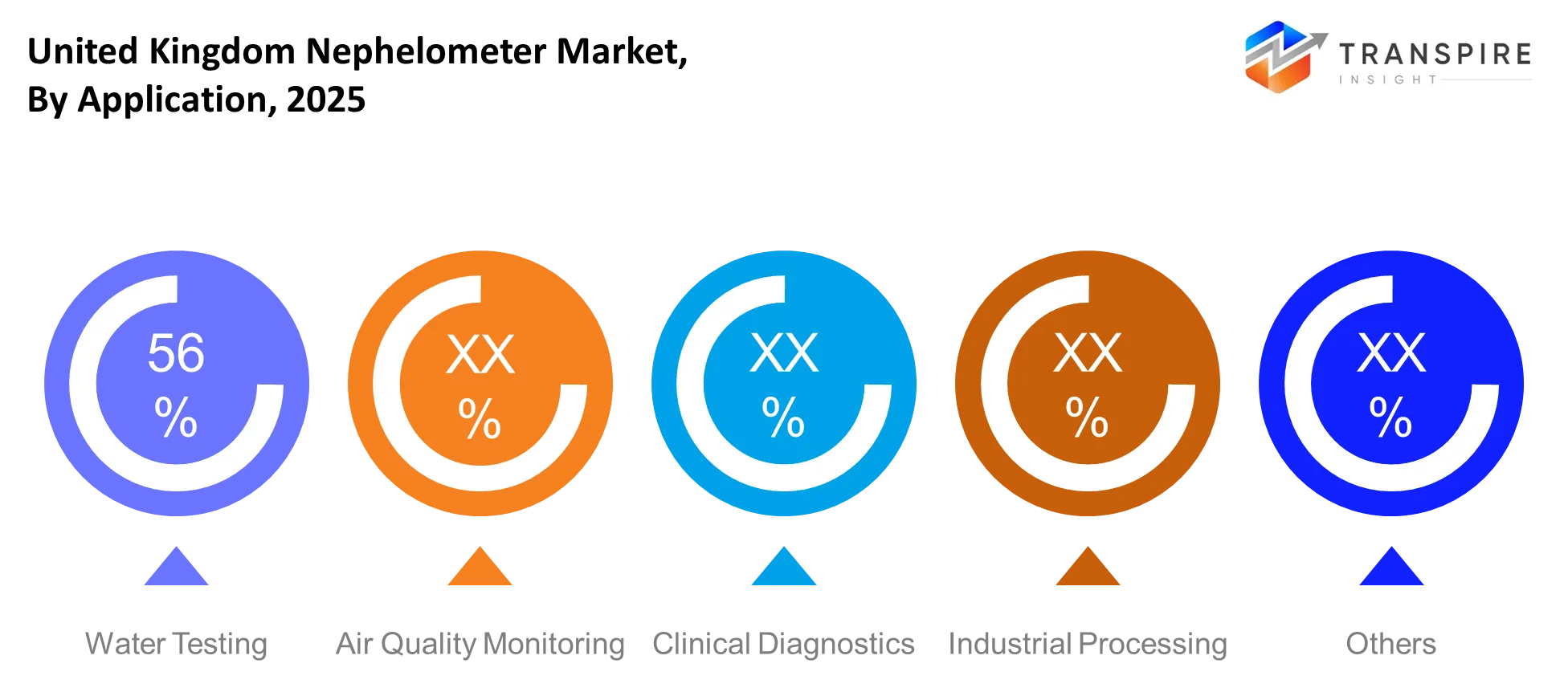
To learn more about this report, Download Free Sample Report
By Technology :
Laser-based nephelometers also support high-sensitivity particle measurement due to enhanced detection sensitivity and measurement stability under rigorous lab and industrial conditions, with increasing acceptance in the manufacturing and research processes in pharmaceutical production activities where sensitive particulate measurement has direct impact on quality control practices. High sensitivity also enables on-line monitoring under various process conditions.
LED-based nephelometers are widely accepted due to the lower operating costs and energy efficiency which suits for routine monitoring tasks. Infrared nephelometers are useful in applications that would be affected by visibility conditions leading to undesirable measurement accuracy in an industrial or ambient environment test procedures, while other detection technologies like custom optics designed for application-specific and dedicated analysis needs might not be sufficient.
By End User :
Laboratories still form a major end-user sector because scientific testing, validation and regulatory analysis necessitate accurate, consistent turbidity measurements throughout research and quality control processes. Environmental agencies use nephelometers to analyze water pollution, wastewater discharge and natural water characteristics for public environmental management programs, allowing early detection of pollution trends and non-compliance risks to be established due to the ability for continuous monitoring.
Hospitals use nephelometers for diagnosis within clinical labs to measure and analyze immunity functions and proteins while manufacturing facilities continue expanding their use throughout various industrial processes where water quality and particulate analysis impacts efficiency and the reliability of equipment. Other end-users can include research facilities and academic departments where controlled environment analytical experiments and studies demand high precision particle measurements.
What are the Key Use Cases Driving the United Kingdom Nephelometer Market?
Water treatment is currently the key application for nephelometers in the United Kingdom market. Water and waste treatment authorities rely on nephelometers for real-time monitoring of turbidity and to ensure adherence to the Environment Agency's water quality standards for discharge. Constant monitoring allows treatment plants to effectively manage contaminants before an event takes place and helps minimize the inefficiency in treatment operations while also preventing compliance related violations stemming from inaccurate measurements.
Applications for clinical diagnostics and industrial processing continue to show moderate growth. Laboratories in hospitals use nephelometers for quantitative determination of protein and Immunoglobulin levels. In these applications precise sample measurements are required in order to obtain accuracy for a diagnosis. For the purposes of quality assurance and contamination control, food processors and pharmaceutical manufacturers are increasingly implementing on-line turbidity monitoring systems to manage the flow and maintain product consistency throughout the manufacturing process during large production runs.
The application of AI technology in smart water treatment infrastructure and remote environmental monitoring is being considered. Some water utilities are beginning to use artificial intelligence embedded with their nephelometers for predictive maintenance programs designed to detect sensor fouling or process variability prior to equipment breakdown. Also, research facilities are investigating the use of transportable monitoring systems for in-situ measurements of river pollutants and to establish rural environmental testing centers
|
Report Metrics |
Details |
|
Market size value in 2025 |
USD 30.08 Million |
|
Market size value in 2026 |
USD 31.92 Million |
|
Revenue forecast in 2033 |
USD 48.37 Million |
|
Growth rate |
CAGR of 6.12% from 2026 to 2033 |
|
Base year |
2025 |
|
Historical data |
2021 - 2024 |
|
Forecast period |
2026 - 2033 |
|
Report coverage |
Revenue forecast, competitive landscape, growth factors, and trends |
|
Regional scope |
Middle East and Africa (Saudi Arabia, United Arab Emirates, South Africa, Rest of Middle East and Africa) |
|
Key company profiled |
Thermo Fisher Scientific, Hach, Horiba, Danaher Corporation, Siemens Healthineers, Merck KGaA, Shimadzu Corporation, Palintest, Tintometer, Anton Paar, Hanna Instruments, Agilent Technologies, BMG Labtech, Beckman Coulter, Waters Corporation |
|
Customization scope |
Free report customization (country, regional & segment scope). Avail customized purchase options to meet your exact research needs. |
|
Report Segmentation |
By Product Type (Portable Nephelometers, Benchtop Nephelometers, Online Nephelometers, Digital Nephelometers, Others); By Application (Water Testing, Air Quality Monitoring, Clinical Diagnostics, Industrial Processing, Others); By Technology (Laser-based Nephelometers, LED-based Nephelometers, Infrared Nephelometers, Others); By End User (Laboratories, Environmental Agencies, Hospitals, Industrial Facilities, Others) |
Which Regions are Driving the United Kingdom Nephelometer Market Growth?
North America is maintaining market leadership as the largest revenue stream due to relatively well-structured standards on water quality enforcement across municipal, pharmaceutical and industrial discharge processes. The presence of extensive laboratory networks and longstanding environmental frameworks in both the US and Canada encourage a high pace of continuous turbidity system deployment. High spending in smart water management systems will lead to faster implementation of online monitoring equipment compared to manual processes. A long history of instrumentation, calibration, and environmental engineering firm activity in both public and private sectors reinforces current North American market share.
Europe remains a steadier source of revenue because implementation of regulations is more of a step-by-step and uniform approach to industrial and environmental regulations. While Britain, Germany and France, for instance, are carrying out upgrade projects to their wastewater infrastructure, strict lab requirements will continue to define pharmaceutical and food industry standards and therefore, to influence demand for testing and measuring equipment, though perhaps not on a grand scale as compared to the North American market. In Europe, the driving factors will be more on efficiency upgrades to existing treatment and monitoring stations rather than new infrastructures, as strong government influence and long-term environmental budgets support long steady buying cycles for manufacturers and service providers in the nephelometer market.
Asia-Pacific presents the strongest growth in terms of sales as quick industrial and urban infrastructure upgrades lead to over-stretched water treatment capacity in regions like China, India, and Southeast Asia. New government regulations for wastewater discharge implemented after 2021 are also pushing the rapid adoption of real-time monitoring systems by public water utilities as well as industrial facilities. A rise in government spending on systems designed for monitoring industrial contamination and the proliferation of smart city water-management schemes will stimulate demand for internet-enabled test and measurement instruments in Asia-Pacific from 2026 to 2033 and foster the growth of local manufacturers and distributors.
Who are the Key Players in the United Kingdom Nephelometer Market and How Do They Compete?
The UK nephelometer market is fairly concentrated. There is competition in accuracy, the level of software integration available, and the length of support available for the instrument. Instrument manufacturers large and small are using either bundled calibration contracts or the development of complete monitoring systems as a way to defend market share. Small instrument specialists offer highly customized systems for specific applications within the environmental and pharmaceutical sectors. Customers are now trying to determine which manufacturers are capable of integrating data, providing remote diagnosis and minimizing the effort required to fulfill regulatory reporting requirements.
Utilities and industrial operations are more inclined to purchasing a continuous monitoring solution rather than just a single instrument. Hach is strong on the side of integrated water quality management systems that utilize cloud monitoring software and automated compliance reporting to offer utilities improved visibility over decentralized treatment processes. Thermo Fisher Scientific’s focus is on laboratory instruments with highly accurate sensitivity and measurement capabilities that target pharmaceutical and clinical diagnostic tests in which particulate measurement impacts accuracy. Strong continued investment in integrated digital lab workflow and connectivity support this with regulated and research facilities.
Xylem Inc is utilizing its smart infrastructure capabilities and water utility focus to offer utility customers predictive maintenance and process optimization solutions tied into ongoing wastewater renewal efforts in UK utilities. HORIBA is targeting specialized environmental monitoring applications for which its compact and stable long-term sensor readings offer an advantage for use in the field. Tintometer Group is building through localized technical support and customizable solutions designed for smaller industrial customers and regional labs requiring quick turnaround service.
Company List
- Thermo Fisher Scientific
- Hach
- Horiba
- Danaher Corporation
- Siemens Healthineers
- Merck KGaA
- Shimadzu Corporation
- Palintest
- Tintometer
- Anton Paar
- Hanna Instruments
- Agilent Technologies
- BMG Labtech
- Beckman Coulter
- Waters Corporation
Recent Development News
In 03 2026, HORIBA launched the “Partica” laser diffraction and dynamic imaging particle size and shape analyzer platform. The release strengthened HORIBA’s analytical instrumentation portfolio used across environmental and water-quality testing applications linked to nephelometric analysis. Source https://www.horiba.com/
In 04 2026, HORIBA expanded promotion of its LAQUA-TB220 portable turbidity meter across global water-testing markets. The company emphasized the device’s field-ready turbidity measurement capabilities for environmental and industrial monitoring applications relevant to nephelometer demand growth. Source https://www.horiba.com/
What Strategic Insights Define the Future of the United Kingdom Nephelometer Market?
The market for nephelometers in the UK is rapidly evolving from isolated testing tasks toward integrated, automated, networked monitoring systems-in which turbidity measurement will support-and eventually constitute an element within comprehensive predictive water management systems. Real-time compliance mandates are increasing, along with an aging infrastructure in utilities and AI adoption for process optimization in municipal and industrial treatment plants. The suppliers providing instrumentation linked with cloud-enabled analysis, remote diagnostics, and service agreements covering the lifespan of their instruments will be able to take a bigger chunk of the recurring revenues in the next 5–7 years.
Another relatively unobservable threat is the increasing reliance on foreign manufactured optical and semiconductor sensing components; in the face of trade disruptions or shortage in such component supplies, there is the possibility for manufacturing lead time and servicing capability of installed instruments to suffer. Nevertheless, the rise of localized, decentralized water monitoring in rural areas of England and Scotland, in contrast to comprehensive programs in larger cities and towns, presents another niche that needs to be addressed, this time with portable, low-power nephelometers that come with wireless reporting capabilities. Software interoperability and the availability of local service agents should not be underestimated when making choices among instrument vendors, as such factors become more influential than raw hardware performance.
United Kingdom Nephelometer Market Report Segmentation
By Product Type
- Portable Nephelometers
- Benchtop Nephelometers
- Online Nephelometers
- Digital Nephelometers
By Application
- Water Testing
- Air Quality Monitoring
- Clinical Diagnostics
- Industrial Processing
By Technology
- Laser-based Nephelometers
- LED-based Nephelometers
- Infrared Nephelometers
By End User
- Laboratories
- Environmental Agencies
- Hospitals
- Industrial Facilities
Frequently Asked Questions
Find quick answers to common questions.
The United Kingdom Nephelometer Market size is USD 48.37 Million in 2033.
Key Segments for the United Kingdom Nephelometer Market are By Product Type (Portable Nephelometers, Benchtop Nephelometers, Online Nephelometers, Digital Nephelometers, Others); By Application (Water Testing, Air Quality Monitoring, Clinical Diagnostics, Industrial Processing, Others); By Technology (Laser-based Nephelometers, LED-based Nephelometers, Infrared Nephelometers, Others); By End User (Laboratories, Environmental Agencies, Hospitals, Industrial Facilities, Others).
Major United Kingdom Nephelometer Market Players are Thermo Fisher Scientific, Hach, Horiba, Danaher Corporation, Siemens Healthineers, Merck KGaA, Shimadzu Corporation, Palintest, Tintometer, Anton Paar, Hanna Instruments, Agilent Technologies, BMG Labtech, Beckman Coulter, Waters Corporation.
The Current United Kingdom Nephelometer Market size is USD 30.08 Million in 2025.
The United Kingdom Nephelometer Market CAGR is 6.12% from 2026 to 2033.
- Thermo Fisher Scientific
- Hach
- Horiba
- Danaher Corporation
- Siemens Healthineers
- Merck KGaA
- Shimadzu Corporation
- Palintest
- Tintometer
- Anton Paar
- Hanna Instruments
- Agilent Technologies
- BMG Labtech
- Beckman Coulter
- Waters Corporation
Recently Published Reports
-
Apr 2026
Fiber Optic Faceplates Market
Fiber Optic Faceplates Market Size, Share & Analysis Report By Type (< 300 mm2, 300-350 mm2, and > 350 mm2, By Application (Night Vision, Holographic Imaging, Medical, and Others), and Geography (North America, Europe, Asia-Pacific, Middle East and Africa, South and Central America), 2021 - 2031
-
Apr 2026
High Temperature Superconductors Market
High Temperature Superconductors Market Size, Share & Analysis Report By Type (1G HTS, and 2G HTS), By Application (Power Cable, Fault Current Limiter, and Transformer), and Geography (North America, Europe, Asia-Pacific, Middle East and Africa, South and Central America), 2021 - 2031
-
Apr 2026
Industrial Plugs and Socket Market
Industrial Plugs and Socket Market Size, Share & Analysis Report By Type (Industrial Plugs, Industrial Sockets), By Current (Up to 32 A, 32 to 125 A, Above 125 A), By Protection (Dustproof and Splash Proof, Waterproof, Explosion Proof), By End User (Heavy Industries, Oil and Gas, Chemicals and Pharmaceuticals, Power Generation, Others), and Geography (North America, Europe, Asia-Pacific, Middle East and Africa, South and Central America), 2021 - 2031
-
Apr 2026
InGaAs Avalanche Photodiodes Market
InGaAs Avalanche Photodiodes Market Size, Share & Analysis Report By Type (1100 - 1700 nm, and 1000 - 1600 nm), By Application (Missile Warning System, Muzzle Flash Detection, Wafer Defect Inspection, Laser Rangefinders, and Others), and Geography (North America, Europe, Asia-Pacific, Middle East and Africa, South and Central America), 2021 - 2031