

United Kingdom Marketing Technology Market Summary
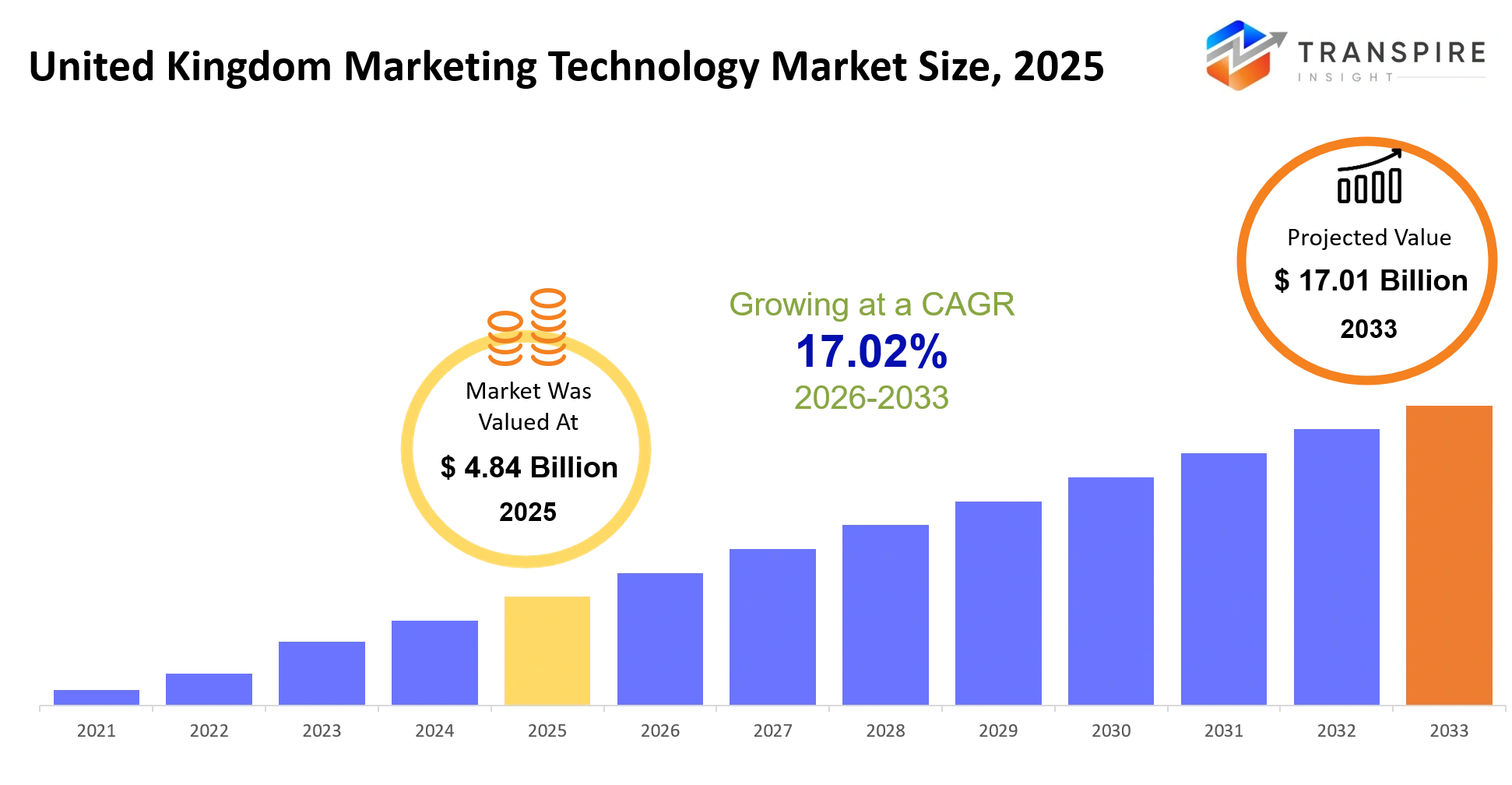
As per Transpire Insight Analysis the United Kingdom Marketing Technology Market size is estimated at USD 4.84 Billion in 2025 and is anticipated to reach USD 17.01 Billion by 2033, growing at a CAGR of 17.02% from 2026 to 2033.
The United Kingdom marketing technology market sort of helps businesses plan , deliver measures, and then improve customer engagement across digital channels, while also trimming wasted advertising spend and pushing better campaign results. Retailers, financial institutions, manufacturers, healthcare providers, and all sorts of business services firms kinda depend on marketing technology platforms to stitch together customer data, trigger automation, shape more tailored communications, and pull out business results that are actually measurable. This down to earth job has gotten bigger, especially since organizations are now juggling larger amounts of customer interactions across both online, and offline touchpoints pretty much all at once, or at least it feels like it.
Over the last three to five years, the trend has drifted away from separate standalone marketing tools, and toward more merged AI enabled platforms that keep analytics, automation, customer data, and content management in one shared space. Tighter privacy expectations after UK data protection rules came into effect, alongside the slow quiet fading of third-party cookies, has definitely sped up investment in first-party data strategies and consent based promotion. At the same time, the way people buy now after the COVID 19 pandemic, sort of forced companies to lean harder into digital engagement, while also tightening up campaign efficiency, and making sure everything performs as expected.As a result these changes have nudged organizations to modernize their marketing infrastructure, which supports faster software uptake, stronger recurring platform revenue, and wider interest in implementation, integration, and analytics services , all together.
United Kingdom Marketing Technology Market Size & Forecast:
- United Kingdom Marketing Technology Market Size 2025: USD 4.84 Billion
- Expected Market Value 2033: USD 17.01 Billion
- Forecast CAGR: 17.02%
- Leading region in 2025: England
- Fastest Growing region: Scotland
- Key Profile: Salesforce, Adobe, HubSpot, Oracle, SAP, Microsoft, Google, IBM, Mailchimp, Braze, Zoho, Hootsuite, Sprinklr, ActiveCampaign, Klaviyo
Key Market Insights
- In 2025 England basically dominated the United Kingdom Marketing Technology Market with about 84% market share, largely because London has this dense cluster of enterprise technology investments, you know. It’s kind of all in one place.
- Scotland, meanwhile, is projected to grow the quickest across 2025–2032, since spending on digital transformation keeps expanding in financial services, healthcare, and also technology firms at the same time.
- When it comes to software types, Customer Relationship Management (CRM) plus marketing automation platforms took the lead with nearly 34% market share in 2025. That happened because enterprises bundled several marketing tasks into one, more unified ecosystem.
- Customer Data Platforms (CDPs) still sit as the second-largest segment, as organizations start focusing on first-party data strength after tighter privacy rules and cookie policy updates started rolling in.
- For AI, solutions focused on AI-driven content creation and campaign optimization are expected to show the fastest growth from 2025–2032, as companies push harder for productivity gains and individualized personalization.
- In the applications space, digital marketing campaign management sort of led the way, hovering near 38% market share in 2025, mainly by making customer acquisition countable, and by backing omnichannel touchpoints, in a more steady way.
- Predictive customer analytics is expected to become the fastest-growing application segment by 2032, since machine learning keeps improving at tuning the targeting and making revenue forecasting a lot more accurate, too.
- Looking at enterprise size, large enterprises made up about 68% market share in 2025, largely because customer journeys are a bit intricate, and they need marketing technology that can scale, together with more robust analytical tools.
- As for end users, small and medium-sized enterprises will probably be the quickest-moving group over 2025–2032. Cloud based subscription platforms help reduce deployment expenses, so uptake feels easier, even when budgets are tight, and timelines are not flexible.
What are the Key Drivers, Restraints, and Opportunities in the United Kingdom Marketing Technology Market?
The main growth driver is moving toward AI-enabled, privacy-first customer engagement, you know. The pullback of third-party cookies, tougher UK data protection expectations, and the push from enterprise digital transformation programs basically forced many organizations to rebuild their marketing setup around first-party data. Marketing teams now want more integrated platforms, not those scattered , disconnected bits of software that don’t quite talk to each other. With better targeting, conversion rates tend to rise. Automation also cuts down campaign execution time. And, these improvements can lift software subscriptions, professional services revenue, plus broader long term platform adoption across retail, financial services, healthcare, and manufacturing.
The biggest limiter is still fragmented enterprise technology infrastructure. A lot of organizations are hanging on to legacy CRM, ERP, and analytics systems, and these can’t exchange data smoothly. Integration efforts often turn into months of customization, plus specialist consulting on top of it. The implementation costs can be high enough that modernization decisions get delayed, especially for mid-sized companies. According to a Transpire Insight review of regional procurement announcements and rollout schedules, supply chain concentration stays the main execution risk. So what happens is slower platform deployment, postponed upgrades, and even reduced service revenue, even with solid commercial interest lingering in the background.
The best opportunity seems to be sitting right inside enterprise adoption of generative AI, but only when it is paired with customer data platforms , and those real time decision engines too. Cloud spending is still rolling across the United Kingdom , so the conditions are pretty good for scalable marketing intelligence. You can see it in retail, financial services , and healthcare organizations putting money into predictive personalization and automated content production. The outcome is that campaign results improve, while the manual workload gets pushed down. Looking ahead, the vendors that bring AI governance along with privacy compliance and interoperable cloud architecture will probably be the ones to seize the next stage of market expansion.
What Has the Impact of Artificial Intelligence Been on the United Kingdom Marketing Technology Market?
Artificial intelligence is, kinda, transforming the United Kingdom Marketing Technology Market by automating campaign execution, audience segmentation, content generation, and compliance monitoring at the same time. Newer platforms continuously scan customer interactions, notice shifts in behavior, and then update campaign parameters on their own across email, social media web, and mobile channels. That means less manual handling , and the whole process feels more operationally steady. At the same time machine learning models estimate customer lifetime value, purchase intent, churn risk, and even likely campaign results before anything goes live, so marketing teams can steer budgets with more clarity. Predictive analytics also helps with sharper demand forecasting, plus it supports customer acquisition plans via data driven suggestions that are more targeted than they used to be.
All of this brings clear operational wins. Marketing teams usually cut down campaign creation timelines, cut repetitive admin tasks, tighten targeting precision, and make ad spend more efficient. AI enabled personalization lifts engagement, while automated reporting speeds up business decisions. Big organizations are increasingly pairing customer data platforms with AI models so they can improve revenue attribution and cross channel optimization. But even with all that, broad adoption still hits real boundaries. Integration costs can get high, data quality is often uneven across older systems , and governance rules slow implementation pace. In addition a lot of companies have trouble training AI models on standardized customer datasets, which can lower prediction accuracy and delay full scale deployment. Even so many firms keep investing, because the long term outlook across the UK marketing technology industry still looks promising.
Key Market Trends
- Since 2023 , enterprises have moved faster away from stand alone marketing tools towards more unified customer experience platforms, which kinda helps in improving operational efficiency and data governance, not always smoothly but still.
- During 2024–2026, AI powered content creation really took off, because vendors were embedding generative capabilities into campaign planning and into customer engagement workflows, kinda like end to end.
- Also, first-party data investments strengthened right after third-party cookie deprecation, which basically pushed privacy focused marketing strategies across retail, financial services, and media orgs to speed up.
- Cloud-native marketing platforms captured major enterprise spending between 2023 and 2025, since subscription deployment made things easier in terms of implementation complexity, and reduced infrastructure costs overall.
- Salesforce, Adobe, and Microsoft increased their AI investments during 2025, so competition around intelligent automation and predictive marketing capabilities got more intense.
- Customer data platforms saw stronger enterprise adoption too, as organizations started unifying fragmented consumer information for real time campaign optimization and measurement, which helps a lot.
- From 2024–2026, API based integrations became pretty standard across enterprise deployments, enabling faster interoperability between CRM , analytics, commerce, and advertising platforms, even when stacks differ.
- Marketing teams increasingly leaned into predictive analytics for budget allocation, customer retention, and conversion optimization, so instead of rule based decision processes they used machine learning, and it felt more adaptive.
- For mid-sized businesses, cloud marketing tech adoption accelerated during the forecast period, because subscription pricing plus AI automation lowered the operational barriers, even for smaller teams.
United Kingdom Marketing Technology Market Segmentation
By Component :
Software holds the leading position because marketing teams need integrated tools, for campaign automation, customer engagement, analytics, and content management all from one environment. Continuous investment in artificial intelligence, customer data integration, and workflow automation has helped strengthen software adoption across retail, financial services, healthcare, and technology organizations . Subscription based licensing has also lowered deployment barriers while still enabling regular feature updates and more robust security standards.
Services are a critical supporting segment because businesses require consulting, implementation, integration, training, and ongoing technical support to maximize the overall platform value. Platforms keep gaining importance too, by combining multiple marketing functions into more unified ecosystems that improve operational effectiveness, as well as reporting precision. The Others category includes specialized marketing solutions that handle narrower needs and industry specific communication requirements, in a way that fits the situation better.
By Deployment :
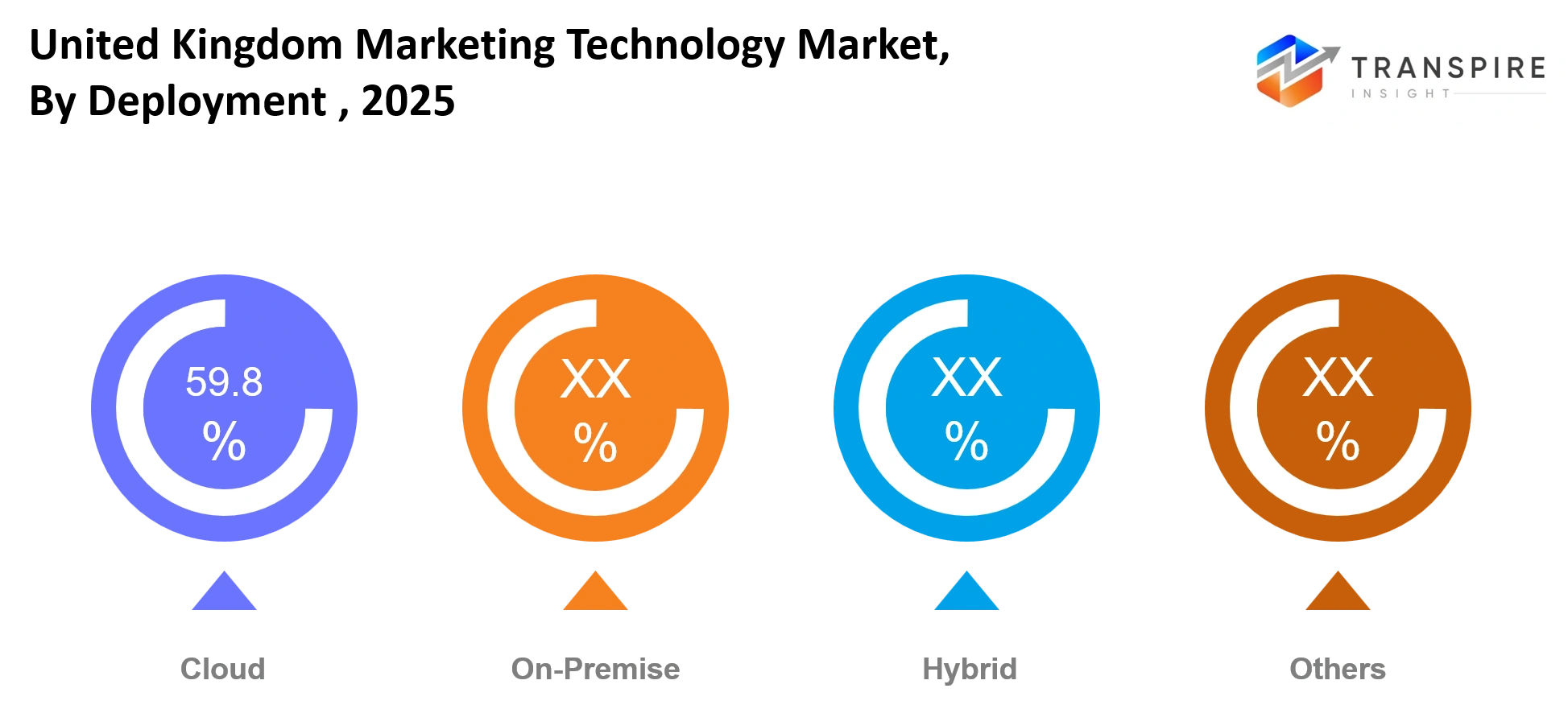
Cloud deployment is kinda leading the market, mainly due to scalable infrastructure, predictable subscription costs, and faster implementation support that fits enterprise digital transformation plans. In cloud environments you can push continuous software updates, link up more easily with customer data platforms ,and enable remote collaboration across far spread marketing teams. Also, the strong cybersecurity investments from cloud providers have raised enterprise confidence for cloud based marketing operations.
Hybrid deployment still pulls in organizations that are trying to balance regulatory obligations with operational flexibility, most noticeably in very regulated industries. Meanwhile, on-premise deployment stays relevant when strict data control and legacy infrastructure are still top business priorities, though the new investments have slowed. The Others category covers customized deployment approaches, meant for specialized operational needs and compliance requirements.
By Application :
Customer relationship management still feels like the big one, because centralized customer info helps with campaign targeting, aligning sales, and keeping customers longer term. When you add artificial intelligence integration , lead scoring gets more accurate, segmentation becomes more refined, and communication can be personalized across various digital channels. There’s also better data visibility, which basically lets teams decide faster, and improves how well marketing performance can be measured too.
Analytics is also growing really quickly, as organizations push for more detailed insight into customer behavior, how effective campaigns are, and where revenue actually traces back to. Content marketing, email marketing, and social media marketing keep expanding due to automation, personalization, and real-time optimization features. The Others segment is more like a mixed corner, it holds specialized applications that support emerging digital engagement ideas, and those sector specific marketing needs that don’t fit the usual molds.
By Enterprise Size :
Big companies typically show the highest adoption rate, because those complex customer journeys need advanced automation, connected analytics, and a marketing tech setup that can actually scale. Because of that , they usually have pretty hefty technology budgets, which helps fund artificial intelligence, customer data platforms, and broad digital transformation moves across the whole enterprise. Also, multi brand teams often get a cleaner win from centralized campaign orchestration, plus standardized performance dashboards, which makes reporting feel less chaotic.
Meanwhile, small and medium-sized enterprises keep ramping up spending too. A lot of it comes from cloud subscription models that quietly cut implementation costs and make platform administration easier. With more reasonably priced software bundles, smaller businesses can tap into automation and analytics features that, before, were mostly seen in larger organizations only. As for the Others group , it covers organizations with specialized operating frameworks, along with unusual deployment requirements, so their setups dont really match the main patterns.
By End User :
Retail still looks like the leading end user bit, mostly because personalized promotions, customer loyalty programs and that omnichannel engagement really do, in practice, move revenue generation forward. The whole digital commerce expansion thing has also pushed companies to put more money into customer analytics, campaign automation, and shopping experiences that feel more tailored. And being quicker at reacting to shifts in purchasing behavior, helps keep technology adoption going across most retail organizations, even when priorities change.
BFSI , healthcare, IT and telecom, and media are also continuing to scale up technology spending, with the aim of strengthening customer engagement, staying on top of regulatory compliance, and improving digital communication efficiency. Each one of those sectors gains from better customer insight, more automated marketing workflows, and campaign performance that’s easy to measure. The Others segment covers manufacturing, education, and other industries that are adopting advanced marketing technology solutions in a more active way.
By Channel :
Omnichannel leads channel adoption, because businesses need a somewhat consistent customer engagement, across web sites , mobile applications, social platforms email, and even physical locations. A more unified customer experience tends to boost conversion rates , while also locking in brand consistency and longer-term customer relationships. When channel management is integrated properly, it also makes campaign measurement less messy and improves operational efficiency, overall.
In the B2B world organizations keep putting money into account based marketing, lead nurturing, and sales alignment technologies, aiming for better commercial outcomes. Meanwhile B2C organizations tend to reinforce digital engagement using personalized messaging, artificial intelligence, and automated customer journeys across different touchpoints. The Others category basically covers specialized communication channels that are built for industry specific marketing goals.
What are the Key Use Cases Driving the United Kingdom Marketing Technology Market?
The biggest kind of use case kinda shows up in customer relationship management, and campaign automation. You’ll see retail chains, financial institutions, telecommunications providers, and big enterprises buy integrated platforms to handle customer data, tune personalized messaging, and track marketing results across a bunch of different channels. The real demand is driven by a push to boost customer retention while also trimming down campaign execution time, and lowering operational costs.
Then there’s content marketing mixed with predictive analytics, and it’s getting more traction in healthcare, media, and business to business organizations. Healthcare providers use these kinds of tools to send compliant patient communications, while media companies make audience targeting sharper, and they can improve ad performance by using real time insights. Business service providers, kind of similarly, reinforce lead generation with data powered campaign planning.
More emerging situations include generative AI for customized content creation, plus real time decision engines that tune customer interactions while people are moving through digital journeys. At the same time privacy-first marketing platforms centered on first party data are gaining interest, mainly because organizations are prepping for tighter data governance rules, and they expect less reliance on third-party tracking technologies during the forecast period.
|
Report Metrics |
Details |
|
Market size value in 2025 |
USD 4.84 Billion |
|
Market size value in 2026 |
USD 5.66 Billion |
|
Revenue forecast in 2033 |
USD 17.01 Billion |
|
Growth rate |
CAGR of 17.02% from 2026 to 2033 |
|
Base year |
2025 |
|
Historical data |
2021 - 2024 |
|
Forecast period |
2026 - 2033 |
|
Report coverage |
Revenue forecast, competitive landscape, growth factors, and trends |
|
Regional scope |
United Kingdom (England, Scotland, Wales, Northern Ireland) |
|
Key company profiled |
Salesforce, Adobe, HubSpot, Oracle, SAP, Microsoft, Google, IBM, Mailchimp, Braze, Zoho, Hootsuite, Sprinklr, ActiveCampaign, Klaviyo. |
|
Customization scope |
Free report customization (country, regional & segment scope). Avail customized purchase options to meet your exact research needs. |
|
Report Segmentation |
By Component (Software, Services, Platforms, Others); By Deployment (Cloud, On-Premise, Hybrid, Others); By Application (CRM, Content Marketing, Email Marketing, Social Media Marketing, Analytics, Others); By Enterprise Size (Large Enterprises, SMEs, Others); By End User (Retail, BFSI, Healthcare, IT & Telecom, Media, Others); By Channel (B2B, B2C, Omnichannel, Others). |
Which Regions are Driving the United Kingdom Marketing Technology Market Growth?
England stays in the dominant position, with an estimated 84% share of the market, and it’s backed by London and the South East, which really act like the country’s main digital business hubs. You can see favorable conditions for tech rollout thanks to solid data governance frameworks, cloud infrastructure that’s pretty advanced, and broad enterprise digital transformation efforts. Also global software vendors, consulting firms, cloud providers, and specialist implementation partners keep a strong presence across the region. That basically helps reinforce the commercial ecosystem. With ongoing investment in artificial intelligence, modernization of enterprise software, and improvements in digital commerce, the region should keep its leading role across the whole forecast period.
Scotland comes in next as the second-largest regional market. The reason is that financial services, healthcare, education, and public sector organizations keep making steady investments in digital modernization. In addition, relatively stable economic conditions along with more structured innovation programs push buyers toward long-term technology procurement, instead of those short term spending cycles. There’s also solid collaboration between universities, technology companies, and enterprise clients, which helps keep building, and then refining, digital marketing abilities. All of this creates a balanced investment setting, leading to dependable recurring revenue from software and professional services.
Scotland is also expected to show the most rapid rise through 2026–2033, as artificial intelligence take up, cloud migration, and regional digital innovation funding start to move faster and push enterprise spending. There has been a recent bloom in technology startups , plus ongoing public backing for digital transformation, so the demand feels steadier across financial services, healthcare, and software industries. With more uptake of customer data platforms and predictive analytics, new openings are forming for solution providers , and for implementation partners too. All of this momentum should translate into pretty appealing growth prospects for technology vendors, system integrators, and investors during the 2026–2033 stretch.
Who are the Key Players in the United Kingdom Marketing Technology Market and How Do They Compete?
Competition is kind of moderately consolidated because big global enterprise software companies share the space with specialist marketing technology providers and cloud-native platform vendors. In other words, the main fight is still over technology innovation, artificial intelligence capabilities, platform integration, and customer experience functionality, not just pricing alone. Meanwhile established vendors keep expanding their product portfolios, but newer providers roll out more specific automation, analytics, and personalization solutions, which better fit how enterprise requirements are shifting.
Salesforce differentiates by doing continuous investment in artificial intelligence across Marketing Cloud , so businesses can automate campaign management and customer engagement at scale. Adobe leans into integrated digital experience capabilities by bringing creative applications, analytics, and generative AI together in one unified platform. HubSpot basically competes with simplified deployment and user friendly automation tools, aiming at small and medium-sized businesses that want faster implementation and less operational complexity.
Microsoft boosts its competitive position by integrating Dynamics 365 with cloud infrastructure, productivity software, and artificial intelligence services that make enterprise adoption smoother. Oracle, on the other hand, strengthens customer data management via advanced analytics and unified customer profiles, which helps improve personalization across multiple communication channels. Overall strategic product enhancements, cloud partnerships, and ongoing investment in AI-enabled marketing capabilities help these firms widen commercial reach while still responding to the evolving digital transformation priorities in enterprises.
Company List
- Salesforce
- Adobe
- HubSpot
- Oracle
- SAP
- Microsoft
- IBM
- Mailchimp
- Braze
- Zoho
- Hootsuite
- Sprinklr
- ActiveCampaign
- Klaviyo
Recent Development News
In April 2026, Adobe expanded its partner ecosystem through new strategic collaborations with Amazon Web Services, Microsoft, Google Cloud, OpenAI, NVIDIA, Accenture, Deloitte Digital, TCS, and other technology partners. The initiative strengthened AI-powered customer experience orchestration and accelerated enterprise marketing transformation across markets including the United Kingdom.
Source: https://news.adobe.com/
In February 2026, WPP and Adobe expanded their global strategic partnership to integrate Adobe's agentic AI capabilities with WPP Open marketing services. The collaboration enables brands to automate content creation, improve customer experience orchestration, and scale AI-driven marketing operations for enterprise clients.
Source: https://news.adobe.com/
What Strategic Insights Define the Future of the United Kingdom Marketing Technology Market?
The market is going to drift toward those more intelligent connected marketing ecosystems, where artificial intelligence, first party data, and real time decision engines kind of work together through one unified cloud platform, not in separate apps, or at least not the same way. Over the next five to seven years, enterprise spending will mostly keep backing the shift through things like clearer measurable customer engagement, tougher data governance, and more integrated digital operations.
There is also a quieter danger, it comes from leaning too hard on a small set of cloud infrastructure and AI platform providers. That can, in practice, raise implementation costs, limit vendor flexibility, and add operational concentration risk.
At the same time, a new sort of upside is showing up: privacy enhancing technologies that make secure data collaboration possible without revealing sensitive customer information, especially in regulated areas like financial services and healthcare. Market participants should put emphasis on interoperable platforms, open integration standards, and responsible AI governance, so they can keep building long term competitiveness while also dialing down both technology and compliance risks.
United Kingdom Marketing Technology Market Report Segmentation
By Component
- Software
- Services
- Platforms
By Deployment
- Cloud
- On-Premise
- Hybrid
By Application
- CRM
- Content Marketing
- Email Marketing
- Social Media Marketing
- Analytics
By Enterprise Size
- Large Enterprises
- SMEs
By End User
- Retail
- BFSI
- Healthcare
- IT & Telecom
- Media
By Channel
- B2B
- B2C
- Omnichannel
Frequently Asked Questions
Find quick answers to common questions.
The expected United Kingdom Marketing Technology Market size for the market will be USD 17.01 Billion in 2033.
Key segments for the United Kingdom Marketing Technology Market are By Component (Software, Services, Platforms, Others); By Deployment (Cloud, On-Premise, Hybrid, Others); By Application (CRM, Content Marketing, Email Marketing, Social Media Marketing, Analytics, Others); By Enterprise Size (Large Enterprises, SMEs, Others); By End User (Retail, BFSI, Healthcare, IT & Telecom, Media, Others); By Channel (B2B, B2C, Omnichannel, Others).
Major United Kingdom Marketing Technology Market players are Salesforce, Adobe, HubSpot, Oracle, SAP, Microsoft, Google, IBM, Mailchimp, Braze, Zoho, Hootsuite, Sprinklr, ActiveCampaign, Klaviyo.
The United Kingdom Marketing Technology Market size is USD 4.84 Billion in 2025.
The United Kingdom Marketing Technology Market CAGR is 17.02% from 2026 to 2033.
- Salesforce
- Adobe
- HubSpot
- Oracle
- SAP
- Microsoft
- IBM
- Mailchimp
- Braze
- Zoho
- Hootsuite
- Sprinklr
- ActiveCampaign
- Klaviyo
About the Authors

Mayur Shinde
I am Mayur Shinde, a Senior Research Analyst at Transpire Insight, specializing in the Automotive & Transportation and Information & Communication Technology (ICT) Industry. My work focuses on analyzing emerging market trends, technological advancements, competitive landscapes, and industry developments to deliver accurate, data-driven insights. I am passionate about transforming complex market information into clear, actionable content that helps businesses, professionals, and decision-makers stay informed and make confident strategic decisions.

Chakradhar Khansole
Chakradhar serves as the Research Director at Transpire Insight, bringing over 8 years of experience in technology, innovation, and strategic market intelligence. He specializes in transforming complex market data into actionable business insights that enable organizations to make informed, growth-oriented decisions. Recognized for his strategic vision and analytical expertise, Chakradhar leads high-impact research initiatives, delivering comprehensive market assessments, competitive intelligence, and forward-looking industry analysis.
Recently Published Reports
-
Apr 2026
3D Optical Profiler Market
3D Optical Profiler Market Size, Share & Analysis Report By Type (Desktop 3D Optical Profiler, and Portable 3D Optical Profiler), By Technology (Confocal Technology, and White Light Interference), By End-Use Industry (Manufacturing, Research Institutions, Automotive, Aerospace and Defense, Medical Devices, and Other), and Geography (North America, Europe, Asia-Pacific, Middle East and Africa, South and Central America), 2021 - 2031
-
Apr 2026
Depth Sensor Market
Depth Sensor Market Size, Share & Analysis Report By Type (Infrared Depth Sensors, Time-of-Flight (ToF) Sensors, Stereo Vision Sensors, Structured Light Sensors, Ultrasonic Depth Sensors), By Application (Automotive, Robotics, Gaming, Consumer Electronics, Industrial Automation, Healthcare, Security & Surveillance, Others), By End Users (Automotive Manufacturers, Consumer Electronics Companies, Healthcare Providers, Industrial Companies, Security Agencies, Gaming Companies, Robotics Companies, Others), and Geography (North America, Europe, Asia-Pacific, Middle East and Africa, South and Central America), 2021 – 2031
-
Apr 2026
Digital Manufacturing Market
Digital Manufacturing Market Size, Share & Analysis Report By Component (Hardware, Software, and Services), By Technology (Robotics, 3D Printing, Internet of Things (IoT), and Others), By Application (Automotive and Transportation, Aerospace and Defense, Consumer Electronics, Industrial Machinery, and Others), By Process Type (Computer-Based Designing, Computer-Based Simulation, Computer 3D Visualization, Analytics, and Others), and Geography (North America, Europe, Asia-Pacific, Middle East and Africa, South and Central America), 2021 – 2031
-
Apr 2026
Digital Visa Services Market
Digital Visa Services Market Size, Share & Analysis Report By Type (Individual Travelers, Group Travelers), By Application (Tourism, Business Travel, Others), and Geography (North America, Europe, Asia-Pacific, Middle East and Africa, South and Central America), 2021 – 2031