

United Kingdom Furniture Fixtures and Equipment Market Size & Forecast:
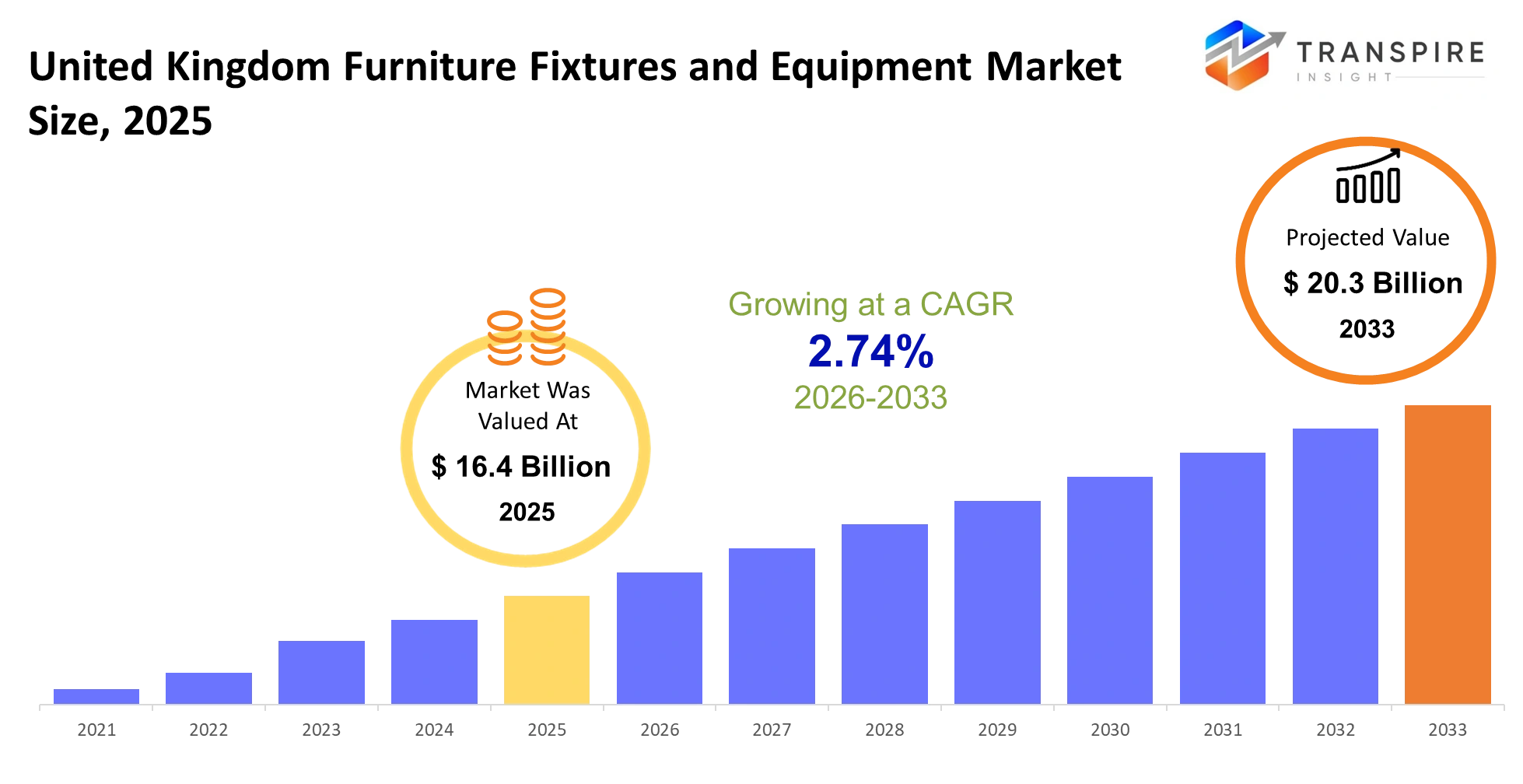
- United Kingdom Furniture Fixtures and Equipment Market Size 2025: USD 16.4 Billion
- United Kingdom Furniture Fixtures and Equipment Market Size 2033: USD 20.3 Billion
- United Kingdom Furniture Fixtures and Equipment Market CAGR: 2.74%
- United Kingdom Furniture Fixtures and Equipment Market Segments: By Product Type (Office Furniture, Hospitality Furniture, Retail Fixtures, Healthcare Furniture, Institutional Furniture, Storage Fixtures, Decorative Fixtures, Others); By Material (Wood Furniture, Metal Furniture, Plastic Furniture, Composite Furniture, Glass Fixtures, Others); By Application (Corporate Offices, Hotels, Restaurants, Hospitals, Retail Stores, Educational Institutions, Others); By End User (Commercial Sector, Residential Sector, Hospitality Sector, Healthcare Sector, Government Sector, Others); By Distribution Channel (Online Retail, Specialty Stores, Direct Sales, Wholesale Distribution, Others).
To learn more about this report,  Download Free Sample Report
United Kingdom Furniture Fixtures and Equipment Market Summary
The United Kingdom Furniture Fixtures and Equipment Market was valued at USD 16.4 Billion in 2025. It is forecast to reach USD 20.3 Billion by 2033. That is a CAGR of 2.74% over the period.
The United Kingdom furniture, fixtures, and equipment market plays a practical, almost quiet role in keeping commercial spaces working and usable, while also staying compliant, and able to pivot across sectors like hospitality, offices , healthcare, education, retail, and even marine infrastructure . Most businesses lean on FF&E procurement not just to “fill” a space, but to push day-to-day operational efficiency, help with employee retention, hit sustainability obligations, and refresh what customers see, without jumping into major structural redevelopment.
Over the last five years, the market has kind of drifted away from pure volume- driven purchasing and toward something more lifecycle minded, like buyers want more than just receipts. They're now prioritizing modular furniture, recyclable materials, and digitally tracked asset management systems as energy reporting expectations and ESG disclosure rules keep getting tighter across the UK. And Brexit related import disruptions, plus the steep rise in freight and raw material costs during the global supply chain crisis, left a lot of procurement teams scrambling a bit, not fully prepared, so they diversified suppliers, and leaned toward items that are locally produced.This shift sped up investment in domestic production capabilities and, in many cases shortened procurement cycles, not always in a clean straight line but enough to matter.
And as hybrid work models keep evolving, alongside hotel refurbishments and healthcare modernization efforts , suppliers that can offer flexible delivery, customization options, and sustainability compliance are capturing stronger contract numbers and building longer-term commercial relationships.
Key Market Insights
- England basically dominates the United Kingdom Furniture Fixtures and Equipment Market, holding almost 68% market share in 2025.
- This is mostly pushed by large-scale commercial and hospitality refurbishment actions, you know, the sort that really rework spaces.
- Office furniture stays in front as the leading product slice, with something like 34% of United Kingdom Furniture Fixtures and Equipment Market revenue in 2025.
- Lighting fixtures are next, since commercial buildings now prioritize energy-efficient LED retrofitting and a smoother smart lighting setup, all tied together.
- Modular and flexible workspace furniture is expected to grow the quickest from 2025 to 2030, supported by hybrid work transformation playbooks.
- For applications, commercial offices still dominate, taking roughly 38% share of the United Kingdom FF&E industry size, mainly from workspace optimization and employee retention measures.
- On the other hand, hospitality refurbishment looks like the fastest-moving application segment too, fueled by hotel renovation pipelines and those investments aimed at a more premium guest experience.
- When it comes to end-users, corporate enterprises remain the main group, with around 41% market share, largely backed by long-term workplace redesign programs across the UK. Healthcare infrastructure is also rising fast, as hospitals and care centers move toward ergonomic, infection-resistant furnishing updates.
- Sustainable procurement trends are also changing the United Kingdom Furniture Fixtures and Equipment Market, with recycled materials and low-carbon manufacturing being preferred in purchasing choices.
- Meanwhile smart fixtures, now being tied to IoT-enabled lighting, occupancy monitoring, and energy management systems, are opening up brand-new revenue possibilities in commercial projects, kind of across the board.
What are the Key Drivers, Restraints, and Opportunities in the United Kingdom Furniture Fixtures and Equipment Market?
The most powerful force driving the United Kingdom Furniture Fixtures and Equipment Market is really the rapid reshuffling of commercial workplaces, right after the hybrid work shift. Big companies in London, Manchester, and Birmingham have started to dial back those fixed desk setups and they are moving budget toward teamwork zones, modular furniture, sound reducing fixtures, and office systems that are digitally connected. This momentum really picked up once decision makers admitted that old style office spaces were quietly wearing down employee staying power , and also lowering how fully the floor gets used. so, more firms are steering larger refurbishment funds into flexible FF&E offerings, which help flexible occupancy formats , and that in turn boosts overall project worth plus pushes replacement cycles across the commercial space.
At the same time, volatile raw material pricing and import related costs stay the market’s toughest structural snag. The UK still relies a lot on imported timber, metal hardware, lighting solutions, and upholstery supplies, with sourcing often tied to Europe and Asia. Brexit customs steps, higher freight fees, and currency swings keep throwing off purchasing schedules and squeezing supplier margins. And it’s not something that can be smoothed out fast, because domestic production capacity for multiple specialized components stays thin. The outcome is delayed commercial fit-outs and renovation work getting pushed back, especially for mid sized hospitality venues and retail operators.
Healthcare infrastructure modernization is really a big long-term chance for wider market reach, and in a way it feels like it never stops growing. The NHS is doing facility upgrades, while private healthcare investments also keep moving forward, so there’s more demand for antimicrobial surface materials, ergonomic patient furniture and even energy efficient lighting systems. More and more, smart healthcare fixtures that are tied to occupancy monitoring and asset tracking technologies are gaining traction, because hospitals are aiming for operational efficiency plus better patient management.
What Has the Impact of Artificial Intelligence Been on the United Kingdom Furniture Fixtures and Equipment Market?
Artificial intelligence and advanced digital techs are kind of quietly changing the United Kingdom Furniture Fixtures and Equipment market, more or less, by lifting procurement precision, bolstering asset supervision, and making facility output better across commercial buildings , healthcare infrastructure and hospitality works . AI enabled building management platforms are now automating lighting command, occupancy tracking, workspace utilization analysis, and energy optimization inside big office and hotel environments. At the same time, commercial property operators are starting to weave in IoT connected fixtures and smart furniture systems into centralized control software, so they can cut operational waste and also make maintenance scheduling a little more disciplined.
Meanwhile, machine learning models are giving predictive maintenance more of a grip, across FF&E assets, in a way that’s pretty noticeable. Sensors that are tucked inside lighting systems , HVAC connected fixtures , and even ergonomics oriented workplace furniture can flag odd usage rhythms, component stress, or energy inefficiencies before anything really breaks down. Facility managers are leaning on predictive analytics to curb unexpected downtime, stretch furniture lifecycle value, and fine tune replacement schedules.In large commercial setups, digital asset monitoring platforms have reportedly helped shave maintenance response times by almost 20%, and at the same time improve energy efficiency across the managed properties.
Still, AI adoption in the UK FF&E sector hits a major wall because integration costs are high and the legacy infrastructure is fragmented. A lot of older commercial buildings do not have standardized digital systems, which makes it difficult to connect new AI driven platforms with existing facility management networks without a fairly heavy retrofit bill.
Key Market Trends
- Since 2021, UK corporate offices have started replacing their old fixed workstation setups with modular, kinda collaborative furniture arrangements, to better fit hybrid attendance patterns and also free up some of the unused floor space.
- Brexit customs delays sorta nudged a bunch of hospitality and retail operators toward UK-based suppliers, and it kind of shortened procurement lead-times by almost 15% since 2022, depending on the category.
- From 2022 through 2025, LED lighting retrofits picked up speed across commercial buildings mainly because energy costs rose pretty sharply across the United Kingdom.
- Healthcare projects also shifted more often toward antimicrobial surfaces and ergonomic patient furniture, after NHS modernization budgets expanded across regional facilities in 2023, almost like this cascade effect where one thing makes another thing happen.
- IKEA Business, Steelcase, and Senator Group expanded recyclable product lines as ESG-linked procurement requirements tightened among UK commercial property developers.
- Smart furniture with occupancy sensors, plus workspace analytics, has been picking up speed, kinda because employers wanted data driven ways to see how offices are really being used after the pandemic, you know, in a way that is more measurable than before.
- Back in 2023, premium hotel renovations in London and Edinburgh started leaning harder into custom FF&E packages, it was meant to help guest retention and also keep premium pricing, without it feeling overly pitchy or salesy.
- Meanwhile, manufacturers have been putting more effort into digital asset tracking systems, and that apparently cut maintenance response times, while also making lifecycle planning smoother for commercial operators.
- Educational institutions, on the other hand, ramped up the use of flexible classroom furniture between 2022 and 2025, since blended learning models shifted how campuses think about their infrastructure.
- More recently, the competitive edge is moving away from only product pricing, and toward swifter installation capability, sustainability certification, and longer term maintenance service agreements across a larger slice of the wider UK market.
United Kingdom Furniture Fixtures and Equipment Market Segmentation
By Product Type :
Office furniture keeps a pretty strong position in the United Kingdom Furniture Fixtures and Equipment Market, mostly because firms are still redesigning their workplaces in a kind of messy reality-driven way, to back flexible seating, cooperative zones, and general employee comfort. People keep asking for ergonomic chairs, modular desks, and movable partitions across a lot of commercial sites. In the near future businesses will keep putting money into adaptable furniture layouts that help people work long hours and support smart space planning, even when layouts change often.
At the same time, hospitality furniture and retail fixtures stay steady, mainly from hotel refurbishments and also from the way stores keep shifting how they present their spaces. Hotels lean into premium interior designs, and durable furnishing materials, to make the guest experience feel smoother and more “handled”. Retailers, meanwhile, are investing in modern display systems and customized shelving, so products can be arranged with more polish.
By Material :
Wood furniture still pulls in commercial and residential buyers, because natural finishes and that long lasting quality just feels right, across offices, hotels, and classrooms too. A lot of engineered wood products help with cost control for big purchasing cycles, like when someone is buying at scale. Also certified wood materials are getting more attention, since companies are trying to meet environmental compliance , and they’re more serious about responsible and sustainable sourcing rules.
On the other hand, metal furniture and composite furniture keep gaining favor, mainly for their durability and lighter weight builds, which fits modern office floorplans and commercial setups. Plastic furniture still works pretty well in healthcare, educational settings, and outdoor use where the upkeep burden is usually lower. And glass fixtures keep showing up in premium offices , retail stores, and hospitality buildings, because many businesses like that open visual presentation , plus a cleaner modern interior vibe.
By Application :
Corporate offices are one major application area, as organizations redesign interiors a bit to boost employee productivity, and also add that workplace flexibility vibe. You’ll see open seating arrangements, meeting pods, and those cooperative workstations still gradually replacing the older office layouts. Companies keep investing in advanced furniture systems that can adjust with shifting occupancy patterns and also help with the efficient use of commercial floor space.
Hotels plus restaurants keep up strong purchasing activity, because the customer experience really ties into interior appearance, comfort standards, and even those overall first impressions that show up right away. Hospitals instead are more centered on hygienic, and ergonomic furniture solutions, designed to back patient care ,while also keeping operational efficiency on track, pretty consistently. Educational institutions are buying flexible classroom furniture and modular seating more and more, which helps with blended learning approaches, and also with whatever changes are unfolding in classroom demands.
To learn more about this report, Download Free Sample Report
By End User :
In the commercial sector this market remains a leading end user, because offices, retail chains, and mixed-use developments regularly refresh interiors to stay aligned with operational standards and current workplace environments. Businesses keep reserving budgets for furniture replacement cycles, smart fixtures and customized installations that can strengthen long-term property value.
And, yes, the hospitality sector as well as the healthcare sector also drive fairly stable purchasing activity across the United Kingdom Furniture Fixtures and Equipment Market. Hotels tend to choose premium furnishings in order to improve guest retention, while healthcare facilities need specialized furniture for patient safety, and infection control. Meanwhile government sector demand often ties back to public infrastructure projects, educational facilities, and administrative office modernization programs.
By Distribution Channel :
Online retail keeps expanding, like fairly consistently, as companies and institutional buyers compare product specs, check costs, and line up delivery timelines using digital procurement platforms. E-commerce channels let suppliers reach more customer groups, plus they boost order management efficiency, you know. Digital visualization tools, and even virtual product catalogs, also make it easier for buyers to decide especially during large commercial projects
At the same time, specialty stores and direct sales are still kind of key. Commercial buyers usually need some level of customization, installation support, and consultative project guidance. Wholesale distribution stays important too, because offices, hotels, hospitals, and schools often buy in bigger volumes, so bulk procurement is still normal. And over the long run, supplier partnerships and direct manufacturer ties will keep shaping procurement strategies across the whole market.
What are the Key Use Cases Driving the United Kingdom Furniture Fixtures and Equipment Market?
Corporate office refurbishment still feels like the main reason people are adopting new systems, across most of the United Kingdom Furniture Fixtures and Equipment Market. Big employers keep redesigning their office interiors, using modular desks, ergonomic seating, sound dampening partitions, and shared collaboration rooms, all to back up hybrid work policies and get more from the same floor space.
At the same time, hospitality and healthcare are starting to catch up, not just casually but in a real way. Hotels are updating guest-facing areas, while hospitals are upgrading care settings. Premium hotel brands are putting more money into tailored furnishings plus energy efficient lighting systems, and healthcare teams are choosing antimicrobial furniture and sturdy fixtures that actually satisfy tight hygiene requirements as well as safety standards.
There are also newer use cases showing up, like smart learning environments and tech enabled co-working setups. Universities and training centers are experimenting with fluid classroom arrangements, using movable furniture systems, and co-working operators are folding in occupancy sensors along with digitally managed fixtures, so they can better apportion space and cut down operational inefficiencies during the forecast period.
|
Report Metrics |
Details |
|
Market size value in 2025 |
USD 16.4 Billion |
|
Market size value in 2026 |
USD 16.8 Billion |
|
Revenue forecast in 2033 |
USD 20.3 Billion |
|
Growth rate |
CAGR of 2.74% from 2026 to 2033 |
|
Base year |
2025 |
|
Historical data |
2021 - 2024 |
|
Forecast period |
2026 - 2033 |
|
Report coverage |
Revenue forecast, competitive landscape, growth factors, and trends |
|
Regional scope |
Middle East and Africa (Saudi Arabia, United Arab Emirates, South Africa, Rest of Middle East and Africa) |
|
Key company profiled |
IKEA, Steelcase, Herman Miller, Haworth, HNI Corporation, Kimball International, Ashley Furniture, Godrej Interio, Okamura Corporation, Humanscale, Knoll, Teknion, Kinnarps, Nilkamal, Vitra. |
|
Customization scope |
Free report customization (country, regional & segment scope). Avail customized purchase options to meet your exact research needs. |
|
Report Segmentation |
By Product Type (Office Furniture, Hospitality Furniture, Retail Fixtures, Healthcare Furniture, Institutional Furniture, Storage Fixtures, Decorative Fixtures, Others); By Material (Wood Furniture, Metal Furniture, Plastic Furniture, Composite Furniture, Glass Fixtures, Others); By Application (Corporate Offices, Hotels, Restaurants, Hospitals, Retail Stores, Educational Institutions, Others); By End User (Commercial Sector, Residential Sector, Hospitality Sector, Healthcare Sector, Government Sector, Others); By Distribution Channel (Online Retail, Specialty Stores, Direct Sales, Wholesale Distribution, Others). |
Which Regions are Driving the United Kingdom Furniture Fixtures and Equipment Market Growth?
England is still kinda the main region in the United Kingdom Furniture Fixtures and Equipment Market, so, the country has a big cluster of commercial offices, hospitality projects, and mixed use developments that basically runs through London, Manchester, and Birmingham. There is continuous investment in the modernization of workspaces, also in premium hotel refurbishments, and it keeps the high-value purchasing active.Corporate headquarters, international hotel chains, and major retail groups keep up fairly steady replacement cycles for office systems, lighting fixtures, and tailored interior solutions. There’s also a mature supplier network, pretty capable logistics infrastructure, and easier access to design consultancies, and all of that together reinforces England’s leadership across the whole market.
Scotland, on the other hand, behaves a bit more like a steady and dependable contributor to market revenue, but the growth track doesn’t quite line up with England’s faster, more commercial style of expansion. In Scotland, demand is often tied to tourism infrastructure, public-sector renovation tasks, and improvements for educational facilities . Hotels, universities, and regional commercial developments keep channeling money into robust energy-efficient furniture systems that can really last for years once they’re out in the world.Plus government-backed infrastructure spending stays consistent, and construction activity remains stable, so procurement demand is more predictable even when the broader economy starts wobbling.
Wales seems to be coming up as the fastest growing regional market, mostly because there is more investment in healthcare infrastructure, plus some urban redevelopment stuff and those more sustainable public buildings. A lot of local authorities and developers are, bit by bit, putting more emphasis on low-carbon construction materials, recyclable furnishings, and energy efficient lighting systems for new projects. On top of that, the regional regeneration programs that started after 2022 have helped push commercial property upgrades, and also education facility modernization across several urban centers. Because of this the market is basically opening up real chances for suppliers with modular furniture, localized manufacturing, and sustainability leaning product portfolios, somewhere between 2026 and 2033.
Who are the Key Players in the United Kingdom Furniture Fixtures and Equipment Market and How Do They Compete?
Competition in the United Kingdom Furniture Fixtures and Equipment Market still looks moderately fragmented, because global manufacturers push in the same space as local suppliers, design specialists and project- based contractors. Bigger firms keep trying to defend their position by leaning on integrated service models , where they bundle product supply with workplace design, installation, and ongoing maintenance support. In other words competitive pressure isn’t only about pricing anymore, buyers in the commercial side often judge vendors by delivery speed, sustainability compliance, customization ability, plus digital asset management support. Newer players are getting more notice in narrower areas like modular workspace systems and smart fixtures, though the established providers still land the bulk of commercial and hospitality contracts thanks to long standing procurement links.
Steelcase, for its part, puts a lot of attention into workplace transformation projects that fit hybrid office environments and more flexible collaborative seating layouts. It differentiates through research driven ergonomic products along with technology integrated office systems, so employers can better track how workspace gets used. Steelcase continues expanding in the UK commercial market via partnerships with architects, workplace consultants , and corporate property developers who are involved in major refurbishment work.
MillerKnoll kind of competes via premium interior design integration, plus high end furniture collections that are mainly aimed at commercial offices and hospitality spaces. The company has this real strong brand recognition going on, and design focused customization capabilities, which tends to attract multinational clients, who like getting things tailored. Senator Group on the other hand really leans into its UK based manufacturing operations, so delivery delays get reduced and project flexibility improves especially after the whole Brexit related supply disruptions. Meanwhile IKEA Business targets cost-conscious commercial buyers , by providing scalable furnishing packages, online procurement tools , and fast fulfillment services. Their focus is on offices, educational institutions and co working operators, so there’s a kind of broad but still pretty specific match.
Company List
- IKEA
- Steelcase
- Herman Miller
- Haworth
- HNI Corporation
- Kimball International
- Ashley Furniture
- Godrej Interio
- Okamura Corporation
- Humanscale
- Knoll
- Teknion
- Kinnarps
- Nilkamal
- Vitra
Recent Development News
In February 2026, SUNPAN entered a strategic distribution partnership with Libra Interiors to expand into the United Kingdom market. The agreement gives Libra exclusive rights to distribute SUNPAN’s furniture collections across UK retail and hospitality channels, strengthening premium furniture availability and international supplier participation in the UK FF&E market.
Source: https://sunpan.com/
In August 2025, Wincanton entered a three-year fulfilment partnership with Futon Company. Under the agreement, Wincanton will manage warehousing and distribution operations for Futon Company, improving supply-chain efficiency and strengthening omnichannel furniture retail fulfilment capabilities across the UK market.
Source: https://www.wincanton.co.uk/
What Strategic Insights Define the Future of the United Kingdom Furniture Fixtures and Equipment Market?
The United Kingdom Furniture Fixtures and Equipment Market is gradually shifting, kind of like, toward digitally run, modular, and sustainability-linked procurement structures over the next five to seven years. This change is mostly pushed by tighter carbon reporting needs, the ongoing hybrid workplace reorganization, and an extra layer of pressure on commercial property owners to boost day to day operational efficiency without really enlarging real estate footprints. Suppliers that bring smart asset monitoring to the table, plus fast installation abilities, and recyclable material procurement will likely get stronger, long haul contract access across offices, healthcare settings, and hospitality undertakings.
There’s also a less obvious risk, sitting in the background, around supply concentration for specialized imported materials and lighting components. If the market stays reliant on overseas sourcing, it could become vulnerable to future tariff swings, transport disruptions, and raw material scarcities which in turn may compress project margins and slow down refurbishment rotations. Still, alongside that, adaptive educational infrastructure is becoming a real opportunity, since universities and training centers are steadily funding flexible learning spaces that rely on modular, technology enabled furnishings. Market players should really lean into regional manufacturing partnerships and more unified digital service platforms, so procurement resilience improves, and so recurring commercial revenue stays healthier over time.
United Kingdom Furniture Fixtures and Equipment Market Report Segmentation
By Product Type
- Office Furniture
- Hospitality Furniture
- Retail Fixtures
- Healthcare Furniture
- Institutional Furniture
- Storage Fixtures
- Decorative Fixtures
By Material
- Wood Furniture
- Metal Furniture
- Plastic Furniture
- Composite Furniture
- Glass Fixtures
By Application
- Corporate Offices
- Hotels
- Restaurants
- Hospitals
- Retail Stores
- Educational Institutions
By End User
- Commercial Sector
- Residential Sector
- Hospitality Sector
- Healthcare Sector
- Government Sector
By Distribution Channel
- Online Retail
- Specialty Stores
- Direct Sales
- Wholesale Distribution
Frequently Asked Questions
Find quick answers to common questions.
The United Kingdom Furniture Fixtures and Equipment Market size is USD 20.3 Billion in 2033.
Key segments for the United Kingdom Furniture Fixtures and Equipment Market are By Product Type (Office Furniture, Hospitality Furniture, Retail Fixtures, Healthcare Furniture, Institutional Furniture, Storage Fixtures, Decorative Fixtures, Others); By Material (Wood Furniture, Metal Furniture, Plastic Furniture, Composite Furniture, Glass Fixtures, Others); By Application (Corporate Offices, Hotels, Restaurants, Hospitals, Retail Stores, Educational Institutions, Others); By End User (Commercial Sector, Residential Sector, Hospitality Sector, Healthcare Sector, Government Sector, Others); By Distribution Channel (Online Retail, Specialty Stores, Direct Sales, Wholesale Distribution, Others).
Major United Kingdom Furniture Fixtures and Equipment Market players are IKEA, Steelcase, Herman Miller, Haworth, HNI Corporation, Kimball International, Ashley Furniture, Godrej Interio, Okamura Corporation, Humanscale, Knoll, Teknion, Kinnarps, Nilkamal, Vitra.
The United Kingdom Furniture Fixtures and Equipment Market size is USD 16.4 Billion in 2025.
The United Kingdom Furniture Fixtures and Equipment Market CAGR is 2.74% from 2026 to 2033.
- IKEA
- Steelcase
- Herman Miller
- Haworth
- HNI Corporation
- Kimball International
- Ashley Furniture
- Godrej Interio
- Okamura Corporation
- Humanscale
- Knoll
- Teknion
- Kinnarps
- Nilkamal
- Vitra
About the Authors

Chetan Dhatrak
I’m Chetan Dhatrak, a Senior Research Analyst at Transpire Insight, specializing in the Consumer Goods, Foods and Beverages industry. I focus on analyzing market trends, consumer behavior, competitive landscapes, and industry developments to deliver accurate, data-driven insights. My research at Transpire Insight is built on credible sources and in-depth analysis, helping businesses and readers better understand market dynamics, emerging opportunities, and evolving consumer preferences. I’m committed to creating reliable, well-researched content that supports informed decision-making and reflects the latest developments in the consumer goods and food & beverage sectors.

Chakradhar Khansole
Chakradhar serves as the Research Director at Transpire Insight, bringing over 8 years of experience in technology, innovation, and strategic market intelligence. He specializes in transforming complex market data into actionable business insights that enable organizations to make informed, growth-oriented decisions. Recognized for his strategic vision and analytical expertise, Chakradhar leads high-impact research initiatives, delivering comprehensive market assessments, competitive intelligence, and forward-looking industry analysis.
Recently Published Reports
-
Apr 2026
Bottled Water Market
Bottled Water Market Size, Share & Analysis Report By Product Type (Still Bottled Water, Carbonated Bottled Water, Functional Bottled Water, and Others), By Packaging (PET, Cans, and Others), By Sales Channel (Supermarkets/Hypermarkets, Convenience Stores/Drug Stores, Grocery Stores/Club Stores, Foodservice, and Others) and Geography (North America, Europe, Asia-Pacific, Middle East and Africa, South and Central America), 2021 - 2032
-
Apr 2026
Color Cosmetic Packaging Market
Color Cosmetic Packaging Market Size, Share & Analysis Report By Application (Mascara Packaging, Liquid Packaging, and Liquid Face), By Type (Tubes & Bottles, Pens & Markers, Compacts & Containers, and Droppers & Pumps), and Geography (North America, Europe, Asia-Pacific, Middle East and Africa, South and Central America), 2021 - 2031
-
Apr 2026
External Microphone For Camera Market
External Microphone For Camera Market Size, Share & Analysis Report By Type (Shotgun Microphone, Lavalier Microphone, and Others), By Application (Digital Camera, Professional Video Camera, and Others), and Geography (North America, Europe, Asia-Pacific, Middle East and Africa, South and Central America), 2021 - 2031
-
Apr 2026
Foot Orthotic Insoles Market
Foot Orthotic Insoles Market Size, Share & Analysis Report By Type (Pre-fabricated, and Custom-made), By Material (Thermoplastic, Composite Carbon Fiber, and Others), By Distribution Channel (Drug Stores, Hospitals & Clinics, and Others), and Geography (North America, Europe, Asia-Pacific, Middle East and Africa, South and Central America), 2021 - 2031