

United Kingdom Ethnic Food Market Summary
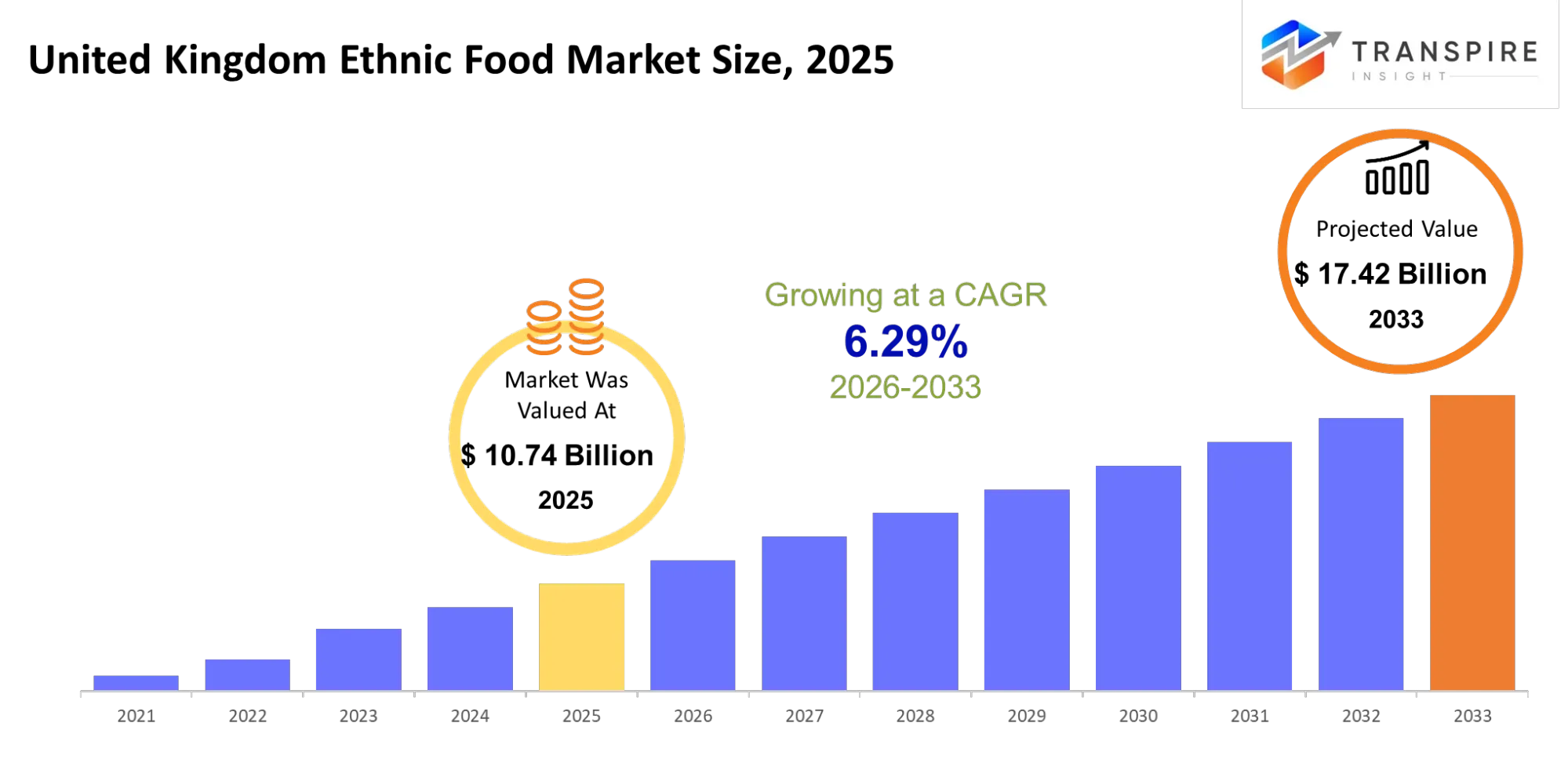
As per Transpire Insight Analysis the United Kingdom Ethnic Food Market size is estimated at USD 10.74 Billion in 2025 and is anticipated to reach USD 17.42 Billion by 2033, growing at a CAGR of 6.29% from 2026 to 2033.
The United Kingdom ethnic food market kind of helps retailers, foodservice operators, and manufacturers make it easier to get culturally familiar ingredients, ready meals, snacks, sauces, and beverages in front of a diverse set of consumers, while also nudging international flavors into more general mainstream food channels. Over the past 3–5 years things have moved, more or less, from those specialist ethnic stores toward broader supermarket lines, online grocery platforms, and mainstream product collections. Brexit created a structural shake up in sourcing, customs, and supplier ties. Then COVID-19 surfaced some real weak spots in imported food supply chains, and a lot of UK food and drink businesses said they saw pretty serious supply-chain disruption. That basically encouraged firms to diversify suppliers, and lean more on UK suppliers. With those shifts going on, distributors and manufacturers have usually boosted local inventory, widened their sourcing networks, and tweaked their product mix. At the same time mainstream retail take up keeps rising, so product access is expanding beyond just specialist communities, which supports faster product turnover, and it also makes room for private label, premium, and convenience minded ethnic food items.
United Kingdom Ethnic Food Market Size & Forecast:
- United Kingdom Ethnic Food Market Size 2025: USD 10.74 Billion
- Expected Market Value 2033: USD 17.42 Billion
- Forecast CAGR: 6.29%
- Leading region in 2025: England
- Fastest Growing region: Scotland
- Key Profile: Nestlé, Unilever, General Mills, McCormick & Company, Patak's, Sharwood's, Blue Dragon, Old El Paso, Amoy, Santa Maria, East End Foods, TRS Foods, Rajah Spices, Kohinoor Foods, Thai Taste
Key Market Insights
- England is basically in the lead with around 70% market share in 2024, helped by London, West Midlands, North West retail density and also multicultural consumer clusters , sort of all working together.
- Wales plus Northern Ireland come in at about 21% together , and Wales looks like the quicker-moving regional market through 2032, rather than just steady growth.
- Asian cuisine is still the top category, grabbing roughly 45% share in 2024, and it’s tied to long-standing Indian, Chinese, Thai and Japanese consumption habits.
- Middle Eastern and Mediterranean food sits near 25% share, it’s gaining shelf space as retailers diversify beyond the “usual” Asian lineups.
- Ready-to-eat meals and snack packs stay among the leading product segments, because time-pressed households keep shifting toward easy, convenient authentic meal formats.
- Packaged and frozen products are the next biggest grouping , and as freezing technology improves flavour retention , it also boosts supermarket reach.
- Online retail keeps being the fastest-growing channel through 2030, with global ethnic-food e-commerce projected to rise at roughly 9.2% per year.
- Mainstream supermarkets are still the main engine for applications and distribution, with supermarkets holding about 52% of ethnic-food sales in 2025 in at least one industry estimate.
- Online grocery is the quickest application area, since digital assortment covers limited shelf capacity and makes access to niche imported products easier.
What are the Key Drivers, Restraints, and Opportunities in the United Kingdom Ethnic Food Market?
The most powerful driver is mainstream retail integration. Supermarkets have expanded their ethnic aisles, private label ranges and ready meal formats, which seems to shrink the distance between specialist products and normal everyday grocery shopping. That helps widen distribution, boosts product visibility, and also grows the number of purchase occasions. Sainsbury’s 2025 launch of more than 50 Discovery products , including Modern Indian ready meals, basically shows how premium global flavours are sliding into mainstream portfolios now. Online grocery then adds a different route, because it makes niche products available beyond those physical shelf constraints. The outcome is broader household penetration, plus stronger revenue potential for manufacturers that can deliver steady quality, convenience, and an authentic flavour profile.
The main restraint is supply-chain concentration. Imported spices, rice, sauces and other specialty ingredients lean heavily on international suppliers, and complex border processes. The UK is still very import dependent, with food , feed and drink imports hitting £67.8 billion in 2025. The EU supplied 64% of UK food-import volume in 2023, while India and Pakistan keep being key rice suppliers. From a Transpire Insight review that looks at regional procurement announcements and launch timing, supply chain concentration stays the biggest execution risk. If there are disruptions, launches can get delayed , landed costs can climb, and retailer availability may end up looking weaker overall.
The clearest opportunity is AI enabled assortment and restocking, not just a vague idea. Retailers can blend loyalty, search and on hand inventory info to forecast demand for specific cuisines, pack sizes and regional items. Ocado’s AI systems already produce more than 70 million supply chain forecasts each day, and they automate replenishment suggestions too. If similar tools are used across ethnic grocery, it can cut down on overstock, raise in shelf availability, and surface overlooked regional demand. All of that gives a pretty workable path to expand long-tail products without increasing inventory risk in the same proportion.
What Has the Impact of Artificial Intelligence Been on the United Kingdom Ethnic Food Market?
AI plus digital tech is kind of reshaping the way ethnic food retailers forecast, replenish, and merchandise products, day to day. Instead of guessing or using only one data source retailers can link point-of-sale, loyalty sign ups, online-search activity and inventory records so they can watch how each SKU really performs and then auto-choose replenishment moves. This helps a lot with imported lines, since the lead times can swing around and the shelf life feels shorter. Ocado’s Smart Platform is often cited as the example at large scale, it uses AI across the supply-chain forecasting, fulfilment, and even last-mile operations. Their systems run over 70 million supply-chain calculations every single day, and they also back automated purchase-order suggestions, based on those outputs.
Then there’s machine learning, which also sharpens demand forecasting by picking up seasonal patterns, promo effects, local or regional tastes, and even basket combinations shoppers tend to form. Ocado says their forecasting models can be as much as 40% more accurate than more traditional retail approaches, and AI-based stock balancing can lower food waste while also keeping items available for customers. For ethnic grocery stores, the practical result is clearer: better forecasts reduce stockouts for imported staples, but they also prevent too much excess inventory building up. Beyond that AI can assist with personalized recommendations, kind of helping retailers introduce newer or emerging cuisines to shoppers, based on what people actually buy and how they browse.
The big snag, though, is integration cost. Smaller ethnic wholesalers frequently run fragmented systems, and they may not have enough historical data to support reliable machine-learning models. The UK Food Standards Agency also points out that the evidence on how well this kind of AI scaling works across smaller food businesses is still limited, so it’s not fully proven in every setting.
Key Market Trends
- Since 2021, supermarkets have broadened ethnic ranges, pushing global cuisine items out of those specialist aisles into mainstream meal sections and the premium line up.
- In 2025, Sainsbury’s rolled out 50-plus Discovery products, including Modern Indian ready meals, and that really boosts premium ethnic options inside everyday grocery.
- Since Brexit, import sourcing has got more complicated, and EU food-import volumes are recovering, after the 2021 disruption that hit pretty hard.
- In 2025, UK food feed and drink imports reached £67.8 billion. So, yeah, international sourcing stays a major deal for ethnic products.
- Online grocery keeps expanding this long-tail assortment, which gives smaller ethnic brands a route to shoppers beyond the usual physical supermarket shelf limits.
- In 2025, Premier Foods launched Sharwood’s Dragon Kick Sauce, using a limited edition partnership approach to land Pan-Asian cooking moments.
- Premier Foods also introduced Sharwood’s curry kits. This is in response to convenience-led cooking trends , and it simplifies the prep of authentic Indian flavours at home.
- AB World Foods acquired Capsicana in 2024, and that strengthens its Latin American range a bit more, with tortillas , pastes, kits, and seasoning mixes.
- Then in 2025 they added something like 30% post-consumer recycled content into some selected PET bottles , and that cut virgin plastic use by more than 200 tonnes.
- Also the AI adoption part seems to be moving away from little experiments into actual operations , with Ocado using machine learning for forecasting, replenishment, fulfilment, and inventory optimisation.
United Kingdom Ethnic Food Market Segmentation
By Cuisine Type :
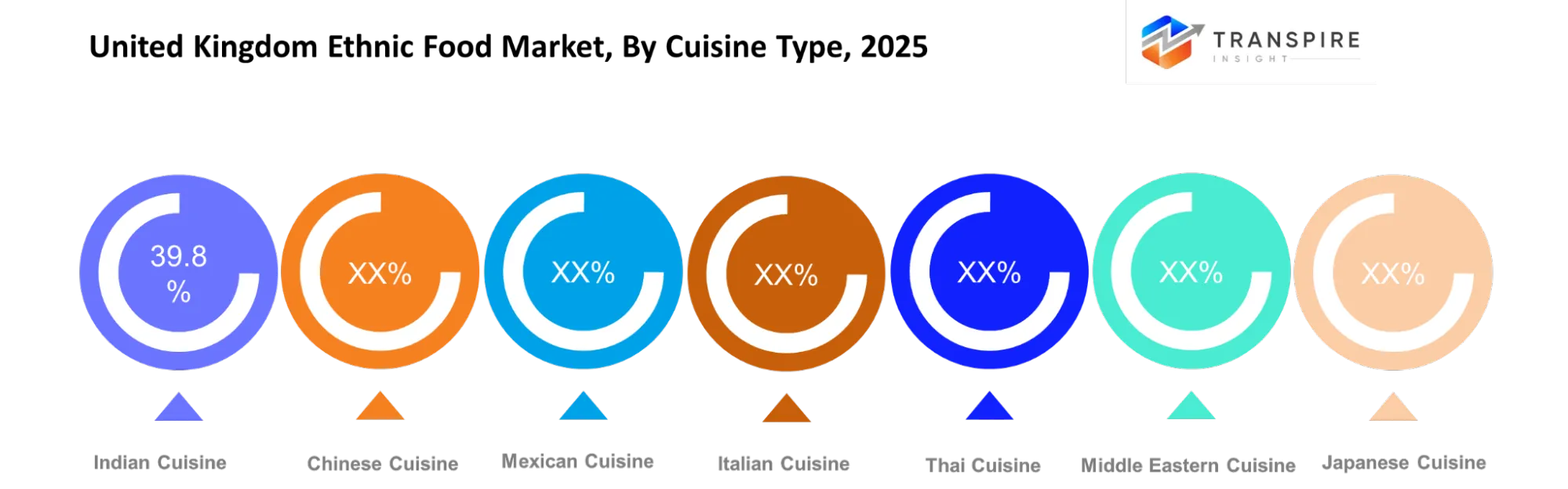
Indian Cuisine has a solid spot everywhere really, like in supermarkets, niche stores, diners, and even takeaway outlets. Indian sauces, spices, ready meals, breads, and frozen goods help with everyday household shopping, plus they bring good volume into foodservice. Chinese Cuisine is pretty widely spread now, mostly through ready meals, sauces, noodles, and frozen foods. Mexican Cuisine has gained more shelf space thanks to cooking kits, tortillas, salsa, and those seasoning items as well, and Italian Cuisine is aided by the typical pasta, sauces, bakery lines, plus wider meal selections too.
Thai Cuisine, Middle Eastern Cuisine, and Japanese Cuisine keep moving forward too, usually via premium products, restaurant menus, and easier meal formats. Middle Eastern products do well because hummus, flatbreads, spices, and prepared dishes are now more available, in lots of places. Japanese products get a boost from sushi, noodles, sauces, and snack categories across both retail and foodservice, if you look at it closely. Then there are the others—African, Caribbean, Korean, Mediterranean, and Southeast Asian cuisines—where specialty products often get even more retail visibility.
By Product Type :
Ready Meals still hold a pretty strong position as retailers expand convenient, almost everywhere meal options for busy households, day after day. Sauces & Pastes as well as Seasonings & Spices stay important categories, because home cooks can put together familiar dishes, even with limited prep time, and maybe a little less patience. Frozen Foods also help the distribution side, by stretching shelf life and cutting down on wastage during storage and transport, which everyone cares about.
Meanwhile, Snacks, Bakery Products, and Instant Meals keep adding shelf space thanks to product launches that focus on convenience. Instant Meals score because they’re ready in a rush and come with a wide range of cuisines to try, while snacks give shoppers a chance to taste unfamiliar flavors through smaller purchase formats. “Others” covers cooking ingredients and specialty products, so retailers and food manufacturers can meet more niche culinary requirements across different consumer groups, sometimes even the ones you don’t notice at first.
By Distribution Channel :
Supermarkets & Hypermarkets stay kind of crucial sales channels because broad store networks basically give a lot of shelf space for established as well as newer ethnic products. Online Retail keeps expanding product access , since it lets smaller brands and specialist suppliers get to consumers without needing huge physical distribution. Convenience Stores back impulse purchasing with things like snacks , sauces, instant meals , and ready to eat products
Specialty Food Stores still matter for authentic ingredients and items that need deeper product knowledge. Wholesale Suppliers and Foodservice Distributors help restaurants, hotels , caterers and institutional buyers with bulk purchasing and regular delivery routines. Direct Sales and Others cover more niche commercial needs, while better digital ordering systems will help suppliers handle stock , manage orders, and keep customer relationships a bit more efficient.
By End User :
Retail Consumers are a big end user group really, mostly through household buys of ready meals, spices, sauces, snacks, frozen foods, and cooking ingredients. Restaurants stay important too , since their menus are diverse and they need steady supplies of authentic ingredients, seasonings, sauces, and prepared items. Hotels and Catering Services also bring along fairly constant procurement needs, especially for large scale food preparation, you know
Institutional Buyers purchase ethnic food products for a bunch of catering needs, across offices and workplaces, schools, health care settings and public facilities. Food Manufacturers then rely on ingredients, sauces, spices, and prepared components for packaged food production. Quick Service Restaurants help drive demand by using standardized recipes and convenient prep formats. Others includes specialist food operators and commercial kitchens that focus on certain cuisine categories, rather than everything at once
By Packaging Type :
Pouches and Bottles stay pretty widely used for sauces, pastes, seasonings and liquid food products, mainly because light weight packaging helps with storage and overall transport efficiency. Glass Jars still back premium sauces, pickles pastes and specialty items, where you can actually see the product and shelf presentation kinda nudges people toward buying. Trays help with ready meals and prepared foods too , offering practical portion formats for chilled as well as ambient retail.
Frozen Packs stay important for frozen foods, snacks, and prepared products that need temperature controlled distribution. Cans support longer shelf life for certain ingredients, meals and specialty products, while Cartons offer practical packaging for dry foods, bakery goods, and instant meals. Others cover flexible and specialist formats, and packaging development is getting more and more focused on convenience, storage efficiency, material reduction and recyclable structures .
What are the Key Use Cases Driving the United Kingdom Ethnic Food Market?
Ready meals and packaged cooking products still stay a core thing in mainstream grocery retail. Retail shoppers, convenience first households, and supermarket buyers all keep supporting that demand, since prepared formats cut cooking time while still giving familiar international flavours, more or less. Food makers also lean on known ethnic recipes to build convenient meal ranges for wider retail distribution, you know.
Restaurants and quick service restaurants are also ramping up use, mainly by relying on standardized sauces, seasonings, frozen ingredients, and pre-built components. Catering outfits and institutional buyers buy in bulk too, for steadier menu preparation, better cost control, and easier daily kitchen operations. Online retail then adds another route, by making it simpler to reach specialist products and by widening the range of cuisines available overall.
Some newer uses are starting to show up too, like ethnic meal solutions for workplace catering and institutional food programs. Premium meal kits, and portion controlled formats, also seem promising as manufacturers aim at easy home prep. Packaging innovation and digital ordering, will support broader adoption among commercial buyers throughout the forecast period.
|
Report Metrics |
Details |
|
Market size value in 2025 |
USD 10.74 Billion |
|
Market size value in 2026 |
USD 11.36 Billion |
|
Revenue forecast in 2033 |
USD 17.42 Billion |
|
Growth rate |
CAGR of 6.29% from 2026 to 2033 |
|
Base year |
2025 |
|
Historical data |
2021 - 2024 |
|
Forecast period |
2026 - 2033 |
|
Report coverage |
Revenue forecast, competitive landscape, growth factors, and trends |
|
Regional scope |
United Kingdom (England, Scotland, Wales, Northern Ireland) |
|
Key company profiled |
Nestlé, Unilever, General Mills, McCormick & Company, Patak's, Sharwood's, Blue Dragon, Old El Paso, Amoy, Santa Maria, East End Foods, TRS Foods, Rajah Spices, Kohinoor Foods, Thai Taste . |
|
Customization scope |
Free report customization (country, regional & segment scope). Avail customized purchase options to meet your exact research needs. |
|
Report Segmentation |
By Cuisine Type (Indian Cuisine, Chinese Cuisine, Mexican Cuisine, Italian Cuisine, Thai Cuisine, Middle Eastern Cuisine, Japanese Cuisine, Others); By Product Type (Ready Meals, Sauces & Pastes, Frozen Foods, Snacks, Seasonings & Spices, Bakery Products, Instant Meals, Others); By Distribution Channel (Supermarkets & Hypermarkets, Convenience Stores, Online Retail, Specialty Food Stores, Wholesale Suppliers, Foodservice Distributors, Direct Sales, Others); By End User (Retail Consumers, Restaurants, Hotels, Catering Services, Institutional Buyers, Food Manufacturers, Quick Service Restaurants, Others); By Packaging Type (Cans, Pouches, Bottles, Trays, Frozen Packs, Glass Jars, Cartons, Others) |
Which Regions are Driving the United Kingdom Ethnic Food Market Growth?
England really sits in the leading role, at something like 70% of the national market, and it gets backed by tight retail networks plus sizeable multicultural population hubs. London, along with the bigger English cities, also gives you solid supermarket, convenience, specialty-shop, dining, and wholesale set ups. Big suppliers like Premier Foods and Associated British Foods help push wide distribution via the Sharwood’s, The Spice Tailor, Patak’s, and Capsicana range of brands, while ongoing deal making keeps expanding the cuisine reach. With that strong retail density, well worn ethnic-food sourcing routes, and fairly concentrated foodservice demand, England should keep market leadership through 2033.
Scotland, though, is a different type of regional market, where demand is supported by long standing supermarket chains, foodservice players, tourism, and urban centres like Glasgow and Edinburgh. The UK’s steady food-safety rules and the already built distribution infrastructure make operating conditions more consistent for makers and wholesalers. Tourism and hospitality in particular drive repeat procurement across restaurants, hotels, catering firms, and even institutional kitchens. And with dependable retail coverage plus varied foodservice buying, Scotland should remain a dependable revenue contributor during the forecast window.
Wales is kind of positioned as a faster growing regional market, where supermarket distribution, convenience retail, and foodservice coverage are broadening outside the usual specialist outlets. With more product availability via mainstream retailers, you also tend to see extra shelf space opening up for Indian, Middle Eastern, Mexican, and Asian food categories. And because there is regional expansion, smaller brands get a more realistic chance to slip into less served locations, often through wholesalers, online retail, and foodservice partnerships. So from 2026 to 2033, those wider distribution routes and lower entry barriers will keep generating pretty attractive opportunities for new market entrants and investors that are specifically looking for regional expansion.
Who are the Key Players in the United Kingdom Ethnic Food Market and How Do They Compete?
Competition still feels a bit fragmented, with big branded suppliers right there next to specialist manufacturers, wholesalers, private-label producers, and smaller regional food businesses. Cost, product authenticity, convenience, how far distribution actually goes, and the speed at which new-product development happens, they all sit at the center of the competitive picture. Meanwhile established brands try to defend shelf space via product launches and a lot of promotional activity, but the specialist crowd tends to win on focused cuisine knowledge, plus a more premium stance.
Premier Foods basically uses Sharwood’s and The Spice Tailor to get mainstream distribution while still keeping premium, more authentic meal formats in the mix. The 2024 Sharwood’s Street Food Sizzler launch went beyond the usual curry sauces, pushing Indian-inspired meal kits, sizzle sauces, and roti wraps. Then the Spice Tailor acquisition added those premium Indian and Southeast Asian meal kits to Premier Foods’ portfolio and helped improve their geographic reach at the same time. Associated British Foods, for its part, expanded Latin American coverage through the Capsicana acquisition, bringing tortillas, pastes, kits, and seasoning mixes into AB World Foods. Premier Foods also rolled out Sharwood’s Dragon Kick Sauce through a 2025 Sony Pictures partnership, with limited-edition packaging and promotion aimed at Pan-Asian cooking moments.
Company List
- Nestlé
- Unilever
- General Mills
- McCormick & Company
- Patak's
- Sharwood's
- Blue Dragon
- Old El Paso
- Amoy
- Santa Maria
- East End Foods
- TRS Foods
- Rajah Spices
- Kohinoor Foods
- Thai Taste
Recent Development News
In June 2025, Premier Foods expanded Sharwood’s and The Spice Tailor product ranges with larger family-sized Indian cooking sauces and new Spicy Butter Chicken and Coastal Mango variants. The launches broadened convenient ethnic meal options while strengthening Premier Foods’ international distribution strategy. Source https://www.premierfoods.co.uk/
In July 2025, Premier Foods launched The Spice Tailor’s first Mexican meal-kit range with five flavours. The expansion moved the brand beyond Asian-inspired cuisine and added Mexican cooking occasions to its ethnic-food portfolio. Source https://www.premierfoods.co.uk/
What Strategic Insights Define the Future of the United Kingdom Ethnic Food Market?
Over the next 5–7 years, the UK ethnic food market is going to drift more into everyday grocery, online retail, and premium convenience, mostly because shoppers are becoming more familiar with global cuisines and supermarkets are pushing harder on activation, kind of in the background. IGD said in 2026 that world foods are still not fully developed in bigger format stores even with improved shopper engagement, so there’s room to tune up merchandising ,and expand the assortment in a more deliberate way.
A quieter but real risk is import concentration because in 2025 35 countries supplied 90% of imported food, meaning a few selected ingredients are basically more exposed to disruptions, border controls and even crop-related shortages. At the same time there’s an emerging play in digital demand sensing, especially for specific cuisines like Korean and West African foods , where online search signals can flag new products before they get rolled out across supermarkets.
Ocado reported a 7,505% year on year rise in gochujang searches, and also a 93% jump in African-food searches. So market participants should, ideally, set up diversified sourcing alongside data-led assortment plans, and lean into products that can scale, using regional demand signals before they lock themselves into wider distribution.
United Kingdom Ethnic Food Market Report Segmentation
By Cuisine Type
- Indian Cuisine
- Chinese Cuisine
- Mexican Cuisine
- Italian Cuisine
- Thai Cuisine
- Middle Eastern Cuisine
- Japanese Cuisine
By Product Type
- Ready Meals
- Sauces & Pastes
- Frozen Foods
- Snacks
- Seasonings & Spices
- Bakery Products
- Instant Meals
By Distribution Channel
- Supermarkets & Hypermarkets
- Convenience Stores
- Online Retail
- Specialty Food Stores
- Wholesale Suppliers
- Foodservice Distributors
- Direct Sales
By End User
- Retail Consumers
- Restaurants
- Hotels
- Catering Services
- Institutional Buyers
- Food Manufacturers
- Quick Service Restaurants
By Packaging Type
- Cans
- Pouches
- Bottles
- Trays
- Frozen Packs
- Glass Jars
- Cartons
Frequently Asked Questions
Find quick answers to common questions.
The expected United Kingdom Ethnic Food Market size for the market will be USD 17.42 Billion in 2033.
Key segments for the United Kingdom Ethnic Food Market are By Cuisine Type (Indian Cuisine, Chinese Cuisine, Mexican Cuisine, Italian Cuisine, Thai Cuisine, Middle Eastern Cuisine, Japanese Cuisine, Others); By Product Type (Ready Meals, Sauces & Pastes, Frozen Foods, Snacks, Seasonings & Spices, Bakery Products, Instant Meals, Others); By Distribution Channel (Supermarkets & Hypermarkets, Convenience Stores, Online Retail, Specialty Food Stores, Wholesale Suppliers, Foodservice Distributors, Direct Sales, Others); By End User (Retail Consumers, Restaurants, Hotels, Catering Services, Institutional Buyers, Food Manufacturers, Quick Service Restaurants, Others); By Packaging Type (Cans, Pouches, Bottles, Trays, Frozen Packs, Glass Jars, Cartons, Others).
Major United Kingdom Ethnic Food Market players are Nestlé, Unilever, General Mills, McCormick & Company, Patak's, Sharwood's, Blue Dragon, Old El Paso, Amoy, Santa Maria, East End Foods, TRS Foods, Rajah Spices, Kohinoor Foods, Thai Taste.
The United Kingdom Ethnic Food Market size is USD 10.74 Billion in 2025.
The United Kingdom Ethnic Food Market CAGR is 6.29% from 2026 to 2033.
- Nestlé
- Unilever
- General Mills
- McCormick & Company
- Patak's
- Sharwood's
- Blue Dragon
- Old El Paso
- Amoy
- Santa Maria
- East End Foods
- TRS Foods
- Rajah Spices
- Kohinoor Foods
- Thai Taste
About the Authors

Chetan Dhatrak
I’m Chetan Dhatrak, a Senior Research Analyst at Transpire Insight, specializing in the Consumer Goods, Foods and Beverages industry. I focus on analyzing market trends, consumer behavior, competitive landscapes, and industry developments to deliver accurate, data-driven insights. My research at Transpire Insight is built on credible sources and in-depth analysis, helping businesses and readers better understand market dynamics, emerging opportunities, and evolving consumer preferences. I’m committed to creating reliable, well-researched content that supports informed decision-making and reflects the latest developments in the consumer goods and food & beverage sectors.

Chakradhar Khansole
Chakradhar serves as the Research Director at Transpire Insight, bringing over 8 years of experience in technology, innovation, and strategic market intelligence. He specializes in transforming complex market data into actionable business insights that enable organizations to make informed, growth-oriented decisions. Recognized for his strategic vision and analytical expertise, Chakradhar leads high-impact research initiatives, delivering comprehensive market assessments, competitive intelligence, and forward-looking industry analysis.
Recently Published Reports
-
Apr 2026
Baby Infant Formula Market
Baby Infant Formula Market Size, Share & Analysis Report By ype (Infant Milk, Follow On Milk, Specialty Baby Milk, Growing-Up Milk), By Ingredient (Carbohydrate, Fat, Protein, Minerals, Vitamins, and Others), By Product Form (Powder, Liquid, and Ready-to-feed), By Distribution Channels (Supermarket/Hypermarket, Specialty Store, Pharmacies, Online Retail, and Others), and Geography (North America, Europe, Asia-Pacific, Middle East and Africa, South and Central America), 2021 - 2031
-
Apr 2026
Edible Insects for Animal Feed Market
Edible Insects for Animal Feed Market Size, Share & Analysis Report By Type (Insect Powder, Insect Meal, Insect Bar, Insect Paste, Insect Oil, and Others), By Insect Type (Beetles, Cricket, Caterpillar, Hymenoptera, Orthoptera, Tree Bugs, and Others), By Application (Livestock, Pet Food, and Aquaculture), By Livestock Type (Poultry, Swine, and Others), and Geography (North America, Europe, Asia-Pacific, Middle East and Africa, South and Central America), 2021 - 2031
-
Apr 2026
Food Industry Disinfection and Bacterial Control Market
Food Industry Disinfection and Bacterial Control Market Size, Share & Analysis Report By Type (Chemical Disinfectants, Physical Disinfectants, and Biocides and Antimicrobials), By Application (Food Processing Equipment Surface Disinfection, Food Preparation Areas Surface Disinfection, Storage Areas Surface Disinfection, Anti-microbial Coatings Food Preservation, and Preservative Solutions Food Preservation), By End User (Meat and Poultry Processing, Dairy Processing, Seafood Processing, Bakery and Confectionery, Restaurants and Commercial Kitchens, and Food Service Providers), By Sales Channel (Online, Offline), and Geography (North America, Europe, Asia-Pacific, Middle East and Africa, South and Central America), 2021 - 2031
-
May 2026
Freeze Dried Food Market
Freeze Dried Food Market Size, Share & Analysis Report By Product Type (Fruits, Vegetables, Freeze-Dried Dairy Products, Freeze-Dried Meat and Seafood, Freeze-Dried Pet Food, and Prepared Meal), By Nature (Organic, and Conventional), By Form (Powdered, Granules, and Diced), By End Use (Breakfast Cereals, Dairy Products, Bakery & Confectionery, Nutritional Bars & Supplements, Powdered Beverages, Snacks, and Retail (Household)), and Geography (North America, Europe, Asia-Pacific, Middle East and Africa, South and Central America), 2021 - 2031