

United Kingdom Direct to Garment Printing Market Size & Forecast:
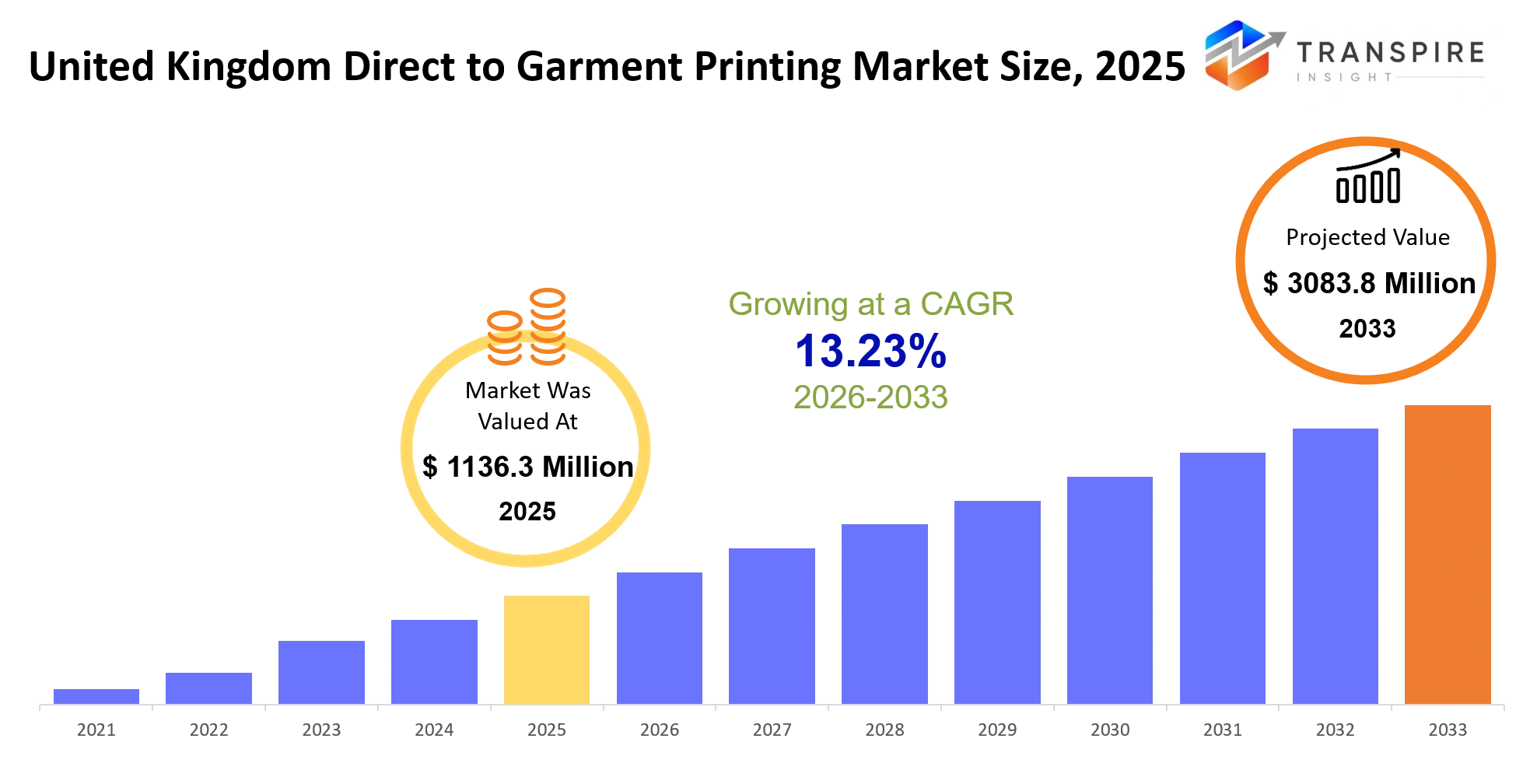
- United Kingdom Direct to Garment Printing Market Size 2025: USD 1136.3 Million
- United Kingdom Direct to Garment Printing Market Size 2033: USD 3083.8 Million
- United Kingdom Direct to Garment Printing Market CAGR: 13.23%
- United Kingdom Direct to Garment Printing Market Segments: By Printer Type (Industrial DTG Printers, Desktop DTG Printers, Roll-to-garment Printers, Hybrid Printers, Multi-color Printers, Others); By Ink Type (Water-based Inks, Pigment Inks, UV-curable Inks, Eco-solvent Inks, Others); By Application (Custom Apparel Printing, Promotional Products, Fashion Printing, Sportswear Printing, Home Décor Printing, Others); By End User (Printing Service Providers, Fashion Brands, SMEs, E-commerce Sellers, Others).
To learn more about this report,  Download Free Sample Report
United Kingdom Direct to Garment Printing Market Summary
The United Kingdom Direct to Garment Printing Market was valued at USD 1136.3 Million in 2025. It is forecast to reach USD 3083.8 Million by 2033. That is a CAGR of 13.23% over the period.
Direct to garment printing in the United Kingdom works like a fast, sort of immediate customization layer for the clothing supply chain, letting brands, retailers, and independent studios print short-run, very detailed artwork straight onto fabric without all the setup lag you’d normally get from screens. It’s basically a fix for the real world issue of too much stock and the awkwardness of large batch production, because it supports on-demand making for fashion lines, promotional clothing, and also personalized merchandise that feels more bespoke than generic runs.
Over the last 3–5 years, seems like the market has been drifting away from mostly inkjet based, hands on kind of workflows toward more connected digital textile spaces, driven by cloud tied design platforms and some automated color management systems, like not just one thing but a whole setup. One structural change that kind of really stands out is the growth of hybrid production models, where DTG gets paired with direct to film workflows too, so that broader fabric types can be dealt with more efficiently. Then the COVID-19 disruption rolled in, and it sort of sped everything up across global apparel supply chains, so UK businesses leaned into localized low inventory production, to make sure they weren’t relying so heavily on overseas fulfillment. In practice, this has improved turnaround time, and it helped adoption grow among small and mid-sized print operators who really care about getting to market quickly, commercialized fast, and with fewer complications .
Key Market Insights
- United Kingdom Direct to Garment Printing market size in 2025, went past USD 1.13 billion, mainly thanks to customization demand that SMEs are pushing pretty hard.
- The forecast pace looks like it will keep climbing, with a push beyond USD 3 billion by 2033, as digital textile automation steps up and on demand production models get more normal, even faster.
- In terms of geography Southern England is sitting on the largest chunk, close to 38% share in 2025, largely because fashion hubs and printing infrastructure clusters are kinda concentrated there.
- Scotland on the other hand is the quickest mover through 2033, backed by regional creative industry grants and textile innovation programs that actually stick.
- When you break it down by system type, inkjet based DTG setups are still the main product group, around 45% share, because the overall cost efficiency and print quality balance works well for most buyers.
- Meanwhile hybrid DTG and direct to film systems are the fastest growing segment through 2033, mostly because multi fabric flexibility is getting essential for brands that want fewer limitations.
- Looking at end use, fashion apparel holds roughly 52% share, driven by fast fashion cycles and influencer led micro collections that keep changing every month.
- Promotional merchandise is next, as the second largest application segment, supported by corporate branding needs and event based demand rhythms.
- Sportswear customization is also starting to rise rapidly, with clubs and fitness brands leaning into localized production models rather than waiting and paying more.
- Some of the key names shaping this United Kingdom Direct to Garment Printing market include Epson, Brother Industries, Kornit Digital, Ricoh, Mimaki Engineering, and Roland DG, especially through improvements in print heads, automation workflows, and ink chemistry adjustments.
What are the Key Drivers, Restraints, and Opportunities in the United Kingdom Direct to Garment Printing Market?
The main pull here is the structural shift toward on-demand clothing production, enabled by digital textile printing systems, and it kinda keeps moving because the whole workflow gets simpler. This move was pushed along when UK apparel retailers started trimming bulk inventory exposure, after a bunch of global supply chain disruptions that kept repeating. With DTG systems, brands can print only what is actually sold, so cash flow improves a bit and unsold stock write-offs get minimized, not like before where you guess demand and hope for the best. Because of that, uptake is spreading beyond just bigger names, into independent fashion labels and online-first retailers, who want fast product refresh cycles, plus design flexibility rather than mass production.
One big obstacle is the high upfront investment you need for industrial-grade DTG systems, plus the fact that maintenance can be kinda intense, especially around print head calibration. Many small print shops struggle to justify the equipment costs when their order volumes are inconsistent, like one week busy then nothing for a while. That structural snag slows down full-scale adoption, particularly outside major city areas, and it makes it harder to move fully from conventional screen printing to digital workflows. There is also the dependence on specialized inks, and controlled fabric pre-treatment, which adds operational friction and makes scaling tough for micro-enterprises.
At the same time, there’s a real emerging opportunity in integrated micro-factory models tied into e-commerce platforms, where DTG units are basically embedded inside fulfillment ecosystems. For instance, UK-based online apparel sellers are exploring localized print-on-demand nodes near logistics hubs like Birmingham, and Manchester too. The upside is shorter delivery time, plus hyper-personalized fashion production that feels more immediate. Overall this setup positions DTG tech as a core enabler for distributed manufacturing networks in the next growth cycle, more or less.
What Has the Impact of Artificial Intelligence Been on the United Kingdom Direct to Garment Printing Market?
Artificial intelligence is slowly reshaping production workflows in the UK DTG printing ecosystem, mostly by sharpening print accuracy, cutting down material waste, and streamlining production timetables. AI enabled color calibration systems now tweak ink density and fabric absorption settings in real time, which helps keep the output steady even when the textile batches vary. That means less fiddling in the print setup, and it tends to speed up turnaround cycles for those small runs that keep popping up.
At the same time, machine learning models are being rolled out for predictive maintenance of print heads and ink delivery systems. They sort of watch vibration signals, ink flow oddities, and nozzle behavior, then they can flag likely issues ahead of time, before downtime becomes real. In practice, this has boosted uptime and lowered the surprise maintenance bill for mid sized printing studios.
On the operational side, AI driven workflow management tools are improving order grouping and job prioritization too. Print farms can then squeeze better results from energy usage and shift labor allocation more intelligently. But there is still a major snag: there are not enough standardized training datasets across the wide range of fabric types and ink formulations, so model accuracy can slip in real production settings. Also integration costs are still high, especially for smaller DTG operators who depend on older printing infrastructure. Even so, AI keeps moving DTG operations toward a more automated, more evidence based production setup.
Key Market Trends
- DTG production kind of shifted away from manual calibration systems around 2021, and by 2025 it was mostly AI-assisted color management or at least moving in that direction.
- In the UK, fashion SMEs have apparently increased adoption by more than 30% since 2022, partly because the lower inventory risk models made it easier to decide, without too much worry.
- Hybrid DTG-direct-to-film systems really gained momentum after 2023, helping with fabric compatibility especially across polyester blend materials.
- In Southern England, the region held on to nearly 38% share during 2025, and that seems tied to concentrated apparel manufacturing clusters, you know the usual.
- Scotland’s DTG installations also grew faster than other regions after 2024, following creative industry funding programs that kicked in around then.
- Fashion personalization demand rose a lot after 2022, it looked like influencer-led micro-brand expansion was a big driver. Meanwhile, automated print queue management cut production delays by almost 25% in mid-sized UK print studios, which is pretty direct honestly.
- Sustainability-led ink innovation then supported wider adoption of water-based formulation across eco-focused apparel brands.
- Also, e-commerce integration with DTG systems jumped sharply after 2023, making it possible for real-time order-to-print workflows.
- And competition got more intense when companies like Kornit Digital and Epson rolled out faster, energy-efficient industrial printing platforms.
United Kingdom Direct to Garment Printing Market Segmentation
By Printer Type
Industrial DTG Printers, Desktop DTG Printers, Roll-to-garment Printers, Hybrid Printers and Multi-color Printers, along with other variants tend to form the basic printer structure of the United Kingdom Direct to Garment Printing Market. In practice, Industrial DTG Printers do really well in high-volume production setups, mostly because the output speed is quicker and the print consistency stays steady. Desktop DTG Printers, meanwhile, fit small studios, and also those entry-level operators, who lean toward low batch personalization or “bespoke” runs. Roll-to-garment Printers back continuous fabric printing, so they match bulk textile workflows pretty naturally. Hybrid Printers kind of blend several printing methods, which helps with garment flexibility and also cuts down processing time a bit. Multi-color Printers support intricate artwork, with solid color accuracy. That matters, since it lifts overall product attractiveness in fashion-first use cases. And then the other printer types, they often cover niche requirements, plus experimental production needs when someone wants to test a new approach.
Across the UK market, demand is still moving, but not just in one direction. It’s shifting toward automated, high-efficiency systems, and that pattern shows up across nearly all printer categories. Industrial DTG Printers are still the main lane, mainly due to scalability in commercial operations. Desktop DTG Printers keep a fairly stable position among SMEs and newer printing businesses, who need something manageable and not overly complex. Roll-to-garment systems gain more interest in textile-heavy environments where uninterrupted output is required. Hybrid Printers keep showing growth too, because companies want to reduce operational hassle and keep workflows smoother. Multi-color Printers are getting more room in premium apparel printing, especially where detail matters. Overall, printer adoption in UK operations will likely keep drifting toward flexible, productivity focused solutions, and that direction seems pretty clear.
By Ink Type
Water-based inks, pigment inks, UV-curable inks, eco-solvent inks and other ink types kind of shape the material side of the United Kingdom Direct to Garment Printing Market. Water-based inks are still the main thing people pick because they match fabrics well, they give that softer feel, and they work nicely with cotton based apparel. Pigment inks hold up long term, they keep print quality steady, and they are better when it comes to washing, plus they resist fading more. UV-curable inks dry quickly, and they form a pretty strong surface bond so they end up useful for specialized projects, even when speed matters. Eco-solvent inks help in situations where printing needs to stay flexible, and durability plus a bigger material range become more important. Then the other ink types basically fill niche industrial or experimental printing gaps, nothing huge, but they do have their place.
Looking at trends in ink consumption, everything keeps shifting as sustainability targets and performance needs keep rising in the United Kingdom Direct to Garment Printing Market. Water-based inks keep leading the way, largely due to those eco-friendly traits and because they are already widely adopted in fashion printing. Pigment inks are moving up steadily too, mainly because customers want outputs that last longer, and look more premium. UV-curable inks are getting more attention in advanced systems where faster production cycles are required, so those inks fit the rhythm. Eco-solvent inks stay in a niche, but the demand is still stable in specialized printing environments. Other inks don’t get that much usage overall, yet they support innovation in textile printing chemistry, sort of the quieter work behind the scenes. In the end, ink selection is clearly drifting toward solutions that are efficient, safer, and better at producing high-quality prints, even if the exact mix varies by application.
By Application
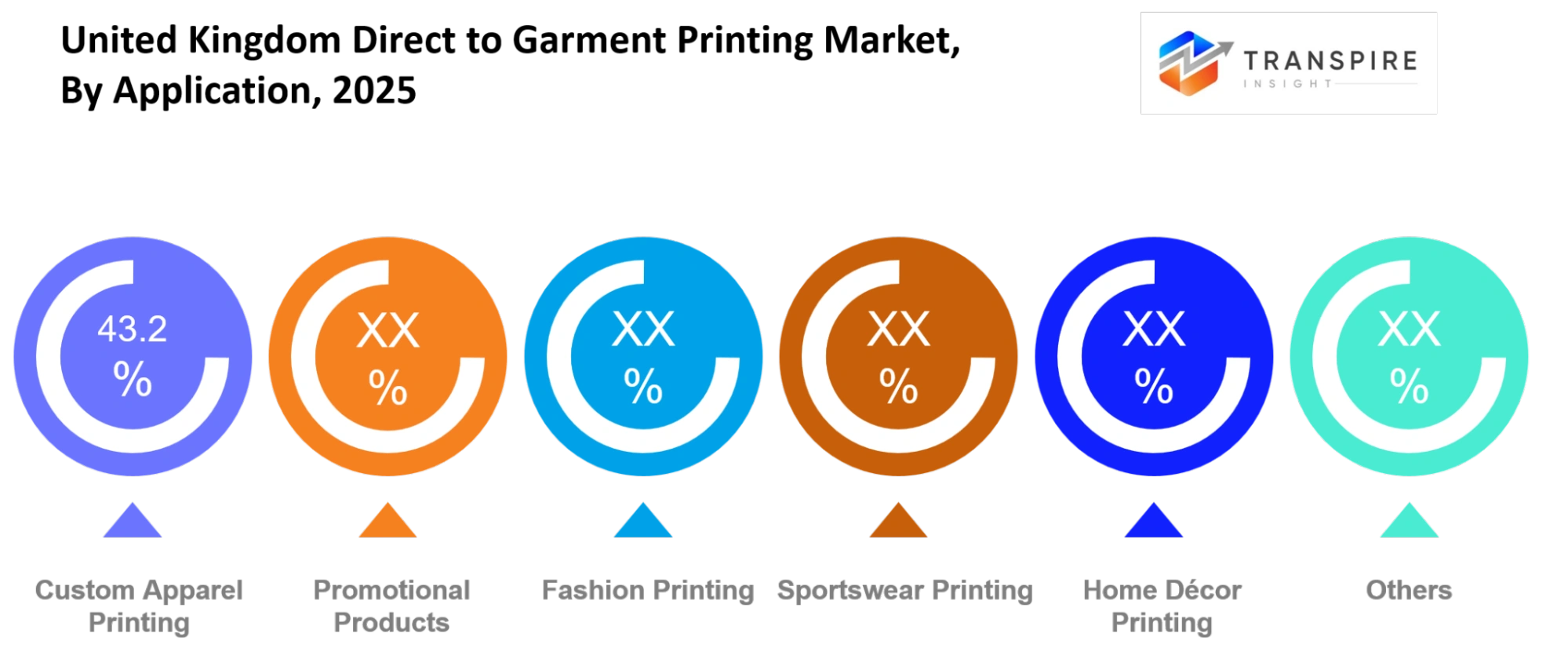
Custom Apparel Printing, Promotional Products, Fashion Printing, Sportswear Printing, Home Décor Printing and other applications kind of set the demand vibe in the United Kingdom Direct to Garment Printing Market. Custom Apparel Printing stays in the lead, mostly because there is steady appetite for personalized clothing and also small-batch production which is kind of a big deal. Promotional Products basically help with corporate branding needs, by putting prints on merchandise that shows up during marketing efforts. Fashion Printing helps designers keep moving, especially with collections and those fast fashion turnarounds that demand quick production flexibility. Sportswear Printing leans into customized jerseys and performance wear, it needs durable print results. Home Décor Printing covers customized fabric- based interior goods. Then the “other” slice exists for more specific creative and industrial situations.
Demand keeps getting wider as personalization keeps rising and more companies adopt digital production. Custom Apparel Printing still contributes the most, largely because e-commerce is pushing customers toward on-demand, personalized buys. Promotional Products remain fairly steady, driven by corporate needs and event-linked runs. Fashion Printing also keeps climbing as designers use short-run production approaches. Sportswear Printing grows too, with more interest in club-based customization and fitness branding. Home Décor Printing tends to grow slower, more tied to personalised interior design trends. In general, the application side in the United Kingdom Direct to Garment Printing Market will keep moving thanks to customization trends, digital retail expansion, and flexible production setups.
To learn more about this report, Download Free Sample Report
By End User
In the United Kingdom Direct to Garment Printing Market, Printing Service Providers, fashion brands, SMEs, e-commerce sellers, and other end users kind of set the consumption pattern and yeah, it matters. Printing Service Providers still dominate demand because they can manage huge orders, plus they have serious commercial production power. Fashion brands tend to favor DTG systems for quick design iterations and also limited edition collections . SMEs lean on compact printing systems so their small customization businesses can keep moving without needing major overhead. E-commerce sellers plug DTG printing into on demand production models, which helps them fulfill orders straight to customers in a cleaner way. And then the other end users, like niche creative studios and industrial design units, they usually want specialized printing output and specific results.
Overall end user demand keeps rising, mainly as digital commerce expands, and as localized manufacturing models keep spreading. Printing Service Providers keep their edge thanks to high volume operational requirements. Fashion brands show fairly steady growth too, supported by fast moving design trends and ongoing customization needs. SMEs are growing in adoption since equipment costs become more reachable and the setups feel more flexible now. E-commerce sellers grow fast, especially with print on demand business models. Meanwhile other end users add smaller demand but it stays relatively stable. So, the United Kingdom Direct to Garment Printing Market will likely keep shifting toward decentralized, on demand, and digitally integrated production ecosystems, which sounds a bit technical but that’s basically what’s happening.
What are the Key Use Cases Driving the United Kingdom Direct to Garment Printing Market?
Core demand is kind of created by fashion apparel customization, where brands use DTG printing to push out short run collections and personal clothing without bulk manufacturing risks. Honestly this use case takes the lead, because it matches fast moving fashion cycles, and at the same time it reduces inventory losses for online retailers.
Also, people are expanding into corporate merchandise and sportswear branding, where organizations and clubs need flexible, small batch printing for events, uniforms, and promotional drives. These areas are getting picked up more by SMEs and independent designers who want a scalable way to produce, without the usual traditional setup costs.
What feels more emerging is the creator led micro brands on e-commerce platforms and localized print on demand kiosks plugged into city retail spaces. Those models help with real time design uploads and near instant production, which in turn enables hyper personalized apparel ecosystems, kinda like everything being on demand.
|
Report Metrics |
Details |
|
Market size value in 2025 |
USD 1136.3 Million |
|
Market size value in 2026 |
USD 1292.5 Million |
|
Revenue forecast in 2033 |
USD 3083.8 Million |
|
Growth rate |
CAGR of 13.23% from 2026 to 2033 |
|
Base year |
2025 |
|
Historical data |
2021 - 2024 |
|
Forecast period |
2026 - 2033 |
|
Report coverage |
Revenue forecast, competitive landscape, growth factors, and trends |
|
Regional scope |
United Kingdom |
|
Key company profiled |
Epson, Brother Industries, Kornit Digital, Ricoh, Mimaki Engineering, Roland DG, ColDesi, Aeoon Technologies, DTG Digital, OmniPrint International, Polyprint, Anajet, Canon, Konica Minolta, Durst Group. |
|
Customization scope |
Free report customization (country, regional & segment scope). Avail customized purchase options to meet your exact research needs. |
|
Report Segmentation |
By Printer Type (Industrial DTG Printers, Desktop DTG Printers, Roll-to-garment Printers, Hybrid Printers, Multi-color Printers, Others); By Ink Type (Water-based Inks, Pigment Inks, UV-curable Inks, Eco-solvent Inks, Others); By Application (Custom Apparel Printing, Promotional Products, Fashion Printing, Sportswear Printing, Home Décor Printing, Others); By End User (Printing Service Providers, Fashion Brands, SMEs, E-commerce Sellers, Others). |
Which Regions are Driving the United Kingdom Direct to Garment Printing Market Growth?
Southern England kind of runs the market, mostly because there’s a dense cluster of fashion houses, design studios, and commercial printing facilities all together. London serves as the central hub where digital fashion startups, plus more established retailers tend to meet. Also strong logistics infrastructure and easier access to skilled designers help keep the momentum going. On top of that, the region seems to benefit from quick adoption of automation inside textile production workflows
Central England is more of a stable player, backed by manufacturing resilience and ongoing investment in industrial printing capabilities. And unlike the South which feels more design heavy, this area leans into production efficiency and smoother supply chain integration. Birmingham, for example, gives strong logistics connectivity, so order fulfillment stays pretty steady. Because of that, the region becomes a reliable backbone for nationwide DTG distribution
Then Scotland is moving the quickest, driven by funding across creative industries and textile innovation initiatives. Newer investments in sustainable fashion hubs have made it easier for small studios to adopt digital printing technologies, at least that’s what it looks like. Universities and innovation centers are actively backing DTG experimentation in apparel design. Overall, this suggests fresh entry opportunities for equipment providers and digital textile solution vendors through 2033
Who are the Key Players in the United Kingdom Direct to Garment Printing Market and How Do They Compete?
The United Kingdom DTG printing market is, sort of, moderately fragmented, with the rivalry mainly pushed by print quality, how fast production runs, and how well everything fits into digital workflow systems. You see established industrial printing firms in the mix, competing right next to specialized digital textile manufacturers, and then the new players come in leaning hard on automation, plus hybrid printing abilities, in a way that feels… very forward.
Names like Epson and Brother Industries show up with high-precision inkjet systems, tuned for small to medium apparel studios. Their edge is basically in scalable desktop-to-industrial product ecosystems, which help people start at the entry level, then move up bit by bit as they grow. Meanwhile Ricoh sets itself apart with industrial-grade print head technology, built for steady, high-volume output, so it tends to appeal to mid tier production places where consistency matters.
Kornit Digital is more about end-to-end digital textile automation platforms, and they’re positioned pretty strongly for large-scale on-demand production environments. Mimaki Engineering and Roland DG, they often lean toward niche use cases—things like specialty fabrics, and color heavy printing—and they gather momentum with design focused studios that care a lot about the look. Also, competitive expansion seems more and more tied to partnerships with apparel brands, and then integration with e commerce fulfillment setups, which lets companies “embed” DTG capability directly into retail workflows, kinda seamlessly, no big drama.
Company List
- Epson
• Brother Industries
• Kornit Digital
• Ricoh
• Mimaki Engineering
• Roland DG
• ColDesi
• Aeoon Technologies
• DTG Digital
• OmniPrint International
• Polyprint
• Anajet
• Canon
• Konica Minolta
• Durst Group
Recent Development News
In March 2026, UK-based Basic Prints expanded its production capacity by installing a second Kornit Digital Apollo DTG system. The upgrade supported its transition toward fully automated, on-demand apparel manufacturing, reducing dependence on traditional screen printing and increasing high-volume digital output efficiency in the UK fashion supply chain.
Source: http://www.texdata.com
What Strategic Insights Define the Future of the United Kingdom Direct to Garment Printing Market?
The United Kingdom DTG printing market is moving, structurally, toward distributed and automated apparel production networks, where design printing and fulfillment sort of run in one digital loop. This change is pulled along by e-commerce-first fashion brands getting more dominant, and by localised manufacturing strategies that lower the reliance on overseas supply chains.
A less obvious risk is technology substitution too, like direct-to-film and advanced sublimation setups, which could snag the mid-tier demand slice if their cost edge stays solid. Meanwhile, a real opportunity is showing up in micro-factory deployment near logistics corridors, especially around Manchester, and also in the Midlands, where fast fulfillment expectations keep climbing.
Market players should really focus on tying their workflows into e-commerce platforms and put money into modular DTG systems that can grow from a small studio to something industrial. That kind of positioning will matter a lot, because production decentralization is likely to become the main framework for the UK apparel printing ecosystem during the next growth phase.
United Kingdom Direct to Garment Printing Market Report Segmentation
By Printer Type
- Industrial DTG Printers
- Desktop DTG Printers
- Roll-to-garment Printers
- Hybrid Printers
- Multi-color Printers
- Others
By Ink Type
- Water-based Inks
- Pigment Inks
- UV-curable Inks
- Eco-solvent Inks
- Others
By Application
- Custom Apparel Printing
- Promotional Products
- Fashion Printing
- Sportswear Printing
- Home Décor Printing
- Others
By End User
- Printing Service Providers
- Fashion Brands
- SMEs
- E-commerce Sellers
- Others
Frequently Asked Questions
Find quick answers to common questions.
The expected United Kingdom Direct to Garment Printing Market size for the market will be USD 3083.8 Million in 2033.
Key segments for the United Kingdom Direct to Garment Printing Market are By Printer Type (Industrial DTG Printers, Desktop DTG Printers, Roll-to-garment Printers, Hybrid Printers, Multi-color Printers, Others); By Ink Type (Water-based Inks, Pigment Inks, UV-curable Inks, Eco-solvent Inks, Others); By Application (Custom Apparel Printing, Promotional Products, Fashion Printing, Sportswear Printing, Home Décor Printing, Others); By End User (Printing Service Providers, Fashion Brands, SMEs, E-commerce Sellers, Others).
Major United Kingdom Direct to Garment Printing Market players are Epson, Brother Industries, Kornit Digital, Ricoh, Mimaki Engineering, Roland DG, ColDesi, Aeoon Technologies, DTG Digital, OmniPrint International, Polyprint, Anajet, Canon, Konica Minolta, Durst Group.
The United Kingdom Direct to Garment Printing Market size is USD 1136.3 Million in 2025.
The United Kingdom Direct to Garment Printing Market CAGR is 13.23% from 2026 to 2033.
- Epson
• Brother Industries
• Kornit Digital
• Ricoh
• Mimaki Engineering
• Roland DG
• ColDesi
• Aeoon Technologies
• DTG Digital
• OmniPrint International
• Polyprint
• Anajet
• Canon
• Konica Minolta
• Durst Group
About the Authors

Chetan Dhatrak
I’m Chetan Dhatrak, a Senior Research Analyst at Transpire Insight, specializing in the Consumer Goods, Foods and Beverages industry. I focus on analyzing market trends, consumer behavior, competitive landscapes, and industry developments to deliver accurate, data-driven insights. My research at Transpire Insight is built on credible sources and in-depth analysis, helping businesses and readers better understand market dynamics, emerging opportunities, and evolving consumer preferences. I’m committed to creating reliable, well-researched content that supports informed decision-making and reflects the latest developments in the consumer goods and food & beverage sectors.

Chakradhar Khansole
Chakradhar serves as the Research Director at Transpire Insight, bringing over 8 years of experience in technology, innovation, and strategic market intelligence. He specializes in transforming complex market data into actionable business insights that enable organizations to make informed, growth-oriented decisions. Recognized for his strategic vision and analytical expertise, Chakradhar leads high-impact research initiatives, delivering comprehensive market assessments, competitive intelligence, and forward-looking industry analysis.
Recently Published Reports
-
Apr 2026
Bottled Water Market
Bottled Water Market Size, Share & Analysis Report By Product Type (Still Bottled Water, Carbonated Bottled Water, Functional Bottled Water, and Others), By Packaging (PET, Cans, and Others), By Sales Channel (Supermarkets/Hypermarkets, Convenience Stores/Drug Stores, Grocery Stores/Club Stores, Foodservice, and Others) and Geography (North America, Europe, Asia-Pacific, Middle East and Africa, South and Central America), 2021 - 2032
-
Apr 2026
Color Cosmetic Packaging Market
Color Cosmetic Packaging Market Size, Share & Analysis Report By Application (Mascara Packaging, Liquid Packaging, and Liquid Face), By Type (Tubes & Bottles, Pens & Markers, Compacts & Containers, and Droppers & Pumps), and Geography (North America, Europe, Asia-Pacific, Middle East and Africa, South and Central America), 2021 - 2031
-
Apr 2026
External Microphone For Camera Market
External Microphone For Camera Market Size, Share & Analysis Report By Type (Shotgun Microphone, Lavalier Microphone, and Others), By Application (Digital Camera, Professional Video Camera, and Others), and Geography (North America, Europe, Asia-Pacific, Middle East and Africa, South and Central America), 2021 - 2031
-
Apr 2026
Foot Orthotic Insoles Market
Foot Orthotic Insoles Market Size, Share & Analysis Report By Type (Pre-fabricated, and Custom-made), By Material (Thermoplastic, Composite Carbon Fiber, and Others), By Distribution Channel (Drug Stores, Hospitals & Clinics, and Others), and Geography (North America, Europe, Asia-Pacific, Middle East and Africa, South and Central America), 2021 - 2031