

United Kingdom Ambulance Services Market Summary
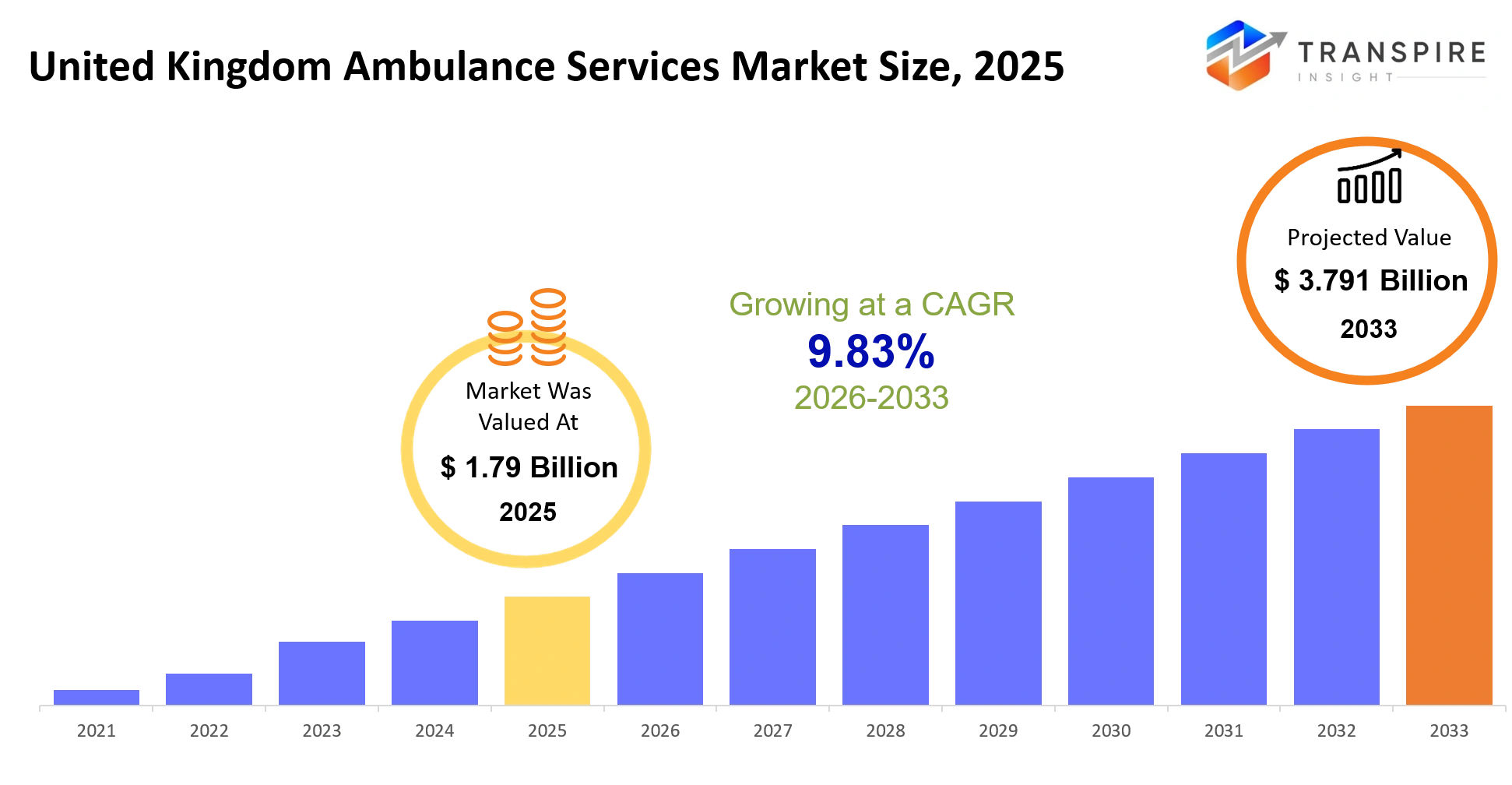
As per Transpire Insight Analysis the United Kingdom Ambulance Services Market size is estimated at USD 1.79 Billion in 2025 and is anticipated to reach USD 3.791 Billion by 2033, growing at a CAGR of 9.83% from 2026 to 2033.
The United Kingdom ambulance services market still keeps emergency medical response systems running, mostly by making sure rapid pre-hospital care happens, patients get transported in a safe way, and local areas stay tied to hospitals,plus specialist treatment. Ambulance providers end up covering emergency calls, urgent patient movements, and also scheduled medical transportation, so healthcare facilities can handle their capacity without losing momentum, and patients can see better results because intervention arrives on time
In the last five years, the whole market has been tilting toward digitally connected ambulance operations, with dispatch platforms that are more advanced, telemedicine options that actually get used, and patient data systems that are better linked. The COVID-19 pandemic pushed things along faster and, sort of, laid bare the strain on emergency response networks. It also made the need pretty obvious for quicker resource assignment, more near-real-time messaging, and service delivery that can bend when conditions shift. Meanwhile, while healthcare organisations keep running into staff shortages, aging populations, and growing clinical complexity, investment has shifted away from just adding fleet size, and toward technology enabled efficiency instead. That shift helps providers fine-tune response coordination, use vehicles more evenly, and keep service quality more consistent, which then supports steadier long-term revenue chances for both public entities and independent ambulance operators
United Kingdom Ambulance Services Market Size & Forecast:
- United Kingdom Ambulance Services Market Size 2025: USD 1.79 Billion
- Expected Market Value 2033: USD 3.791 Billion
- Forecast CAGR: 9.83%
- Leading region in 2025: England
- Fastest Growing region: Scotland
- Key Profile: London Ambulance Service, South East Coast Ambulance Service, East Midlands Ambulance Service, Yorkshire Ambulance Service, West Midlands Ambulance Service, Scottish Ambulance Service, Welsh Ambulance Services, Falck, G4S Medical Services, ERS Medical, St John Ambulance, Medic 1, Acadian Ambulance, Air Ambulance Kent Surrey Sussex, Independent Ambulance Association
Key Market Insights
- In 2025, England kind of dominated the market, sitting at about 82% market share, while also leaning on the biggest NHS ambulance infrastructure and broad population coverage, in a very real way.
- Scotland meanwhile is projected to grow quicker than the other regional markets during 2025–2032, mainly because of digital emergency reply investments and rural health modernization efforts.
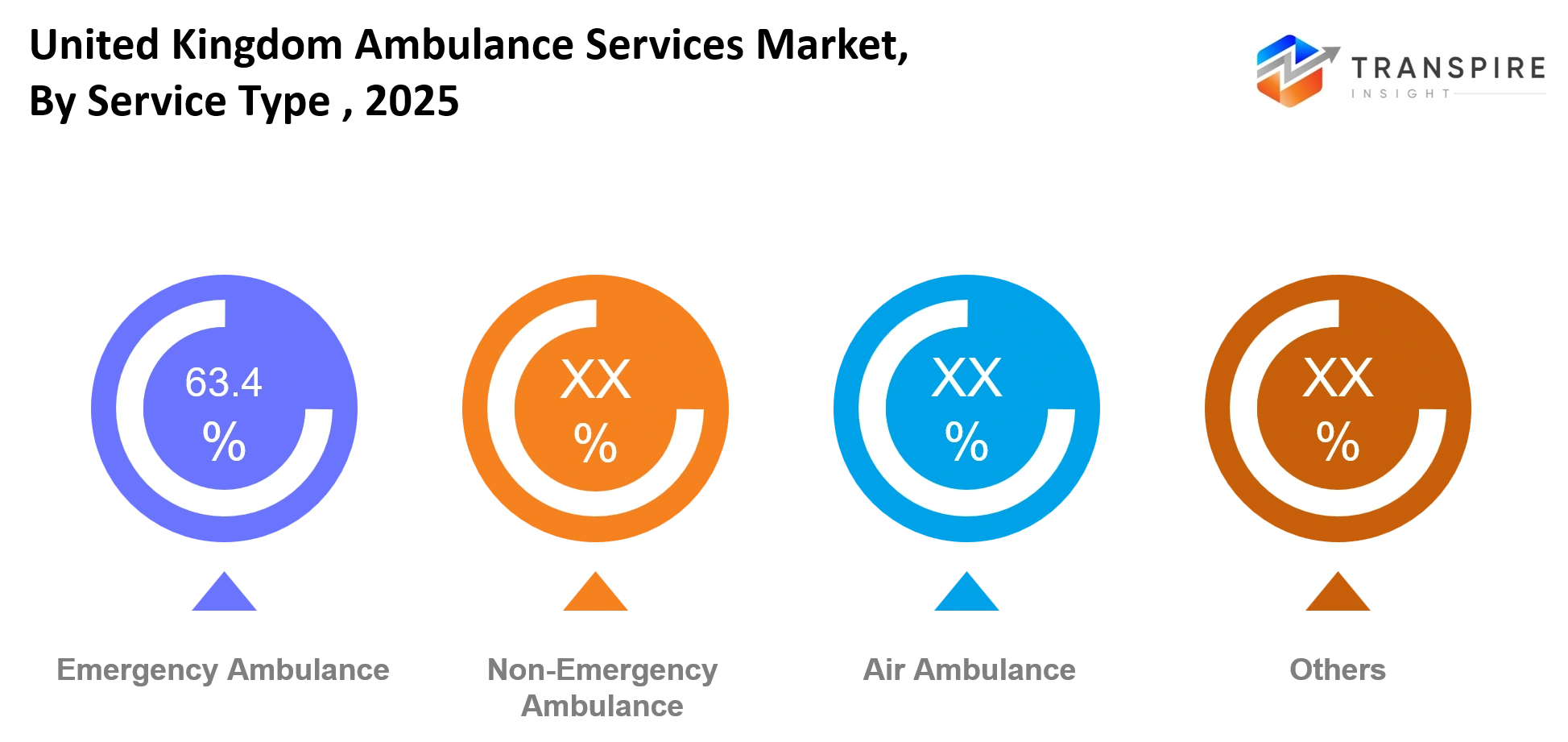
- When you look at the service parts, emergency ambulance services were in front with roughly 68% market share in 2025, which basically shows the nonstop need for rapid response across the NHS network.
- Non-emergency patient transport services came second as the bigger piece, backed by outpatient care that keeps expanding, plus planned hospital transfers that are more frequent.
- For air ambulance services, forecasts point to the quickest expansion rate through 2032, with backing from the enlargement of critical care and improved emergency reach for far remote areas.
- On the application side, emergency medical response stayed the dominant driver, holding roughly 72% market share in 2025, showing how priority funding was meant for situations that are life-threatening incidents.
- Community-based urgent care transport is expected to be the fastest mover across the forecast period, as care keeps shifting beyond hospital walls and into other settings.
- As for end users, NHS ambulance trusts took the lead, with approximately 85% market share, supported by government-funded emergency health service delivery.
- Private healthcare providers are expected to be the fastest-growing end-user crowd in the 2025–2032 span, mostly because of outsourced transport arrangements and specialist medical services, which just keeps stacking up.
What are the Key Drivers, Restraints, and Opportunities in the United Kingdom Ambulance Services Market?
Digital transformation across NHS emergency care is basically the main force speeding up market growth. National funding into integrated care systems, electronic patient records, and smart dispatch platforms has already led to broader technology take up across ambulance providers. Quicker incident assignment helps response quality and also makes vehicle usage more sensible. When coordination is tighter, it cuts avoidable hospital admissions too. Overall, these upgrades lift contract worth, boost service efficiency, and make it easier to keep investing in connected ambulance operations, you know.
Still, the largest structural snag is workforce shortages together with older vehicle fleets, plus patchy modernization across infrastructure. Bringing in and keeping paramedics takes years of training, so scaling capacity fast is kind of hard. Tight budgets then slow fleet renewal and hold back digital improvements across multiple regions. From a Transpire Insight look at regional procurement notices and go live timings, supply chain concentration stays the top delivery risk. Because of that, procurement timelines get pushed out, operational capability is capped, and revenue that could come from advanced emergency response solutions gets suppressed.
There’s also a real opportunity with AI-enabled emergency dispatch, connected ambulances, and remote clinical triage platforms. Government support for integrated digital healthcare backs broader rollout of predictive resource planning and virtual care. Private ambulance firms keep expanding specialist patient transport services as well. Put simply, combined technology investment plus deeper healthcare integration should open up fresh commercial routes while also improving day to day performance across emergency medical services.
What Has the Impact of Artificial Intelligence Been on the United Kingdom Ambulance Services Market?
Artificial intelligence and digital tech are kinda reshaping ambulance operations across the United Kingdom, by boosting dispatch accuracy, adding clinical decision support , and making fleet management a bit more smooth. Lately the command centres are using AI assisted dispatch tools more often, so they can triage emergency calls, suggest which vehicle should go, and fine tune routing based on what’s happening on the roads in real time. At the same time electronic patient records help crews share key details quicker with receiving hospitals, so treatment delays get trimmed down, and everyone is on the same page faster
Machine learning models are also used to forecast how many emergency calls might come in, spot the busy hours, and line up workforce resources with better efficiency. Then there are predictive maintenance systems that watch how vehicles behave, which lowers the odds of surprise breakdowns , while also improving overall fleet availability. All these digital capabilities tend to improve operational throughput, keep response quality more steady , and raise how well assets get used. Healthcare organizations then apply analytics to review response performance, and point out practical improvements for service delivery in both city areas and rural regions
Even so, big scale AI adoption is still held back by the usual suspects: expensive integration costs, patchy legacy IT environments, and different data quality across healthcare organizations. On top of that rural connectivity can get unreliable, which may interfere with real time data transmission during an incident. What happens next will depend on continued investment in interoperable digital infrastructure, plus standardized clinical data, because that’s what will decide how quickly these advanced AI applications move from pilots to broad deployment across emergency medical services
Key Market Trends
- After 2022 AI assisted emergency dispatch platforms kind of blew up, and in practice it improved call prioritization, plus it cut down the response coordination time , a bit quicker than before.
- Then from 2023 to 2025 NHS ambulance trusts sped up the rollout of electronic patient records, which meant hospital handovers were faster, not really surprising, but still helpful.
- Around the same time connected ambulance fleets started using real time telematics more and more , boosting vehicle utilization and also trimming maintenance related downtime .
- Telemedicine integration also got stronger, because remote specialist consultation during emergency transport helped clinical decision making, even when the patient was already on the move .
- And community paramedicine programs expanded across several NHS regions, which reduced avoidable emergency department admissions, and it also improved how healthcare resources are allocated , overall.
- Air ambulance organizations invested in more advanced onboard critical care technology during 2024–2025, and that really strengthened rapid response capabilities on the ground and in the air.
- Private ambulance providers increased their involvement in non-emergency patient transport too, mainly through multi-year NHS outsourcing plus regional service contracts , so it wasn’t just one-off.
- Sustainability initiatives also accelerated fleet replacement with lower emission ambulances, alongside energy efficient operational practices across multiple trusts, kind of a double win.
- Finally, cloud based command and control platforms improved interoperability between ambulance services , hospitals and integrated care systems, starting around 2023 and continuing after that .
United Kingdom Ambulance Services Market Segmentation
By Service Type :
Emergency ambulance services are going to hold the biggest share, since fast medical response still feels essential for crisis incidents, accidents, and situations that threaten life. Lots of ongoing emergency call traffic, plus government support and full coverage throughout the nation, will help keep utilization steady in both city centers and far out rural places. Meanwhile, non-emergency ambulance services still have a key role too, mainly by taking care of those planned patient transports for hospital visits, rehabilitation, and more longer-term medical care. At the same time air ambulance services should keep expanding, especially for urgent cases that really need instant movement over long stretches or in areas that are difficult to reach.
Other types of ambulance services will also step in where specialized transport is needed, like patients with specific clinical needs and local community healthcare programs. Digital dispatch systems, better messaging platforms, and tighter fleet coordination will push operational efficiency forward across pretty much every category. Service providers will likely concentrate on quicker arrival times, steadier patient care, and more sensible resource use. Altogether, these changes should open up balanced opportunities for both emergency response and planned medical transportation services.
By Vehicle Type :
Ground ambulance units will stay the leading vehicle category, because road networks back most of the urgent emergency and patient transfer work across the entire nation. Fleet modernization schemes, linked navigation systems, and upgraded vehicle dependability will help boost day to day operational output. Air ambulance services will keep getting more weight, especially for the high acuity care missions where quick transport, really can change patient outcomes in a big way. Medical helicopters and fixed-wing aircraft will cover remote settlements and tricky emergency circumstances
Water ambulances will handle coastal areas , islands and places where road access is still rather limited. Other specialized emergency vehicles will be used for disaster response public events and those one of a kind operational needs. Money put into fleet renewal and smarter onboard medical gear will raise service quality in each and every vehicle category. With more capable fleet management tech, there will also be fewer maintenance slowdowns and better vehicle readiness for the next call.
By Equipment :
Basic Life Support equipment will stay pretty widely used, because in a lot of patient transport cases it still needs essential monitoring, stabilization, and day to day emergency care , even when it feels like a “standard” thing. Standard medical devices will back up frontline ambulance operations across hospitals and community health services, and not just in one place either. Advanced Life Support equipment will see more noticeable expansion as emergency providers keep investing in critical care capabilities. Cardiac monitors, ventilators , infusion systems and advanced diagnostic tools will help stabilize treatment before hospital arrival.
Other kinds of medical equipment will also support specialized clinical procedures, neonatal care, and disaster response work. Technology integration should make equipment reliability better, while also supporting quicker clinical decisions when emergencies pop up. Healthcare providers will keep replacing older systems with connected , digitally enabled medical devices. Overall, improved equipment standards will strengthen patient safety and treatment effectiveness, in a way that’s easy to measure.
By Provider :
Public providers will keep being the ones that really drive service delivery because the government funded ambulance groups manage most of the emergency response work across the country. More national spending for healthcare infrastructure and digital emergency systems should boost how well everything runs, and that operational capacity will get stronger. Meanwhile private providers will likely grow by taking on non emergency transport contracts, offering specialist medical services, and building partnerships with healthcare organizations. With flexible service models, they can also open up new business avenues that aren’t only tied to the traditional emergency response line.
Other providers will, sort of, fill in around community healthcare initiatives, charitable ambulance operations, and event based medical services. Investing in technology along with operational partnerships should help improve coordination across the different provider groups. When resources are shared better, service efficiency gets stronger especially when demand spikes. And as modernization continues it should improve the overall emergency medical response capabilities, in practice.
By End User :
Hospitals will still be, kind of, the biggest end user segment because emergency admissions, patient transfers and critical care referrals just need steady ambulance support every single day. At the same time hospital networks are going to keep investing in faster patient movement , and in systems that actually tie together integrated emergency care, so it doesn’t feel like everything is disconnected. For individual users there will be steady activity from emergency response requests , scheduled transportation, and even specialized medical travel. Government agencies will remain active too, backing emergency preparedness, disaster management, and public healthcare initiatives.
Other end users will also show up, like corporate health care programs, community organizations, and event management services that need medical transport support. Digital coordination between healthcare facilities and ambulance operators will keep improving service efficiency, more like smoother handoffs. With better communication systems, delays during patient transfers should drop. And then operational improvements overall will end up strengthening healthcare delivery across multiple end user categories.
By Application :
Trauma applications will keep holding the largest share because road accidents, workplace injuries , and emergency incidents ask for immediate medical transportation and rapid clinical intervention. Fast-response capabilities, plus advanced emergency care, will remain a key element for improving patient outcomes. Cardiac applications will keep getting bigger as ambulance providers build up pre-hospital cardiac treatment, with advanced monitoring and life-support equipment. Neonatal transport services will also get more attention, through specialized ambulance equipment and clinical teams that are properly trained .
Other uses will back respiratory emergencies, infectious disease transport, bariatric care and specialized medical referrals too. Healthcare providers will keep tuning treatment protocols by using digital patient information systems and connected clinical devices. Better emergency coordination will help solidify service quality across the different medical application areas. Long-term investment in emergency healthcare infrastructure will support broader service capabilities across basically all these areas.
What are the Key Use Cases Driving the United Kingdom Ambulance Services Market?
The biggest use case shows up in emergency trauma, critical care response, where public ambulance providers (kinda) back up hospitals with rapid stabilization and transport. Hospitals, plus government agencies, typically buy these services to keep in line with national emergency response standards , lessen the time-to-treatment, and help survival rates during road accidents, heart related emergencies, and other life threatening moments.
Planned patient transfer is becoming more important too, especially across the non-emergency ambulance part. Healthcare providers lean on this kind of support to shuttle patients between facilities, and rehab centres—along with specialist clinics—use scheduled transport to keep continuity of care. There’s also air ambulance coverage, which often steps in for time sensitive transfers where patients need specialist attention fast.
Another emerging angle is remote clinical assessment, powered by connected ambulance technology. At the same time, community healthcare programs are piloting mobile care models, aimed at avoiding avoidable hospital admissions by treating people where they are, at the point of care. Altogether, these efforts seem to fit NHS digital transformation plans, and should see broader uptake during the forecast window.
|
Report Metrics |
Details |
|
Market size value in 2025 |
USD 1.79 Billion |
|
Market size value in 2026 |
USD 1.966 Billion |
|
Revenue forecast in 2033 |
USD 3.791 Billion |
|
Growth rate |
CAGR of 9.83% from 2026 to 2033 |
|
Base year |
2025 |
|
Historical data |
2021 - 2024 |
|
Forecast period |
2026 - 2033 |
|
Report coverage |
Revenue forecast, competitive landscape, growth factors, and trends |
|
Regional scope |
United Kingdom (England, Scotland, Wales, Northern Ireland) |
|
Key company profiled |
London Ambulance Service, South East Coast Ambulance Service, East Midlands Ambulance Service, Yorkshire Ambulance Service, West Midlands Ambulance Service, Scottish Ambulance Service, Welsh Ambulance Services, Falck, G4S Medical Services, ERS Medical, St John Ambulance, Medic 1, Acadian Ambulance, Air Ambulance Kent Surrey Sussex, Independent Ambulance Association. |
|
Customization scope |
Free report customization (country, regional & segment scope). Avail customized purchase options to meet your exact research needs. |
|
Report Segmentation |
By Service Type (Emergency Ambulance, Non-Emergency Ambulance, Air Ambulance, Others); By Vehicle Type (Ground Ambulance, Air Ambulance, Water Ambulance, Others); By Equipment (Basic Life Support, Advanced Life Support, Others); By Provider (Public, Private, Others); By End User (Hospitals, Individuals, Government Agencies, Others); By Application (Trauma, Cardiac, Neonatal, Others). |
Which Regions are Driving the United Kingdom Ambulance Services Market Growth?
The South East pretty much holds the biggest chunk of the United Kingdom ambulance services market, taking about 28% of all revenue. This is helped by strong NHS investment, a dense healthcare setup, and emergency care policies that are sort of well stitched together, which keeps service deployment steady across the region. There is also a wide web of ambulance trusts, specialist hospitals, technology providers, plus fleet maintenance partners ,and that mix really supports operational strength and day to day service reliability. Looking ahead, ongoing digital healthcare spending, population growth, and fleet modernization should keep the region in a leading position through most of the forecast window.
London sits in second place ,mostly because what ambulance services need there is driven by very high population density and awkward urban movement, plus emergency demand that never really pauses, not just by geographic reach. Healthcare funding stays fairly stable, emergency response expectations are already set, and the procurement programs tend to roll along in a consistent way, so providers can plan without too much uncertainty. Big hospitals, specialist trauma centers, and advanced command-and-control systems help keep service delivery dependable across the capital. So even with the operational complexity, these structural strengths make London a steady contributor to long term industry revenue.
Scotland is expected to see the most rapid growth in 2026–2033, mostly because of the ongoing investment in digital emergency response, fleet renewal and, uh, wider rural health-care access. Lately, modernization programs have boosted connected dispatch systems and they’ve also brought in more advanced clinical technology for remote communities. There are still geographic hurdles though, so that keeps pushing funding toward air ambulance capability and for digitally enabled emergency coordination, kind of a double track. With that going, the pace should unlock promising chances for technology suppliers, vehicle makers, and private service providers aiming for long term expansion across areas that are still underserved.
Who are the Key Players in the United Kingdom Ambulance Services Market and How Do They Compete?
The competitive environment still feels kinda moderately consolidated since NHS ambulance trusts handle most of the urgent call response activity, while private operators end up battling it out mostly in specialized transfer work and contracted healthcare services. The competition is not really about price alone, it’s more about digital ability, speed of response, service standard, and how well they perform in regional contracts (often measured through KPIs and real world reliability). The existing providers keep pushing their technology platforms further and tightening day-to-day operations, and then the specialist businesses come in by scaling outsourced healthcare services and going after specific regional agreements, almost like a stitched approach.
London Ambulance Service stands out with advanced digital dispatch, electronic patient records, and integrated command systems, which helps response coordination across one of Europe’s most overloaded urban healthcare networks. West Midlands Ambulance Service puts real weight into connected fleet technology and clinical innovation, which translates into faster resource deployment and better operational efficiency overall. EMED Group grows by taking on long-term patient transport arrangements and expanding its regional footprint, so it gets a solid position in scheduled healthcare transportation. G4S Health Services leans into adaptable medical transport solutions for both public and private healthcare organizations, whereas South Central Ambulance Service keeps boosting telemedicine features and virtual clinical assessment, aiming to improve patient care before they even reach the hospital.
Company List
- London Ambulance Service
- South East Coast Ambulance Service
- East Midlands Ambulance Service
- Yorkshire Ambulance Service
- West Midlands Ambulance Service
- Scottish Ambulance Service
- Welsh Ambulance Services
- Falck, G4S Medical Services
- ERS Medical
- St John Ambulance
- Medic 1
- Acadian Ambulance
- Air Ambulance Kent Surrey Sussex
- Independent Ambulance Association
Recent Development News
In May 2026, EMED Group completed the transfer of Bristol Ambulance EMS operations and assets. The agreement added approximately 315 employees, 120 ambulances, and seven operational depots, strengthening EMED Group's patient transport and specialist ambulance capabilities across South West England.
Source: https://www.emedgroup.co.uk/
In April 2025, East of England Ambulance Service NHS Trust (EEAST) completed a successful technology trial using Excelerate Technology connectivity equipment at four hospitals. The deployment improved the speed and reliability of transferring patient data between ambulances and emergency departments, supporting faster patient handovers and more efficient emergency care.
Source: https://www.eastamb.nhs.uk/
What Strategic Insights Define the Future of the United Kingdom Ambulance Services Market?
In the United Kingdom ambulance services market, things will likely drift toward a more integrated emergency healthcare approach, where digital coordination, predictive resource planning, and connected clinical systems are at the core of day to day operational performance rather than being treated like optional add-ons. This push will be fueled by long term NHS modernization, tougher interoperability expectations, and the ongoing need to boost patient outcomes, but without proportional increases in day to day operating expenses.
There is also a quieter kind of trouble on the horizon, one that comes from leaning on a relatively small set of technology vendors and digital platform providers. That dependence can mess with procurement timelines, nudge implementation costs higher and quietly limit flexibility later when the whole system needs a refresh or upgrade.
On the other side, an important opening will show up via AI supported clinical decision instruments and remote patient assessment, especially for rural communities and other underserved areas where access to healthcare is still uneven. Market participants should do well by putting money into interoperable digital platforms, practical workforce training, and longer term technology collaborations, so their strategies match upcoming procurement priorities and the way emergency healthcare requirements are evolving.
United Kingdom Ambulance Services Market Report Segmentation
By Service Type
- Emergency Ambulance
- Non-Emergency Ambulance
- Air Ambulance
By Vehicle Type
- Ground Ambulance
- Air Ambulance
- Water Ambulance
By Equipment
- Basic Life Support
- Advanced Life Support
- By Provider
- Public
- Private
By End User
- Hospitals
- Individuals
- Government Agencies
By Application
- Trauma
- Cardiac
- Neonatal
Frequently Asked Questions
Find quick answers to common questions.
The expected United Kingdom Ambulance Services Market size for the market will be USD 3.791 Billion in 2033.
Key segments for the United Kingdom Ambulance Services Market are By Service Type (Emergency Ambulance, Non-Emergency Ambulance, Air Ambulance, Others); By Vehicle Type (Ground Ambulance, Air Ambulance, Water Ambulance, Others); By Equipment (Basic Life Support, Advanced Life Support, Others); By Provider (Public, Private, Others); By End User (Hospitals, Individuals, Government Agencies, Others); By Application (Trauma, Cardiac, Neonatal, Others).
Major United Kingdom Ambulance Services Market players are London Ambulance Service, SouthEast Coast Ambulance Service, East Midlands Ambulance Service, Yorkshire Ambulance Service, West Midlands Ambulance Service, Scottish Ambulance Service, Welsh Ambulance Services, Falck, G4S Medical Services, ERS Medical, St John Ambulance, Medic 1, Acadian Ambulance, Air Ambulance Kent Surrey Sussex, Independent Ambulance Association.
The United Kingdom Ambulance Services Market size is USD 1.79 Billion in 2025.
The United Kingdom Ambulance Services Market CAGR is 9.83% from 2026 to 2033.
- London Ambulance Service
- South East Coast Ambulance Service
- East Midlands Ambulance Service
- Yorkshire Ambulance Service
- West Midlands Ambulance Service
- Scottish Ambulance Service
- Welsh Ambulance Services
- Falck, G4S Medical Services
- ERS Medical
- St John Ambulance
- Medic 1
- Acadian Ambulance
- Air Ambulance Kent Surrey Sussex
- Independent Ambulance Association
About the Authors

Pankaj Ghogare Patil
I am Pankaj Ghogare Patil, a Senior Research Analyst at Transpire Insight, specializing in the Pharmaceutical, Chemicals & Materials, Healthcare IT, and Biotechnology industry. My expertise lies in conducting comprehensive market research, analyzing industry trends, evaluating competitive landscapes, and translating complex data into actionable insights. At Transpire Insight, I closely follow emerging technologies, regulatory developments, and market innovations to create accurate, well-researched, and informative content that helps businesses and professionals make informed decisions. I am committed to producing credible, evidence-based articles that reflect industry best practices while making technical topics accessible and valuable for a broad audience.

Chakradhar Khansole
Chakradhar serves as the Research Director at Transpire Insight, bringing over 8 years of experience in technology, innovation, and strategic market intelligence. He specializes in transforming complex market data into actionable business insights that enable organizations to make informed, growth-oriented decisions. Recognized for his strategic vision and analytical expertise, Chakradhar leads high-impact research initiatives, delivering comprehensive market assessments, competitive intelligence, and forward-looking industry analysis.
Recently Published Reports
-
Apr 2026
AI in Diabetic Retinopathy Market
AI in Diabetic Retinopathy Market Size, Share & Analysis Report By Type (Screening AI Systems, Diagnostic AI Systems, and Predictive AI Models), By Application Segment (Hospitals, Ophthalmology Clinics, Diagnostic Centers, and Research and Development), and Geography (North America, Europe, Asia-Pacific, Middle East and Africa, South and Central America), 2021 - 2031
-
Apr 2026
Psychometric Tests Market
Psychometric Tests Market Size, Share & Analysis Report By Type (Personality Tests, Ability/Aptitude Tests, Skill/Knowledge Tests, and Others), By Application (Talent Acquisition and Talent Management), and Geography (North America, Europe, Asia-Pacific, Middle East and Africa, South and Central America), 2021 – 2031
-
Apr 2026
Rare Biological Sample Collection Market
Rare Biological Sample Collection Market Size, Share & Analysis Report By Type (Isolation Kits & Reagent, Blood Collection Tubes, and Others), By Application (Oncology, Transcriptomics, Pharmacogenomics, and Others), and Geography (North America, Europe, Asia-Pacific, Middle East and Africa, South and Central America), 2021 – 2031
-
Jul 2026
Diabetic Retinopathy Market
Diabetic Retinopathy Market Size, Share & Analysis Report By Type (Proliferative Diabetic Retinopathy, and Diabetic Macular Edema (DME)), By Treatment Type (Anti VEGF Drug, Steroid Implants, Laser Surgeries, and Vitrectomy), and Geography (North America, Europe, Asia-Pacific, Middle East and Africa, South and Central America), 2021 – 2031
Our Clients







