

United Kingdom Agricultural Irrigation Machinery Market Size & Forecast
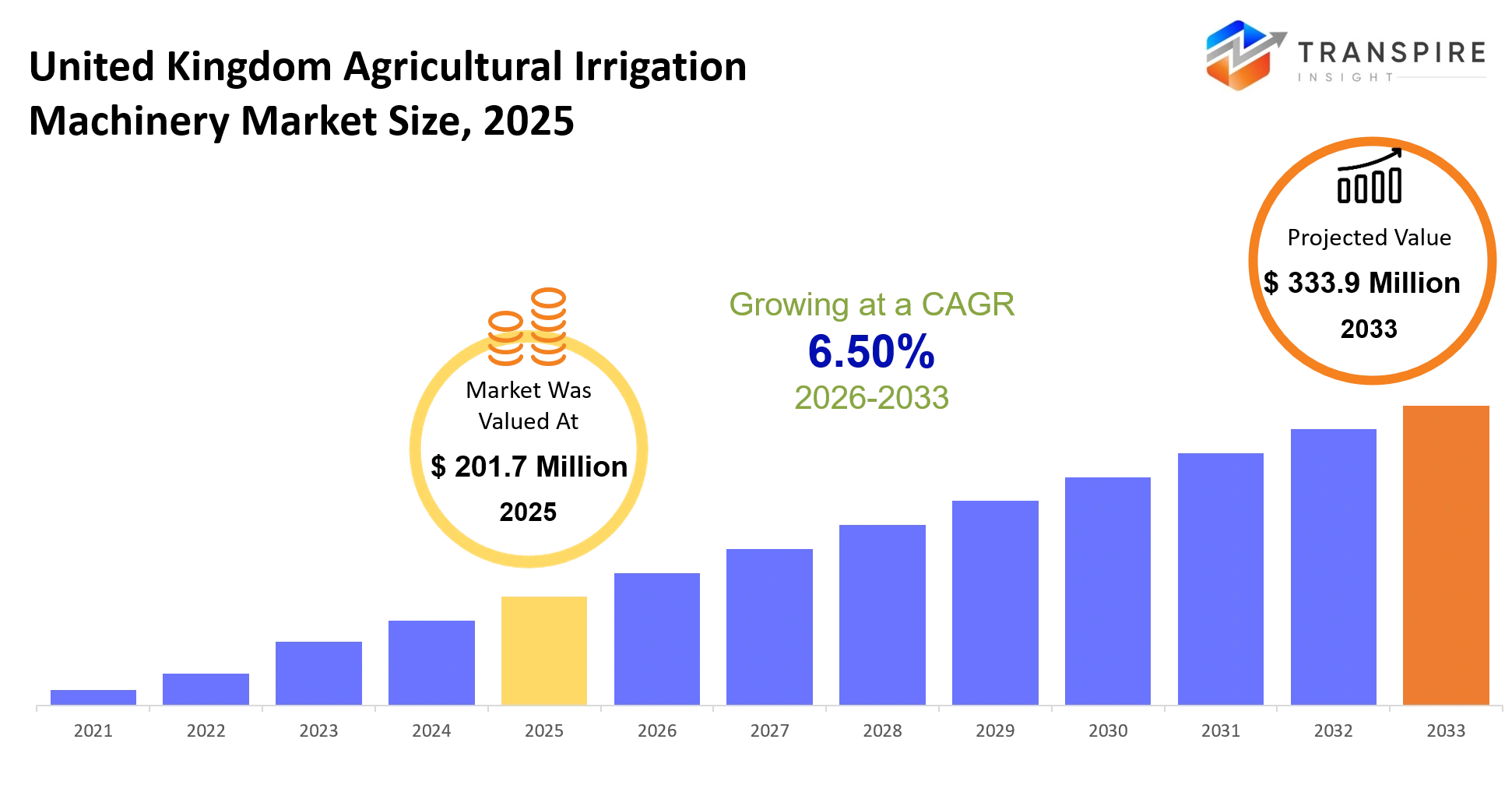
- United Kingdom Agricultural Irrigation Machinery Market Size 2025: USD 201.7 Million
- United Kingdom Agricultural Irrigation Machinery Market Size 2026: USD 214.8 Million
- United Kingdom Agricultural Irrigation Machinery Market Size 2033: USD 333.9 Million
- United Kingdom Agricultural Irrigation Machinery Market CAGR: 6.50%
- United Kingdom Agricultural Irrigation Machinery Market Segments: By Equipment Type (Sprinkler, Drip, Pivot, Lateral Move Systems, Pumps, Others), By Component (Pipes, Valves, Emitters, Controllers, Sensors, Others), By Power Source (Electric, Diesel, Solar, Hybrid, Others), By Farm Size (Small, Medium, Large, Commercial, Others), By Application (Field Crops, Fruits & Vegetables, Greenhouses, Turf & Landscape, Others), By Distribution Channel (Direct Sales, Dealers, Online, Distributors, Others)
United Kingdom Agricultural Irrigation Machinery Market Summary
As per Transpire Insight Analysis, the UK market reached USD 201.7 Million in 2025 and is projected to grow to USD 333.9 Million by 2033 at a compound annual growth rate of 6.50%, reflecting sustained demand from intensifying agriculture.
In the UK, agricultural irrigation helps address water scarcity during dry periods - enabling all-year-round crop growth on many different types of farms. The industry encompasses both equipment makers and component suppliers as well as distribution networks serving small plots right up to very large commercial set-ups.
Climate variability is becoming an ever-more apparent structural change. UK farmers have to cope with very irregular rainfall patterns - making supplementary irrigation necessary rather than a luxury item. Between 2020 and 2023, increasing summer water shortages led to a rise of more than 25% in irrigation adoption amongst field crop producers. The Environment Agency brought in new abstraction licensing frameworks in 2022 which really restricted irrigation water availability during the height of summer - except when farmers used licensed sources. This regulatory adjustment compelled growers to invest in highly efficient drip systems - and even water recycling infrastructure.
The other key factor driving things forward is sustainability pressure. UK retailers, processors, and overseas buyers are asking for irrigation systems with officially verified water efficiency ratings more and more often. European Union Ecolabel requirements and current UK environmental standards actually state minimum water use efficiency thresholds for farm supplies. Equipment manufacturers responded by really pushing drip and micro-irrigation systems that cut down water usage by as much as 30 to 50% compared to old-fashioned sprinkler systems. This certification-driven purchasing created a long-term upgrade cycle - extending equipment replacement times whilst also raising average sale prices right across the market.
Key United Kingdom Agricultural Irrigation Machinery Market Insights
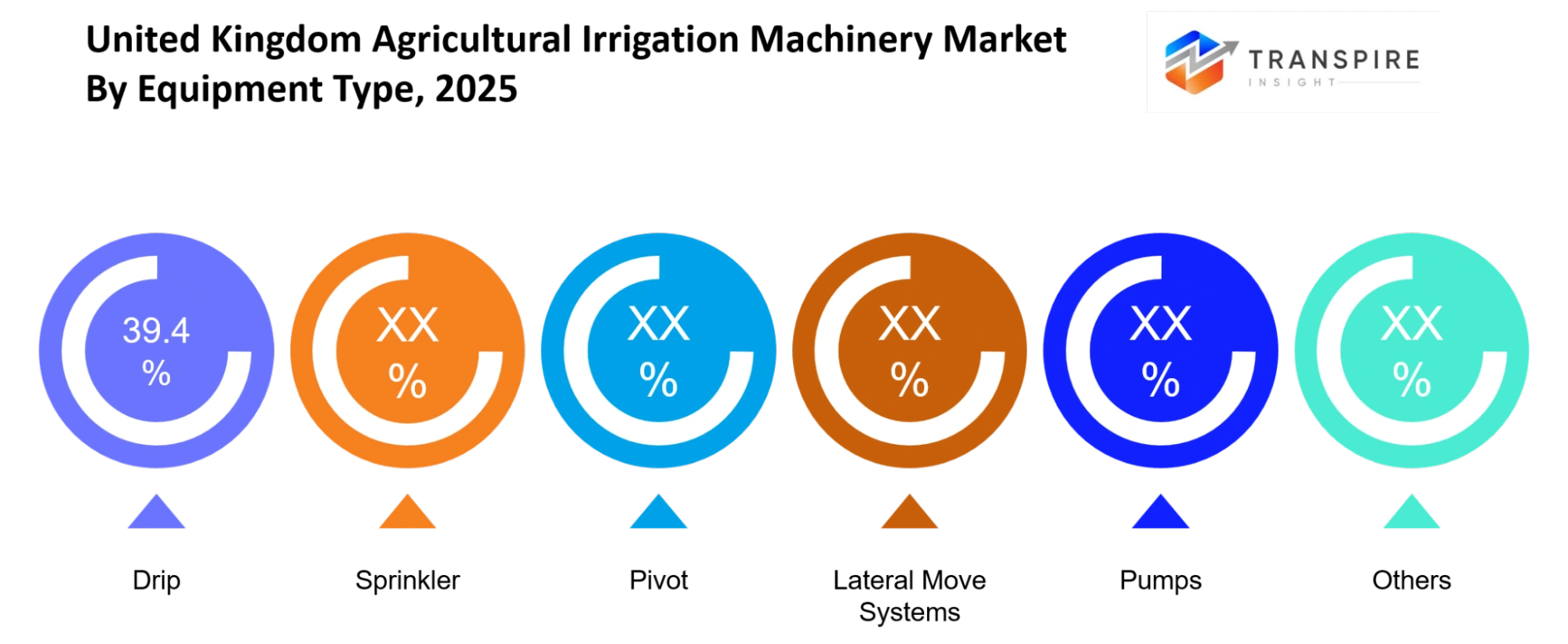
- Drip irrigation systems really lead the equipment market - they'll have a 39. 4% revenue share in 2025 because of water efficiency requirements and our need for very precise application in high-value crops like soft fruits and veggies.
- Sprinkler systems still keep 28% of the market share but are losing relative importance because of stricter water regulations pushing growers towards even more efficient options - although these alternatives may be more expensive than sprinklers themselves.
- Electric power systems make up about 45% of the market - this reflects the UK's pretty reliable and cost-competitive grid compared to diesel, though solar-hybrid systems are really growing at double-digit rates every year.
- Small to medium-sized farms produce 62% of unit volume but only represent 35% of market revenue - while large commercial operations account for much higher average equipment spending per farm.
- Field crop irrigation makes up about 38% of the market value, yet fruits and veggies really represent the fastest-growing segment because of very intensive production needs and those premium prices that justify investing in equipment.
- Direct sales from manufacturers account for 34% of commercial deals, whilst dealer networks remain super important for smallholder and remote farm access points all over the country.
- Valmont Industries and Lindsay Corporation together roughly hold around 28% of the UK irrigation equipment market via their respective product lines and well-established dealer connections.
- Netafim and Jain Irrigation dominate the drip irrigation component part segment - they leverage huge global manufacturing scale and technical service capabilities that smaller regional competitors simply can't compete with.
- Online distribution channels really grew 18% year-over-year in 2024 because of component sales and spare parts - rather than whole system equipment itself.
- Government grants for modernizing irrigation infrastructure under CAP transition programs gave us about $45 million extra demand support in both 2024 and 2025.
What are the Key Drivers, Restraints, and Opportunities in the United Kingdom Agricultural Irrigation Machinery Market?
Driver: Water shortages during very crucial growth stages - combined with more stringent abstraction licensing regulations - create a pretty clear necessity for investing in new equipment. The frequency of severe UK summer droughts has actually gone up from roughly one per decade before 2010 to about one every three to four years by 2023. Farmers simply can't absorb yield losses due to moisture stress, so investing in irrigation becomes a vital business need rather than just an optional upgrade. Government help through the Agricultural Transition Plan offers around GBP 2. 4 billion in structural funding, with rural business grants specifically focusing on upgrading irrigation systems. This financial support greatly reduces capital constraints - something that had previously really limited adoption among smaller-scale operations.
Restraint: The high upfront cost and relatively long payback period create quite a hurdle for adoption by farms under 50 hectares. A basic drip system for 10 hectares would set you back approximately GBP 8, 000 to GBP 12, 000 installed, with a 5-7 year payback period depending on crop value and water pricing. Small farms run on very tight margins indeed - where capital expenses really represent a significant portion of their annual profits, making equipment choices extremely sensitive to changes in commodity prices. Moreover, uncertainty over future water pricing makes long-term financial planning very difficult: regulatory changes might alter water costs unpredictably - which would affect your entire equipment investment return calculation even further. Uncertainty surrounding future abstraction licensing also keeps many growers from making those larger multi-year capital commitments.
Opportunity: Integrating irrigation systems vertically with soil moisture sensors and automated controllers offers a chance to achieve much higher profit margins from recurring software subscription fees and data analysis services. Smart irrigation systems that adjust water delivery based on real-time soil moisture readings can cut down waste by 15-25% when compared to traditional timer-based systems. UK precision agriculture companies including soil technology specialists are teaming up with irrigation equipment manufacturers to bundle their hardware products with expert soil data interpretation services. This coming together really opens up a new software and services market estimated at GBP 50 to 75 million by 2030 as growers shift away from buying expensive equipment towards more result-oriented water management agreements based on outcomes.
What Has the Impact of Artificial Intelligence Been on the United Kingdom Agricultural Irrigation Machinery Market?
Artificial intelligence really changes the face of UK irrigation through predictive water demand modelling and self-operating system control. Machine learning algorithms trained on lots of historical weather information, soil properties, and plant development phases can now forecast our water needs much more accurately than older methods. Toro Company and Hunter Industries have both introduced AI-integrated irrigation controllers in 2024 that adjust water flow automatically based on weather forecasts - this greatly reduces the need for manual adjustments and saves a lot of wasted water.
Sensor-based monitoring systems linked with AI anomaly detection find equipment failures even before they happen. Leaks in valves, pump cavitation, and faulty controllers all create quite distinct pressure and flow patterns that machine learning models spot in real time. This predictive maintenance method cuts down unexpected breakdowns and increases the lifespan of your gear by letting you do preventive fixes instead of emergency replacements all the time.
The biggest barrier to adoption is how complicated it is to integrate these systems and what kind of data infrastructure is required. Most UK farms run with very limited high-speed internet connections, making real-time cloud-based AI systems rather impractical indeed. There are some local processing solutions available but these do make hardware costs go up by 15 to 25 percent extra. Also, training data availability holds back AI accuracy a bit: models specific to our region's soil, weather, and crops really need localised datasets that suppliers have only just started gathering thoroughly across different types of UK farms.
Key Market Trends
- Drip irrigation system revenue grew 9.2% year-over-year in 2024, with adoption among field crop producers accelerating due to water licensing restrictions that make efficient equipment mandatory.
- Solar-powered hybrid irrigation systems are expanding at 18% annually as equipment costs decline and government rural electrification grants make off-grid systems economically competitive.
- Smart irrigation controllers with soil moisture feedback mechanisms grew from 2% market penetration in 2020 to approximately 12% in 2025, reflecting grower demand for precision water management.
- Component-only sales, including replacement valves, emitters, and sensors, increased 12% year-over-year, indicating an established installed base transitioning into maintenance and upgrade cycles.
- Equipment manufacturers launched 24 new irrigation products between January 2024 and March 2026, concentrated in water-efficient drip systems and solar-hybrid power configurations.
- Dealer networks contracted by approximately 8% from 2020 to 2025 as online distribution and direct manufacturer sales channels captured growing share of component and replacement part transactions.
- Government agricultural transition support directed GBP 320 million toward irrigation modernization between 2023 and 2025, creating temporary demand acceleration that may moderate post-2026.
- Water reuse and recycling system installations grew 15% annually, driven by growers seeking to optimize under-licensed water availability and reduce abstraction dependency.
- Precision agriculture integration with irrigation platforms accelerated in 2024, with 18 announced partnerships between irrigation equipment manufacturers and soil-data analytics companies.
- Export demand for UK-manufactured irrigation components remained constrained, with domestic market focus increasing as trade friction elevated input costs for cross-border sales.
United Kingdom Agricultural Irrigation Machinery Market Segmentation
By Equipment Type
Drip irrigation systems command 39.4% of market revenue due to water efficiency requirements and adoption among high-value crop growers. These systems deliver water directly to plant root zones, minimizing waste. Sprinkler systems retain 28% share despite slower growth as cost-sensitive smallholders continue purchasing for general-purpose use. Pivot and lateral move systems account for 18% of revenue, concentrated on large commercial field crop operations where equipment scale justifies higher per-hectare installation costs. Pump equipment represents 10% of the market, spanning replacement and component sales to existing installations. Others, including specialty systems and drip line accessories, constitute 5% of total revenue.
By Component
Pipes and fittings dominate component revenue at 32%, driven by replacement demand from aging irrigation networks. Valves account for 24% of component sales, essential for system control and flow regulation. Emitters and drippers contribute 22%, concentrated in drip system maintenance and retrofitting projects. Controllers represent 12% of component revenue but are the fastest-growing category as automation adoption accelerates. Sensors, including soil moisture and pressure devices, comprise 7% of component sales and are expanding at double-digit rates as precision irrigation gains adoption. Other components including filters and regulators make up 3% of the market.
By Power Source
Electric power systems account for 45% of market revenue, reflecting UK grid reliability and operational cost competitiveness for most farm types. Diesel-powered systems retain 32% share but face declining demand due to fuel cost volatility and emissions regulations tightening on agricultural machinery. Solar hybrid systems represent 15% of the market but are growing at 18% annually as equipment costs decline and government grants reduce capital barriers. Hybrid systems combining multiple power sources comprise 6% of the market, expanding as farms seek resilience against utility outages and fuel price spikes. Other power sources including wind and biogas systems constitute 2% of the market.
By Farm Size
Small farms under 20 hectares generate 25% of unit volume but only 12% of market revenue, reflecting lower equipment investment capacity and reliance on cost-effective sprinkler systems. Medium farms between 20 and 100 hectares account for 28% of unit volume and 23% of revenue, representing the core upgrade market for drip and automated systems. Large farms between 100 and 500 hectares comprise 32% of unit volume but 45% of revenue, driven by investment in efficient multi-system installations and component redundancy. Commercial operations over 500 hectares represent 15% of unit volume but 20% of revenue, concentrated on mega-installations and water recycling infrastructure. Others including turf management and horticulture operations constitute the remaining segments.
By Application
Field crops account for 38% of market value, including cereals, root vegetables, and pulses irrigated at scale across the UK breadbasket regions. Fruits and vegetables represent 31% of revenue, the fastest-growing segment due to intensive production requirements, premium crop pricing, and the concentration of drip irrigation adoption. Greenhouses and protected cultivation comprise 18% of market value, concentrated among specialist horticulture operations with year-round environmental control requirements. Turf and landscape irrigation accounts for 9% of revenue, spanning golf courses, sports fields, and ornamental turf management. Others including aquaculture and specialty nurseries constitute 4% of the market.
By Distribution Channel
Direct sales from manufacturers account for 34% of market revenue, concentrated among large commercial farms purchasing complete system installations. Dealer networks represent 32% of revenue, critical for geographic distribution and technical support services. Online channels comprise 16% of sales, growing fastest in component and replacement parts markets but less significant for complete system sales. Distributors account for 14% of revenue, primarily serving mid-sized dealer networks and agricultural retailers. Other channels including agricultural cooperatives and equipment leasing services constitute 4% of the market.
What are the Key Use Cases Driving the United Kingdom Agricultural Irrigation Machinery Market?
Field crop irrigation represents the largest use case, with water-stressed cereal and vegetable growers investing in sprinkler and drip systems to maintain consistent yields during summer dry periods. Premium soft fruit growers including strawberry and raspberry producers prioritize drip irrigation to optimize water application and reduce disease pressure from foliar wetting. Greenhouse operators depend on automated irrigation systems for year-round production scheduling and environmental control.
|
Report Metrics |
Details |
|
Market size value in 2025 |
USD 201.7 Million |
|
Market size value in 2026 |
USD 214.8 Million |
|
Revenue forecast in 2033 |
USD 333.9 Million |
|
Growth rate |
CAGR of 6.50% from 2026 to 2033 |
|
Base year |
2025 |
|
Historical data |
2021 - 2024 |
|
Forecast period |
2026 - 2033 |
|
Report coverage |
Revenue forecast, competitive landscape, growth factors, and trends |
|
Regional scope |
United Kingdom (England, Scotland, Wales, Northern Ireland) |
|
Key companies profiled |
Valmont Industries, Lindsay Corporation, Netafim, Jain Irrigation Systems, Rivulis, Rain Bird, Toro Company, Hunter Industries, Nelson Irrigation, T-L Irrigation, Komet Irrigation, Reinke Manufacturing, Bauer Group, EPC Industries, Irritec |
|
Customization scope |
Free report customization (regional & segment scope). Avail customized purchase options to meet your exact research needs. |
|
Report Segmentation |
By Equipment Type (Sprinkler, Drip, Pivot, Lateral Move Systems, Pumps, Others), By Component (Pipes, Valves, Emitters, Controllers, Sensors, Others), By Power Source (Electric, Diesel, Solar, Hybrid, Others), By Farm Size (Small, Medium, Large, Commercial, Others), By Application (Field Crops, Fruits & Vegetables, Greenhouses, Turf & Landscape, Others), By Distribution Channel (Direct Sales, Dealers, Online, Distributors, Others) |
Which Regions are Driving the United Kingdom Agricultural Irrigation Machinery Market Growth?
England leads UK irrigation equipment demand with approximately 65% of market revenue, concentrated in the East Anglia, East Midlands, and South East regions where water scarcity during summer peak growing season creates consistent equipment replacement demand. The Environment Agency's water licensing restrictions disproportionately impact English agriculture, creating mandatory equipment efficiency upgrades across mixed arable, vegetable, and soft fruit operations. Intensive greenhouse horticulture concentrated around Essex, Kent, and Lincolnshire generates above-average per-hectare equipment spending.
Scotland represents 18% of UK market revenue, with irrigation adoption concentrated in central belt operations and premium soft fruit regions. Water availability in Scotland exceeds England substantially, moderating irrigation necessity but not eliminating it. Scottish specialty crop producers including potatoes, berries, and vegetables invest in reliable systems to mitigate spring and summer deficits in specific seasons.
Wales accounts for 12% of market revenue, anchored by livestock and mixed farming operations where supplemental irrigation supports forage and root crop production. Welsh smallholdings dominate the market structure, constraining average equipment spending per operation. Government support through the Welsh Agricultural Investment Fund provides capital subsidies that offset equipment cost barriers for adoption.
Northern Ireland comprises 5% of market revenue, with irrigation concentrated among intensive vegetable and fruit producers. Relative water abundance reduces mandatory adoption pressure compared to England, limiting market growth compared to other UK regions.
Who are the Key Players in the United Kingdom Agricultural Irrigation Machinery Market and How Do They Compete?
Valmont Industries and Lindsay Corporation dominate the equipment segment through North American manufacturing scale and established UK dealer networks built over multiple decades. Both companies compete on product breadth, spanning center pivot systems for large operations to component supply for existing installations. Netafim and Jain Irrigation control the drip irrigation component segment through global manufacturing capacity and technical service depth that regional competitors struggle to match. Rain Bird and Toro Company leverage golf course and sports turf markets to cross-sell agricultural irrigation, particularly among precision-focused larger operations.
Rivulis pursues vertical integration by acquiring regional distributors and component manufacturers to consolidate supply chains and expand direct control over installation and maintenance relationships. Nelson Irrigation competes through specialization in lateral move and sprinkler systems with superior durability in UK weather conditions. T-L Irrigation and Komet Irrigation maintain regional relevance through dealer relationships and customization for local farm types but lack scale to compete with global manufacturers on price. Reinke Manufacturing focuses on large commercial pivot systems where UK demand remains constrained but stable.
United Kingdom Agricultural Irrigation Machinery Market Companies
- Valmont Industries
- Lindsay Corporation
- Netafim
- Jain Irrigation Systems
- Rivulis
- Rain Bird
- Toro Company
- Hunter Industries
- Nelson Irrigation
- T-L Irrigation
- Komet Irrigation
- Reinke Manufacturing
- Bauer Group
- EPC Industries
- Irritec
Recent Developments
In December 2025, Netafim launched an expanded UK service center network targeting East Anglia and the South East, committing to same-week component delivery and technical support expansion to capture growing drip irrigation demand. https://www.netafim.com (Netafim Press Release).
In October 2025, Valmont Industries completed the acquisition of a UK-based soil moisture sensor company, integrating data analytics capabilities into its irrigation control platform to support precision agriculture adoption. https://www.valmont.com (Valmont Investor News).
In August 2025, the UK Government announced GBP 180 million in additional irrigation modernization grants under the Agricultural Transition Plan, expanding equipment subsidy eligibility to include smart controller systems and renewable energy integration. https://www.gov.uk (UK Agriculture Department Release).
What Strategic Insights Define the Future of the United Kingdom Agricultural Irrigation Machinery Market?
The UK irrigation market will consolidate around water efficiency standards and regulatory compliance over the next five to seven years. Equipment manufacturers that position hardware as compliance enablers rather than discretionary upgrades will capture market share from competitors emphasizing cost or product breadth. The underlying force is regulatory tightening: water availability restrictions will likely expand beyond summer peak seasons into spring and autumn periods, creating year-round rather than seasonal irrigation necessity.
The hidden risk is government agricultural support discontinuation post-2026. Current CAP transition funding accelerates equipment purchases, temporarily inflating market growth. When subsidy programs conclude or reduce scope, demand normalization could occur rapidly. Additionally, British farm consolidation driven by Brexit-induced smallholder attrition will reduce total farm count by 12 to 15 percent through 2033, partially offsetting equipment adoption gains from efficiency requirements.
The forward opportunity is irrigation-as-a-service business model expansion. Water scarcity and equipment capital intensity create conditions favorable for equipment leasing and outcome-based water management contracts where service providers own systems and charge growers by water volume delivered. This model eliminates capital barriers for smallholders while creating recurring revenue streams for manufacturers. The strategic recommendation is to establish lease and service partnerships with agricultural finance providers and farm management consultancies before competitors consolidate this channel.
- By Equipment Type
- Sprinkler
- Drip
- Pivot
- Lateral Move Systems
- Pumps
- Others
- By Component
- Pipes
- Valves
- Emitters
- Controllers
- Sensors
- Others
- By Power Source
- Electric
- Diesel
- Solar
- Hybrid
- Others
- By Farm Size
- Small
- Medium
- Large
- Commercial
- Others
- By Application
- Field Crops
- Fruits & Vegetables
- Greenhouses
- Turf & Landscape
- Others
- By Distribution Channel
- Direct Sales
- Dealers
- Online
- Distributors
- Others
Frequently Asked Questions
Find quick answers to common questions.
The United Kingdom Agricultural Irrigation Machinery Market size is expected to reach USD 333.9 Million by 2033.
The key segments are By Equipment Type (Sprinkler, Drip, Pivot, Lateral Move Systems, Pumps, Others), By Component (Pipes, Valves, Emitters, Controllers, Sensors, Others), By Power Source (Electric, Diesel, Solar, Hybrid, Others), By Farm Size (Small, Medium, Large, Commercial, Others), By Application (Field Crops, Fruits & Vegetables, Greenhouses, Turf & Landscape, Others), and By Distribution Channel (Direct Sales, Dealers, Online, Distributors, Others).
Major players include Valmont Industries, Lindsay Corporation, Netafim, Jain Irrigation Systems, Rivulis, Rain Bird, Toro Company, Hunter Industries, Nelson Irrigation, T-L Irrigation, Komet Irrigation, Reinke Manufacturing, Bauer Group, EPC Industries, and Irritec.
The United Kingdom Agricultural Irrigation Machinery Market size is USD 201.7 Million in 2025.
The United Kingdom Agricultural Irrigation Machinery Market CAGR is 6.50% from 2026 to 2033.
- Valmont Industries
- Lindsay Corporation
- Netafim
- Jain Irrigation Systems
- Rivulis
- Rain Bird
- Toro Company
- Hunter Industries
- Nelson Irrigation
- T-L Irrigation
- Komet Irrigation
- Reinke Manufacturing
- Bauer Group
- EPC Industries
- Irritec
About the Authors

Kartik bhong
I am Kartik Bhong, a Senior Research Analyst at Transpire Insight, specializing in the Packaging, Manufacturing, and Construction industry. My work focuses on analyzing market trends, emerging technologies, industry regulations, and competitive landscapes to deliver accurate, data-driven insights. I am passionate about transforming complex industry information into clear, practical content that helps businesses, professionals, and decision-makers stay informed and make confident strategic decisions. Through continuous research and a strong commitment to accuracy, I strive to create reliable, well-researched content that reflects the latest developments across these dynamic industries and supports the vision of Transpire Insight in delivering valuable market intelligence.

Chakradhar Khansole
Chakradhar serves as the Research Director at Transpire Insight, bringing over 8 years of experience in technology, innovation, and strategic market intelligence. He specializes in transforming complex market data into actionable business insights that enable organizations to make informed, growth-oriented decisions. Recognized for his strategic vision and analytical expertise, Chakradhar leads high-impact research initiatives, delivering comprehensive market assessments, competitive intelligence, and forward-looking industry analysis.
Recently Published Reports
-
Apr 2026
Handling and Lifting Equipment Market
Handling and Lifting Equipment Market Size, Share & Analysis Report By Product (Cranes and Hoists, Forklifts, Conveyor Systems, Aerial Work Platforms, Others), By Application (E-Commerce, Automotive and Railway, Food and Beverages, Aviation, Others), and Geography (North America, Europe, Asia-Pacific, Middle East and Africa, South and Central America), 2021 - 2031
-
Apr 2026
HVAC Equipment Market
HVAC Equipment Market Size, Share & Analysis Report By Heating Equipment Type (Boilers and Furnaces, Heat Pumps, and Unitary Heaters), By Ventilation Equipment (Air Handling Units, Humidifiers and Dehumidifiers, Air Filters, and Fan Coiling Units), By Air Conditioning Equipment (Unitary Air Conditioners, Room Air Conditioners, Packaged Terminal Air Conditioners, and Chillers), By End User (Commercial, Residential, Industrial, and others), and Geography (North America, Europe, Asia-Pacific, Middle East and Africa, South and Central America), 2021 – 2031
-
Apr 2026
Refrigeration Valves Market
Refrigeration Valves Market Size, Share & Analysis Report By Type (Solenoid Valves, Expansion Valves, Check Valves, Service Valves, Others), By Application (Commercial Refrigeration, Industrial Refrigeration, Transport Refrigeration, Residential Refrigeration, Air Conditioning Systems), By End User (Food and Beverage Industry, Pharmaceutical Industry, HVAC Industry, Chemical Industry, Others), and Geography (North America, Europe, Asia-Pacific, Middle East and Africa, South and Central America), 2021 – 2031
-
Apr 2026
E-Commerce Packaging Materials Market
E-Commerce Packaging Materials Market By Material Type (Corrugated Boxes, Paper & Paperboard, Foam & Cushioning Materials, Plastic Packaging, Flexible Packaging, Protective Packaging, Others), By Product(Primary Packaging, Secondary Packaging, Tertiary Packaging), By Packaging Function (Protective Packaging, Branding & Presentation Packaging, Transit & Logistic Packaging, Sustainable Packaging, Tamper Evidence Packaging), By End-User (Retail & Consumer Goods, Electronic Appliances, Food & Beverages, Healthcare & Pharmaceutical, Fashion & Apparel, Home & Furnishing, Others); By Industry Analysis, Size, Share, Growth, Trends, and Forecasts 2021-2033