

United Kingdom Aesthetic Needles and Cannulas Market Summary
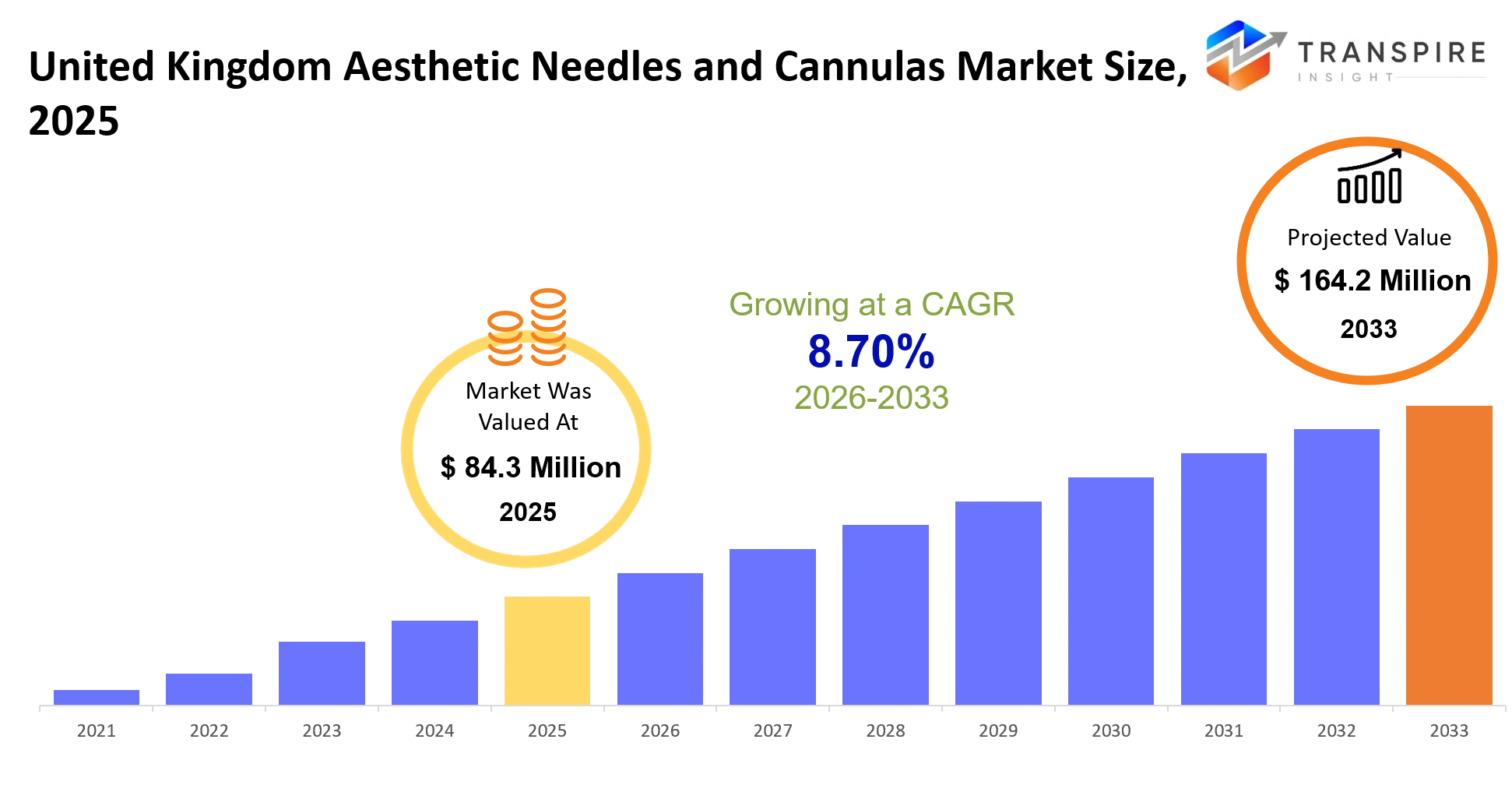
As per Transpire Insight Analysis the United Kingdom Aesthetic Needles and Cannulas Market size is estimated at USD 84.3 Million in 2025 and is anticipated to reach USD 164.2 Million by 2033, growing at a CAGR of 8.70% from 2026 to 2033.
Aesthetic needles plus cannulas help clinics and cosmetic practitioners do minimally invasive facial and body work with more finesse , so procedures like dermal filler placement , skin rejuvenation , and contouring can be done with better accuracy while also cutting down tissue disturbance and shortening recovery time. In the last 3–5 years, the United Kingdom market seems to have moved toward newer cannula designs, devices that are much more centered on safety, and a clear practitioner liking for tools that make procedural control easier in real life. The rise of non-surgical aesthetics has gotten pushed along by post-pandemic shifts in what people tend to book , plus the steady growth of private aesthetic clinics all around the UK. Because of all that, providers are more willing to put money into higher-grade disposable instruments, which backs safer outcomes and more uniform results. And as training expectations and day-to-day clinical standards keep climbing, manufacturers get more openings linked to product innovation, premium branding, and dependable supply routes .
United Kingdom Aesthetic Needles and Cannulas Market Size & Forecast:
- United Kingdom Aesthetic Needles and Cannulas Market Size 2025: USD 84.3 Million
- Expected Market Value 2033: USD 164.2 Million
- Forecast CAGR: 8.70%
- Leading region in 2025: England
- Fastest Growing region: Scotland
- Key Profile: Merz Aesthetics, Galderma, Allergan Aesthetics, Sinclair Pharma, Croma Pharma, TSK Laboratory, Needle Concept, Sterimedix, Dermasculpt, SoftFil, Medtronic, Becton Dickinson, Integra LifeSciences, Vitrex Medical, Huons
Key Market Insights
- The United Kingdom kind of dominates the regional market, sitting at about 70% share in 2025, helped along by London-led concentration of aesthetic clinics , plus this big lift from private healthcare spending.
- Northern England and Scotland are the fastest moving regions in the 2025–2030 window, and that’s mainly due to specialist clinics getting more numerous, and also more regional availability of cosmetic services.
- In the product breakdown, blunt-tip cannulas take the lead with roughly 45% share, because they’re usually preferred for precise filler delivery , and for lowering tissue damage risks.
- After that, hypodermic aesthetic needles keep the second-largest segment spot, supported by broad usage across injectable treatment procedures.
- Looking ahead 2025–2030, advanced safety cannulas show up as the fastest-growing product group, driven by practitioners who are increasingly focusing on accuracy and on reducing complications.
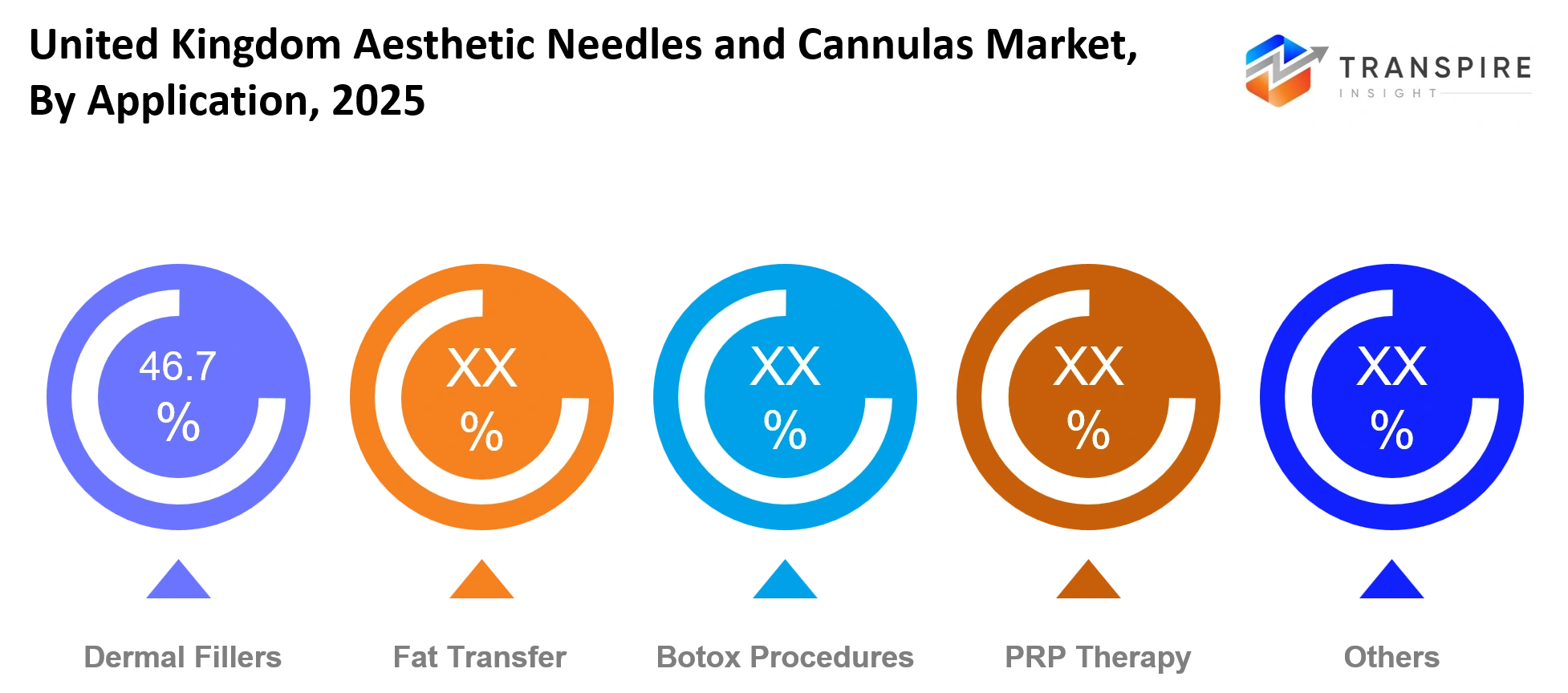
- For applications, dermal filler procedures pretty much run everything, with close to 60% share in 2025, which lines up with strong adoption for facial sculpting and contouring treatments.
- Skin rejuvenation is the application that grows quickest, aided by younger patient tastes and by the steady expansion of non-surgical aesthetic offerings.
- On the end-user side, private aesthetic clinics lead the way, holding around 65% share , and also representing most of the device purchase volume.
- Meanwhile, med spas and dermatology centres are expected to grow fastest through 2025–2030, as their treatment portfolios keep expanding.
What are the Key Drivers, Restraints, and Opportunities in the United Kingdom Aesthetic Needles and Cannulas Market?
The United Kingdom aesthetic needles and cannulas industry is sort of being pulled into shape by precision treatments showing up more , regulatory attention getting tighter, and clinics putting more money behind safer injection tools. In the private aesthetic space providers are gradually refreshing their device collections, because people are leaning toward minimally invasive options, with quicker downtime, and yeah it feels like recovery periods are getting shorter in practice too.
The biggest push is the tech move toward safety-engineered cannulas and precision delivery systems. Regulatory focus on practitioner capability ,and on injectable treatment standards too has made clinics more willing to choose higher quality devices. That, in turn helps procedural consistency stay steadier, lowers the likelihood of complications, and it also supports premium pricing for treatments. From a Transpire Insight style review of regional procurement news and launch timelines, supply chain concentration still looks like the main “do or die” execution concern.
The main drag is a kind of uneven uptake of newer techniques among practitioners across independent clinics. Smaller operators often hit cost hurdles when they try to switch from conventional needles to advanced cannula systems. Because of that, budget limits can slow upgrades, reduce how far premium products can spread, and it may even delay new product rollouts in smaller nearby regional markets.
The key opportunity seems to be AI-supported treatment planning along with digital training platforms. Manufacturers that put resources into connected education tools and data-led procedural guidance can make adoption easier for up-and-coming clinics. Overall the UK private aesthetics sector gives fairly favourable conditions for technology-enabled product differentiation, even when competition is strong.
What Has the Impact of Artificial Intelligence Been on the United Kingdom Aesthetic Needles and Cannulas Market?
Artificial intelligence and digital technologies are starting to nudge the UK aesthetic device ecosystem, mostly in the way things like inventory planning, compliance management, and practitioner support are handled. Clinics, and suppliers are leaning more on digital platforms to keep an eye on product usage, automate stock tracking, and also keep up the paperwork that is needed for safer injectable procedures . Instead of doing everything manually, machine learning models can look at purchasing rhythms and treatment volumes, then that helps with demand prediction, so distributors can avoid runs outs and handle inventory with a bit more calm and control.
On top of that, digital analytics tend to help with performance tuning by spotting procedure patterns, reshaping supply allocation, and letting manufacturers sync production timing with what the market actually wants. In practice these setups can lighten the administrative burden, and push operational efficiency across aesthetic clinics as well as distribution networks. Even automated compliance monitoring tools can improve reporting accuracy and support regulatory readiness, though not everyone has the same setup.
Still, AI take up feels fairly limited , because many aesthetic providers run as standalone businesses, with data that is fragmented or stored in separate systems. Integration costs can be high, data access is uneven, and digital infrastructure is not always there in the first place, which slows down broader rollout. But as bigger clinic groups move toward connected platforms, AI functions will likely become more available across the UK aesthetic needles and cannulas market, with more consistent visibility across the value chain.
Key Market Trends
- From 2024 to 2026, UK clinics started using blunt-tip cannulas a bit more , as practitioners looked for lower trauma alternatives for injectable procedures that feel a little gentler in day-to-day work.
- Safety engineered needle designs got more attention after 2023 , kind of in line with a stronger push to cut down treatment complications and also to lift compliance expectations.
- Between 2022 and 2025, private aesthetic clinics bumped up procurement budgets, which then helped premium disposable devices move forward in adoption.
- After 2024, digital ordering platforms appeared, and they let distributors see inventory better, so supply interruptions became less frequent, or at least easier to manage.
- In 2025, manufacturers leaned harder into product differentiation via ergonomic needle designs , and they also added injection control features that work smoother in practice.
- London stayed the main driver of aesthetic service activity in 2024 , while regional clinics began offering more specialist treatment options, slightly expanding their coverage.
- Training partnerships between practitioners and companies increased starting in 2023 , because brands really focused on correct device handling and consistent procedure execution.
- Sustainable packaging initiatives showed up across medical device suppliers in 2024–2025, aiming at reducing clinical waste management costs, and generally making operations feel tighter.
- After 2025, AI based forecasting tools started entering healthcare supply chains, improving inventory planning accuracy for distributors.
- By 2025, strategic partnerships between aesthetic manufacturers and training providers also helped reinforce market positioning, sort of by combining expertise and access.
United Kingdom Aesthetic Needles and Cannulas Market Segmentation
By Product Type :
Needles still stay pretty widely used for aesthetic procedures, since clinics basically need dependable instruments for those more accurate injectable treatments. Microcannulas are getting more attention right now, maybe because their entry tends to be smoother, the surrounding tissue gets less disturbance, and practitioners often have better steering while placing filler. Blunt cannulas, meanwhile, tend to back up safer approaches in facial work, since they help lessen bruising and overall discomfort .
Sharp needles still fit well for procedures that need exact delivery and tight injection depth control. There are also other product groups, like specialized designs, for more specific treatment requirements. Manufacturers keep concentrating on ergonomics, improved materials , and stronger safety features, all because the standards are changing and aesthetic professionals expect more, every year.
By Application :
Dermal fillers are a big application area , since clinics use injectable solutions meant for facial volume restoration , contouring, and wrinkle easing. There’s still a big push for precise delivery devices because practitioners want steady results and better patient comfort overall. Even fat transfer procedures need more specialized tools that help with accurate placement during cosmetic enhancement sessions, you know.
Meanwhile Botox procedures keep strong momentum across aesthetic clinics , mostly due to routine maintenance treatments and how widely patients already get them. PRP therapy applications are also growing through cosmetic skin and hair programs. Beyond that , there are other directions too , like newer procedures that demand advanced injection methods and dependable disposable devices , which makes sense in practice.
By Material :
Stainless steel still comes out as the go to material , mostly because manufacturers really value strength, durability, and that fit with medical standards. Stainless steel needles and cannulas help keep a high precision feel during injectable procedures , and they also tend to deliver steady performance across different treatment areas. So material quality stays a key consideration when clinics pick products, not just a background detail.
At the same time , polymer based choices are getting more attention , mainly because they’re light weight in construction and there is more design flexibility. Companies are looking into polymer materials for specialized use cases where handling characteristics need to be different. And then, other materials are used for more niche product development, aiming at better safety, improved comfort, and overall treatment efficiency .
By End User :
Dermatology clinics are a pretty big end user group, because cosmetic specialists do a high volume of injectable treatments. In practice, clinics keep putting money into advanced needles and cannulas, not only to lift procedure quality but also to stay competitive with their service line, you know. MedSpas are also ramping up usage as non surgical aesthetic treatments keep turning into more of private cosmetic services
Hospitals tend to use these aesthetic devices mostly within focused dermatology and reconstructive departments, so it’s a bit narrower. Still, other end users show up too like cosmetic centres and independent practitioners, who really need reliable injection equipment. As private providers keep expanding, there’s more demand for premium disposable products and newer treatment tools, and that whole cycle moves faster over time
By Procedure Type :
Facial aesthetics see quite a lot of major procedure activity, mostly because fillers are being used so often , along with wrinkle treatments and contouring solutions. Practitioners do end up needing precise instruments, to make sure results look natural, and also to handle the more complex facial treatment zones. Body contouring procedures are getting attention too , since many clinics are broadening their cosmetic treatment portfolios.
Hair restoration procedures with injectable techniques are still evolving, especially with platelet based therapies and other regenerative approaches. There are also several other specialized cosmetic applications that are becoming more common, partly because device designs are improving. In general, product innovation should help enable wider adoption, across the different aesthetic treatment categories.
By Distribution Channel :
Distributors still stay an important channel, because clinics depend on dependable supply networks, for usual device procurement, and such. Direct sales channels help the manufacturer keep solid ties with large clinics and healthcare groups. Online platforms are also picking up steam, by making ordering feel more simple, and giving smaller providers wider reach on product choices.
Digital purchasing systems improve inventory control and make product comparison easier, especially for aesthetic professionals. Other channels include specialized medical suppliers that serve regional clinics and independent practitioners too. Distribution plans will keep leaning on swifter delivery, good product availability, and tighter supplier relationships.
What are the Key Use Cases Driving the United Kingdom Aesthetic Needles and Cannulas Market?
Dermal filler procedures are seeing big use across United Kingdom aesthetic clinics, so there’s strong demand for precision needles and cannulas, you know. Dermatology clinics and MedSpas tend to buy aesthetic devices for things like facial sculpting, wrinkle reduction, and keeping injectable results consistent during minimally intrusive treatments.
Also, fat transfer treatments and PRP therapy are becoming more common across cosmetic centres and dermatology providers. Fat transfer usually needs controlled injection tools for body contour improvement, whereas PRP therapy helps with regenerative skin and hair programs.
More recently, new applications are showing up, like upgraded skin rejuvenation approaches and more personalized beauty care inside premium clinics. Digital treatment planning plus refined injection technologies may open fresh opportunities for specialized aesthetic providers over the forecast period, though.
|
Report Metrics |
Details |
|
Market size value in 2025 |
USD 84.3 Million |
|
Market size value in 2026 |
USD 91.6 Million |
|
Revenue forecast in 2033 |
USD 164.2 Million |
|
Growth rate |
CAGR of 8.70% from 2026 to 2033 |
|
Base year |
2025 |
|
Historical data |
2021 - 2024 |
|
Forecast period |
2026 - 2033 |
|
Report coverage |
Revenue forecast, competitive landscape, growth factors, and trends |
|
Regional scope |
United Kingdom (England, Scotland, Wales, Northern Ireland) |
|
Key company profiled |
Merz Aesthetics, Galderma, Allergan Aesthetics, Sinclair Pharma, Croma Pharma, TSK Laboratory, Needle Concept, Sterimedix, Dermasculpt, SoftFil, Medtronic, Becton Dickinson, Integra LifeSciences, Vitrex Medical, Huons. |
|
Customization scope |
Free report customization (country, regional & segment scope). Avail customized purchase options to meet your exact research needs. |
|
Report Segmentation |
By Product Type (Needles, Microcannulas, Blunt Cannulas, Sharp Needles, Others); By Application (Dermal Fillers, Fat Transfer, Botox Procedures, PRP Therapy, Others); By Material (Stainless Steel, Polymer, Others); By End User (Hospitals, Dermatology Clinics, MedSpas, Others); By Procedure Type (Facial Aesthetics, Body Contouring, Hair Restoration, Others); By Distribution Channel (Direct Sales, Distributors, Online, Others). |
Which Regions are Driving the United Kingdom Aesthetic Needles and Cannulas Market Growth?
London and the South East region kind of leads the United Kingdom Aesthetic Needles and Cannulas Market, with an estimated 45–50% share in 2025, more or less. You can see it clearly because private aesthetic clinics , specialist dermatology centres, and those advanced cosmetic training facilities are pretty concentrated there. That mix helps adoption stay strong in a way that feels more “immediate” compared to other places. Dense networks of practitioners, distributors, and premium healthcare providers also keep product availability steady and push innovation along. Leadership should keep going through the forecast period too since higher-value cosmetic procedures and specialist services stay grouped around the biggest urban healthcare hubs.
Scotland on the other hand is more steady, acting as a stable revenue contributor. This is tied to consistent healthcare standards, regulated clinical practices, and gradual investment in private dermatology services. It feels different from London because the provider base is smaller but more structured, with a focus on dependable treatment delivery rather than just high-volume cosmetic centres. Solid medical infrastructure and steady procurement routines support reliable demand for disposable aesthetic devices. Clinic growth plus ongoing professional training programs should keep Scotland’s contribution in place.
Northern England is starting to move faster as private aesthetic clinics keep expanding beyond the usual metropolitan zones. Better access to specialist cosmetic services, plus growing investment in regional healthcare businesses, has opened up new procurement channels. MedSpa networks are widening, and independent practitioners are playing a bigger role in adoption of advanced injection tools. From 2026–2033 the growth pattern should give manufacturers and distributors a chance to form regional partnerships, and reach those still underserved markets with more confidence.
Who are the Key Players in the United Kingdom Aesthetic Needles and Cannulas Market and How Do They Compete?
Competition in the United Kingdom Aesthetic Needles and Cannulas Market still looks kinda moderately fragmented, and companies keep pushing against each other using product precision, safety add-ons, distribution reach and practitioner support, yes. Most established suppliers keep trying to guard their market share with trusted product lines, but meanwhile specialized brands are finding openings by leaning into newer designs and more tailored aesthetic solutions. In the end, clinics and healthcare providers tend to care about product reliability, real clinical usability, and whether supplies stay consistent, especially when demand gets hectic.
Merz Aesthetics competes with premium aesthetic offerings alongside practitioner education programs that help drive uptake across cosmetic clinics. Galderma leans on an integrated aesthetic treatment portfolio approach, pairing injectable products with clinical support materials so they don’t just feel like device-only suppliers. Teoxane goes for specialized filler technologies and precision-oriented treatment options, targeting professionals who want advanced cosmetic procedures.
Braun differentiates using medical-grade manufacturing know-how, plus safety-driven device development. Terumo Corporation, on the other hand, competes through needle engineering improvements and manufacturing strength that helps keep performance steady. These players tend to expand through product innovation, distributor ties, and investments in clinical training networks, which is kind of the whole playbook these days.
Company List
- Merz Aesthetics
- Galderma
- Allergan Aesthetics
- Sinclair Pharma
- Croma Pharma
- TSK Laboratory
- Needle Concept
- Sterimedix
- Dermasculpt
- SoftFil
- Medtronic
- Becton Dickinson
- Integra LifeSciences
- Vitrex Medical
- Huons
Recent Development News
In January 2025, Hudson Meditech launched the Premium 9-Pin Needle 31G for skin booster treatments. The single-use multi-pin needle was designed to reduce leakage and injection discomfort during aesthetic procedures, strengthening the company’s position in precision skin booster delivery and expanding advanced needle options for aesthetic practitioners.
Source: https://huonsmeditech.com/
In February 2025, TSK Laboratory International introduced the STERiGLIDE cannula series with enhanced design features for aesthetic procedures. The cannula technology uses a proprietary surface treatment and dome-shaped tip design to improve glide performance, filler placement accuracy, and patient comfort, supporting adoption of higher-precision cannulas in aesthetic clinics.
Source: https://www.tsklab.com/
What Strategic Insights Define the Future of the United Kingdom Aesthetic Needles and Cannulas Market?
The United Kingdom Aesthetic Needles and Cannulas Market is kind of headed , toward higher precision, safety focused injection solutions over the next 5–7 years, pushed by stricter practitioner standards, more demand for minimally intrusive procedures , and also a strong preference for devices that help keep treatment consistent. There’s also a less visible risk, sort of like the market becoming more concentrated around already established medical device suppliers, which might slow down innovation tempo and make the ecosystem too dependent on just a handful of manufacturers for specialized parts. Still , there’s an opportunity that’s starting to show up , in smart cannula and needle layouts , with enhanced ergonomics, tracking features , or better visualization options , since many clinics want tighter procedural command. Market players should really lean into collaborations with aesthetic training networks and put resources into differentiated product development, the kind that tackles practitioner workflow obstacles, instead of mostly chasing the lowest price. Doing this should help protect and improve positioning as regulatory pressure and clinical expectations continue to climb.
United Kingdom Aesthetic Needles and Cannulas Market Report Segmentation
By Product Type
- Needles
- Microcannulas
- Blunt Cannulas
- Sharp Needles
By Application
- Dermal Fillers
- Fat Transfer
- Botox Procedures
- PRP Therapy
By Material
- Stainless Steel
- Polymer
By End User
- Hospitals
- Dermatology Clinics
- MedSpas
By Procedure Type
- Facial Aesthetics
- Body Contouring
- Hair Restoration
By Distribution Channel
- Direct Sales
- Distributors
- Online
Frequently Asked Questions
Find quick answers to common questions.
The expected United Kingdom Aesthetic Needles and Cannulas Market size for the market will be USD 164.2 Million in 2033.
Key segments for the United Kingdom Aesthetic Needles and Cannulas Market are By Product Type (Needles, Microcannulas, Blunt Cannulas, Sharp Needles, Others); By Application (Dermal Fillers, Fat Transfer, Botox Procedures, PRP Therapy, Others); By Material (Stainless Steel, Polymer, Others); By End User (Hospitals, Dermatology Clinics, MedSpas, Others); By Procedure Type (Facial Aesthetics, Body Contouring, Hair Restoration, Others); By Distribution Channel (Direct Sales, Distributors, Online, Others).
Major United Kingdom Aesthetic Needles and Cannulas Market players are Merz Aesthetics, Galderma, Allergan Aesthetics, Sinclair Pharma, Croma Pharma, TSK Laboratory, Needle Concept, Sterimedix, Dermasculpt, SoftFil, Medtronic, Becton Dickinson, Integra LifeSciences, Vitrex Medical, Huons.
The United Kingdom Aesthetic Needles and Cannulas Market size is USD 84.3 Million in 2025.
The United Kingdom Aesthetic Needles and Cannulas Market CAGR is 8.70% from 2026 to 2033.
- Merz Aesthetics
- Galderma
- Allergan Aesthetics
- Sinclair Pharma
- Croma Pharma
- TSK Laboratory
- Needle Concept
- Sterimedix
- Dermasculpt
- SoftFil
- Medtronic
- Becton Dickinson
- Integra LifeSciences
- Vitrex Medical
- Huons
About the Authors

Pankaj Ghogare Patil
I am Pankaj Ghogare Patil, a Senior Research Analyst at Transpire Insight, specializing in the Pharmaceutical, Chemicals & Materials, Healthcare IT, and Biotechnology industry. My expertise lies in conducting comprehensive market research, analyzing industry trends, evaluating competitive landscapes, and translating complex data into actionable insights. At Transpire Insight, I closely follow emerging technologies, regulatory developments, and market innovations to create accurate, well-researched, and informative content that helps businesses and professionals make informed decisions. I am committed to producing credible, evidence-based articles that reflect industry best practices while making technical topics accessible and valuable for a broad audience.

Chakradhar Khansole
Chakradhar serves as the Research Director at Transpire Insight, bringing over 8 years of experience in technology, innovation, and strategic market intelligence. He specializes in transforming complex market data into actionable business insights that enable organizations to make informed, growth-oriented decisions. Recognized for his strategic vision and analytical expertise, Chakradhar leads high-impact research initiatives, delivering comprehensive market assessments, competitive intelligence, and forward-looking industry analysis.
Recently Published Reports
-
Apr 2026
AI in Diabetic Retinopathy Market
AI in Diabetic Retinopathy Market Size, Share & Analysis Report By Type (Screening AI Systems, Diagnostic AI Systems, and Predictive AI Models), By Application Segment (Hospitals, Ophthalmology Clinics, Diagnostic Centers, and Research and Development), and Geography (North America, Europe, Asia-Pacific, Middle East and Africa, South and Central America), 2021 - 2031
-
Apr 2026
Psychometric Tests Market
Psychometric Tests Market Size, Share & Analysis Report By Type (Personality Tests, Ability/Aptitude Tests, Skill/Knowledge Tests, and Others), By Application (Talent Acquisition and Talent Management), and Geography (North America, Europe, Asia-Pacific, Middle East and Africa, South and Central America), 2021 – 2031
-
Apr 2026
Rare Biological Sample Collection Market
Rare Biological Sample Collection Market Size, Share & Analysis Report By Type (Isolation Kits & Reagent, Blood Collection Tubes, and Others), By Application (Oncology, Transcriptomics, Pharmacogenomics, and Others), and Geography (North America, Europe, Asia-Pacific, Middle East and Africa, South and Central America), 2021 – 2031
-
Jul 2026
Diabetic Retinopathy Market
Diabetic Retinopathy Market Size, Share & Analysis Report By Type (Proliferative Diabetic Retinopathy, and Diabetic Macular Edema (DME)), By Treatment Type (Anti VEGF Drug, Steroid Implants, Laser Surgeries, and Vitrectomy), and Geography (North America, Europe, Asia-Pacific, Middle East and Africa, South and Central America), 2021 – 2031
Our Clients







