
Transmission & Distribution Equipment Market Summary:
According to Transpire Insight, a detailed research report on the market reflects that the power transmission application segment dominates the Transmission & Distribution Equipment Market, accounting for approximately 58% of the total market share worldwide. Siemens Energy AG leads the market with approximately around USD 40 billion in annual revenue and an estimated 8–12% global market share, making it a leading contributor to global market development, innovation, advanced transmission and distribution equipment production, expanding manufacturing capabilities, and growth dynamics.
Market Snapshot
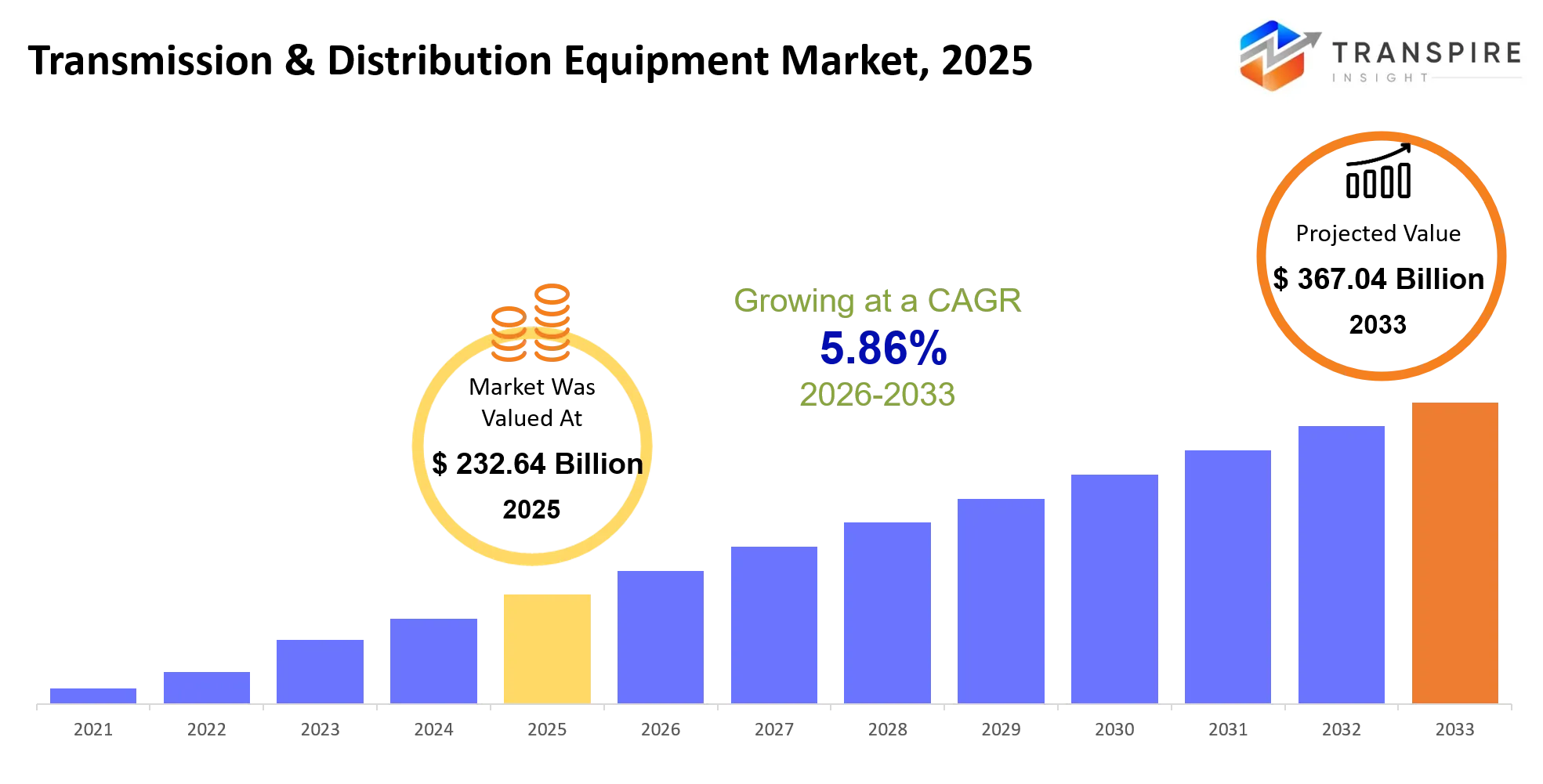
- Global Market Value (2025): USD 232.64 Billion.
- Expected Market Value (2026): USD 246.29 Billion.
- Estimated Market Value (2033): USD 367.04 Billion.
- Forecast CAGR (2026–2033): 5.86%
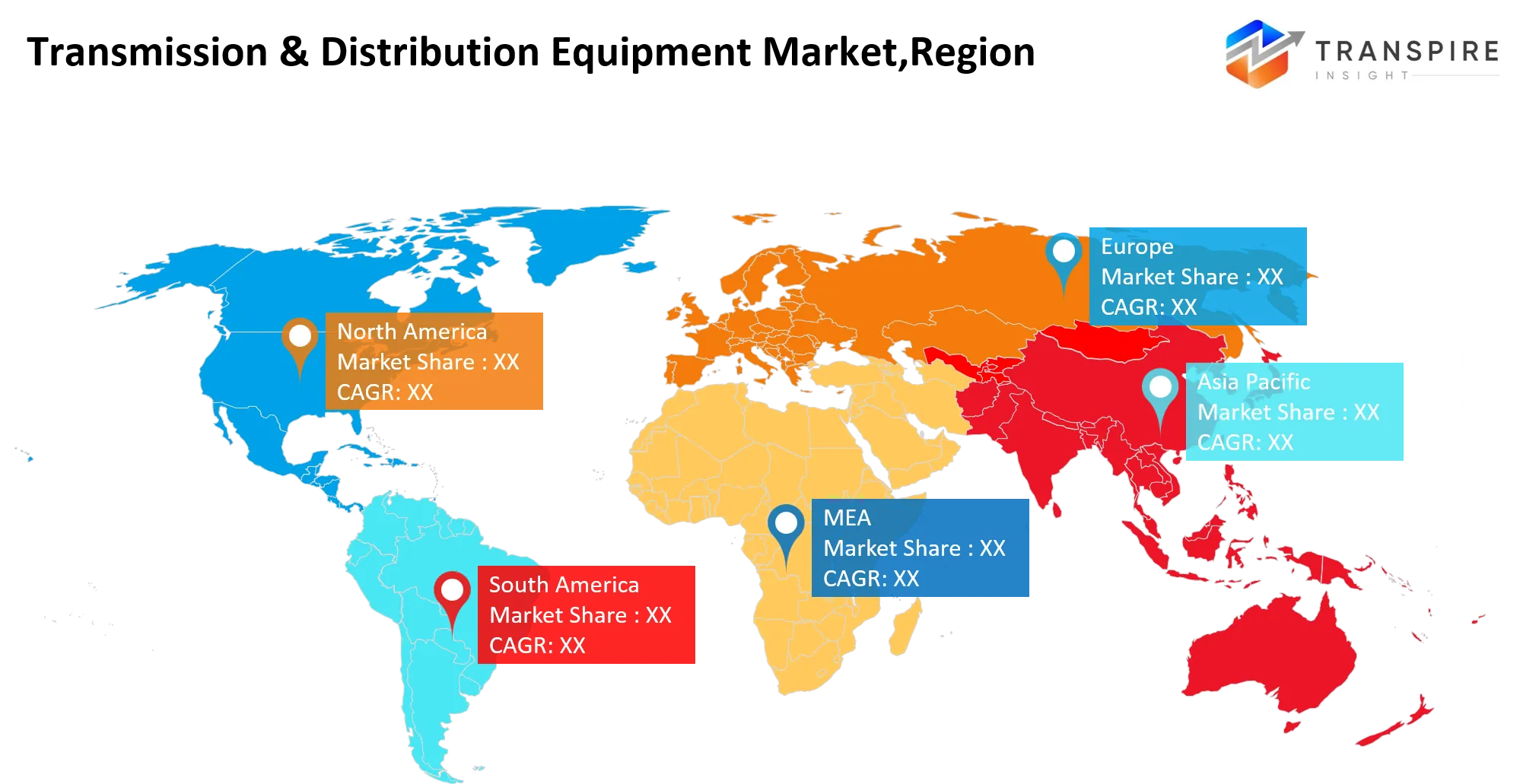
- Leading Region in 2025: Asia Pacific
- Second-largest Region: Europe
- Fastest Growing Region: North America
Introduction
The T&D equipment market includes the manufacture, supply, and installation of the apparatuses and systems used to transmit electrical power from power stations to end users. T&D Equipment is the physical apparatuses and automation systems installed in an electrical system that is responsible for the transmission, distribution, controlling, and measurement of electricity. Transmission equipment is the high to ultra-high voltage equipment that helps in the efficient transmission of bulk electricity over large distances from the power generating stations to the substations (large power transformers, high voltage switchgear, transmission towers, and overhead/ underground high voltage cables). Distribution equipment is the lower voltage equipment that ensures efficient distribution of electricity from the substations to the consumers (distribution transformers, smart meters, low voltage switchgear, and insulators). There are many positive implications of the Transmission and Distribution Equipment Market. Advanced technology allows achieving more efficiency in energy transmission. High-voltage and ultra-high-voltage transmission lines allow minimizing the amount of losses of electricity when transmitting it across long distances. Intelligent grid systems help to integrate renewable energy sources into the power system, thanks to their capability to control wind and solar power generation. SCADA systems, IoT devices, and digital substations increase reliability in real time due to their ability to monitor and detect problems quickly. Advanced transformers and automated equipment of the power distribution system help to manage capacity in data centers, green hydrogen production facilities, and electric vehicle charging stations.
For instance:-North American Transmission and Distribution Equipment Market are propelled by the substantial investments made for the modernization of the grid. High demands for electricity generated by artificial intelligence-based data centers and deteriorating infrastructure necessitates huge capital expenditures on custom transformers, smart meters, and digital substations.
Market Highlights: -
- Asia Pacific is anticipated to hold almost 50% share of the Transmission & Distribution Equipment Market over the predicted timeframe.
- Europe is expected to grow at a rapid CAGR in the Transmission & Distribution Equipment Market by holding almost20% of the share during the forecast period.
- North America is anticipated to hold almost15% share of the Transmission & Distribution Equipment Market over the predicted timeframe.
- By application, the Distribution segment dominated the market and holds nearly 55% share in 2025 and is projected to grow at a substantial CAGR during the forecast period.
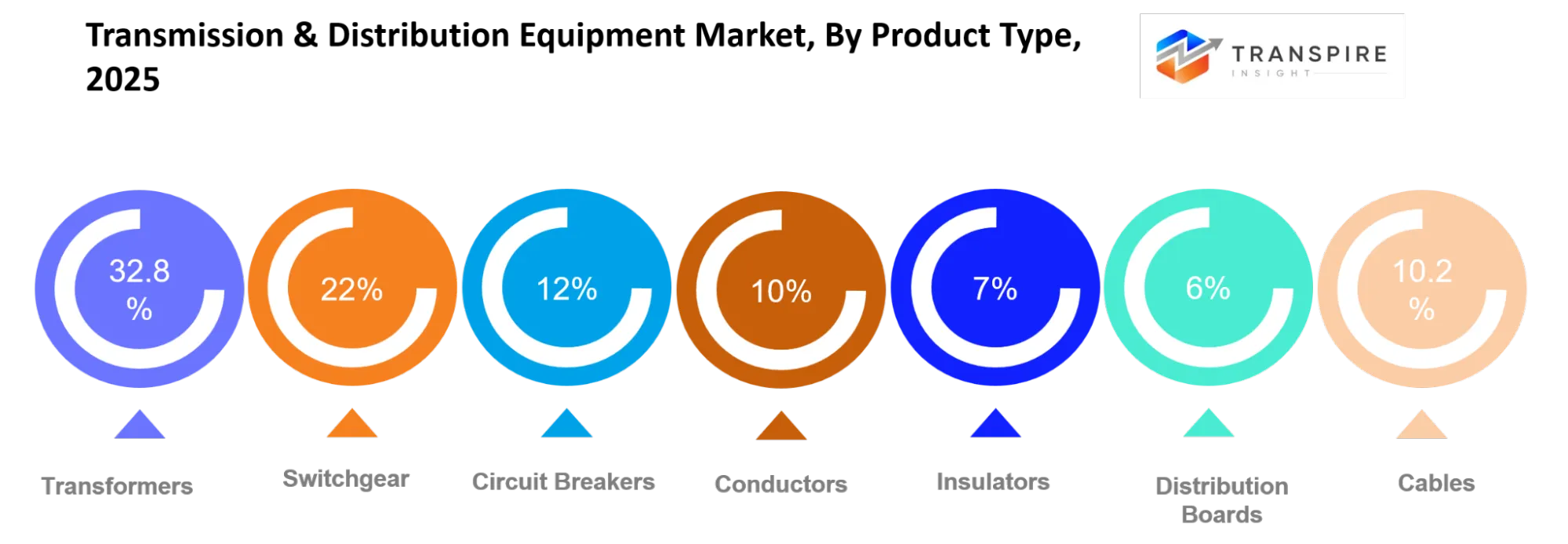
- By product type, the Distribution Transformers segment dominated the market and holds nearly 30% share in 2025 and is projected to grow at a substantial CAGR during the forecast period.
- By end user, the Utilities segment dominated the market and holds nearly 53% share in 2025 and is projected to grow at a substantial CAGR during the forecast period.
- As per India’s National Electricity Plan (2023-2032), there would be approximately 6.48 lakh km of transmission lines along with 2,345 GVA of transformation capacity by 2031-32. This development will definitely have an effect on boosting the demand for transformers, switchgears, sub-stations, conductors, and grid equipment in the Indian Transmission & Distribution Equipment Market.
How is Technology Driving Growth in the Transmission & Distribution Equipment Market?
The Transmission and Distribution Equipment Market is undergoing fast changes due to innovations like the use of smart grids, IoT-based monitoring, artificial intelligence and automation. Digitization allows the companies to track and manage the flow of energy and perform other activities related to optimization and reliability of the grid. Advanced metering infrastructure helps to accurately track consumption and detect any outages, and at the same time, AI and analytics help to maintain the system and route the power in a more efficient way. The technologies related to grid automation, voltage management, reactive-power compensation and dynamic support become crucial for the integration of intermittent sources of energy. On the other hand, producers use more ecological solutions such as SF₆-free switchgear.
|
Report Metrics |
Details |
|
Market size value in 2025 |
USD 232.64 Billion |
|
Market size value in 2026 |
USD 246.29 Billion |
|
Revenue forecast in 2033 |
USD 367.04 Billion |
|
Growth rate |
CAGR of 5.86% from 2026 to 2033 |
|
Base year |
2025 |
|
Historical data |
2021 - 2024 |
|
Forecast period |
2026 - 2033 |
|
Report coverage |
Revenue forecast, competitive landscape, growth factors, and trends |
|
Regional scope |
United States; Canada; Mexico; United Kingdom; Germany; France; Italy; Spain; Denmark; Sweden; Norway; China; Japan; India; Australia; South Korea; Thailand; Brazil; Argentina; South Africa; Saudi Arabia; United Arab Emirates |
|
Key company profiled |
ABB, Siemens Energy, Schneider Electric, GE Vernova, Hitachi Energy, Eaton, Toshiba Energy Systems, Mitsubishi Electric, Hyundai Electric, Fuji Electric, Bharat Heavy Electricals, CG Power, Nexans, Prysmian Group, NKT |
|
Customization scope |
Free report customization (country, regional & segment scope). Avail customized purchase options to meet your exact research needs. |
|
Report Segmentation |
By Equipment (Transformers, Switchgear, Circuit Breakers, Conductors, Insulators, Distribution Boards, Cables, Others); By Voltage (Low Voltage, Medium Voltage, High Voltage, Extra-high Voltage, Ultra-high Voltage, Transmission Voltage, Distribution Voltage, Others); By Application (Transmission, Distribution, Substations, Grid Modernization, Renewable Integration, Industrial Power, Commercial Power, Others); By Product Type (Power Transformers, Distribution Transformers, GIS, AIS, HVDC Equipment, FACTS Devices, Capacitors, Others); By Installation (Indoor, Outdoor, Underground, Overhead, Substation, Grid, Pole-mounted, Others); By End User (Utilities, Industrial, Commercial, Residential, Renewable Energy, Government, Infrastructure, Others); By Technology (Conventional, Smart Grid, Digital Substation, IoT-enabled, AI-enabled, Automated, Remote Monitoring, Others) |
Market Drivers
Key factors driving the Transmission and Distribution Equipment Market include increasing demand for electricity, renewable energy installation, grid upgrade, and favorable government investment. Increasing urbanization, industrialization, population, and digitalization are driving up electricity consumption, which in turn is pushing the growth of the transmission and distribution grid. Renewable energy installation is raising the demand for more advanced transformers, switchgears, substations, and grid management equipment able to deal with the fluctuating nature of power generation. The need for upgrading aging infrastructure has been pushing utilities towards the adoption of smart grid systems, digitized substations, automation technology, and IoT solutions. The Transmission and Distribution Equipment Market offers substantial value with the help of advanced grid infrastructure and digitalization. The use of high voltage and ultra-high voltage transmission helps with long-distance transportation of electricity and minimizes losses in transmission. Smart transformers, automated switchgear, and modern substations make it easy to integrate renewable energy into the grid because they help manage the variable power output. The Internet of Things devices, SCADA system, and digitalization improve reliability of the grid through increased visibility of assets and faster detection of faults. It is also possible to increase the life cycle of the aging electrical infrastructure, reduce unexpected outages, and minimize expenses for emergency maintenance.
For Instance: -
- Russian transmission and distribution equipment market, stimulated by increasing demand for industrial electricity. Investment is concentrated on upgrading outdated Soviet-era infrastructure. According to 6wResearch, strategic emphasis is placed on domestic production to secure long-term grid reliability.
- The European transformers and grid equipment market is witnessing rapid growth owing to substantial investments made towards grid modernization and renewable energy deployment. Old systems and EU decarbonization efforts are pushing capital into transformers, smart grid switches, and high-voltage cables in Europe.
Restrain
Restrictions that impact the Transmission and Distribution Equipment Market include raw material price fluctuations, cost of grid modernization, lengthy permitting processes, and logistics disruptions. Price fluctuations in copper and electrical steel raise the cost of production, while old infrastructure necessitates investments in grid modernization. The permitting process could lead to delays in transmission projects, while geopolitical risks and logistics disruption could be a challenge.
|
Driver |
Relative Impact on Growth (%) |
Geographic Relevance |
Impact Timeline |
Demand Strength |
Growth Mechanism |
Key Beneficiaries |
Major Constraint |
|
1. Grid Modernization & Aging Infrastructure Replacement |
27% |
North America, Europe, Asia Pacific |
Long-term |
High |
Replaces aging assets with higher-capacity equipment |
Transformer, switchgear, cable and grid-technology manufacturers |
High capital expenditure and lengthy permitting |
|
2. Renewable Energy Integration & Grid Expansion |
24% |
Asia Pacific, Europe, North America |
Long-term |
High |
Expands grids to connect variable renewable generation |
HV equipment, transformer, HVDC and grid-integration providers |
Renewable intermittency and connection delays |
|
3. Rising Electricity Demand & Electrification |
20% |
North America, Asia Pacific, Europe |
Medium-term |
High |
Expands capacity for growing electricity consumption |
Utilities, transformer, cable and switchgear manufacturers |
Equipment shortages and supply-chain constraints |
|
4. Smart Grid Digitalization & Automation |
16% |
North America, Europe, Asia Pacific |
Medium-term |
High |
Enables monitoring, automation and predictive asset management |
Digital-substation, IoT, AI and SCADA technology vendors |
Cybersecurity risks and integration complexity |
|
5. Government Grid Investment & Regulatory Support |
13% |
Asia Pacific, Europe, North America |
Short-term |
High |
Accelerates procurement through infrastructure funding programs |
Equipment manufacturers, EPC firms, utilities and service providers |
Regulatory delays and project execution bottlenecks |
Analysis of Prices and Consumer Behaviour
The Transmission & Distribution Equipment market is backed by significant demand for modernization, replacement, and infrastructure growth with upgrades and replacement comprising about 58.4% of market revenues in 2025. The Utilities end-user segment comprised about 40.6% of market demand due to investments in grid reliability, capacity development, and modernization. Power cables contributed around 32.8% of the market based on the type of equipment in 2025, indicating their importance in electricity transmission and distribution grids. The purchasing behavior is becoming more driven by factors such as equipment reliability, energy efficiency, lifecycle cost management, digitization, and technical standards compliance. Utilities and Industrial purchasers are increasingly using long-term purchasing arrangements and strategic partnerships with suppliers.
|
Investment Factor |
Why It Matters to Investors |
Opportunity |
Investment Implication |
|
Grid Modernization & Aging Infrastructure |
Aging networks require replacement, upgrades, and capacity expansion. |
Transformers, switchgear, substations, automation, grid-monitoring equipment |
Long-term infrastructure demand supports scalable investment. |
|
Renewable Energy Integration |
Variable renewable generation requires stronger transmission and flexible distribution networks. |
HVDC, grid interconnection, advanced transformers, power-quality equipment |
Renewable expansion creates sustained equipment replacement demand. |
|
Rising Electricity & Electrification Demand |
Data centers, EVs, industrial electrification, and urbanization increase grid-loading requirements. |
High-capacity transformers, cables, substations, distribution equipment |
Electrification expands addressable infrastructure investment opportunities. |
|
Smart Grid Digitalization |
Utilities increasingly require real-time visibility, automation, and predictive asset management. |
Digital substations, IoT sensors, AI analytics, SCADA, intelligent switchgear |
Digitalization enables higher-value technology and service revenues. |
|
SF₆-Free & Sustainable Equipment |
Environmental regulations are accelerating alternatives to high-GWP insulation technologies. |
SF₆-free switchgear, sustainable insulation, low-loss transformers |
Regulatory transition creates technology replacement opportunities. |
|
Regional Grid Investment Expansion |
Infrastructure spending is increasing across emerging and developed power markets. |
Asia Pacific, North America, Europe, and emerging-grid projects |
Regional diversification can broaden long-term market exposure. |
Who are the Key Players in the Transmission & Distribution Equipment Market and how do they compete?
The competitiveness of the international Transmission & Distribution Equipment Market involves companies that specialize in modernizing electricity networks, producing advanced power equipment, digital solutions, and development of distribution networks internationally. Not only competing in pricing but also through high-voltage equipment, smart grids, digital substations, efficiency in energy usage, and grid automation, this type of competition stimulates companies towards constant innovations and helps utilities gain higher efficiency and reliability of the grid.
By developing advanced grid technology, digital substations, and high-voltage transmission solutions, Hitachi Energy increases its competitiveness in the market. By developing high-performance transformers, switchgear, grid automation solutions, and power transmission equipment, companies can distinguish themselves from their competitors. Siemens Energy strengthens its competitive position with the help of integrated transmission and distribution solutions, including transformers, switchgear, grid technologies, and digital solutions.
Top Companies in the Transmission & Distribution Equipment Market
- ABB
- Siemens Energy
- Schneider Electric
- GE Vernova
- Hitachi Energy
- Eaton
- Toshiba Energy Systems
- Mitsubishi Electric
- Hyundai Electric
- Fuji Electric
- Bharat Heavy Electricals
- CG Power
- Nexans
- Prysmian Group
- NKT
|
Company |
Est. Revenue Share Range |
Key Offerings |
Strategic Positioning |
Geographic Strength |
Technology Focus |
|
ABB |
6–9% (Estimated) |
MV/LV switchgear, circuit breakers, transformers, grid automation |
Integrated electrification and grid technology leadership |
Europe, North America, Asia Pacific |
Digital substations, automation, smart switchgear |
|
Siemens Energy |
6–9% (Estimated) |
Power transformers, HVDC, FACTS, substations, HV/MV switchgear |
Technology-led transmission systems and grid modernization |
Europe, North America, Asia Pacific |
HVDC, FACTS, grid-forming, digital substations |
|
Schneider Electric |
5–8% (Estimated) |
MV switchgear, RMUs, distribution systems, grid software |
Digital energy management and smart distribution leadership |
Europe, North America, Asia Pacific |
IoT-connected equipment, EcoStruxure, SF₆-free switchgear |
|
GE Vernova |
5–8% (Estimated) |
Transformers, GIS, circuit breakers, HVDC, FACTS |
End-to-end grid solutions with utility-scale expertise |
North America, Europe, Asia Pacific |
HVDC, GIS, GridBeats, digital grid automation |
|
Hitachi Energy |
5–8% (Estimated) |
Power transformers, HV switchgear, HVDC, substations, grid automation |
High-voltage grid integration and service differentiation |
Europe, Asia Pacific, North America |
HVDC, digital grids, EconiQ, asset analytics |
|
Eaton |
3–5% (Estimated) |
Switchgear, transformers, relays, reclosers, grid automation |
Distribution-focused electrical infrastructure solutions |
North America, Europe, Asia Pacific |
Grid automation, predictive diagnostics, smart distribution |
|
Mitsubishi Electric |
2–4% (Estimated) |
Transformers, HV switchgear, HVDC, FACTS, protection systems |
High-reliability equipment and integrated grid systems |
Asia Pacific, North America, Europe |
HVDC, FACTS, network control, protection systems |
|
Toshiba Energy Systems |
2–4% (Estimated) |
Distribution transformers, HV transformers, GIS, digital substations |
Reliability-focused Asian grid equipment specialization |
Asia Pacific, North America |
Digital substations, intelligent monitoring, efficient transformers |
|
Prysmian Group |
3–5% (Estimated) |
HV/MV/LV cables, submarine cables, grid components, monitoring |
Cable-system leadership across electrification infrastructure |
Europe, North America, Asia Pacific |
HVDC cables, P-Laser, smart-grid monitoring |
|
Nexans |
2–4% (Estimated) |
HV/MV/LV cables, accessories, grid services, turnkey systems |
Integrated cable solutions for grid expansion |
Europe, North America, Asia Pacific |
Grid monitoring, high-voltage cables, turnkey systems |
Market Segmentation
The Transmission & Distribution Equipment Market share is divided into seven categories: By equipment, voltage, application, product, installation, end user and technology.
The Distribution dominated the market, accounting for nearly 55% in 2025 and is expected to rise at a significant CAGR during the forecast period.
The Transmission & Distribution Equipment Market is segmented by application into Transmission, Distribution, Substations, Grid Modernization, Renewable Integration, Industrial Power, Commercial Power, Others. Among these, the Distribution segment dominated the market, accounting for nearly 55% in 2025 and expected to increase at a significant CAGR during the forecast period. The distribution segment reigns supreme since the trend towards urbanization, renewable energy production dispersed across regions, increasing levels of electrification, and the rising demand for electricity on the part of households and businesses necessitates an extensive network of low and medium voltage systems.
The Distribution Transformers dominated the market, accounting for nearly 30% in 2025, and is expected to rise at a significant CAGR during the forecast period.
The Transmission & Distribution Equipment Market is segmented by product type into Power Transformers, Distribution Transformers, GIS, AIS, HVDC Equipment, FACTS Devices, Capacitors, Others. Among these, the Distribution Transformers segment dominated the market, accounting for nearly 30% in 2025 and expected to increase at a significant CAGR during the forecast period. The Distribution Transformers segment led the market in terms of share, holding almost 30% in 2025 owing to increasing electricity distribution networks, urbanization, industrialization, and growing power consumption. Grid modernization and the use of renewable energy are rapidly boosting the demand for transformers that ensure better voltage regulation, lower energy losses, increase efficiency, and provide smart distribution.
The Utilities dominated the market, accounting for nearly 53% in 2025 and is expected to rise at a significant CAGR during the forecast period.
The Transmission & Distribution Equipment Market is segmented by end user into Utilities, Industrial, Commercial, Residential, Renewable Energy, Government, Infrastructure, Others. Among these, the Utilities segment dominated the market, accounting for nearly 53% in 2025 and expected to increase at a significant CAGR during the forecast period. In 2025, the Utilities sub-segment accounted for 53% of the total share due to substantial investments in power transmission and distribution networks. There is modernization of aging grids, integration of renewables, and electrification being undertaken by utilities through the use of smart grid technology. Higher demands for electricity increase transformer, switchgear, meter, and substation purchases.
Regional Segment Analysis of the Transmission & Distribution Equipment Market:
- North America (U.S., Canada, Mexico)
- Europe (Germany, France, U.K., Italy, Spain, Rest of Europe)
- Asia-Pacific (China, Japan, India, Rest of APAC)
- South America (Brazil and the Rest of South America)
- The Middle East and Africa (UAE, South Africa, Rest of MEA)
Asia Pacific is the fastest-growing region in the Transmission & Distribution Equipment Market during the period, holding almost 50% share.
Asia Pacific is the fastest-growing region in the Transmission & Distribution Equipment Market during the forecast period, holding almost 50% share during the forecast period. Rapid growth is being seen in Asia Pacific on account of rapid urbanization, industrialization, electrification and rise in renewable energy capacity. Nations have been spending considerable sums on modernizing grids, building transmission systems, substations and smarter distribution networks. Increase in power consumption, data centers, electric mobility and national energy projects have created a surge in demand for transmission & distribution equipment.
Europe is expected to grow at a rapid CAGR in theTransmission & Distribution Equipment Market, holding almost 20% of the share during the forecast period.
Europe is expected to grow at a rapid CAGR in the Transmission & Distribution Equipment Market holding almost 20% share during the forecast period. The European continent is witnessing robust growth owing to grid modernization, energy from renewables, and decarbonization. Investments made in the form of smart grids, digital substations, energy storage, and HV transmission equipment have helped fuel market growth. Old power grids and strict energy efficiency mandates are also adding to the rising demand for the equipment.
North America is the fastest-growing region in the Transmission & Distribution Equipment Market during the period, holding almost 15% share.
North America is expected to grow at a rapid CAGR in the Transmission & Distribution Equipment Market holding almost 15% share during the forecast period. The North American region is growing at a fast pace due to grid modernization, electricity demand, renewables, and infrastructural developments. Aging transmission infrastructure needs advanced transformers, substations, switchgears, and smart grid solutions. The demand for advanced solutions from the T&D equipment market is further fueled by data centers, electric vehicles, and distributed energy sources.
Strategies for Market Growth in Non-Leading Regions:
The development of non-leaders through effective and scalable equipment manufacturing technology in transmission and distribution would provide great help for small to medium-sized equipment manufacturing companies. The local manufacturing of such products as transformers, switch gears, circuit breakers, substations, and other components, along with the creation of regional facilities for transmission and distribution equipment manufacturing, will lead to lower dependence on imports and lower overall costs of production. Building strategic alliances with regional utilities, equipment manufacturers, engineering companies, and distributors will enhance the penetration in the market of transmission and distribution equipment products. Furthermore, training and skills improvement would be needed in order to increase the knowledge in the area of grid modernization, equipment installation, quality control and standardization of transmission and distribution systems. Moreover, flexible financing, long-term agreements, and contract manufacturing would lower prices of transmission and distribution equipment and would motivate the utilities to implement them. The establishment of collaborative projects with government, energy and infrastructure projects, and digital sales strategies will provide access to transmission and distribution equipment and help the worldwide sustainable development in developing countries.
Future Market Trends for the Transmission & Distribution Equipment Market: -
- Integration of Renewables & Grid Modernization: The increasing investment in solar, wind, and offshore wind energy needs strong high-voltage connections and dynamic voltage regulation.
- Move from SF₆ Switchgears: Power companies are increasingly using environmentally sustainable, fluornitrile mix switchgear (e.g. GE Vernova’s g³) to reduce greenhouse gas emissions from hazardous sulfur hexafluoride.
- Replace Transformers: Old oil transformers put up in the 1980s for electrification have started a huge replacement and upgrading trend across the world.
- Digitization & Grid Observability: Using smart sensors, intelligent electronic devices (IEDs), and SCADA systems assists power companies to cope with climate-related disruptions and peak load times.
- Region Specific Drivers: Asia-Pacific region remains the largest market share holder (above 42%) because of quick industrialization and smart cities initiatives in developing countries such as India, whereas North America shows quickest growth in modernization.
Recent Development
- In March 2023: HMAX Energy is a recently released AI-based solution offered by Hitachi Energy that provides support to predictive maintenance, early fault detection, and alerts to critical transformers and grid components. The innovation contributes to the reduction of downtime, improvement of reliability of grids, and digitalization of substations and advanced Transmission & Distribution Equipment Market infrastructure.
- In April 2026: Kerun Intelligent Control introduced Integrated Transformer & Substation Solutions for Artificial Intelligence data centers and High-Density Computing Centers. The system combines transformer systems, prefabricated substations, switchgear, and intelligence monitoring to improve reliability, cooling efficiency, and maintenance for the increasingly complex requirements of the future Transmission & Distribution Equipment Market.
- In August 2026: Schneider Electric along with BRPL launched the first ever SF₆-free Smart RMU pilot system in India. It includes 12 kV RMU switchgears with intelligent remote monitoring technology. This system is an environmentally friendly one that will help in the sustainable distribution of electricity in cities and will be helpful in growing the transmission and distribution equipment market.
This study forecasts revenue at global, regional and country levels from 2020 to 2033. Transpire Insight has segmented the Transmission & Distribution Equipment Market based on the below-mentioned segments:
Transmission & Distribution Equipment Market, By Equipment
- Transformers
- Switchgear
- Circuit Breakers
- Conductors
- Insulators
- Distribution Boards
- Cables
- Others
Transmission & Distribution Equipment Market, By Voltage
- Low Voltage
- Medium Voltage
- High Voltage
- Extra-high Voltage
- Ultra-high Voltage
- Transmission Voltage
- Distribution Voltage
- Others
Transmission & Distribution Equipment Market, By Application
- Transmission
- Distribution
- Substations
- Grid Modernization
- Renewable Integration
- Industrial Power
- Commercial Power
- Others
Transmission & Distribution Equipment Market, By Product Type
- Power Transformers
- Distribution Transformers
- GIS
- AIS
- HVDC Equipment
- FACTS Devices
- Capacitors
- Others
Transmission & Distribution Equipment Market, By Installation
- Indoor
- Outdoor
- Underground
- Overhead
- Substation
- Grid
- Pole-mounted
- Others
Transmission & Distribution Equipment Market, By End User
- Utilities
- Industrial
- Commercial
- Residential
- Renewable Energy
- Government
- Infrastructure
- Others
Transmission & Distribution Equipment Market, By Technology
- Conventional
- Smart Grid
- Digital Substation
- IoT-enabled
- AI-enabled
- Automated
- Remote Monitoring
- Others
Transmission & Distribution Equipment Market, By Regional Analysis
North America
- US
- Canada
- Mexico
Europe
- Germany
- UK
- France
- Italy
- Spain
- Russia
- Rest of Europe
Asia Pacific
- China
- Japan
- India
- South Korea
- Australia
- Rest of Asia Pacific
South America
- Brazil
- Argentina
- Rest of South America
Middle East & Africa
- UAE
- Saudi Arabia
- Qatar
- South Africa
- Rest of the Middle East & Africa
Frequently Asked Questions
Find quick answers to common questions.
The market is projected to reach USD 367.04 billion by 2033, growing at a 5.86% CAGR from 2026–2033.
Distribution dominated with nearly 55% share, driven by electrification, urbanization, renewable integration, and expanding distribution networks worldwide.
Distribution transformers held nearly 30% share, supported by grid modernization, rising electricity demand, and expanding distribution infrastructure globally.
Asia Pacific held approximately 50% share, supported by industrialization, urbanization, renewable deployment, electrification, and extensive grid investments.
Key players include ABB, Siemens Energy, Schneider Electric, GE Vernova, Hitachi Energy, Eaton, Mitsubishi Electric, and Prysmian Group.
- ABB
- Siemens Energy
- Schneider Electric
- GE Vernova
- Hitachi Energy
- Eaton
- Toshiba Energy Systems
- Mitsubishi Electric
- Hyundai Electric
- Fuji Electric
- Bharat Heavy Electricals
- CG Power
- Nexans
- Prysmian Group
- NKT
About the Authors

Avinash Kumar
I’m Avinash Kumar, a Senior Research Analyst at Transpire Insight, with expertise in the Electronics and Semiconductor and Energy & Power industry. My work focuses on analyzing emerging technologies, market trends, industry developments, and innovation across these sectors. I specialize in transforming complex technical and market insights into clear, research-backed content that helps professionals, businesses, and decision-makers stay informed. Through continuous industry research and data-driven analysis, I strive to deliver accurate, reliable, and practical perspectives on the latest advancements shaping the semiconductor and energy landscape.

Chakradhar Khansole
Chakradhar serves as the Research Director at Transpire Insight, bringing over 8 years of experience in technology, innovation, and strategic market intelligence. He specializes in transforming complex market data into actionable business insights that enable organizations to make informed, growth-oriented decisions. Recognized for his strategic vision and analytical expertise, Chakradhar leads high-impact research initiatives, delivering comprehensive market assessments, competitive intelligence, and forward-looking industry analysis.
Recently Published Reports
-
Apr 2026
Active Power Filter Market
Active Power Filter Market Size, Share & Analysis Report By Type (Shunt Active Power Filters, Series Active Power Filter, Hybrid Active Power Filter), By Application (Harmonics Mitigation, Reactive Power Compensation, Voltage Regulation, Power Factor Correction), By Phase (Single Phase, Three Phase), By End-User Industry (Manufacturing, Healthcare, Commercial, Automotive, Oil and Gas, Others), and Geography (North America, Europe, Asia-Pacific, Middle East and Africa, South and Central America), 2021 - 2031
-
Apr 2026
Electrical Transformer Market
Electrical Transformer Market Size, Share & Analysis Report By Core (Closed, Shell, and Berry), By Insulation (Gas, Oil, Solid, Air, and Other), By Phase (Single, and Three), By Rating (100 MVA to 500 MVA, 501 MVA to 800 MVA, and 801 MVA to 1200 MVA), and Geography (North America, Europe, Asia-Pacific, Middle East and Africa, South and Central America), 2021 – 2031
-
Apr 2026
Hydraulic Piston Pumps Market
Hydraulic Piston Pumps Market Size, Share & Analysis Report By Type (Axial Piston Pumps, Radial Piston Pumps), By Operating Pressure (Low Pressure, Medium Pressure, High Pressure), By Application (Construction, Mining, Agriculture, Automotive, Oil & Gas, Industrial Machinery, Others), By End-User (OEMs, Aftermarket), and Geography (North America, Europe, Asia-Pacific, Middle East and Africa, South and Central America), 2021 – 2031
-
Apr 2026
Laboratory Gas Generators Market
Laboratory Gas Generators Market Size, Share & Analysis Report By Product (Nitrogen Gas Generator, Hydrogen Gas Generator, Zero Air Gas Generator, Purge Gas Generator, TOC Gas Generators, Others), By Application (Gas Chromatography, Liquid Chromatography-mass Spectrometry (LC-MS), Gas Analyzers, Others), By End-user (Life Science, Chemical & Petrochemical, Food & Beverage, Others), and Geography (North America, Europe, Asia-Pacific, Middle East and Africa, South and Central America), 2021 – 2031