

Television & Set Top Box Market Summary:
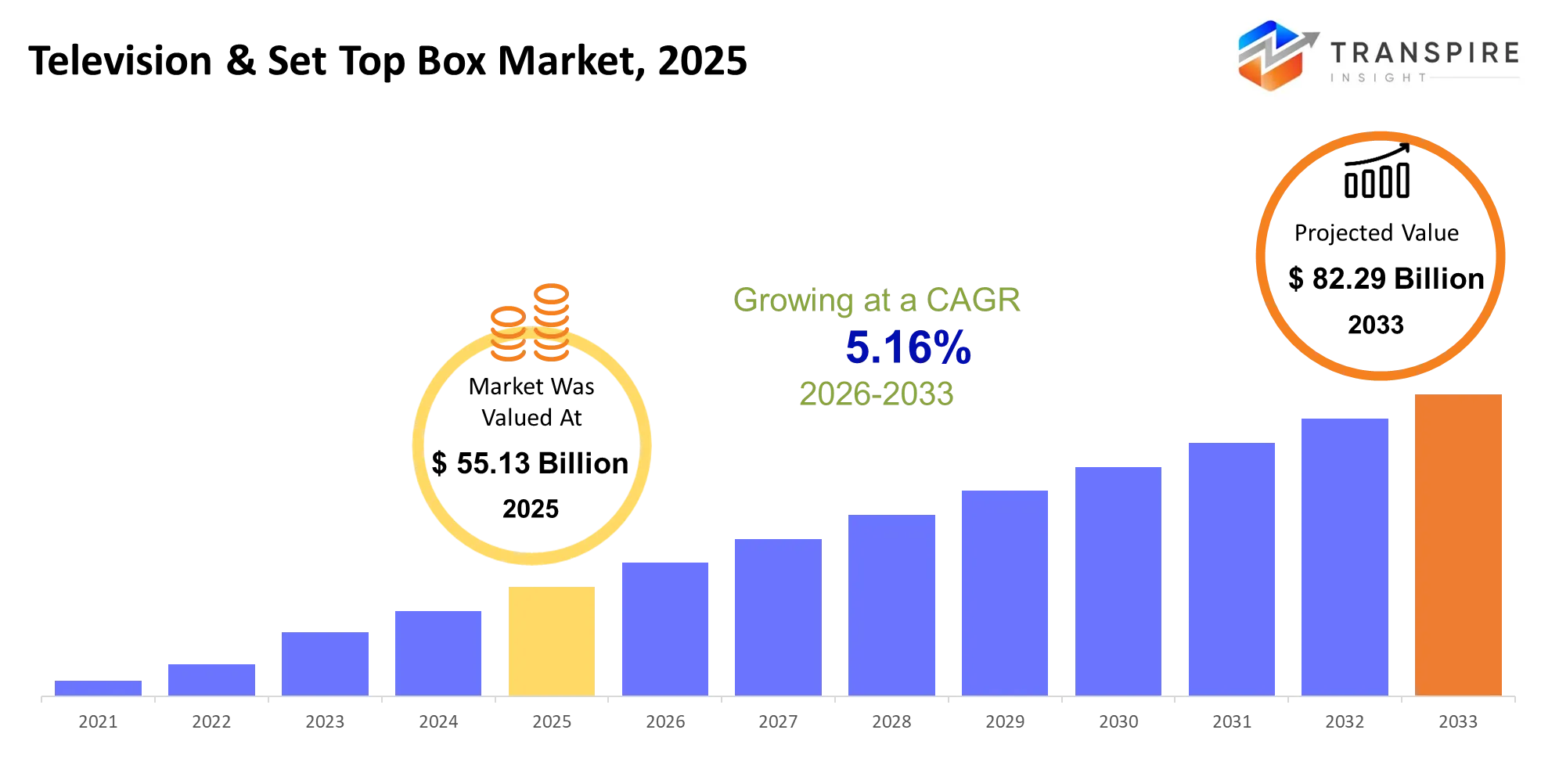
As per Transpire Insight Analysis, the Television & Set Top Box Market size is estimated at USD 55.13 billion in 2025 and is anticipated to reach USD 82.29 billion by 2033, growing at a CAGR of 5.16% from 2026 to 2033.
The television market and set box industry is changing from old-style home entertainment tools into a connected digital viewing world that is connected. People are starting to like TVs that mix regular TV with internet-based streaming, games and things you can interact with. In the past three to five years, companies have added more 4K and OLED options while bringing in better image processing, voice control and AI features for watching. A big change is moving from selling televisions based on hardware to offering software-based entertainment systems and combined content services. More streaming services and faster internet connections have made this change happen faster by making it easier for homes to get content whenever they want. Digital broadcasting projects led by governments and the availability of smart TV models have also played a role in what people buy. Because of this, companies are now trying to win by improving displays, operating systems, content deals and ongoing software support, which creates chances in televisions, streaming devices and set-top boxes.
Television & Set Top Box Market Size & Forecast:
- Market Size 2025: USD 55.13 Billion
- Expected Market Value (2033): USD 82.29 Billion
- Forecast CAGR (2026-2033): 5.16%
- Leading Region in 2025: Asia Pacific
- Fastest Growing Region: Middle East & Africa
- Key Company Profiles: Samsung Electronics, LG Electronics, Sony, TCL, Hisense, Panasonic, Vizio, Skyworth, Xiaomi, Roku, Amazon, Apple, Google, DISH Network, ARRIS
Key Market Insights:
The market trend is shifting towards consumer trends in connected entertainment, advanced display technology, and streaming services. The manufacturers are concentrating on AI based technologies, picture quality, and low-cost smart televisions.
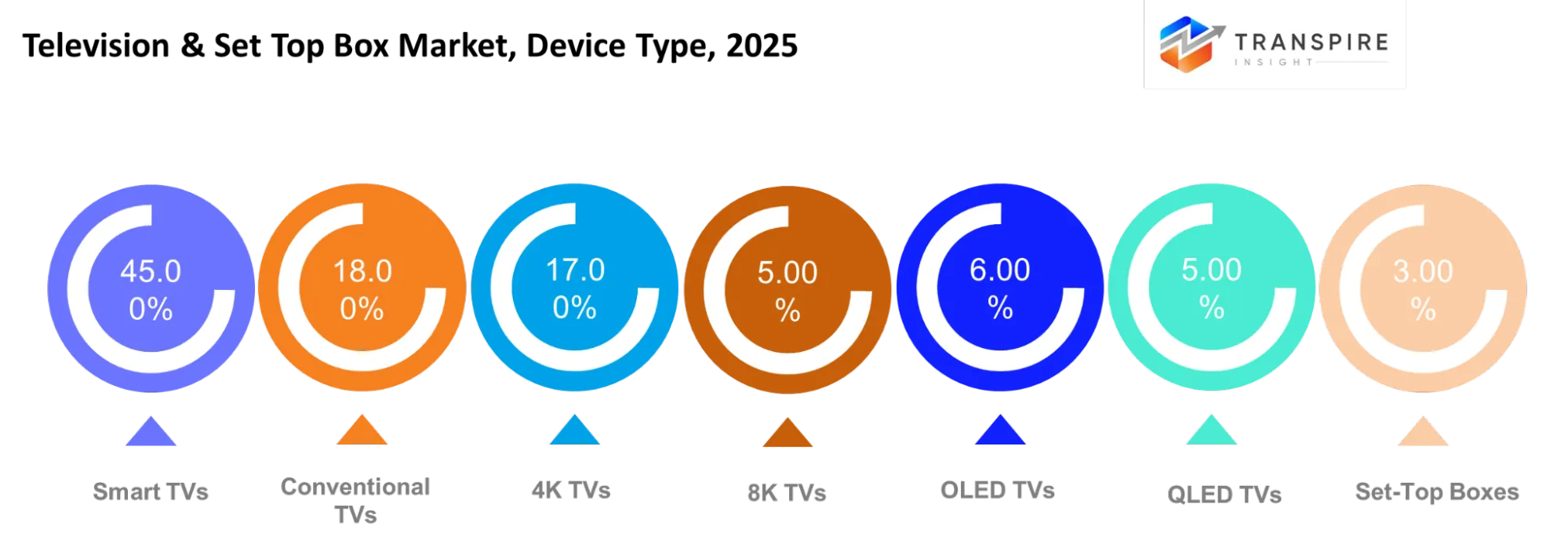
- Smart TVs constitute 45.00% of the supplied device type breakdown, owing to an increase in preference among customers for inbuilt internet capability.
- 8K and advanced display televisions are expected to grow at a CAGR of 9.40% on account of improvements in display performance, AI-based upscaling capabilities, and premium experience.
- Conventional TVs constitute 18.00% of the supplied breakdown, catering to price-sensitive customers relying on traditional broadcasting services.
- 4K TVs constitute 17.00% of the supplied breakdown, owing to rising demands for high-resolution and larger screen sizes with gaming and streaming requirements.
- OLED TVs make up 6.00% of the supplied breakdown, while QLED TVs constitute 5.00%, competing with better contrast, brighter colours, and improved display performance.
- Set Top Boxes constitute 3.00% of the supplied breakdown, being used by cable, satellite, IPTV, and hybrid service providers.
What are the Key Drivers, Restraints, and Opportunities in the Television & Set Top Box Market?
Drivers
Connected entertainment is a leading growth factor for the television and set-top box market. The proliferation of broadband connections, growing content libraries, and popularity of online video content have led consumers to prefer Smart TV versus traditional TV sets. Upgrades of 4K resolution, OLED displays, gaming capabilities, and artificial intelligence-based picture optimisation are additional drivers for conversions. Manufacturers can generate additional revenue by launching flagship models, software products, and related connected devices. Digital broadcasting schemes can also stimulate demand for related reception equipment and TV sets.
Restraints
Premium prices for high-end screens remain an obstacle for many markets. Shorter replacement cycles due to faster product releases and decreased willingness to pay a premium for high-end screens could slow adoption. Other issues include the cost of components, electronic waste, demand for new software standards, and the need for an always-on internet connection. Set-top box manufacturers are also under threat from TV makers who are offering televisions with direct access to internet TV and streaming services.
Opportunities
Opportunities in the Market In order to establish themselves in the market, manufacturers could look into niche markets like value smart TVs, energy-saving screens, user interface in local language, and pre-loaded streaming apps. Along with the use of technologies like Mini-LED, OLED, AI upscaling and processing chips, there is potential for the premium segment to grow. The areas where opportunities may lie for new markets are affordable smart TVs and devices that have both streaming and broadcast capabilities.
|
Driver |
Relative Impact on Growth (%) |
Geographic Relevance |
Impact Timeline |
Demand Strength |
Growth Mechanism |
Key Beneficiaries |
Major Constraint |
|
Smart TV adoption and connected entertainment |
28% |
Asia Pacific, North America |
Short-term (≤2 years) |
High |
Expands streaming access and accelerates television upgrades |
TV manufacturers, streaming platforms, operating-system vendors |
Price sensitivity and longer replacement cycles |
|
Premium display technology and larger screens |
23% |
North America, Asia Pacific, Europe |
Medium-term (2-4 years) |
High |
QLED, OLED, Mini-LED improve picture quality and upgrade appeal |
Display manufacturers, TV brands, panel suppliers |
High production costs and premium pricing |
|
OTT streaming and hybrid set-top box integration |
20% |
Asia Pacific, North America, Europe |
Short-term (≤2 years) |
High |
Combines broadcast channels, broadband streaming, and on-demand content |
Telecom operators, STB manufacturers, content platforms |
Smart TVs reduce standalone box demand |
|
Broadband expansion and digital television infrastructure |
17% |
Asia Pacific, Latin America, Middle East & Africa |
Long-term (≥4 years) |
High |
Wider connectivity expands digital TV and IPTV household access |
Telecom providers, network equipment vendors, STB manufacturers |
Infrastructure costs and uneven connectivity |
|
AI-enabled features, energy efficiency, and regulatory compliance |
12% |
North America, Europe, Asia Pacific |
Medium-term (2-4 years) |
Medium |
AI personalization and efficient hardware strengthen product differentiation |
TV manufacturers, chipmakers, software vendors |
Compliance expenses and hardware integration costs |
|
Total |
100% |
— |
— |
— |
— |
— |
What Has the Impact of artificial intelligence on the Television & Set Top Box Market?
The use of artificial intelligence has completely changed the way televisions treat their content, personalize the entertainment experience, and interact with viewers. The technology of AI picture processing consists of analyzing the input video and enhancing its sharpness, contrast, color, and brightness depending on the results. Upscaling allows improving the quality of lower-resolution content on high-resolution screens, and AI sound processing allows separating the dialogue from the background music and environmental sounds. Personalisation is another application that should be mentioned as an important one. Smart televisions use information about the viewing history and content to recommend the appropriate programs, arrange applications, and search through the entertainment platforms. Voice assistants and chatbots enable discovering content and controlling compatible smart home devices. In set-top boxes, software optimisation allows navigating easily, streaming content, and interacting with user interfaces. However, such innovations have certain disadvantages. High-performance processors increase the costs of the development of televisions, while older devices do not support the new features. Privacy concerns, inconsistency of recommendations, and the difference in the performance of the processing in various price categories are other factors affecting adoption.
Instance
In March 2026, Samsung Electronics rolled out AI-enabled functionalities in its 2026 range of televisions. The company has released some state-of-the-art AI functions that would help to enhance picture and sound quality, provide a customised experience, and facilitate easy access to content. This is an example of how artificial intelligence has been shaping the international television market by making smart TVs more interactive and entertaining.https://news.samsung.com/ca/samsung-brings-full-2026-ai-tv-lineup-to-consumers-worldwide
Key Market Trends:
TV makers are shifting beyond screen specifications to gain an edge via connectivity, smart software, and entertainment. On the other hand, set-top box makers are adapting to the increasing convergence of broadcasting and internet television.
- TVs are starting to feature AI-driven picture and sound processing, making viewing experience and personalisation factors in competition along with screen resolution.
- TV makers are adding more big-screen TVs into their portfolios as consumers look for a more immersive experience for sports, movies, and gaming. High-end TV sets are starting to compete with home theatre devices.
- Different types of panels such as OLED, QLED, Mini-LED, and the new RGB panels are being used by TV makers, offering more choice at both premium and upper mid-range levels.
- People want easy access to the streaming services via the built-in TV operating system. This means that there is less of a need to buy additional streaming sticks for people who choose Smart TVs.
- Longer commitments to operating system upgrades are one of the competitive advantages that make a difference now. TV makers are extending software support and improving security through it.
Television & Set Top Box Market Segmentation
By Device Type
Smart TVs are an important part of the market with a 68.20% dominant share according to the provided data, and a separate device breakdown indicating 45.00%. Traditional TVs make up 18.00%, whereas 4K TVs make up 17.00%. OLED TVs and QLED TVs constitute 6.00% and 5.00%, respectively. Additionally, 8K TVs comprise 5.00%, set-top boxes make up 3.00%, and streaming devices comprise 1.00%. The 8K and other advanced displays sector is expected to register a CAGR of 9.40%, driven by better picture quality and viewing experience. The two smart TV shares need verification before publishing.
By Technology
LCD and LED TVs, due to lower costs, ready availability and proven manufacturing processes, are still popular. OLED TVs appeal to high-end customers due to deep blacks and high contrast, while QLED TVs are more focused on brightness and colour reproduction. Mini LED TVs are now available in the market due to improved backlight control and contrast performance. MicroLED TV is also in the concept stage for any potential premium TV but is facing manufacturing costs. Plasma TV has been replaced by newer developments in TV, while projectors are still used in some home theatre and commercial applications.
By Screen Size
The market is support to purchase Less than 32 inch is best for small spaces, small families, and cost savings. 32 to 43 inches is best for apartment and bedroom settings. 44 to 55 inches is best for mainstream buyers who like more screen real estate but want to spend the least. 56 to 65 inches is best for larger home settings and an immersive experience. 66 to 75 inches is best for premium home experiences and living rooms. 76 to 85 inch is best for higher-end home theatre setups, such as dedicated rooms. Greater than 85-inch TVs are best for luxury homes, luxury rooms and some commercial setups.
By Set Top Box
Cable and satellite set-top boxes are used for television broadcasting and subscription television services. IPTV devices carry TV services via the internet protocol networks, and OTT set-top boxes and streaming media players are used to access internet-provided entertainment services. Hybrid set-top boxes are used for traditional broadcasting and internet services - commonly an internet-enabled set-top box used to watch live channels and paid content on demand with a single device. Digital terrestrial television boxes are still relevant for countries where terrestrial broadcasting is used. Android set-top boxes appeal to consumers requiring app-based entertainment and customizable user interfaces.
By Distribution Channel
Offline retail and electronics shops are still relevant because they enable buyers to compare sizes, judge picture quality and seek expert advice before buying. Online retail provides the convenience of home shopping and comparisons between offers, products and promotional prices, possibly coupled with home delivery. Speciality retail offers a technical service and consultation on high-end display technology. Direct sales enable manufacturers to target customers through their own sales channels, whereas telecom operators can offer connected devices when users subscribe to a broadband package. Pay TV operators also use them to distribute compatible set-top boxes with subscriptions.
By End User
Residential households represent a dominant application segment where television screens have become an integral part of leisure, home cinemas, gaming activities, streaming services, and broadcasting. The retail, restaurants, and hospitality sectors use digital displays for dynamic digital signage in-store marketing, promotions, digital menus, in-room guest services and high-quality entertainment. Healthcare uses television displays to give patients access to information and education. In classrooms and educational settings, teachers use interactive displays for sharing curriculum content, classroom training, group lessons and general information sharing.
What are the Key Use Cases Driving the Television & set-top box market?
Use cases of entertainment are focused around residences and include Smart TVs integrating live broadcasting, streaming applications, gaming, and video on demand. The categories of 4K, OLED, and QLED cater to people who are looking for better picture quality, while set-top boxes assist people in gaining access to cable, satellite, and IPTV services. Commercial use is increasing in hotels, restaurants, retail stores, corporate offices, and academic organisations. They use televisions as well as connected display screens for guest entertainment, signage, presentation, education, and informational purposes. Future application areas can be cloud gaming, connected home control, interactive learning, and content discovery using AI technology. Hybrid set-top boxes and streaming devices will further enable people to gain access to digital services through their conventional televisions.
|
Report Metrics |
Details |
|
Market size value in 2025 |
USD 55.13 Billion |
|
Market size value in 2026 |
USD 57.88 Billion |
|
Revenue forecast in 2033 |
USD 82.29 Billion |
|
Growth rate |
CAGR of 5.16% from 2026 to 2033 |
|
Base year |
2025 |
|
Historical data |
2021 - 2024 |
|
Forecast period |
2026 - 2033 |
|
Report coverage |
Revenue forecast, competitive landscape, growth factors, and trends |
|
Regional scope |
United States; Canada; Mexico; United Kingdom; Germany; France; Italy; Spain; Denmark; Sweden; Norway; China; Japan; India; Australia; South Korea; Thailand; Brazil; Argentina; South Africa; Saudi Arabia; United Arab Emirates |
|
Key company profiled |
Samsung Electronics, LG Electronics, Sony, TCL, Hisense, Panasonic, Vizio, Skyworth, Xiaomi, Roku, Amazon, Apple, Google, DISH Network, ARRIS |
|
Customization scope |
Free report customization (country, regional & segment scope). Avail customized purchase options to meet your exact research needs. |
|
Report Segmentation |
Device Type (Smart TVs, Conventional TVs, 4K TVs, 8K TVs, OLED TVs, QLED TVs, Set-Top Boxes, Streaming Devices); Technology (LCD, LED, OLED, QLED, Mini-LED, MicroLED, Plasma, Projection); Screen Size (Below 32 Inches, 32-43 Inches, 44-55 Inches, 56-65 Inches, 66-75 Inches, 76-85 Inches, Above 85 Inches); Set-Top Box Type (Cable STB, Satellite STB, IPTV STB, OTT STB, Hybrid STB, DTT STB, Android STB, Streaming Media Players); Distribution Channel (Offline Retail, Online Retail, Specialty Stores, Electronics Stores, Direct Sales, Telecom Operators, Pay-TV Providers); End User (Residential, Commercial, Hospitality, Healthcare, Education, Government, Corporate) |
Which Regions are Driving the Television & Set Top Box Market Growth?
North America
North America constitutes 25.00% of the supplied regional market segmentation and has an existing broadband network, streaming penetration, and good access to connected devices among consumers. There is competition among TV brands, streaming channels, and pay-TV that fosters product innovation and entertainment solutions. There is demand for premium screens through the usage of home theatres, games, and larger screen viewing. The retail infrastructure in the region allows for manufacturers to launch innovations and connected products.
In June 2026 , There was an announcement of a deal made between the Fox Corporation and Roku Inc. The deal is set to combine live television and sports content of the FOX with Roku's connected TV platform and streaming services and is worth around USD 22 billion. This is an indication of the investment that has been happening in the streaming platforms, connected TV audience and digital advertising in North America. https://investor.foxcorporation.com/news/corp-press-releases/2026/fox-corporation-to-acquire-roku-inc/
Europe
Europe accounts for 22.00% of the supplied regional breakdown, with foundations of consumer electronics distribution, broadband access and demand for energy-efficient home and lifestyle products. Consumers can choose from various television technologies, including traditional LED, OLED and Mini LED products. Competition between these products will be determined by factors such as quality, energy efficiency, software support and pricing across individual countries. Regulatory factors and consumer interest in efficient products may also have an impact on product design, replacement levels and manufacturers' regional priorities.
In March 2026, TCL announced SQD-Mini LED televisions in the European markets. This is TCL's latest 2026 lineup of television sets, which includes the models X11L, C8L and C7L, which have advanced picture processing, brightness, colour reproduction and features for home theatre and gaming. The development is in response to the demand for premium television technology in the region. https://springlaunch2026.tcl-eu.com/announcements_tv_soundbar_monitor
Asia-Pacific
Asia-Pacific, the largest share region, constitutes 43.60% and benefits from a manufacturing ecosystem, a large consumer base, and varying prices. Existing production infrastructures for electronics allow the production of electronics for export and domestic consumption, and this facilitates the production of a broad range of display technologies. The rise in digital entertainment, urbanisation, and connected access will enable affordable Smart TVs and displays, provide the opportunity for high-end product launches and expanded distribution, and drive growth in TV demand over time.
In May 2026, Samsung India has launched its 2026 Vision AI line-up of televisions. Samsung has released 72 models of televisions in its new Vision AI line-up, including Micro RGB, OLED, Neo QLED, The Frame, Mini LED and UHD televisions. Samsung has included more AI-powered viewing features in its range of products. https://news.samsung.com/in/samsung-brings-2026-vision-ai-tv-lineup-in-india-launches-72-models-across-micro-rgb-oled-neo-qled-the-frame-mini-led-and-uhd-tvs
Who are the Key Players in the Television & Set Top Box Market and how do they compete?
The competition in the television and set-top box industry comes from established electronics manufacturers, affordable television brands, operating system providers, and broadcast equipment providers. The differentiation among these players is based on display performance, production capacity, software ecosystems, pricing, and partnerships with content providers. With the rise of integration of streaming capabilities in televisions, the competition is moving towards user experience and connected services.LG Electronics differentiates itself by using OLED technology, webOS, and advanced picture processing technology, and by extending its range of advanced features to other screen sizes and prices. The company's 2026 QNED evo Mini-LED range shows a focus on large screens, AI processing, and gaming.TCL and Hisense compete with each other through aggressive pricing and advanced display specifications, such as QLED and Mini-LED models. The companies' move towards larger screens and high-performance televisions enables them to compete with established premium brands. On the other hand, Roku, Google, and Amazon compete in connected-TV software and streaming devices, while Cisco and CommScope compete in relevant video delivery and set-top box markets.
Television & Set Top Box Market companies
- Samsung Electronics
- LG Electronics
- Sony
- TCL
- Hisense
- Panasonic
- Vizio
- Skyworth
- Xiaomi
- Roku
- Amazon
- Apple
- DISH Network
- ARRIS
|
Company |
Est. Revenue Share Range |
Key Offerings |
Strategic Positioning |
Geographic Strength |
Technology Focus |
|
Samsung Electronics |
Estimated 20-25% |
Neo QLED TVs, OLED TVs, Crystal UHD TVs, Tizen smart TVs |
leadership through premium displays and scale |
North America, Europe, Asia Pacific |
AI picture processing, QLED, OLED, Tizen |
|
LG Electronics |
Estimated 10-15% |
OLED evo TVs, QNED TVs, UHD smart TVs, webOS televisions |
Premium OLED differentiation and connected-TV ecosystem |
North America, Europe, Asia Pacific |
OLED panels, AI processors, webOS |
|
TCL Electronics |
Estimated 8-12% |
QD-Mini LED TVs, QLED TVs, Google TVs, smart televisions |
Value-led expansion with advanced display technology |
Asia Pacific, North America, Europe |
Mini-LED, QLED, quantum dots, Google TV |
|
Hisense |
Estimated 7-11% |
ULED TVs, RGB Mini-LED TVs, Laser TVs, VIDAA smart TVs |
Aggressive pricing with premium display innovation |
Asia Pacific, Europe, North America |
RGB Mini-LED, ULED, AI image processing |
|
Sony Group |
Estimated 4-7% |
BRAVIA TVs, OLED TVs, Mini-LED TVs, Google TV models |
Premium audiovisual quality and brand differentiation |
North America, Europe, Asia Pacific |
XR processing, OLED, Mini-LED, HDR |
|
Xiaomi |
Estimated 3-5% |
Xiaomi Smart TVs, Redmi TVs, Google TV models, Android TV devices |
Affordable smart TVs integrated with consumer ecosystems |
Asia Pacific, Europe, Middle East |
Google TV, AIoT integration, wireless connectivity |
|
Panasonic |
Estimated 2-4% |
OLED TVs, LED TVs, 4K smart TVs, Fire TV-enabled models |
Picture-quality specialization and selective premium positioning |
Europe, Asia Pacific, North America |
OLED, HDR, image processing, smart-TV platforms |
|
Skyworth Digital |
Estimated 2-4% |
Android TV boxes, IPTV boxes, OTT boxes, hybrid set-top boxes |
Operator-focused manufacturing and customized device solutions |
Asia Pacific, Europe, Latin America |
4K decoding, AV1, Wi-Fi 6, Android TV |
|
Huawei Technologies |
Estimated 1-3% |
IPTV terminals, carrier set-top boxes, smart-TV products, home entertainment devices |
Telecom-led integration and operator partnerships |
Asia Pacific, Middle East, selected European markets |
IPTV, 4K video, network integration, smart-home connectivity |
|
Sagemcom |
Estimated 1-3% |
IPTV set-top boxes, satellite receivers, hybrid video terminals, operator media devices |
Customized connected-TV hardware for pay-TV operators |
Europe, Middle East, Latin America |
IPTV, hybrid broadcasting, 4K video, conditional access |
Recent Development News
In January 2025, the Vision AI technology was released along with Samsung’s refreshed Neo QLED, OLED, QLED, and Lifestyle TVs. Among other highlights, this move was driven by content personalisation, adaptive picture and sound, as well as connected services. https://news.samsung.com/in/samsung-electronics-unveils-samsung-vision-ai-and-new-innovations-at-first-look-2025-delivering-personalized-ai-powered-screens-to-enrich-everyday-life
In March 2026, Access to free satellite television becomes possible in India. The Government of India’s Ministry of Information and Broadcasting revealed the introduction of new advanced electronic programming guides and integrated satellite tuners to allow access to DD Free Dish services without needing a set-top box. https://www.pib.gov.in/PressReleasePage.aspx?PRID=2243949&lang=1®=1
What Strategic Insights Define the Future of the Television & Set Top Box Market?
The future TV and set-top box market will be determined by the efficiency with which the manufacturers can integrate display innovations, connectivity and value-based pricing. Smart TVs are poised to benefit from the integration of streaming services, AI-based content recommendations, and home automation. Premium displays will be aimed at consumers requiring higher quality visual images. For the set-top box providers, hybrid broadcasting services, operator partnerships and superior competitive value to that provided by embedded TV services are necessary. There is a hidden threat in the form of increased product cost through frequent upgrades with technology without providing the user with enough benefits worth replacing their existing products in price-sensitive segments. A promising opportunity in the industry is the availability of low-cost AI-equipped TVs and integrated broadcasting services in developing economies. The manufacturers should emphasise good software services, energy efficiency, local content compatibility and flexible pricing while selectively investing in premium displays.
Device Type
- Smart TVs
- Conventional TVs
- 4K TVs
- 8K TVs
- OLED TVs
- QLED TVs
- Set-Top Boxes
- Streaming Devices
Technology
- LCD
- LED
- OLED
- QLED
- Mini-LED
- MicroLED
- Plasma
- Projection
Screen Size
- Below 32 Inches
- 32-43 Inches
- 44-55 Inches
- 56-65 Inches
- 66-75 Inches
- 76-85 Inches
- Above 85 Inches
Set-Top Box Type
- Cable STB
- Satellite STB
- IPTV STB
- OTT STB
- Hybrid STB
- DTT STB
- Android STB
- Streaming Media Players
Distribution Channel
- Offline Retail
- Online Retail
- Specialty Stores
- Electronics Stores
- Direct Sales
- Telecom Operators
- Pay-TV Providers
End User
- Residential
- Commercial
- Hospitality
- Healthcare
- Education
- Government
- Corporate
By Regional Analysis
North America
- US
- Canada
- Mexico
Europe
- Germany
- UK
- France
- Italy
- Spain
- Russia
- Rest of Europe
Asia Pacific
- China
- Japan
- India
- South Korea
- Australia
- Rest of Asia Pacific
South America
- Brazil
- Argentina
- Rest of South America
Middle East & Africa
- UAE
- Saudi Arabia
- Qatar
- South Africa
- Rest of the Middle East & Africa
Frequently Asked Questions
Find quick answers to common questions.
The television & set top box market size was valued at USD 55.13 Billion in 2025 and is poised to reach USD 82.29 Billion by 2033, expanding at a 5.16% CAGR.
Key segments for the television & set top box market are Device Type (Smart TVs, Conventional TVs, 4K TVs, 8K TVs, OLED TVs, QLED TVs, Set-Top Boxes, Streaming Devices); Technology (LCD, LED, OLED, QLED, Mini-LED, MicroLED, Plasma, Projection); Screen Size (Below 32 Inches, 32-43 Inches, 44-55 Inches, 56-65 Inches, 66-75 Inches, 76-85 Inches, Above 85 Inches); Set-Top Box Type (Cable STB, Satellite STB, IPTV STB, OTT STB, Hybrid STB, DTT STB, Android STB, Streaming Media Players); Distribution Channel (Offline Retail, Online Retail, Specialty Stores, Electronics Stores, Direct Sales, Telecom Operators, Pay-TV Providers); End User (Residential, Commercial, Hospitality, Healthcare, Education, Government, Corporate)
Growth is primarily driven by Increasing demand for smart TVs, adoption of 4K and 8K displays, increasing popularity of OTT streaming services, increase in digital broadcasting, consumers spending more money on home entertainment, and technology innovations.
The market is led by major manufacturers including Samsung Electronics, LG Electronics, Sony, TCL, Hisense, Panasonic, Vizio, Skyworth, Xiaomi, Roku, Amazon, Apple, Google, DISH Network, ARRIS
Asia Pacific dominates the television and set-top box market, holding a 43.60% market share, driven by rising consumer demand, growing disposable incomes, rapid urbanisation, strong electronics manufacturing capabilities, and increasing adoption of smart TVs and digital broadcasting services.
commercial opportunities of the TV and Set Top Box Market are increasing needs for Smart TVs, increasing popularity of 4K and 8K TVs, growth of Over The Top (OTT) services, increasing demand for sophisticated Set Top Boxes, and energy-efficient display technology.
- Samsung Electronics
- LG Electronics
- Sony
- TCL
- Hisense
- Panasonic
- Vizio
- Skyworth
- Xiaomi
- Roku
- Amazon
- Apple
- DISH Network
- ARRIS
About the Authors

Mayur Shinde
I am Mayur Shinde, a Senior Research Analyst at Transpire Insight, specializing in the Automotive & Transportation and Information & Communication Technology (ICT) Industry. My work focuses on analyzing emerging market trends, technological advancements, competitive landscapes, and industry developments to deliver accurate, data-driven insights. I am passionate about transforming complex market information into clear, actionable content that helps businesses, professionals, and decision-makers stay informed and make confident strategic decisions.

Chakradhar Khansole
Chakradhar serves as the Research Director at Transpire Insight, bringing over 8 years of experience in technology, innovation, and strategic market intelligence. He specializes in transforming complex market data into actionable business insights that enable organizations to make informed, growth-oriented decisions. Recognized for his strategic vision and analytical expertise, Chakradhar leads high-impact research initiatives, delivering comprehensive market assessments, competitive intelligence, and forward-looking industry analysis.
Recently Published Reports
-
Apr 2026
3D Optical Profiler Market
3D Optical Profiler Market Size, Share & Analysis Report By Type (Desktop 3D Optical Profiler, and Portable 3D Optical Profiler), By Technology (Confocal Technology, and White Light Interference), By End-Use Industry (Manufacturing, Research Institutions, Automotive, Aerospace and Defense, Medical Devices, and Other), and Geography (North America, Europe, Asia-Pacific, Middle East and Africa, South and Central America), 2021 - 2031
-
Apr 2026
Depth Sensor Market
Depth Sensor Market Size, Share & Analysis Report By Type (Infrared Depth Sensors, Time-of-Flight (ToF) Sensors, Stereo Vision Sensors, Structured Light Sensors, Ultrasonic Depth Sensors), By Application (Automotive, Robotics, Gaming, Consumer Electronics, Industrial Automation, Healthcare, Security & Surveillance, Others), By End Users (Automotive Manufacturers, Consumer Electronics Companies, Healthcare Providers, Industrial Companies, Security Agencies, Gaming Companies, Robotics Companies, Others), and Geography (North America, Europe, Asia-Pacific, Middle East and Africa, South and Central America), 2021 – 2031
-
Apr 2026
Digital Manufacturing Market
Digital Manufacturing Market Size, Share & Analysis Report By Component (Hardware, Software, and Services), By Technology (Robotics, 3D Printing, Internet of Things (IoT), and Others), By Application (Automotive and Transportation, Aerospace and Defense, Consumer Electronics, Industrial Machinery, and Others), By Process Type (Computer-Based Designing, Computer-Based Simulation, Computer 3D Visualization, Analytics, and Others), and Geography (North America, Europe, Asia-Pacific, Middle East and Africa, South and Central America), 2021 – 2031
-
Apr 2026
Digital Visa Services Market
Digital Visa Services Market Size, Share & Analysis Report By Type (Individual Travelers, Group Travelers), By Application (Tourism, Business Travel, Others), and Geography (North America, Europe, Asia-Pacific, Middle East and Africa, South and Central America), 2021 – 2031